For $100, The World's Largest Dungeon game me 16 regions, many of which were filled with rooms without description or contents, and a map that didn't match the descriptions provided, and 'every creature in the SRD', but not really. If you've read up to this point you'll understand why it wasn't great. I'm not promising that this dungeon is, but let's delve in!
Reading ahead there are 26 total levels. The cost for the three books together was $38. The first book is 46 numbered pages, the second is 61, and the third and final is 109, for a total of 216 pages (about 25% the length of The World's Largest Dungeon). Some of the length of TWLD was taken up with formulaic information about empty rooms, and a lot of it was taken up with pages of backstory that the player's had no way of learning about or interacting with.Enter the World's Most Legendary Dungeon!
From the nefarious black skeletons to the lair of the arch-lich, Zelkor, Rappan Athuk is the most famous and feared dungeon in all the lands. Do you seek the mithril gates, adventurer? Or perhaps the ring of the sorcerer, Akheth? Does your quest take you to Hell itself? Then you have come to the right place. A pity you won't be staying long....
Death and Despair
The first in the "R" series of D20 System dungeon modules by Necromancer Games, Rappan Athuk - The Dungeon of Graves: The Upper Level is the grand-daddy of all dungeon crawls! This dungeon of caverns, passages, traps and hidden chambers defies even the most experienced adventurer to travel its halls. This module features six levels of this evil, multilevel dungeon, including monsters your players have never imagined in their worst nightmares. Rappan Athuk awaits!
WLD is a 4x4 grid with 16 interconnected regions. Rappan Athuk is a primarily vertical dungeon.
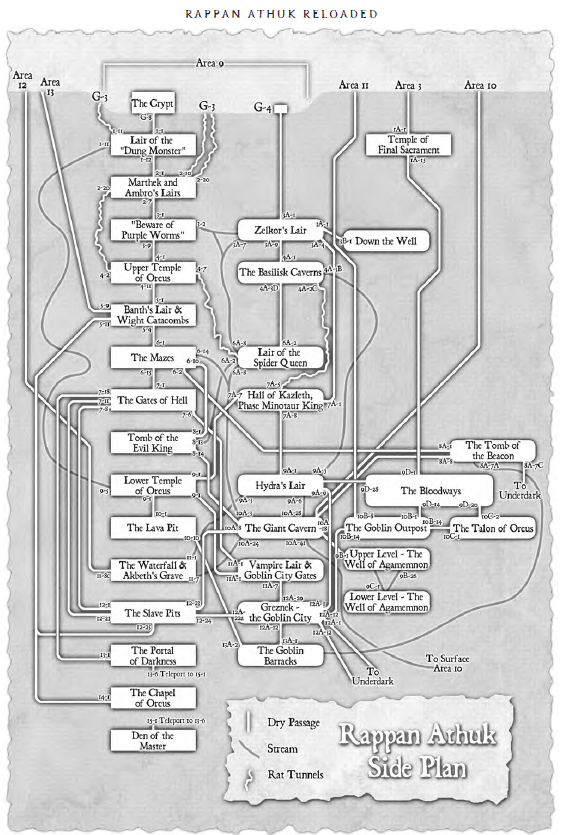
So right off the bat, there's a huge difference between tWLD and Rappan Athuk. You might remember that one of the 'level bosses' spent two years torturing a sage before he found the secret location of tWLD. The PCs (and RingTail, the boss of Region A) just sort of stumble upon it with no understanding of what they're there for, or why they should want to explore it. This adventure has a multi-paragraph backstory that you're SUPPOSED to read to the players. Cultists of Orcus were defeated and fled their temple. They found the empty passages of the dungeon and took shelter as they were pursued by the forces of good. Everyone, good and bad, was thought to have perished, but the evil survived in hiding. Now everyone knows that there's a dungeon and some of the dangers, including 'don't go down the well'. There are also 28 'rumors' that most players will know at least 1. While some of the rumors are noted as false, they could be reasons to brave the dungeon. For example, 'It is said that the great paladin, Bannor, was overcome by a horde of enemies in the dungeon. His might holy sword, Gurthdurial, is rumored to have been lost in the Hall of the Cyclops King.'Because Rappan Athuk is a complex dungeon with numerous levels, rooms are numbered by level prefix then room number. For example, Zelkor's lair is room 3A-8 meaning room number 8 on level 3A. Rappan Athuk also uses an old-style level numbering convention with "main" levels and "side" levels. The "main" levels are numbered consecutively indicating relative depth below ground. The "side" levels (those marked A or B), often skip numbers. The numbers of the side levels indicate depth relative to the main levels. For example, Level 3A (beneath "the Well") is at approximately the same depth as Level 3.
The upper levels are intended for a party of six 3rd level characters, and should be 5th before delving beyond the 2nd level. 'The Well' takes you to level 3, and shouldn't be attempted by parties below 7th level. For the moment, I'm just noting these for reference to judge encounter difficultly later.
The first book also has a list of 15+ levels (15 numbered levels and several 'side' areas. This book has 6 of the 26 levels including such places as 'the Lair of the Dung Monster' (level 1) and ''The Basilisk Caverns'. R2 includes levels such as 'The Hall of Kazleth, the Phase Minotaur King' (7A) and 'Caves and Caverns: The Tomb of the Evil King', while R3 includes levels such as 'The Goblin Barracks (13A) and 'The Chapel of Orcus' (14).
Altogether there are 15 numbered levels and 11 'side' levels, totaling the 26 levels. As evinced by the option to 'go down the well', players don't have to go through the levels in a strictly linear order, but compared to tWLD, there's a lot more 'push' to hit things in order.
Maps
The maps are in the middle of the book (where the staples in the binding are). Each map is half a page. Gridlines are completely absent - it's not possible to determine the scale by looking at the map. Some maps have passages that are noted as being 5' or 10', but even on the same map they may be drawn equally wide. Most maps in the first book have approximately 10-15 numbered locations. Compared to the 100+ in a tWLD region, this feels imminently manageable. Effectively Rappan Athuk has more regions, but individually they're smaller and more focused.
Appendix
The last 3 pages details the monsters in alphabetical order, covering 29 monsters. Unique monsters exist where they are encountered and are not reprinted in the appendix. New monsters have their full stat block presented when they are first encountered and the appendix. Compared to tWLD it's fairly easy to find a stat block when you need one. Many of the creatures do exist in the SRD, so in 2025 it's very easy to pull them up online.
Entries
The book is divided into chapters, but without a table of contents. Each chapter indicates the level. Read-aloud text is clearly marked. Each area includes relevant information including relative difficulty (it's not really Encounter Level), entrances and exits, appropriate wandering monsters and features. tWLD had something similar, but because the regions were so large, it tended to have MULTIPLES, and nothing that actually listed entrances and exits. While tWLD had a grid, the squares are too small to count, so with the more manageable regions, this makes sense.
Ground Level
Rappan Athuk is called the 'Dungeon of Graves' because it's located under a graveyard. The graveyard is protected by green gargoyles (CR3, if both claws hit target must save versus hold person) and when you enter the main mausoleum you encounter Black Skeletons (CR 4, their attacks drain strength). There's a magical key required to enter the dungeon - entering without the key results in an instant-kill trap, sorta. The ground starts moving upward and there's a limited amount of time to find a secret door to escape. I remember in the first Age of Worms adventure by Paizo there was a dungeon with two entrances and if players chose the wrong one (despite the warning signs) they died with NOTHING to do. Even if the PCs fail to find the secret door, they can defeat the Black Skeleton and two of them can take refuge in it's sarcophagus.
I definitely feel like the danger is communicated, but it's not complete Gygaxian F*ckery, or even later Paizo F*ckery. Presumably if you're interested in a dungeon like this, you're at least somewhat into other major modules like Temple of Elemental Evil.
Level 1: The Lair of the "Dung Monster"
The Dung Monster is a mutated mimic (CR 6). It has DR 25/+5, SR 50, and regeneration 5. You're not supposed to win. If you manage to contain the creature, it's supposed to always be free within 1 day. With a SPD of 10 feet, you're supposed to run. As a player I remember fighting it. There's Green Slime in the entrance chamber (1-1). So we dissolved the thing. The GM determined that it'd come back anyway because the module said it would. I don't think that's fair, but we felt good about defeating it. Fun times.
The stairs to level 2 includes a Wererat ambush. Five wererats and 20 dire rats. Ouch.
There's a heckuva lot of danger in level 1, but definitely not a lot of boredom. The challenges seem extremely dangerous for a party that doesn't play tactically, and even with optimal play there's a lot of reason to suspect that characters may die or get so hurt they have to withdraw from the dungeon to recover.Encounter Modification
If the party is of a low experience level, this ambush will destroy them. In that case, the wererats simply spy on the party and follow them, hoping to loot their corpses when they meet their untimely end elsewhere in the dungeon. Filaar and Jarvik are intelligent enough not to waste their dust and poison arrows on obviously weak parties. If the party is low level but has a large number of humans, Filaar orders the wererats to attack with normal arrows, saving their poison arrows and her dust for more deserving targets, allowing the 20 dire rats to attack. Her hatred for humans prevents her from allowing them to pass unharmed.
Compared to tWLD, there's a lot more treasure. In the third room you can find a +1 keen shortsword and a scroll with 3 arcane spells. My gut says that players will feel better about the haul - it definitely seems more fair. It may be just as deadly, but at least you get something for surviving!
Level 2: Marthek's Place and Ambro's Base
This level has a madman (Barbarian 6) and an ogre. The real threat is a Skeletal Warrior Ftr 8/Blackguard 2. If you defeat him, he has a +2 holy large shield of blinding.

The last room (2-22) of the level has an army of ghouls and ghasts (21 ghouls and 6 ghasts, less any defeated as wandering monsters). They've been responsible for the defeat of numerous low-level parties (not surprising) so have decent treasure - more than 2k GP, two MW Steel Shields (large and small), a MW heavy mace, a MW shortsword, a MW morningstar, a silvered dagger, a mighty composite shortbow (+1 STR), 18 +1 arrows, a keen punching dagger (somehow missing a magical bonus), a +1 keen throwing axe, and a +2 warhammer. Plus a few more potions and several suits of regular armor.
I honestly don't remember how much of the dungeon we did on our first go. I don't think R2 had been published yet, and I think we needed to withdraw to lick our wounds.
This is far from a perfect dungeon, I'm sure, but it's been more fun to read than anything in tWLD up to this point. Maybe it's just they don't have to justify trying to squeeze everything in, and they feel a little more freedom to develop interesting encounters. Maybe it's that each area is small enough so that players can get a taste but they're able to move on before they're sick and tired of the same thing over and over and over and over again.
Back when I was in Middle School, I built a dungeon that was a Dwarven Mine that had been taken over. For the sake of realism, there were 'living quarters' for the hundreds of Dwarves who called the place home. Exploring that area which really didn't have ANYTHING interesting was tedious and I learned that it's not really important to have those things. But they at least MADE SENSE in the context of the history of the dungeon - tWLD fails even in that. There are no guardrooms, no conference rooms, no Celestial apartments. The main GM said that he always puts those places behind a door that the PCs can never get through - not a solution that I'm really fond of - but even though this is a 'big dungeon', each level has felt 'self-contained' and 'manageable'. I'm actually tempted to run this...