Thoughts About the Game
At the beginning I said that I'm happy that this game is released. I don't think that there is 'one true way' as far as gaming goes, and I think having lots of products that appeal to lots of different types of gamers is generally a good thing for the hobby. I love that Critical Role is attracting a more diverse player base to RPGs generally, and migrating toward their own intellectual property is almost certainly going to be necessary based on WotC traditional efforts to shake-down anyone that makes a buck from anything related to D&D.
After having read the game, I am not surprised that they didn't choose to make this the focus of their next campaign. I do have issues with 5th edition/Next, and since this shares some DNA it's my contention that this game creates new problems.
But did it do anything right?
Massive Damage Breaks D&D, but Daggerheart is Insulated
If you're a character in a game world and fire-breathing dragons are your reality, it stands to reason that you'd develop tools to defeat dragons.

Or at least learn to use them against your enemies
That is to say, both Players and Characters have an interest in figuring out some manner of dealing a huge amount of damage, rendering any threat in the game inconsequential. However, nothing but easy victories and hitting an 'I win' button gets old fast. So if you can figure out how to do 700 damage in a single attack,
and you do it regularly, the game definitely suffers. Overcoming difficult challenges rewards players and provides a dopamine hit.

An easy win SOMETIMES is fun, too, but it shouldn't be every time
In Daggerheart, if you figure out how to do 700 damage in a single hit, your reward is....doing 3 damage. That's also true if you do 200 or 1200. There's no such thing as a single attack that can drop a level-appropriate foe (outside of minions). The
Jagged Knife Bandit, a Tier 1 Standard, has 5 Hit Points. A 'standard encounter' for 4 1st level PCs might include 7 Jagged Knife Bandits and 4 Minions (or 6 bandits and 12 minions). It doesn't appear that these bandits can reduce damage, but the PCs must do 8+ damage to deal 2 HP or 14+ to deal 3. That's a tall order at 1st level; even with multiple attacks you might deal 1d8+1d6 using a special ability. So badguys take a minimum of 2-3 hits.
A Tier 3 Standard (Stag Knight) has 7 HP, a threshold of 19/36 and requires a 17 to hit. At Tier 3 you're doing 3d8+3d6+6 with standard attacks (call it 30) so you're going to need....2-3 hits. Using some of your bigger powers make that marginally faster, but if you could do 36 damage without your super, there's no reason to use a super and deal 50 or 100 damage - every bit of overkill is wasted.
If you're a wizard using the 6th level Codex Spell
Sigil of Retribution you can get up to 6d8 additional damage against the target. Wielding a Tier 3 Advanced Quarterstaff that deals 3d10+9 you might get ~50 damage. Tag-Team with a partner and make it ~100. If the total hit points of the opposition was roughly based on expected damage, it might be possible to one-shot powerful opponents that would be a slug-fest using regular attacks over and over.
That said, there's a ton of
complexity dedicated to calculating damage. You're potentially considering equipment, special abilities, spells, tokens, etc. It's possible that the complexity
is necessary to disguise the fact that the underlying game isn't very complex. Going through the cycles of adding up damage, then comparing against a target number, then applying 1-3 damage might be sufficiently convoluted that players feel they're doing something meaningful, and maybe they feel more special when the damage roll is 50 versus 36 even though the in-game consequences are the same.
I posit that the game would play the same if you rolled 1d6 after every hit where a 1 or 2 equated to 1 damage, a 3-4 to 2 damage, and a 5-6 to 3 damage, and if you use a special ability shift it by one so a 1 equates to 1 damage, a 2-3 equates to 2 damage, and a 4-6 equates to 3 damage. At the very least, close enough that I don't think anyone would be able to tell the difference if that's what the GM did. From a
MECHANICS point of view, all the damage rolls are extra steps to obscure the underlying simplicity. Since many RPG players aren't great with math they probably won't automatically realize that you could simplify everything; they think the steps are IMPORTANT for generating the result, but they're really just really there to make it seem like what you're doing is important.
Psychologically that may be required.
While usually an attack targets a single individual, there are situations where attacks hit multiple targets (like all opponents within Close Range). While you only make a single attack roll and a single damage roll, each enemy may potentially have a different 'Difficulty' (like Evasion for PCs, but the target number for affecting them), and even if they all have the same Difficulty, they may all have different Thresholds. So for the GM to be accurate he needs to compare your damage against the Thresholds for a Leader, a Solo, 2 different Standards and a Brute. And even though they all have different numbers, it's still probably going to be '2'.
While I think 'counting hits' has some benefits to ensure your enemies remaina challenge, I think the extra complexity this game adds is unnecessary, ungainly, and inelegant.
Tracking Resources is Too Fiddly and Rolling Offers Perverse Incentives Contrary to Play
In Standard D&D, you're always tracking something. You've got hit points to worry about. You might be tracking which spells you've already cast. Maybe you're tracking rounds before a spell ends. The more things you track, the more likely you are to forget something, even if individually they're relatively easy. In this game you're constantly 'marking' and 'unmarking' various resources. You literally can't roll a die without someone needing to either add Hope or Fear - so every roll either the GM is taking an extra action or the player is taking an extra action. I pity you if you're using a pencil and eraser on regular paper. Laminating it and using dry erase might be better (though that comes with it's own perils and pitfalls). Every time you roll a die you have to ask if you add a Hope, or remind the GM to add a fear, and 1/12 of the time you clear a Stress.
You might think that having a token for hope would make it easier. Maybe a giant pot in the middle that you pull from and toss back into? I didn't harp on it, but the game is very insistent that you have tokens at hand for tracking your bonuses to die rolls. I can see how counting on tokens is easier for some people, but it's another physical object taking space on the table. Getting rid of tokens to track Experience Bonuses on your roll and other sources of a bonus (or penalty) might help.
While tracking it can become a headache, the way its refreshed creates additional problems.
It's probably okay that characters want to to roll in combat. It's not as good if players are ASKING to roll when it isn't really necessary. If I'm going to make a climb check and the GM determines that it isn't INTERESTING there's no need to roll. But rolling generates bennies for me. So being told that I don't NEED to roll prevents me from getting Hope. That's not an issue when I'm full, but if I'm down, having more is definitely to my benefit. Even risking giving the GM more Fear half the time isn't really a problem. It's a bigger problem that 'Fail with Fear' creates complications. So I'm incentivized to find 'easy rolls' that I'm allowed to make to generate Hope as a resource. That's not 'playing the game as intended' but that's why INCENTIVES should ALIGN with game objectives.
I honestly don't think there's any point in saving the 'Roll with Hope' or 'Roll with Fear' mechanic. Despite the advice to the contrary, 'Success BUT' is really hard to describe without turning it into a failure. Failure is pretty easy, Success is pretty easy, it's the Success with Fear that's hard. If we take away generating Fear/Hope on a roll we can can focus instead on success/failure. In either case, the GM could 'spend a fear' to add a complication. That's a GREAT way to keep the story going. All the advice about allowing success is great.
You succeed in unlocking the door, and just in time. As the lock clicks open [GM tosses a Fear Token out]
you can hear the sounds of approaching guards from where you entered. It sounds like they may have found the guard you left unconscious. Having the GM spend a currency prevents it from feeling like your success was completely invalidated.
So if you don't get Hope/Fear from rolling as suggested, how do you get it? Well, PCs start with 2 Hope to begin with. There's no reason they can't start with 6. When they roll a critical (and only when they roll a critical) they should get a choice of a) getting 1 Hope or b) clearing 1 Stress or c) Removing 1 Fear from the GM. How does the GM get Fear? He starts with a pile, too. Probably 4 per PC. Then when players roll a failure he gets one and he gets to introduce a Free Complication. Players won't be trying to make rolls they're likely to fail with the hope that they generate Hope, so the incentives for play are aligned with what is good for the game.
Abilities that Matter
D&D has robust combat rules. It's very clear what you can do in combat and how those actions lead to the defeat of your enemies. Daggerheart tries to keep robust combat rules with a collection of special actions that you can take based on an adversary's relative position. They also have 'moves' for Downtime and some spells that have out-of-combat uses like
Astral Projection. But even though the game gives an example of a wizard enemy using 'arcane power' to cause a parapet to collapse it's not clear who else can do that and in what circumstances. Can a player declare that they're using their magical power to collapse a wall? If the enemy wizard can collapse a parapet
why couldn't that same power be applied to breaching the castle wall?
For a game that expects to be narratively driven and cooperative,
it is imperative that players understand what they can do. You can play Mother-May-I instead of an RPG if you want, but the more players understand about the game world and their abilities, the more PROACTIVELY they can engage with the world. In D&D when a spider crawls toward the party clinging to the roof of the cave 20' above, I know I could try to find a stalagmite to allow me to get close enough to swing a sword, or that I can shoot my bow. If I have
spider climb I know that I can walk right up to it and engage in melee just as easily as if it were on the floor of the cave. This game has
Wall Walk, a 1st level Arcana Power, so I don't think that a player could make an argument that their 'undefined magical powers' ought to allow that. When the spider misses them they're allowed to say 'my arcane warding protects me' just as much as they're allowed to say 'my full plate armor easily withstands the blow' - that's flavor and it's a miss
so it doesn't CHANGE reality. Using your narrative powers to change the world or the game state is more limited, in part because to maintain the narrative once the GM says yes,
for the sake of consistency they should always say yes.
There are very few powers, they are very specific in what they can do, and every action that changes the game world is subject to GM interpretation. Your best case is that you're offered a roll with a TN determined entirely by the GM where success permits you to do what you like.
This is fine for a script - the director tells you what he wants you to do and we evaluate you based on how well you follow those instructions and whether you emote well - but it's NOT what you need for a player-driven (at least in part) narrative.
Final Thoughts
I think Daggerheart is trying to strike a balance between mechanically complex and rigidly defined powers (like D&D Next) and Narrative games where die rolls determine what happens on an almost entirely ad-hoc basis (like Bearworld) and they're not easily merged. Once players recognize that the apparent mechanical complexity doesn't have any meaningful impact on the way the game plays I expect players to tire of it quickly. I've heard people say that this game is designed for one-shots and not really to support longer campaigns, and I think there's an element of truth to it. While you might expect high level games to involve 'cavorting with Gods', the TNs for that level of play aren't supported by corresponding bonuses. The longer you play, the worse you are relative to the types of challenges you'd expect to face. Something like a fixed +4 bonus per tier would mean that someone who is Tier 3 might actually have a chance for TN 30 outcomes; and there's no reason that godlike outcomes need to be POSSIBLE for Tier 1 characters. Other games have you on a treadmill....
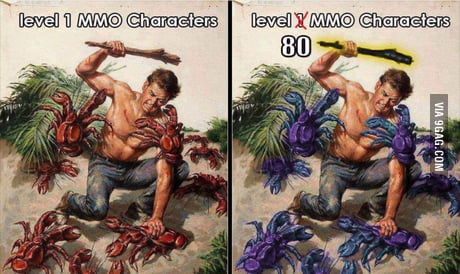
There are even memes about it
Where you're doing the same things but the descriptive language makes it sound more interesting. Fighting EPIC land-crabs instead of Giant land crabs. The thing with a treadmill is that you should be holding steady relative to your opposition and expected challenges. Here you may hold steady with the expected opposition, but you can't actually advance to more interesting challenges.
I have heard that the Critical Role people are exciting and engaging to listen to, and I'm sure that they can take a game like Daggerheart and use the prompts to create something that's exciting and engaging to listen to, but I really do believe that it would be a harder lift than standard D&D. Maybe good marketing and popular performers will be enough to raise this game's profile above that of D&D (any edition), but my take is that it isn't going to happen because of innovative game play or exciting mechanical elements.
I'd certainly love to hear what other people think of the mechanics as I've described them and if they have a different take on gameplay. I've mostly tried to accurately describe what the game says to do and make sure my commentary throughout was separate and didn't color the mechanics. I am certainly happy to delve into more sections or go into more detail on any specific elements like classes or the other domains. That said, don't forget that you have access to all that
via the SRD in PDF format.