OSSR: Fiend Folio
Monsters A-Z: Mantari to Slaad
 Giant Frog!
FrankT:
 This is a Mantari.
It's a mantaray, but it flies. It's pronounced “Mantar
ee,” which makes it almost as innovative as a Pokemon name. That tail is supposed to only be 4 feet long, so I think there's some seriously weird perspective in that picture. We are told that the stinger is “not poisonous” but “acts on the victim's nervous system,” which leads me to believe that the author did not know what
poison was. This thing has an incredibly weird system for handling its... non-poisonous but potentially fatal nerve agent that involves subtracting the victim's constitution from 19 and possibly multiplying by four. If it hits you two rounds in a row, you're probably dead, but this is not likely to happen because it only has 6 hit points itself. No word on how this fucking thing works if it attacks a creature that isn't a player character and thus doesn't have a Constitution score because AD&D was fucked like that. It flies pretty fast and can kill Steve Irwin or pretty much anything else that it gets the drop on, which is why it likes to hang out in areas with low ceilings full of ninjas with spears.
 Everything about this picture is a fucking lie.
The Meazel is, despite the appearance in the picture, a man-sized solitary monster. Yeah. The picture promises us evil muppet Thuggee with the hair stylists and possibly sword smiths of the Githyanki. That sounds awesome. Unfortunately, the actual text describes a creature that is nothing like that. Thus, the Meazel has languished in obscurity, because when a DM's eye is caught by the art, they are looking for a monster that is in no way similar to the one actually described in the text and mechanics.
Actual Meazels are like tougher Hobgoblins that almost never leave the house and when they do, use stealth to pick off individual Orcs and Kobolds on solo raids. It's... not what is promised on the tin, that's for damn sure.
 This is a Meenlock. It's not so much a monster as a story.
The Meenlock entry is a quite elaborate walkthrough of a horror story, where various scary events happen and the monsters harrass an individual person for days, causing them nightmares and killing the people around them, and baiting them into walking down spooky hallways and finally causing the bad end where the protagonist becomes a monster themselves. It's... not actually D&D. It's like a bizarre parody of a railroad adventure, or perhaps someone trying to write mechanics for a series of events that happen in a campfire story. It's all made sort of surreal by the fact that Meenlocks are seriously 2 feet tall, which I suspect might be a typographical error but in any case makes all of the monster horror and the eventual transformation into one take a weird comical feeling that I don't think was at all intentional.
AncientH:

The original mephits came in Fire, Lava, Smoke, and Steam flavors. They were sort of like imps, in that they were minor evil critters that fawned and served any devil or demon more powerful than they were, which was pretty much all of them. They were mostly forgotten until Planescape re-envisioned them as coming from the paraelemental planes.
Mephits are connoisseurs of the vulgar and tasteless; they share an extraordinarily twisted sense of humour (to a mephit, the sight of a creature writhing in agony is excruciatingly funny). They delight particularly in tormenting the helpless. If they can obtain them (and it is usual that they do) they will wear clothes of the most garish design and colour possible. They are often seen puffing upon smoking rolls of exceedingly foul-smelling dried vegetation. They adopt a strutting gait and have shrill voices (they all speak a common mephit tongue and their alignment language).
They're basically yobbos. Surprisingly, they're also 5' tall. I always thought they were shorter. Artwise, they look closer to faeries.

I've never been quite clear on the
purpose of creatures like mephits. I mean obviously, you want a demon or devil that is within smacking range of every level of player character, and in later games you sort of want PCs to be able to cow or summon minor devils to take out the trash or kidnap the princess or breed some cambions or whatever the fuck wizards do, but mephits don't really have any sort of mythological precedence or place in the ecology of the underworld. The demons and devils don't raise vast armies of them, they don't pokevolve into more powerful forms, they don't
do shit. They just are. Assholes. They don't even torture the damned or anything like that.
FrankT:
I would feel better about Mephits if I didn't know they were connected to Quasi-Elemental and Para-Elemental planes of existence. Back when I was a child and didn't know that, I liked Mephits more.
 The Mezzodaemon
Originally coming from Vault of the Drow, the Mezzodaemon is one of the original Yugoloths. The word “Yugoloth” is just a nonsense word that was made up during 2nd edition's attempt to scrub itself of satanic imagery to protect itself from angry Christian mothers. However, unlike Baatezu and Tanar'ri, people still use the word Yugoloth unironically. And this is because the original term for the Neutral Evil variants of Demons and Devils that Gygax came up with was “Daemon.” Which is literally just the word “Demon” with a slightly different orthography, so fuck that.
 This is a Mite. Unlike the Meenlock, I'm pretty sure the fact that this guy is 2 feet tall is not a typo.
Mites are small creatures who are dicks. They can't talk and despite the picture do not actually appear to work metal. They capture people, take their shinies, and dump them naked into dungeons full of monsters because, as previously noted, they are dicks. Not a terrible nuisance monster, the book notes that they are related to Jermlaine and Snyads, implying that there is a whole category of vile little fairies. This would later be called “Gremlins,” but since the category was defined in 2nd edition it came with a lot of stupid.
AncientH:
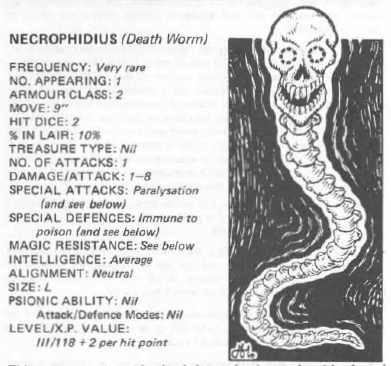
I have a soft spot for the Necrophidius. It's not just a
necromancer golem-crafter working with what they have, it's being creative about it! Basically, these are skeletal snakes with a human skull at the end. Suitably creepy. Their special ability is the
Dance of Death, where they go into a swaying dance and hypnotise onlookers, allowing them to get closer and kill them.
There are three ways of creating a necrophidius. The first is by means of a special magical tome, similar to a Manual of Golems. The second method is for a high-level magic-user to employ a limited wish, a geas and a charm person. The third method is for a high-level cleric to employ quest, neutralise poison, prayer, silence and snake charm. The materials include the complete articulated skeleton of a giant snake (poisonous or constrictor) and the skull of a cold-blooded murderer killed within the previous 24 hours. The cost is 500 gold pieces per hit point of the creature and it requires 10 days construction time.
My favorite use of a necrophidius was to team it with an iron cobra; the cobra would get close and then unhinge its iron jaw, letting the necrophidius vomit forth. Most of the PCs were so unnerved by this they forgot to attack it immediately. Good times.
Continuing on with the looks-like-undead-but-isn't theme is the Needleman.

Which is actually a sort of ambulatory cactus-plant, so I have no idea why it's wearing a codpiece. They hate elves and are very vulnerable to magic. 2nd edition tried to make some sense out of these critters and failed.
I suppose I should take a moment to mention that many of these critters are
ambush predators; most of them are given some special ability that allows them a better-than-average chance of hitting the PCs from ambush. Now, you might well argue that this is just because Mister Cavern is a dick or so that the critter gets at least one hit in, but objectively I think ambush tactics are good for monsters that really
won't win in a straight fight. It's an established and successful evolutionary niche. That said, I was glad in 3e when monsters got the Hide skill and we didn't have to waste an eighth of each entry on how fucking hard the critter was to see.
Moving on, we have the infamous Nilbog!

This entry is so insane, I'm just going to copy it in its entirety:
This creature looks exactly like a normal goblin and has all the characteristics of that race (see ADVANCED DUNGEONS & DRAGONS
MONSTER MANUAL - Goblin) with one important exception - it suffers from a curious spatio-temporal reversal. It remains a mystery why only goblins are susceptible to this strange disorder. Nilbogism (the name given to the disorder) appears to occur when overly heavy use of magic strains the fabric of the space-time continuum, and leads to some very strange localised events. The coincidence of conditions which lead to nilbogism is extremely rare and is only imperfectly understood. Although the creature itself does not in any sense transmit the disorder to those around it, some of the effects are transmitted.
Many and varied accounts have been received about the nature of the space-time disturbances which take place in the presence of nilbogs. Only one factor appears to be common - the adventurers will have no control over their own actions and will generally pursue courses of action contrary to their normal intent; for example they may feel an overwhelming compulsion to load all their treasure into an empty treasure chest in the nilbog lair and leave empty-handed. There are no saving throws against these effects, nor is there any known defence (though a powerful spell such as a wish, will, if used properly, have a good chance of rendering local immunity against the effects).
Another curious feature of nilbog power is that the creature gains hit points when it is struck, the addition being equal to the intended damage rolled. It can only lose hit points by such means as casting cure wounds spells on it, forcibly feeding it healing potions and so on. For obvious reasons, encounters with these strange creatures are dreaded and, as a result, normal goblins tend to be treated with extreme caution lest they turn out to be nilbogs. There appears to be no way of distinguishing between the two apart from the use of such spells as commune or by trial and error.
So far as is known, no other creature has been afflicted with nilbogism.
These are some of the original joke monsters, although the joke is likely to be on the PCs. They don't make much of any sense in any context. Their single greatest contribution to AD&D were
healing arrows.
FrankT:
The Nonafel is a big black panther that splits into nine much smaller black panthers and then reassembles into a big black panther again and regenerates and shit. It's actually a decent boss monster. You can cut it up good and then it swarms you and then you beat that off and then you fight it again and win. This one seems like it should be related to the Displacer Beast, but it spends so much time fucking around with its overly complicated hit point mechanics that it doesn't really get around describing why this thing is a thing. I mean, other than that it makes a pretty decent set piece battle.

Norkers are supposed to be a “far distant relative” of Hobgoblin. That makes my brain hurt. Goblins and Bugbears, for example, are close relatives of Hobgoblins. So if something is a far distant relative, why are they specifying
Hobgoblins? It was before the whole Goblinoid thing really got ironed out, but this writeup was puzzling even when it was written. It gets more surreal, what with it insisting that they look like Hobgoblins and then mentioning that they have a fucking
exoskeleton, which Hobgoblins very obviously don't have.
For all the bullshit, the Norkers are basically low tech Hobgoblins. Their in-game purpose is to be about as tough as Hobgoblins as opponents while only dropping shitty stone-age equipment. So they make up for their low tech by being strong and tough. So really, this is basically just the same idea as the Drow's underground radiation or the Disenchanter's swag destruction nose: it's a way for Mr. Cavern to reduce the amount of toys the Player Characters go home with. And while I think that's actually a kind of stupid goal most of the time, the Norker explanation for why your cash take from the adventure is less than you might have thought is much less stupid and insulting than the others.
Generally speaking, Humanoid encounters are very well paid because combat equipment is very valuable (some of that is medieval realism, where a set of chainmail cost as much as a house, and some of that is the authors knowing that you mostly care about buying things that affect the biggest mini-game in the game). So your expected takehome from beating up a lot of humanoids is actually potentially destabilizing to the campaign
– all the more so because AD&D didn't have encounter or wealth guidelines. The Norker exists to be an encounter that is
like fighting a bunch of Hobgoblins, but without giving the party a wagon load of armor and weapons when they fall.
AncientH:

The Nycadaemon is a yugoloth from the Middle Lower Planes, who grew up in a modest but loving household in the suburbs and could never pretend he was "street" like the Baatezu, and the rest of the evil kids avoid them. That said, they're pretty bad ass as Neutral Evil outerplanar entities go. They're as strong as stone giants, use magic items, have a shitload of personal spell-like powers, regenerate, have various weapon immunites, AC -4, a "graduated magic immunity" (i.e. 100% immune to 1st level spells, 95% immune to 2nd level spells, etc.; theoretically they'd have a 55% immunity to 10th level spells, if 10th level spells were a thing back then), and just to give Mister Caverna headache:
The entire spectrum of radiation can be seen by nycadaemons (i.e.
infrared, ultra-violet, X-rays, gamma rays etc.) The telepathic ability of these creatures allows them to communicate on the telepathic level
with creatures of intelligence low or better.
The 'N' chapter ends with a half-page drawing of a scrawny evil humanoid with pointed ears and fangs, dressed only in a loincloth and rags on its feet, holding a cleaver bigger than it's entire body. No idea what it is.
The 'O' chapter is one page, with two monster. The first is the Ogrillon, an orc-ogre crossbreed. Later on in 2nd edition, digging deep into the lore of orc mating practices, it was decided that the ogrillon was the product of a female orc and a male ogre, while an orog was the product of a male orc and a female ogre. I think this was supposed to be a bit like ligers and tigons, but orogs and ogrillons really aren't that distinct enough for anyone to give a fuck. Although I suddenly have a terrible visage in my head of an hermaphrodite orc demigoddess that is the mythical progenitor of all orogs and ogrillons by seducing different members of the Ogre pantheon.
Anyway, the other critter is the humble osquip.

It's a giant rodent that can have 6 (70%), 8 (25%), or 10 (5%) legs. It burrows through soil and rock and eats smaller rodents and jermaine. Honestly, I'd rather have these things than cats in a fantasy setting. I will also love them always as being the subject of one of the most entertaining Monster Hunter Association "Monster Ecology" articles in
Dragon Magazine, where a one of said monster hunters adopts an osquip named Ozzie and makes him his familiar.
 Also, always a great excuse to use this joke.
FrankT:
Lots of monsters are taken from science fiction and fantasy books. Others are made up from whole cloth by authors that may or may not be on drugs. And finally, some come from old folklore. And when a monster gets
really weird, you know it's probably traditional. There's just a limit to how crazy these things can get after only a round or two of telephone.
 Seems Legit.
The Penanggalan is kind of like a vampire, but its head pops off its shoulders, pulling a trail of visceral organs out behind it so it can fly around looking for victims. It might not surprise you to learn that this monster is 100% folkloric. Drawn from the myths of Malaysia, Indonesia, and the Philippines, there are more people who believe in these things today than ever believed in wyverns in the entire history of the world.
The writeup here goes on for a page and a half, throwing in weird facts (like if it doesn't reunite its intestines and body by cock-crow, it risks being paralyzed all day when the sunlight hits its floating head), and strange rulings (like how it explains that
all undead are immune to spells that control the mind or body, which in this edition is very much
not true). Basically, it reads like someone found out about these things and then flipped the fuck out and felt compelled to just write everything they could think of to translate all the strange facets of this majestic beast into AD&D terms. Like you do.
 There is an entire genre of Malaysian Penanggalan movies. One day they are going to get a special effects budget and that will be awesome.
 Who Are You?
The artist clearly was thinking of The Caterpillar from Alice in Wonderland when he drew this guy. This is actually
not the picture of the Pernicon that appears in the book, but the original piece drawn by Russ Nicholson. He was asked to redraw it and to make sure that it had a visible pincer on its tail. So the one in the book looks pretty much exactly like that except that it has a pincer on its tail. According to the description, these things latch on with their pincers and drain blood and water from their victims. Making this the only monster I am aware of with a blood draining ass. Other than that, they hum when sources of water are nearby, so you can potentially use them as divining rods.
 Phantom Stranger Stalker
The Phantom Stalker is much like an Invisible Stalker, except that rather than being
invisible, it's
intangible because it's chillin like a villain on the Ethereal Plane. Yes, that makes the second monster in this book that is “like an Invisible Stalker but...” I don't know. Back in the late seventies, I think Invisible Stalkers made a much bigger impression on people than they do now.
AncientH:
The last two entries in "P" don't merit an illustration. This is because they consist of the Poltergeist, which is just a ghost that throws shit and has no physical form, and the Protein Polymorph, which is just a fucking bargain-bin mimic.
 Later editions also failed to capture the majesty of a shape-shifting colony organism.
The 'Q's get a page-and-a-quarter because they include
three entries. One of these is the quipper, which is just a fucking piranha, and another is the Qullan, which are chaotic evil humanoids that radiate confusion and attack with impossibly sharp swords for no particular reason. No one cares about either of those. No, the star of this section is the Quaggoth, which is an exemplar of adaptation
advancement.

This is the original quaggoth. It's not much to look at. It is, in fact, a shaggy stone-age humanoid that hates surface elves. It hates surface elves
so much, it sometimes enslaves itself to the drow so it can fight surface elves.

This is the quaggoth Mark II. It's now a sort of ursine humanoid. It organizes itself like vikings, and gets enslaved by mindflayers, and has a small chance of psychic powers. Dragon would later add Quaggoth mutants.

And this is the quaggoth Mk. III, which we noted in
Monsters of Faerun, and later
Drow of the Underdark would add the Greater Quaggoth.
It's hard to see why quaggoth literary evolution has followed this particular path. There's no one guy that's "the quaggoth guy" and writes them into anything they can, subtly expanding on the culture and write-up. What these are is an example of a critter just interesting enough to revisit, and then somebody rewrote them to be more interesting
and that got more people interested in them. Lots of monsters in Fiend Folio have been re-specced in later editions, but few have seen the sort of
evolution you see with minor monsters like the quaggoth, and its sort of the kind of thing you want to see in games - not just the same old shit rehashed and updated to the latest ruleset, but reimagined and expanded a bit.
FrankT:
 Demogorgon apparently designed these guys to inspire maximum terror.
The Retrievers are living constructs made by Demogorgon whose nominal purpose is to go retrieve things but whose actual talents lie in ripping things to shreds and shooting destruction rays out of their eyes. Unless Demogorgon likes his morning paper delivered chopped in half, set on fire and then turned into lead – I can only imagine that the title “Retriever” was bestowed ironically. Or perhaps was titled that by one head so the other head wouldn't figure out what was being made. In any case, this is one of the most seriously dangerous monsters in first edition, and the 3e conversion was both bogus and sad.
 This is the dreaded Hobo Revenant.
Revenants are neutral undead who single mindedly attempt to avenge their own murders. Basically like The Crow, but 13 years earlier than that. They regenerate, because this was a simpler time in which Undead regenerating wasn't a problem. Apparently, becoming a Revenant teaches you the Neutral Alignment Tongue, which I personally find insulting, but other than that it's pretty much what you expect.
 If those look like cave bison to you, that is because they are cave bison.
The Rothé are a herd animal that lives in caves. They are like yaks or bison or something, but they live in caves. Really. I actually fully support these things. They aren't very useful as a
monster, but the fact that they exist is really helpful for designing Underdark cultures. Dwarves can put Rothé milk butter on their food and Kuo-Toa can pull wild Rothé into the pond in order to have feasts. It's just a single brick, but it's a brick that's genuinely useful for world building.
AncientH:
Rothé were embraced by Ed Greenwood for the Forgotten Realms specifically for that purpose.
 Sandman
 Sandman
 Sandman
SO. Sandman (D&D) is a humanoid made out of sand that makes you sleepy. There's no reference to their culture, habits, what they eat, or anything else about them. Also no account of what happens when they run into elves, which are immune to sleep.

Frank was not the only one to use the
Fiend Folio as a coloring book. THis is the scarecrow. They're evil animate scarecrows. 'nuff said.
 Also, I just ran across this great mashup.
The Screaming Devilkin looks like a mephit. Which is to say, your traditional small red devil, little horns, barbed tail, wings, etc. It flies around screaming, preventing magicians from using spells with verbal components. Rather weaksauce.

The Shadow Demon is a combination of the Shadow, which in pretty much every incarnation is ridiculously broken, and a demon. This is actually to the detriment of the critter, since it lacks the ability to drain levels and make no shadow demons, and is vulnerable to various light sources. Even the author has no idea how this fits into demons, which have a fairly strict pokevolution structure going on.
The Sheet Ghoul and Sheet Phantom are presented together, although this is sort of by accident since the whole thing is nominally alphabetical so the sheet ghoul comes first. Basically, the Sheet Phantom is a wraith in the form of a sheet.
 Hooah, got it, next.
The sheet envelopes a target (which takes any damage if you attack the sheet), and when the target eventually suffocates they become a sheet ghoul. I probably would have save an entry and just had the victim become a regular ghoul, but then I'm a forward-thinking designer looking to save conceptual space.
The part I like about sheet phantoms is the speculation that they're undead lurkers, even though that doesn't make much sense.
FrankT:

Oh wait, that's not it...
 There we go.
Shockers are electrical villains that essentially specialize in
shocking grasp from back when that was pretty decent. They make touch attacks from before that was a thing and are immune to non-magical weaponry. The only real surprising thing about these assholes is that rather than being a boss monster like you might think, they have one hit die each and show up in groups of fifteen. So... bring a
fireball I guess. The book explicitly says that little is known about their
purpose, but I think their purpose is reasonably clear. It's to make Fighters feel small in the pants.
 The Skeleton Warrior
.
D&D has used animate Skeletons as mook monsters from the beginning. From
before the beginning actually, because you could field them in Chainmail before it became D&D. The Skeleton Warrior is just an animated badass Fighter who continues being a badass Fighter in death. It's like a Death Knight, but less interesting. So while this monster became generally accepted, it never achieved the iconic status of the Death Knight.
 Spot the Skulk!
Skulks are a sister species of Human that got camouflage powers because they were cowardly. They are wicked and sneaky, and badly in need of a coherent spotting mechanic to reference.
AncientH:
Frank offered to let me start in on the Slaad, but he's been doing well with the chaos frogs so far, so I think I'll let him take first whack at 'em next post.