[OSSR]Monster Compendium: Monsters of Faerun
Posted: Sun Oct 20, 2013 9:32 pm
Monster Compendium:
Monsters of Faerun
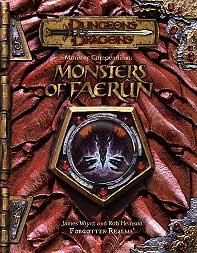
We're setting the wayback machine to 2001, when the first Monster Compendium came out for 3rd edition. It is also when the last Monster Compendium came out for 3rd edition, or indeed for any edition of Dungeons & Dragons. Back in 2nd edition, the basic set up for monster books was that they came in various regional and conceptual packets which all went into the vague “Monstrous Compendium” heading, and they got compiled and put into binders and shit. It was all very cumbersome, and didn't even seem like a great idea at the time.
So into the era of 3rd edition but only barely so, WotC decided to give it another go. It's pretty much the same idea as for 2nd edition, but they call it a “Monster Compendium” instead of a “Monstrous Compendium” so that it will come earlier alphabetically than all the dozens of Monstrous Compendium shovelware installments they had lying around from the last 11 years. That is literally the actual reason for the name change. Put in charge of this project are James Wyatt and Rob Heinsoo, two names spoken with spit takes today because they were also in charge of the project of 4th edition D&D. It is totally mysterious why that happened, just as it was mysterious why it was happening at the time, and it was mysterious why it was going to happen when it was announced that it would.
Simply put: this project, the Monster Compendium book line, did not do very well. It did so not very well that the entire book line has a single book in it: Monsters of Faerun.
Now, there's a lot to be said for the AD&D Monstrous Manual and its contingent Compendiums. Mostly you would say "they invented the fucking format" and that would be the end of it. Believe it or not, there are relatively few ways to do what we think of as a proper bestiary or monster book, and D&D locked their format in as the default rather early - one page entry (maybe spilling on if absolutely necessary), with all the stats you need right there and a few words on its place in the world, with a picture. That is now the Generic Monsterbook Template. So when D&D 3.0 decided to go "fuck that" and opt for a more condensed "rolling double column" format, that was actually a big change - and, it becomes readily apparent, one that the other writers and game designers at WotC were not quite used to yet.
Before:

After:

Monsters of Faerun is interesting as a transitional fossil – a book not quite 2nd edition and not quite 3rd edition. What's especially interesting about that fact is that the book actually was published in February of 2001, several months after 3rd edition happened. Which basically means that the B-team (that is to say: Rob Heinsoo and James Wyatt) were still working in an AD&D framework in a lot of ways. The rules are mostly 3rd edition compatible, but I can't help wondering how much of it was cleaned up and 3rd edition justified by editors at the last moment.
Or possibly we're looking at a piece of market research. The people at WotC wanted to know if they had gone “too far” with 3rd edition and the public might want things scaled back a bit towards AD&D presentation. If that was the question being asked, WotC certainly got their answer. And that answer was No.
I honestly think that chunks of WotC were writing more or less independently of each other for years at a time, and what we have here is essentially a third party product put out by the main game company - something like when Kenzer Co. did their Kingdoms of Kalamar supplement advertised as the "IVth" essential book after the PHB, DMG, and MM.

So in a lot of ways, it's the Forgotten Realms guys trying to jump on the D&D3 bandwagon and stay relevant. However, I also think it was an effort by the main D&D guys to see how much they could get away with - that is, could they spit out mini-Monster Manuals and have the readers buy them? Because for a lot of gamers, monster manuals are only really of any use to Mister Cavern, as they generally have fuck-all useful information for players, unless you're a specialized summoner or necromancer or something. So in presentation and layout, these guys were hewing very closely to the established D&D artistic choices - faux-cool book cover, weird water damaged paper inside sheets, pencil-scratch lined pages, the works.
Introduction
The first page has an “Introduction,” a “Presentation,” and a “Reading the Entries” section. Those don't quite sit right with me, because they all mean the same thing. But also because they are all headings on the same page and aren't the same part of speech. It's kind of clunky language use in a way that's hard to describe, like when people use the singular and plural interchangeably in the same sentence. But mostly, it's the actual contents that are unenlightening.
The fact is that there is basically no chance of anyone wanting to buy this book if they don't already have the Monster Manual. So having a section that tells you how to read a monster entry when it is formatted the same way as the Monster Manual was just wasted space. And this wasted space drags on for seven more pages where they tell you what the size categories are and what is meant by “special qualities.” It's all very puzzling, because this book is not a complete product. It's a Monster Manual addendum, and there is absolutely no way you would read this book if you didn't know what the size categories were in D&D. For fuck's sake, in 3rd edition that information was in the PHB, the DMG, and the Monster Manual. It doesn't need to be in this book too.
Again, this is a bit of a throwback to AD&D, because the Monstrous Compendiums would actually have basic introductory "how to read monster entries" page eaters in there back then too. And, honestly, it's as dead a giveaway as any that this book was written with the principles not quite sure what they were doing. They obviously felt the need to sell or justify the book, but really couldn't.
Eighty monsters is frankly not very many. It's not something to brag about. It's a fairly small number all around. Real Monster Manuals have hundreds of monsters in them, so having a book that had less than a hundred was sort of throwing in the towel. It might be something if they had gone through a list of several hundred monsters and winnowed it down to four score and seven that were really cool, but it's pretty obvious that's not what happened.
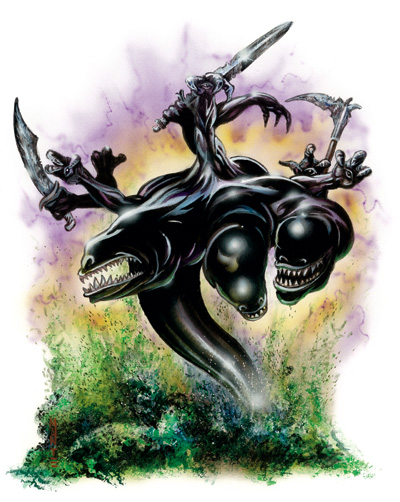
This is a real monster in here. We'll get there, I promise.
Just so you know, this is not a long book. 96 pages, softcover. The first 10 pages are introduction and rules that are in at least three other books and the SRD at this point. The last half-page is actually a table of monsters in the book ranked by CR, with one quarter devoted to dragons by age. So 80 monsters are squeeze into 85.5 pages...that's actually worse than if they were doing the old AD&D monster-a-page format. How the fuck did they manage that?
Well, I'm counting the templates, and we'll get to those. But probably the most egregious reason this book is so long and yet has such a low information density is that each fucking entry includes a tacked on "In the Realms" sidebar, telling you how this monster gets the fuck on in Faerun. Why? WHY? THIS WHOLE FUCKING BOOKS ENTIRE FUCKING PURPOSE FOR FUCKING BEING is to show monsters IN THE REALMS. Why fucking pretend that these are generic-ass fucking critters that you're going to drop into your laughably unsupported Greyhawk game without modification? I don't have a good answer for that, but I know that somebody didn't learn their lesson and this shit crops up again in later 3e products.
The authors of the book seemed to have no real idea of what kind of information should be handled as function calls and what kind of information should be handled in individual entries. Obviously, 3e was young and still finding its way, but it's also clear that neither Rob Heinsoo nor James Wyatt ever got the hang of this sort of thing. These days they are universally reviled for deciding that absolutely all information should be special snow flake information standing on its own in each monster entry, but in 2001, they were guilty of making the following high function call:
When it comes down to it, there is really only one actual “rule” in that whole mess of gobbledegook. and that's the rule that ceasing to hear the siren's song doesn't mean you get to stop walking into the siren's trap. And that is seriously bullshit.
Yeah, fucking Odysseus had that one nailed.
In hindsight, it's amazing that Wizards of the Coast didn't make more of the System Reference Document. I mean, if you're going to put the guts of your system out there, why not make use of it? Okay, maybe 2000 was a little early for the "laptop at every table" style of gaming, but you'd have to know that it would be better to just have everything point to a text-searchable website than have a shelf-breaking pile of books, right?

The last part of the introduction is some copypasta feats from the Monster Manual and then the 3rd edition Creature Advancement by Type chart. This was before that got simplied and rectified with player character advancement, so it's weird as fuck. Monsters get a feat every 4 hit dice, the Beast and Magical Beast types are different, and all that. Not really this book's fault, but it didn't make any attempt at all to make any of this shit more transparent. Indeed, this book is rather best understood as an experiment in seeing if people would like some of the standardization and formatting of 3rd edition rolled back. As it happened: they would not.
I still don't understand why there are so few monsters in this book. Though sadly, this book languishing in obscurity pretty much removed many of these monsters from common knowledge for a generation of gamers. The monsters in Monsters of Faerun were mostly not reprinted during 3rd edition or 3.5's lifetime. That's 8 years straight when the only way you'd find out about Fire Newts or Bullywugs was to dig up this obscure and universally reviled monster pamphlet. For people who didn't game in the nineties or before: Bullywugs are frog people and they used to be a fairly iconic D&D adversary race. The fact that the kids reading this may not have ever heard of them shows how easily things can be memory holed by a bad book. Consider that the next time someone tells you that 4th edition or D&DN being shitty doesn't affect you as long as you still have a game you like to play.
Something Frank pointed out moments before this post, the original 3e Monster Manual was $20. This spindly paperback was originally priced at $21.95.

I guess the extra money went into research. Or up someone's nose.
Next up: the Monsters!
Monsters of Faerun
FrankT:
We're setting the wayback machine to 2001, when the first Monster Compendium came out for 3rd edition. It is also when the last Monster Compendium came out for 3rd edition, or indeed for any edition of Dungeons & Dragons. Back in 2nd edition, the basic set up for monster books was that they came in various regional and conceptual packets which all went into the vague “Monstrous Compendium” heading, and they got compiled and put into binders and shit. It was all very cumbersome, and didn't even seem like a great idea at the time.
So into the era of 3rd edition but only barely so, WotC decided to give it another go. It's pretty much the same idea as for 2nd edition, but they call it a “Monster Compendium” instead of a “Monstrous Compendium” so that it will come earlier alphabetically than all the dozens of Monstrous Compendium shovelware installments they had lying around from the last 11 years. That is literally the actual reason for the name change. Put in charge of this project are James Wyatt and Rob Heinsoo, two names spoken with spit takes today because they were also in charge of the project of 4th edition D&D. It is totally mysterious why that happened, just as it was mysterious why it was happening at the time, and it was mysterious why it was going to happen when it was announced that it would.
Simply put: this project, the Monster Compendium book line, did not do very well. It did so not very well that the entire book line has a single book in it: Monsters of Faerun.
AncientH:
Now, there's a lot to be said for the AD&D Monstrous Manual and its contingent Compendiums. Mostly you would say "they invented the fucking format" and that would be the end of it. Believe it or not, there are relatively few ways to do what we think of as a proper bestiary or monster book, and D&D locked their format in as the default rather early - one page entry (maybe spilling on if absolutely necessary), with all the stats you need right there and a few words on its place in the world, with a picture. That is now the Generic Monsterbook Template. So when D&D 3.0 decided to go "fuck that" and opt for a more condensed "rolling double column" format, that was actually a big change - and, it becomes readily apparent, one that the other writers and game designers at WotC were not quite used to yet.
Before:
After:
FrankT:
Monsters of Faerun is interesting as a transitional fossil – a book not quite 2nd edition and not quite 3rd edition. What's especially interesting about that fact is that the book actually was published in February of 2001, several months after 3rd edition happened. Which basically means that the B-team (that is to say: Rob Heinsoo and James Wyatt) were still working in an AD&D framework in a lot of ways. The rules are mostly 3rd edition compatible, but I can't help wondering how much of it was cleaned up and 3rd edition justified by editors at the last moment.
Or possibly we're looking at a piece of market research. The people at WotC wanted to know if they had gone “too far” with 3rd edition and the public might want things scaled back a bit towards AD&D presentation. If that was the question being asked, WotC certainly got their answer. And that answer was No.
AncientH:
I honestly think that chunks of WotC were writing more or less independently of each other for years at a time, and what we have here is essentially a third party product put out by the main game company - something like when Kenzer Co. did their Kingdoms of Kalamar supplement advertised as the "IVth" essential book after the PHB, DMG, and MM.
So in a lot of ways, it's the Forgotten Realms guys trying to jump on the D&D3 bandwagon and stay relevant. However, I also think it was an effort by the main D&D guys to see how much they could get away with - that is, could they spit out mini-Monster Manuals and have the readers buy them? Because for a lot of gamers, monster manuals are only really of any use to Mister Cavern, as they generally have fuck-all useful information for players, unless you're a specialized summoner or necromancer or something. So in presentation and layout, these guys were hewing very closely to the established D&D artistic choices - faux-cool book cover, weird water damaged paper inside sheets, pencil-scratch lined pages, the works.
Introduction
MC:MoF wrote:This book contains descriptions for more than eighty creatures for use in DUNGEONS & DRAGONS® adventures.
FrankT:
The first page has an “Introduction,” a “Presentation,” and a “Reading the Entries” section. Those don't quite sit right with me, because they all mean the same thing. But also because they are all headings on the same page and aren't the same part of speech. It's kind of clunky language use in a way that's hard to describe, like when people use the singular and plural interchangeably in the same sentence. But mostly, it's the actual contents that are unenlightening.
The fact is that there is basically no chance of anyone wanting to buy this book if they don't already have the Monster Manual. So having a section that tells you how to read a monster entry when it is formatted the same way as the Monster Manual was just wasted space. And this wasted space drags on for seven more pages where they tell you what the size categories are and what is meant by “special qualities.” It's all very puzzling, because this book is not a complete product. It's a Monster Manual addendum, and there is absolutely no way you would read this book if you didn't know what the size categories were in D&D. For fuck's sake, in 3rd edition that information was in the PHB, the DMG, and the Monster Manual. It doesn't need to be in this book too.
AncientH:
Again, this is a bit of a throwback to AD&D, because the Monstrous Compendiums would actually have basic introductory "how to read monster entries" page eaters in there back then too. And, honestly, it's as dead a giveaway as any that this book was written with the principles not quite sure what they were doing. They obviously felt the need to sell or justify the book, but really couldn't.
Okay, I can't take anymore. Someone pry the thesaurus out of Wyatt's hands before he does any more damage.The come from the depths of the earth, the endless expanse of the lightless Underdark.
They come from the stinking pits of the Abyss, from the infinite maze of the Spider-Queen's web, from the Bastion of Hate where the Godson of Bane resides.
They are born of ancient curses and bred in magical laboratories, birthed in obscene rites and formed in magical catastrophes.
They are the minions of divine will and the wrecked remnants of divine fury, rampaging forces of destruction and subtle agents of corruption.
FrankT:
Eighty monsters is frankly not very many. It's not something to brag about. It's a fairly small number all around. Real Monster Manuals have hundreds of monsters in them, so having a book that had less than a hundred was sort of throwing in the towel. It might be something if they had gone through a list of several hundred monsters and winnowed it down to four score and seven that were really cool, but it's pretty obvious that's not what happened.
This is a real monster in here. We'll get there, I promise.
AncientH:
Just so you know, this is not a long book. 96 pages, softcover. The first 10 pages are introduction and rules that are in at least three other books and the SRD at this point. The last half-page is actually a table of monsters in the book ranked by CR, with one quarter devoted to dragons by age. So 80 monsters are squeeze into 85.5 pages...that's actually worse than if they were doing the old AD&D monster-a-page format. How the fuck did they manage that?
Well, I'm counting the templates, and we'll get to those. But probably the most egregious reason this book is so long and yet has such a low information density is that each fucking entry includes a tacked on "In the Realms" sidebar, telling you how this monster gets the fuck on in Faerun. Why? WHY? THIS WHOLE FUCKING BOOKS ENTIRE FUCKING PURPOSE FOR FUCKING BEING is to show monsters IN THE REALMS. Why fucking pretend that these are generic-ass fucking critters that you're going to drop into your laughably unsupported Greyhawk game without modification? I don't have a good answer for that, but I know that somebody didn't learn their lesson and this shit crops up again in later 3e products.
FrankT:
The authors of the book seemed to have no real idea of what kind of information should be handled as function calls and what kind of information should be handled in individual entries. Obviously, 3e was young and still finding its way, but it's also clear that neither Rob Heinsoo nor James Wyatt ever got the hang of this sort of thing. These days they are universally reviled for deciding that absolutely all information should be special snow flake information standing on its own in each monster entry, but in 2001, they were guilty of making the following high function call:
Everything about that is fucked. First of all, under no circumstances am I going to look at page 7 of the Monster Compendium: Monsters of Faerun middle of the god damned “Reading the Entries” section of a fucking bonus monster pamphlet to find out what kind of action it is to stuff wax into my ears. That is one of the last places I look for that information, coming only slightly before volume 2 of Mein Kampf and the ingredients list to a box of Cheerios. Secondly, siren songs and explosive noise blasts are so obviously completely different things that it doesn't make any sense to try to jury rig them into the same entry. Thirdly, their inability to use pronouns correctly is driving me to run out of Metaxa. For fuck's sake, putting wax into one's ears protects the opponent? But finally, even the ruling here is obviously fucked. Of course wrestling your friend to the ground and shoving wax in their ears breaks the effect of the siren's song! That's why you fucking do it!Monsters of Faerun, Reading the Entries, Special Attacks, page 7 wrote:Sonic Attacks (Su): Unless noted otherwise, a sonic attack follows the rules for spreads (see Aiming a Spell in Chapter 10 of the Player's Handbook); the range of the spread is measured from the creature using the sonic attack. Once a sonic attack has taken effect, deafening the subject or stopping its ears does not break the effect. Stopping one's ears ahead of time allows opponents to avoid having to make saving throws against mind-affecting sonic attacks, but not other kinds of sonic attacks (such as those that inflict damage). Stopping one's ears is a full round action and requires wax or other soundproof material to stuff into the ears.
When it comes down to it, there is really only one actual “rule” in that whole mess of gobbledegook. and that's the rule that ceasing to hear the siren's song doesn't mean you get to stop walking into the siren's trap. And that is seriously bullshit.
AncientH:
Yeah, fucking Odysseus had that one nailed.
In hindsight, it's amazing that Wizards of the Coast didn't make more of the System Reference Document. I mean, if you're going to put the guts of your system out there, why not make use of it? Okay, maybe 2000 was a little early for the "laptop at every table" style of gaming, but you'd have to know that it would be better to just have everything point to a text-searchable website than have a shelf-breaking pile of books, right?
This image has nothing to do with anything, but when I went to google "D&D shelf breaking point" this popped up.
FrankT:
The last part of the introduction is some copypasta feats from the Monster Manual and then the 3rd edition Creature Advancement by Type chart. This was before that got simplied and rectified with player character advancement, so it's weird as fuck. Monsters get a feat every 4 hit dice, the Beast and Magical Beast types are different, and all that. Not really this book's fault, but it didn't make any attempt at all to make any of this shit more transparent. Indeed, this book is rather best understood as an experiment in seeing if people would like some of the standardization and formatting of 3rd edition rolled back. As it happened: they would not.
I still don't understand why there are so few monsters in this book. Though sadly, this book languishing in obscurity pretty much removed many of these monsters from common knowledge for a generation of gamers. The monsters in Monsters of Faerun were mostly not reprinted during 3rd edition or 3.5's lifetime. That's 8 years straight when the only way you'd find out about Fire Newts or Bullywugs was to dig up this obscure and universally reviled monster pamphlet. For people who didn't game in the nineties or before: Bullywugs are frog people and they used to be a fairly iconic D&D adversary race. The fact that the kids reading this may not have ever heard of them shows how easily things can be memory holed by a bad book. Consider that the next time someone tells you that 4th edition or D&DN being shitty doesn't affect you as long as you still have a game you like to play.
AncientH:
Something Frank pointed out moments before this post, the original 3e Monster Manual was $20. This spindly paperback was originally priced at $21.95.
I guess the extra money went into research. Or up someone's nose.
FrankT:
Next up: the Monsters!




 Disguise skill: I roll 20s.