Page 1 of 1

[OSSR]S. Petersen's Field Guide to Cthulhu Monsters

Posted: Sun Dec 08, 2013 9:50 pm
by Ancient History
Image

There's no firm line between a game supplement and a game accessory, but I like to draw a distinction between something that expands the settings or rules of the game (supplement), and something which is just a bit of fun to have (accessory). So a new fluff book is a supplement, a set of themed dice are an accessory. S. Petersen's Field Guide to Cthulhu Monsters I would qualify as an accessory.

Named in honor of Sandy Petersen (who created the Call of Cthulhu Roleplaying Game) and the long-standing series of Peterson's Field Guides.

Image

So we're already established, before we even open the cover, what this is - a parody of an established spotter's guide, only with Lovecraftian beasties. This is different from a normal monster manual because there is nothing new in these pages, and no stats because they're all in the core rulebook. Thus the S. Petersen's Field Guide to Cthulhu Monsters has a sort of timeless quality to it.

In dimensions it is large - taller than the average RPG book at 12 inches, and very short, only 64 pages (which is fair, because it only covers "the 27 most frequently encountered monsters.") It is, more or less, just a big art book - and it was so successful that the next year they did another one, S. Petersen's Guide to Creatures of the Dreamlands.
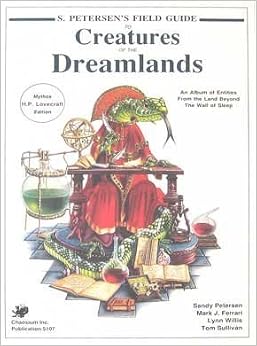
Image

The two Petersen's Field Guides were also heavily influenced by Barlowe's Guide to Extraterrestrials, and include a shout-out in the recommended reading.

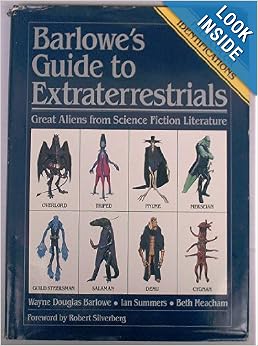
Image Image

Anyway, let's crack the cover. The first thing you see after the title page is a picture of H.P. Lovecraft. Because this is Chaosium, and they like to make it clear that unlike the rest of RPGs, they know full well who their lord and master is.

Image
Physical existence: 1890 - 1937

Then there's a second title page, a dedication to Robert Bloch, and then finally the introduction - an in-character piece by "Professor-Emeritus Eliphas Cordvip Fallsowrth, The School of Medieval Metaphysics, Miskatonic University" that establishes this book as supposed to be an in-character document throughout - no stats, no breaking the fourth wall, although even this early on the book is half-jocular and full of injokes. For example:
PRENATURALIST FIELD WORK IS EXCITING and personally rewarding, but amateur preternaturalists are reminded to take appropriate precautions before initiating observations.

Obstacles to successful observation are plain. With rare exceptions, preternatural collections in museums or zoological gardens do not exist, so that the student gains little acquaintance with the entities he or she seeks to encounter. Indeed, preternatural physical evidence of any sort is difficult or impossible to come by.

The naturalist can establish blinds, follow game paths, lurk near water holes, plant video cameras, and otherwise dog the heels of his chosen species. Such ploys are unavailable to the preternaturalist, whose interest may be not only off-planet but out-of-universe. And metaphysical observation methods are available only to scholars and other trained professionals. Understandably, the successful observer must be extremely patient and have a comprehensive knowledge of previous Earthly appearances.

But the thrill of seeing your first Dark Young smashing its way, say, through the Louisiana bayous cannot be duplicated.

I REMIND READERS OF SUPERB DESCRIPTIONS to be found in the writings of Howard Phillips Lovecraft; his work remains an inspiration. An intriguing game, Call of Cthulhu, discusses these monsters and others more rare. Actual investigations are more dangerous and more tedious than the fictive adventures which the game creates; still, the tone is exactly right.

GOOD SPOTTING!
The book then goes through a spotter's chart - a two page decision-tree flowchart which helps you figure out what monster you're looking at. You start out at 1:
1. Is it invisible?
yes - got to question 2;
no - go to question 3.
..and goes on from there, narrowing down which of the 27 Mythos beasties given in the book that it might in fact be.

In format, each entry is a double-spread - on the left is a snippet quote from Lovecraft, a description of the critter, it's habitat, life, and distinguishing features, a comparative height chart, and some little cartoon related to its characteristics in the lower left; the right-hand page is a full-page color artwork of the beastie, like so:
Image Image
A few of the monsters are formatted differently, with the main picture up top across two pages, with the text below - such as the Shoggoth:
Image Image
Contrary to what the cover and introduction promised, these aren't quite the most commonly encountered Mythos monsters, if only because they include greater gods which will kill and/or cause the PCs to go insane the moment they seem them. Case in point, because they have the critters arranged in alphabetical order, the first one up is Azathoth:
Image
That said, most of the beasties featured here are the memorable ones - dholes, nightgaunts, Deep Ones, ghouls, shantaks, shoggoths, Elder Things, Fungi from Yuggoth, Cthonians, the Dark Young of Shub-Niggurath, Shubby itself (though not the big C)... admittedly it doesn't have everything, but the artwork is pretty good for a late-80s project, though tremendously uneven for the black-and-white bits, but this is all in good fun. Like a lot of CoC books though, there's not a great deal of innovation or deviation from the source material - these are Deep Ones as they are in the Call of Cthulhu 3rd Edition book, based on HPL's Deep Ones, and nobody else's. However, given the extraordinary obstinacy of the CoC player base, the game hasn't really moved forward at all in fifteen years and players of CoC 6/7th edition can probably enjoy this one as much as their pimply-faced selves did back in '88 - moreso, maybe, because they don't have to deal with the rules changes, small as they might be.

Image
Sorry dude, maybe next book.

That pretty much sets the tone for the book really, and the critter descriptions continue on in that combination of weirdly clinical/specific tone and faux-scholarship (which, if you go back to the bibliography, refers to specific short stories which feature the entity in question). It's hard for me to say exactly how influential the art is, since a lot of it is obviously based on earlier art, just larger and in greater color and detail, but it's obviously an influence on, say, this statue of Nyarlathotep:

Image

The Dreamlands guide fills out the roster with a few more classical fantastic critters like basilisks and whatnot, but considering that the Dreamlands has shit like Cats from Saturn and Zoots in it, I think they maybe needed the padding.

After critter #27 (Yog-Sothoth), is a two-page splash size comparison chart:
Image Image
The final part of the book is a collection of recommended reading (real books, both from Chaosium and others, and then a much larger list of fictional reference books, with items like:
Gilman, W. Duin. 1984. "Ghoul Reproduction in the Northeastern United States," Proceedings of the International Metaphysics Society 42:41-59.
The level of detail and thought given to each one probably deserves a Sanity Check all on its own.

For reasons I don't remember (I assume it came with mine when I bought it second-hand), stuck into the back of my copy is a four-page CoC Scenario "The Bleeding Stone of Iphtah." What the fhtagn!?

Re: [OSSR]S. Petersen's Field Guide to Cthulhu Monsters

Posted: Sun Dec 08, 2013 10:03 pm
by shadzar
Ancient History wrote:There's no firm line between a game supplement and a game accessory, but I like to draw a distinction between something that expands the settings or rules of the game (supplement), and something which is just a bit of fun to have (accessory).
its all the same thing to me, as anything is an accessory and supplemental to the "core" of whatever as it isn't "stock".

never heard of these things, so interesting review to read.

Posted: Mon Dec 09, 2013 3:03 am
by Korgan0
What exactly are the metaphysical implications of ghoul reproduction, I wonder?

Posted: Mon Dec 09, 2013 3:20 am
by Koumei
This book appears to be a thing of wonder and beauty.

Also, just as I was up to Barlowe's Guide to Extraterrestrials, my boss walked past the PC and said "Oh, I have that book! It's a really useful one to have, must have had it for more than ten years."

Posted: Mon Dec 09, 2013 3:57 am
by erik
Pity the big images with all the beasties didn't have the names right by them. That would have been a much better layout decision.

I am thinkin of slippin them on my wish list already regardless.

Posted: Mon Dec 09, 2013 3:58 am
by fectin
Looks like it's ~$70 used now. That's a little steep for an impulse buy for me.

Posted: Mon Dec 09, 2013 5:17 am
by kzt
Finally an OSSR of a book I own!

Posted: Mon Dec 09, 2013 5:27 am
by OgreBattle
Is the Barlowe's guide to Fantasy good too?

Posted: Mon Dec 09, 2013 10:07 am
by Ancient History
Barlowe's Guide to Fantasy (which came out later, in '97 or so) is, if anything, better than Barlowe's Guide to Extraterrestrials.

Posted: Tue Dec 10, 2013 12:13 am
by Heisenberg
Wow, this book sounds adorable. I wish I owned it! Probably pretty expensive now, I'd imagine, can't imagine great quantities of it were produced.

Posted: Wed Dec 11, 2013 8:22 pm
by Nath
Illustrations and the bestiary at large have been debated in Call of Cthluhu in some circles. Your typical Cthulhu story relies for some part on the idea of an unknown. A defined bestiary goes precisely against that. Though Lovecraft did re-use creatures from one story into another, people have been playing for longer than HPL did wrote Cthluhu Mythos stories, and it sometimes showed. After a while, players know exactly what to expect based on the illustrations the GM would be tempted to use out of laziness, or or on some keyword in the description ("'Fongoid' you say ? Mi-Go, it's okay, only 10-11 hit points.").

Your typical answer may be "change players". But the sixth edition sourcebook Malleus Monstrorum did bring an interesting idea, only illustrating entries with paintings, statues or old photographs instead of clear drawings (oh, and I guess it also was cheaper to produce...).

Posted: Thu Dec 12, 2013 4:22 am
by Prak
Yeah, and a bunch of people say that the point of Call of Cthulhu isn't to beat the monsters but to see who goes crazy and dies in the best way.

I personally find my fun in a different way. If they want to play that way, that's fine for them, but I'm having much more fun when I'm playing a cultist librarian with an elephant gun shooting down zombie grizzly bears. Likewise, give me fucking defined monsters. I've been playing D&D 10+ years and even if I can say "Oh, mind flayer, CR 8, barring class levels, we're fine" or "What the fuck? You're throwing a gargoyle at level 3s!? Jesus... Ok, both of you grapple the thing and ram it into a wall. Don't worry, DM, it takes [xdy] each turn doubled because there's two of them, yes, trust me... *smile and nod*" that doesn't ruin the game in anyway.

Posted: Thu Dec 12, 2013 4:28 am
by RadiantPhoenix
The only way I like my Lovecraft-like-setting is as a setting for the protagonists being badass.

What makes it worth using (besides just being, "a setting people are vaguely familiar with") is that, stereotypically, you expect everyone to be doomed all of the time in it, which makes the protagonists' successes feel like more of a contrast.

Posted: Thu Dec 12, 2013 7:11 am
by Cynic
The art is badass.

I owned the Barlowe's guide to fantasy before my move to New Jersey. I had a giant moving sale. I always hope that the art student who was eyeing that book along with a few of my extra Monster Manuals got some good use out of them.