[OSSR]GURPS: CthulhuPunk
Posted: Mon Jan 05, 2015 12:33 am
OSSR: GURPS: CthulhuPunk: Colons:
Ancient Horror Crawls Into the Dark Future

This is the reprint cover of this book, and how Steve Jackson would like you to remember it. The cover from the time was a bit more... period appropriate.
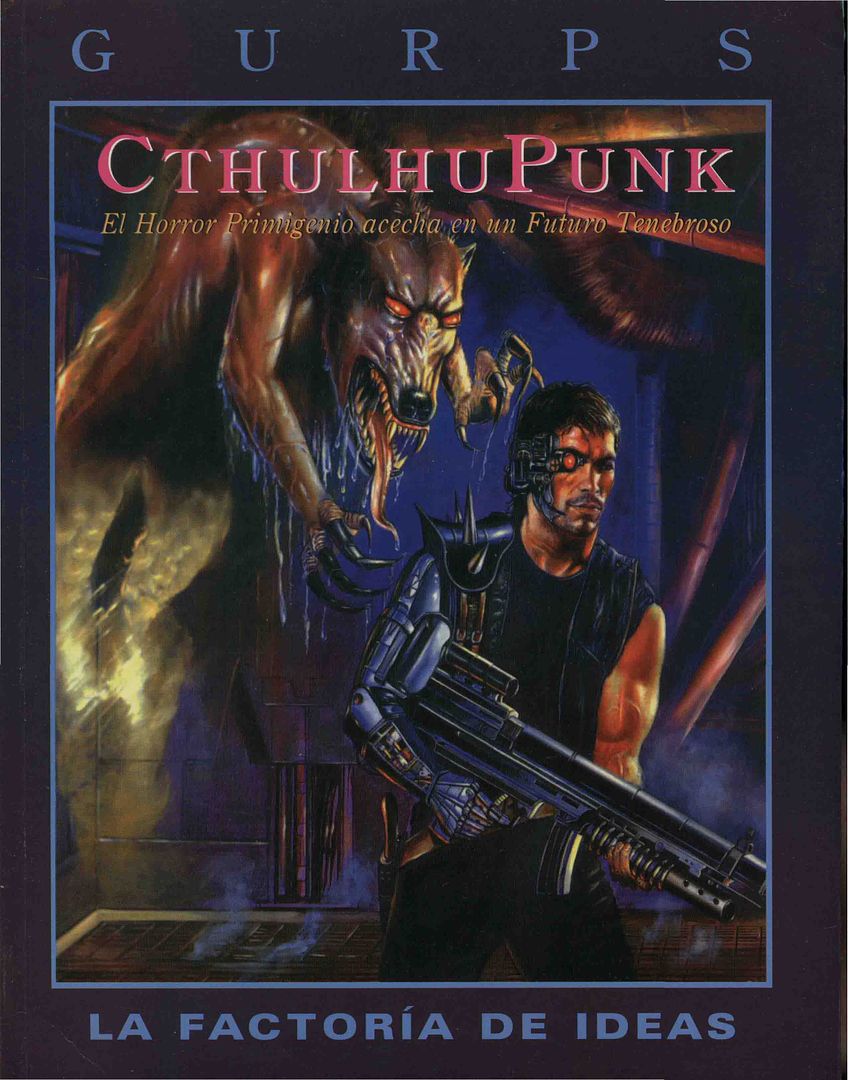
There we go. It's like bionic commando.
We did GURPS Cyberpunk.
We did Call of Cthulhu (5.6).
Now, we're sort of doing the combination of the two. GURPS CthulhuPunk is a one-shot adaptation of another games system in a GURPS context; sort of like GURPS: Vampire: The masquerade: The Coloning, but unlike G:V:tM, G:CP is a re-imagining of the Cthulhu Mythos game into the near-future setting of GURPS: Cyberworld, which was in turn the setting book for GURPS: Cyberpunk.

GURPS Cyberworld is not necessary to understand this product.
A lot of RPGs in the first edition are, well, igneous - fired by the forces of creation. Later books tend to be sedimentary, small accretions building up to new editions. This is one of those rare metamorphic books. Not just an adaptation, but a true mixing and reimagining. Shit got weird.
GURPS Cthulhupunk is written by Chris W. McCubbin, who also wrote the GURPS Bestiary, GURPS Aliens, GURPS Space Bestiary, GURPS Fantasy Folk, GURPS Atomic Horror, GURPS Magic Items Volume 1, Cyber Mage: Darklight Awakening, and the official strategy guides to a bunch of Star Wars and Wing Commander videogames. He is a science fiction fan and a hack writer with a special focus in GURPS and writing fill-in-blanks books on “lists of stuff” topics.
The 90s was a time in RPGs where setting was selling RPGs more than mechanics. A cynical historian might be tempted to conclude that the mechanics on offer in the 90s tended to be a plate of hot ass, but the conclusion of the people making games was that “setting sells.” TSR was busy bankrupting itself by writing more settings than they could actually manage, and even GURPS is getting in on the action by tying their nominally generic gameline books to halucinogenic fever dreams masquerading as stand alone settings. I can't say it was a bad idea, the strongest games of the period tended to do exactly that – with games like Vampire: the Masquerade and Shadowrun kicking the snot out of the generic systems from the 80s. Anyway, it's 1995, and Steve Jackson Games has decided to tell one of their workhorse writers to write a near future scifi pastiche of Cthulhu for GURPS. So... like if CthulhuTech had been written 13 years earlier by a slightly different flavor of fanboy using a better core game mechanic.
Actually, it's a lot like that.
McCubbin also wrote some bits and pieces on GURPS: Vampire: the Masquerade, and apparently was slated to write the hypothetical Texas sourcebook before the honeymoon period with White Wolf turned septic.
This is a GURPS book, so the standard disclaimers apply - GURPS just does not do half-assed books; it's the entire ass or nothing. It is worth saying, however, that even by GURPS standards this gamebook concept has unusual staying power. Maybe it has to do with the incestuous nature of Cthulhu Mythos roleplaying, but people will know of CthulhuPunk even if they have never read it, and even decades after it was released and all official and unofficial support had ceased it stands as a point of reference in comparing with other Mythos RPG products.
...and well it should. Chaosium, at this point, had never quite managed to do a decent contemporary Mythos RPG. They had tried with Cthulhu Now, and the guys at Pagan Publishing did Delta Green, but any sort of future or near-future stuff was pretty much relegated to a very few scenarios tucked away into obscure sourcebooks. The very possibility of tipping a toe outside the well-established waters of "Mythos shit happens, go investigate, handwave everything" was still something that sent the Chaosium writers into fucking hives.

Yes, exciting rules for playing the Mythos in the 80s. There was an adventure involving a computer-dating service and Shub-Niggurath. Not even kidding.
Yet it's important to bring up Cthulhu Now, because there is a shred of its mRNA in this book; the idea of transcribing eldritch horrors into a setting outside of Lovecraft's 1920s and 30s (or Arthur Machen's gaslight 1890s) was realized there, so I think it contributed, in some small way, to the drug trip that allowed GURPS CthulhuPunk to be born.
This isn't just any old Mythos related or inspired RPG, this is an explicit tie-in to Chaosium Games' Call of Cthulhu. Steve Jackson Games got permission from Chaosium to use their intellectual property, and the credits page gives you a window into how little there actually is of that. This book needed permission to use the Call of Cthulhu trademarked name in a roleplaying game context (as opposed to using the term “Call of Cthulhu” in a movie, TV show, novel, or any other context, which you don't need their permission for because they don't own the term), and to reprint a specific drawing of August Derleth's design of an Elder Sign that Chaosium happens to own. Not the design, just that specific drawing of that design.

If you draw your own damn Elder Sign, Chaosium ain't got shit on you.
It's pretty trivially easy to write a Cthulhu-based RPG without using any IP that Chaosium actually owns. Most of Chaosium's material is actually just “fair use” or public domain references to the works of authors who are explicitly allowing their works to be shared and in many cases also long dead. If you wanted to publish Call of Cthulhu your own damn self you could copy the game almost word for word so long as you gave it the title of a different HPL story and used a different font. CthulhuTech showed how easy that is a few years back. But US Steve Jackson liked licensing other peoples' stuff whenever possible, and so he was willing to cut a deal with Chaosium to license their ownership of... two logos.
Artists don't actually get any credit here, just the art director and the people who bought the prints. They might have been trolling highschool art fairs and flea markets by the look of some of the pieces, which would explain why they don't know or care about the names of the original artists. Speaking of not crediting the original artists – the authors of the mythos stories that are being pastiched in this book are also not credited. Material by Brian Lumley is for the most part excised from the text (no Cthonians in this book, and Ithaqua's planet of Borea is unmentioned), but HPL and August Derleth's material is used all over the place. They were dead of course, but I think in 1995 some of Derleth's copyrights still applied.

On your left, we seem to be passing the point where it's traditional to credit the work of people whose copyrighted material we are are going to be using. Or not. You know, whatever.
In 1995, people had had enough of paying tribute to Arkham House for the things they probably didn't own. And while they were at it, they figured they might as well not pay them tribute for things they probably did own. Because fuck it.
By '95, the Arkham House claim to copyrights for Lovecraft's material was really dubious. If you're really interested in an overview, you can check out Black Seas of Copyright, and then understand that the situation was even more fraught and complicated than that.
Hell, most of the reason people equate Chaosium with copyrights, gaming, and the Mythos is because of the kerfluffle over the Deities & Demigods Cyclopedia.
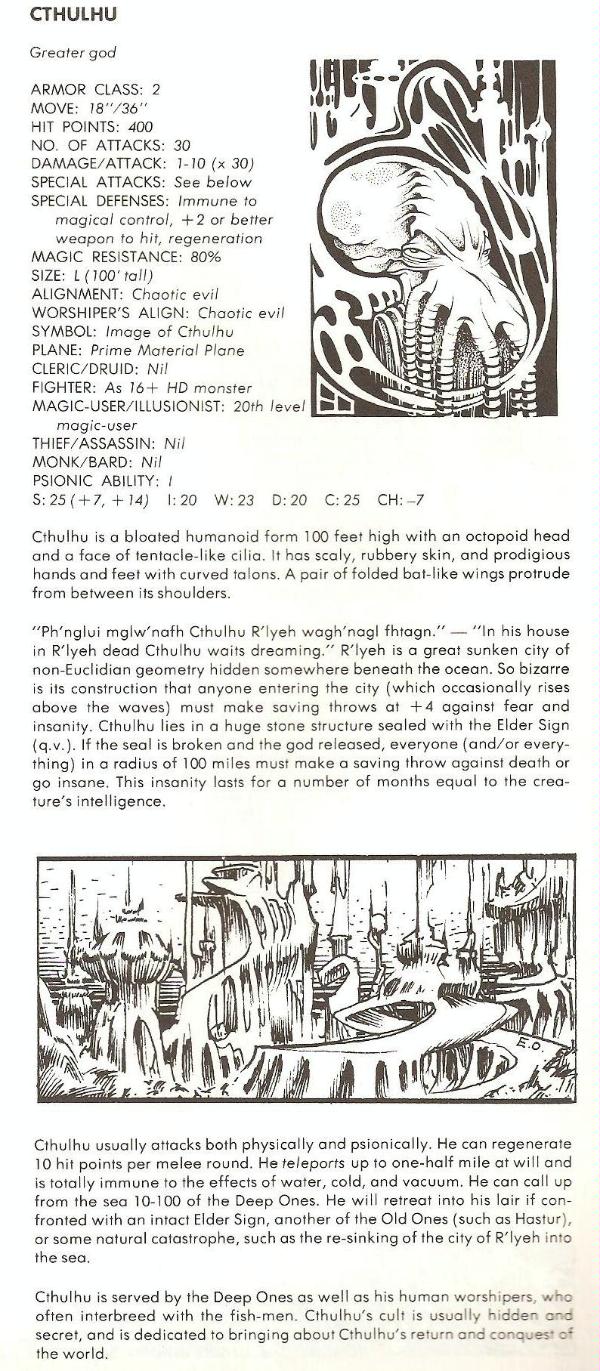
tl;dr: TSR used the Cthulhu and Melnibonean Mythos without permission (which they didn't need for the former, but they didn't know that), because Chaosium had the RPG licenses for both, and had to issue a second edition without those two - thus beginning a cycle of hunting after rare RPG books.)
This book has 8 numbered chapters, as well as a conversion chapter numbered “g.” and an introduction and bibliography. Chapter “g.” was probably supposed to be a “9.” and in this font it kind of looks like a 9. It's an odd typesetting mistake, but there are a lot of ones like that (“Rdventure” for example). It's the kind of error that got made when people were fucking with actual movable block print, or in this case some primitive scan to text programs with little human oversight. That's 11 chapters/sections, but the whole book is only 125 pages, so we can probably do a couple of chapters per post.
On the second edition of this book, the inner front cover suggests several helpful GURPS books to go along with this product, including GURPS: Steampunk, G:Cyberpunk, G:Cyberworld, G:Undead, and the rather weird Floor Plan 1 - Haunted House, which was part of a line of generic maps and floor plans for various settings. The back inside cover pimps the GURPS website and Pyramid online. All power to the tubes.
Introduction
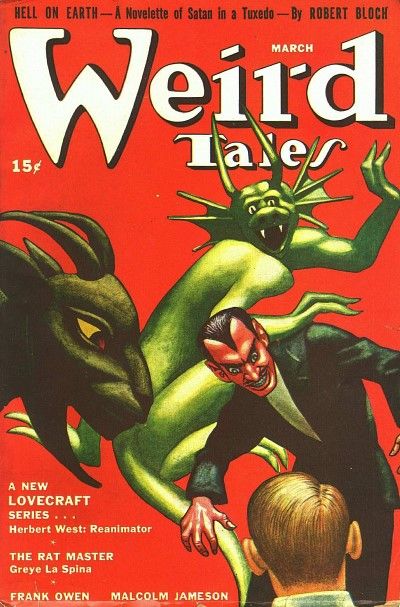
Tell me more about these “Weird Tales.”
The introduction is three pages long and is split into two streams of text side by side. It's like a two-column format, except that text in the “inner” column steams from page to page into the next “inner” column, and text from the “outer” column streams into the next page's “outer” column. Or since it's just three pages, it goes that one text stream is Left Column, Right Column, Left Column while the other text stream goes Right Column, Left Column, Right Column. It's like if there was box text, except there are no boxes involved.
Anyway, the bigger text stream is a more proper introduction. But the smaller text stream that should be box text technically comes first and it is a rant about why you should buy more GURPS books. It being 1995, Steve Jackson games promises that they will send you an up-to-date errata sheet for any book if you send them a self addressed, stamped envelope. Also, they abbreviate that “SASE” because it was 1995 and people actually knew what that meant. As Steve Jackson Games was always striving to be on the forefront of technology, they assured you that they had a 28.8 baud modem, not the 14.4 modem they had in 1990 when they did GURPS Cyberpunk. The 56k modems actually didn't come out until 1997, so those higher data transfer rates would have to wait for GURPS Steampunk.
Once we start pimping specific products, things get kind of surreal. They tell you that the source of all the mythos lore in this book is Call of Cthulhu 5th edition – which is a book we OSSRed and doesn't actually contain all that much mythos lore. So while the statement may be true, it's not encouraging. Also it probably isn't true, because this book has its own extensive bibliography at the end. The book's second recommendation is GURPS Cyberworld by Paul Hume (of Shadowrun fame), which it specifically calls out as being a “plausible dark future” which may be the only time anyone has ever accused Cyberworld of being plausible. They then make progressively weaker and weaker cases first for reasonably applicable things like GURPS high tech until it trails off with an I-am-not-making-this-up pitch for you to buy GURPS Vampire: The Masquerade.
More on the Cthulhu Mythos and GURPS in general, as with G:V:tM, it is a weird concept - Call of Cthulhu is noted as having a very terrible rules lite "system" (I use the term loosely; it is a very many numbers held together by a connective tissue of mindcaulk and fanwank) that its fanbase is rabidly in favor of, and GURPS translations tend to be very rules-heavy, even if the rules themselves are cumbersome and unwieldy. So your CoC fans probably are going to ignore the mechanics and be confused by the changes to the setting material...and the GURPS fans are going to exploit the rules and be confused by the setting material. Ah, the joys of roleplaying!
I have no fucking clue who the audience for this book is supposed to be. Seriously, it's not like GURPS aren't down for including eldritch horrors in an RPG game - they're probably an entire chapter on it in GURPS Horrors, or something - but think about how very weird it is to have a GURPS product married to Cthulhu married to Cyberpunk. I don't disapprove, but it is really fucking strange, because the typical GURPS approach would have been to do a GURPS Cthulhu book, and then tell players they could marry it up with GURPS Cyberpunk and make their own GURPS Cthulhupunk. I'm not sorry they decided to sort of cut out the middleman on this one, but it is atypical, which is what makes this such an interesting product. I mean, you don't see GURPS CyberVikings or GURPS AztechPunk books out there. The only likely possibilities I can think of are some really good drugs, or a line in the deal with Chaosium to make sure that GURPS didn't step on all of their toes in terms of settings.
What's odd about this is that the pitch for doing Mythos as science fiction makes itself. The Cthulhu-mythos is science fiction. It's science fiction that was first written in the past, but mythos material is still being written today is science fiction of the present. Instead of ranting about how the Great Depression was created by telephones (by the way: it was not) or how a Hound of Tindalos is not that different from a cyberninja, they really could just say “Mi-Go are fucking aliens with space ships who use ultra-tech to transfer brains into jars and keep them alive, and in Cyberpunk that kind of technology is also available to the humans.” Really, this introduction just serves to highlight the ignorance of the genres enjoyed by the author.

This is literally 100% of what should have been said about the so-called “difficulties” of mashups involving science fiction with aliens and science fiction with cybernetics.
GURPS CthulhuPunk was, according to this introduction, written under a one-book licensing deal with Chaosium, with the idea that if it did well enough there would be more licensed collaborations in the future. As far as I know, there were no such future collaborations, lending credence to the conspiracy theory that this book sold like herpes cream with 20% more herpes.
In McCubbin's defense, there is a literary link between Cyberpunk and pulp fiction - I think William Gibson acknowledge the influence of 30s detective fiction on Neuromancer, and Ridley Scott clearly borrowed film noir aesthetics for Blade Runner - and of course, the weird fiction of Lovecraft was part of the scientifiction (yes, that was a real word, if you just learned a new word, have a cookie) movement, and led more-or-less directly to Phillip K. Dick and John Shirley and Rudy Rucker and all that jazz. Fuck, H. P. Lovecraft was positing futuristic dystopias before it was cool.
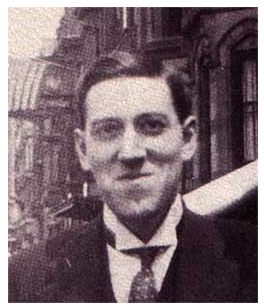
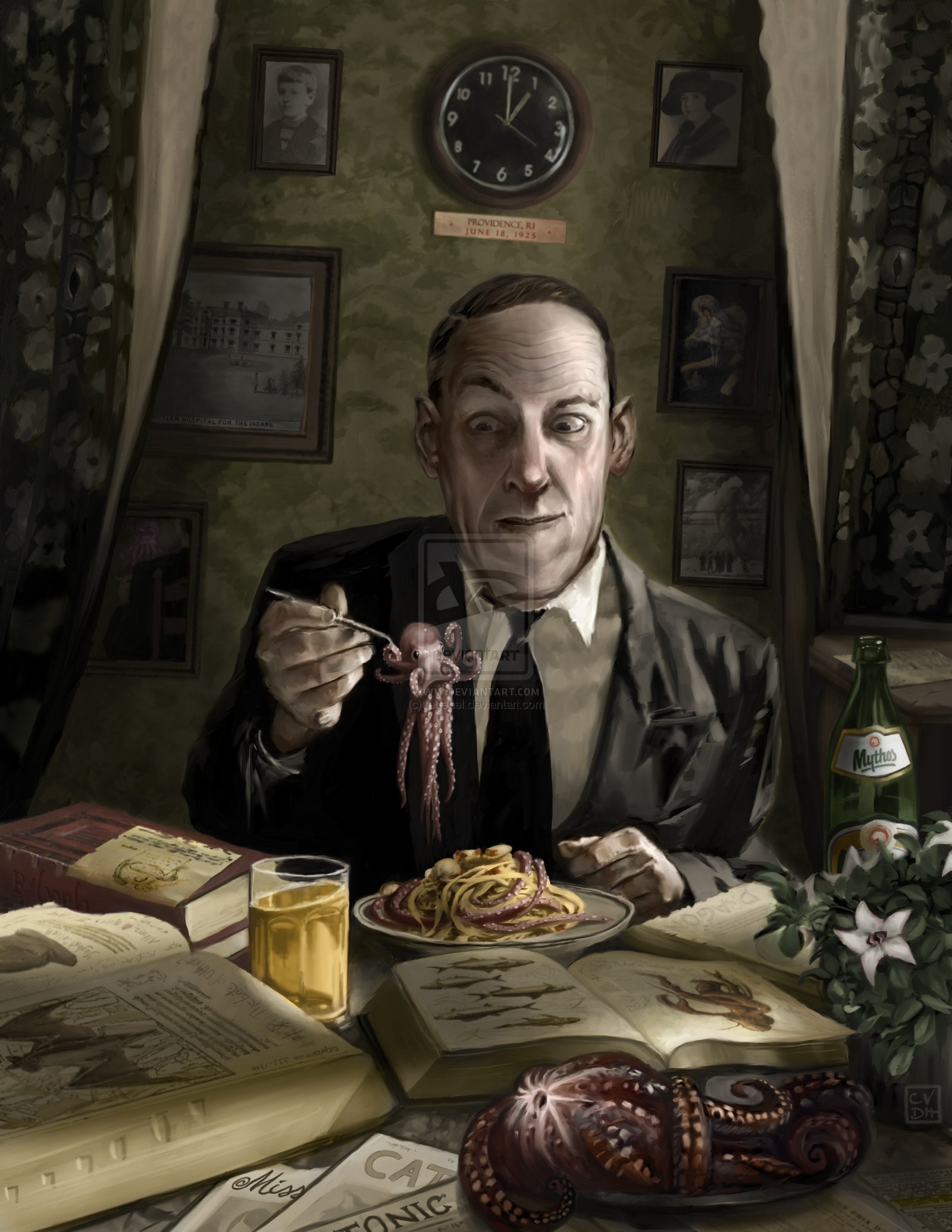
This is one of the few known pictures of Lovecraft trying to smile.
Also, despite the weird wording, McCubbins wasn't claiming telephones created the Great Depression - but the sudden massive propagation of new communication technologies helped shape the Depression era, much as the promulgation of personal computers and the world wide net helped shape cyberpunk fiction.
The About the Author section holds that the author believes he is best and most fondly remembered for his work as an editor of the already canceled fanmagazine “Autoduel Quarterly.” This might actually be true.
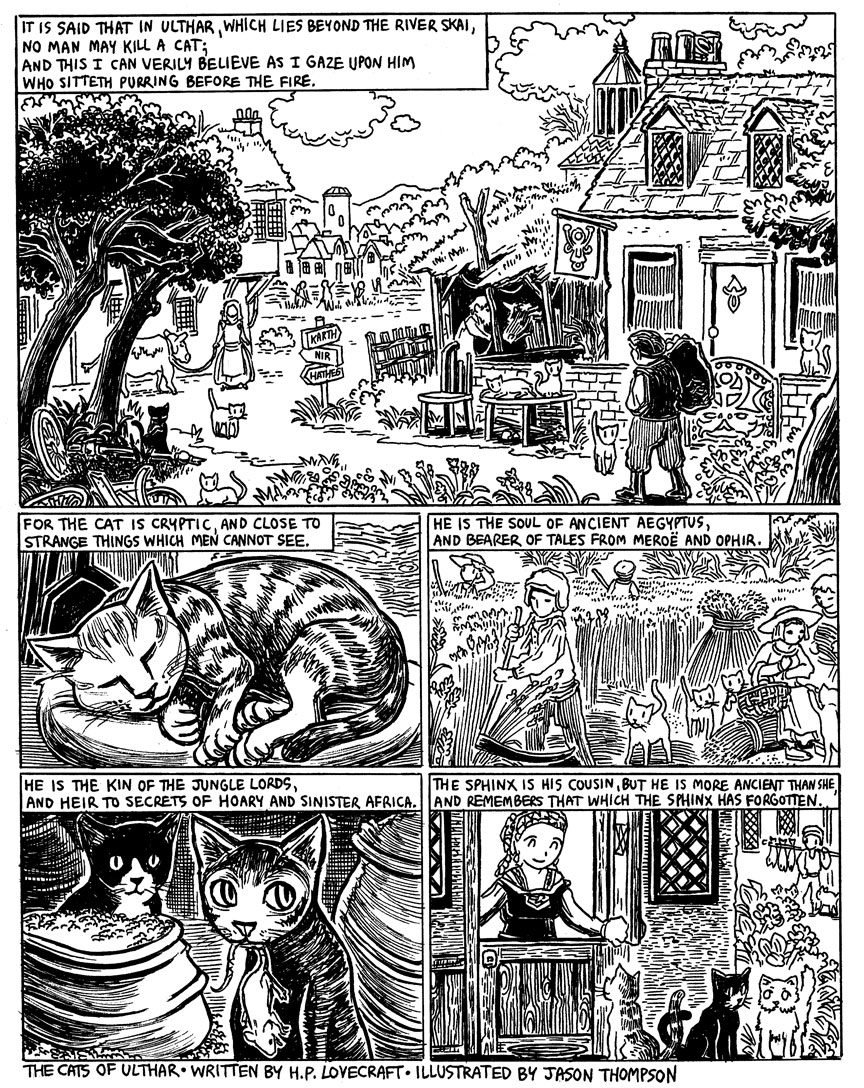
He also has two cats, Polychrome and Clipper. Lovecraft would approve, and welcome him to the Kappa Alpha Tau fraternity.
 Okay, it sounds like we're ribbing a bit harshly...bottom line, this is a very strange, high-concept book, even by GURPS standards, and it's written by a veteran industry hack. You know going in that you're going to see a lot of Mythos setting weird and GURPS clunky rules weirdness. That's a given, that's the ticket to entry. The question we have to answer at the end of the book is: is it any good? Does it come up to GURPS standard? Did it fulfill its bizarre and unholy purpose of combing Cyberpunk and the Cthulhu Mythos? And if so, did it do it well?
Ancient Horror Crawls Into the Dark Future
This is the reprint cover of this book, and how Steve Jackson would like you to remember it. The cover from the time was a bit more... period appropriate.
There we go. It's like bionic commando.
AncientH:
We did GURPS Cyberpunk.
We did Call of Cthulhu (5.6).
Now, we're sort of doing the combination of the two. GURPS CthulhuPunk is a one-shot adaptation of another games system in a GURPS context; sort of like GURPS: Vampire: The masquerade: The Coloning, but unlike G:V:tM, G:CP is a re-imagining of the Cthulhu Mythos game into the near-future setting of GURPS: Cyberworld, which was in turn the setting book for GURPS: Cyberpunk.
GURPS Cyberworld is not necessary to understand this product.
A lot of RPGs in the first edition are, well, igneous - fired by the forces of creation. Later books tend to be sedimentary, small accretions building up to new editions. This is one of those rare metamorphic books. Not just an adaptation, but a true mixing and reimagining. Shit got weird.
FrankT:
GURPS Cthulhupunk is written by Chris W. McCubbin, who also wrote the GURPS Bestiary, GURPS Aliens, GURPS Space Bestiary, GURPS Fantasy Folk, GURPS Atomic Horror, GURPS Magic Items Volume 1, Cyber Mage: Darklight Awakening, and the official strategy guides to a bunch of Star Wars and Wing Commander videogames. He is a science fiction fan and a hack writer with a special focus in GURPS and writing fill-in-blanks books on “lists of stuff” topics.
The 90s was a time in RPGs where setting was selling RPGs more than mechanics. A cynical historian might be tempted to conclude that the mechanics on offer in the 90s tended to be a plate of hot ass, but the conclusion of the people making games was that “setting sells.” TSR was busy bankrupting itself by writing more settings than they could actually manage, and even GURPS is getting in on the action by tying their nominally generic gameline books to halucinogenic fever dreams masquerading as stand alone settings. I can't say it was a bad idea, the strongest games of the period tended to do exactly that – with games like Vampire: the Masquerade and Shadowrun kicking the snot out of the generic systems from the 80s. Anyway, it's 1995, and Steve Jackson Games has decided to tell one of their workhorse writers to write a near future scifi pastiche of Cthulhu for GURPS. So... like if CthulhuTech had been written 13 years earlier by a slightly different flavor of fanboy using a better core game mechanic.
Actually, it's a lot like that.
AncientH:
McCubbin also wrote some bits and pieces on GURPS: Vampire: the Masquerade, and apparently was slated to write the hypothetical Texas sourcebook before the honeymoon period with White Wolf turned septic.
This is a GURPS book, so the standard disclaimers apply - GURPS just does not do half-assed books; it's the entire ass or nothing. It is worth saying, however, that even by GURPS standards this gamebook concept has unusual staying power. Maybe it has to do with the incestuous nature of Cthulhu Mythos roleplaying, but people will know of CthulhuPunk even if they have never read it, and even decades after it was released and all official and unofficial support had ceased it stands as a point of reference in comparing with other Mythos RPG products.
...and well it should. Chaosium, at this point, had never quite managed to do a decent contemporary Mythos RPG. They had tried with Cthulhu Now, and the guys at Pagan Publishing did Delta Green, but any sort of future or near-future stuff was pretty much relegated to a very few scenarios tucked away into obscure sourcebooks. The very possibility of tipping a toe outside the well-established waters of "Mythos shit happens, go investigate, handwave everything" was still something that sent the Chaosium writers into fucking hives.
Yes, exciting rules for playing the Mythos in the 80s. There was an adventure involving a computer-dating service and Shub-Niggurath. Not even kidding.
Yet it's important to bring up Cthulhu Now, because there is a shred of its mRNA in this book; the idea of transcribing eldritch horrors into a setting outside of Lovecraft's 1920s and 30s (or Arthur Machen's gaslight 1890s) was realized there, so I think it contributed, in some small way, to the drug trip that allowed GURPS CthulhuPunk to be born.
I should go on to say that the whole '20s and '30s setting for the Cthulhu Mythos roleplaying is fucking bizarre. Lovecraft wrote stories set in what was for him the current day, or pretty damn close to it, most of the time. A large chunk of his motivation for doing so was to get away from the hackneyed ghost stories and Gothic romances of stuff set far away in some distant period. The whole idea of setting the game back in the '20s and '30s has little to do with Lovecraft's conception of the Mythos as timeless horrors and everything to do with shortsighted nostalgia by raging grognards.
FrankT:
This isn't just any old Mythos related or inspired RPG, this is an explicit tie-in to Chaosium Games' Call of Cthulhu. Steve Jackson Games got permission from Chaosium to use their intellectual property, and the credits page gives you a window into how little there actually is of that. This book needed permission to use the Call of Cthulhu trademarked name in a roleplaying game context (as opposed to using the term “Call of Cthulhu” in a movie, TV show, novel, or any other context, which you don't need their permission for because they don't own the term), and to reprint a specific drawing of August Derleth's design of an Elder Sign that Chaosium happens to own. Not the design, just that specific drawing of that design.
If you draw your own damn Elder Sign, Chaosium ain't got shit on you.
It's pretty trivially easy to write a Cthulhu-based RPG without using any IP that Chaosium actually owns. Most of Chaosium's material is actually just “fair use” or public domain references to the works of authors who are explicitly allowing their works to be shared and in many cases also long dead. If you wanted to publish Call of Cthulhu your own damn self you could copy the game almost word for word so long as you gave it the title of a different HPL story and used a different font. CthulhuTech showed how easy that is a few years back. But US Steve Jackson liked licensing other peoples' stuff whenever possible, and so he was willing to cut a deal with Chaosium to license their ownership of... two logos.
Artists don't actually get any credit here, just the art director and the people who bought the prints. They might have been trolling highschool art fairs and flea markets by the look of some of the pieces, which would explain why they don't know or care about the names of the original artists. Speaking of not crediting the original artists – the authors of the mythos stories that are being pastiched in this book are also not credited. Material by Brian Lumley is for the most part excised from the text (no Cthonians in this book, and Ithaqua's planet of Borea is unmentioned), but HPL and August Derleth's material is used all over the place. They were dead of course, but I think in 1995 some of Derleth's copyrights still applied.
On your left, we seem to be passing the point where it's traditional to credit the work of people whose copyrighted material we are are going to be using. Or not. You know, whatever.
In 1995, people had had enough of paying tribute to Arkham House for the things they probably didn't own. And while they were at it, they figured they might as well not pay them tribute for things they probably did own. Because fuck it.
AncientH:
By '95, the Arkham House claim to copyrights for Lovecraft's material was really dubious. If you're really interested in an overview, you can check out Black Seas of Copyright, and then understand that the situation was even more fraught and complicated than that.
Hell, most of the reason people equate Chaosium with copyrights, gaming, and the Mythos is because of the kerfluffle over the Deities & Demigods Cyclopedia.
tl;dr: TSR used the Cthulhu and Melnibonean Mythos without permission (which they didn't need for the former, but they didn't know that), because Chaosium had the RPG licenses for both, and had to issue a second edition without those two - thus beginning a cycle of hunting after rare RPG books.)
FrankT:
This book has 8 numbered chapters, as well as a conversion chapter numbered “g.” and an introduction and bibliography. Chapter “g.” was probably supposed to be a “9.” and in this font it kind of looks like a 9. It's an odd typesetting mistake, but there are a lot of ones like that (“Rdventure” for example). It's the kind of error that got made when people were fucking with actual movable block print, or in this case some primitive scan to text programs with little human oversight. That's 11 chapters/sections, but the whole book is only 125 pages, so we can probably do a couple of chapters per post.
AncientH:
On the second edition of this book, the inner front cover suggests several helpful GURPS books to go along with this product, including GURPS: Steampunk, G:Cyberpunk, G:Cyberworld, G:Undead, and the rather weird Floor Plan 1 - Haunted House, which was part of a line of generic maps and floor plans for various settings. The back inside cover pimps the GURPS website and Pyramid online. All power to the tubes.
Introduction
Tell me more about these “Weird Tales.”
FrankT:
The introduction is three pages long and is split into two streams of text side by side. It's like a two-column format, except that text in the “inner” column steams from page to page into the next “inner” column, and text from the “outer” column streams into the next page's “outer” column. Or since it's just three pages, it goes that one text stream is Left Column, Right Column, Left Column while the other text stream goes Right Column, Left Column, Right Column. It's like if there was box text, except there are no boxes involved.
Anyway, the bigger text stream is a more proper introduction. But the smaller text stream that should be box text technically comes first and it is a rant about why you should buy more GURPS books. It being 1995, Steve Jackson games promises that they will send you an up-to-date errata sheet for any book if you send them a self addressed, stamped envelope. Also, they abbreviate that “SASE” because it was 1995 and people actually knew what that meant. As Steve Jackson Games was always striving to be on the forefront of technology, they assured you that they had a 28.8 baud modem, not the 14.4 modem they had in 1990 when they did GURPS Cyberpunk. The 56k modems actually didn't come out until 1997, so those higher data transfer rates would have to wait for GURPS Steampunk.
Once we start pimping specific products, things get kind of surreal. They tell you that the source of all the mythos lore in this book is Call of Cthulhu 5th edition – which is a book we OSSRed and doesn't actually contain all that much mythos lore. So while the statement may be true, it's not encouraging. Also it probably isn't true, because this book has its own extensive bibliography at the end. The book's second recommendation is GURPS Cyberworld by Paul Hume (of Shadowrun fame), which it specifically calls out as being a “plausible dark future” which may be the only time anyone has ever accused Cyberworld of being plausible. They then make progressively weaker and weaker cases first for reasonably applicable things like GURPS high tech until it trails off with an I-am-not-making-this-up pitch for you to buy GURPS Vampire: The Masquerade.
AncientH:
This is why people love Steve Jackson Games. They're honest. Wizards of the Coast and White Wolf will lie to you about release dates and rules fixing and keeping James Fucking Wyatt away from the drugs or the rules or both, but only Steve Jackson Games will actually deliver on any of those promises.Will there ever be another GURPS/CoC crossover? Frankly, I don't know.
More on the Cthulhu Mythos and GURPS in general, as with G:V:tM, it is a weird concept - Call of Cthulhu is noted as having a very terrible rules lite "system" (I use the term loosely; it is a very many numbers held together by a connective tissue of mindcaulk and fanwank) that its fanbase is rabidly in favor of, and GURPS translations tend to be very rules-heavy, even if the rules themselves are cumbersome and unwieldy. So your CoC fans probably are going to ignore the mechanics and be confused by the changes to the setting material...and the GURPS fans are going to exploit the rules and be confused by the setting material. Ah, the joys of roleplaying!
I have no fucking clue who the audience for this book is supposed to be. Seriously, it's not like GURPS aren't down for including eldritch horrors in an RPG game - they're probably an entire chapter on it in GURPS Horrors, or something - but think about how very weird it is to have a GURPS product married to Cthulhu married to Cyberpunk. I don't disapprove, but it is really fucking strange, because the typical GURPS approach would have been to do a GURPS Cthulhu book, and then tell players they could marry it up with GURPS Cyberpunk and make their own GURPS Cthulhupunk. I'm not sorry they decided to sort of cut out the middleman on this one, but it is atypical, which is what makes this such an interesting product. I mean, you don't see GURPS CyberVikings or GURPS AztechPunk books out there. The only likely possibilities I can think of are some really good drugs, or a line in the deal with Chaosium to make sure that GURPS didn't step on all of their toes in terms of settings.
FrankT:
What's odd about this is that the pitch for doing Mythos as science fiction makes itself. The Cthulhu-mythos is science fiction. It's science fiction that was first written in the past, but mythos material is still being written today is science fiction of the present. Instead of ranting about how the Great Depression was created by telephones (by the way: it was not) or how a Hound of Tindalos is not that different from a cyberninja, they really could just say “Mi-Go are fucking aliens with space ships who use ultra-tech to transfer brains into jars and keep them alive, and in Cyberpunk that kind of technology is also available to the humans.” Really, this introduction just serves to highlight the ignorance of the genres enjoyed by the author.
This is literally 100% of what should have been said about the so-called “difficulties” of mashups involving science fiction with aliens and science fiction with cybernetics.
GURPS CthulhuPunk was, according to this introduction, written under a one-book licensing deal with Chaosium, with the idea that if it did well enough there would be more licensed collaborations in the future. As far as I know, there were no such future collaborations, lending credence to the conspiracy theory that this book sold like herpes cream with 20% more herpes.
AncientH:
In McCubbin's defense, there is a literary link between Cyberpunk and pulp fiction - I think William Gibson acknowledge the influence of 30s detective fiction on Neuromancer, and Ridley Scott clearly borrowed film noir aesthetics for Blade Runner - and of course, the weird fiction of Lovecraft was part of the scientifiction (yes, that was a real word, if you just learned a new word, have a cookie) movement, and led more-or-less directly to Phillip K. Dick and John Shirley and Rudy Rucker and all that jazz. Fuck, H. P. Lovecraft was positing futuristic dystopias before it was cool.
This is one of the few known pictures of Lovecraft trying to smile.
Also, despite the weird wording, McCubbins wasn't claiming telephones created the Great Depression - but the sudden massive propagation of new communication technologies helped shape the Depression era, much as the promulgation of personal computers and the world wide net helped shape cyberpunk fiction.
FrankT:
The About the Author section holds that the author believes he is best and most fondly remembered for his work as an editor of the already canceled fanmagazine “Autoduel Quarterly.” This might actually be true.
AncientH:
He also has two cats, Polychrome and Clipper. Lovecraft would approve, and welcome him to the Kappa Alpha Tau fraternity.