[Let's Play] Blood Sword I - The Battlepits of Krarth
Posted: Sun Mar 29, 2015 1:44 pm
Welcome everyone to my first multi-player gamebook series LP I'm not counting Heroquest). I hope you will enjoy the game long enough for us to get through all 5 books. 
So what's this book about? The main plot of the overall series talks about how the world is threatened by the impending return/resurrection of 5 powerful beings known as the True Magi, sorcerous rulers who controlled a large portion of this magical world (the world is known as "Legend", apparently) a couple centuries ago before they (and all the rest of their kind) were destroyed in some magical holocaust. A small band of adventurers found out that the only object that's capable of stopping them is the MacGuffin known as the Blood Sword, also known as the Sword of Life. Except that the Sword isn't in one piece at the moment, and the adventurers had to begin by travelling around looking for the pieces to join them together before they go the True Magi.
That's what the series is about. Book 1, which we are starting with, has nothing to do with that plot. In fact, Book I is the one book that can be see as a standalone from the rest of the series, probably because the authors meant for this as more of an introduction to both the game and this new world they creation. Book 1 does introduce a certain NPC that will become one of the major characters in the rest of the series, though.
Cover:
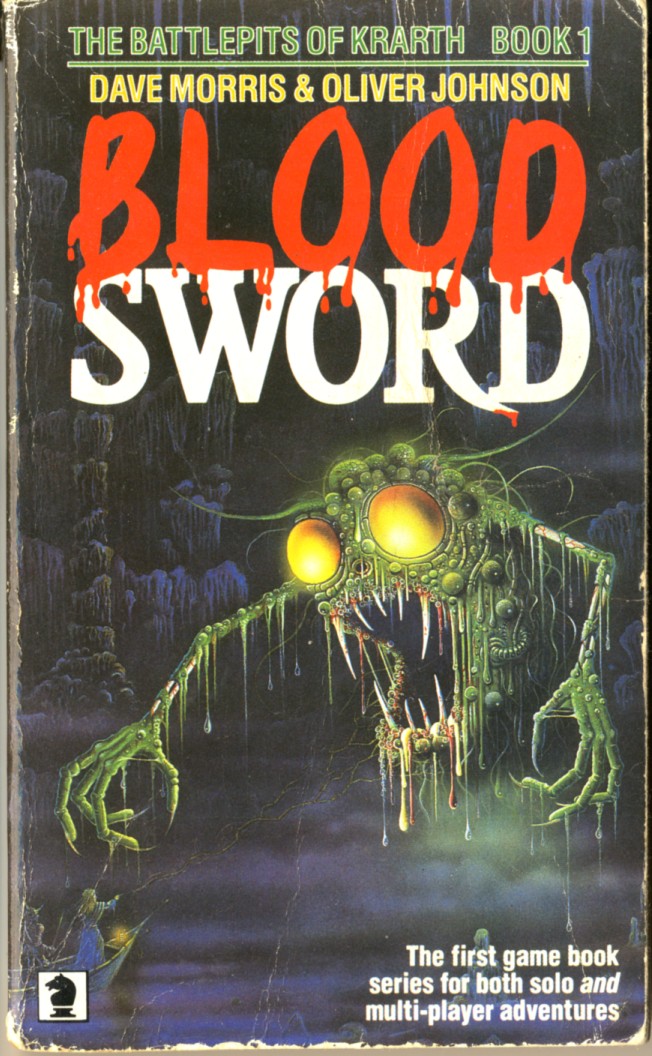 From the back cover blurb of this first book:
The "Magi" mentioned above are the current lords of Krarth (as opposed to the "True Magi" of history), and Krarth was the kingdom that used to be under the True Magi's rule. There's also a glossary in the book that explains some of the names and places of this world. I will post that after I'm done with all the rules.
So what sort of characters are we playing as? As mention, the book is designed for up to 4 players. You can do with less, and starting with less characters means that the characters will start at a higher level, or 'rank', as they are called in the book. To be precise you can play as:
Higher ranked characters obviously get higher stats, and low-ranked characters can improve their stats as they 'level up'. What stats, you ask?
Speaking of which, let's take a brief look at the character classes:
Generally, the Trickster and the Sage tend to get the most Special character options, but the Enchanter gets them fairly often too (not to mention he gets the most options in Combats due to the wide range of spells he has). The Meatshield Warrior, as might be predicted, is more limited in terms of special options, but does get the chance to stand out from time to time. Sometimes, the book makes it clear which character should get priority (e.g. the Enchanter only gets to do his stuff if the Sage isn't there). Sometimes, all 4 characters have the option do something, in which case the players will have to vote on it.
In this playthrough, here's what I'm proposing in terms of character options, in what I see might make the most sense: when one or more character has the option to act, everyone get to post who they think should act, but the player who picked those characters must agree. So If the Trickster's player thinks the Sage should do something, the Sage agrees, then the Sage gets to act, even if the Warrior and the Enchanter both vote for the Trickster. If both Trickster and Sage think they should do something, then the decision will depend on the majority player votes.
Encounters:
Similar to Heroquest,, there is a "Battle Order" to be decided between the 4 characters, and usually it makes more sense to put the better fighters in front, as they will be facing the brunt of enemy attacks (however, there will be occasional situations, normally after players make a bad decision and get ambushed, when the players at the back get threatened more by close combats). But rather than Player 1 always getting automatically targeted like Heroquest, here we have actual character/enemy positions illustrated on maps:

As you can see, the PCs are marked in accordance to their Battle Order positions (1-4). Enemies are marked by letters, usually the Initial letter of their names/type (in this example 'M' = Monster). Black boxes on the maps are inaccessible locations (like pillars). Shaded (but non-black) squares are inaccessible to PCs, but not to the enemies, for various reasons (for example, that square may represent a pit, and the enemy might be able to access it because they can fly). If the option to flee is available, exits will also be marked on the map, as shown above.
There're still more rules to go, but I've run out of time ATM. :/
I'd been hoping to get the individual character details up today, but it'll have to wait till tomorrow. Interested players are still welcome to register their choices for the characters they wish to play in the meantime!
So what's this book about? The main plot of the overall series talks about how the world is threatened by the impending return/resurrection of 5 powerful beings known as the True Magi, sorcerous rulers who controlled a large portion of this magical world (the world is known as "Legend", apparently) a couple centuries ago before they (and all the rest of their kind) were destroyed in some magical holocaust. A small band of adventurers found out that the only object that's capable of stopping them is the MacGuffin known as the Blood Sword, also known as the Sword of Life. Except that the Sword isn't in one piece at the moment, and the adventurers had to begin by travelling around looking for the pieces to join them together before they go the True Magi.
That's what the series is about. Book 1, which we are starting with, has nothing to do with that plot. In fact, Book I is the one book that can be see as a standalone from the rest of the series, probably because the authors meant for this as more of an introduction to both the game and this new world they creation. Book 1 does introduce a certain NPC that will become one of the major characters in the rest of the series, though.
Cover:
So.....almost sort of like a Deathtrap Dungeon, huh? Except you can play in groups instead of solo.Every thirteen lunar months the Magi of Krarth hold a deadly contest to see which of them will rule that bleak and icy land. Teams of daring adventurers are sent down to the labyrinths that lie beneath the tundra, each searching for the Emblem of Victory that will win power for their patron.
Only one team can survive. The others must die.
The "Magi" mentioned above are the current lords of Krarth (as opposed to the "True Magi" of history), and Krarth was the kingdom that used to be under the True Magi's rule. There's also a glossary in the book that explains some of the names and places of this world. I will post that after I'm done with all the rules.
So what sort of characters are we playing as? As mention, the book is designed for up to 4 players. You can do with less, and starting with less characters means that the characters will start at a higher level, or 'rank', as they are called in the book. To be precise you can play as:
Ranks are gained through experience points, which we will gain at the end of every book we successfully complete. Generally, the amount of XP gained is fixed for each book, but there are also certain events that we may encounter that allows us to gain/lose extra XP due to certain heroic/inappropriate actions we take. Some of them may apply to only 1 character (for example, the Warrior is generally expected to behave in a honorable and courageous manner, so if he made a choice that can be deemed cowardly, he'll be the only member of the party to gain less XP at the end of the book). Every 250 experience points gained allows a character to gain a rank.a single eighth-rank character
two characters of fourth rank
three characters of third rank
four characters of second rank
Higher ranked characters obviously get higher stats, and low-ranked characters can improve their stats as they 'level up'. What stats, you ask?
The way the stats are distributed will, of course, also depend on the character class.Fighting Prowess a measure of how powerful a fighter the character is;
Psychic Ability an indicator of the character's resistance to attack spells and (in the case of an Enchanter) his or her aptitude for magic;
Awareness a difficult concept, as it encompasses quickness of thought, dexterity and general nous;
Endurance the attribute measuring the character's state of health; wounds are deducted from Endurance, and if it reaches zero then the character dies.
Speaking of which, let's take a brief look at the character classes:
Other than stats, the major difference between the characters is that there will often be "Special Character options". (e.g. 'If there is a Trickster in the party, turn to ...'.). When cases like this happens, only that particular character class get to see that section and the information contained (as I mentioned in the poll thread).Your world is the magical land of Legend. In Legend there are many kinds of Adventurer, each with unique skills and techniques for dealing with creatures of the supernatural. Those who rely on a good sword and the strength of their right arm are called Warriors. The practitioners of the magical arts are called Enchanters, with many deadly spells always ready at their fingertips. Sages are a class of ascetic monks - wise in ancient lore, but also skilful in the use of quarterstaff, bow and the unarmed martial arts. Lastly there are the Tricksters; they are swift and dextrous swordsmen, but their true forte is the use of stealth, guile and cunning to achieve their ends.
Generally, the Trickster and the Sage tend to get the most Special character options, but the Enchanter gets them fairly often too (not to mention he gets the most options in Combats due to the wide range of spells he has). The Meatshield Warrior, as might be predicted, is more limited in terms of special options, but does get the chance to stand out from time to time. Sometimes, the book makes it clear which character should get priority (e.g. the Enchanter only gets to do his stuff if the Sage isn't there). Sometimes, all 4 characters have the option do something, in which case the players will have to vote on it.
In this playthrough, here's what I'm proposing in terms of character options, in what I see might make the most sense: when one or more character has the option to act, everyone get to post who they think should act, but the player who picked those characters must agree. So If the Trickster's player thinks the Sage should do something, the Sage agrees, then the Sage gets to act, even if the Warrior and the Enchanter both vote for the Trickster. If both Trickster and Sage think they should do something, then the decision will depend on the majority player votes.
Encounters:
Similar to Heroquest,, there is a "Battle Order" to be decided between the 4 characters, and usually it makes more sense to put the better fighters in front, as they will be facing the brunt of enemy attacks (however, there will be occasional situations, normally after players make a bad decision and get ambushed, when the players at the back get threatened more by close combats). But rather than Player 1 always getting automatically targeted like Heroquest, here we have actual character/enemy positions illustrated on maps:
As you can see, the PCs are marked in accordance to their Battle Order positions (1-4). Enemies are marked by letters, usually the Initial letter of their names/type (in this example 'M' = Monster). Black boxes on the maps are inaccessible locations (like pillars). Shaded (but non-black) squares are inaccessible to PCs, but not to the enemies, for various reasons (for example, that square may represent a pit, and the enemy might be able to access it because they can fly). If the option to flee is available, exits will also be marked on the map, as shown above.
There're still more rules to go, but I've run out of time ATM. :/
I'd been hoping to get the individual character details up today, but it'll have to wait till tomorrow. Interested players are still welcome to register their choices for the characters they wish to play in the meantime!


