Page 1 of 1

[OSSR]GURPS: Planet Krishna

Posted: Wed Dec 16, 2015 2:46 am
by Ancient History
Image

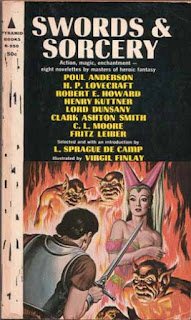
You've probably never heard of L. Sprague de Camp, and even if you have heard of him you're not likely to be familiar with his "Viagens" book series, and if that wasn't enough you might be curious what the fuck "Swashbuckling Adventures in Space" means in the olden days of 1997, when Spelljammer was pretty much dead and the only folks that would take swords into space were Corsair from the X-Men and Jedi.

Image
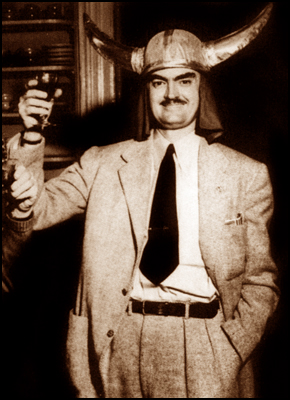
This guy is the father of Cyclops and Havok. He prefers to play space-pirate and date a real live furry. Wouldn't you?

I've been meaning to drag my sorry ass into writing more on my Space Madness! draft, but before I do that I kind of need to get worked up to it, and I saw this in the dollar bin at the local game store. Before we get into the OSSR proper, however, I feel y'all need a little background.

Image

L. Sprague de Camp is today mostly known for writing biographies of H. P. Lovecraft and Robert E. Howard, critical appraisals of the Cthulhu Mythos and J. R. R. Tolkien's The Lord of the Rings, for his work presenting and editing and expanding on Robert E. Howard's Conan the Barbarian series. He was also a materialist that wrote popular books pointing out Atlantis was bullshit and on the history of engineering, and wrote many fantasy and science fiction novels and short stories which were very well-received at the time. Hell, the dude shared a beer with Tolkien once.

Image

This was mostly in the 70s. De Camp's biographies and criticism haven't aged particularly well; even his Conan novels and his handling of Robert E. Howard's material have been endlessly criticized. Much of his own fiction has been largely forgotten, rotting away in used bookstores as cheap paperbacks. This is a bit of a shame, because while de Camp was definitely in the first bloom of the sword & sorcery craze that followed Robert E. Howard and Tolkien, a lot of his novels were at least fun - not deep, but fun - and you could do worse for an evening's entertainment than to pick up The Fallible Fiend, The Pixelated Peeress, or Lest Darkness Fall.

Image

The "Viagens" books aren't fantasy, though, they're kind of a soap opera. Sort of in the vein of Edgar Rice Burroughs, Otis Adelbert Kline, and Leigh Brackett, or Howard Chaykin's Iron Wolf. The basic concept is that you've got interstellar travel and civilizations, but people still fight with swords. Which means that Conan-types have at least a reasonable opportunity for conquering the planet. Okay, that might be a slight exaggeration, because really all it is is an extrapolation of colonial fiction into a more exotic environment: instead of white people going to Africa and finding primitive native tribes and lost Greek and Roman colonies, you have Earthlings going to an alien planet full of green-skinned women riding six-legged horses or some shit. The heroes would have to use their wits (and sometimes superior technology) to outwit the natives and steal their resources/treasures/women/etc.

Image
Some writers would take this a bit too literally.

To his credit, de Camp put a little more thought and effort into his books, based largely on his education in engineering, his deep reading into exploration literature, and growing up in an era when people weren't quite as racist; he was one of those fellows that really enjoyed being able to put some sex and serious discussions about racism into his work. His sword-and-planet novels are a good overall example of the kind of thought and detail he put into his stories at a time when...well...that wasn't the case.

By "time" I mean that the first novels in the series were written from 1948 to 1953, and the last novels were written from 1977 to 1992. Which might explain why this GURPS book came out as it did in '97: picking up a "new" novel in '92 and finding out it's the latest in a series of nine novels and a collection of short stories, it would take some time to read them all, be inspired to write a GURPS product, track down de Camp (who was, amazingly, still alive until 2000), pitch it to Steve Jackson and write the damn thing. GURPS did a lot of these sortof-obscure scifi ports in the 80s and 90s, including GURPS Humanx, GURPS Planet of Adventure, and even GURPS Riverworld. I imagine the only reason we never got GURPS Known Space is because it was too expensive or Larry Niven wanted too damn much money.

Image

Alright, this might not sound quite up everybody's alley...but wait. See, the thing is that de Camp actually put a good bit of work into the setting, and there was a lot of material to cover. And that's the sort of thing that GURPS is actually really good at covering. I mean, really really good. This might seem like a throw-away GURPS book, but there is more setting development in this book than in McWoD, and vast swathes of it are actually useful and interesting. You're probably never going to actually run a Viagens campaign, but you sure as shit might mine this book for the bits of it that are really cool - and honestly, isn't that the point of GURPS books?

Image

Next Up: Introduction and Chapter One

Posted: Wed Dec 16, 2015 3:11 am
by Blicero
Is de Camp the one who took Howard's relatively cunning Conan and made him all brutish and barbaric? Or am I thinking of someone else?

Posted: Wed Dec 16, 2015 3:48 am
by erik
I think someone else. The only one of L Sprague's that I remember off the top of my head was Return of Conan, where he's king of Aquilonia and his wife Queen Zenobia is kidnapped at the start, and recall Conan as being fairly thoughtful in fact.

I think at one point he is introspecting after a fight that he doesn't think some battle was so tough, though he couldn't remember ever besting such a deadly foe when he was younger.

Posted: Wed Dec 16, 2015 6:21 am
by OgreBattle
advance hit location chart
I'd hit it

Posted: Wed Dec 16, 2015 6:22 am
by Aryxbez
I knew that name sounded familiar somewhere, I actually do own Hostage of Zir (or least one of those books in that series).

Posted: Wed Dec 16, 2015 6:51 am
by Josh_Kablack
L Sprague D. Camp was the editor and/or blurb writer for damn near every fantasy short story collection in my dad's library of old paperbacks.

Posted: Thu Dec 17, 2015 1:51 am
by Ancient History
Image

Introduction
Welcome to Krishna! For decades readers of science fiction have enjoyed fantastic adventures on the second planet of Tau Ceti, courtesy of the fertile imagination of L. Sprague de Camp. Now gamers can join in the fun.
Insert usual sidebars on GURPS (this product was 3rd edition), and notes on the author (James L. Cambias, whom you haven't heard of, but he did Arabian Nights: A Genre Book for Rolemaster and several GURPS supplements) and L. Sprague de Camp and his wife, who were apparently very forthcoming about questions on the book. It's the usual pithy one-pager.
As a setting for roleplaying games, the planet Krishna is a trove of wonders. Brave Earthmen engage in swordplay beneath the triple moons and win the hand of a beautiful green-haired princess! A pirate queen and her stalwart band waylay ships on the Sadabao Sea! Tailed cannibals menace castaways on the island of Fossanderan!

The Krishna stories combine classic space opera with hard-science realism and a dash of humor. If they are space opera, they are space opera as written by Gilbert and Sullivan. The brave Earthman is likely to be a novice tour guide or a scheming con artist. The pirate queen is fat and middle-aged. On Krishna, a hero who wins the hand of a princess must then live with the consequences of being married to a woman who lays eggs, on a world where dinner is eaten still wiggling and executions are a popular form of entertainment.
Image
Who's next to be decapited
Cannot cut off another's head
Until he's cut his own off


Readers who might think that Douglas Adams and Terry Pratchett had a monopoly on humor in fantasy/science fiction don't quite know what they're missing...even if de Camp's sensibilities do tend to lie, as was pointed out, in the slightly-but-not-explicitly-bawdy-and-domestic-bliss vein that is more familiar to an episode of Married with Children than, say, Firefly.

Image

The Krishna Stories
L. Sprague de Camp himself contributes a three-page essay on the Viagens Interplanetarias series in 1988, which starts off by talking about the space opera/sword-and-planet of Edgar Rice Burroughs, then blitzes merrily through a rundown of the eight novels and miscellaneous short stories. De Camp traces some of the basics flaws of the Barsoomian stories ("While Barsoomians do much fighting with swords, none uses a shield or armor. On Earth, even Stone Age peoples have made serviceable shields, helmets and other defences of wood, leather, cane, reeds, and coconut fiber.")

Image

The essay is workmanlike, typical de Camp, and a bit...quaint for '97. Phrases like "e.t." and "Stone Age peoples" creep in unselfconsciously. And maybe with a few book sins to its credit.
I assumed that in the 22nd century Brazil would be a leading world power, and the Brazilian-dominated interstellar transport system was the Viagens Interplanetarias. (That is pronounced vee-Ah-zhayñsh eeñ-ter-pla-neh-TAH-ree-ush. The ñ is not a sound, but a sign that the preceding vowel is nasalized, since Portuguese, like French, has nasal vowels.)
Image

The reason why early science fiction has a hard-on for Brazil is not a sudden love of all things South American, but size. Brazil looks pretty big on a globe, so it was naturally assumed it would become a superpower...given time.
Krishna is assumed to be a satellite of Tau Ceti, 10.9 light years from our own Terra, with similar surface gravity and atmosphere. The intelligent species superficially resembles humans, save for feathery olfactory organs above their eyebrows, pointed ears, and greenish complexions resulting from blood based on haemocyanin instead of haemoglobin. Sexual intercourse between the species is possible. The resemblance is close enough for a person of one species to disguise him or herself as the other.
Rubber forehead aliens and hot green alien chicks, check.

Image
Sexually compatible, check.
Relict populations exist of a less advanced species, with tails. These bear much the relationship to the dominant species that a population of Homo habilis pr H. erectus, if it had survived, would bear to H. Sapiens.
Well, considering we murdered, fucked, or murder-fucked every other hominid species on our planet, I'm not sure what this means in context. But okay, Lyon.
To account for the medieval weaponry, I assumed that an Interplanetary Council imposes stern rules about giving technological secrets to natives of pre-industrial planets, because of the social breakdowns that result from technological change at too fast a pace. The Krishnans, however, suspect that this technological blockade is a plot to keep them backward so that they can be more easily conquered and exploited. Hence they try to get around the blockade.
This was about 15-20 years before Gene Roddenberry came up with the Prime Directive, so this Ur-Directive has more in common with colonial empires on Earth deciding it would be a bad idea to sell Maxim guns to the Zulu and Aborigines more than anything else. But it gives you the sword-and-planet feel.
The blockade explains why Krishnans, although they know about Terran guns, have none and fight with swords and crossbows. At the chronological end of the series, they are just beginning to make their own muskets.
Which is good. Nothing like the native peoples being stupid on top of being disadvantaged. Plenty of Earth cultures, when faced with superior weaponry, carefully captured it, copied it, then reverse-engineered the basic principles.
Percy blows up: "Blasted cheek!... If you think I'll sit on my arse while these bloody barbarians mistreat a Terran woman, you can jolly well think again!"
On the one hand, this is obviously de Camp being tongue-in-cheek and playing up on British sexism during the colonial era. On the other hand, this is a dude that had a beer with Tolkien. It boggles the mind.

I don't know if de Camp gets a bad rap for how he wrote female characters; they tend to be very competent, but also bossy, fussy, and sort of hopelessly mired in a kind of caricature of 50s and 60s era feminism... which shows here in talking about a bossy woman "having undergone psychotherapy to smooth off the jagged spots in her personality" - de Camp was not a Scientologist, whatever his other faults.
Victoria Poyser did a splendid jacket painting for this, also. It shows Alicia teaching a native of the planet Osiris, resembling a man-sized dinosaur, to dance the tango.
Image

...and that's about it for tonight. I think it tells you a lot about the series as de Camp saw it; next up we'll see what Cambias makes of it.

Posted: Sun Dec 20, 2015 8:30 pm
by Ancient History
Chapter 1: The Viagens Interplanetarias Universe
The long-awaited showdown between the Communist powers and the West came in 1963, when the Russians attempted to build a wall across Berlin. American soldiers demolished the wall, Russians fired upon them, and within hours Europe was mobilizing.
I'm about 99% sure that the rise of Brazil as a major world power was written as a throw-away line about the Third World War happening in the 1960s (recall that the first book was written in 1949), so the couple paragraphs of alt-history history is just GURPS fodder. GURPS had a major hard-on for "realistic" alternate history, and this is basically an adaptation of de Camp's backstory cast in the GURPS mold, with talk about Technology Levels and most major powers.

Anyway, most of this game actually takes place on the planet Krishna, so they go ahead and tell you it's OK to fuck around with the Earth timeline, because it's less important. Major take-aways of this section are that Brazil is a major space-faring power, Brazilian Portuguese is a lingua franca, the World Federation is the unified government of the planet Earth (the assembly is named 'the Althing', which I love), where most natural resources are nationalized and national militaries are outlawed and replace with the Armed Force (thus, miltech is a bit low by spacefaring civilization standards); we get tantalizing hints of much more interesting sci-fi projects...
Occasionally the Federation authorizes the use of fission explosives for large engineering projects, such as the Gamanovia continent-building operation of the Applied Tectonics earthquake-prevention system.
...population growth is discouraged and enforced by "genetic ratings" that limit how many kids you have, and the starships of the Viagens Interplanetarias arrive and leave out of bases on Pluto and Neptune's moon Triton.

Image

Viagens Interplanetarias gets its own section, and we get a sidebar on world classifications (from "Class A - Council members" to "Class L - Uninhabited worlds") and what that means as far as prime-directive type restrictions go. Class Ls are where you're basically allowed to set up casinos, sex colonies, drug dens, strip-mine the planet, blow up random mountains with nukes, and whatnot. They're the 4chans of the galaxy. There's also a list of the other inhabited planets and of the various star systems: Sol (Earth and Mars), Tau Ceti (Vishnu, Krishna, Ganesha), Epsilon Eridani (Thor, Odin), Procyon (Osiris, Thoth, Isis), Sirius (Sirius Nine), Alpha Centauri (Ishtar, Tammuz), Lalande 2285 (Ormazd). We get some sidebars on these various planets while Cambias gets his GURPS-groove on with regards to the Technology (mostly TL8, except for the Mesonic Drive and Longevity Pills which are TL10), and there is a lengthy section complete with formulas for Time Dilation to replicate the effects of relativistic time travel.

Image

Your campaign is not going to use time dilation. But it's kind of interesting in a pseudo-hard science RPG setting to have a characters have a "calendar age" and a "subjective age" - that's some really old-school stuff, the kind of thing where your body could subjectively be thirty years old, but in calendar years you're 90 because of time dilation or cryogenics or what-have-you sci-fi miracles like Longevity Pills, which "cut aging by 2/3" when taken regularly.

There's also some stuff on Moritzian psychotherapy, the Saint-Remy Treatment, and the Pannoetic treatment...this is basically advanced psychology + hypnosis to solve mental problems, remove troublesome personality traits, and/or become the Manchurian candidate. Imagine if Scientology embraced psychiatry as a route to superpowers, and you have roughly the right idea. The Pannoetic treatment in particular is strongly based on [Panpsychism](https://en.wikipedia.org/wiki/Panpsychism) and some obscure psychological theories of the mid-twentieth century. Cambrias apparently found the Panneotic treatment fucking unworkable even in a GURPS format and pretty much dismisses it as driving humans fucking insane, but feels obliged to at least mention it because it's in the book.

Image

I'm skipping a lot of the sidebars on the different planets, but all this back-end mechanics is largely so that you can steal this shit for your GURPS Star Trek campaign or something. It includes a lot of jokes-in-passing ("The Terrans settled on a small continent in the northern hemisphere, and purchased it from the inhabitants with a case of whiskey and a phonograph.") and some things that are just bizarre:
Odin is the fifth planet of the Eridanian system. It is as big as the Earth, with a diameter of 8,300 miles. It is much less dense, however, and has a surface gravity of only 0.52. Odin is a cold world, with an atmosphere of methane and seas of ammonia. The temperature hovers around -100 degrees. The creatures of Odin have a body chemistry based on ammonia.

Odin is home to one intelligent species, resembling giant beetles four feet tall. They have a pre-industrial civilization, with windmills, sailing ships plying the ammonia seas and bronze cannon. Odin is a Class E planet. Its civilization is TL4, and the most common CR is 2.
I have no idea how you justify -100 F temperatures and bronze cannon manned by four-foot tall crabs, but I'm imagining the most insane pirates in the 'verse.

Image

Anyway, that's the 'verse. Next up: Krishna!

Posted: Sun Dec 20, 2015 10:49 pm
by Maxus
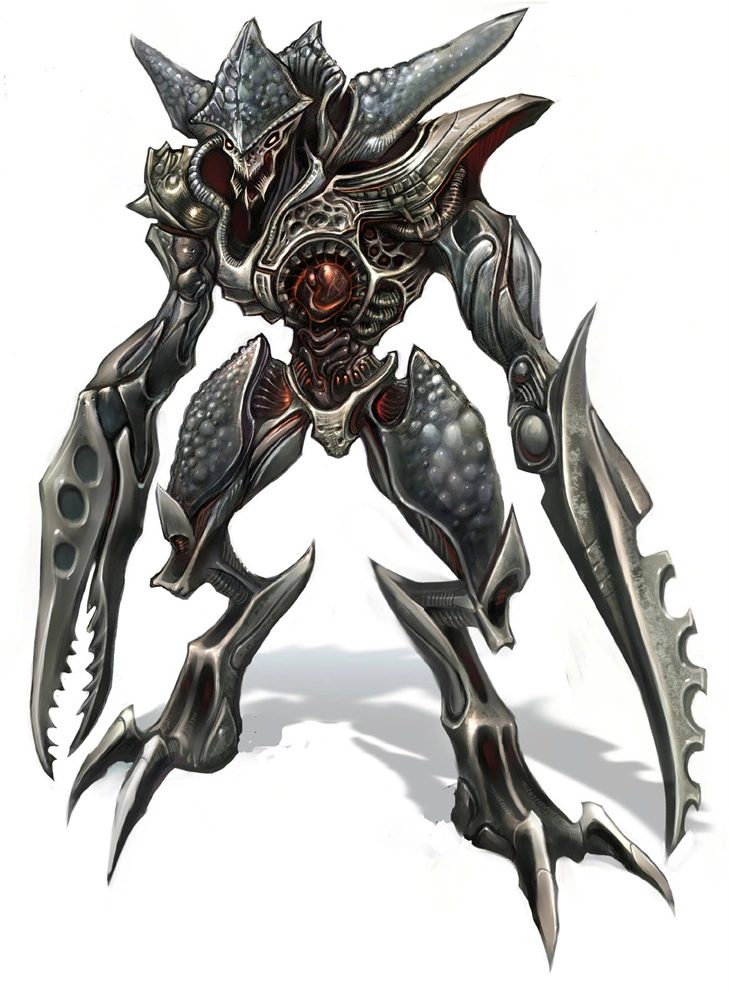
Completely unrelated: I need to find a way to replay Metroid Prime

Posted: Mon Dec 21, 2015 11:16 am
by maglag
Ancient History wrote: Image

The reason why early science fiction has a hard-on for Brazil is not a sudden love of all things South American, but size. Brazil looks pretty big on a globe, so it was naturally assumed it would become a superpower...given time.
To be fair, Brazil nowadays has a space program and can put people on space on their own (and bring them back alive), which is more than a lot other countries nowadays can claim.

They also have Tormenta RPG, which is a portuguese-written D&D 3.5 clone that's about old enough to drink with a crapload of splatbooks, novels, and even their own manga. All with lots of boobs because that's how brazilians roll. Actually since I can read portuguese, I may write an OSSR about that when I'm drunk enough.

Posted: Mon Dec 21, 2015 4:16 pm
by talozin
Any discussion of L. Sprague de Camp's fiction should really include mention of his collaboration with Fletcher Pratt on the "Harold Shea" series, a/k/a "The Incompleat Enchanter", "The Compleat Enchanter" and "The Complete Compleat Enchanter", depending on which omnibus you can find in your local used bookstore. On the list of inspirational readings in Appendix N of the original DMG, "de Camp & Pratt" are first-mentioned as "most immediate influences" on AD&D. So at least you know who to blame, next to Gary Gygax.

Posted: Mon Dec 21, 2015 4:24 pm
by Shrapnel
Maxus wrote:Completely unrelated: I need to find a way to replay Metroid Prime
I would highly recommend Metroid Prime: Trilogy. It's on the Wii U eShop.

Posted: Mon Dec 21, 2015 5:17 pm
by Maxus
Shrapnel wrote:
Maxus wrote:Completely unrelated: I need to find a way to replay Metroid Prime
I would highly recommend Metroid Prime: Trilogy. It's on the Wii U eShop.
Gracias.

[/derail]

Posted: Thu Dec 24, 2015 12:39 am
by Ancient History
Image
The World of Krishna
Krishna is slightly larger than Earth, with a diameter of 8,400 miles, but is less dense, giving it a surface gravity of 0.92 standard gees. The difference in gravity is not enough to give humans any great advntage in strength. espite the lower gravity, Krishna has a thick atmosphere, with an average atmospheric pressure 1.34 times that of Earth's. The composition is nitrogen-oxygen, and Krishna's air is perfectly breathable by Terrans. The sky appears slightly greenish.

Krishna rotates a little more slowly than Earth does, with a day 28 standard Terran hours long.

Krishnans divide their day into 20 hours. The day begins at sunrise, and noon comes at the fifth hour. Sunset is at the 10th, and midnight is at the 15th hour. Since the actual time of sunrise varies form summer to winter, the hours vary in length from 67 to 100 standard minutes.
Image

GURPS Planet Krishna is a kinda-sorta hard sci-fi setting, built to justify a lot of soft sci-fi space fantasy/opera tropes. As such, it has an innate, intuitive appeal to the kind of people that write GURPS adaptations of settings, because GURPS is all about slapping numbers on shit. It is, as I think we have said, an outgrowth of the simulationist school of game design, coming out of old tabletop war games. There are a lot of problems with this - I'll give some more specific examples later on - but one of the issues is granularity. Not a unique issue with GURPS, but a particular issue that GURPS deals with because while you build characters bottom up from the point level with lots of finicky detail, campaign settings like this are designed top down, with lots of broad strokes and high-level mechanics that don't always translate down very easy.

Like Tech Levels.
Tech Level 0 — The Stone Age (up to 4000 BC)
Fire, lever, language, transportation by canoe and sledge, stone weapons, power from slaves [Basic Set]
Dogsled, mittens, sandals, fur clothing, wicker shield, wooden helm, sling (stone-throwing), atlatl (spear-thrower), boomerang, hatchet, throwing axe, blowpipe, bolas, longbow, short bow, wood harpoon, quarterstaff, great axe, maul, two-handed mace, stick noose, knotted club, sewing needle, drum, rope, fish-hook, saw, spindle [Low-Tech]


Tech Level 1 — The Bronze Age (4000 BC to 1200 BC)
The wheel, writing, agriculture, transport by horseback, horse-drawn carts, sailing rafts, small galleys, metal-tipped spears and arrows, bronze swords, leather armor, power from horses and mules, water wheels, herbal medicine [Basic Set]
The plow, papyrus, early forms of non-pictogram writing, mathematics, sundials, the month (lunar cycle defined mathematically), sails, chariots, brewing alcoholic beverages, potter's wheel, kilns, tanned hides (boiled or dried leather), woodcutting for fires, composite bow, sickle with curved handle, file, plane (wood-working), abacus, balance for weighing and measuring, ladder, trumpet (from animal horns), ships built from planks, early siege weapons (rams and picks) [Low-Tech]
Wheelblades, bulldozer blades and plows for vehicles [Vehicles]


Tech Level 2 — The Iron Age, Imperial Rome (1200 BC to 500 AD)
Keystone arch, horseback with a saddle, oceangoing galleys, shields, scale armor, power from windmills, bleeding the sick, chemical remedies [Basic Set]
Crop rotation, iron plowshare (the blade of the plow), heated rooms (heat pumped under tile floor), large-scale glassblowing, irrigation, water clocks, codex (early books), scrolls, rotary locks, heavy cavalry, wheelbarrow, bellows, bridle and bit, saddle, spurs, soap, weapons: pike, trident, mace, broadsword, shortsword, scythe, crossbow, metal harpoon, lasso, ballista [Low-Tech]


Tech Level 3 — Medieval (500 to 1450 AD)
Steel weapons, mathematics with zero, transportation on horseback with a saddle and stirrups, sailing ships, lances, flails, crossbows, plate and chainmail, castles, power from horses with horse-collars, amputations and crude prosthetics [Basic Set]


Tech Level 4 — Renaissance, Colonial (1450 to 1700)
Gunpowder, printing, transportation from fully-rigged ships, hot-air balloons, black-powder muskets, cannon, sailing warships [Basic Set]
Dress smallsword, fencing saber, rapier, cavalry saber, buff coat (long leather coat worn by musketeers), amputations, bonesetting, cauterizing wounds, opium as a medical painkiller, basket hilt [Compendium II]


Tech Level 5 — Industrial Revolution (1700 to 1900)
Mass production, steam power, telegraph, transportation by steam ship, railroads, zeppelins, ironclad warships, dynamite, repeating handguns, direct current power, germ theory of disease, anesthetics, vaccines [Basic Set]
Steam engine, earliest internal-combustion engine [Vehicles]


Tech Level 6 — The World Wars (1900 to 1950)
Cars, airplanes, radio, ocean liners, submarines, battleships, tanks, machine-guns, fighter aircraft, fission bombs (A-bombs), flak jackets, hydroelectric power, alternating current, major surgery, antibiotics [Basic Set]
Helicopter drivetrain, tracked drivetrain, liquid fuel rocket, helium airships and manned balloons, weapon bays (in aircraft), radar, sonar, bombsight, airlock, steam turbine, diesel engine [Vehicles]


Tech Level 7 — Modern (1951 to 2000)
Nuclear energy, computers, lasers, rockets, jet aircraft, space shuttles, mag-lev monorails, hovercraft, nuclear missiles (H-bombs), atomic submarines, Kevlar, fission and hot fusion power (nuclear power plants), solar power, organ transplants [Basic Set]
Ablative armor, composite armor, laminate armor, improved suspension for ground vehicles, variable sweep wings for aircraft, aircraft with controlled instability designs, improved brakes, all-wheel steering, roll stabilizers for water vehicles, leg drivetrain, magnetic levitation vehicles, orion engine (spacedrive using nuclear explosion for propulsion), ornithopter drivetrain (aircraft with mechanical flapping wings), lightsails (spacedrives that use light for propulsion), ducted propellers for water vehicles, ducted fans for aircraft, tilt rotors, turbofans, ramjets, turbo-ramjets, afterburners [Vehicles]


Tech Level 8 — Spacefaring (2001 to 2050?)
Slower-than-light space travel, fusion power, bionic implants, ballistic airliners, cybertanks, orbital lasers, BPC combat armor and battlesuits, gauss needlers, fission/electric power, orbital-collected solar power, cloning, plastiskin [Basic Set]


Tech Level 9 — Starfaring
Faster-than-light space travel, sentient computers, space yachts, genius bombs, flamers, particle-beam blasters, stunner weapons, cold fusion/electric power, panimmunity, braintapes, complex implants, suspended animation, automedic [Basic Set]
Blaster pistol, blaster rifle, electrolaser, electrolaser rifle, hand flamer, plasma rifle, tripod flamer, holdout laser, survival laser, monowire blade, monowire whip, dinosaur laser, gatling laser, gauss SMG, gauss battle rifle, sonic stinger, stunner (beam weapon), stun rifle, screamer (beam weapon), M-LAW (missile launcher), splat gun [Ultra-Tech]


Tech Level 10 — Interstellar Civilization
Antimatter power, artificial gravity, slow FTL radio, nerve pistols, superheavy combat armor, disruption beams, genericillin, torpine [Basic Set]
Bioplas sails for water vehicles, fusion air-ram (jet engine), hyperdrive, jump drive, warp drive, gatling x-laser vehicle gun, x-ray lasercannon, neutrino communicator, sentient computer, neural interface vehicle control: socket interface and neural induction field, artificial gravity unit (generates a gravity field inside or on top of vehicle in space), bioconvertor power plants (herbivore, carnivore, omnivore, vampire) [Vehicles]
The Interplanetary Council is mostly at TL 8, with bits of TL 9 tech. Planet Krishna is TL 3, with advanced countries nearly TL 4, and backasswards tailed races at TL 1. This is sort of a recipe for disaster. And they know it:
Therefore, the Interplanetary Council enacted the famous Regulation 368, the one rule all travelers to Krishna must obey. Regulation 368 of the Interplentary Council rules, Section 4, subsection 26, paragraph 15 reads as follows:

"It is forbidden to communicate to any native resident of the planet Krishna any device, appliance, machine, tool, weapon, or invention representing an improvement upon the science and technics already in existence upon this planet."

Note that the regulation doesn't just prohibit bringing advanced technology to Krishna. It also makes it illegal to give Krishnans scientific or technical information.
It's the Big Conceit of the setting, and they devote a lot of wordcount to it - the fucking climate data, three moons, and other two inhabited planets in the system are relegated to sidebars while they tell us how even your allowed high-tech gear is booby-trapped to self-destruct (the given example includes "a powerful spring") if anyone tries to disassemble (or repair) it.

It's not a bad conceit, if you're writing a novel. It's not even a bad RPG conceit: you can see how it's trying to replicate Kirk beaming down to a planet and having to beat up a Gorn in hand-to-hand combat.

Image
Stardate: Awesome. So glad. I. Put those points into. TL 4 demolitions.

It also approximates being a time traveler, with only your wits and knowledge of technology to lord it over the primitive screwheads.

Image

Hell, you can see a whole WikiLeaks type organization trying to bootstrap the Krishnans. Unfortunately, things are...not so simple. Visitors are hypnotized into not revealing information. High-tech gear is booby-trapped. There are cops. But, y'know, just because you can't introduce the paperclip doesn't mean you can't introduce their medieval bureaucracies to the ISO 9000 process or Six Sigma.
Exceptions to the Rules
Some technologies are specifically exempted from the blockade by the Interplanetary Council. Printing with movable type was deliberate released to the Krishnans early in the 22nd century in the hope that widespread literacy might be good fro their culture. Soap is similarly encouraged to encourage hygiene and prevent disease.

Some non-technical innovations were impossible to stop. Kissing was introduced in 2114. In the resulting uproar the chief of security at Novorecife, Cristovao Abreu, was sent to Ganesha as punishment. Three years later a Cuban explorer taught the Krishnans about tobacco.
The hard part of this is trying to define what is TL 4. It ultimately devolves into a game of "Mother May I?" with Mister Cavern as to how much you can get away with, if you feel like trying to get away with anything. There's a lot of possibility space here, especially if you work in other GURPS books. I mean fuck, you can have Programming at TL 4, if you're willing to convince the gamemaster that the Antikythera Mechanism qualifies, and if you add GURPS Magic you can turn awaken the spirit of the machine and have yourself a crude AI. But let's not get too far away from the main game concept here.

See, when I say that the technology ban is the main conceit of the setting, I mean the main conceit. A large part of de Camp's books revolve around the dynamics of the Krishnans in contact with a more technologically advanced culture that doesn't want to share. There's a lot of Prometheus/Agni steal-fire-from-the-gods kind of thinking going on in both camps. And Cambias, in true GURPS fashion, latched onto this aspect and expanded on it. It's the major focus of the chapter and the setting as a whole, with the result that you're looking at a very weird level of alternate technological development.

See, the Krishnans aren't trying to steal fire from the gods for the good of planet Krishna. They want to steal fire so they can sell it for immense profits or throw it on their enemies.
Once the Krishnans knew of the existence of guns, every prince on the planet was desperate to get them. In the 2160s, the mad King Kir of Balhib financed a projected to develop firearms to repel the menacing hordes of Qaath. [...] After long experimentation, the Balhibuma discovered a mixture of asphalt, powdered sugar and niter which functioned adequately as gunpowder, although it produced thick smoke. The Balhibo gunsmiths constructed crude matchlocks, ignited by fuse, in turn lit with a match or cigar.
Sometimes, this is played for laughs (the first native Krishnan patent laws were established in 2140) and some of it is bizarre ("...even street bandits can be seen carrying light, pitol-sized crossbows. Crossbow sights, introduced in 2140, made them more accurate.") This leads into a lot of little sections on weapons, transportation (including a kind of railroad where the cars are pulled by a native elephant-like critter, the bishtar), and a frankly worthless set of unstandardized local measurements.
The standard unit of weight is the kadj, or pound. There are 1.5 Terran pounds to a kadj, but it also varier somewhat from country to country.
Image
Not a bishtar, but to give you a rough idea.

There's a lot of fantasy terminology here. Remember, de Camp started writing during the waning days of the pulps and right through the heyday of Tolkien clones, and was largely based on Englishized Indian lexicography.

Image
We're somewhere on the far right.

I mean, this is a book where you can unironically include a sentence like "The artisans of Katai-Jhogorai can make intricate puzzle-locks of polished qong-wood." That would be a crime today. I could have had a slip of the keyboard writing that and you would not be able to tell the difference.

On the other hand, we get rocket-gliders and lighters powered by Yasuvar spores; there are primitive glass-plate cameras and unbound books where the best paper is made from mummy wrappings. Where armies can field things called the gatling arbalest and primitive steam-powered tanks and American Civil War-era submarines. It's the kind of setting that makes history majors and engineering students smile. Which is pretty much your college-level GURPS audience.

Once they get past the tech, there's a brief section on language (which involves dealing with the GURPS Language rules; take a drink), sidebars on oaths, curses, and proverbs ("You double-crossing zeft! By the six breasts of Varzai! By the egg that hatched me! The early bijar catches the safq. Don't name your children util they are hatched."), another sidebar on why everyone speaks like they're in a sword-and-sorcery movie, yet another siebar on the Varasto Alphabet - this is mostly a substitution alphabet, though with some extra compound characters, punctuation, and numbers up to five. Then we get into religion.

De Camp was one of those science fiction authors that were raised Christian, basically athiest, and fascinated by religion without really having a good grasp on it. So it's basically roughly based on European pre-Christian pantheons as understood by Christians, with snide jabs at Christianity and a very thin skein of Indian mythology. Various cults include a form of astrology (which has been in decline since the Terrans arrived and proved the various planets in the solar system were not, in fact, gods), "the Temple of Ultimate Verity" which holds an alien will beget a messiah on the high priestess (hasn't happened yet, but not through lack of trying), "Krishnan Science" which declares the other religions don't exist, a Neophilosophical Socety that believes in Earth pseudoscience, and various imported religions, including Christianity, Hinduism, Islam, Cosmotheism ("founded in the mid-21st century by a Madame von Zschaetszsch, who claimed to be the reincarnation of Franklin Roosevelt"), Neo-Puritanism ("A few Neo-Puritan missionaries on Krishna tried to abolish mixed bathing and topless clothes for women."), and the Lord of Light (sort of an Islam-based take on Mormons, not based on the Roger Zelazny novel).

Image

The legal system is fantasy medieval; heavy on dueling and torture ("Torture is a fine art on Krishna, and its practitioners spend years as apprentices before they are allowed to work on live subjects.") Lots of little cultural details are handled quickly: bath houses are popular, as are animal shows, glider races, fighting games, plays, frequent festivals, and dice are numbered 0 through 5.

Image

This brings to mind something I've been meaning to bring up: this might be the only GURPS book I've read with bare-breasted females in artwork. I won't swear they aren't in other books, but I swear this is the first time I've seen nipples in GURPS.

Image

Yadda yadda...we're heavily into the cultural guidebook here. Stuff on marriage, architecture, family life, food and drink (naan bread makes a discreet appearance, so you can order in a curry to share the Krishna experience), popular drugs like tobacco and salaf root, musical instruments, clothing, slavery (and the underground railroad)...which is actually part of the section on economics ("Paper money has not been a success on Krishna.") - the Interplanetary Council has so far disallowed the introduction of modern economic theory to Krishna, which seems pissy. The go-to currency is the kard (plural karda) a silver coin worth Terran $20 depending on exchange rates (a gold kard is worth Terran $400). Other currency includes the bronze arzo (1/64 of a kard) and the khich (plural kichit, 2/3 kard).

...look, this shit was probably funny to de Camp, who really was just going for a couple laughs. But GURPS costs don't go below a theoretical $1, and no one wants to remember that 3 kard = 2 kichit = 192 kards. That makes Lsd look bespoke and reasonable. I know they're including it for accuracy to the source material, but it's bullshit and stupid. It's more bullshit and stupid than standard D&D currency, which takes some effort.

Finally, we get to the History of Krishna.

You don't care. The oldest relics of Krishnan civilization date back 30-40,000 years, or roughly four times as long as human history...and they remember less of it than we do. So we get a couple paragraphs on relatively recent history in the Triple Seas region (with map!) It's insufficient and no one cares. Not you, not me, not Cambias, and probably not the grumpy, billy-goatee'd ghost of de Camp.

Image

Next up: Places to Go

Posted: Fri Dec 25, 2015 12:12 am
by Ancient History
Chapter Three: Places to Go
Krishna is a big planet - it has nearly twice as much land as Earth, and only a fraction of that area has been explored by Terrans. Most visitors restrict themselves to the lands around the Triple Seas.
Image

This entry starts off with a lengthy description of Novorecife Spaceport, since that's basically where all your adventures on Krishna are going to begin and end. It also includes a sidebar on the Nova Iorque Bar, which has the unique quality of being the only place of Krishna where you can buy Terran liquor. Y'know, in case the local mezcal isn't to your liking.

The Spaceport isn't a city in the usual sense, and there's a surprising (for GURPS) lack of hard numbers - it sounds like there's a max of around a thousand Terrans and an unknown number of Krishnans.
Jobs at Novorecife are divided into the "dollar list" and the "kard list" - jobs paid in World Federation dollars require advanced technical knowledge and are usually filled by Viagens Interplanetarias employees, while unskilled jobs are paid in Gozashtando karda and can be filled by anyone. Terrans down on their luck can sometimes get a kard job at Novorecife to tide them over until the next ship arrives.
It's the little details that shine.

Outside the Spaceport is Gozashtand, a feudal state ruled by the Dour of Gozashtand, which is divided into Dashtates...there's a gypsy-analog population called the Gavehona (who are often accused of egg-stealing)...the Republic of Mikardand, ruled by the Order of the Knights of Qarar (sort of a Knights Templar-type deal)...look, it's all your pretty typical science-fantasy hodgepodge. We occasionally get some really weird references ("The land resembles western Texas, and is too dry for farming."), quirky bits from de Camp's books, and a surprising number of nipples in the artwork. I don't actually want to try and go through each of these fantasy-countries in turn, with names like Zir and Zanid and Zamba and Jo'ol (I'm sinning the use of apostrophes, but not Z-names).

It's not that this stuff isn't vaguely important if you're actually planning a campaign, but it's all standard gazetteer stuff, but without any GURPS CIA Factbook-style crunchy bits. So it's not bad for what it is, but it's hard to really grab your interest unless, y'know, you're already interested in it.

Image
I'm also wondering if the egg-laying thing would attract an unintended audience for this sort of thing these days. The internet is infinite and strange.

The thing about gazetteers in RPGs is that they're sort of necessary, in that you want some information on all the spots specified on the map, but the information given is all broad strokes and surface stuff...so it kind of reads like a pocket travel guide to Europe in the 1910s, where people think all Norwegian people love butter and wear fur-lined capes that make them look like Santa Claus. Does that make sense? I mean, if it's an *in character* document it makes sense, but as an out-of-character document - which GURPS books are by default - it can make stereotypes sound official. I dunno, maybe I'm making too big a deal about all this.

Next up, Chapter four! Tits! Stats! Characters!

Posted: Fri Dec 25, 2015 11:57 am
by OgreBattle
Does the setting explain why they're called Kirishnans when Hinduism is a religion foreign to them

Posted: Fri Dec 25, 2015 12:06 pm
by Ancient History
I thought it was obvious, but that's the Terrans' name for the planet - that's why most of the different solar systems have a mythological theme.

Posted: Sat Dec 26, 2015 4:39 pm
by Ancient History
Chapter 4: Characters
A party of PCs might include a Terran historian, an Osirian tourist, a tailed Koloftuma guide and a fugitive Krishnan noblewoman.
Image

Probably the most immediate problem with GURPS Planet Krishna is the same problem with GURPS in general: it sells you a setting, but the game you have to make for yourselves. Unlike D&D where you are going to be adventurers going on an adventure, or Shadowrun where you're going to be shadowrunners going on a shadowrun, or Mind's Eye Theatre where you're going to be wankers having a wank, GURPS Planet Krishna is not selling you a default game concept. There is no defined end goal or factions as such, you have to figure out not only your own win condition, but how you want to get there. This can make it difficult to properly kit out a character, and concepts of "balance" go right out the fucking window.

Image

So, the recommendation for Planet Krishna campaigns is 50 points on the low-end - this being the equivalent of rat catchers in WFRP - to 200 points for the upper limit. Keeping in mind that Hellboy is nominally 855 points. Most characters are expected to fall in the 75-100 point "Talented" range or the 100-150 point "Seasoned Adventurer" range.

Then there's the typical rundown of suggested roles and character-building tips. For Humans, this includes Criminal archetypes (Con-Man, Smuggler, Thief), Explorer, Missionary, Private Detective, Scientist, Settler, and that most awe-inspiring of options: Tour Guide.

Image
Rincewind took a level in Tour Guide once, and eventually qualified for the Egregious Professor of Cruel and Unusual Geography prestige class.
A good tour guide must be a combination of Henry Stanley and Mary Poppins.
No one born after 1990 is likely to know both of those figures.

...other suggestions are Tourist, Viagens Personnel, World Federation Personnel (including Constable or Diplomat), and Writer or Journalist.

Krishnans get a little more play, since they're technically rubber forehead aliens and we need to talk about their anatomical differences...sometimes in detail.
Reproduction
Krishnans lay eggs, but are mammals. Females lay an egg after three months of pregnancy. The eggshell is flexible and leathery at first, but hardens on contact with air. Incubating eggs must be kept at a relatively constant temperature of 75 degrees for the remaining six months while the fetus develops. In some cultures this is done by burying the egg. Civilized Krishnans carry their eggs about in a portable incubator on wheels; once the baby hatches the incubator converts into a stroller. Krishnan women nurse their children once they hatch.

The Krishnan and human reproductive organs are compatible in size and shape, although the two species are not inter-fertile. The genitals of Krishnan men are longer and slimmer than those of Terrans. It has been suggested that Krishnan-Terran relations would be much less complicated if the two species were not so similar in mating habits. Many Krishnans find Terrans desirable, and vice versa. Churches on both planets frown on this sort of thing.
Image

Okay, at the point where you're laying eggs mammal seems like a stretch; but platypuses are a thing so let that pass. I probably could have lived a long time without the whole "longer but slimmer" part of things, but it's still a better handle on the subject than, say, Wraeththu. So let's move on.

It costs 5 points to play a Krishnan on Planet Krishna, which accounts for their free level of Extended Lifespand (5 points), their racial bonus to smelling (+1), and their racial disadvantage to taste (-1). Off-planet, they get a 10 point disadvantage since they can't carry any technical knowledge back home and however many levels of Primitive the GM thinks appropriate.

Tailed Krishnans are stronger, stupider, with better sense of smell and worse sense of taste, with a free Tail and swimming skill, but crippling social stigma and Primitive 3. That works out to 8 points total. Welcome to GURPS.

Suggested Krishnan character roles are Bandit, Pirate, Couriers, Doctor ("Pacifism is common; Sadism or Bloodlust are thankfully rare"), Glider Pilots, Herders, Krishnan Viagens Agents, Merchants or Traders, Krishnan Nobles...I have to break this off here.

Some games, like GURPS and World of Darkness, tried to give a point-value to Status. The problem is, Status is a pretty subjective value that is not always formalized in ranks in a given culture/organization, and when it is formalized you can usually earn or blackmail your way into it, except when you absolutely can't because it requires being born into the Samurai class or some shit. So it's really difficult to give an accurate point value on Status, and often Status doesn't really do anything mechanical, because it's just a measure of social rank that doesn't really effect how hard you can hit or even your usual social rolls. GURPS actually broke this out a bit more in separating Status and Legal Enforcement Powers, but that's a deep, dark rabbit hole from which there is no return.

Image

Special bonus here goes to the Knights of Qarar, who are more or less based on the Knights Templar - complete with Legal Enforcement Powers, Military Rank, Status, and Wealth (hint: you're not average until you're Rank 5/Garm-Commander; Ranks 0 and 2 are Poor).

Osirans!
Next to Terrans, the Osirians are the most important species in the Interplanetary Council. They are saurian creatures, similar in build to some of the smaller dinosaurs. They have small heads perched at the end of a foot-long neck. Osirians walk on two clawed feet, with a long tail for balance, and are covered with tough scales They speak a sibilant language of hisses and rasps. Their name for themselves is Sha'akhfi, and heir planet is called Akhfiq'thaf.
Image

Pretty much this. GURPS is basically made for building small dinosaurs as player characters and with their bullshit built in weaknesses (-20 for Hideous off their homeworld, and -10 involuntary duty not to share technology) it costs -4 points to play them on Planet Krishna. Yes, that does mean you get four extra points just for showing up to the table as a psionic velociraptor (and much ink is spilled on their "telepathic pseudohypnosis").

Other races in the Viagens Interplanetarias universe are covered in a couple pages. Thothians are "small, furry creatures resembling lemurs or raccoons which bear live young but are not mammals" - they're also hermaphrodites, and I'm kind of glad de Camp died before we got to that bit of fanfiction. -75 points to play them - yes, you get 75 points to show up at the table as your furry herm slashfic wetdream.

Image
They were delicious!

Isidians are small, eight-legged, "low-slung elephants." "They evolved as browsing herbivores and so must spend much of their time eating." 53 points to play Snuffleupagus' dwarf cousin.

Image

Thorians are vengeful creatures descended from flightless bird-like creatures. Sort of like what you'd get if you crossed a dwarf with an emu. 3 points to play.
Thorians are great keepers of grudges. They are very sensitive to slights and insults, and often look for offense where none is intended. They are not especially aggressive, however - one who feels himself wronged will sulk and whine rather than fight.
Vishnuvians are centauroids, except the upper-part consists of three-eyed gorilla torsos. -17 points to play, and "are good for players who enjoy running barbarian bersekers."

Ormazdians are human-looking - except they have "reddish-pink skin, and are completely hairless except for Mohawk stirp on the top of the head" and "have only four fingers on each hand and four toes on each foot" and "their eyes have slit pupils, like a cat's, and they can see in the dark." Like the Krishnans, they're egg-laying mammals. Take a drink.
Sexual maturity is closely tied to die, such that an Ormazdian raised on a low-protein diet remains sterile, while a mixed diet produces normally fertile adults and a diet extremely rich in protein makes them hyper-fertile - a female on an all-meat diet can lay an egg every day.
Ormazdians have a "hive community," which is one of those de Camp tropes he liked to revisit at least every decade or so, where the communities were organized around a single fertile queen and a small cast of male drones, while the sterile proletariat workers were kept in place by being told that meat was toxic. 0 points to play.

Image

Then we get into the many pages of Advantages, Disadvantages and Skills - in proper GURPS fashion, this is less about introducing new stuff than to discuss how the old stuff applies to the new setting, complete with page callouts for other GURPS 3rd books. The one I'm going to call out is Immunity to Disease, which I think is just wrong:
Terrans on Krishna are effectively immune to most native diseases anyway, due to their alien metabolism and advanced medicine. The same is true for Krishnans on Terra. But both species must still worry about contracting their native diseases. Terrans on Krishna get Immunity to disease as part of their racial package.
"Racial package" just sounds bad, but these guys were already going on about how native pests and parasites were a major problem earlier in the book, so if the fucking microfauna is a problem, I don't see why the microbes might not be an issue. So I'm sinning that one.
The point value for having no antennae is -5.
That's for Krishnans, as the antennae are connected to their sense of smell.
Athropology is the study of Terran cultures; Terrans studying Krishnans learn Xenology. However, Krishnans are so similar to humans that anthropologists have gained useful insights into the evolution of Terran societies by studying Krishnans, and vice-versa. Characters with Anthropology skill can apply it to Krishnans at a penalty of -2. Otherwise Anthropology and Xenology default to each other at -4.
This is hardcore GURPS. Tell your children to avert their eyes.
Occultism
Mystic beliefs differ from planet to planet. A character with Occultism skill gets a -5 penalty when dealing with the superstitions of alien beings. Characters can study the occult traditions of another world as a separate skill, for the normal cost.
This is something you wonder why it didn't migrate into the core GURPS rules, but then you remember that it doesn't come up that often, and it would make things a shitload more difficult in a GURPS Alternate Earths campaign.
Sex Appeal
Ordinarly, this skill cannot be used on aliens, but the curious external similarity among Terrans, Krishnans and Ormazdians is an exception. Sex Appeal skill can be used among those three species with a penalty of only -2. Soem members of these races find one or both of the others exotically attractive. Using Sex Appeal on an individual with that quirk suffers no penalty.
Image
This could have gone OG or TNG.

Then we have a bunch of bullshit about starting wealth...Terrans and space-faring races get $20,000 to play with, Krishnans get 500 karda; 80% of your wealth is supposed to be tied up in property with only about 20% to spend, but it still sucks.
The basic unit of currency on Earth is the World Federation dollar, which has the power of a U.S. dollar of the 1990s. Both use the symbol $.
There's a random table for the exchange rate, because somebody felt that was necessary, and some common prices for the typical goods and services, given in a confusing mix of dollars and karda. There's several pages on setting-specific equipment, including a hologram camera (called "bathygraphic camera") - this goes straight past digital camera and uses special film to create 3D images, and is used together with a "bathygraphic imaging computer" to make a 3D printer:
This device is a godsend for paleontologists and archaeologists working on Krishna. Using sophisticated bathygraphic technology, an imagine computer can store an exact model of any object. Hooked up to an assembly device, it can construct an exact replica, faithful down to the micron. It is most useful for "transporting" fossils and native stonework, which would be too heavy to move by spaceship.
On the one hand, this is another example of sci-fi writers not seeing quite far enough - on the other hand, that is pretty much exactly how archaeologists would study shit on alien planets, as nobody wants to load up a rocket full of fossils and bits of stone.
The ultimate in compact record-keeping, the Konig & Das notebook measures six centimeters by ten, and is one centimeter thick. Its pages are not paper, but incredibly thin sheets of titaniridite. A single notebook one centimeter thick has a thousand pages. The notebooks come with a folding pantograph device to reduce the user's handwriting to microscopic size, so that a single page can hold 2,000 words. One Konig & Das notebook can hold as much information as 16 books the size of GURPS Planet Krishna!
Image

It's easy to forget that we're living in the future - a future that our recent ancestors could not have imagined. We exist in a world of technological marvels the likes of which they could not comprehend and did not dream of - and we know this, because when we look back, we see they did not dream of them. This is the same line of thought that gave us the Orange Catholic Bible in Dune, and postulated solar empires where calculations were still done by hand with pencils.

Then there's a half-page on weapons: crossbows, arbalest-pistols, and "Osirian shock guns" which are described, after many paragraphs of stats, as "identical to the Electrolasers in GURPS Space." Well, thanks for that.

The chapter ends with a two-page "Job Table", a very typical GURPS thing that show how much you should earn at typical jobs and their Skill/attributes/advantages requirements. This involves some truly arcane notations.

Next up: Chapter 5: People to Meet

Posted: Sun Dec 27, 2015 5:56 am
by maglag
Ancient History wrote:Reproduction
Krishnans lay eggs, but are mammals. Females lay an egg after three months of pregnancy. The eggshell is flexible and leathery at first, but hardens on contact with air. Incubating eggs must be kept at a relatively constant temperature of 75 degrees for the remaining six months while the fetus develops. In some cultures this is done by burying the egg. Civilized Krishnans carry their eggs about in a portable incubator on wheels; once the baby hatches the incubator converts into a stroller. Krishnan women nurse their children once they hatch.
...
Okay, at the point where you're laying eggs mammal seems like a stretch; but platypuses are a thing so let that pass.
Biology trivia time, what defines a mammal is that they have mammary glands that produce milk to feed their young (plus having warm blood, hair and single jaw bone). Egg-laying is not a criteria to be classified as a mammal.

There's also more egg-laying mammals than the platypus, they're known as monotreme. Granted, it's just 5 total nowadays, four species of spiny ant eaters plus the platypus, but in Earth's past they were a lot more widespread. So if you're going for "primitive alien Earth", there being a lot of egg-laying mammals is quite possible.

Posted: Sun Dec 27, 2015 7:09 am
by Mechalich
Yeah, 'egg-laying mammals' is a reasonable vernacular shorthand for just about anything in the Therapsida that doesn't qualify as part of the Mammalia crown group. That's a fairly diverse group with ~150 million years of evolutionary history, roughly the same as crown group mammals.

Therapsids don't get nearly the same amount of pop culture play as dinosaurs, but if de Camp did a little paleontology reading perhaps he latched onto them for some ideas.

Posted: Sun Dec 27, 2015 5:49 pm
by Ancient History
Chapter 5: People to Meet
If you've read this far, this is for you.
Image
This is the NPCs chapter. Normally, for an ongoing game, this is full of the characters you can't kill. However, GURPS settings are almost by default one-shots, so these are all characters your PCs can interact with an kill! They also represent a vast range of point values and none of them are minmaxed and most of them are administrators and shit, so your PCs are likely to stomp them if it ever comes to that. Probably the most fun bits are the quirks: Distrusts tall men, Uses bureaucracy well, Makes jokes in Hindi, etc. You also get fun little notes like "Overcoming his Alcoholism raises Glumelin's point value from 90 to 113 points." Of course, like Who's Line Is It Anyway, the point totals are meaningless.
Image

A lot of these NPCs are characters from the books - fuck, as far as I know they all are - but they represent a fairly wide range of personalities a PC might end up dealing with, from customs officers and security chiefs to medical doctors and conmen, including various commandants of Novorecife. They provide, although this is inadvertent, a nice overview of how GURPS character creation works: you have some PCs with a lot of low-to-moderate skills, or PCs with very few skills but their ranks are pretty high. PCs usually maximize their attributes then buy skills, and load up on disadvantages, which gives them more skills at higher levels than pretty much all of the NPCs...

Probably the most cringe-worthy NPC is Percy Mjipa, "a tall, lean African from Botswana" who is described in complete positive fashion until you get to his disadvantages: Appearance (shocking to Krishnans). I mean, I'm not against the fact that to a planet of green skins a brown dude might be a little shocking, but any more shocking than all the pink, freckled people wandering around? Really?

Image

On the other hand, one of his quirks is "Devoutly monogamous" and he has "Survival (Veldt)-13." I dunno, man.

My favorite Terran NPC is Kenneth Strachen, "a burly Scots engineer" who basically lives as a Scottish stereotype, playing bagpipes and with quirks "Dresses in Scottish style; Drinks heavily."

Image
You could get away with this in '97!

Queen Alvandi is a deposed Krishnan queen turned into the first advice columnist for Krishnan newspapers. One of her quirks is "Female chauvinist," and I'm not entirely sure what that means but I'm glad that the GURPS dudes weren't proto-MRA, even though de Camp grew up and wrote these things during a less enlightened era.

King Kir is...an odd duck:
Kir was among the few Krishnans who could grow a full beard and proudly displayed his facial hair until the terrible incident in 2137 when a Knight of Qarar cut off the dour's beard. After that, Kir became increasingly eccentric developing a fixation upon beards, believing that anyone wearing whiskers is actually the knight who stole his beard. [...] After his whiskers were stolen, Kir adopted false ones.
L. Sprague de Camp's sense of humor, everybody. Okay, it's better than infecting Baron Harkonnen with an STD that turns him into a fat bastard, but still.

One of the characteristic absences from these statblocks is equipment - they only really cover attributes, skills, advantages, disadvantages, and quirks. Mostly, I think this is to keep the stat blocks down to a reasonable size, and because they didn't want to fall into the Shadowrun trap of fiddling with lots of equipment. Cyberware is pretty much unknown in this setting, so they can get away with that.

The NPC chapter ends with a trio of aliens, but the most interesting of those is one of those lemur-things who swindles Terrans for a living, and wears no clothing but always wears sunglasses.

Image
Don't feed that furry fuck after midnight.

Anyway, next up is Chapter 6: Krishnan Bestiary

Posted: Tue Dec 29, 2015 2:21 am
by Ancient History
Chapter 6: Krishnan Bestiary
Image
Like this, but, y'know, through the lens of 40s sci-fi.

GURPS should not do bestiaries.

That is not to say that GURPS cannot do bestiaries; it's just that bestiaries need to strike a balance between mechanics and fluff, and there are many different ways to do this, from the proverbial Monstrous Manual to Creatures of Barsaive or the Old World Bestiary. It gets worse when you remember that GURPS of all games actually has a robust point system so that you can fucking build the goddamned critters like PCs, but they...don't. Instead, what we get are a basic (and I mean basic) GURPS Critter(TM) stats block, and a paragraph that contains all the information you will ever have on the critters...and you will have to use your imagination to go along with the description, because the art department budget ran out once they saw that the Krishnan vertebrates were split between hexapods and tetrapods.
About 400 million years ago, two separate species of fish-like creatures made the transition from life in Krishna's oceans to existence on land.

Their descendants make up two separate classes of land vertebrates found everywhere on the planet. The two classes are the Tetrapoda and Hexapoda. The Tetrapoda have four legs and lay eggs; Krishnans are derived from this group. The Hexapoda bear live young, but have six limbs. A small minority of scientists still maintain that the Tetrapoda evolved from the Hexapoda after the transition to land, but the fossil evidence is against them.

Both the Tetrapoda and Hexapoda classes include families resembling mammals and reptiles. Creatures are often found which combine features of both types having bodies covered with both scales and hair. Tetrapoda and Hexapoda can be either warm or cold blooded.
Also, we get a couple paragraphs on life on the multicellular level that tries to explain that "Immunity to Disease" thing, and it turns out that while Terrans and Krishnans are immune to each other's viruses ("Terran and Krishnan organisms use different proteins, and their genetic codes are completely alien."), they're still vulnerable to bacterial diseases, so I don't really fucking get this.

Anyway, vaguely hard sci-fi biopunk stuff aside, this is six pages of one-paragraph critters with bullshit alien names. Like...the Makhaf.
The makhaf is the largest known flying animal of Krishna. The makhaf lives by hunting other flyers, hijacking their catches, or snatching small animals from the ground. A makhaf has a wingspan of 20 to 30 feet, with leathery wings covered by velvety fur. Makhafa have four clawed legs; the rear pair are used to catch prey while the front pair are used to hold food or young. These claws do 1d of damage when the beast dives at its prey; the makhaf can also bite for 1d-2 cutting damage. A majhaf's head has a large toothy mouth and a trailing flap of skin like a pennant.
I understand they don't want to draw direct comparisons to Earth critters...but what the fuck did you just picture there? A furry dragon? Giant bat? Because I have no idea what this thing is supposed to look like. I'd probably describe it to players as an explosion of wings, claws, teeth, and fur.

This is actually kind of okay, because when they do compare them to Earth critters, they go a bit too far.
Ambars have been described as looking like a cockroach the size of a lobster.
...that's basically what a lobster is.

The last actual "Water Creature" is actually the fucking sea turtle. I mean, it's not an actual turtle, it's a 1,000-2,000 pound flippered beasty that they call a turtle. But then, why the fuck is this the only critter given a Terran name? (Okay, the aqebat is sort of a bat, but besides that.)

Image

Vermin and plants are squeezed into a single (the last) page. These lack the usual stat blocks, so are even less useful.
SAFQUA
Safqua are small, multi-legged creatures with a spiral shell. here are dozens of species of safq, ranging from nearly microscopic in size to monsters as big as a man's head. Some are edible; others have poison glands or bitter-tasting flesh.
Murder-spider-snails, no stats, got it.

Image
Look, I'm not saying you need to go the full Barlowe's Guide to Extraterrestrials. I'm just saying that GURPS is the game that could do that, in a way that, say, Shadowrun, cannot. And they don't. And that sucks.

Posted: Tue Dec 29, 2015 6:33 am
by OgreBattle
Do the rules promote fighting with your manly chest an thighs exposed to the elements in some way

Posted: Tue Dec 29, 2015 7:09 am
by maglag
Ancient History wrote: Also, we get a couple paragraphs on life on the multicellular level that tries to explain that "Immunity to Disease" thing, and it turns out that while Terrans and Krishnans are immune to each other's viruses ("Terran and Krishnan organisms use different proteins, and their genetic codes are completely alien."), they're still vulnerable to bacterial diseases, so I don't really fucking get this.
Virus work by basically "hacking" into the victim cell's DNA and turning them into new virus factories. That's why Virus aren't even considered lifeforms-they cannot reproduce on their own.

Bacterias on the other hand follow the usual pattern of "nutrients go in, waste and progeny comes out". And several bacteria can survive in relatively simple chemical elements that are everywhere in the universe, not needing any kind of specific complex molecules (aka proteins), in particular as both worlds seem to have water-based lifeforms.

Now if Krishnans have completely different kinds of proteins than humans, they would probably be immune to a massive chunk of terran bacterial diseases and vice-versa, but some should be able to make the crossing right away, and many other bacteria could probably adapt relatively quickly to the new enviroment. Bacteria are pretty hardcore after all, they're the original lifeform and can turn pretty much anything in food with enough mutations.

Posted: Wed Dec 30, 2015 1:12 am
by Ancient History
Campaigning
THis is the end of the book. I mean, the chapter is only 12 pages long, and there are 18 pages left, but that's because there's a timeline, glossary, and index.

Image

I've commented before, but GURPS actually tends to do surprisingly well at these sort of sections. While the nominal purpose of GURPS is to provide a generic universal roleplaying system, the points often take second place to the earnest desire to do things right, which meant trying to do as insightful and interesting a job at presenting a playable setting as possible. This doesn't always work - Frank and I were bitterly disappointed by GURPS Cthulhupunk - in general, the people involved are really interested in doing things right. I like to point out some silliness with the setting, because it is a setting that lends itself to silliness, but the whole product is both straightforward and eminently aware of itself.

So they talk about sex:

Image
ROMANCE
Depending on the age and attitudes of the players, Game Masters should decide how much to emphasize the risque elements of the Krishna stories. Certainly the planet has no shortage of lusty Krishnans and lecherous Terrans. Many stories revolve around efforts by Krishnan nobles to lure or coerce a Terran into the sack. Some players may find a certain level of bawdiness entertaining, but others may be offended. Younger players, especially, may be embarrassed or bored by "mushy stuff." Game Masters should be very careful to respect their players and avoid making anyone uncomfortable.
...which is maybe the simplest, most straightforward and grown-up take on sex in roleplaying I've ever seen. That one paragraph is better than the pages devoted to the subject in the Book of Erotic Fantasy. Maybe it's a little innocent - I suspect more GURPS players are greying neckbeards than pre-pubescent 11-year olds...

Image

...but never mind that; it doesn't go into Oglaf-level fetish fantasies or Violation: Rape in Gaming high-minded discussions of sexual violence...hell, it's not even a prostitute table. It's just common sense. Which isn't that common.

That one sidebar aside, this chapter is largely a collection of discussions of different campaign options and considerations, including a couple pages discussing technology smuggling, interstellar trade, trying to conquer/organize/unite the Krishnans, starting a native movie industry ("They haven't made movies in California since the great earthquake of 2006..."), the quest for the Trumpet of Qarar ("Game Masters should feel free to put their Raiders of the Lost Trumpet through a course of cliffhangers that would make even Qarar himself think twice."), diplomatic shenanigans, war on Krishna, exploration expeditions...

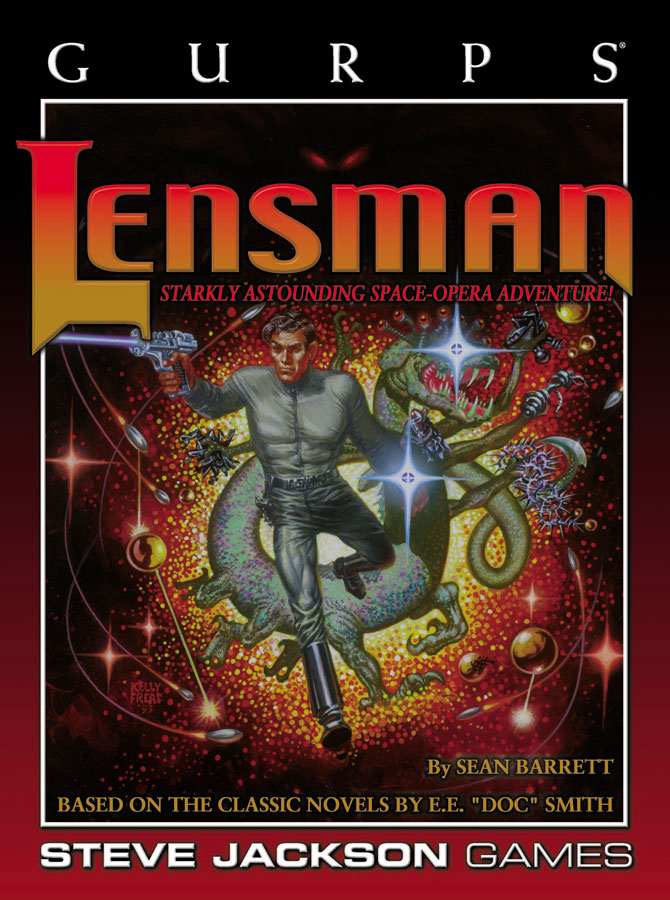
Some of this stuff sounds a bit generic, but that's largely because even given the hi/lo science fiction setting, it's all very pulpy. Cambias does well to try and ground these concepts in specific places and people of Krishna whenever and however possible, but you could still basically mine this for ideas for your GURPS Star Trek Final Frontier or GURPS Time Traveler campaign. In fact, they have an entire sidebar devoted to how to incorporate GURPS Planet Krishna into your other science-fiction campaign, giving specific ideas for GURPS Atomic Horror and and GURPS Lensmen.

Image
The nerd is strong in this one.

...not to mention GURPS Fantasy and Illuminati games. Which illustrates, I think, both the flexibility of the setting and of the system. GURPS is pretty much designed for mash-up, and while purists - if, indeed, there was such a thing as a Planet Krishna purist, which I kinda doubt since de Camp is dead, and even he probably would have considered it if there was a buck in it - might wail and whine, Planet Krishna as an appropriately pulpish, exotic setting with a mix of hidden (really, forbidden) high tech and low tech is actually great for sword & sorcery or sword & planet style games, where you're not sure if the sorcerer is a genuine occultist or maybe has a hidden anti-grav somewhere. That's the kind of thing I can get behind.

Now, if you don't mind, I'm going to make my New Year's Resolution early: I am going to finish Space Madness! It may not be good, but I'll try to make it fun.