Page 1 of 1

[OSSR]Miskatonic University (2005)

Posted: Wed Mar 14, 2018 3:08 am
by Ancient History
So, The Great Fence Builder asked if there were any Call of Cthulhu supplements that didn't suck. I could have pointed to S. Petersen's Guide to the Cthulhu Mythos, which is beautiful and fun, but...sort of pointless. It's an accessory, not a supplement. You don't hand that book out to players for a game.

The thing is, CoC has a lot of challenges as a game. The system sucks, and always has. Line development is almost non-existent; products don't build on each other they way they do for Shadowrun or World of Darkness or Greyhawk or other RPG settings, and the mechanics rarely develop. CoC is the game the diverges into endless heartbreakers and fluff, every product seems to be its own little world, and even books written by the same goddamn people often don't interact with each other in any meaningful way, failing to build a consistently developed setting. But unlike GURPS, you don't go into CoC with the expectation of having to build the fucking game before you start to play.

...but it wasn't always that way, and I can point to at least two products which, if far from perfect for many reasons, at least approach useful, non-sucky RPG books. These are the books you can actually unashamedly hold up next to other RPG products and people will say "Yeah, okay, those seem like comparable products." One if a third-party product, The Golden Dawn, which is probably as close as CoC has ever gotten to an almost useful and consistent magic subsystem. The other is Miskatonic University (2005).

A little background: in 1990, Chaosium had an actual editor named Keith Herber in charge of things, and he masterminded the writing and release of several "Lovecraft Country" books covering the major locales in Lovecraft's stories, including Arkham Unveiled, a supplement which covered the principal city in Lovecraft Country.
Image

This was "updated" to 2nd edition (that is, the 2nd edition of the book, not of the game system) in 1995 as The Compact Arkham Unveiled ("compact" because it omitted the scenarios from the first book, and despite the smaller pagecount [96 vs 160] the price increased [$18.95 vs $17.95]; like with cars, CoC figures they can charge you more money for less), and a dude named Sandy Antunes wrote a work that expanded on the university itself, Miskatonic University: The University Guidebook, which was written to actually closely correspond with Arkham Unveiled 2.0 and be compatible with it.

Image

Flash forward ten years...Keith Herber is long gone, CoC has largely lost direction, but as a sort of last gasp to bring the game out of the made-it-in-a-garage look which has haunted the previous 15 years of products, they actually start to use some fucking layout software and make books that don't look like shit. On top of that, they decided to revisit and expand old products - a practice which I normally decry in RPGs because the recycling is often poorly conceived and done, and CoC in particular have a really well-deserved reputation for basically republishing the same fucking book over and over again (Arkham Unveiled would be updated and republished in 2002 as H. P. Lovecraft's Arkham), but in this case they actually make a valiant effort to compile, consolidate, and update the material regarding Miskatonic University...and so we have this book. Which, while flawed, I would contend may be a CoC product that doesn't suck.

Image

So while I try to get back into the headspace to actually finish the system for Space Madness, let's pop the hood and look at this thing. I won't say it's the last gasp before 7th edition where Chaosium attempted to make an actual RPG product, but it might be the last book before 7th edition which made any real effort to present and develop a consistent worldview, or to develop reasonable alternate styles of play. There's a lot of dross in there still, plenty of relics of older editions, but...we'll get to that.

Posted: Thu Mar 15, 2018 2:02 am
by Ancient History
Clear Credit
The book is 256 pages, which is substantial. It has a one-page table of contents, and an index at the back. But it really starts out with two pages of credits. That may seem excessive, but there's a good explanation you probably haven't considered.

Call of Cthulhu is really a very small setting, by RPG standards. While it covers the entire world and some places beyond, and multiple time periods, about 75% of the action takes place in the Miskatonic Valley, particularly Arkham, with less attention given to Dunwich, Innsmouth, and Kingsport. Major cities like New York and London get their entire supplements, but in the 90s especially the focus was on Arkham and its environs, and as much as there was any sort of shared worldbuilding, you could always have NPCs that graduated from Miskatonic U., or were professors from there, or lived in town.

And while that stuff was all generated more or less on the whims of the first writers as they blitzed through their early scenarios, that shit adds up. This is where they attempted to sort it out. So as far as this book is concerned, author/editor Sam Johnson is the Don Rosa to Sandy Petersen's Carl Barks - taking all that material generated by previous writers and trying to cram it in here in such a way as it made at least a small modicum of sense, while adding his own.

So there's a lot of people to credit. And a sort of process to how Johnson went about it.
My approach in writing this book was (not surprisingly) an academic one: I have embellished, interpreted, and compiled far more than I've created in these pages. Miskatonic University was so long in the writing and took so many unsuspected turns that the sheer number of references has become impossible to track: my fingertips and spin are all over the book, but it's bones and foundations were wrought long before I came to it.
tl;dr: This is a labor of love. Geeky, scholarly, Lovecraftian love.

As far as canonicity goes, Johnson lists as Primary Sources: H. P. Lovecraft, August Derleth, Lin Carter, the Encyclopedia Cthulhiana, Joan C. Stanley's Ex Libris Miskatonici, and Peter Cannon's "The Chronology Out of Time." None of those are strictly RPG sources, although the Encyclopedia was also published by Chaosium.

Secondary Sources are Call of Cthulhu products. Because Johnson knows his audience, and the worldbuilding in the RPG doesn't rate next to the literary worldbuilding.
The present work is another iteration, an attempt to expand and embellish even further while at the same time incorporating more information from the canon of Mythos fiction and twenty-five years worth of Call of Cthulhu scenarios. Most of the people, places, and things you'll find in these pages have their origin in those works.
Johnson would also be about the last person to really try this. The multiplicity of borrowed sources is also responsible for the vaguely schizophrenic nature of the book as we get into it - there's really a lot going on, and if it sometimes seems like six people are writing at cross purposes...well, they sort of are, even though it's one dude trying to keep straight things that were never meant to be taken together.

Even third party products aren't ignored. Johnson calls out especially GURPS Egypt, Delta Green: Countdown, Liber Kia for Nephilim, and Steve Jackson's Pyramid magazine.
Sandy Antunes titled "Hail Miskatonic, Hail" and chose the melody. Sam Johnson wrote the lyrics, and Steve White set it to music.
Hail Miskatonic, Hail
(San Loss 0/1)

Next up: Introduction

Posted: Sat Mar 17, 2018 4:41 pm
by Ancient History
Introduction
I don't want to say that Call of Cthulhu products don't have gamemaster-advice, "how to use this book in your game" sections, but they're usually paltry, pathetic things. No real thought put into them, no real insight into how to play beyond canned scenarios.
Just how large is Miskatonic University? No exact figures are given here: as Keith Herber says of Arkham in H. P. Lovecraft's Arkham, it should be small enough that a professor or student should feel he or she could get to know everyone on campus, but just large enough to make that goal impossible. Leaving Miskatonic's population uncounted allows keepers to add students or faculty as scenarios and campaigns require. Besides, as Sandy Antunes pointed out in the earlier Miskatonic U. Guidebook, 70% of Miskatonic's population changes every four years anyway. Likewise, while the campus is extensively mapped and cataloged, detailed interior plans of campus buildings are left to the keeper's devising.
These are sound principles. I mean, it may seem mindcaulkish to not have any population stats, but most population numbers in RPGs are stupid and nonsensical anyway. What you want from Miskatonic is to get a feel for the size of the student body, not a precise count per year.
Students entering Miskatonic as freshmen in 1928 have an interesting tenure ahead of them: they can witness the ill-fated Antarctic Expedition and the beginning of the Great Depression before they graduate. In the fall of 1932 (a short summer after graduation) they'll have the opportunity to join the Starkweather-Moore Expedition and journey Beyond the Mountains of Madness.
This is quite literally the kind of tie-in between fiction and RPG product which a lot of players want, and which CoC is normally so bad at delivering.
My second goal in creating this book was to reconcile and bring in as much new material as I could while staying firmly "within canon."
This is...trickier.

The problem is, there is no "canon" with the Cthulhu Mythos. Lovecraft and his contemporaries were all doing their own thing, trading references and whatnot, but not trying to develop a cohesive setting. It was later writers who started writing sequels, prequels, interquals, and tie-ins, trying to bridge certain gaps...not always successfully, and sometimes at odds with each other. The Cthulhu Mythos itself was a kind of game long before the Call of Cthulhu RPG was produced. Most of what is considered "canon" is focused on what Lovecraft wrote.

So Johnson then gives a recommended reading list, short and very Lovecraft-heavy, and then we get into...

Campaigning at Miskatonic
Basically "ways to make this book useful." Johnson discusses using Misk. U. as a base of operations for investigators (as students or faculty), or using the university as a resource ("We must go to the Miskatonic University Library and consult the Necronomicon"), and simply as a presence - the university sends out expeditions, graduates students, publishes research journals, etc. You can run across references to M.U. without ever stepping foot on campus, and that's a good reference point, even if not the best use of the book.

Then there's a fairly extensive section Lovecraft's Shadow: Making Peace with the Canon. This is a straight discussion of how your games may or may not screw up with the "canon" timeline of events. Unlike, say, MERP, CoC is not set in any specific time. You can adventure before, during, and after the events of Lovecraft's (and other's) Mythos stories. This then raises the question of what happens if you kill Dr. Armitage before "The Dunwich Horror" happens. Wisely, Johnson doesn't say "you can't."

It's a weird kind of RPG freedom, albeit one that puts a lot of responsibility on the gamemaster for getting things to "work out." If you kill Dr. Armitage, you might have to deal with the Dunwich horror yourself. Or maybe another Miskatonic prof will handle it, and you can go investigate the strange artifact from Burma that just arrived. There's a lot of possibilities that are opened up by not absolutely requiring PCs to not dick with NPCs, is what I'm saying, but the consequences are on the GM to sort out. The game line, as much as there is one, uses a default timeline. You as players and GM are free to deviate from that, but it means you're sort of off on your own. Which is fine.
One of the greatest problems facing a keeper trying to run a game based directly on the fiction is that the fiction often contradicts itself, or else goes against other source material published for Call of Cthulhu.
This is sort of a "hierarchy of headcanon" - where sources disagree, the authors went with the "most canonical" source (i.e. Lovecraft, and then in descending order other materials) - this is just showing their work, not a requirement for anybody else to follow their method. Very academic.

Next up: Chapter One: Miskatonic Univeristy

Image
There's a shitload of M.U. seals and shields online, but the version in this book features a prominent badger. I don't know why.

Posted: Sat Mar 17, 2018 8:33 pm
by Ancient History
Chapter One: Miskatonic University
Miskatonic University, 238 years old as the 1928/1929 academic year begins, is nearly as old as the town of Arkham itself, and events in Arkham township have traditionally driven the destiny of the school.
Image

Normally, I dislike RPG chapters that go into extensive history. Not because I at all dislike history, but because for so many RPGs it is ultimately pointless. You want RPG material to cover the now of the setting, and provide tangible hooks for adventures. In-depth histories tend to get bogged down in great personalities (read: Mister Cavern penis NPCs), lists of kings, and lots of minutiae which doesn't actually elucidate the now, and sometimes causes its own issues. Like the teenage elf revolution in Oregon in Shadowrun.

CoC is a little different. For one, the players reading these books all like the history, both official and secret. Second, the game setting covers multiple different time periods, so the history is more immediately relevant than you'd normally expect. Third, a major aspect of CoC as a game is doing historical investigation, so again, more relevant than you would think.

I won't say the history is the strongest aspect of Call of Cthulhu supplements, but it's an important one. CoC history tends to either clarify things that were more interesting when they were vague and not totally explained, or to complicate events that should have been straightforward. Most of this comes down to cultists. The bulk of all Mythos activity never seems to be a random alien or strange occurrence, but an actual cult or independent wizard working toward some end, but having to cover their tracks, with varying degrees of ability and success. When this is done well, it looks like Sarkism. When it's done poorly, you get yeti butlers.

Anyway. Witch-haunted Arkham values education. The college was chartered in 1690, survived the Witch Trials in Salem in 1692 (which caught a couple Arkham natives). Over the centuries the college got some generous bequests, particularly from Jebediah Orne, and expanded operations. A brief look at the future is less rosy, as the disaster of the Antarctic expedition and the looming Great Depression could lead it to financial ruin.

What they don't really touch on much is the secret history, mostly because this is taken care of in Arkham Unveiled. So for example, one of the senior nurses at St. Mary's Teaching Hospital (part of M.U.) is a member of the Arkham Witch Cult. If the PCs get hurt, guess who treats them?
None of the hospital staff have noticed how frequently her patients seem to die of natural causes. Smith also keeps the cult supplied with hair, blood, and fingernails from prominent Arkhamites, and organs and the occasional cadaver stolen from the morgue. Her cult name is Camlas.
Along the way, we get a two-page spread with school legends and traditions - these are somewhere between flavor and adventure hooks. For example:
A singular legend centers around the president's residence: the building has four chimneys, but visitors have always affirmed there are only three fireplaces inside. Why is there an extra chimney? Is a fourth fireplace walled off somehow? If so, where? What could be in it?
These kind of hooks are not Johnson's strong suit; a lot of these are ultimately pointers to other parts of the book. The page also affirms that the school mascot is "the Badger," but most real fans know the M.U. sportsball team is the Fightin' Cephalopods (go 'pods!)

Image

But, there are some fun flavor tidbits:
In the last few years senior men have attended the homecoming football game wearing only one shoe (usually the left one). During Hell Week of 1919, a group of seniors hazed fraternity pledge Frederick Abernathy, demanding he hand over his right shoe before trying out for a place on the M.U. track squad. Abernathy gave up his left shoe and ran wearing only the right. Not only did he manage to make the team anyway, but by the time he graduated in 1924 he was the most celebrated athlete in school history. Abernathy earned the nickname "Shoeless Joe" (a reference to both his hazing and the Black Socks scandal of 1919). And as quarterback of the Badgers he led Miskatonic to the Legendary Series, the only time in school history M.U. manages to beat Brown on the football field three years in a row ('20, '21, and '22). Many toasts are still made to Shoeless Joe, and Abernathy returns to M.U. each homecoming. Though he wears both of his shoes, he is always honored by the student recognition.
Fun, but mostly useless. Maybe an excuse to out someone is a Deep One hybrid.

There are maps of where Arkham is in Massachusetts (near the NH border, north of Salem), a street map of Arkham, and a campus map of M.U. The Campus map is accompanied by a Campus Guide, which is your generic what-is-every-building listicle, covering 52 separate locations. Not a lot of adventure seeds here; we're literally talking about dorms, lecture halls, theatre buildings, where the library & cafeteria are, etc. But there is lots of useful detail, like the Arkham newspaper office (the Arkham Gazette) and the student newspaper (the Crier), and book stores (the Book Nook, Jawyil's Book Store, etc.) which gets in the occasional low-level Mythos tome (currently housing a copy of People of the Monolith), and there are occasional statblocks and portraits for various NPCs. I think these must be mostly taken from scenarios, because the distribution is a bit random.

Also as a nice touch is a section on Distant M.U. Facilities - locations affiliated with the university but far afield. This ranges from off-campus athletic fields to the Woods Hole Research Campus (a former minor Coast Guard facility used for oceanographic research) and the Mesa Grande Archaeology Compound in New Mexico.

Much attention is given to the Orne Library, where many a player has spent their Library Use rolls.

Image
And provides an exception to the rule about not giving detailed interior maps of buildings

This section includes extensive profiles of library staff, right down to the library's watchdog, Napoleon the Mastiff (Bite 45%, Listen 75%, Recognize Friend 99%, Scent Something Interesting 90%). The dog has more HP than some humans, and killed Wilbur Whateley. Respect.

Image
Good doggy. 13/10

The library gets its own chronology, which is longer and more extensive than that of the whole university. Because the parts that the PCs are more like to use gets more attention. The library also gets its own section of legends and special locations (a "haunted corner" where a student committed suicide, a hidden vault, two entrances to the campus tunnels, etc.), and then...an overview of the Restricted Collection, a list of the Mythos books they contain, and other Mythos texts and Occult tomes that are in the general collection.

We also get our first optional rule:
Option: Hermetic Spells
The following spells, taken from Call of Cthulhu 5.5 or later, can serve as hermetic occult rituals. TO be able to learn and cast these spells, it is recommended that a would-be magus have at least Occult 40%, to reflect sufficient initiation. These spells are "nature" -- they derive from the elemental and spiritual forces of Earth and the cosmos as we know it, not the hypergeometry and alien nature of the Cthulhu mythos. The keeper can run the spells as written or incorporate new elements such s limiting the casting to certain days of the week, exotic components, lengthy rituals, requires a POWx1 roll for success, etc. hermetic magic should never flow as easily as mythos magic. Any book described in this chapter and marked with (og) is an occult grimoire and at the keeper's discretion an contain 1D6+2 of the following spells. A more detailed system for occult magic may appear in future Call of Cthulhu releases.
That never quite happened, but you can sort of see how designers had realized the necessary shortcomings of the CoC magic system, and wanted to provide readier access to at least some form of magic to PCs and NPCs. The list of Hermetic spells overlaps heavily with another group of "Egyptian" spells, and we'll get to that later on. But players aware of "options" like this could seriously present them to the Keeper and at least try for some greater degree of agency.

Shadowed Stacks looks at the individual Mythos tomes in the collection, with each major book getting its own entry, stats, notes, and spell list, including notations of what spells are new or unique to this book. Some of this is a rehash of existing material, but a lot of Mythos tomes tend to be "unique," in that even two copies of the same book have lived different lives and may not be identical - copies being incomplete, annotated, damaged, expanded, redacted, rebound, enchanted, stained, etc. etc.

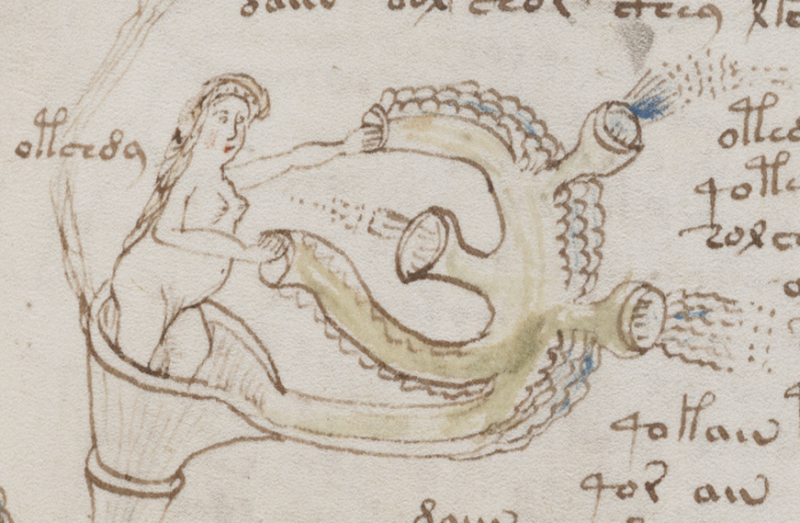
From a strictly practical standpoint, this is way too many fucking books. On the other hand, we're talking about a condensation of 50+ years worth of stories involving M.U., so pretty much every book anyone ever mentioned as being in the library has to get crammed in there, and the result is just a glut -- more tomes than any PC could read and stay sane. They have three versions of the Necronomicon for fuck's sake, and a facsimile of the Voynich Manuscript.

Image
The Voynich Manuscript can be decoded to reveal it is also a translation of the Necrnomicon. This requires 25-INT months of research and a successful D100 roll vs. character's Cryptography skill divided by five.

There's actually quite a few little sidebars on Cryptography, and they basically all involve deciding that straight Cryptography rolls are insufficient to decrypt these books. That's less than ideal, but so is the entire CoC percentile skill system. Still, you're not likely to meet a PC with even Cryptography 40%, so giving them an 8% chance of decrypting some of these books is kind of a dick move.

When we're finally done with the tomes, miscellaneous papers, and cryptography rules (I would like to add that chapter one is 62 pages, and the library and books get 30 of that), we get a section on the Miskatonic Exhibit Museum, which displays art, historical and archaeological artifacts. Stats on the staff are restricted to the curator, an immortal sorcerer that serves as caretaker, and his dog Rhodey ("Cheerful German Shepherd").

The museum gives a good excuse for PCs to get introduced to artifacts (a selection is listed in the section, ranging from a hatched Cthonian shell to a "brontosaur" skeleton assembled from three different sauropods to a genuine Egyptian mummy). Borrowing exhibits is difficult ("There has been one such withdrawal since Lee surrendered at Appomattox."), but not impossible. The museum also gets its own section of legends (the Egyptian mummy, for example, is nicknamed "Old Squinty," and by tradition a glass is set aside for him at parties, with those who drink from it suffering "Squinty's revenge." I can't make this shit up.)

Next up: Chapter Two: People On Campus

Posted: Sun Mar 18, 2018 2:58 am
by erik
Ancient History wrote:The page also affirms that the school mascot is "the Badger," but most real fans know the M.U. sportsball team is the Fightin' Cephalopods (go 'pods!)
or is it?

Image

Posted: Sun Mar 18, 2018 6:29 pm
by Ancient History
Chapter Two: People On Campus
While a good knowledge of the buildings and arrangement of Miskatonic University is important, all of that is secondary to the people who live, work, and learn in them. Whether taking the roles of students or faculty, players need to know the kinds of people who bustle down the halls or linger on the quad, and the keeper must be able to take the role of any one of them at a moment's notice. Players and keepers should also be aware of the kinds of pressures mythos investigations will put on students and teachers alike, and how the university lifestyle can be made to accommodate their stranger activities. This section describes, in detail, the sorts of people your investigators will meet on the Miskatonic campus, whether they come there to learn, to teach, or to visit.
After which introduction, it gives us the words and musical notation for "Hail, Miskatonic Hail." Which isn't a detraction, just an acknowledgement that there are a few things stuck in here...more or less at random.

Johnson starts off describing the student body:
A number of church- and community-sponsored students from China, Africa, and Polynesia also attend, but roughly 90% of the student body remains white Anglo-Saxon Protestant males.
Which doesn't mean you can't be a black female student...but you are probably the black female student. This is the only point where they actually address race or gender in any meaningful manner, and after that they basically ignore it. Which is true of most CoC products.
More important than race, creed, or gender is one's class status. Freshman are at the lowest end of the social order, regardless of their status in the outside world.
This is actually reminding me of my own introduction to the university experience, right down to the descriptions of living in dorm rooms, curfew, and meal tickets. There's a couple paragraphs on student jobs (roughly ~1$/hour unless you're working at the steel mill or the ice cream factory), and a very lengthy treatment on graduate students. There's more than a touch of humor in the latter:
The last sub-species of graduate student is the rarest and most insidious. Perpetual Graduate Students are those doomed souls who, often through no fault of their own, find that their insightful new discoveries are either fatally flawed or too avant-garde for acceptance by the academic world. Some were unlucky enough to make an enemy of a Dean or a department head, and are trapped in academic purgatory: all of their ideas are dismissed, buried, or damned into obscurity with faint praise.
Then we get into the different levels of professor (Senior, full, adjunct, associate, visiting, assistant, instructor, tenured, emeritus, and dean); their professional and academic duties, salaries, and benefits.

Much of this isn't directly Mythos-centric (with a note that emeritus professors are the most likely to know about the Mythos, because they have all this free time and no real responsibilities). It's necessary background material, and not the worse summary of university experience I've ever read.

Couple paragraphs on Miskatonic Expeditions (with a one-page timeline, which basically points to all the Chaosium scenarios involving MU expeditions).

We finally get into some solid advice with How Campus Investigators Survive, pointing out that while investigations have consequences (legal, social, and health-wise), working/studying at a university is a grounding experience and universities generally squash any rumor of scandal. This touches on, but doesn't really address one of the major issues in CoC regarding Miskatonic University: with so much otherworldly shit going down, it's never clear if anyone really has a handle or awareness of all of it. You might think the Board of Regents were "in the know" and working to actively cover things up, but instead it just looks like M.U. tends to...attract weird Mythos stuff, rather than it being a determined effort by any single group to accomplish a definite goal. I mean, there are some dedicated groups and individuals that interact with the university that way, but there's no design to it. Which I think gives the university and its history a sort of organic feel. It isn't all a vast conspiracy. It's academia.

Which then leafs into the section Insanity in Academia, which is probably less useful than you'd hope.
In the context of the University, many excuses can justify a companion's behavior. Lines such as "had to work all night on her paper" or "just failed his math final" go far to excuse frothing at the mouth and screaming fits.
In large part, I think this is trying to deal with the CoC Sanity system, where you pick up mental illnesses the same way you unlock achievements in Fallout. So while it makes a game effort of dealing with the issue of Sanity loss vis-a-vis keeping your job/remaining a student, it's...a bit weak. Then there's a section on Villainy in Academia and...we're into the character profiles.

Basically, these are stat blocks and personal descriptions/histories for a significant cross-section of the M.U. faculty, staff, and student body. Some of them are just bizarre (Weathertom Artsbalm, the Oldest Student on Campus) and verge on the silly (Artsbalm's skills include Play Chess 64% and Tickle Fish 50%). Not everybody gets stat blocks, but every college, school, and department gets at least a little love and attention, so you get at least some idea of how the school is set up and how each sub-organization operates; plenty of little Mythos tie-ins are included to, although these are less adventure hooks than connective tissue. A lot of these are also old familiar names from Lovecraft's fiction or various Chaosium scenarios.

This can get a bit dry because, well, not everybody has a Cthulhu Mythos rating, and those that do don't often have spells. Stats are usually very unevenly distributed (probably because so many were lifted from existing products), although there are very few "joke skills" (Tickle Fish being an exception) - unless you count that fact that some skills are so low as to be useless. What does Afrikaans 10% tell you about Dr. William Moore? It tells you if he wants to know where the bathroom is in South Africa, he's better off using another language. Or miming.

The chapter finishes off with a look at student clubs and organizations - and the Miskatonic People-Maker, which lets the Keeper randomly generate people using a series of die rolls and tables, "Be forewarned that some odd female characters may result."

Let's try:
Sarah Parker, determined visiting scholar has Archaeology 60% and Navigate 50%
That requires six die rolls. Whoo.

Anyway, campus activities include student government, spirit committee, student newspaper, athletics, fraternities and sororities (none of which, sadly, have any Mythos connection), honor societies, glee club, marching band, jazz band, various academic clubs (including the Miskatonic Engineering Society, French Club, Medieval Recreation of Society, Royal Scottish Country Dance Society, and Veterans of Future Wars). A lot of these clubs give percentile increases to Academic Standing, which is explained in the next chapter.

Faculty organizations are listed, but more briefly. This is stuff like the local chapter of the American Folklore Society and the American Medical Association, the National Society of the Daughters of the American Revolution and the Society for the Prevention of Cruelty to Children <insert joke here>.

...and finally, two "secret societies": The Skull (based on Skull & Bones), which is a secret fraternity rumored to by older than Miskatonic University, and the Students for Industrial Democracy, who are the student Bolsheviks.

This is a pretty dry chapter. A lot of academia and student life is. I think a large part of it is that you can't have too many murders, disappearances, and open cultic activity on campus. Gotta be at least a veneer of normality. But it does make things...less interesting than they could be.

Next up: Chapter 3: Getting An Education

Posted: Mon Mar 19, 2018 12:04 am
by Ancient History
Chapter 3: Getting An Education
This is arguably the most ambitious concept in the book. It starts off with just talking about tuition fees, scholarships, and classes, but the crux of the chapter is the idea the PCs can play as student investigators - complete with attending classes, earning grades, calculating GPA, and paying tuition.

This probably sounds terrible. But. It also offers an alternative progression system called the Semester Check. The basic idea is that you devote X amount of time to your classes, and can spend the rest of the time working or investigating. At the end of the semester you make a check for each class/athletics/hobbies/employment/etc. you devoted your time to, and you gain 1d10 skill points in the relevant skill (with some limitations; to raise skills higher, you need to take tougher courses, for example).

This gives you a faster character progression than normal, a more structured environment to adventure in and - this is kind of interesting - it actually works out really well with Mythos tomes, because their study is measured in weeks. So during a typical 18-week semester, it can actually be really relevant an interesting that Cthulhu in the Necronomicon takes 14 weeks to study and comprehend.

And if you combine this with the Hermetic Magic option earlier, you might even stay sane, if you stick to the occult grimoires. Granted, you might not be the biggest dick-swinging wizard of all time, but it works better than the alternative, where you hope to stumble across a tome during the course of an investigation and then spend all the down time reading it...while your other skills stagnate because actually improving skills in CoC is terrible and probably gives you stress-induced cancer.

The system has some complications based on semester half-checks, bonuses for outstanding academic achievement, penalties for slacking off on your studies, etc. But if you were ever going to re-envision CoC as being based around something like Hogwarts the RPG, this is theoretically the kind of system you'd be looking for. But given the amount of prep that goes into setting your semester schedule and whatnot, this would probably work better as a computer-based RPG system than a tabletop one...but not impossible.

New skills include Academic Standing - it's sort of like Credit Rating but for academia; no one cares - and also Academic Lore, Botany, Cryptography, Literature, Mathematics, and Philosophy and Religion (as one skill). This isn't actually all the new skills in this book also mentions Miskatonic University Lore but doesn't have a separate entry for it. I don't know if it was cut for space, or if they just forgot about it in the editing pass.

If you're never going to use the system, you can skip 90% of this chapter. And it's still using the CoC system, so it's lipstick on a pig. But by Tsathoggua, no-one's complained about the bristles on Lulu yet, so maybe a bit of lipstick is better than nothing.

Next up: Chapter 4: Miskatonic Secrets

Posted: Mon Mar 19, 2018 8:00 pm
by Ancient History
Chapter 4: Miskatonic Secrets
This feels a little Unknown Armies-ish, in that we're getting a kind of a peel-the-onion approach...but I think that's mostly superficial. Plenty of stuff in the earlier chapters was tied into the Mythos, Johnson just wanted to concentrate on getting the geography and the mundane persons/organizations of interest taken care of before going all-in on the weirdness. I can understand that, even if I might have gone a slightly different organizational route myself.

First things first: there are tunnels under campus. They aren't a secret and some of them are even well-mapped and popular; they represent the intersection of pre-University catacombs and smugglers tunnels, local sewer lines, and some hand-dug tunnels. There's a whole club devoted to exploring them, and basically every basement for every building on campus is connected to the tunnel network somehow. Professors use them to get between classes when it's wet or cold out.

...and some of them contain ghouls. And some of them contain Little People (which normally in the Mythos are not fairies, but side-branch of humanity which became the inspiration for such stories in the British Isles, according to Lovecraft and Robert E. Howard's interpretation of the stories of Arthur Machen). For reasons I don't understand, Johnson makes them actual fairies, with a full two-page spread, and claims:
These tiny, distorted humanoids, native to Ireland, came to Arkham along with the first Irish immigrants.
Uh...no, I don't buy that. But, whatever. I've seen worse. You could probably even make this work with some material in Cthulhu Britannica.

Other inhabitants in the tunnels are up to the Keeper, and they don't shy about suggesting the tunnels were used by the witch cult, a shoggoth, Cthonians, or Serpent People. More mundane hazards include bad air, rats, raw sewage, and any medical waste the hospital stores down there "temporarily" before taking it to the incinerators. Notes on the tunnel network are fairly extensive, with a partial map, cross-section sketches of the sewer system, and list of entrances and places of interest.

Other "Secrets" include:

The Bronze Head, a bust of university founder Rev. Ward Phillips which has been continually stolen by various fraternities (the head is actually cast from a melted-down bust of Baphomet from the Knights Templars).

The Mummy; "Old Squinty" from before was actually the High Priest of Set during the reign of Nephren-Ka, the Black Pharaoh, and his ba is still trapped within, where it can potentially possess someone else. This provides the meat for a scenario seed immediately following. Johnson even ties this in with our old friend The Cairo Guidebook! This also gives an excuse for a sidebox with a new Mythos tome, The Black Rites of Luveh-Keraph (Luveh-Keraph == Lovecraft; Luveh-Keraph was a priest of Bast, HPL loved cats, you get the picture.)

The Mythos at Miskatonic (a bit of a misnomer) is actually about the local cults and investigators. The "Armitage Cabal" consist of the survivors of "The Dunwich Horror" and other faculty aware of the Mythos and trying to keep the material in the library out of dangerous hands; the Peaslees are the father-and-son team from "The Shadow Out of Time"; there are a couple of professors that are individually interested in the Mythos but aren't part of or aware of other organized parties on campus; Dr. Felix Fuda (prof of Ancient History) is a member of the Hermetic Order of the Silver Twilight, which is a quasi-knockoff of the Hermetic Order of the Golden Dawn, only focused on the Cthulhu Mythos (and technically the bad guys) - this is a tie-in to Shadows of Yog-Sothoth campaign, and gives us another sidebar with another tome; then there's the members of the Antarctic Expedition, various professors that have gone "missing" (taken from various Mythos stories, but provided stats in case they re-appear or the adventure is set before they left)...

...brief interruption for a 2-page chronology of Miskatonic's response to the Mythos from 1928 to 1937...

...and we get to the actual occultists and cultists.

The Eye of Amara is an Egyptian-themed group of occultists. They have a small library of occult tomes and one Mythos tome, The Sussex Manuscript. Good organization for students interested in Hermetic occultism.

Collegium Arcana is a Rosicrucian sect of Hermetic magi, with their own library of occult grimoires and ritual space.

We'll talk about the details of Hermetic magic when we get to the spells, but needless to say, these groups are neither good nor bad: they're just dabblers in the occult with just enough raw material to train a reasonable apprentice wizard or get said dabbling sorcerer into trouble by calling up that which they cannot put down. The Collegium is the more benevolent but...well, you never know who the Hidden Masters are.

Then there's a couple standalone warlocks, honor student Asenath Waite, a derived murderer possessed by an extraterrestrial insect visiting from Goatwood (setting of Ramsey Campbell's Mythos stories). The local branch of the Esoteric Order of Dagon and the Arkham Witch Cult are both given considerable attention, with a list of ways the Keeper can say "fuck you" if you piss off the latter:
Most members of the cover can summon up byakhee, hunting horrors, or star vampires to unleash upon their enemies, but their desire to remain hidden ensures that they rarely resort to such noticeable deeds. Dimensional shamblers (which come and go without a trace) are much butter, but even then there are easier ways to eliminate unruly investigators. Several of the cult's favorite magical attacks follow.

* Snare Dreamer combined with Bind Soul -- induces a coma that is eventually fatal, and has a range that can reach all the way to Kingsport!

* Cause Blindness -- if triggered while the target is driving, death will seem an accident.
Etc.

Wild Cards include Lucas Tetlow, caretaker of the Exhibit Museum, who is an effectively immortal sorcerer whose purpose is left up to the Keeper, and Dr. Swanson Ames, English Professor, who is actually a freemason, member of the Knights Templar, and really impressive Hermetic sorcerer, considering he has dozens of spells and still has a SAN of 50. This lead into a rather extensive couple of pages on the Knights Templar which seems...excessive. But if you want an anti-Mythos organization, you could do worse.

Image

The section on Miskatonic Mysteries refocuses on the university, suggesting possible plot hooks connected to the University symbols, and going into some detail on the origin of the huge number of Mythos tomes in the Orne Library. A lot of possibilities are suggested--but only suggested; this is a case where the Keeper is encouraged to consider the possibilities and answer the questions asked on their own. Which is a bit weak sauce, but I can see what Johnson was trying to do, reconciling different sources and finally determined to give the Keepers more leeway to decide on their own who and what the "big bad" at Miskatonic, if there is one, is.

We then get a number of (fairly extensive) adventure seeds, which aren't bad and basically run the gamut of normal Mythos threats, from Colours Out of Space getting into the reservoir to the Martin's Beach Monster and a student that learns the Chant of Thoth and begins acing his exams. Not all evocative, but not bad.

Up next: Chapter 5: A Little Knowledge

Posted: Tue Mar 20, 2018 9:35 pm
by Ancient History
Chapter 5: A Little Knowledge
Image

So, Call of Cthulhu likes its scenarios. And it likes reprinting it's goddamn scenarios. The only thing better than writing a half-baked mini-adventure is cramming an old one into a new product.

Anyway, this scenario first appeared in Arkham Unveiled five years earlier, and if you have that book - which you probably would, because who the fuck are we kidding, you're buying a book about a college set in that town - and despite whatever little touch-ups Johnson has done, it hasn't really gotten better with age.

I guess I shouldn't say it's a bad scenario, but it's still leftovers. Also, it's based on "Herbert West--Reanimator!" which is not one of Lovecraft's better stories, although Herbert West is surprisingly a break-out character.

Image
Yes, there is a co-ed.

Like a lot of scenarios, there's no solid established reason for the PCs to get involved. The body of a student in medieval metaphysics is found on the steps of the library - do you care? - and of course there's a little mystery to it, because he had been reanimated for a period. Someone has found Herbert West's notes. There's a reanimator loose in Arkham...

It's not a terrible premise. But it's a CoC scenario. If the PC investigators had a solid hook to get involved, then you'd just have the fun of hunting down the clues - including the red herring of Asenath Waite - and then a showdown in the re-animator's hidden lab (in a root cellar beneath a barn). Your reward for the scenario (if not kicked out of school for sticking your nose in where it doesn't belong, or going to jail for murdering the new re-animator, provided you do kill him) are his notes, which contain the reanimation formula. Which is a good way to make zombies.

Short scenario, ties in well with the University, it's just...like West himself, I would have preferred something fresher.

Appendix 1: New Magic
I said we'd talk about this now, so we'll talk about this now.

A lot of RPG magical systems put a good bit more thought into a magician character and the nature of their abilities than is necessarily given in real-life grimoires. Shadowrun, for example, recognizes that characters will need to see into the spirit world (Astral Perception), craft their own tools (Enchanting), protect themselves (Warding), and defeat hostile magic (Dispelling, Banishment, etc.); D&D distills these utilities into individual spells (more or less; counterspelling gets interesting), Earthdawn and GURPS divide them between various skills/spells/talents, etc. No one character needs to have all of these magical capabilities at their beck and call - some of the most interesting PCs and NPCs are those that work within a limited skillset - but they do generally need to know those basic capabilities exist, so that they can call upon them if needed. If a street samurai figures out there's a spirit committing arson, they call in a street shaman that can figure out how to deal with the spirit. If a fighter finds out the fire elemental they're fighting is vulnerable to cold, they go buy an icy burst longsword or hire a wizard that specializes in Cold of Cone or something.

Not all games are good at that. The World of Darkness, for example, was very bad at packaging basic groups of abilities together in any meaningful way. This generally meant that a lot of Necromancer vampires could not sense magic or deal with it any way, and there was a better-than-even chance that they wouldn't even know where to turn when they came across some weird magic that their couple dots worth of Paths didn't directly address.

CoC is worse. At least WoD groups some abilities together. If you have one dot in the Path of Blood, you can buy more, no problem. CoC, by the nature of it, does not have anything that organized. There are analogous spells to many Shadowrun and D&D functions buried in various CoC books, but they aren't organized in any kind of logical manner, they aren't grouped together in any sort of easy package in any grimoire, and the ones you kind of want and need to be an effective magician character rather than a one-shot pony with one or two magical tricks are so far apart from a game perspective that you are required to use out-of-game knowledge to even be aware that the vague possibility of them might exist.

Because CoC doesn't want you to play sorcerers, see. They want magic to be a rare thing where maybe maybe if the PCs are clever and the dynamite doesn't work, they find a tome that has a counterspell that they can learn and use at great personal cost to themselves. This basic approach gets schizophrenic because the game designers themselves absolutely want PC and NPC sorcerers, but they never give any real thought to what that means from a practical perspective. If I ever do the Golden Dawn supplement, I'll go into more detail, but for now...

One of the things that CoC 5.x edition quasi-codified was adding certain tags to certain spells. So enchant wanga might be labelled "voodoo" and bind child of the sphinx might be labelled "Egyptian." Practically, this means nothing. The tags don't do anything. They're intended to restrict who gets to learn/use them, but there are no character classes per se and everyone effectively ignores them whenever it is convenient to do so. There are plenty of voodooists with spells not labelled "voodoo," and plenty of voodoo spells not labelled "voodoo" in different products. That's just life.

We see some of that here. But the trick is that Hermetic Magic option from earlier - Johnson was serious about wanting to create a legit option for PCs that wanted some occult magic, without going insane. But even that's a little insane.

So, there's a spell called Awaken the Inner Light. By fasting and meditating and being a good dooby for an entire month, you get to roll for a chance to increase your POW. This is generally a big deal, as more POW means more magic points, better Luck rolls, a higher maximum Sanity rating, and more success on POW vs. POW contests and things of that nature. There aren't many good ways to increase POW. The catch is that it's just a POW roll. The higher your POW is, the easier it is to succeed. The more you succeed, the higher your POW is. Let's say you start out with POW 10. You only have a 10% chance each month of success...you'd have to be insanely lucky to succeed at every test. But the chances are you succeed on at least one out of 10 tests, and that increases the probability of succeeding on subsequent tests. It's only game-breaking if your Keeper lets you fuck off to a monastery in Tibet for a couple years to do it uninterrupted, but the potential for incredible growth is there.

And I'm pretty sure this spell is never mentioned again in any product, unless it appears in one of the Chaosium compendiums somewhere. Not because it's potentially gamebreaking, but because no one cares.

Most of the other complaints about spells are the same as for any CoC product. Some other oddities:

Enjoin Pnakotic Pentagram - CoC has a lack of a really good generic warding spell. Which means several different writers have, over time, each written their own versions, each with different mechanics, requirements, and limitations. None of which most scenario writers actually keep in mind. Magic does not exist in CoC games to be used, it's like those feat trees in D&D3.x products which no one takes because they aren't worth it. Cluttering up databases for all time.

Perceive Text - Costs 1 SAN point to learn, but zero to cast; 1 MP per six hours of use. Let's you read books by touching them. Not like Braille, but like Daredevil.

Image

Second Sight is a spell you don't learn. If you have POW 16+, you have a 5% chance to learn it. Lets you spend MP to read auras and detect magical items and crap. This is ability so demanded that there are at least three different ways to get it in CoC, because either none of the designers were aware of previous attempts or thought they could do better.

Sacred Molting of the Serpent - You get a fair number of immortality options in CoC. Extended or eternal life is a big carrot for humans, with death being the stick. A number of these are designed very specifically to be unpleasant - this one involves an enchanted dagger and the blood sacrifice of a "pure soul" less than 10 years old: the caster has to kill the kid and drink their blood. For which benefit they begin to molt out of their skin, coming out a few years young.

Quicken the Voice of the Deep - Speeds up the transformation of a Deep One hybrid to full Deep One. Uses way too many magic points to be at all practical, but points for effort.

Appendix 2: Mythos Tomes In Game Play
Optional rules for treating Mythos tomes as subjects of Independent Study. Because this is CoC, this requires creating a subsystem that integrates with and bypasses part of the existing game mechanics, so you know it's going to be good. In practice there's a gross similarity to how they handled things in the Golden Dawn, but more in spirit than in detail.

The basic conceit is you generate a Research Modifier (R.M.) based on the character's Intelligence, Education, appropriate Language Skill, Occult or Cthulhu Mythos (whichever is higher) and the library modifier (20 for M.U.). Subtract the result from 100 to get your R.M. Multiply the R.M. against the nominal period in the tome description to see how long it takes you to actually study and absorb the tome.

If this sounds like a complicated way of letting investigators read tomes faster, because the durations listed are bullshit long and unfeasible for normal games....yeah, you've grasped the fundamental concept exactly. Other options given (sometimes reprinted from other CoC books) here include:

- "feverish study": By reading twice as fast and twice as long, the character can get through the book in a quarter of the time! Speed reading has the drawback of 1) making you more obsessive about reading the book and 2) it drains hit points. You can literally read yourself to death with this method.

- "skimming": Takes hours instead of weeks, you only lose minimum SAN, don't get the Cthulhu Mythos percentiles, but do know where all the spells are.

- "tomes as reference works": For when you want to check the Necronomicon for a fact, not lose all your marbles to figure out how many toes Cthulhu has. No SAN loss, no Cthulhu Mythos percentiles, no spells.

- "learning spells": I swear they change up the details of learning spells every edition. Basically, you do not want to spend 2d6 weeks learning a single spell. PC life is too short.

- "progressive sanity loss": this is a stupid fiddly thing where people thought it didn't make sense if you lost sanity only when you finished reading the last page, but should lose SAN as you make your way through the book (or discover evidence that it is real). The latter is a genuine effort at trying to adapt CoC to the fact that the Sanity mechanic as designed doesn't replicate either real life or Lovecraft's fiction...but it's one of those uphill battles.

- "toxic texts": Some books are not good for your health - this is an exception to the idea of progressive sanity loss, where the SAN loss all happens the moment you turn the final page. It's inspired by The King in Yellow, but you are permitted to roll POWx3 to emit an audible groan of frustration.

Appendix 3: Useful Portable Items Found on the M.U. Campus
Literally just a list of stuff you might find useful: acids, large batteries, fencing foils, piano, searchlight, etc. What and where to find it, never mind how. No stats.

Appendix 4: Pre-human Languages, and How to Read Them
Some of the tomes aren't in normal human languages. Mostly this boils down to a separate skill and appropriate Skill Roll, but Johnson decided to give a go-to on the most popular pre-human alphabets/languges, like Aklo, Yithian, Hyperborean Tsath-To, R'lyeh Glyphs, Atlantean Senzar, Nacaal, etc. Useful? I guess? I'm pretty sure large chunks of this are copped from other products.

Published Scenarios Adapted to M.U. Play
Chaosium adventures that do or can potentially involve M.U. students or professors.

And...there's a few character sheets, some blank M.U. diplomas, and index, and that's the book.

I'll finish up with final thoughts next post.

Posted: Wed Mar 21, 2018 11:24 am
by Longes
Ancient History wrote:Cold of Cone
Is that them newfangled Fahrenheits?

Posted: Wed Mar 21, 2018 12:57 pm
by Ancient History
Shut yer gob, Longeshanks.

Anyway, final thoughts.

5th edition is basically the last gasp of Call of Cthulhu trying to be an actual RPG. At some point - and I don't know all the internal politics - the fanboys with any organizational skills and a desire to "do it right" all fucking left. Or maybe they ran out of money and people got burned. Probably a bit of both, RPGs are like that.

But Miskatonic University is basically what you would want and expect from a CoC book - a hefty tome that tries to cover both the simulationist aspect of the setting and reconcile as much of the material that has come before as possible, while setting up new possible adventures. It manages that about as well as any mid-range RPG did in the 1990s.

But it came out in 2005. D&D 3 was already five years old by then. Call of Cthulhu was still a lumbering dinosaur in the d20 era, despite the best efforts of all involved because...well, it didn't grow and change. The game needed the strip-down and rebuild that Dungeons & Dragons got, and it never got it.

Where this book falls down, mainly, are the mechanics. We can quibble about the sillier jokes and more pointless NPCs included in the book, and I for one would have been in favor of more plot hooks - but the fluff writing is solid enough. But it's a honking massive collection of Mythos tomes and spells, and optional rules that never quite cut the mustard. You can see that this was sort of wanting to be the Bookhounds of London of its day, a different type of campaign from your normal run of Call of Cthulhu...but it is hobbled, at every turn, by the old RPG problem of never wanting to throw away anything.

It's still one of the best Chaosium CoC products. Perhaps the best that actually has game stats in it, and isn't a glorified art book or encyclopedia. There are third party products that are prettier, and better thought out, more innovative. I might do Golden Dawn at some point, if people are morbidly curious about the magic system I keep talking about. But for now...I need to get back to writing Space Madness! It is the albatross around my neck.

Posted: Wed Mar 21, 2018 3:01 pm
by Trill
Ancient History wrote:I might do Golden Dawn at some point, if people are morbidly curious about the magic system I keep talking about.
I sure am

Posted: Wed Mar 21, 2018 8:51 pm
by Hadanelith
Agreed. Golden Dawn sounds interesting.

Posted: Wed Mar 21, 2018 8:58 pm
by Longes
Plus one.