Page 1 of 2

Somewhat plausble but mostly fun not-RIFTS Scifi weapons

Posted: Thu Feb 20, 2020 8:34 am
by OgreBattle
Jotting down scifi sci-fantasy tech weapons for a not-RIFTS setting, aiming for vague realism to influence how weapons are used for more fun. I have some questions on the 'kinda plausible' science behind some technology though.

Particularly looking for what each weapon 'should look' like. Like Masamune Shirow draws a lot of fictional slugger guns but we know they work based on gun features.

Just read this post on the quality of different particles in a beam weapon to have variety in a scifi story: https://www.reddit.com/r/MawInstallatio ... cientific/


Particle Beam Weapons

Charged Particle Beams: Can be deflected by electromagnetism, may need laser to create a path in atmosphere. Range greatly decreased in vacuum?
--Using Protons: Big energy requirements
--Using Electrons: Lesser energy requierments, can intercept neutral beams

Neutral Beam: Not affected by EM fields, rapidly loses power in atmosphere tho'?

Aesthetics...

A Sonic Hedgehog loopy thing makes particles go fast
Image

So circular, disc shaped bits on a particle beam weapon are cool:

Image

What do you figure that 'torch' at the end of the barrel is for? The canister above the barrel could be coolant or providing the tiny hedgehogs to speed up.
__

Lasers: Using multiple lasers in one 'cannon' is a cool aesthetic. Usually 'pulse' to cause stuff to break from rapid heat expansion. Diluted by dust, fog, certain mirrors but that's tricky to get right. Does it really matter what spectrum the laser is?
--Electrolaser: Laser plasma channel for a lightning bolt. EM field should greatly affect this yeah?

Aesthetics...

So the Donkey Kong Barrel contains multiple lasers focusing on one point, that's cool. Fiberoptics... carry the laser energy? I don't know but it lets you have a backpack and cool hoses going to a shoulder cannon
Image

Read that heat is a big big issue, so fans and liquids running around the laser barrel is cool.
Image


Antimatter- used as a bomb, emits gamma rays. Gamma rays too tricky to use as a directed energy weapon.

Coilgun: Is that hardon collider already a coilgun? Uses magnet magic to throw stuff affected by magnets really far.
Railgun: Simpler, can be smaller like a man portable recoilless rifle vs a tank cannon

Aesthetics...
Railguns are square 'cause they got two rails to throw things
Coilguns got thick fat barrels for the coils

___

Plasma: particle beams cover exotic ranged attacks, so this setting's plasma is a short ranged 'melee' weapon. Plasma torches and 'scalpels' are already real.

Is it somewhat plausible to emit plasma along an edge though?

High Frequency Blades: Vibrates fast to wiggle molecules apart. What's somewhat plausible technology to get such vibrations. Does it have some overlap with electromagnetic stuff?

Monomolecular edge: What are some ways to achieve that, crystals?
--Monowire: What would it be made of? Weighted at both ends so it can forcibly go through things? Counters would be blowing it away, freezing, burning yeah 'cause it's monomolecular?

_____


So... energy shields. Electromagnetic fields are cool but what 'could' the generators look like? A circular disc is very shield-ish, rods that stick out or spin are also neat.

Read about plasma run through mesh to deflect charged particles: https://www.newscientist.com/article/dn ... mars-trip/

Not quite sure how that looks though.

Posted: Thu Feb 20, 2020 9:39 am
by Orca
Missiles which execute pre-programmed maneuvers and/or home in on targets, in a antipersonell rather than antivehicle package. More like bullets than LAWs I mean.

Useful and safe knockout gas.

A microwave pain inducer, scaled down to a personal weapon. Or a laser blinder if you're feeling nasty.

Drones with a lethal package disguised as pigeons or retrofitted inside them or something.

Posted: Thu Feb 20, 2020 9:47 am
by OgreBattle
Whoah there's a lot of neat radio-jamming anti drone guns

Image
Image
Image

Do y'all know why these got different shapes?

Posted: Thu Feb 20, 2020 10:44 am
by Username17
A radio jammer that intends to be ay good is going to have to make noise on a number of radio frequencies. This generally means having circuits of different lengths. So you're probably going to end up with some kind of Christmas tree or ice cream cone shapes somewhere on your device. But there's no design constraint that they be or not be in any particular configuration. And then once you've got your coils, you probably want to put them into a radio-transparent casing so your wires don't get caught on things - and that casing can look like pretty much whatever.

The anti-drone jammers that look like rifles produce a narrow cone of emission, which reduces the power drop for range by a lot. If you either have very large power supplies or are willing to accept very short ranges, your jammer can emit a sphere of interdictment and you don't have to aim it or even be aware of the drones you are jamming.

-Username17

Posted: Thu Feb 20, 2020 11:17 am
by Thaluikhain
FrankTrollman wrote:The anti-drone jammers that look like rifles produce a narrow cone of emission, which reduces the power drop for range by a lot. If you either have very large power supplies or are willing to accept very short ranges, your jammer can emit a sphere of interdictment and you don't have to aim it or even be aware of the drones you are jamming.
Not just affecting a particular drone you're seen and aimed at has all sorts of pros and cons under certain circumstances, though.

I expect to see a lot of this sort of thing around in the near future. In Australia, people used to like aiming lasers at the cockpits of planes to try to dazzle planes while landing (lasers got restrictions because of this), before that it was getting radios and transmitting authentic seeming instructions to landing planes. Not as acts of terrorism, mind, as a hobby for vandal types who've gone a bit higher tech than bricks through windows.

People flying drones at landing planes seems likely to be a real problem.

Posted: Thu Feb 20, 2020 12:34 pm
by erik
For Nexus I had this same task. Came to much the same conclusions. I have a whole folder of images for inspiration. Lemme try and reverse image search em...
(Note, I was going for rule of cool rather than scientific accuracy. Just wanting each one to have their own aesthetic)

Particle beams bulky (something to generate the beam).
Image
Ion weapons tended to have split barrels (firing electrons to create a lightning bolt)
Image
Image
Lasers usually more slender barrel.
Image
Image
Plasma weapons a bit bulky with wide barrel
Image
Gauss guns pretty much same as standard guns. Tiny electromagnets along the barrel not adding too much oomph to the profile to launch flechettes.
Image
Stun weapons, shock weapons for very short range.
Image
Grenade launchers and rocket pistols. Basically giant barrelled munitions.
Image
Image
Technomagic weapons, mostly steampunk
Image
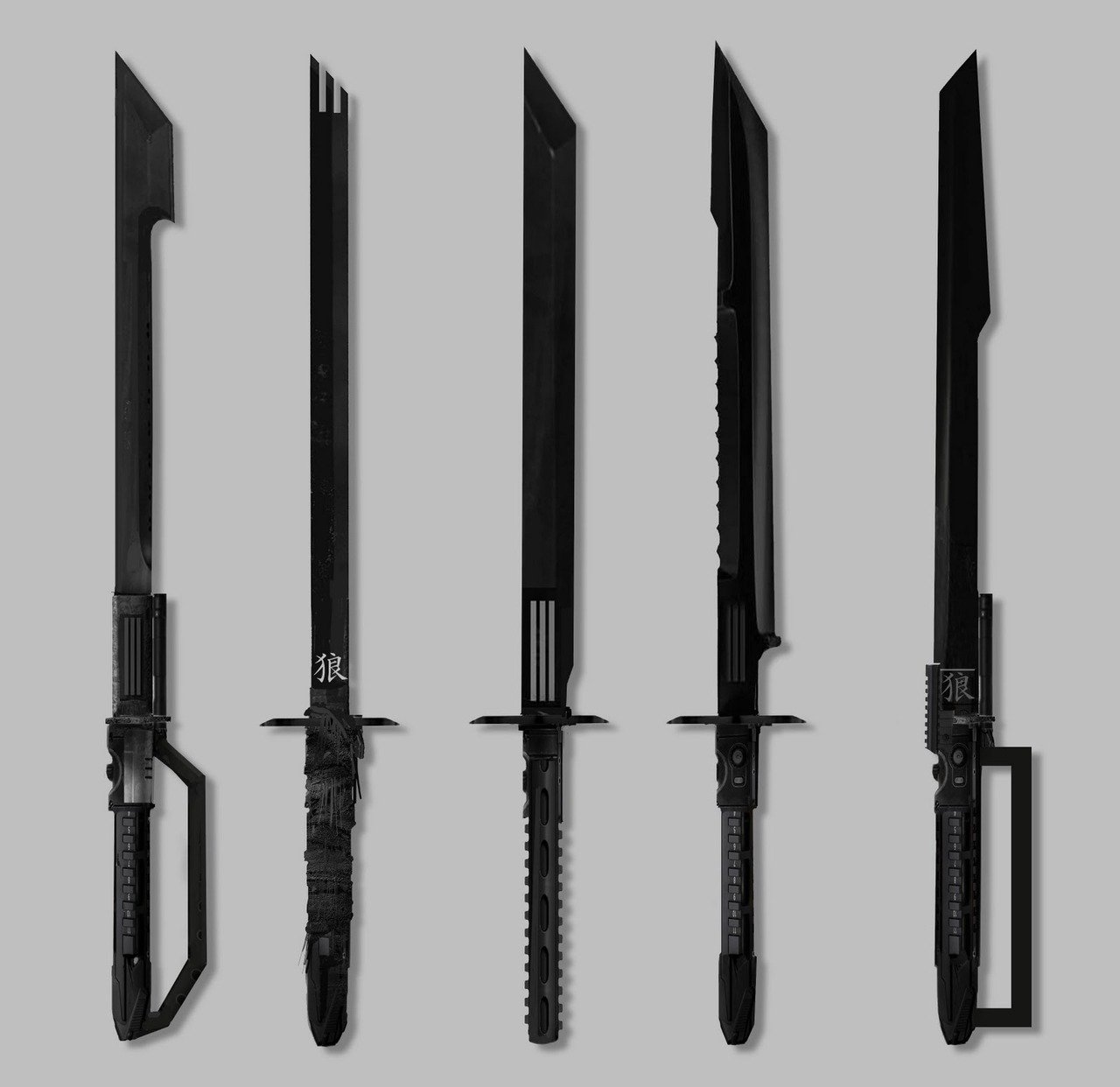
Vibroblades, just blades, but important that they look cool.
Image
I didn't actually include directed jammers. Instead have EMP grenades which also come with a cloud of magnetic chaff making a local area hostile to use of tech equipment and comms.
Image

Posted: Thu Feb 20, 2020 12:53 pm
by Thaluikhain
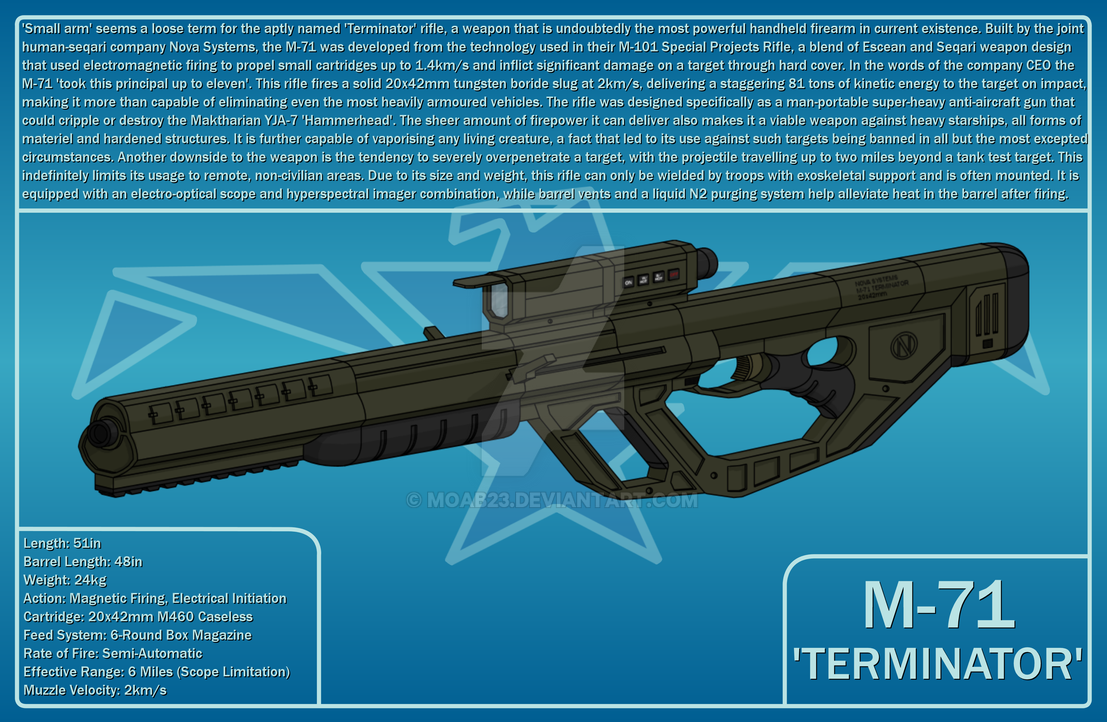
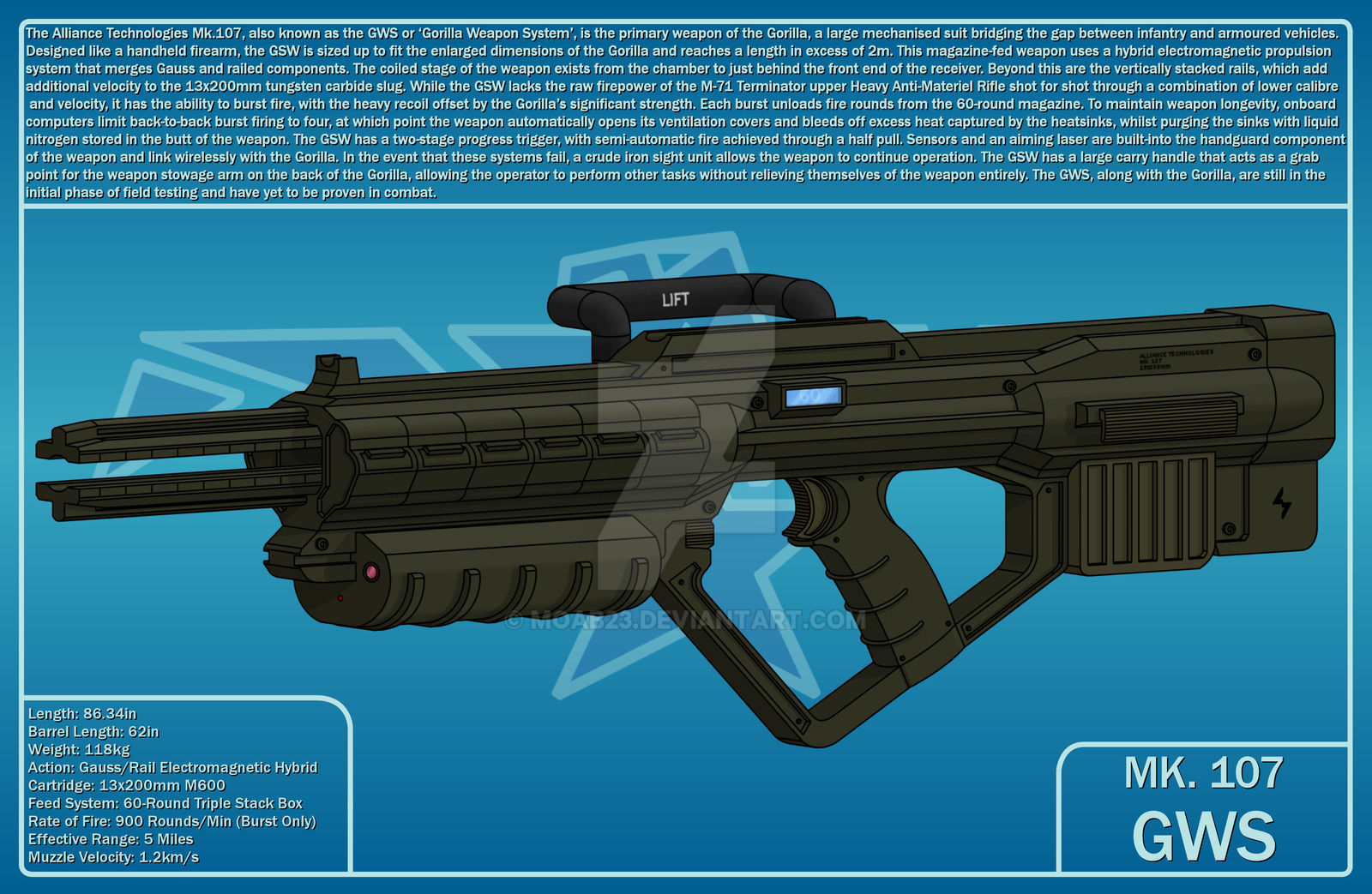
Firing a heavy projectile at absurd speeds means absurd recoil, which is going to be a serious problem for ordinary humans carrying the thing. Also, liquid nitrogen as coolant? Uh-huh.

One often overlooked thing for lasers is that you're using visible light to aim with, so if you've zeroed the weapon properly you need to worry about parallax, but you don't have to worry about bullet drop and the like. Possible you could set it up so that the scope looks down the "barrel" except when actually firing, so you'd not have to worry about parallax.

Posted: Thu Feb 20, 2020 8:10 pm
by Trill
Thaluikhain wrote:Firing a heavy projectile at absurd speeds means absurd recoil, which is going to be a serious problem for ordinary humans carrying the thing.
Well, advanced materials can probably absorb huge amounts of recoil. And if not you just need exoskeletons (like in the first Ion Weapon spoiler)
Thaluikhain wrote:Also, liquid nitrogen as coolant? Uh-huh.
Why not? As long as it's not ejected into your face afterwards there shouldn't be that much of a problem.

Posted: Thu Feb 20, 2020 8:47 pm
by deaddmwalking
Trill wrote:
Thaluikhain wrote:Also, liquid nitrogen as coolant? Uh-huh.
Why not? As long as it's not ejected into your face afterwards there shouldn't be that much of a problem.
From wikipedia:
Liquid nitrogen's efficiency as a coolant is limited by the fact that it boils immediately on contact with a warmer object, enveloping the object in insulating nitrogen gas. This effect, known as the Leidenfrost effect, applies to any liquid in contact with an object significantly hotter than its boiling point. Faster cooling may be obtained by plunging an object into a slush of liquid and solid nitrogen rather than liquid nitrogen alone.

Posted: Thu Feb 20, 2020 10:42 pm
by Trill
The thing is, that Nitrogen is basically the cheapest and easiest high-power cooling method.
And liquid nitrogen is easier to manufacture and store than a mix of liquid and solid nitrogen.
Sure, in large weapon systems where the heat energy output becomes high enough to destroy the weapon even with liquid nitrogen cooling you'll likely have either the nitrogen slush or Suprafluid helium cooling.
But in handheld weapon the ease and cost of using liquid nitrogen just becomes a dealbreaker.

Think of it this way: Would you cool your car's motor with liquid nitrogen? No. Cost- and Ease-wise it's simpler to just air cool it.
Are there vehicles where this could be insufficient? Sure, but for most of the ones you use it isn't

Posted: Fri Feb 21, 2020 12:48 am
by hyzmarca
Storage is also a problem. Keeping liquid nitrogen liquid for any substantial length of time requires far more insulation than any sane person would put on a gun.

For practical logistics reasons, you want weapons that don't require constant heavy maintenance.

Posted: Sat Feb 22, 2020 9:35 am
by OgreBattle
This blog with camera type laser guns, where you can look through the barrel like a camera is neat:
http://www.projectrho.com/public_html/r ... energy.php

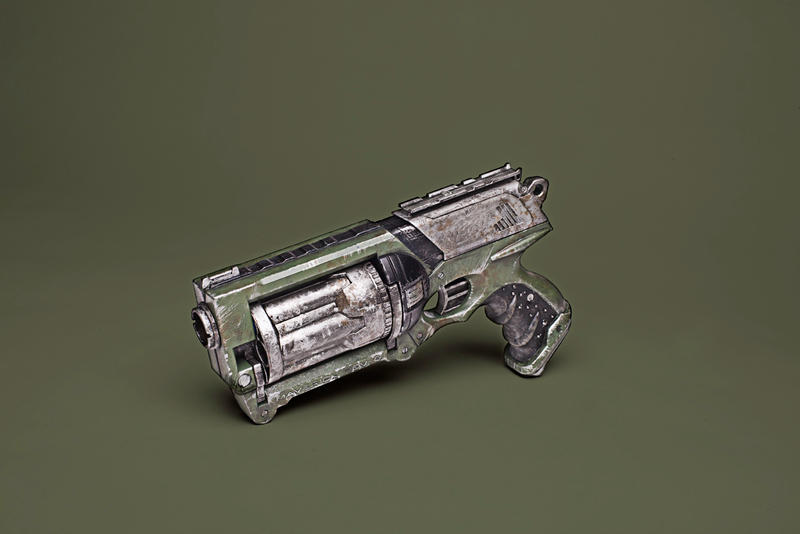
So where would be a good location for a heatsink and radiator on a man portable energy gun?

The Necromunda Van saar suppression lasers have thingies that could be interpreted as heat radiators, right above the barrel

Image

Posted: Thu Feb 27, 2020 11:57 pm
by merc1138
OgreBattle wrote:This blog with camera type laser guns, where you can look through the barrel like a camera is neat:
http://www.projectrho.com/public_html/r ... energy.php

So where would be a good location for a heatsink and radiator on a man portable energy gun?

The Necromunda Van saar suppression lasers have thingies that could be interpreted as heat radiators, right above the barrel

Image
There's a couple of assumptions to make with that. Since it's an energy weapon, the energy source doesn't necessarily have to be in the same location as the magazine on a modern day rifle, albeit if that energy "pack" or whatever needs to be swapped that would be a convenient location. If the energy source is backpack mounted and has cabling running to the weapon, hoses for cooling could be included and run to a backpack mounted radiator which would be ideal, but then limit the amount of other stuff such a soldier could carry. If the energy source is in the weapon itself, since it's not a mag feeding an action it could be mounted in the stock for better weight distribution so long as it doesn't have to be quickly swapped. That would basically allow mounting of an air cooled radiator setup right where the "action" is, and of course you could extend that along the length of the front handguard(doesn't need a barrel, but you need something to hang onto).

There is however a huge problem with this, that's already an issue with gunpowder firearms. Heat dissipation creating mirage effect. Fortunately this is future tech so an optic could somehow compensate for this? But anything producing mirage effect between the sights and the target is going to make it more difficult to use at range, and of course magnification just magnifies the mirage effect. This would be why for some rifle competitions you'll actually see people using mirage bands(length of material suspended across the barrel) to block it from interfering with line of sight(but of course doesn't eliminate it from the ground or other surface between the shooter and the target in hot weather).

Posted: Thu Mar 05, 2020 10:12 am
by OgreBattle
So in some places I've read that lasers can be fanned out, how exactly does that work?

I think there's a Heinlein story where an armor piercing laser is set to fan out to cut a feller in half

Posted: Thu Mar 05, 2020 2:53 pm
by erik
You’d need to know the distance you’re aiming at to know how much of an angle to spread the laser by, which is fairly trivial. With the energy being spread out you’ll need proportionally more energy to apply the same amount per area, which could be a lot depending upon how large your laser dot was to begin with.

Edit: another thing for laser weapons. Their range isn’t as great as you might expect. The beam diffuses and widens over distance, ie becomes less focused and powerful. Even the ginormous us navy laser has only an effective range of about 1 mile and the primary use is for taking down relatively fragile things like missiles, not burning through tank armor plating.
https://en.m.wikipedia.org/wiki/AN/SEQ- ... pon_System

I’m not sure what the physical repercussions are for a laser so powerful that it burns a 500mm x 1mm band through armor at several hundred feet in a fraction of a second.

Posted: Thu Mar 05, 2020 8:40 pm
by Trill
Depends on the armor and its heat capacity, the laser wavelength and focus, and the material the beam has to travel through.
Stainless Steel 430 has a specific heat Capacity of 460.548 J/(kg*K). You need about 460 Joules of heat to increase the temperature of one kilogram of Stainless Steel by one Kelvin.
Assuming the metal is a centimeter thick, then the volume of metal to be heated is 50cm*0.1cm*1cm=5 cm^3
SS430 has a density of 7.8g/cm^3, and thus the amount of steel in our example is 39 g.
So the heat capacity is 460.548 J/kg/K * 0.039 kg=17.961 J/K
Liquidus (the temperature above all of a material is liquid) is 1510°C. Assuming a starting temperature of 20°C this is a heat increase of 1490 K. 17.961 J/K*1490 K =26762.444 J
Assuming a duration of 100ms this gives us a power of 267624.443 W, or 268kW.
Assuming a generous absorption of 50% this gives us a laser power of about 540kW.

Posted: Fri Mar 06, 2020 1:47 am
by deaddmwalking
The M1A1 tank uses a combination armor that includes metal and ceramics. While the ceramics were not specifically chosen to make them resistant to lasers, they were selected because they have a much higher heat capacity than metal.

Armor values are often given as an equivalent of steel - and ratings are given as how effective they are against specific weapons. One of the most effective weapons against a tank is a 'Armour-piercing fin-stabilized discarding sabot'. The armor value of the M1A1 versus this weapon type is estimated to be equivalent to 600mm of steel (60 cm).

Trill's estimate is based on material 1 centimeter thick, not the equivalent of 60 cm.

The best estimates I can find for how thick the armor on the tank is ~3 inches (7.62 cm) meaning you'd have to multiply Trill's estimate by 7.62 disregarding any assumption about composite materials having a higher specific heat capacity. That'd be the equivalnet of 4,114kw.

The average coal powerplant procduces 1 GW per second (1,000kw), so you'd need to charge your laser for just over 4 seconds for each shot.

The main advantage for lasers is that the amount of energy you can input is theoretically unlimited. The world's current most powerful laser (measured by peak energy expenditure) outputs 2,000 trillion watts, but for only a fraction of a second.

In your plausible reality, you might create gamma ray lasers. They would be so high energy that they would be able to penetrate through the armor without damaging it and potentially kill things inside.

Of course, if that's your intent, a neutron bomb is probably much easier.

Posted: Fri Mar 06, 2020 6:25 am
by OgreBattle
erik wrote:You’d need to know the distance you’re aiming at to know how much of an angle to spread the laser by, which is fairly trivial.
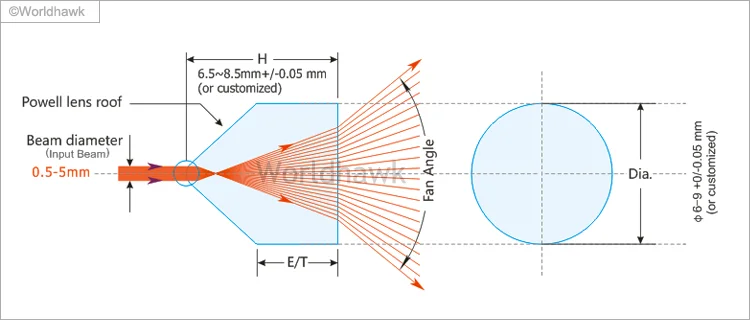
So how is the laser spread angled? Found this diagram from a line laser prism sales site:

Image

So if the lens is made for fanning out the laser beam, it will only shoot one specific angle of laser fan yeah? Or is there some way to have a prism that can focus on a dot or fan?

If not then the solution would be a 'revolver' cylinder with different prisms
---

On the gamma laser... does it still burn through things or is it a radiation beam now?

Is gamma radiation and neutron radiation the same?

Posted: Fri Mar 06, 2020 2:22 pm
by deaddmwalking
OgreBattle wrote: Is gamma radiation and neutron radiation the same?
No. So radiation is the release of energy from atoms. There are two ways an atom can release energy. Once is releasing electromagnetic energy - this is light/radio/x-ray etc. Electromagnetic energy has no mass - depending on how energetic it is we classify it as radio waves or light, but effectively it's ALL light - our eyes just aren't sensitive to most of the EM spectrum. Anything you know to be true about visible light is largely true about all other electromagnetic waves.

The other form of radiation is particle radiation. In this case the atom 'shoots out' a piece of mass. The ejection of mass from an atom is less common than the emission of light.

Particle Radiation is an important part of a Fission bomb like the one dropped on Hiroshima. When the first atom splits, it releases 2-3 neutrons which split 2-3 other atoms, which split 2-3 other atoms - this is a runaway atomic reaction.

For a Neutron Bomb, you make sure that the neutrons that are emitted aren't absorbed by other materials and limit the other types of radiation that is emitted.

Previously, it was discussed how certain materials absorb certain forms of EM radiation better than others. Visible light, for instance, penetrates the Earth's atmosphere very easily, but some more energetic forms of energy do not, which is important for life on Earth.

While every atom is mostly empty space (ie, if the nucleus of an atom were the size of a marble placed on the 50-yard line of the Dallas Cowboy's stadium, the size of the atom would be equivalent to the entire Stadium. That electron shell is pretty good at 'picking up' EM radiation (moving the electrons into a higher state before they release it in the form of other EM radiation), but they can't pick up Neutrons. Neutrons are therefore more penetrative than even Gamma Rays.

The following link is a good, simple overview of radiation.

OgreBattle wrote: On the gamma laser... does it still burn through things or is it a radiation beam now?
For the most part, it doesn't burn through things - it doesn't interact with them well enough to NEED to burn a hole... If a gamma ray is like a bullet, and you SEE it coming, do you jump out of the way? If that's the choice, you probably should. Remember when Indiana Jones killed 6 Nazis with one bullet in Last Crusade on the tank? The gamma ray is energetic enough to do that and keep going, so might as well jump out of the way. If you do, though, you don't do anything to slow or stop the bullet. If you can get 30-40 guys to all agree to get shot to death, you might actually stop the bullet... Earth's atmosphere is full of guys jumping in front of the bullet, but most materials are primarily transparent to gamma radiation.

Posted: Fri Mar 06, 2020 2:58 pm
by erik
The angles should be adjustable by changing the vertex (moving lens farther or closer).

Posted: Fri Mar 06, 2020 5:07 pm
by Iduno
deaddmwalking wrote:The M1A1 tank uses a combination armor that includes metal and ceramics. While the ceramics were not specifically chosen to make them resistant to lasers, they were selected because they have a much higher heat capacity than metal.

Armor values are often given as an equivalent of steel - and ratings are given as how effective they are against specific weapons. One of the most effective weapons against a tank is a 'Armour-piercing fin-stabilized discarding sabot'. The armor value of the M1A1 versus this weapon type is estimated to be equivalent to 600mm of steel (60 cm).

Trill's estimate is based on material 1 centimeter thick, not the equivalent of 60 cm.

The best estimates I can find for how thick the armor on the tank is ~3 inches (7.62 cm) meaning you'd have to multiply Trill's estimate by 7.62 disregarding any assumption about composite materials having a higher specific heat capacity. That'd be the equivalnet of 4,114kw.

The average coal powerplant procduces 1 GW per second (1,000kw), so you'd need to charge your laser for just over 4 seconds for each shot.

The main advantage for lasers is that the amount of energy you can input is theoretically unlimited. The world's current most powerful laser (measured by peak energy expenditure) outputs 2,000 trillion watts, but for only a fraction of a second.

In your plausible reality, you might create gamma ray lasers. They would be so high energy that they would be able to penetrate through the armor without damaging it and potentially kill things inside.

Of course, if that's your intent, a neutron bomb is probably much easier.
Yes, but we were talking about cutting "a feller" in half, which is probably someone wearing somewhat less armor than an abrams has, but still enough to count as armor.

Posted: Fri Mar 06, 2020 7:25 pm
by Stahlseele
Electromagnetic Weaponry.
Always a fan favourite!

Posted: Sat Mar 07, 2020 3:57 am
by erik
Iduno wrote: Yes, but we were talking about cutting "a feller" in half, which is probably someone wearing somewhat less armor than an abrams has, but still enough to count as armor.
Well, if this Not Rifts is at all similar to Rifts, then body armor is probably more durable than an Abrams armor plating.

Posted: Sat Mar 07, 2020 11:29 am
by OgreBattle
Thanks. So reading on the neutron bomb, its going to irradiate the tanks with Dead bad guys inside and the German city they invaded yeah? The wiki says the US was trying to convince Europeans allies it was ’clean’ and dissipates fast.

To be clear, only neutron and proton pew pew radiation will irradiate things yeah? gamma rays and x rays won’t make stuff they hit radioactive, yes? So a proton or neutron particle beam would irradiate stuff they hit but not an electron beam.
erik wrote:
Iduno wrote: Yes, but we were talking about cutting "a feller" in half, which is probably someone wearing somewhat less armor than an abrams has, but still enough to count as armor.
Well, if this Not Rifts is at all similar to Rifts, then body armor is probably more durable than an Abrams armor plating.
I would want to avoid that for my storytelling. More Masamune Shirow oriented where a human vaporizing laser can exist as a mounted weapon, and can’t be kept clenched between non augmented human buttcheeks

Now reading this blog for more imagery: http://toughsf.blogspot.com/search?upda ... lts=10&m=1

These laser coupled particle beams look cool http://toughsf.blogspot.com/2019/02/col ... s.html?m=1

A particle beam fires within a larger lager beam, the laser pushes the particles tighter. Makes for visible beams and reminds me of Gundam SEED

Posted: Sat Mar 07, 2020 5:50 pm
by Omegonthesane
Neutron bomb radiation takes a little while after exposure to be fatal. So militarily it's super situational as once you use it you have replaced your opponent's army with an army of suicide berserkers who know they're going to die before the next morning anyway and can adjust their tactics accordingly