Page 1 of 2

Review - Lejendary Adventure by Gary Gygax

Posted: Mon Feb 10, 2025 7:31 pm
by deaddmwalking
I'm actually really busy at work and with additional responsibilities outside of work, and the world is burning down around me, so what better time to retreat from the news and take a look at a game from a rosier time.

In 1984, TSR was brining in $30 million per year in sales (equivalent to $91 million today), but was still losing money. There's been a lot of ink spilled over what happened next, but Lorraine Williams ended up with a controlling interest in TSR and by 1986, Gygax was out. As the co-creator of D&D, his name had cachet in the industry, but competing directly with TSR was a tall order - especially since they didn't become any less litigious after he left. His first post-TSR game was Dangerous Journeys (originally titled Dangerous Dimensions, but renamed to avoid association with D/D), released in 1992. It didn't exactly set the world on fire - Gygax claims that it was largely due to a nuisance law suit by TSR that resulted in them gaining ownership of the game. We might try to look at that some other time, but for now, we're going to look at his next effort.

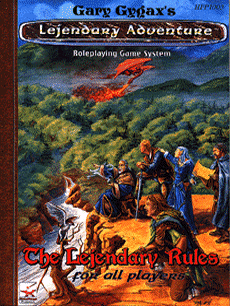
In 1999, Gygax tried again, releasing Lejendary Journey. It was published by Troll Lord Games, and it was supported until 2008, when, after his death, his widow canceled the license. At least, that's what Wikipedia says. We'll be looking at two books, The Lejendary Rules for all players (1999), and Lejend Master's Lore Information for the Lejend Master (2000). My copies are listed as copyright Trigee Enterprises, which appears to now be registered to Gail Gygax. The spine and ISBN have HFP, and the front cover has an icon for Hekaforge Productions. I'm guessing that's all a convoluted way to make sure that the ownership can't be taken by TSR (or WotC at this point). The question is, given free reign and no interference, could EGG catch lightning in a bottle again? I mean, we know he didn't - D&D 3.0 was released about the same time, and it sucked the oxygen out of the room for all kinds of d20 games. So the question really is, did we miss something because this game was published when we were all getting excited about Tome and Fist, and people sincerely arguing that monks were the most overpowered class in the new edition.

So what do we have?
Image

The books I have are both perfect bound paperback books, each about 200 pages. Both books credit Gygax as the author; they have a different chief editor, but most of the assistant editors are the same. There's no reference to playtesters, but the Lejend Master's (hereafter GMs) book has a shout out to an online community at Hekaforge - the Fellowship of Lejendary Adventure Gamers - but that community is defunct and the way back machine can't access the member's only sections where presumably all the action happened. If anyone was a member and wants to ruminate here, you're more than welcome.
Insider you will find a very special set of fantasy role playing game rules indeed. These are uncomplicated rules providing fast character creation, with possibilities for near-endless variety of unique Avatar characters that are neither "cookie-cutter' stereotypes nor "know-it-all juggernauts". These are easy rules that grant a thorough understanding of the mechanics of play. They help to facilitate, not merely allow, the imagination and creativity of the Game Master and player alike to take precedence over rules, providing structure, not statute. These rules encompass the extraordinary in a logical and clearly defined manner. And as they do all this, they reflect reality and a logical sort of fantasy that brings the participant past suspension of disbelief into a desire to share in the marvels of experiencing worlds of whimsy, fabulous beasts, and all that is encompassed in the realms of fantastic heroism and adventure.
Author's Preface

The book launches with a 2 page letter explaining that games need a constant source of new players, and that the problem with new players today is that they entered RPGs through card-games, so the rules have to be simple to understand. That's not intended as an insult - instead most of the back-handed compliments go toward the grognards who want more complexity in the game without regard to how that makes it more difficult to bring in new players. Let's just say that it reads now as an error in foresight - 3.x brought in legions of new players - and the promise of being accessible but still allowing complexity for experienced players sounds...impossible. He also points out that the experience of the game world is paramount, and that the rules should be easy to apply so players can focus on interaction; and then throws in the whole 'ignore rules that get in the way'. Or as Gygax says it, "Do not be misled into thinking that because there is a disagreeable rule, or no rule at all, the game is not serving well. In the former case, change the rule. In the latter case, make up a rule that suits the campaign. Rules should provide the LM with the power to create the milieu, devise and develop the environments that will enable compelling play activity, and direct and engage in the game play so that the other participants will marvel at the ingenuity and artistry of the LM".

The writing style isn't full on high-Gygaxian, but it's recognizable. In any case, it's clear that one of the intended goals is to avoid a world that is only a combat simulator - Gygax wants to ensure that there's banter and battle, confrontation and conversation.

We still have to look at the 'what is an RPG' and the 15-page character overview. The character creation section is composed of ~15 pages on races, ~15 pages on 'orders', ~2 pages of equipment, and ~100 pages of magical abilities. The last 20 pages include everything on actually playing the game - resolution mechanics, improving abilities, movement, initiative, combat resolution. There's not much in the game rules section, so we may end up hitting some of that first.

More to come....

Re: Review - Lejendary Adventure by Gary Gygax

Posted: Mon Feb 10, 2025 10:03 pm
by deaddmwalking
The Lejendary Journey Continues


Image
Not to be confused with Kung-Fu: The Legend Continues


Usually, when a game talks about what role-playing is, usually there's a reference to a game of make-believe and a question about what actually happened when imaginations collide - and the provision of rules to guide that imaginary play. Gygax takes a bit of a different approach:
"This game will allow participants to engage in all manner of fantasy play, limited only by the imaginations of the players themselves. Role playing is simply an exercise in imagination coupled with the use of the rational mind. Imagination and reason are used in conjunction to assess information, solve make-believe problems posed, optimize potential gains, and minimize potential losses in play."
I'm literally not sure if he's talking about role playing or filing my taxes. I actually don't mind Gygaxian language, but it is clearly not the most concise way of saying things. To be fair, he does reference Cops and Robbers and almost immediately the mythic quest described by Joseph Campbell. Characters are called Avatars, and the game claims that beginning characters 'will be quite strong, able, and well-equipped'.

The next section is a 2-page glossary, many with acronyms. Here we learn that rounds are Ability Blocks (ABs) of 12 seconds each, and each AB is composed of four 3-second Ability Block Counts (ABCs). I read ahead that when you activate an ability, it typically doesn't activate immediately - some amount of additional time will pass - so this will certainly feature later.

Ability Scores (also called 'Score') is a rating from 1-100 (though it can be higher). The game uses 1d100 roll under for resolving most tasks. That is not my favorite resolution mechanic...

Avoidance is the term used for general 'resist checks'.

Base Rating - These are the three fundamental stats for each character; Health (H), Precision (P) and Speed (S). Intellect is an optional 4th stat.

Orders - We'll learn more about these later, but they sound like classes - groups of skills that you'll want to advance together to match an archetype, but players don't have to belong to an order (presumably meaning they advance whatever skills they want without regard to standard archetypes). If you have an order, as you advance you gain rank, meaning you have power within the order. Characters without an order don't have rank.


Image
This may be true in the game...or being a murder-hobo may be the best life choice. We'll see!


The game has both merits and demerits. Merits are used to advance characters, so they're good, and you want to get them. Demerits are bad - I don't know if you actually lose abilities you have or if you just have to pay them off before you get merits. Generally, I think it's better to just have merits - and give few or none if players play poorly. What qualifies as good or poor play hasn't been defined yet, but I'm generally not a fan of incremental advance tracking (like XP) and instead prefer to give the entire party a chance to advance together.


Avatars (Character Creation)
There are five essential areas that th player must deal with in creating an Avatar, and twelve steps that deal with those areas. The race of the Avatar must be chosen, the Base Ratings must be generated, for those determine the broad capabilities of the character. Specific Abilities are then chosen, showing what skill areas the Avatar has some proficiency with. The character's background is then described and the basics of the character's personality decided. Finally, the player must choose equipment for the Avatar, prepatory [sic] to play. These are the essential areas to be dealt with when creating an Avatar.


Image
Not this one


Image
Not this one, either


The use of the term Avatar feels like it's an attempt to stake out a term that can be protected as Intellectual Property (IP) so even though it's not trademarked, you just get the sense that Gygax is deliberately avoiding words that he used before. He makes it clear that Game Characters are exactly what these are. In the sense that you're projecting yourself into a role-playing game, the character being 'your avatar' makes sense, but I'm not wholly convinced that's what the game should be encouraging. A character doesn't have to reflect you, and focusing on the 'controlled by a person sitting at a table' aspect seems counter to the immersive experience. This is one of those things that I've thought about because what you call things in game does matter, and that's one I had considered myself. Incarnate or Incarnation have some thematic overlap - being 'made flesh' in the game world strikes me as better, but in any case, I'll be using the term 'Character' from here on out except in direct quotes.

Step 1: Race
This step must be taken first because it impacts Base Ratings and choosing abilities. Some races must have certain abilities, some cannot have certain abilities, and some may not have certain abilities at character creation but can purchase them later. Now, races are listed in the Table of Contents, but there's no way you, as a first time player, know what race you should want to be based on your concept. There are three race groups; human (only 1 race), veshoge (only 1 race), and Alfar (11 races). In the sense that the mythological underpinnings of elves, dwarves, gnomes etc are all the same, putting them into a single group sorta makes sense? The Alfar include Dwarf, Gnome, Ilf, Kobold, Oaf (2 types), Orc (3 types) Trollkin, and Wylf (which it says is an elf). I would have expected the Ilf to be an elf, but surely they'll clear up my confusion in a moment.

Base Ratings
An 'average' NPC human has a 10 for Speed, a 20 for Health, and a 20 for Precision. Human Adventurers will likely have a Speed less than 25, a Health of 50-60 (and eventually reach 200), and probably Precision less than 100. It appears that Health is also hit points; if you have 50 hit points you die when your total reaches -6 (and you're near death at -5). Speed is often used to avoid being hit in combat and avoiding traps (like a Reflex Save), while Precision is used to hit people with pointy sticks and other weapons.

Abilities
This includes ordinary abilities (like sailing) and extraordinary abilities (like spells). Like GURPS, the abilities you choose can increase your Base Ratings. Ie, if you have a lot of martial skills, they could increase your 'reflexes, coordination, and perception' - we'll find out what that means shortly, but it feels like doing my taxes (well, to be honest, my taxes aren't that hard, but when I used to try to do it by hand and I lived in Iowa and had to do State Taxes, too, well, it seemed like I was always adding something from A to B and then taking that number and subtracting it from C, unless it was more than C, in which case I needed to check Table D) - I don't know that character CREATION should be FUN, but it shouldn't be WORK.

Equipment
Each ability you choose grants you access to equipment chosen from a specific list (including money). There's a hierarchy to abilities, the more important an ability is to your character the more choices it will provide you for equipment. Money can also be used to buy equipment that you can't (or don't) select from a list.

There are two copies of the character sheet in the book (and permission given to copy it), but despite that I can't find an exact copy online, but Dragon's Foot has one that's almost exactly like the one in the book - at least the top half. It's clear that your 'first ability' is prime and matters, and that you have other abilities that aren't prime; and that all three of your Base Ratings have a 'normal value' but that you lose points from them temporarily.

Step 1: Select a Race
The book suggests that you skip ahead and read the racial descriptions and choose one that sounds interesting to you.

Step 2: Distribute Points
You get 100 points to divide among the Base Ratings, but there are restrictions based on your race.

For Humans the following restrictions apply:
Health: MIN 40, MAX 70
Precision: MIN 20, MAX 50
Speed: MIN 8, MAX 12

Off the bat, it looks like speed has such a narrow range that maximizing it makes sense - if relative ability matters at all, you'd think having 66% of the max would hurt you, and since the scores all cost 1 point per bonus.

When you choose Abilities, Humans get 100% of their Base Rating in their first ability, 80% in the their second, 60% in their third, and 40% in their 4th.

Step 3: Augment Base Ratings per Racial instructions

Ilfs (which are like Elves, except Wylfs are ALSO like Elves, and they're the ones that explicitly say so) have the exact same minimums, but they get a random increase; 2d12+2 Health, 1d10+4 Precision, and 1d6 (half-points) to Speed. They only choose two abilities, because three abilities are pre-selected (Hunt, Stealth, and Weapons). If those were abilities you wanted to select, choosing an Ilf seems like a sensible like choice - you get rewarded with higher Base Ratings for a smaller selection.

Radom variations in character creation isn't something that I'm particularly fond of. You could have two Ilfs, (fortunately, auto-correct isn't trying to do anything inappropriate with that word) where one rolls the absolute minimum on the 'random Base Ratings' and the other rolls the maximum. It's ostensibly a 'cooperative game', so on the one hand it doesn't matter which one is higher and which is lower, but on the other hand I think we'd all agree that we'd rather be the player with the higher abilities. Since it's not competitive, there's no reason NOT to let starting characters actually be equal. It has the potential to create resentment or feelings of inadequacy right out the gate.

Step 4: Choose Abilities
Some abilities are extraordinary and include multiple magical disciplines with names like Geourgy and Necrourgy, and also things like Hunt, Stealth, and Weapons (like our Ilf has). Dwarves can't ever have Chivalry. What does that mean?

When choosing Chivalry, 'add two points to Health rating when initially selecting this Ability. All activities having to do with courtly behavior, manners, diplomacy, persuasion, precedence, castles, fortification and siegecraft, siege engines, command, management of lands, livestock, riding, etc are governed by this Ability. Each five Ability points possessed adds one point to Weapons Ability use and any weapon-based Harm inflicted by the individual' (bold added for emphasis).


Image
Aye, I admit it. I was talking out of my ass when talking about defending the caves.


Look, I have the Rules Cyclopedia, a version of OD&D where Dwarf was a class and it was basically the same as a Fighter (but not as good!), and in AD&D Dwarves could be Clerics but not Wizards. Frankly, that's a failure of imagination of epic proportion. Locking Dwarves out of Siege Craft, but allowing them to take Waterfaring???* Just kidding - I wouldn't lock them out of that, either. While I don't normally think of Dwarves as a semi-aquatic species, there's no reason they couldn't be, at least in SOME settings.
*Technically they can't take it at character creation, but they can take it later.

Each ability is tied to a Base Rating - it appears that all magical traditions are tied to Speed.

Abilities aren't really relatively equal. You could choose 'creative' and pick up a +2 to Precision, and a bonus of 10% of your Creative ability to nine other abilities that you may not even have, or you can pick up Geourgy (getting +1/2 Speed) and using this ability to summon elemental power or actual elemental spirits.

Step 6: If you forgot weapon skill, add it now at the lowest rating

Seriously, you're not allowed to have a character without weapon skill. If you do have weapon skill because you realized that this was the kind of world where sometimes your sword would have to do the talking for you, you get to choose a different skill.


Image
I have 15 ranks in Intimidate


Step 7: Apply bonuses to your Base Ratings

Every Ability has an associated Base Rating. If you chose an Ability that has Health as the Base Rating, you add +2 to Health; if you chose an Ability that has Precision as the Base Rating, add +2 to Precision; and if you chose an Ability with Speed as the Base Rating, add +.5 to that.

Having skipped ahead, I know that often you're often using your Speed (x4) for various values. Having Speed as a smaller value, increase at a slower rate, and then using a larger value seems inelegant. Adjusting values so that the three systems use the same scale doesn't seem that hard. I'm a bit disappointed.

Step 8: Optional Rule - Determine Intellect

Intellect is 10 + 2 for each of several listed Abilities (like Learning and Commerce).

Step 9: More Math

Determine your Abilities by multiplying by a percentage. Ie, if you have a skill that's 70% of your Base Rating, figure out what that is and write it down.

Re: Review - Lejendary Adventure by Gary Gygax

Posted: Tue Feb 11, 2025 12:02 am
by deaddmwalking
Avatars: Back for More

Step 10 - Background

Make some stuff up - it can be incomplete and cursory, and more can be added later.

Step 11 - Equipment

Each time you choose an Ability, you get a relevant equipment list. Fora human who chose 4 abilities, they get 9, 7, 5, and 3. So a character that chose Chivalry, Sorcery, Physique, and Stealth would get 9 picks from the High Equipment List (for Chivalry), 7 picks from the Magical List (restricted to Sorcery, general, and memory tablet - ie, can't choose from other magical traditions), 5 picks from the Low Equipment List (for Physique) and 3 more from the same list (for Stealth).

I can only pick cash once, and the high list has $25k (the low list has $100), and many of the choices are redundant - like I could get a suit that has a colorful cap or a dark cap, but are otherwise the same, or I could pick a war horse (courser) or a war horse (destrier) but I can't see riding two horses at once (though I could get a pack horse in addition to my riding horse).

There are pages of general equipment, all prices listed in $. A 1 gallon copper pan is $200 while a War Horse (destrier) is $150,000.


Image
A small copper pan is $250 at Williams and Sonoma - the full set is $1500, so maybe these prices are reasonable


So one of the magical items listed was 'memory tablet'. For several magical traditions, if you want to cast spells, you need one of these. Each of these can have up to 4 powers, so if you want 5+ powers you'll need 2+ memory tablets. If you're a Sorcerer, you need a 'command circle' and a 'protection circle' instead. If you're a Geoursy (Geourserer?) you need both. For all magic traditions there are 10 levels of spell, but each is given a Grade (from Very Minimal to Extreme). You'll have to remind yourself which order is Good, Strong, and Major. The more powerful a spell is, the longer between when you activate it and when it actually activates. More powerful spells also cost 1+numerical grade except Extreme powers which are 2+Grade.

So let's say I want to activate a Very Minor power (2 AEP). First, I have to determine if I have the AEP (which is equal to 4x Speed). So if I ended up with a 12 Speed (because I maxed it out as a human, for instance) I have 48 AEP. If I chose my magical tradition as my 'highest ability' (at 100% of Base Rating) I would have a 12%. If I'm suffering from 'clear and present danger', I'm at -10 (which is written as +10% to my roll). If someone hits hit while I'm activating a power, it's +100% (which means I can't succeed, but the GM is supposed to give at least 1/2 of 1% chance (meaning if I roll a 01, then less 50 or less on a follow-up roll, the spell should go off).

If you fail your roll, you spend the AEP and nothing happens.

So if I want to do a Fiery Bolt (a Geourgy spell that can be used at any level from Minimal to Extreme) and I'm in combat, I'd expect to succeed 2% of the time (once every 50 rounds) so I can do 6-8 plus 1-2 for every AEP I spent. If I spent the 2 AEP, it does 8-10 damage.

That seems....really bad. Even if I decided that there was no clear and present danger, 12% chance of your spell activating is pretty piss poor. Nobody chooses to be a wizard because they want all of their spells to fail.


Image
Not even for comic relief


A lot of spells can be cast outside of combat, like armor buffs, but with the high failure rate that doesn't really seem like any mollification.

Edit - The rules do say that for Abilities that rely on Speed, the rating is multiplied by 4 to determine the Ability; thus a character with a 12 would have a 48% chance to succeed on spellcasting before penalties for combat.

I was desperately hoping that I misunderstood something, so I'm glad to find that I did. Still, even a 64% chance of success is pretty low. This being Gygax, I don't expect more permissive rules in the not-DMG, and instead a bunch of things that can go wrong. But there were already 'bad things' that could happen in this book! If you summon an elemental (successfully), there's a chance that they break from their control circle and freaking kill you , so you're actually HOPING you fail to summon a creature, I guess.

If you want to cast spells, you definitely need to put your spell casting tradition as your 'first ability'. That means it is at 100%, and because it uses Speed, it is x4; if you put a spell casting tradition as your second choice, it would be at 80% of your ability multiplied by 4 (so a 12 Speed would be 38.4 if it was your second ability, rather than 48 if it was your first).

Major heart attack avoided. Blood pressure returning to normal.

Next time we'll look at Orders more closely - to advance in an order you must arrange your Abilities in the 'proper order' as determined by 'the order'. And if you order your abilities in the order's preferred order, you get benefits for doing so.

Re: Review - Lejendary Adventure by Gary Gygax

Posted: Tue Feb 11, 2025 2:06 am
by deaddmwalking
The Order of the Order


Image
Not the order of the Stick


So I mentioned that orders are a little like classes. If you're a priest, and you're part of the Ecclesiastical Order, people see you and think that you're a priest. And if you're in the Ecclesiastical Order, you get advancements based on that order. But what if you don't like any of the orders?

You're still in an order - but it's the unordered order. Oxymoronic? For sure.

In any case, every character has a 'first ability' - the ability that has the highest score. At 1st level that should be the one that is at 100% of the Base Rating. And whatever Ability you choose has an associated Base Rating (Health, Precision, or Speed). If you're unordered, you get a benefit each time that skill hits a new threshold of 10 points starting at 61 (ie, 61, 71, 81, 91 etc). If your first ability is tied to Health, when you hit a score of 61 and every 10 points after you get a +1 in all other Health based abilities; then at 91+ it's +2 in all other Health Based Abilities. At 81, 91, and 131 you also get a bonus to a single Precision and/or Speed based ability.

Ordered Orders work in a similar way - when your highest ability is 61+ you enter a new rank and get a benefit. Unlike unordered characters, there are also benefits at lower ability scores. Each order has a list of required abilities. You can have EXTRA abilities, but to advance in rank (and gain new abilities) you must have all the required abilities. Higher ranks are lower numerically than lower ranks (ie, rank 1 is the highest and rank 12 is the lowest).

The Warlock Order requires Necoursy, Arcana, Luck, and Pantology. If you have only Necoursy, you're Rank 12 and get no benefits. If you have all four required abilities you start at Rank 9 and you get an automatic +2 increase to each Ability plus 1 Power.

If you had all 4 abilities and you had a 61+ in Neurology you would start immediately at Rank 8. Starting at a higher rank means you don't get the bonus you would have gotten at lower ranks; so if you start at Rank 8 you don't EVER get the rank 9 benefit. There's potentially some benefit to aiming to game the system; like starting with a 60 so you get the rank 9 benefit, and then raise your Ability to 61 to get the 8th rank benefit.

Automatic increases in multiple Abilities seems like the primary way of advancing, but it's not the only way.

Next time we'll look at the 20 pages of rules that cover combat and advancement through merits (and demerits). And any thing else we find.

Re: Review - Lejendary Adventure by Gary Gygax

Posted: Tue Feb 11, 2025 6:43 am
by Thaluikhain
Ok, spelling Legendary like that is an automatic fail from me. Though, I guess it'd help search engines?
deaddmwalking wrote:
Tue Feb 11, 2025 12:02 am
For all magic traditions there are 10 levels of spell, but each is given a Grade (from Very Minimal to Extreme).
Hey? Are Level and Grade interchangeable, or could you have spells of the same Level and different Grade? What's the point of this?

Re: Review - Lejendary Adventure by Gary Gygax

Posted: Tue Feb 11, 2025 5:22 pm
by deaddmwalking
A higher grade represents a more difficult (and ostensibly better) spell. The Grades are just given verbal descriptions (Very Minimal, Minimal, Low Moderate, Moderate, Good, Very Good, Strong, Very Strong, Major, Extreme) but there are 10 of them so for convenience I've been saying 'Grade 1' (Very Minimal) or 'Grade 10' (Extreme). Since this book seems to like high ranks to be low numerically, it might have been more appropriate to reverse them.

The game doesn't have levels for characters, so Avatars could activate any power they know when the game begins. If your 'highest power' is your spell tradition (and it should be) you can choose 9 'items' from the magical equipment list. Each spell known counts as a potential item, in addition to required activation device(s). Some Abilities may also grant an additional spell known. You could reasonably know 8 spells as a starting character.

There are 51 Necrogoury spells, compared to 203 Enchantment spells, so those starting spells may cover more or less of the potential play space.

So why not just take the highest level spells? The first reason is that you spend the activation cost even when the spell fails. If you've maxed out Speed you probably have a 64% success rate, and 64 AEP (activation points). That means you're likely only able to cast 3 spells successfully before you no longer have enough to activate any more powers.

The second is the time cost - an Extreme Spell (Grade 10) takes 20 seconds to activate after you cast it - that's well into the next round.

The spell descriptions aren't necessarily consistent with the delay. One 'Extreme' Enchantment is Zap! which is essentially a dispel magic. Spell descriptions are all moderately Gygaxian, but here's this one:
Zap!: Extreme
This Supernatural Power enables the Enchanter to attempt to immediately dissipate the activation energy of some other Power in operation. Unless the energy is of the persistent sort not due to expire in foreseeable time, there is a probability equal to the Enchantment Ability score of the activator that the Zap! Power will succeed in deactivating the other Power's energy. If the Power to be disrupted is one that is of persistent sort, the chance for success is one-half normal.
To me that means you can't use it to counter a spell being cast - you have to cast it on a spell in operation. But can you? Their version of Black Tentacles (called Xargya's Demonic Arms) says that 'the arms remain active and attacking for 1 ABC plus an additional ABC for every six extra AEPs invested by the Enchanter at time of activation'.

So, if I cast Zap to get rid of the Demonic Arms? If that spell lasts 4 ABCs (12 seconds) and my counter takes 20 seconds to initiate, the spell will have ceased to exist before I can dispel it.

Even in the very earliest editions of D&D, spells had some consistent heading information (name, range, duration, effect). These spells don't have that - you have to read the spell fully to understand what it does.

Some spells have a variable grade - it is determined by how much AEP you apply. For example take a look at the Geoursy spell Ice Arrow
Ice Arrow: Minimal-Extreme Power of Water
This is a Power of water that conjures a dagger-like icicle which appears directly before the activator and flies for a distance from the activator equal to ten times the energy points expended to activate it, i.e. 20 to 120 feet distance. It attacks the first target in its path and causes a base 1-20 points of Harm plus 3-5 points of additional Harm, the latter ignoring all protection save that against cold. for each increase of the Grade of its activation, another 1-2 bonus points of Harm that ignore most protection as noted are added. At the upper limit this means 9-18 points of bonus damage. The target struck suffers piercing Harm, unless some solid object of stone, thick metal (nor armor) or thick, hard wood intervenes to blunt its progress and stop the flight of the ice arrow missile.


Image
This is what I see when I google 'thick, hard wood'


Now compare that to the following Enchantment Spell:
Xargya's Military Fork: Minimal
This Preternatural Enchantment causes a crackling bolt of electrical energy to manifest itself. It will appear immediately before the activator and travel a distance in sight up to 180 feet in the direction he or she is pointing (a digit or Extraordinary wand or the like). It will surround two subjects of up to twice the size of a human (12 feet length/height, 800 pounds weight) or strike a single larger subject. For each extra AEP, up to 10, the Enchanter invests at time of activation, this force will deliver 1-2 points of Harm disregarding all armor/protection. Regardless of the Harm inflicted, however, the target subject is shocked and unable to do anything on the following ABC of time. If only one subject of around man size is thus attacked, the Energy fork paralyzes that individual for 2 ABCs.
So the first spell at maximum activation deals 13-43 Harm, while the other deals 10-20 Harm and auto stuns*. Since it is a Grade 2 spell (Minimal) it takes 2 seconds to cast compared to the 20 seconds for the 'extreme' spell.

*In the 20 pages of actual rules we haven't discussed yet, it says:
The Harm or baneful effect from a deadly Extraordinary attack - such as one enabled by Extraordinary Ability, Power or innate capacity such as exhalation or glare of eye - may be mitigated by a successful check against the Avatar's Speed Rating. This procedure does not apply when faced with an attack of inescapable sort, such as VT (venom or toxin) delivered by contact or injection.

This Disaster Avoidance Check is rolled against the Avatar's Speed Rating multiplied by four, and ten percent of the Avatar's Luck Ability Score may modify the odds, as will any other factors cited by the GM.

Failing in the check indicates the full Harm or effect is inflicted on the character. A successful check involving a roll greater than half the target number indicates half-effect for the Avatar. A roll of less than half the required target indicates total avoidance of the disaster.
So if I'm in a mirror match, and I have a 16 Speed, I'm making a save (d100 roll under 64). The way I read that a 32-64 is half; 01-31 is no damage. I happened to roll a 31, so I avoid the harm.

But if that's the rule, some spells have their own 'save' language. Yukking (the equivalent of Tasha's Hideous Laughter) affects everyone in the area 'unless able to succeed in a check against twice Speed Base Rating (or Intellect, if that optional rating is employed).'

So normally I use 4x Speed Rating to avoid a disaster, but in this case I use 2x Speed Rating. Is it because this spell doesn't have a harm effect, so there's no partial?

Note that the save is based on my ability, not the caster.

A Note About Damage (Harm) and Dice
So one of the things that made me want to take a look at this game was a dice mechanic related to weapon damage. Most weapons do 1d20 damage, with a floor based on weapon size. An Axe is 5-20; a Battle Axe is 7-20. If I roll below the 'minimum', it's treated as if that's what I rolled. Thus a 1-4 on an Axe is treated as a 5; a 1-6 on a Battle Axe is treated as a 7.

Let me know if that adequately addresses the question.

Re: Review - Lejendary Adventure by Gary Gygax

Posted: Tue Feb 11, 2025 6:27 pm
by deaddmwalking
Game Rules & Resolution Mechanics

The game suggests that players often won't need to roll - if you have an ability and you're not under stress, rolling isn't required. That's probably good because a roll under tends to produce a lot of failures otherwise, unless you spend a lot of time adding modifiers.

I talked about Chivalry before, and there were a number of abilities that were associated with it (like siege craft). If Chivalry is your 'highest rated skill', it is at 100% of your relevant attribute (Health). But if it is NOT your highest attribute, it is less than 100% of your Health Base Rating. Ie, if it was your second highest skill, you would have a rating of 80% of your Health, etc.

And this is where we come to the first major failure point in my mind. If I invest in a skill, I should be better at it than someone who did not. So if I have Chivalry and the Dwarf (by rule) does not, but we both want to make a Siege Craft check, what do we roll? If the Dwarf is allowed to use his Base Rating, he'll score higher than I will. I could make it an auto-succeed for the person that has the skill (that was suggested above, though this type of situation wasn't given as an example).

The easy fix for this would be that Base Ratings start relatively low, and you add a bonus on top of it for skills. That would ensure that you have a higher rating for anything you have skills for, and the Base Rating would always be your minimum. As is, you WANT to roll against Base Rating, rather than your Ability score.

When an action isn't covered by an Ability, you're supposed to use Base Rating. This includes examples of Health to avoid a disease, or Precision to balance on a fence, or Speed to act before another (using Base Rating x4).

Players earn XP for good play, with a suggested value of 250 for an average gaming session. Improving an Ability gets more expensive; 200 for >20, 250 for a score of 21-50, 300 for a score of 51-75, 350 for 76-100, and 400 for 101+. For 1000 you can buy +1 Health; for 15000 you can buy +1 Precision, and for 3,000 you can buy +1 Speed. A new ability can be purchased for 2500 points. I think I read somewhere else that new abilities always start with a score of 20, but it doesn't say that here. The GM can also aware a new ability (with 1-3% success) as a special award. Since raising it to 20 would cost at least 17*200 that's not actually a kindness (unless I've misremembered a rule).

Game Movement
Your speed multiplied by 12 is how fast you can move in yards in 2 minutes. Knowing how far you move in 2 minutes is completely pointless, so dividing by 120 to get your speed per second is actually required, so I don't know why you don't just divide your speed by 10 to start with. Trotting is 3x walking speed, and Running is 6x walking speed. Like OD&D there are different speeds for overland and underground movement, and some is in yards and some is in feet. It boggles the mind.

Initiative is determined by rolling 1d10. Every action has a cost in Action Block Counts (ABCs), with the assumption that you can do 4 things per round (like climb 5' up a ladder 4x), or fire an arrow 8x. Each time you make an attack you calculate situational bonuses that apply to you (like having your back braced on a wall) and your opponent (like moving erratically). Then you roll d100% to determine if you hit. If you do, apply Harm (reduced by armor). Armor takes the damage it absorbs, so every 11 hits or so you'll have to get new armor (or get it repaired). No information about that in the first book.

The examples of calculating attacks aren't very detailed, and there's not a detailed example of how a combat might go from start to finish. I don't feel like I have a good enough understanding to run combat with what I have, but more importantly, I don't know why I'd want to.

An RPG should have a pitch - some reason that you want to buy it - and while the back of the book makes an appeal to lands of imagination, that's pretty much what all RPGs do. The races feel like a hodgpodge, and Oaf as a race seems out of place and unnecessary in any setting. The 'setting information' isn't detailed in this book, so why they chose the races they did remains an enigma. For me the subtext is 'Gygax needs money so please buy his new game'. Making the claim to do things BETTER (even if it's wrong) is worthwhile. There's nothing here about what sets this game apart from any other on the market.

I'm still going to tackle the other book and see if I can find anything worthwhile, but for having low expectations going in, I'm still disappointed.

Re: Review - Lejendary Adventure by Gary Gygax

Posted: Tue Feb 11, 2025 8:42 pm
by deaddmwalking
I always ask myself whether I'm being unfair when I have a negative opinion of a game system, and I always keep in mind that I might have misunderstood something critical. I found the below review and it appears consistent with what I've said, but it puts a much more positive spin on it.
Lunamancer (RPG.net), 2006
My group and I have a lot of experience with the LA game, so I can pretty much answer any question you'd have about the game.

First, the name of the game is Lejendary Adventure, singular with a j instead of a g. A web search on key word "Lejendary" works quite well.

LA is similar in only a few ways to Dangerous Journeys (Mythus). For starters, both are percentile systems. In terms of rules depth, LA is in between Advanced Mythus and Mythus Prime, leaning closer to Mythus Prime. Both are multi-genre systems (subtly different from being "generic"), although in both cases the core books focus only on the medieval fantasy setting. Rather than taking the GURPS approach of trying to put general information into a single core book (which I found rather useless in my experience), both game lines tie the rules to the setting for each individual genre.

DJ's original genre was actually horror, but there was supposed to be a DJ video game and the makers insisted on medieval fantasy, so that is what was rushed to print. Lejendary Adventure has several settings on the back burners, but only medieval fantasy has been put into printed form. A search on Lejendary AsteRogues will probably turn up the beta manuscript available for free download--it's the science fantasy genre for LA. Another science fiction setting in progress is Elder Worlds, which used to be available at gygax.com back when Gary had that web site. I believe Elder Worlds is actually the original LA setting, but I could be mistaken. In any case, I hear it is being converted to the current LA rules (like AsteRogues, LA was originally available for free in beta and changes were made as feedback was gathered).

Overall I find LA gives a lot of the old-school rules lite feel of OD&D while its actual rules are completely different. LA is a skill-based RPG, armor absorbs harm (rather than making you harder to hit), and it uses a magic point system rather than fire-and-forget. A couple of recurring themes I've noted is that the LA game rules provide guidance without taking over, and also give total access.

By total access I mean that starting characters can use even the highest grade of powers. A new character can join a group of highly experienced ones and actually be a valuable member of the team and not at an ungodly risk of dying. Any creature from Beasts of Lejend can be used to challenge without automatically anihilating any party, be it beginning of highly experienced. Granted, a beginning party probably won't be able to actually kill a powerful drake, but with a little clever thinking on the part of the players, the party can certainly survive a run-in with a drake. Likewise, even a powerful party who throws caution to the wind can find even the weakest creatures to be more than a handful.

By providing guidance without taking over, I mean (for starters) the character's stats aren't painted on their chests. Health covers both physical and mental health, so a character with a high Health rating is not necessarily a huge hunk of meat that can take a lot of punishment. It could just as easily be the little guy with an iron will and a never-say-die attitude. And all points in between, of course. Health provides a hard stat for the sake of game use, but the player gets to decide the creative stuff. Similarly, a high Physique score doesn't mean the character is a muscle-bound hulk--he or she could just as easily be a wirey-muscled athletic type. The game stats are organized in such a way that provides the GM plenty of tools for making rulings on the fly, so although the game is rules-lite, it doesn't leave you high and dry.

Situational modifiers affect odds of success about twice as much as those in D&D. This gives more weight to the player's actual decisions and to the specific situation rather than an outcome being a highly predictable matter of who's got the better stats. This is not to say the stats are entirely useless either. I find a good balance is struck between player ability and character ability--enough of the latter to help define the game persona in a meaningful way, enough of the former to make the game higly interactive and playable.

The game system is simple and straight-forward. It's the details that make the game special and fun. Some of the activations/powers are creative and unique. So is the case with extraordinary items and beasties. Even harsh critics give mad props to LA's handling of Living Dead, Unquiet Spirts, et al, as well as the section on Dragonkind. Character creation can be downright addictive. It's not as simple as it could have been (but it is quick) as it was aimed to be fun first and foremost.

To respond to one comment I've seen on this thread that I've seen a lot, actually, is the idea that spell-casters take longer to create than other kinds. I find that this is absolutely not the case. The reason lies within the equipment pick system. All (human) characters get more or less the exact same number of picks, and an Enchanter choosing the Seeing Orb activation is literally the same as the Soldier choosing a cleaving sword. I found the equipment pick system brilliant particularly because it alleviates the problem of spell-casters taking longer to create than other sorts of characters (which certainly exists in D&D, Dangerous Journeys, GURPS, and many, many other RPGs).


Oh, and by the way, the best web site for more info on the Lejendary Adventure RPG is Lejendary.com. Included on that site is a Gary Gygax Q&A thread, and he definitely prefers answering questions about Lejendary Adventure than his previous works.
Note that Lejendary.com is defunct (it redirects to an Indonesian website). While I believe that the reviewer is correct about how the game works, I disagree with certain elements. For example, spell choices take longer than other equipment choices. If you choose to learn a spell, you could learn any spell. There's not a page of 'short descriptions' that says 'Zap counters a spell in effect', so the only way to know what spell you should choose is to read potentially 200+ descriptions. Now, once you're familiar with the spells available and have a general understanding of what a good mix to start out is and don't have to consider every spell option it'll likely go faster. If you chose a mace instead of a battle axe, you get 5-20 instead of 7-20 damage; if you choose a spell that disguises your party as plants willowkin in place of Xargya's Military Fork you have very different options.

Indications that an experienced group may struggle with even simple monsters, but that new players can contribute meaningfully even against serious opposition isn't necessarily to my taste. One of the things I like about fantasy RPGs is the sense of improvement - being high level and trouncing opposition that used to cause abject terror feeds a sense of accomplishment.

Let's talk about Henry Ford for a moment. He's well known for bringing assembly line manufacturing to the automobile industry. There are people that call him a 'genius'. But that only goes so far. He sued a newspaper for libel when they referred to him as an idiot. This man went to court and proved that he was an idiot. He gets a lot of credit for getting one thing right, and doing it well.

Gygax helped bring Dungeons & Dragons to the world, and launched RPGs as a game category. It's impossible to know how much was his own invention, and how much was compiling other ideas - but ultimately, that doesn't matter - he gets a lot of credit as the father of RPGs. But getting one thing right (even really right) isn't enough to shield your future works from criticism. This is a game that feels horribly dated in 2025, but it was also horribly dated in 1999. It might have gotten some general interest in 1986. I don't want to call the man an idiot, but I'm convinced that he released this book to cash in on his name and that it doesn't represent his interests in the game or gaming. On the other hand, he spent some time answering detailed questions that imply a pretty deep knowledge of the game - maybe he did play and maybe other groups found more of value here than I did. Still, at the end of it, I can't help but think less of the man than I did before.

Re: Review - Lejendary Adventure by Gary Gygax

Posted: Tue Feb 11, 2025 9:08 pm
by deaddmwalking
Lejend Master's Lore

The GM book is a bit of a hodgepodge. There's roughly 200 pages with 10 spent on Character Details (should have been in the Player's Book), 20 spent on the Economy (buying/selling), 70 on magical items, 40 spent on 'Rules Reference' (including 12 pages on combat), 10 pages on followers, 10 pages on NPCs and Sieges, and then 25 pages of random tables. It also includes an Index, which was sorely missing from the Player's Guide, but it's not great. While it lists all the magic items and things like 'boarding', it doesn't list abbreviations like ABC or AST. And there were a lot of abbreviations used in the first book.

As much as I want to understand some of the combat options, I can't bear to even start in on this right away - not even to procrastinate on my real work.


Image
Me, now

Re: Review - Lejendary Adventure by Gary Gygax

Posted: Wed Feb 12, 2025 5:53 am
by Thaluikhain
deaddmwalking wrote:
Tue Feb 11, 2025 5:22 pm
Let me know if that adequately addresses the question.
Ah, I think I might have misread you before. Do you mean to say that the spell levels are referred to as grades, not that spells have separate levels and grades?

Also, the whole thing looks a mess. And, silly names for spells...Tunnels and Trolls did that, and I don't see why anyone would want to emulate that.

Re: Review - Lejendary Adventure by Gary Gygax

Posted: Wed Feb 12, 2025 2:29 pm
by deaddmwalking
Thaluikhain wrote:
Wed Feb 12, 2025 5:53 am
deaddmwalking wrote:
Tue Feb 11, 2025 5:22 pm
Let me know if that adequately addresses the question.
Ah, I think I might have misread you before. Do you mean to say that the spell levels are referred to as grades, not that spells have separate levels and grades?
I had meant to say that levels are referred to as grades, and to emphasize that they were not numeric. I understand that having many different types of levels (character level, spell level, class level) is confusing, so if they used Grade 1, Grade 2, that might have been justifiable and relatively clear. Instead Grade 1 is 'Very Minimal' and Grade 3 is 'Moderate', and you're always going to be referring to a chart to determine how many AEP each one is.
Thaluikhain wrote:
Wed Feb 12, 2025 5:53 am
Also, the whole thing looks a mess. And, silly names for spells...Tunnels and Trolls did that, and I don't see why anyone would want to emulate that.
There's definitely a lack of precision with description. I can get behind the position that a game book might want to take an authorial tone and try to be fun and engaging in the writing style. That's a bit of a nebulous goal, but I don't think the Gygaxian prose hits that mark. The Zap! spell is a good example. It's short of full legalese, but it feels like it aspires to it.
Zap!: Extreme
This Supernatural Power enables the Enchanter to attempt to immediately dissipate the activation energy of some other Power in operation. Unless the energy is of the persistent sort not due to expire in foreseeable time, there is a probability equal to the Enchantment Ability score of the activator that the Zap! Power will succeed in deactivating the other Power's energy. If the Power to be disrupted is one that is of persistent sort, the chance for success is one-half normal.
Suggested Rewrite:
Dispel
Make an Enchantment Ability check against an ongoing active spell or Supernatural Ability. On a success a target with a remaining duration of one hour or less ends when this spell activates. If you roll under half of your Enchantment Ability, a target with a duration of greater than one hour (including permanent) ends when this spell activates.

Even that could be cleaned up with standardized language regarding 'great success' when you roll less than half of what is required. There are several instances where you may need a 64 to avoid some portion of an effect, but if you roll under 32 you avoid additional effects, but the language around them is inconsistent, and you lose a lot of [claimed] benefits of a roll under if sometimes your target is your ability and sometimes it's 1/2 of your ability, and usually you have a modifier (or multiple modifiers).

I'm convinced that playing this game is the RPG equivalent of going to a December football game in Iowa with your bare chest painted while you freeze to death - it's hard to believe that you're having FUN but you're certainly proving that you're a hardcore devoted fan. I'm sure playing this game earns you 'cred' in some very insular OSG circles, but only because it proves your masochism sufficiently to ensure you'll worship at the altar of GM infallibility - whatever hodgepodge ruleset they use is unlikely to be WORSE.

Re: Review - Lejendary Adventure by Gary Gygax

Posted: Wed Feb 12, 2025 8:49 pm
by deaddmwalking
I've had a long rest (not a thing in Lejendary Adventures) and I feel ready to take on Lejend Master's Lore.
This work is aimed solely at the Lejend Master (or "LM"), for it contains information not merely useful, but vital to the management of the game sessions and campaign in general. However, players might be interested in this data also, of course, for many reasons, not the least of which is to better understand the functioning of this game system so as to eventual become a Lejend Master in addition to a player participant...What more need be said? This is a book that every Lejend Master using the LEJENDARY ADVENTURE (TM)"! Rules must have!"
That part skipped by the ellipses represents a broad overview of the book that includes a call back to the Table of Contents. The overview describes the book as being composed of three broad sections, plus appendices, while the table of contents has four, so that looks like an editing fail. This lumps the first (character quirks) and second (buying things) sections into one, and since the character section is so short, maybe I can't blame them.

Knacks and Quirks
So the first numbered page has a picture that includes a rising column of smoke. This rising column of smoke splits text into two columns, but you're supposed to read jumping the gap and continuing on the same line in the other column. Graphic Artist is Daniel Lewis, and I don't know if he gets sole responsibility for the layout, but he is now suspect in my book.

In any case, Knacks and Quirks are supposed to be chosen as the first step in character creation. They can be assigned by the GM, chosen by the player, or rolled randomly. There are 100 of each knacks and quirks, and a suggestion to write a whole bunch more, using these as a guideline.

A couple of example Knacks:

18) Comedy: The Avatar can crack jokes, make funny faces, and the like so as to cause any human/humanoid audience hearing him to at least moderate its hostility; uncommitted parties will consider the Avatar a fine individual, while even a very hostile audience can be induced to laugh with a base 90% chance.


Image
Don't punch me until I've gotten to the punch line, get it?


43) Insight: Once per week, the Avatar can apply a bonus of 20 when attempting any non-attack, non Extraordinary Ability.

My favorite is Jacking at all Trades. I mean, I know what they meant, but doesn't Gary know I have a juvenile sense of humor?

For Quirks, Dwarf Disliking and Dwarfophilia and Ilf Hating and Ilfophilia. All of the racism Quirks have a different adjective, so Gary's Thesaurus got a good workout when he was writing this. You shun kobolds, but you loath humans. But it's only the heat that you have intolerance for.

If I were picking one, I'd probably go with 28) Flower Loving: The Avatar must pause to admire, smell, and even pick any blooms or flowers he sees. People are always saying you should stop and smell the roses, and I think making the GM think about whether to include floral bouquets in each dungeon is enough that he'll let me ignore it. A lot of these have the worst sort of general guideline like 'you're 90% likely to believe anything a dwarf says' which doesn't actually create realistic results - and while we were told to ignore rules that interfere with the fun of the game, that's a poor excuse for deliberately writing those rules in the first place. I know writing actual rules for what a character will believe when the player would rather they not are hard, but this is just asking for discord at the table.

Buying Things
Gary has bad advice about buying things. For example, "Generally, though, it is a good idea to have monetary exchange and to charge the players' Avatars, because, in all likelihood, they otherwise will retain far too much cash." You're the GM, you give out the cash. You don't have to force the players to exchange metal based currencies if that's what you're using. This is imaginary money being spent on imaginary things - it's not hard to get players to spend vast sums on hot baths with bottle service or other extravagances that play to fantasy fulfillment.

Costs for items are listed in dollars ($). I personally don't think that's immersive. Gary justifies it saying that costs make sense when you put them in a familiar currency, but that you shouldn't call it that - and he has a list of coin names that you might use. I'm fond of corona myself.


Image
Three hundred coronas for a destrier, sir? You must be mad. I'll give you 200 and forget this insult!


Coronas, crowns, sovereigns, a lot of coins are variations on the same concept. There's a conversion of how much an ounce of gold ($500), silver ($10), and copper ($1) is worth, so if you decide that a crown in a 1 oz gold coin, then you have to divide all the costs by $500. This is the type of extra work that the book is unapologetically full of those types of extra steps, and I'm increasingly vexed by it.

Avatars aren't supposed to be able to buy extraordinary (magical) equipment at any price. If that's the case, then what's the problem with having too much money, anyway? There are no ships or shipwrights. Outside of a destrier ($150,000) the most expensive thing you can purchase is an Exotic/Highly skilled Slave ($250,000). It also occurs to me that there may be another target audience for this book.


Image


Following mundane equipment and where to buy it, there's a rather large section on Extraordinary (magical) items. I'll randomly generate one treasure item using the tables:

Step 1 (84) Very Strong Item
Step 2 (25) Non-Sentient
Step 3 (73) Durability (730 Health Points, Sturdy, Strong, Stout)
Step 4 (53) Pectoral of Protection, Supernatural 60%
A metallic necklace device that is energized so as to provide Extraordinary armor protection, ranging from 20% (-4) to 80% (-16), to any wearer not garbed in armor or otherwise employing some other Extraordianry protection device --save for the most basic forms of the pectoral that are able to function with a Shielding Ring, as noted hereafter.
...
Supernatural 60%: Very Strong: A pectoral that will only function when employed alone.
The Extraordinary (magic) items are very similar to what you would have seen in a 1st edition DMG, so that's all I'm going to say on that unless anyone would like to hear more.

That brings us to page 103 which launches into 'Lejend Master Reference' without any visual change or blank space. You're just confronted with a table for random Avatar heights and you can check the header on odd pages to see that apparently that's the first thing that a Lejendmaster should, nay, MUST, know to run their game.

Re: Review - Lejendary Adventure by Gary Gygax

Posted: Wed Feb 12, 2025 11:50 pm
by deaddmwalking
Lejend Master Reference (continued)

I mentioned that the rules section starts with random height/weights. Roll 1d4 for height and 1d4 for weight and use the value determined. Our randomly generated human male is 5'6 and 100 lbs. There's a giant sword graphic between height and weight so it's really hard to make sure you're on the appropriate line for each species. There is no shading or guidelines that help with this visually. To extend the ranges, roll another 1d4; our man is actually 90-95 lbs.


Image
I'm calling him Little Mac

This is followed by racial/species characteristics including head shape, complexion, neck, hair length, hair kind, hair style, moustache length (75% of humans apparently have one!), moustache style, beard length (likewise 75% of all humans), Eye Size, Eye Shape, Eye Color, Eyebrow Shape, Eyebrow density, Nose size, Nose type, nose shape, mouth size, lips, ears, ear shape, ear protrusion, hands and feet, digit length, and digit type. I've never felt the need to describe someone as having an inverted turnip shaped head with highly protruding ears, but maybe my games would be better if I spent some time with those types of descriptions. Putting this into a random generator so you could have this at the click of a mouse wouldn't be that hard, and if I thought there was any value in it at all, I'd be tempted to put one together just for fun. Following that we have racial epithets and compliments. If you like a dwarf, you can call him a Hammer Hefter; if you don't like him call him a Rock Chewer. The last section talks about how rare extraordinary powers are, and if you don't start with one as an Avatar, you probably should never be allowed to pick one up (well, technically you have a 5% chance after making a sincere effort to develop one). If you decide that playing a sword-swinger sucks because enchanters have the same hit points, the same weapon skill, and they cast spells, well, I guess that's too bad. I mean, they probably don't have the same weapon skill as you - you probably rated that higher so in play it's probably not that big a deal, but I find it disheartening that role protection only goes one way.

After 10 pages of that foolishness, we're at the first meaningful 'rule' section, where we learn about Repute and Disrepute. The point of measuring Repute/Dark Repute versus Disrepute (evil repute) is supposed to give you a non-arbitrary means of assessing reactions. If you're a hero that protects innocents, you get repute. If you're maliciously neutral (meaning you kill the monster, but didn't worry about protecting innocent bystanders) you get dark repute. If you are the monster, you get disrepute. But actually you get all 3, and they're all culturally specific. Sir Francis Drake is a hero to the British (high repute), respected (and perhaps feared) by naval allies (dark repute), but a monster to the Spanish (disrepute). Having a Repute of 15 is equivalent to being known 'far and wide'. Getting Disrepute cancels getting Repute, and since they claim that everyone has a tripartite reputation that's culturally specific, there's no way that works. Anyways, if players have a high repute you should consider that when deciding how NPCs react, so it's still basically 'arbitrary'.

There's sections on creating new material including orders, abilities, extraordinary activations (spells) , extraordinary items, and creatures. Most of the advice boils down to 'sure, look at the existing material and make something like that but different'. Monsters has more information on considering ecological niches and environments, and general intelligence.

That's followed by two pages explaining why random encounter tables are important, but not actually providing any. It gives the example of determining that a passerby noticed the PCs left a door open after breaking into a shop, so a drunk stumbles in and ends up alerting the proprietor. This is followed, seemingly randomly, by a discussion of how many magical items you can have. Each body part can have two items, one passive and one activated. Apparently 'body' isn't a slot, so no armor or robes are listed. But you get hands AND wrists as separate locations, plus arms. And hips.


Image
You know my hips don't lie (no fighting)
And I'm starting to feel it's right
All the attraction, the tension
Don't you see, baby, this is perfection?


The next section is about 'related activities'. One of the things that it didn't cover in the Player's Book, for example, is climbing. Can you do it? How do you do it? Is it a Base Rating check on Health? Well, since Climbing isn't an Ability (capital B), and assuming you don't have the Climbing Knack (99% chance) it might become relevant whether or not you can climb a wall or a cliff. The way the game handles this is by saying that if you have a physical activity Ability, you can climb. What are the physical abilities? Archery, Hunt, Mechanics, Metallurgy, Minstrelsy, Nomadic, Physique, Ranging, Rustic, Wayfaring, Waylaying, and Weapons. If you have any of these, you can climb as well as average. What's that mean? Maybe it means 50%? If you have any of the following Abilities, you add the highest of those to your 'average' climbing: Minstrelsy, Physique, Ranging, Rustic, Savagery, Stealing, Stealth, and Waterfaring. And if your GM likes you, you get an extra +10% for each additional ability you have on the list. Apparently if you can play a lute, you can climb a wall.


Image
This actually makes a lot more sense to me than the rule above


There are a whole lot more skills that work exactly like this - diving, jumping, riding, running, swimming, swinging from a projecting surfaces (brachiating) - I'm not even making that one up and I skipped others. What happens if you don't have any physical abilities? Presumably that means you can't climb 'as average', but I don't see anything that explains what you'd do instead. I'll admit that I might have missed some general rule printed in some completely different part of the book, but the Index doesn't have Climbing anywhere else, and I don't know what I'd look up as a general rule for Avatar Activity Related Conditions, General that wasn't included in the section.

The fact that this book just wanders from one rule section to another without an explanation of why the rule is being presented is probably makes this more of a challenge than it should. My daughter in middle school was telling me that she's not good about following her teacher's writing guidelines of topic paragraph that outlines what is being presented, 2-3 body paragraphs presenting the material, conclusion that restates what was covered, but she knows why they teach that as basic explanatory writing.

We're heading into random combat rules next, so it's definitely time to take a break and refresh myself enough to read carefully.

Re: Review - Lejendary Adventure by Gary Gygax

Posted: Thu Feb 13, 2025 6:07 am
by Thaluikhain
Ok, random question, and it might not be one you can really answer, but what was he trying to do with this game? Make another Dungeons and Dragons? Because there's already one (or more, if you count different editions) of that game, you have to fight for that niche, but there's other directions to go for, could try to dominate the sci-fi RPG market, for example, and it's not like he'd never done any sci-fi stuff before.

Re: Review - Lejendary Adventure by Gary Gygax

Posted: Thu Feb 13, 2025 2:28 pm
by deaddmwalking
Thaluikhain wrote:
Thu Feb 13, 2025 6:07 am
Ok, random question, and it might not be one you can really answer, but what was he trying to do with this game? Make another Dungeons and Dragons? Because there's already one (or more, if you count different editions) of that game, you have to fight for that niche, but there's other directions to go for, could try to dominate the sci-fi RPG market, for example, and it's not like he'd never done any sci-fi stuff before.
So I think that's a worthwhile question but I don't know that anyone living can give a definitive answer. After Gary was forced out at TSR, he tried to publish a game called Dangerous Dimensions. He did change the name to Dangerous Journeys after a lawsuit by TSR. Eventually the lawsuit was settled and Gary got a relatively large payment but TSR took ownership of the game, effectively killing it. I suspect that he thought Dangerous Journeys would have been the TSR killer - people would embrace his 'editor's cut' version. I think that with Lejendary Adventures, he was basically ready to try again, but with a lot more changes to make sure there was no grounds to sue.

There's an interview that Gary gave and he addresses this question. The TL:DR version - he had done the work for computer games, wanted to do a Sci-fi game but fantasy was more popular, so he revised it for fantasy.
Why did you decide to write another fantasy RPG in a market seemingly saturated by fantasy titles?

It is essentially correct that the Mythus game was killed before it had a chance. Because it was a complex one, I had urger GDW to release the MythusPrime material as an introductory book, then produce the remainder of the game system Mythus , Mythus Magic , Mythus Bestiary , Epic of Aerth and Necropolis all of which had been completed and turned over to GDW at the conclusion of the publishing agreement. My advice was not taken, so initial sales were somewhat slow. Realizing that a low-cost introductory book for a large and complex system was a good idea after all, GDW then published the primer book, and at that point sales began to increase substantially. Sadly, that was just before we were forced to settle the lawsuit.

It is also correct that I was disgusted with things, angry that NEC and JVC had not stuck with us. Someone who I knew from my time on the West Coast approached me for a computer RPG and that determined things. As noted, I spent the next two years writing game proposals and games aimed at the computer. Two were sold, neither went into production. Tired of that sort of thing, I returned to writing paper games once again.

There is no question that the fantasy RPG commands the great majority of consumer interest. I m the process of developing RPG-like games for the computer, I had devised a simple and rules-light system based on skill-bundles. This approach was so different from any existing paper games that I determined to employ it in that field. So I set to work writing the Lejendary Adventure game system, the first genre developed being that of Fantastical Science, as found in the initial beta-test version of the Lejendary AsteRogues RPG that is posted online. As the market is most interested in pure fantasy, however, I then went on to do the Lejendary Adventure fantasy RPG, much of that work not in print, with the balance slated for release later this year, in 2003, and possibly going on into 2004. As the LA game is not like any other in print and very different indeed from D&D Third Edition, I am confident it will establish its place over time, grow as gamers play the system and find it to their liking, for it covers all elements of the RPG form, does not focus on combat or on theatrics and acting, but handles those features and others equally well. Only rules lawyers are likely to find the Lejendary Adventure game unsuitable. That the LA game has the spirit and soul of my earlier efforts should be evident and even though it is not class based, it does manage archetypes well even as it allows free rein to players in building unique avatars as they envisage their game character should be. For all those reasons I determined to publish in the fantasy RPG arena.
If someone wanted to try to take a look at Lejendary AsteRogues, that'd be cool.

Re: Review - Lejendary Adventure by Gary Gygax

Posted: Thu Feb 13, 2025 3:52 pm
by deaddmwalking
Combat Rules

In the Player's Handbook, there are about 10 pages of combat rules, total (starting on 186 and ending on 195). But it's really less than that - each page has somewhere between 1/3 and 1/2 of the page taken up by a picture. At first I thought it was the same picture, repeated multiple times, but it's almost like an animation, showing the same people a few combat counts later. The 'stage' doesn't change at all.

Half a page lists typical actions by time required, like 'weapon discharge or wielding to attack and defend: 1/ABC'. Most actions take 1 ABC, but an action like 'move back facing opponents: two and one-half feet/ABC so it's clear that discharging a weapon is 1 per ABC. It's not clear what 'wielding' does, but I'm sort of assuming that swinging it in the form an attack counts as 'wielding it to attack and defend'.

An AB (activity block) is 12 seconds. An ABC (Activity Block Count) is 3 seconds. The fact that there are some actions (like throwing a knife) that are .5 ABC really seems to muddle the action economy. Drawing a weapon? Not mentioned. Pulling an arrow from a quiver, fitting it to the bow string, pulling the bow back, and firing is .5 ABC, so I'm guessing drawing and throwing a knife is all one action, but I don't know. Players roll initiative every ABC. If you're both doing an action that takes 1 ABC, that sorta makes sense, but if you're doing an action that takes .5 ABC, the first one should resolve before an action that takes 1 ABC, even if you announce it last, but again, that's not clear that you shouldn't resolve things as they're announced.
1. Figure the Attacker Situation Precision base.
2. Add the Weapon Precision Bonus to Weapon Ability or Precision Rating.
3. Add Attacker Situation Adjustments.
4. Add Defender Situational Adjustments.
5. Determine success or failure by rolling d%.
6. If the number scored is otherwise a miss, see if a Lucky Hit occurs.
7. Find the Harm to Health by Weapon type and any bonuses.
8. Adjust actual Harm for Precision, Physique, and armor.
9. Determine morale of opponents.
The process is straightforward, as shown by the step listing above.
So what does that mean? Let's say I decided to play a Martial Character, so I put Weapon Skill as my highest rated ability. If I had maxed Precision as a human, I would have started with a 50, improved by +2 for choosing Weapon Skill. There are some compelling reasons NOT to have maxed precision, but we'll assume that's what I did, anyway. I'm swinging a Battle Axe, which has a Precision Bonus of 10. While swinging an axe, the only attacker situational adjustments I have to worry about are positional - if I get behind my opponent I can get a +15%; if I'm above I get +5%. But let's assume I'm just walking up to him and whacking him, so no adjustments for Attacking. The Defender gives me a -5% if he's moving. Does that mean if he's announced he's moving but hasn't moved yet? Does that apply if he moved before my turn? I don't know, but let's say he's got that -5%. So I'm rolling at 52 + 10 (weapon precision) - 5 (defender moving) for a 57%. I roll a 25% - well under - it's a hit! The Battleaxe does 7-20 (a roll of 6 or less is treated as a 7), and I roll 9. For every 10 points of Physique I have, I get a +1 damage bonus (like a STR bonus). If my Precision is over 100, I deal extra harm for being so awesome. Then I subtract damage for the subject's armor, if any, -1 per 5% armor rating. Full Leather Armor reduces the damage by 8. Steel Half Plate reduces it by 9. The difference is that leather armor is going to survive around 15 of these hits, and half plate will survive 45 of these. So, all that done and I did 1 harm to the opponent. Fortunately I didn't have to worry about a 'lucky hit'. Morale checks are only in the GMs book, but there's a list of what things affect morale for player's knowledge.

The above fully covers what's in the Player's Book. Now I'm looking at the GM's book to see what additional information is provided.

There's some options on initiative, where apparently everyone is supposed to have an Adjusted Speed Base Rating, and then a number gets added and the fastest people go first. If someone has multiple attacks, the second attack is resolved after all primary attacks at that initiative.

There are several optional rules presented at various points. Here's the text of one:
The routine of combat seems mundane, and almost unrealistic at times, perhaps, because of its mechanical nature and repetitiveness. The players roll the dice to see if their Avatars succeed in hitting their foes, the LM then does the same for the opponents, and so forth. Perhaps such exchanges are logical, but they tend to be dull and fail to evoke the heroic or fantastic, even with parrying and lucky hits included. So, without further ado, the following additional factor is offered:
So how do you make the game fun and interesting? Add a deck of cards, and if you draw an Ace, Alfar females get double actions on that ABC, while a 2 means Non-Avatar characters get double actions.

This is followed by overbearing, throwing, or grappling/wrestling. This is determined using Precision, with a bonus for every 10 points of Physique. Throwing someone damages and stuns them. If you decide to hold them instead they need to roll under half their physical attack score to break out. If you want to knock your opponent out, you can do 10% of your normal damage roll, but 100% of the damage counts towards knocking them out. There's also rules for trying to dive out of the way, or diving and rolling.


Image
As illustrated here


All kinds of special situations are given a paragraph of bespoke rules, so you know what benefit you get if you leap down from a height, or drop a rock on somone's head. There are rules for when you get additional attacks, using two-weapons, and how to break weapons. But let's be honest - the rules aren't in the index, and maybe I can quickly find 'weapon breakage' listed on the Table of contents (page 134), but it's going to be faster and easier to just make something up that's PROBABLY similar enough to the actual rule that nobody cares.

There's a section on morale - skeletons have morale 100% and never make checks. Starving people have a 90% morale. Each enemy makes a morale check when certain conditions are met, like taking 10% or 25% of their HARM. Whether it's 10% or 25% is determined by whether they have 90% or 60% morale to start with. There are faster and easier rules to use that would produce the same effect; for example, you have a morale rating; every point of harm you take reduces your morale by a like amount. Thus, if you have a morale of 80%, and you have 40 hit points, you'll make a check at 60% if you've taken 20 damage, and you'll check morale at 41% if you have 1 harm left. That would take less time to explain and would certainly be easier to apply during game play. If you don't like people running away 20% of the time when they get hit, instead require that they fail 2 or 3 times. Having morale being a universal value determined by character statistics and then adding a bonus for situations (like starving, crazed, single-minded) would be pretty straightforward.

I'm a fan of morale rules, generally - most monsters shouldn't fight to the death - but these are not particularly easy to handle. I don't know if the Monster Book breaks out how much 20% damage is for any particular foe, or 50%, and while those calculations aren't hard for me, that's too much math for most people most of the time.

There's falling damage, and lists of 'disasters' to potentially avoid. Why an avalanche that does 51+ harm is a disaster and can be avoided, but one that does 49 isn't makes no sense to me. Basically if the damage would be so much that maybe your player would cry, they get a chance to avoid all the damage. At least, that's how it appears.

\
Image
Sure, you get a disaster check. Okay, nobody died, good.


Next up is character training and advancement rules. We have about 15 pages of additional rules text before we make it to the Appendices.

Re: Review - Lejendary Adventure by Gary Gygax

Posted: Thu Feb 13, 2025 6:43 pm
by deaddmwalking
More GM Book - Advancing Characters

I may have mentioned that Gygax likes to use fancy words.


Image
You use your tongue prettier than a $20 whore


He doesn't always use them in the accepted way, however. Pantology is apparently related to 'all knowledge', so you might think that's a general knowledge/lore skill. It's actually a 'jury rig any kind of repair' skill. Now there's an actual skill for repairing things - that's 'Mechanics'. You can create and repair things if you have Mechanics, but only if you also have a related Ability to what you want to repair. Ie, if you want to repair Armor, you have to have the Weapons Ability. They have carpentry/cabinet-making as examples of a skill that's represented by Mechanic, but it doesn't say what Ability you'd need for wood working. Is that Forestry? HA - not even an ability. Hunt? Nomadic? Ranging? Rustic? Savagery? Those are actual abilities. There's no quick description, so to know what those even do you have to read the one paragraph description. Hunt mentions 'woodcraft', while Nomadic only includes crafting 'necessities and weapons', while Rustic is only 'small things such as making rude things for personal use'. Ranging covers traps, and it also directly adds to your Hunting score (10% = +1), so that's probably not it. Anyways, as confusing as that is, the question I was trying to answer was why would I ever take Pantology, because while I could jury-rig a fix, if I had the Mechanics skill, I could actually repair the item. But I was only wondering that because "an Avatar with this Ability [Panology] can attempt something, such as repairing any sort of armor, building a trap, etc. along the gimcrack lines indicated by the nature of this capacity."

Gimcrack, incidentally, means 'flimsy or poorly made, but deceptively attractive'. So can I make a trap that works with the skill, or do I need Hunting? Or does having this skill mean I can use my Hunting skill to make traps, so it's an underlying requirement, and with the Hunting Skill alone I would be able to place a trap purchased from a store, but not rig one up?

As potentially important as those considerations might be, they're not DIRECTLY related to the GM Guide that I'm reading now. No, this is about whether or not I can learn one of those Abilities and how. There are four Abilities that you can put points into and just have: Creativity, Divination, Luck, Psychogenic (and the magical ones have some additional restrictions). There are also 8 skills that you can train yourself - spending 1-3 weeks learning and practicing to use. This refers to initially gaining the Ability, not advancing it. All other abilities require a mentor of sorts. It appears that there's no time or training cost for advancing an EXISTING Ability by +1% (costing 200-400 merits). I would have literally blown a gasket if it took 3 weeks of game time to get a measly +1% increase in a skill, so here's to the game not being as terribad as I initially thought.

Still, philosophically (or should I say pantologically), I'm pretty much opposed to these types of player burdens. While your character is the protagonist, and 'the camera' is focused on them 'all the time', not every second of every day is explicitly accounted for. While setting up camp, you could be playing with rocks, or at least THINKING about them. A 20% base in a skill is BAD. If you walked into your local hospital saying 'I'm a doctor', I'd expect that you could get doctoring right at about a 20% level just by TRYING. You'd make a very bad doctor and you'd probably soon have a lot of dead patients if you tried to handle a lot of cases, but doctors don't always solve problems and often just default to 'let's try an antibiotic, and if you don't feel better in 10 days come back and see me'. To raise that score to 80%, you'll have to advance it 60x. That's 30x @ 250, 25x @ 300, and 5x @ 350. That's 7,500 + 7,500 + 1,750 or 16,750. I'm entirely uncertain if you increase a Base Attribute whether your skills improve or not - I assume not. But you could have bought 16 extra hit points just trying to go from 'not a complete dweeb' to 'not entirely incompetent'. I'm pretty sure I'd rather go to a surgeon with a 99% success rating than an 80% success rating.

The rules have a lot more about how much time, money, and merit resources advancing should cost, even to the point of tracking what Abilities merits were awarded for, so they can justify automatically what ability they're increasing. Buying new magical abilities is particularly expensive, ranging from the cost of a used Camry to a new 4Runner ($21k to $50k) for Psychogenic powers, to the cost of an RV ($100-$150K) for a new Necrourgy ritual.

And that ends a section and we start in the Appendix. Is the Appendix any different from what came before? Not clearly or appreciably. The first section of the Appendix is about relationships with NPCs called Overlords, Vassals, Adherents, and Servitors. There's 10 pages on vassalage and relative dispositions, followed by a glossary on fortifications and siegecraft. I honestly can't believe that Gygax felt 14 pages of information on what a catapult and curtain wall are. It's not like there's a guide to creating a fortification or determining how hard it is to batter a reinforced iron portcullis . Heck, portcullis didn't even make the list (but drawbridge did). There's nothing about fortification building costs or benefits to defenders or just anything at all that would explain why this is here. I was going to say that if you don't know how castles work, you could read Castle by David Macaulay, but there's a 'select bibliography', so Gary tells you that.

Okay, we're on page 171 - the last numbered page is 194. What's left is random tables. Lunar phases, weather generation, Encounter Tables (in a Special Land Wilderness: Sylvan Woodland/Plain [Mediterranean-type, warm and generally open woodland and meadow-like plains] you have a 20% chance to roll on table 17: Rare Alfar/Humanoid Races, Sylvan Wilderness Setting). We encounter an Ellylon. I don't have the Monster Book, so I can't tell you that it isn't exactly like a Brownie, but it's probably close.

And then an Index, and the book is done. My review, well, I have some more thoughts to share.

Re: Review - Lejendary Adventure by Gary Gygax

Posted: Thu Feb 13, 2025 8:08 pm
by deaddmwalking
It's hard to put myself in the headspace of 1999 or 2002 - we're talking about a quarter century ago! It might be easier to commune with Shadzar and imagine that there was some pure strain of D&D that pre-existed 3.x and try to connect this game to that unbroken line to some Platonic ideal of D&D that was achieved and then abandoned. Is this, then, something that uses different mechanics to try to capture that same pure spirit?

I really can't see it. If D&D was something that was perfected when it was 'theater of the mind' and the mechanical crunch detracts from the experience by rooting the player's mind in the game aspects of it, getting rid of the concepts of levels and putting everything on a d% doesn't really put those game concepts further out of mind, do they? Being 'of the ecclesiastical order' instead of 'being a priest' effectively convey the same information in game, and 'rank' within an order is somewhat equivalent to 'level' - a measure of how good you are in the primary measure of your 'schtick'. With D&D, when you gain a level you get automatic 'across the board' advancement. With a skill based character there's potentially a lot more variety possible - two characters that start out identical at creation can each choose to advance differently and end up with very different play experiences. But in reality, you generally want players to have the ability to contribute in similarly meaningful fashion, even if it's in different ways. With the game telling me I can play as a Mariner (Waterfaring, Commerce, Weapon, Archery) or a Mage (the order for Enchanters, and they're basically D&D Wizards with a random-ass spell list that can potentially do anything), it implies that those are roughly equivalent choices, but it's pretty clear they're not. Maybe a Soldier versus a Mage is a reasonable choice, but there's still a lot of ways to go wrong with either choice.

It's okay that this is intended as a primarily skill based game. It's okay that the skills are very broad and poorly defined. Honestly, this would benefit from a Honor + Intrigue (or Barbarians of Lemuria) style 'career' that just gave you bonuses when you can apply your training. Gygax made a big deal about how your skill could represent broad but shallow knowledge, or deep but highly focused knowledge. It's a bit undefined, anyways... No, the more fundamental problems come from the way the skills are calculated and applied.

As a human Soldier, your skills will be Weapons (Precision), Planning (Health), Ranging (Health), Physique (Health). You'd be doing pretty well to start with a 50 in Precision and Health (and it makes the math easy, so that's what we're doing). That means you have a 50% Weapons (100% of BR), a 40% Planning (80% BR), a 30% Ranging (60% BR) and a 20% Physique (40% BR). That seems very limiting in what you can do and how well you do it. Clearly 50% means 'half the time on a d100', but normally % is measurement of some QUALITY. If you added 100% of the required sugar to a recipe, that's something - a cup, a kilogram, but it's the full expected amount. Outside of a recipe 100% of sugar doesn't really make sense. What the game really means is that you're at '50% success rate versus standard difficulty', but it isn't defined. More importantly, it's not really RELEVANT who your opposition is. Sure, they can have some LUCK or other ability that makes them harder to hit in a small degree, but you're basically 50% likely to hit a kobold or a Balrog - it's about YOU. And if you don't have a 50% chance to hit because you apply difficulty penalties, then what's the supposed advantage of the percentile dice? How important is it to track relative 1% differences?

First Recommended Change
I already mentioned this, but the game isn't really good about establishing what 'base level success' looks like if you don't have a relevant Ability. If your trained ability is at 40% of your Base Attribute, it doesn't make any sense to default to your Base Attribute. The simple fix is to cut the percentages in half, but add them to your Base Rating. If you have a 50 Precision, your 'first skill' should give you +25%, so your skill should be 75%. Your next skill would get a +20%. So our Soldier would be Weapon Skill 75%, Planning 70%, Ranging 65%, and Physique 60%. And if we had a Precision or Health based check to make and didn't have a Relevant ability, we'd have a 50%. You could change the Base Ratings (maybe they should be 20, not 50), but having all of your scores above your Base Rating would go a long way to make adjudication easy.

Second Recommended Change
It is really bizarre that you multiply your Speed by 4 to determine your Speed based Abilities. There's really no reason for it, and it has to be the single most baffling design decision in a book that's full of baffling bad design decisions. If the abilities aren't really equal, maybe they could be made to be. It doesn't really matter what you set Base Attributes - they could all be 25, or 10, or 50. If you want to show Growth, having something like a 25 and then giving people a bonus to their 'primary' of +10 and a 'secondary' of +5 would help ensure different characters, especially when you layer Abilities on top of that.

Dynamic (Cinematic) versus Static Combat
This one doesn't qualify as a recommended change, but it does deserve a conversation. It's pretty clear that Gygax comes from a strategy gaming perspective. It would be too confusing if the Germans are making multiple moves along the trench lines of the Western Front while the French are simultaneously moving, and resolving who's artillery kills who when they're both shooting at the same time would be a mess. Taking turns is fundamental to reducing confusion of what happens at a given moment, even when it is 'theoretically' simultaneous movement. If combat is boring and static and involves taking turns swinging at each other, you don't have to do that. A game like Magic: the Gathering is dynamic in part because there are actions you can take during the other player's turn. Now being able to act while someone else is doing something doesn't work with play by post, which is why I'm not saying it's a recommendation. But for 'in person games', instead of drawing a card and saying 'female humans get to take 2 turns this round', let people accrue 'reactions'. Whenever you take your turn, you pick up 1 ABC that can be used in reaction - maybe it's a parry, or a sidestep, or a riposte, maybe it's situational or maybe it has a cost - but give people something to do outside of their turn if you want to make things more interesting and think each side taking a turn is repetitive and dull, don't do it. There would be a lot of potential space to explore with picking up 'special maneuvers' as you advance your 'Abilities' - and this game is sorely lacking in these types of options. I know that sounds an awful lot like Feats, but I remain convinced that many of those are good, and if you pick up these abilities 'automatically' by being 'sneaky enough', so you're not constantly evaluating all possible options and trying to select the most optimal, you can avoid a lot of problems with later 3.x.

There's a bunch of other random things that need fixing. The races are a mess, and what they are and how they inhabit a world together is not covered here at all. You're left entirely with your own stereotypes to figure that out. The absence of any sort of GUIDELINE for things that seem like they ought to be important (like Sieges, based on the page counts devoted to it), really seems like a problem that would need to be addressed, but writing detailed rules for a revised system that wasn't very good to begin with is well beyond what I want to tackle now.

So I went into this asking if maybe this was an overlooked gem that just got missed in the explosion of 3rd edition, and I'm walking away with the conclusion that this was a dud that didn't really achieve the design goals it laid out. I know people say they have played it (including Gary) and that it was their primary system, but I'm skeptical. Gary (and other 1st-generation TSR employees) have mentioned Hackmaster (a D&D parody ruleset / AD&D homebrew released in 2001) as a system they wrote for due to being most similar to the early editions of AD&D. I'm not going to call it a better system (mostly because I haven't read it), but I think that it hits some of the design goals that Gary laid out better than he did. And maybe it's because they weren't afraid of being sued, and released 2 years later in 2001, but I sincerely believe that they ate Gary's lunch, here, producing a more appealing 'old-school mentality' game. Even if you really want a d% game, you're probably no worse off (maybe better) pitching Warhammer FRPG to your table.

Re: Review - Lejendary Adventure by Gary Gygax

Posted: Mon Feb 17, 2025 5:39 pm
by angelfromanotherpin
Next do Dangerous Journeys!

Re: Review - Lejendary Adventure by Gary Gygax

Posted: Tue Feb 18, 2025 2:01 am
by deaddmwalking
angelfromanotherpin wrote:
Mon Feb 17, 2025 5:39 pm
Next do Dangerous Journeys!
I thought about it. I found one at The Other Side Blog - they did one for Lejendary Adventure, too. While the admit they glossed over a lot, I think you can see the outlines well enough. It's a similarly overcomplicated system that makes hard to explain choices about how they decided on their priorities. And the unique lingo/acronyms are arguably worse - using BUCs (basic universal costs) instead of ($).

If you want to see all their Gygax reviews, they're all in the 'other games' tagged section. There's a more in-depth review of magic separate from the above link.

I don't know that a more in-depth view would offer any more interesting insights. If you really think so... I could.

Edit - Direct Link to the Magic Review

Re: Review - Lejendary Adventure by Gary Gygax

Posted: Thu Jun 05, 2025 6:08 am
by lunamancer
deaddmwalking wrote:
Tue Feb 11, 2025 8:42 pm
While I believe that the reviewer is correct about how the game works, I disagree with certain elements. For example, spell choices take longer than other equipment choices. If you choose to learn a spell, you could learn any spell. There's not a page of 'short descriptions' that says 'Zap counters a spell in effect', so the only way to know what spell you should choose is to read potentially 200+ descriptions. Now, once you're familiar with the spells available and have a general understanding of what a good mix to start out is and don't have to consider every spell option it'll likely go faster. If you chose a mace instead of a battle axe, you get 5-20 instead of 7-20 damage; if you choose a spell that disguises your party as plants willowkin in place of Xargya's Military Fork you have very different options.
What I've found to be true back then as well as today, none of the reviews about this game are ever accurate. And the big recurring theme I always see is the difference between actually play and [insert unflattering adjective] theory. The argument you make here sounds good in theory. But I was writing from actual experience where players consistently would pick their Activations faster than other equipment. Not slower as your theory suggests. And not even equally fast as I had said back then--I was making sure I didn't overstate the case and left room for individual mileage to vary. And the reason it would go faster is for exactly the reasons you cite, you just got the conclusion completely backwards.

The best way I can explain it is using a color analogy. If you're a starting human Avatar, you're looking at a total of 25 equipment picks. Activations are like shades of ROYGBIV. Ordinary equipment are like shades of black, white, and grey. The trouble players run into with 25 picks is you've got your armor, your shield, your main weapon, backup weapon, missile weapon, then you get your rope, lantern, food, water, backpack, grappling hook, and take a cash pick. That's 12. 13 to go. Have fun choosing a grey. Then a darker shade of grey. And then maybe mix it up with a gray. A starting Mage, who will have the most Magical List picks, would have on average 18 picks from the Magical List, 4 of which would have to be memory tablets, leaving you to choose 14 powers. And then your other 5 picks will be ordinary equipment--weapon, armor, food, water, backpack... shit, you're already out. The 14 powers will go easily because they are so different. Dark red, light red, dark orange, light orange, etc. You just barely have enough. And you probably have a few ideas of types of activations you'll want based on equipment you need but didn't have the picks for.
Indications that an experienced group may struggle with even simple monsters, but that new players can contribute meaningfully even against serious opposition isn't necessarily to my taste. One of the things I like about fantasy RPGs is the sense of improvement - being high level and trouncing opposition that used to cause abject terror feeds a sense of accomplishment.
To each his own, but I've observed what I say about LA was even true in AD&D in the early years. The monsters in the original monster manual were carefully created with strengths and weaknesses that would make it so under the right circumstances and with the right plan, a low level party could beat very powerful monsters. And the reverse is also true, that under the right circumstances weaker monsters can absolutely menace a high level party. Now in theory land, sure, you can make the exact argument you made. I think it's a grotesque mischaracterization of reality. I don't recall ever meeting a player at an actual game table who wasn't absolutely thrilled about taking down a monster above his character's weight class due to a smart decision. And on on the reverse side, Tucker's Kobolds were legendary.
This is a game that feels horribly dated in 2025, but it was also horribly dated in 1999. It might have gotten some general interest in 1986.
Again, to each his own. But the trend in '86 was towards ever more rules, that's why Dangerous Journeys was what it was, and it definitely would not have been the right time for LA. As for the entire period from 1999-2025, it's been a godawful doldrums for RPGs. Yeah, yeah, yeah, OSR, and, hey, I feel just as validated as the next old fuck that thing-I-like is getting so much love. What I'm not seeing, though, is any new RPG that people are going to want to rehash over and over and over again for the next 50 years. I appreciated Lejendary Adventure back then as offering something genuinely fresh and different. Because even before OSR, when mechanics varied a lot more from game to game, I couldn't help but feel there was an awful sameness to it all. Here's the same old thing you've already done a million times repackaged with yet another way to roll dice. Now we don't even really get that. You cannot possibly do a just review of something novel guided by stale theories and standards.
I don't want to call the man an idiot, but I'm convinced that he released this book to cash in on his name and that it doesn't represent his interests in the game or gaming. On the other hand, he spent some time answering detailed questions that imply a pretty deep knowledge of the game - maybe he did play and maybe other groups found more of value here than I did. Still, at the end of it, I can't help but think less of the man than I did before.
The mission statement of HekaForge Productions was to have as much fun as possible without going broke. He didn't have to publish anything. He did consulting work on games, billing $80/hour in the 90's with a 10-hour minimum. He had a weekly LA game he ran from his porch that he had an open invite to anyone who happened to be in the area to swing by and join in. He also ran an online LA game on Macray's Keep in the late 90's for his adventure The Hermit which Troll Lord Games recently re-released. All of his posts on Dragonsfoot and EN World was a tiny fraction of how much he was posting on Lejendary.com. That site came down right after Gary died due to less amicable dealings between the owner of the site and the widow Gygax. As far as I know, the owner still has the forum archived that he was holding until he got paid for his time and cost running the site. Among the things he posted was summaries of what happened at his home game. The adventures he released were all developed and first run in his home game.

And also, I'm still running my homebrew world for LA that I started running in 2001. I originally came across the game in 1997 when it was still in the beta version and was less organized than what was published. It was extremely easy to pick up and understand and fun enough that I was hooked just from rolling up my first Avatar. Then again, back in 1997, gaming culture wasn't as mired in goofy theories as it would become just a few years later. Every time I've ever seen anyone who had any difficulty at all learning this game, it's usually because they've got a mindset stuck in some really silly ideas. And I don't think the hobby has been left better off for the theory revolution.

Re: Review - Lejendary Adventure by Gary Gygax

Posted: Thu Jun 05, 2025 5:41 pm
by deaddmwalking
Lunamancer,

Thanks for sharing your thoughts. I definitely appreciate that we can approach things from different directions and have different preferences.

I expect that people playing a game like D&D have a sense of what an axe is versus what a mace is, and that the MECHANICAL DIFFERENCES between them are relatively minor, so it essentially amounts to an aesthetic choice when learning a game. I maintain that there is no way to have a sense of what spells are like without reading the full descriptions of each. Colors would be an aesthetic choice and players have some familiarity with them. Spells have no organizing principle, and therefore no ability to make a decision confident that their choice(s) would be roughly equally useful.

Now, needing to ACTUALLY READ THE OPTIONS isn't a criticism of the rules, or even necessarily their organization. That said, there are certainly ways that they could make it easier, like short descriptions and/or 'choice trees'. When playing D&D, you have to worry about 0th level spells and 1st level spells. Even if you assume that 0th level spells are 'aesthetic', that's 39 spells that you'd have to look at as a wizard. But there is a table with a short description. It's definitely a bit of a burden, but RELATIVELY manageable.

If you could POTENTIALLY take any spell from 1st to 9th level AND YOU HAVE TO CONSIDER THE RELATIVE BENEFITS OF EACH, that's impossible without significant play experience.

You sound like someone who has played, and therefore is aware of the choices. From that perspective, I think it's hard to remember what it was FIRST LIKE, and since all games (even D&D back in the day) required a significant investment in rules knowledge, it may seem relatively comparable.

Anyways, I've looked over my review, and I stand by my conclusions and feel that I provided good examples demonstrating my concerns. Clearly if someone reads 'ZAP!' and feels like that's what they want with a magic system, they'll have enough information to know why I'm not a fan and for them to know why they would be.

I don't think I'm stuck in some type of 'theory world' that leaves games worse off. I have been playing RPGs since the mid-eighties (mostly D&D, but many, many others) and I've come to learn what I like. I try to be clear about my preferences in my reviews and this particular game does not align with my preferences very much.

Re: Review - Lejendary Adventure by Gary Gygax

Posted: Thu Jun 05, 2025 9:00 pm
by PseudoStupidity
Loving that lunamancer said every review of the game has been wrong instead of considering that maybe they are the one who has a distorted view of its quality. That's a real power move.

Re: Review - Lejendary Adventure by Gary Gygax

Posted: Thu Jun 05, 2025 9:11 pm
by deaddmwalking
@Lunamancer

I do have a question that I meant to ask.

In my read of the rules, I understood that if a skill was 'primary' you began with a score of 100% of the relevant attribute (ie, if your Health was 40 and this was your primary skill, your score would be 40%). On the other hand, if you had a secondary skill, your score would be 80% of the relevant ability. (So if you had a secondary skill based off of Health, it would be 80% of 40, or 32%).

However, if you did not have a relevant ability, you would default to using your attribute. Essentially, having a 'secondary skill' tied to Health (32%) is worse than NOT HAVING THAT ABILITY (40%). I feel very strongly that I must be misunderstanding the rules as printed in the book but I do not have the experience of having had a chance to discuss the rules with EGG directly via forums. Can you confirm if my understanding of the rules as written is correct, and whether there was any clarification provided that would supersede them? Do you use that rule in your own games?

Please note that I suggested that having a skill should IMPROVE your chance of success, so I recommended that a primary skill add 2x to your Attribute, and a secondary skill add x to your Attribute (or some other variable amount less than the primary) to ensure that skills you had invested in always provide more benefit than not having the skill.

Considering your extensive familiarity with the game, I'm hoping you can help me understand this specific rule better.

Re: Review - Lejendary Adventure by Gary Gygax

Posted: Fri Jun 06, 2025 12:56 am
by lunamancer
deaddmwalking wrote:
Thu Jun 05, 2025 5:41 pm
If you could POTENTIALLY take any spell from 1st to 9th level AND YOU HAVE TO CONSIDER THE RELATIVE BENEFITS OF EACH, that's impossible without significant play experience.
And yet I and every single person I played with did exactly that before having any significant play experience. We were all new to the game at some point. And I can be real that the game never had the level of following where I would ever randomly run into someone who already plays the game. Literally every last person I played with I got to observe starting from zero, and they did not have any trouble with this. Not only is it possible, it's consistently what happens.
I don't think I'm stuck in some type of 'theory world' that leaves games worse off. I have been playing RPGs since the mid-eighties (mostly D&D, but many, many others) and I've come to learn what I like. I try to be clear about my preferences in my reviews and this particular game does not align with my preferences very much.
Well, let's put it this way. That thing you thought was impossible--quickly picking out powers by a newbie--is something my youngest brother did when he made an Ecclesiastic completely on his own. He wasn't even alive in the mid 80's and was 12 years old with very little experience in any RPG when we let him join in at the big boy table. And I was prepared to help him during play (I wasn't GMing this one), but he not only picked out his powers, he used them extremely effectively in game to the point where it fucked up the GM who we could tell then started retconning things.

And that's not to brag about my baby brother. It's not a one-off thing. I've observed time and time again newbs spank veteran gamers. With LA specifically, I've seen a lot of people come and go, especially on the old Lejendary.com forums, and I helped out a lot of people along the way learn the game. And by far bad habits and expectations formed by years of playing the standard fare of RPGs has been the #1 culprit causing gamers difficulty understanding LA. It comes with an extremely high incidence of apparent inability to analyze or engage with anything new on its own terms.

This also isn't even something that LA uniquely brings out. I ran a group of newbs who had never played AD&D before through the Tomb of Horrors, feeling the hairs on the back of my neck stand up as they successfully worked their way through the puzzles and figured things out that, if you read the reviews, there's no way anyone could possibly figure out. (I also laughed my ass off as they literally triggered every single pit trap in the entry hall because Gary's knowledge of player psychology is next-level.)

deaddmwalking wrote:
Thu Jun 05, 2025 9:11 pm
@Lunamancer

I do have a question that I meant to ask.

In my read of the rules, I understood that if a skill was 'primary' you began with a score of 100% of the relevant attribute (ie, if your Health was 40 and this was your primary skill, your score would be 40%). On the other hand, if you had a secondary skill, your score would be 80% of the relevant ability. (So if you had a secondary skill based off of Health, it would be 80% of 40, or 32%).

However, if you did not have a relevant ability, you would default to using your attribute.
It doesn't actually default. I'm assuming you're referring to this section of the rules: "Some of the checks required by the Game Master will involve actions not covered by any of the Abilities possessed by the character or even described in the game. These checks will be made using the character's Base Ratings to determine the odds of success." (LR4AP, pg 180)

Emphasis mine. This is what this rule is mainly referring to--stuff not covered by any of the Abilities in the game at all. Not as a default for not having the right skill.

Continuing: "Such checks are typically detailed in an adventure scenario or else are called for by the Game Master as he sees fit."

In other words, it's not an actual rule for BRs to stand in when an Ability is absent. But it may be stipulated in a specific situation or adventure or when otherwise adjudicated by the GM. An example of this sort of use is given later, "There will be many situations that arise in play wherein the LM may use either a Base Rating or an Ability as the basis for a check. A check of an Avatar's perception, for example, may involve using the character's Speed Rating. The check might instead use an applicable Ability such as Scrutiny, Hunt, Savagery, Nomadic, or Urbane, depending on the location and circumstance." (LR4AP, pg 183)

So now consider a starting Desperado Avatar (doing this off the top of my head) where initial BR assignment is 40 Health, 48 Precision, 12 Speed, with average die additions of +10 Health, +6 Precision, +1 Speed, and then with the initial ability selection bonuses of +2 to Health (for Evaluation Ability) and +6 to Precision (For Stealing, Urbane, and Scrutiny), we get starting Base Ratings of Health 52, Precision 60, Speed 13. And starting Abilities will be (after applying 9th rank benefits) Stealing 60, Urbane 50, Evaluation 33, Scrutiny 26, Weapons 15. I specifically chose this example because it's one where Scrutiny is not only a secondary ability at 80%, but it's all the way down the list at 40% of BR. And sure enough, you will find that your odds of success are actually double for having Scrutiny (26%) rather than just defaulting to Speed (13%).


Okay. Extra credit time. You want to see something really crazy? This straight-forward, average, cookie-cutter Desperado Avatar I made has a 60% chance of picking someone's pockets via Stealing Ability and 26% chance of hearing a faint noise via Scrutiny Ability. In AD&D, a 7th level thief has 60% chance to successfully Pick Pockets. And a 25% chance to successfully Hear Noise.

I've done a ton of conversions between the system with an extreme degree of mathematical precision. I try to base it on easy things that are definitely the same between the two games, like ordinary soldier stats (not Desperado vs Thief since I can only assume their intended similarities and relative power levels). The formula I came up with for humans, converting Hit Points to Health is fairly simple for Hit Point totals of 8 or higher. LA Health is simply 28 + Hit Points. Okay. So what's the average hit points of a 7th level thief? 7 x 3.5 = 24.5. Add 28, and it's 52.5. This Desperado I created has 52 Health. Technically I assumed the average die addition on d20 would be +10 when the average actually is 10.5 which would have made Health 52.5 on average.

Want to keep going? What are the odds of a 7th level thief with a long sword hitting someone in chainmail? 35%. What's the chance of this Desperado hitting someone in chainmail with a thrusting sword? Weapons Ability 15 + Weapon Precision 20 = 35%.