Page 1 of 2

Let's Read - DaggerHeart RPG (New Critical Role RPG)

Posted: Sun Aug 24, 2025 12:57 am
by deaddmwalking
Dear Friends,

Some of you may be aware that there is a Discord Server loosely associated with the Den, and even with the limitations of the format, sometimes interesting conversations happen. I greatly prefer the ability to organize our discussions into specific threads and easily refer back to them even years later, but conversation can be quite lively when several people are online the same time - much more than these boards even in their heyday.

One poster on the Discord has been looking at the SRD and brought up what they saw as a major concern - perhaps even a deal-breaker.
As a narrative focused game, Daggerheart is not a place where technical, out-of-context interpretations of the rules are encouraged. Everything should flow back to the fiction, and the GM has the authority and responsibility to make rulings about how the rules are applied to underscore the fiction.
The den has a well-earned reputation for evaluating technical, out-of-context interpretations of the rules, so on the Discord server this statement was taken much more as a direct slight than any comments the authors may have made about their mothers and their uncertain ancestry.


Image

In this case, I, alone, took the way the quote was evaluated as a technical, out-of-context interpretation rather than a fair look at the game. This was later followed by someone explaining 'initiative' (or a lack of) and suggesting that the GM can have 4 bad guys take 12 actions before every allowing the PCs to go. Again, that doesn't seem consistent with the tone of the game as I understand it, so I was curious - is Daggerheart the GM PowerTrip designed to, NAY, exclusively for the use of abusing your players?

I decided it was time to find out - for myself, and for you, if you're interested. I first checked Amazon and they wanted $120 for the physical copy. Then I went to The Critical Role Store where it was available for $60, and it included free PDFs available for immediate download. I'm probably going to lose my job in the next 45 days so this was an irresponsible purchase, but on the other hand, I have to find something else to do besides looking for new work, so here we are.


Image

We'll be reading through Daggerheart. I do not watch/listen to Critical Role at all, though several people I game with do and speak highly of it. I know that the games from the 3 existing seasons all use D&D 5th edition rules, and that the new season is NOT using the Daggerheart rules. Still, since I don't know how Mercer runs his games, I shouldn't believe that what the book says can't possibly be true because that's not how they run their games - but I can believe that they're generally focused on player empowerment so I'm skeptical that the rules really push GMs to abuse their power. Hopefully we'll see how much GMs COULD abuse their power, and what rules might limit that. We'll also look at the advice that GMs receive so if it says something like 'you could totally take 20 turns in a row, but here's why you shouldn't' we'll call that out.


The website says I'm buying a 366 page hardcover book, but the PDF says it has 415 pages including covers and all that jazz. The discrepancy appears to be that there are many pages of cards (18 ancestry cards, 2 sets of 9 community cards, 54 subclass cards, Foundation/Specialization/Mastery cards for each of the 18 subclasses [that appears to be the 54 subclass cards???] and 189 Domain Cards). I don't know what any of that is, but I'm going to find out. Tune in next time where we skip the Design Team and Table of Contents and instead start reading the Introduction.

I'll be making comments as I go, and I'm open to questions - if you want me to look for something specific I don't mind skipping around. If you've seen my reviews up to this point, you know what you should expect.

See you next time!
Re: Let's Read - DaggerHeart RPG (New Critical Role RPG)

Posted: Sun Aug 24, 2025 2:47 pm
by deaddmwalking
A couple of housekeeping items - in addition to the $60 for the gamebooks, I paid $10 for shipping, so it was $70 for the physical books plus the PDF. I'm reviewing from the PDF because that's what I have right now, but I'll talk about the physical book and cards when they arrive.

Aryxbez (long time poster) is also interested in doing this review. Rather than each of us passing drafts back and forth and organizing our thoughts in an easy to digest format, we figured we'd just both read and bounce ideas and comments off each other in the same thread. If this works you'll get two reviews from different perspectives - it's possible neither of us likes the game or the rules, but we might hate it for completely different reasons.


Image
Two hecklers is better than one


To be fair, even if this game isn't for me, I don't hate it. I love that we have a lot of options as gamers, and clearly people put a lot of work into this product. Even if I end up deciding they're all chucklefucks, their heart (daggerheart???) is probably in the right place.

If I were looking at a game that was inspired by the original Tomb of Horrors and it focused on OD&D and Gygaxian dickery it'd be fair that anyone playing the game expects that and maybe even wants that type of game - something that focuses on PLAYER problem solving, and characters are little more than tokens with no distinguishing features. As a result, constantly attacking the game for not providing CHARACTER AGENCY doesn't really make a lot of sense - even if it's important to me, as long as the game has clearly marketed itself appropriately and consumers are informed, it's worth noting but not dwelling on. On the other hand, if a game promises to make character actions and abilities of key importance, but it doesn't, that deserves being called out every time.

Basically, I'm going to say 'this is what the game promises, and this is what it delivers'. When it doesn't deliver what it says it is, we're going to have words.

Outside of that, I'm also going to talk about what I like in games and why I'm bothered by some of the choices they made. While these reflect my opinions, I'm going to try to connect them to the games stated goals - the things I think are important and worth having if they can be supported within the games existing goals I'm going to call out. One I expect to talk about is monster/PC symmetry; if you're a 1st level wizard and your opponent is a 1st level wizard, I'd expect that they look the same. Giving NPC wizards a bow that does 1d8 magical damage isn't the same thing... But more on that when I actually read from the book myself.

Credits

The Daggerheart RPG is produced by Darrington Press. The Senior Game Designer for the press and the lead game designer for the product is Spenser Starke. Rowan Hall is also a credited game designer with Darrington Press, and one of several product game designers. The other credited game designers include Carlos Cisco, John Harper, Matthew Mercer, Alex Ulboldi and Mike Underwood.

Among the credits they list Session Zero Tools from other products including CATS, LINES AND VEILS, and X-CARD. I know the OD&D crowd will spit invectives because 'This game was built by a diverse team of various races, genders, faiths, sexualities, and identities'. I'm good with that - I think that representation in products is good, and representation in a development team helps foster that. I think when creating it's much easier to imagine yourself in a product, and it takes extra effort to imagine a world with people that don't look like you. More designers with more variety in their background usually helps build a more compelling world that more players can imagine themselves in more easily.

Finally, if you're interested in writing adventures or supplements, it directs you to Darrington Press Community Gaming Licenses. There's a link to the SRD at that site or if you want the PDF you can click HERE. Like the D&D SRD for 3rd edition, you can build from the SRD but NOT the rulebook (or not elements that are in the rulebook but NOT the SRD). I'm not going to get into the weeds of what you can or can't do, but it looks like it's relatively permissive in the same way the 3.0 OGL was.

Judging a Book by Its Cover


Image

The cover appears to be a collage of monsters and various character options (maybe some of the monsters are character options???). We have a flying PC wearing armor and a shield, a magical frog with a tricorn hat, two dwarves, a Tiefling, a robot, an elf head, and then what look like bad guys including a flying skeletal ghost, a LotR like combination of orc/mouth of Sauron, and an enchantress wearing a Helga (Thor's sister) cosplay headdress. The only thing that says 'this is not D&D' is having tiny frog people as a playable race (assuming they even do). Like eyes as the windows to the soul, the artwork on these books matter - this seems to say 'I'm mostly a standard fantasy RPG, but I'm not rigidly limiting you to the types of characters found in the 70s.

Next time, we actually read something!

Re: Let's Read - DaggerHeart RPG (New Critical Role RPG)

Posted: Sun Aug 24, 2025 3:49 pm
by deaddmwalking
The book starts with the standard sections about what is a TTRPG and more about the type of game that Daggerheart intends to be. There's a major focus on it being interactive, collaborative and narrative. It does explain that the GM introduces rewards, complications, and consequences, as well as playing the role of NPCs. Dice are used, but your background and character choices can impact the dice. "The system facilitates emotionally engaging, player-driven stories punctuated by exciting battles and harrowing challenges"


Image

I really want to highlight the next paragraph describing What Kind of Roleplaying Game is Daggerheart?
The game takes a fiction-first approach, encouraging players and GMs to act in good faith with one another and focus on the story they're telling rather than the complexity of the mechanics. The rules provide structure when it's unclear how actions or moments will resolve within that story. The system takes a free-flowing approach to combat to avoid slowing the game down with granular rounds, and it doesn't rely on grid-based movement for maps and minis. These aspects coalesce to create a game that allows for the terrain and map-building that miniature-based systems are known for while facilitating a streamlined, narrative experience for players.
Emphasis mine. I feel like that phrase is going to be asked to patch a lot of POTENTIAL abuses - if the GM could do something but it would be INAPPROPRIATE, we're being asked to assume the GM is acting in good faith and wouldn't do those things even though they can. It may be easier to imagine how the GM might 'screw players over' in a world that is primarily narratively focused, but even in a game with a lot of clear rules the GM usually creates the challenges and monsters.

MAYBE we'll see a place where the GM could have 4 enemies attack 12 times before the PCs go even once, but in D&D the GM could have 12 enemies and rule that they got surprise, so they all get an attack first. If anything, the first case is more OBVIOUSLY egregious and therefore more likely to cause the players to openly revolt. There are very few rulesets that can constrain an actively antagonistic GM, so if this one doesn't, I don't really have a problem with that especially if they have advice on how to run the type of game imagined by the rules.

I'm more confused about how not having granular rounds and grid-based movement 'create a game that allows for the terrain and map-building that miniature-based systems are known for', but we'll tackle that when we get to it.

Players typically roll two 12-sided dice to resolve actions. GMs don't usually roll, but when they do, they roll 1d20.

Because this is a narrative game, there's no 'losing'. Even if the bad guys enact their evil plan you may 'face the consequences of that failure and try to make it right'.
No matter what happens during the story, as long as you're working together to craft a narrative that is fun and exciting to everyone, you've already won.
That seems like a pretty hard place to get everyone's head around. I know players don't like suffering perceived defeats - like losing a battle and getting taken prisoner, or losing their gear - even though those are often important story beats in single-author fiction. Everyone knows that The Empire Strikes Back is the best of the Star Wars movies, but the heroes lose their base, get frozen in carbonite, lose a hand, and fall into the hands of a rogue who ends up being a pretty decent fellow but it seems unlikely.

I just can't imagine a scenario where PCs are okay with all getting captured because they think it will make a better story than if they win the fight. That doesn't mean that those players don't exist, or that they won't find this game, but it takes a lot of trust and players that give that to a new GM are rare indeed.

The next section is 'Touchstones' - this is like Appendix N from the original DMs' Guide - a list of sources of inspiration. It includes a number of RPGs including 13th Age, Apocalypse World, Pathfinder, D&D and many others. It only includes a few books - Lord of the Rings, A Song of Ice and Fire, the Wheel of Time, and Earthsea. It also has a few TV shows and video games.

Under Special Appreciation they list 9 specific mechanics that they incorporated or were inspired by other games. Of interest to me are minion rules from 4th edition, advantage/disadvantage from 5th edition, and Monte Cook's Cypher system for GM Intrusions - in Daggerheart GMs can spend Fear to interrupt a scene.

Core Mechanic

Daggerheart uses Duality Dice. This is a pair of d12s, one representing Hope and the other Fear.


Image
There is a fifth dimension beyond that which is known to man. It is a dimension as vast as space and as timeless as infinity. It is the middle ground between light and shadow, between science and superstition. And it lies between the pit of man's fears and the summit of his knowledge. This is the dimension of imagination.


You add both dice together, adding any modifiers, to hit a target TN. Depending on whether Hope or Fear contributed more to the roll, which will impact the narrative.

That section is followed by permission to toss out any rules (even all the rules) if the table consents.
While playing Daggerheart, the GM and players should always prioritize rulings over rules. This book offers answers for many questions your table may have about the game, but it won't answer all of them. When you're in doubt about how a rule applies, the GM should make a ruling that aligns with the narrative.
I know that's an area of major concern for a lot of players - a blank check for the GM to screw you and diminish character abilities. They give the example of using a Scorpion-like 'come here' move on a castle - it doesn't SAY you can't pull an entire castle toward you, but either pulling out a few bricks or pulling yourself TOWARD the castle are more reasonable consequences that the GM should enforce.


Image
Not capable of dragging the entire planet to you, apparently


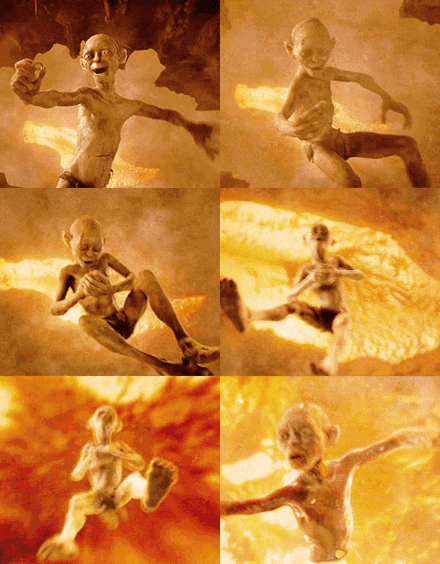
This is the section where we get the quote about technical, out-of-context rules. In this case it follows a situation where a character deliberately takes a suicidal action (like diving into an active volcano without protection). Normally characters have control of their 'final moments', but this might supersede that - you disappear into the lava and dissolve.


Image
But Smeagol thought he had narrative control!!!!


In this chapter we also have an overview of the five chapters and Appendix - we'll cover them as we get to them. That's followed by tools for play including players, GM, dice, tokens, game cards, and optional maps and minis. Just a couple of things to pull out from this section.
As a GM, it’s important to remember that you’re not an
antagonistic force against the players. Though you’re the
one introducing the dangers and complications in a scene,
the thrilling challenges you provide are meant to let the
players showcase their characters’ strengths and face their
characters’ flaws. Be a fan of the characters and a collaborator
with the other players at your table.
Tokens are used to mark certain abilities as active, and sometimes to represent adding to dice. Something like glass beads (different color for every player) might be appropriate; players will need between 7-15. The included cards are also required, but available to print (presumably for free).

The final page of the introduction outlines Player Principles.

They are:

-Be a fan of your character and their journey
-Spotlight your friends
-Address the characters and address the players
-Build the world together
-Play to find out what happens
-Hold on gently

Each is followed by a paragraph that explains what a good player will do to make the game work.

Finally, the chapter wraps with instructions that the table should be a safe place where everyone is respected and empowered. Using session zero tools (covered in chapter 3) to determine what topics might be unwelcome is covered later, but as part of the intro it needed to be said up front.

We've only covered 11 pages, but insomuch as the intro hits the highpoints of everything else we're going to discuss and lays out the objectives and 'social contract' elements, I figured it was worth a close read. Next up Chapter One - Preparing for Adventure (ie, Creating Characters).

Re: Let's Read - DaggerHeart RPG (New Critical Role RPG)

Posted: Sun Aug 24, 2025 9:38 pm
by deaddmwalking
Chapter 1: Preparing for Adventure

This is a long chapter - 76 pages long. The reason it's so long is mostly because it details the classes and races, and most of those get at least a page. Plus artwork it creates a pretty voluminous section. Prior to the long sections there are quick overviews of each of the nine steps of character creation. Many of the steps relate to information covered more in Chapter 1 or later in Chapter 2, especially the mechanics.

For example, we assign attributes, but we haven't had an example TNs yet. It's implied that we are rolling 2d12 and adding attribute modifiers, and it appears that you may have additional bonuses from your background. In this section we also learn that hitting a first level character is between a TN 7 and TN 10 (depending on class) - but a fair bit of that is based on applying a variety of information that isn't yet presented in a comprehensive whole. But let's take it in order.

World Overview (1 Page)

There are three planes of existence; the mortal world, the hallows above (divine realms), and the circles below (where demons live). There's some world-building with the Forgotten Gods being defeated by the New Gods and the enemies of the New Gods being the Fallen Gods imprisoned in hell. Most of the Forgotten Gods created aspects of divinity that exist on the mortal plane. None of this gives very much information and all the terms appear to be very generic.

I believe that the concept of Forgotten Gods is oxymoronic - why would anybody call them forgotten unless they were, and if they were, why would anyone talk about them at all?

Magic and Spells (1/2 Page
If you get spells, you'll get cards. Cards describe the spell you cast. There are pictures, but nothing that actually describes how they work.

Flavoring your Game (1/2 Page)
If you have magic, you could describe it as gadgets (the example they provide). Basically you can describe things however you want as long as they remain the same mechanically.

Character Creation Overview (7 pages)

There are 9 steps described; they are:

Step 1: Choose Class
Step 2: Choose Heritage
Step 3: Assign Stats
Step 4: Additional Character Info (derived stats)
Step 5: Starting Equipment
Step 6: Background
Step 7: Experiences
Step 8: Domains
Step 9: Connections

I'm confident that looking at this list experienced players will mostly have a sense of what you're doing. Each of these takes about a page and provides a bit of the information, but the REAL information comes later in the chapter or later in the book.

Classes

The book includes 9 classes, each of which includes a choice between 2 subclasses. Each class has access to 2 domains (covered in Step 8), but they're essentially Power Sources. If you have 9 Power Sources and Each class has 2 you'd have 72 'combinations'. Since Grace/Midnight is the same as Midnight/Grace, you divide that by 2, so you have 36 possible combinations of power sources. While procedurally generating classes that combine each element seems relatively easy, they've organized the classes into a circle with each class sharing a Domain with neighboring classes. This is a situation where a picture is worth a thousand words:


Image

So, taking a look at the chart above, you can see that a Warrior combines Blade and Bone, while a Guardian combines Blade and Valor. But there's no class that combines Blade and Midnight (and no way to create such a class without destroying the circle.

There are also some strange choices in my mind as far as how classes are related. You might expect the Wizard/Sorcerer to share Arcana as a domain, but instead Druid shares Arcana.

At this point, each class is listed with a one sentence description of the subclass. As a Druid you can play Warden of the Elements if you want to embody the natural elements of the wild, or play a Sorcerer Elemental Origin to channel the raw power of a particular element, or play a Wizard School of War if you want to utilize trained magic for violence.

The class descriptions don't really give you enough information to even quickly make a decision - many just seem similar. Even if a class sounds good to you, choosing your sublcass would be a challenge. For the Guardian you can Play a Stalwart if you want to take heavy blows and keep fighting or Play a Vengeance if you want to strike down enemies who harm you or your allies. I think that not dying and striking down foes are going to appeal to just about anyone, so without more detailed class mechanics it's impossible to say what's good or bad. I'll plan on doing a more detailed look at classes when they come up later in the chapter, but I'm happy to address questions later.

Heritage
There are 18 listed ancestries (races) and 9 listed communities (region). You could be a Seaborne Orc or a Underborne Elf. These each have cards, and none of them are described here, so what these decisions mean will also be covered later.

Traits (attributes)
There are six traits; Agility, Strength, Finesse, Instinct, Presence, and Knowledge. That's pretty much the D&D stats, except no Constitution and Dexterity is broken over two stats.

Attributes are given as their modifier (a good thing). Everyone gets the same array: +2, +1, +1, 0, 0, -1. Gut says that these modifiers are very small relative to the dice. On a straight attribute roll (2d12), the difference between someone who is 'the best' at something ' and 'the worst' at something is the difference of 3. With 2d12+2 there's a 50% chance that you have a 15 or less; with a 2d12-1 there's a ~40% chance that you have a 16 or better. That ends up working out to about a 20% chance that the 'uncoordinated' character rolls higher than the 'coordinated' character on any given roll.

You can get other bonuses from your background/experiences, and potentially from a variety of abilities.

Step 4 - Derived Stats
Evasion is the equivalent of D&D's Armor Class - it's the TN required to hit you. It's determined exclusively by class, with a number from 7-10. When an opponent misses you, you can flavor it however you like. As a wizard you can conjure a magical shield that blocks the blow, or as a ranger you can dodge. But that's just flavor - it's just that your opponent didn't hit, so you're claiming some action on your part.

Rolling a straight 2d12 would mean hitting a 7 90% of the time, and a 10 75% of the time. It said the GM uses a d20, so it's really more 70% or 55%.

There are two types of damage characters take. Hit points are pretty much like D&D hit points but you don't directly apply weapon damage rolls to them. Players start with fewer Hit Points than in standard D&D; a bard at 1st level has 5, while a Guardian has 7. Armor reduces the severity of the damage (also covered later). Besides hit points, characters suffer Stress. All characters get 6 Stress to start. Certain abilities require you to take on Stress, so more on that later, too.

Fear and Hope
Each time you roll 2d12, one of the dice represents fear and the other hope. If you roll higher on the Hope die, you get an additional point of Hope (to a maximum of 6). You start with 2 hope right off the bat. Hope can be used to power abilities, so having it available to you is good. So why don't you just find excuses to roll dice to get up to your maximum?

Well, when you roll higher on your Fear die, the GM gets a point of Fear, which they get to use to make your life harder. Since there's a coinflip chance of either die rolling higher, roughly half the time you'll generate hope and the other half fear. I say mostly because it doesn't say explicitly what happens if you roll doubles, but presumably that would mean that you generate neither currency (since neither die is higher than the other).

Step 5: Choose Equipment

So you basically just get to pick a weapon and armor from the tier 1 list (much later in the book) that represent basic gear. For weapons this includes things like a broadsword (1d8 physical damage) and Chainmail.

I mentioned that hit points are a lot lower than you might see in D&D. It looks like the rules really expect you to have armor of some type, because not having armor is pretty brutal.

Every 1st level character has a 'damage threshold', a multiple of their level. They are 3x (severe), 2x (moderate) and less than that (light). So at 1st level, anything that does 2 damage is a moderate hit, anything that does 3 damage is a severe hit. Wearing armor changes those numbers by a lot. Chainmail adds +7. So with chainmail your light damage would be anything less than 8, moderate would be 8-15, and severe would be 16+.

Each time you take a severe wound, you mark off 3 hit points; any time you take a moderate wound you mark off 2 hit points; any time you take a light wound you mark off 1 hit point.

Also your armor can only take a few hits before it stops providing protection. For Chainmail it's 4 hits. The most for any armor, even wonderous magical Tier 25 armor if it were to exist would be 12 hits, after which time it needs to be repaired before it can be used again.

So, if you're a bard and someone is hitting you for 1d8 damage, they're really determining whether they score a light (1-7) or moderate wound (8). If they score a critical hit (also discussed much later) they'll do 1d8+8 damage, so there's a small chance they do a severe wound. So basically you can most likely get hit 4 times, each doing 1 point of damage, and then your armor is gone, and if they hit you again you're going down because you only had 5 hit points to start with.

To me that feels like a lot of effort - I'm pretty confident I could think of more elegant ways to handle that, but it might matter how much variety of armor there is.

There are more steps to creation, and much much more detail on the races, classes, communities, etc, in this chapter, so we'll pick up with Step 6 next time.

Re: Let's Read - DaggerHeart RPG (New Critical Role RPG)

Posted: Mon Aug 25, 2025 1:20 am
by deaddmwalking
Summary of the Main Mechanical Points So Far

Keeping in mind that we're in an overview section and the actual coverage comes later, the main differences from standard D&D are that you roll 2d12 instead of 1d20; each d12 is associated with a currency; one for helping you and one for hurting you; there are limits to how much of that currency you can accumulate.

Those currencies are Hope and Fear, and they allow you to activate abilities.

There are two 'condition' tracks, hit points and stress. Using abilities can accumulate stress while taking hits can cause hit point damage. This sounds like Lancer has been described to me.

Relative to D&D, the number of hit points is very small. But you're not directly applying rolled hit point damage. Instead there are thresholds for damage; every hit does at least one damage but if you exceed a threshold you do 2 damage, and if you exceed double that threshold you deal 3 damage. Armor appears to have a very big impact on damage thresholds and level seems to have a minor impact.

Step 6: create your background

In addition to choosing weapons and armor in the last step, you also get a bunch of minor equipment and pretty much any minor items that you want if they don't provide a mechanical benefit.

For background, they have several questions they ask - they're just suggestions and you can make any background you like, really. Since play starts at Level 1 (at least, it assumes that and suggests that for new players) I'm surprised there isn't anything about avoiding an epic background that exceeds a character's competence. They haven't done anything to establish what a 1st level character OUGHT to be able to do, or talked about their abilities, so this remains very abstract.

Step 7: Experiences

These are kinda background traits, but they actually matter in play. You get two to start and whenever it applies to something you want to do, you can use a Hope point to pick up a +2 on your roll. If both of your experiences apply, you can spend 2 Hope and get a +4 on your roll. Keep in mind that you're 50% likely to pick up a new Hope on this roll, so there probably isn't too much reason not to use them generally. There's some explanation of what a good Experience is - not too broad so it applies all the time (Focused) or too limited mechanically (One-Hit Kill). An example of a 'good' Experience is 'Assassin of the Sapphire Syndicate'. Assassin would be okay, but it doesn't clearly offer out-of-combat options. The social aspects of being connected to a syndicate make it better.

They have 5 categories of sample experiences including backgrounds (Circus Performer), characteristics (Friend to All), specialties (Swashbuckler), skills (Quick Hands), and phrases (No One Left Behind). There are about a dozen in each category.

Step 8: Domain Cards
So every class is associated with 2 domains (see the chart above). At 1st level you an pick two 1st level Domain cards. These are abilities (maybe spells, maybe not) that you can choose to activate. You can choose one from each of your domains, or two from the same domain. They strongly suggest that different players avoid taking the same domain powers - since each 'neighboring class' on the chart shares a domain with a class, it's definitely possible to have characters with access to the same domain.

It's not talked about here, but you're limited to how many cards you can have 'in hand'. As you gain levels you gain more cards and if you want to activate a card that's not in your hand you'll pay a cost (probably stress). Skipping 300 pages to look a Domain Cards, the Arcana Domain (Sorcerer/Druid) has Rune Ward, Unleash Chaos, and Wall Walk as 1st level options. Rune Ward allows you to spend 1 hope and reduce damage by 1d8. To Unleash Chaos you make a Spellcast roll against a target. You can deal 1d10 per Spellcast trait. Recharging it costs 1 Stress. I don't know what your Spellacasting Trait is yet (I don't think that's one of the six traits we've already talked about). Wall Walk lets you spend 1 Hope to let a creature walk on walls until the scene ends.

Bone (Warrior/Ranger) offers Deft Maneuvers (take a stress to get to anywhere on the battlefield without having to make a roll); I See it Coming (spend 1 stress to get +1d4 to your Evasion); or Untouchable (gain a bonus to your Evasion equal to half your Agility.

At this point it appears that your Traits range from -1 to +2, and 5/6 of them are +1 or less. Untouchable seems like a really useless power at 1st level where the maximum bonus you can get is +1 assuming you put a 2 in Agility. Getting +1d4 is much better. Maybe you can raise your Traits quite a bit somewhere, but since Domain Powers are supposed to be pretty important I'm already concerned that there are some bad choices.


Image
You've chosen Untouchable???


Step 9: Create Connections
This is how you know the other characters.

The next couple of pages show a sample character sheet filled in for a Sorcerer. I found a similar one on Twitter, so check it out:


Image
The picture above lists a minor damage threshold of 3 (major 8 and severe 13). That appears to be something that changed in the playtest. What I see is anything less than 7 is minor damage. It appears that at one point you had a minor damage threshold and anything below that dealt one Stress. Since Stress is limited, taking stress might be worse than taking damage, I'd expect, depending on the situation. There's a second page for the sample but it mostly has suggestions and you circle the ones you like. For example, you can have Skin the color of: ashes, clover, falling snow, fine sand, obsidian, rose, sapphire, wisteria.

The bottom 3rd of the second page has level-up instructions. The game has four tiers; tier 1 (1st level only), tier 2 (2-4), tier 3 (5-7) and tier 4 (8-10). Each time you level you get to choose two options from a list. Some options can only be chosen once, some 2x and some 3x. Each has a box that you check when it is done. Some instruct you to 'check' something else. For example, at level 2 you can choose a +1 bonus to two traits. Then at level 3 you can choose a +1 bonus to two traits, but they can't be the same ones you did the last time. At 5th level you can 'erase' those marks', so you can do it again.

Domains
There's another section giving pictures of the Magic:the Gathering like symbols for each of the nine Domains, and a color. Each has a paragraph description. To me it feels a little like the D&D 3.x explanation of why Mialee is chaotic because she sees her magic that requires intensive study as an art and Ember is lawful because she sees her art art that requires intensive study as a science - or something similarly contradictory and vague.

Arcana is the domain of innate and instinctual magic. Sage is the domain of the natural world and the power of the earth to unleash raw magic. Codex is the domain of intensive magical study. Splendor is the magic to both give and end life.

This is followed by a 'reading domain cards' infographic. Every card has a level and a symbol/color denoting the domain. The recall cost (paid in Stress) can bring a card to your hand if you hadn't 'prepared it' and have a full hand. It also lists a type (ability/spell/grimoire) and then rules text that explains what it does.

We're now on page 28 and we're heading into the full class descriptions - 24 pages of class descriptions (9) and sub-classes (2 per).

Each class determines what domains you have access to, starting evasion (AC), starting hit points, items you get to start with, a unique class feature (or more than one, maybe, sometimes), and a special move you can make by spending 3 hope.

Each subclass determines your Spellcast Trait (if you cast spells). So yeah, apparently the reason I don't know what your Spellcast Trait is is because it depends on your class; presumably Intelligence for Wizards and Charisma for Grace casters. :)

Subclasses also determine a Foundation feature, Specialization features (something you gain when you level up), and a Mastery Feature (also granted at higher levels). It warns you that the class descriptions have a ton of information related to the rules that you haven't learned yet and will be covered in the next chapter. Which is probably true, but I've looked ahead and I am afraid...very afraid.

Covering every class and sub class seems like it would take quite a long time, so I'm going to look at just a couple to provide a sense of what we're talking about.

Seraph
Remember the cover picture? Remember the winged warrior flying around? Apparently that's a class. Seraphs are divine fighters and healers imbued with sacred purpose. Basically paladins.

They have access to the Splendor and Valor domains, get an Evasion of 9 and 7 Hit Points. They can spend 3 hope to remove a hit point of damage from an ally (remember that mostly means +1 hit at 1st level). Both subclasses use Strength as their Spellcasting Trait. At the beginning of each session, roll 1d4 for each point of Strength you have. These are called 'prayer dice'. You can use a die to reduce incoming damage, add to a roll's result after it has already been rolled, or gain Hope equal to the result - for yourself or an ally.

The subclasses include Divine Wielder (you get a legendary weapon) but I'm going with Winged Sentinel - you fly. While flying you can take 1 stress to pick up a willing creature and carry them, or spend 1 hope and deal +1d8 damage on an attack. When you're flying you gain advantage on Presence Rolls. When you succeed with Hope on a Presence Roll you can either gain +1 Hope (normal) or take away 1 fear from the GM. I don't know what rolling with advantage means here - it hasn't come up before. It says Specialization happens at 'higher levels' but nothing here says when or how.

Eventually you get the Mastery Features of Ascendent (+4 to your Severe Damage threshold) and Power of the Gods (deal 1d12 instead of 1d8 while flying). Not gonna lie, an extra 2 damage as a high level ability only usable while flying seems pretty lame.

So I'm looking at domain cards. Remember how we have a class ability to spend 3 hope to clear 1 hit point? I could take a spell that lets me heal 1 hit point for 2 hope instead, but it also takes longer. Probably better to take Beacon. Make a spellcast roll and if you succeed a target within far range takes (d8xProficiency)+2 damage and becomes vulnerable until the condition is cleared.

So what is proficiency? It's 1 at level 1, but as you gain levels you can raise your proficiency. All regular weapons deal the base weapon damage x proficiency, so it's a scaling damage mechanic.

One of the Valor abilities is Bare Bones. When you're not wearing armor, you count as if you are, and the base damage is 10/20 at 1st level. That seems pretty solid. Combine it with 'I am Your Shield' and you can take your allies damage and apply your armor multiple times (taking stress for each time).


Wizard
Domains: Codex and Splendor
Evasion: 11
Hit Points: 5
Class item: book or harmless pet
Hope Feature: Spend 3 hope to force an enemy to reroll an attack or damage roll
Class Features: Prestidigitation - at will minor magic. Strange Patterns - pick a number between 1-12; whenever you roll that number on a duality die gain a Hope or clear a Stress.

We could choose School of Knowledge, but we're going with School of War.


Image
School of Rock wasn't an option


We use Knowledge as our Spellcast Trait (as does a Knowledge caster, so maybe our CLASS is really what determines it, but maybe when they release more subclasses that'll change???). The Foundation Features are that a I get +1 Hit Point and when I succeed with Fear on an attack roll, I deal +1d10 magic damage.

When I get specialization, I can conjure a shield which lets me spend 2 hope to add my proficiency to Evasion. I also get Fueled by Fear where my extra magic damage increases to +2d10.

When I get Mastery I can take Stress to deal +1 Hit Point (not damage, an actual hit point); I also get Have no Fear and the damage from before increases to +3d10.

Codex Domains give you 3 unrelated spells (that codex is unique). My Battlemage can take Book of Ava or Book of Illiat, or Book of Tyfar. Of course those names don't mean anything to you or to me, but they determine which 'spells' I can cast. Ava gives me 'push someone to far range and take 1d10 damage', spend a hope to give someone +1 Armor Score, get an ice spike to deal Proficiency x d6 damage to someone. If I chose Illiat instead I would put someone to sleep, or fire magic missiles, or spend hope to telepathically communicate.


Image
I know they said I could flavor my magic, but apparently Wizard Elsa is not the right way to go


For reference the following is a list of Class(Subclass 1/Subclass 2)
Bard (Troubadour/Wordsmith)
Druid (Warden of Elements/Warden of Renewal)
Guardian (Stalwart/Vengeance)
Ranger (Beastbound/Wayfinder)
Rogue (Nightwalker/Syndicate)
Seraph (Winged Sentinel/Divine Wielder)
Sorcerer (Elemental Origin/Primal Origin)
Warrior (Call of the Brave/Call of the Slayer)
Wizard (Knowledge/War)

Just looking at class abilities, I feel the way I do about 5th edition. They just don't seem that interesting and your class does the same thing at all levels of play. Domains may really impact that as I haven't looked at many of the Domain Powers. I will say that I'm quite disappointed with the Wizard. I would at least prefer that the spells on each card share some kind of theme. Particularly for a new RPG, I would hope they'd spend some effort on a metaphysics of magic to explain what magic can and can't do and why. For any RPG, I highly recommend incorporating Sanderson's Laws of Magic.

I'm taking a break, but if anyone wants to know more about any of the classes/subclasses, let me know. Otherwise we'll hit Ancestry next.

Re: Let's Read - DaggerHeart RPG (New Critical Role RPG)

Posted: Mon Aug 25, 2025 3:11 am
by Thaluikhain
deaddmwalking wrote:
Sun Aug 24, 2025 3:49 pm
Core Mechanic

Daggerheart uses Duality Dice. This is a pair of d12s, one representing Hope and the other Fear.

You add both dice together, adding any modifiers, to hit a target TN. Depending on whether Hope or Fear contributed more to the roll, which will impact the narrative.
Interesting, but then since you've not way of influencing the result, not mechanically that different from tossing a coin (excepting ties). If you rolled a d12 for one, but could roll a d12 or d6 for the other, risking lesser numbers or risking one set being higher than the other, you'd at least be choosing something.

Re: Let's Read - DaggerHeart RPG (New Critical Role RPG)

Posted: Mon Aug 25, 2025 12:50 pm
by deaddmwalking
There hasn't been an example of play yet, which actually would have been a really nice feature. I know the 3.0 PHB had something like that - describing each player taking their turn through a round of combat (edit - not until page 115 of the 3.0 PHB)- and I think that something like that EARLY would have been helpful.

I can see why having some choices about whether to risk accumulating fear might be fun - it definitely would give a decision point. Being able to choose not to possibly gain hope can be a trade-off, or using smaller dice 'normally' but upgrading to Duality Die to increase chance of success could also work.

From the designer's view, getting Fear and Hope are both good, because they give fuel to drive the game. I'm not sure that the players will see it that way - giving fear to the GM is giving him license to make your character's life more difficult (in some manner that we haven't really learned yet).

I'm sure I'll have more thoughts about those after getting through all the 'DM Moves' that cost Fear.

Re: Let's Read - DaggerHeart RPG (New Critical Role RPG)

Posted: Mon Aug 25, 2025 5:12 pm
by deaddmwalking
Since looking at classes, I've spent more and more time reflecting on the features and I want to say how disappointed I am with how limited the classes are. For a game that talks so much about a collaborative narrative, it seems strange to me that classes have so few meaningful abilities. In standard D&D, you would expect just about any wizard to be able to magically start a fire. That's not even considered an important power - it's a 0th level spell. It has few in-combat benefits, but in terms of shaping narrative, it's a really useful spell. You can use oil-soaked rags to create a distraction, or you can quickly light a readied torch ambushing someone in the darkness - it gives you an ABILITY that lets you creatively create a scene.

The powers that these classes give you just don't even rise up to that level.

I'm going to look at another class because this class gets an ability that you actually want EVERYONE to have some ability to access.

Rogue - Syndicate

As a rogue, you get Evasion 12 and 6 Hit Points. You also can have a set of forgery tools or a grappling hook. For 3 hope you can get a +2 bonus to Evasion until you're next hit, then it goes away. They have two class features - cloaked and Sneak Attack. Cloaked is like Hidden, but if someone moves to where they could see you and you don't move, you remain hidden. If you attack or end a move within line of sight you are no longer cloaked (so probably no longer hidden, either). When cloaked (or when another ally is in melee range with your target) you get to add Tier x d6 to your damage (ie, 1d6 at 1st level, 2d6 at 2nd-4th level.

Okay, that class kinda does the absolute bare minimum of a 3.x rogue - you have a special benefit when sneaking and you can do some extra damage. But all the other abilities that you expect to see like picking locks? Not there. Now that's not really a problem - you take Locksmith as a background whether you're a Rogue or a Seraph and you can probably open the lock, but the CLASS doesn't give you much.

You can pick two Domain abilities from Grace or Midnight. Grace includes 'deft deciever' - spend 1 hope for advantage on a roll to trick someone; 'enrapture' - they only focus on you and you can take a stress to make them take a stress; or 'inspirational words' - get tokens equal to Presence; spend one to clear a stress, clear a hit point, or give a hope to an ally. From the Midnight Domain you could take 'Pick and Pull' for advantage on checks involving locks, traps, or stealing from people; 'rain of blades' to summon a throwing dagger to deal proficiency x d8 +2 damage; or 'uncanny disguise' - mark a stress to get a disguise. You can take a number of actions while disguised equal to your Finesse; after you have taken that number of actions your disguise ends. While disguised you have advantage on Presence rolls to avoid scrutiny.

So picking a couple of items gets you closer, but you still can't do as much as a 1st level 3.x rogue. Having 'more abilities' doesn't give you more spotlight. It's good that you can do a bunch of things well.

But let's get to my real complaint - the subclass.

Syndicate
Spellcast Trait (Finesse)

Foundation Feature: Well-Connected
When you entter a town, you know somebody who could be helpful; you have to choose a complication (like they owe me a favor but they'll be hard to find or we didn't part on great terms).

That's it!!!

When you get a specialization feature your contact can give you a benefit like a handful of gold or a mundane object once per session. When you get mastery you can use the contacts feature 3x instead of once, and they can also take a hit for you. There are a couple more minor things, but this is your CLASS ABILITY.

In a narrative game, saying 'I think I know a guy who might help' should be something ANYONE can do. That's a good way to give players the ability to help shape the narrative.

I don't think this game wants that.

I think the game expects the DM to tell a story, and the players to use their abilities in specifically detailed ways that amount to little more than action cues in a script. The GM says 'you see dark shapes moving through the alley and they don't look friendly' and the Rogue dutifully says 'I hide, using my Cloaked ability', sneaking up to get a better look.

But that's what the GM wanted - as you sneak up you can see that they're surrounding a small child. One of them is cracking his knuckles threateningly and says 'your father didn't pay the protection money. If we hurt him he won't be able to work, so he knows that we're taking it out of your hide'.

We haven't gotten to combat yet, but I think the PCs can handle the thugs without too much worry. There's some uncertainty with some rolls, and you might generate more fear than you wanted, but basically your NARRATIVE abilities are pretty non-existent.

This entire sub-class could be a 3.x feat. In fact, it should be. This is something that players should pick up, and it should get more useful as they advance tiers. But it could be equally useful for a divine crusader or the wizard who is a prospective member to the Circle of Sequestered Magic.

There's something to be said for 'this ability always produces something', but pretty much every character should have an ability like this - limited in some fashion, both by how often they can use it and how likely it is to be successful. Adding new NPCs that the PCs know actually makes the GMs job easier in a lot of ways. And if the PCs are thinking 'I could use a phone a friend', that's a clear sign that they want to impact the narrative, so LET THEM.


I also wanted to talk more about choosing Flight as your class ability as a Seraph. Flight is really helpful when nobody else has it. You may be able to attack your enemies and they can't hope to hit you (at least, if they only have melee attacks). Of course, your friends aren't so lucky. Being able to survive an encounter doesn't mean much if everyone else dies. But flight is also very limited - you can't use it in the dungeon. Once the GM decides that the mcguffin is in a dungeon, your class feature doesn't do much. Even if there's an outdoor encounter, the GM must add challenges that threaten the flying character. Before flight all the gnolls carried scimitars; now that someone flies they all have crossbows, too. While this is and must be so, it's not just me saying it.
Page 175 wrote: Flight and Other Features
When building battles, consider the abilities and spells your PCs have. For example, if they can fly, consider adding enemies that can fly or attack distant targets, ensuring the combat remains dynamic and challenging for all PCs. Remember that your players probably chose their features because they want to use them! You have the chance to craft engaging opportunities for the players to show off those powers in exciting ways.
So the classes just don't offer many options, and outside of a class you don't get to do the things that everyone should do (unless the GM modifies the rules with the assent of all the players, which the game designers would then claim we're following the rules by modifying the game to suit our preferences), and when you have abilities the GM is tasked with making sure that carefully curate the challenges to make sure that your advantages aren't extreme.

That's bad. But there's more!


Image
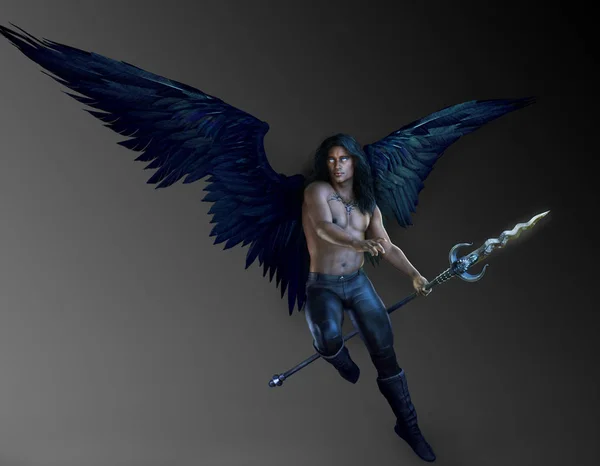
Let's say this image inspired me to make a character


The rules encourage me to 'flavor' things without changing the mechanics, so I could be a Seraph with black wings that was imbued with sacred purpose, but that doesn't feel 'demon background' enough. Their version of Tiefling (Infernis) doesn't offer a winged option, so the Seraph Class is a good mechanical way of getting that feature. But the demonic background isn't well represented by the Domains of Splendor and Valor. Doing a Domain Swap and picking up Grace (deceit/enrapture/inspire) and Midnight (Disguise) might better emulate someone of Succubus origin. I can flavor the healing touch that comes with the class pretty easily, but picking those domains would make more sense.

So why isn't that an option?

I mean, outside of making the case to the GM that it's totally reasonable and it should be allowed?

If everyone has to say 'I'm a Seraph but I took Alternate Domains of Grace and Midnight' that makes communicating ability and role a little more complicated, and I understand that.

You could have an awesome idea for a Necromancer that combines Bone and Splendor, or a Dark Wood Hunter combining Midnight and Sage or a Shield Guardian using Valor and Bone as you transform your body into a shield for others. I said earlier that there are 36 unique combinations of the nine items (9x8 = 72, divide by 2 because Grace/Sage is the same as Sage/Grace = 36). That may be too many combinations to test, but the individual powers appear so limited, and even if a combination that seems too useful is uncovered, going back to the social contract is mostly fine.

Maybe Darrington Press has plans to release hundreds of new classes and all the other combinations of Domains. Even if that's the plan, people will still buy it even if you give us the building bricks and full permission to mix/match.

Okay. I had planned to come back to this rant after reading everything else in order to be more fair, but I don't think there's anything that says 'go ahead, freely choose domains - that's allowed'.


Image

Next time Ancestry (races) [probably]...

Re: Let's Read - DaggerHeart RPG (New Critical Role RPG)

Posted: Mon Aug 25, 2025 6:40 pm
by deaddmwalking
Ancestry

The beginning section explains that players choose their appearance and can potentially work with the GM to replace ancestry features. Every ancestry provides two features. You can also have mixed ancestry, in which case besides determining our appearance you also pick one ancestry feature from each ancestry. When doing so, you must pick the first option from on and the second from another. Generally, the second feature is the 'good' ability, so getting two of those would be 'better' than two of the first ability. I think some of the abilities are overrated but that's hard to say without more experience.

We're going to do these quickly, a couple of lines per race.

Clanks are like Warforged. Your ancestry features are a +1 to one Experience chosen at 1st level (so a +3 instead of +2), and when taking a short rest you can do something that normally requires a long rest. Since class features often reset after a long rest, being able to do those on a short rest seems pretty powerful. On the other hand, if the rest of the party can't recharge, you're stuck with a long rest even if you could do a short rest. There's nothing about not being normally alive - since healing spells all remove hit point damage and/or stress, they all work normally for clanks.

Drakona are Dragonborn. Your scales make it so when taking Severe Damage (3 hit points normally) you can convert one to Stress, taking 1 less (2 instead). It's written weirdly in a way that implies maybe there are exceptions to how things normally work, though I haven't seen any yet. To be accurate it says: When you would take Severe damage, you can mark a Stress to mark 1 fewer Hit Points. They also get a breath weapon that deals 1d8 at 1st and 2d8 at 2nd.

Dwarves are Dwarves. When taking minor damage, they can take 2 stress instead of taking 1 hit point of damage. They can also spend 3 hope to reduce physical damage in half. Keep in mind that 6 is the maximum amount of hope available (and 2 is how much you start with) so an ability like that is fairly limited.

Elves are Elves, and they're better than you.

Actually, they're not. For the first time, ever, probably, they're not. They can take 1 Stress to get advantage on a Reaction Roll, and they can take a downtime move during a rest.


Image
Several Ancestries appear to be inspired by Pan's Labyrinth


Faeries are bug people, at least in most of the art. It says they can look humanoid so you can be a pretty Neverland fairy if you want. Faeries can spend 3 hope to allow themselves or a willing ally to reroll their duality dice. They also have Wings meaning they can fly. While flying you can spend a Stress to get +2 Evasion against an attack. They're surprisingly big - 2 feet to 5 feet on average, but there aren't apparently any game mechanical effects from being 2 feet tall instead of 7 feet tall.

Fauns
You can leap to anywhere in Close range using normal movement. The game uses zones like close, far, melee. This is used to bypass barriers within the zone. Their special ability is a Kick - they can take 1 stress to deal 2d6 damage and move either yourself or the target to Very Close Range.

Image
Could be this, though I still think inspired by Pan's Labyrinth more
Firbolgs appear to be minotaur people. When you move from Far or Very Far range you can take 1 stress to deal 1d12 damage to all targets within melee range. That damage doesn't scale with level, so it probably means 1 Hit Point to everyone when you come close - it's not nothing but you're not going to be dropping multiple powerful foes just by showing up. Their 'good ability' is the ability to ignore taking stress 1/6 of the time. I'm pretty sure just giving them +1 Stress would be equivalent, but people like to gamble.

Fungrils are fungus people like Myconids. They don't have to be girls even though I keep reading fungril as fungirl. That wouldn't be fair to the funguys.


Image

Like in Star Trek Discovery, the whole world is connected by a mycelial network. If you can succeed on a TN 12 Instinct Roll you can talk to other mushrooms anywhere. You can also spend 1 stress to extract a memory from a recent corpse.

Galapa are Turtle People.


Image
Authorial Note: I like Oogway from Kung-Fu Panda better


Not sure any of their abilities are good. They gain a bonus to damage thresholds equal to their proficiency (1 at 1st level, 2 at 2nd level, 3 at 5th). They can also take a stress to get disadvantage on action rolls, be unable to move, but gain resistance to physical damage. Since it's relevant, resistance means you take half the normal damage. So if someone hit you with a Faun Kick for 12 damage, you would treat that as 6 damage. If 7 is the threshold for moderate damage, you'd take 1 hit point instead of 2.

Giants get an extra hit point and can treat anything that requires Melee range as if it had Very Close Range instead.

Goblins ignore disadvantage on Agility rolls (meaning if they didn't have disadvantage they wouldn't have anything to ignore). Giving them Advantage seems like it would be nicer. Once per rest they can take 1 stress to force someone to reroll an attack against them or someone nearby.

Halflings give everyone in the party +1 Hope. That means you always want your friends to be a halfling, but you don't want to be one yourself. Oh, and the 1/12 of the time that you roll a 1 on a Hope Die during your duality roll, you can reroll it. There's no limit to that and it doesn't require taking stress or anything, so effectively your hope die is 2-12.

Humans get +1 stress and can spend a stress to reroll a failed roll that included an Experience bonus.

Infernis are Tieflings, but they don't get wings. Well, I suppose they could have non-functioning wings for aesthetic purposes, but none of them have it in the art. When Infernis roll higher on their Fear die, they can spend 2 stress to make that their Hope die. They also have advantage on hostile creatures. If you're willing to give up the benefit of advantage on intimidate, this would make a good feature to give up with mixed ancestry. You could be half-infernis and half-fairy so you get flight! You can't pick anyone up (even willing people), or at least your flight ability doesn't SAY you can, the way the Seraph can, so even though this is a narrative game that's just not something you can do.

Image
This image is brought to you by MY TAMAGO


Katari are cat people. They can be big cat people with lion heads, or little cat people with cat ears and tails, or they can be the monstrosity that is Cats. Cat people can spend 2 hope to reroll a hope die on agility checks. If you roll over your fear, you'll get one back, but that's still a net loss. You can also make an Agility Roll to rake someone with your retractable claw. If you succeed, they become Vulnerable (meaning all rolls against them have Advantage). There are lots of ways to make a target Vulnerable but the GM can spend 1 fear to Spotlight them and remove the condition.

Orcs are normal orcs, but with even bigger lower teeth than you'd expect. When they have 1 Hit Point left, attacks against them have disadvantage. I don't think that's likely to save them. When they succeed on an attack in melee range, they can spend 1 hope to deal an extra 1d6 damage. That only helps if you can deal enough extra damage to move up a damage threshold range, and I don't know if you even know what opponents have for that.

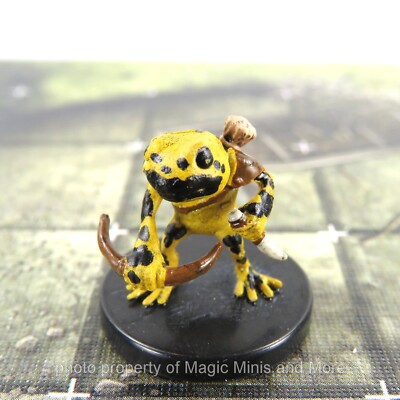
Ribbets are frog people. Frog mins are cool because you can paint them in all kinds of cool ways.
Image

Ribbets can move and breath underwater (which isn't actually what frogs do, at least as adults), and they can use their tongue to grab things within close range by using 1 stress. Their tongue can deal Proficiency x d12 damage.

Simiahs are monkey people. They get advantage on Agility rolls for climbing or balancing, and a +1 Evasion.

That covers the ancestries. Next up is Community.

Re: Let's Read - DaggerHeart RPG (New Critical Role RPG)

Posted: Mon Aug 25, 2025 8:51 pm
by deaddmwalking
Communities

While backgrounds are a thing that have no mechanical effect, communities do. Each community gives you a feature. On the one hand, I'm in favor of having additional sources to distinguish otherwise similar characters, but on the other it's a bit of a problem if the mechanics incentivize you to play a character you don't want.

Highborne - You're a Karen and you get advantage on rolls to talk to nobles, negotiate prices, or leverage your reputation to get something. If you're a rogue from the streets that now makes your living hobnobbing with the elite, you wouldn't take this background but you might want that advantage.

Loreborne - You grew up on a university campus or something. You get advantage on rolls that involve history, culture, or politics of prominent people.

Orderborne - Record three sayings; if one of them applies to an action you can roll a d20 for your hope die instead of a d12.


Image
Boxer from Animal Farm has a good one: I will work harder. I can't imagine a situation where that COULDN'T net you your bonus. I'm sure we could collectively come up with a few that would really cover the gamut. 'Pain is temporary, but glory is forever'. 'Think before you act'.

Ridgeborne - You grew up on the edge of a cliff so you have advantage navigating harsh environments and using survival.

Seaborne - You grew up on the water (or near it). When you roll more fear than hope, you get a token (up to your level). When you're about to make an action, you can spend a token for a +1 before you roll.

Just an aside, it would be nice if your bonus in this case could be applied to a specific die. Maybe you roll 6/6. You could apply it to hope so it counts as a 7. Or maybe you want Fear to win. That'd give you a new token. I don't think it works like that - the +1 is just a generic bonus independent of the dice rolls, but that seems like it would be cool.

What does that have to do with water? Well you're used to going with the flow.

Slyborne You have advantage when dealing with criminals, to detect lies, or find a hideout.

Underborne - you grew up in a cave. You have advantage on hide, investigate or perceive in low-light.

Wanderborne - you grew up in a caravan or something. You can spend a hope to have a useful mundane item handy once per session.

Wildborne - you have advantage on rolls to move without being heard. This page (82) has a mushroom village, but I'm pretty sure someone was trying to hide a dick pic. Especially the one that's labeled 'the mushrooms grow with a rainbow of bioluminescence'.

The next section has information about characters with disabilities and how to include them. These rules incorporate essays with author by-lines, so I presume they came from somewhere else rather than having been written specifically for Daggerheart. And that gets us to Chapter Two: Playing an Adventure.

Re: Let's Read - DaggerHeart RPG (New Critical Role RPG)

Posted: Tue Aug 26, 2025 1:18 am
by deaddmwalking
Chapter 2: Playing an Adventure

This chapter starts on page 88 of the PDF and ends on 140, so that's 52 pages. There's a lot of stuff in this chapter, to the point that it seems that it could have been broken up into multiple chapters. For example, Equipment is in this chapter, and it makes up at least 15 pages - a big enough chunk that it deserves to go on its own.

The organization of this chapter also feels hectic. Duality Dice are covered on page 90 and Advantage/Disadvantage is on page 100, and while there are other rolls between them, there's also HP &Damage Thresholds and 'Story is Consequence'. To show what I mean, this is how Chapter 2 shows up in the Table of Contents:


Flow of the Game87
Core Mechanics89
The Spotlight89
On your turn89
Duality dice90
Evasion91
HP & Damage Thresholds91
Stress92
Action Rolls92
Example Action Roll95
Story is Consequence95
Special Action Rolls96
Damage Rolls98
Reaction Rolls99
Advantage & Disadvantage100
Battling Adversaries100
Domain Cards101
Conditions102
Countdowns102
Maps, Range & Movement103
Targets and Groups104
Cover, Sight & Darkness104
Gold105
Downtime105
Death106
Additional Rules107
Player Best Practices108
Leveling Up109
Equipment112
Loot129
Full Example of Play134


I'm torn between trying to explain it in a reasonable order (what they should have done) versus taking them in order. I think we're going to try to do things in a more sensible order, starting with rolling.

Advantage & Disadvantage
In D&D 5e, you roll 2d20 when you have Advantage, taking the better of the two. In 5e, when you have Disadvantage, you roll 2d20 and take the lower of the two. In Daggerheart you're already rolling 2 dice and taking both, so I wasn't sure what Advantage looks like. Instead it's just a d6 that is added to your rolls. When you have Disadvantage, you subtract a d6. In the case that you have multiple sources, you roll multiple d6, only applying the highest value. Rolls are never made with both advantage and disadvantage; they cancel out. If you had 2 sources of Advantage and one of Disadvantage, the offsetting dice cancel and you'd roll with only one source of Advantage.

The DM uses a d20 when rolling, even for NPCs. In that case they use the 5th edition rules and roll 2d20, taking the higher or lower as appropriate.

Duality Dice
Roll a pair of d12s; one represents Hope and one Fear. If hope is higher, you gain one Hope, even if the action fails. If Fear is higher, the GM gets a Fear (again, whether you succeed or fail). When you roll doubles it counts as a critical success with hope, even if it otherwise would have failed. Previously I figured that you didn't get Hope or Fear if you rolled double; apparently this replaces that instead.

That's actually pretty frequent. You'll roll doubles approximately once every 12 rolls (1/12 of the time) or 8.3%. In 3.x, you often needed a natural 20 (5%) and it counted as a success anyway. Perhaps double 12s seemed punishingly rare (1/144).

With a critical success on an attack roll (referenced here but described elsewhere) you do maximum variable damage and roll normal damage. For example, if you have a weapon that does 1d8 normally, it instead does 8+1d8.

The hope you earn can power class or domain abilities referred to as 'activating a hope feature'. Each of those abilities, like your class ability that requires 3 hope indicate how they are used and when. You can also spend hope to add a bonus to your rolls by using an Experience - basically you have to say how your predetermined experience helps in the situation you're currently in and if you can, you get a bonus. This isn't too dissimilar to Barbarians of Lemuria but you have to spend a currency in addition to being able to say how your past experience is helpful. You can also use Hope to help an ally. In this case you roll 1d6 to add to their roll. This counts as Advantage, so if they already have Advantage from another source they just take the single best roll. Finally, you can spend 3 hope to initiate a 'Tag Team' with another player. I'm going to cover that later.

Action Rolls
An Action Roll is what you use your Duality Dice for. Every Action Roll is assigned a DC and a relevant attribute (like Finesse 15). You can choose to activate an Experience, or potentially gain other modifiers from abilities as well as Advantage or Disadvantage.

If you roll doubles it's a critical success. You get what you want and a little extra. You gain 1 Hope and remove 1 Stress. If it was an attack, you deal extra damage.

If you succeed with Hope you get what you want and get +1 Hope.

If you fail with Hope things don't work out - there are consequences but you get +1 Hope.

If you Succeed with Fear you get what you want, but it comes with a consequence. This sounds like Quantum Bears. The GM gets +1 Fear.

If you Fail with Fear, things go badly. And the GM gets +1 Fear.

Example Action Roll
The next section provides an example - while being targeted by spellfire a character tries to run across a narrow parapet and close with the wizard.

With a Critical Success the player clears 1 stress and gains 1 hope. They succeed in the action, successfully crossing the parapet. They also get an extra benefit. The GM offers closing the distance and getting to deal damage to the mage immediately, or getting advantage on their next roll. Since the player succeeded with hope, the player gets to continue acting.

With a normal Success with hope, the player gains 1 hope and succeeds. Since it was a success with hope, action continues with the players and they get to describe what they do next.

With a success with fear you successfully cross the parapet. But the mage reaches out with magic and causes the parapet to crumble, trapping the player with the mage and separating her from the rest of the party.

Can mages do that? Sounds like Quantum Bears to me.

With a Failure with Hope the player gains 1 hope but fails. She doesn't cross. The mage hits her with spellfire, knocking her to hang precariously from the parapet, so she might need help reaching safety.

With a failure with Fear the mage hits her with spellfire and knocks her off the parapet, so she falls to the ground and has to restart the level get back up to the mage.

Special Action Rolls
A Trait Roll requires a specific trait like Presence or Agility. These are the equivalent of Attribute Checks. A feature that applies to a specific trait like Agility applies to all rolls that use that trait. For example, an Agility roll to avoid rough terrain and an Agility roll to attack with a weapon that uses Agility can both benefit from an ability that allows you to reroll an Agility check.

An Attack Roll is used when you want to deal damage, and the trait is specified by the weapon or spell. Usually an attack applies to only a single enemy; if an attack allows you to attack multiple opponents roll once and use it for all targets. If you're making an unarmed attack it's Strength or Finesse (your choice) unless you can think of a reason it would be something else. It does Proficiency x d4 damage.

A Spellcast Roll is used to activate a spell, usually from a Domain Card. The card will have something like 'Spellcast roll (14)'. If you're a Druid or a Sorcerer, both classes use 'Instinct' and they're the only classes to have access to 'Arcane', so Arcane (under the standard rules) is always activated with Instinct. But Druid and Ranger both have access to Sage, and Druid activates it with Instinct, and a Ranger activates it with Agility.

I think I'd prefer that each Domain had an associated ability, but with 6 abilities and 9 domains, maybe that doesn't work out too neatly. In any case, it's why 'Spellcast Roll' is used because depending on which class is rolling, they'll use a different Attribute.

A Group Action Roll has one character make an action roll, and everyone else makes a REACTION ROLL (described later). For each successful Reaction Roll the check gets a +1; for every failure it gets a -1. You could use 'help an ally' instead.

A Tag Team Roll is a special move that requires each player to spend 3 Hope. Each PC makes a roll, but use only one of them (your choice) to determine shared success. If you succeed on an attack, you both deal damage. Sometimes there is a countdown (like the door will close after 2 actions are taken, I think - more on that soon), but this counts as a single action. Each PC can initiate a tag team once per session, but you can be a PARTNER in any number of tag teams initiated by your fellow PCs.

Reaction Rolls
These are rolled like actions, but they don't generate hope or fear; they're normally used to avoid or withstand an effect (basically saving throws). Nobody can help you with your Reaction. Adversaries also get reaction rolls, but they're handled differently.

Damage Rolls
Many damage rolls are tied to proficiency. The maximum proficiency for any character is 6, but always starts at 1. Some abilities may allow you to increase your Proficiency beyond the maximum. When you deal damage to an opponent from multiple sources (like extra damage from an Orc Tusk attack), the damage is combined before determining whether it is a minor, major, or severe hit.

Some damage (like poison) is direct and therefore armor can't be used to reduce it. It looks like all damage is either Physical or Magical. I'll be curious to see if what fire-breathing dragons do. If you have Resistance Physical, you take 1/2 damage from physical attacks; if you have Resistance Magical, you take 1/2 damage from Magical attacks. This is determined before applying Armor resistance. If you are Immune, you don't take any damage from that source. Again, curious to see how common that is.

I think that covers the rolls much more coherently than as presented in the book. Next up, continuing with Chapter 2 and talking about NOT ROLLs.

Re: Let's Read - DaggerHeart RPG (New Critical Role RPG)

Posted: Tue Aug 26, 2025 4:30 pm
by Foxwarrior
Comparing to Seaborne, I guess they imagine that Orderborne should trigger somewhere south of 1 in 8 times? I feel like it'd be hard to come up with one "wise saying" that was that hard to apply, let alone three.

Re: Let's Read - DaggerHeart RPG (New Critical Role RPG)

Posted: Tue Aug 26, 2025 5:47 pm
by deaddmwalking
Foxwarrior wrote:
Tue Aug 26, 2025 4:30 pm
Comparing to Seaborne, I guess they imagine that Orderborne should trigger somewhere south of 1 in 8 times? I feel like it'd be hard to come up with one "wise saying" that was that hard to apply, let alone three.
My fault - I forgot to specify that is a once per rest feature. So if you do it right you're almost certainly going to be able to use it when you want to use it, but you can't use it all the time.

Re: Let's Read - DaggerHeart RPG (New Critical Role RPG)

Posted: Tue Aug 26, 2025 5:47 pm
by deaddmwalking
Chapter 2, Continued

Flow of the Game
The chapter begins with 'flow of the game', which explains how they expect. The flow begins with GM Narration, followed by questions, followed by answers, followed by actions, then repeating.

It suggests that players and GMs both ask questions. Obviously player questions may relate to what the GM described, asking for more information. GM questions might be to allow a player to determine a feature, or later to explain how an action resolved. If information can't be obtained from 'looking' you move on to rolling dice.

Core Mechanics
When someone is taking an action, they have the spotlight. If a player 'rolls with fear', spotlight moves to the GM to highlight an adversary. Outside of that, there aren't turns and players need to make sure they take actions. There's nothing OFFICIAL to stop one player from doing everything, just a suggestion that players not take two actions in a row, and if you want to make sure everyone gets a turn maybe give everyone three action tokens and then after they're all used, refresh them. Describing an action is 'a move'. On Your Turn you'll make a move, then let someone else make a move, then you might make another move.


Image
I've been known to bust a move myself


Opening a door might be an action, but that might not even require a roll. Talking, moving, activating a class feature. If there's some question of whether you can do something, a roll might be appropriate. A single roll might represent a significant amount of time. In a play example a character failed to pickpocket a noble so makes a move to scramble up to the rooftops, then another roll to escape cleanly. Moves in Combat are like moves outside of combat. GM Moves and Adversary Actions work like PCs moves and usually are triggered by success with fear or a failed roll. A GM move usually involves changing the scene or spotlighting an adversary and giving them an action. PCs aren't allowed to do anything that involves rolling or using resources UNLESS it's a reaction or the ability specifically says you can use it to interrupt an attack or damage cycle. So basically GM moves are cutscenes - the cave roof collapses, separating the party, or more guards begin to arrive from elsewhere.


Evasion works like Armor Class. You can flavor it however you want. You can say 'a sudden burst of magic makes the arrow miss' if the attack would have missed, but you can't also make that magic reflect it to the attacker.

HP & Damage Thresholds
This section confirms that you take between 1-3 Hit Points in damage, depending on the damage roll of the opponent and your damage thresholds. Armor like Chainmail has a value of 7/15, and you add your level. If you're first level wearing chainmail your Major Damage Threshold is 8 and your Severe Damage Threshold is 16. When you lose your last hit point, you get to make a Death Move.

As an optional rule, you can allow really big attacks to do 4 hit points. That would apply to attacks that deal double your severe threshold (mega-severe?), so 32 in the example above. But if you're not wearing armor your severe threshold is Level x 2; that would be 2 at first level, so anything dealing 4 points of damage would deal 4 actual hit points. Everybody can use armor and everyone can flavor the armor however they want. A wizard wearing plate armor can just pretend it's enchanted robes. Not wearing armor is pretty brutal, and armor only negates a small number of hits before it must be repaired during downtime.

You can heal some hit point damage during Downtime.

Death
When you drop to zero hit points, you make a Death Move. You can choose to die, allowing you to make a single action that critically succeeds before dying. You know, maybe ram your sword through someone's chest before breathing your last. If you don't want to die, you can choose to avoid death. You drop to zero and are unconscious, and later you'll have to deal with the consequences. You roll a d12; if you roll equal or under your level you get a scar. A scar permanently reduces your hope (ie, your new maximum is 5 instead of 6). If you get 6 scars before you gain more hope or find a way to clear them (narratively possible with GM assistance) you can't play your character anymore. Alternatively, you can Risk it All. Roll your duality; if hope is higher you clear some damage and stress. If Fear is higher you die. If you critically succeed you clear all damage. Resurrecting a dead character is narratively possible.

Stress
Many abilities require taking Stress to activate. When you spend all of your Stress you are Vulnerable (all rolls against you are with Advantage). If you must mark a stress but you don't have any left, you take 1 Hit Point damage instead.

Conditions
In addition to vulnerable which covers any situation where you're in danger (enemies have advantage against you) that basically covers entangled, tripped, enfeebled, off-balance, it lists Hidden (all actions against you have Disadvantage) and Restrained (you can't move but can still take actions). Most conditions can be cleared by an Action Roll. If you're Restrained because you're pinned under a fallen cart, maybe you can make a STR check to shift the cart and free yourself. Some conditions cannot be cleared until you do something special. There aren't any listed examples, so I'm going to assume something like 'you're on fire until you douse yourself in liquid' would qualify.

Battling Adversaries
When play passes to the GM because of a failed roll, a roll with fear, or the GM spends fear, he can spotlight an adversary and they do something. Usually they take one of four actions; move within close range and attack; move within close range and use an adversary action; clear a condition; or sprint within very far range on the battlefield.

Domain Cards
You choose 2 domain cards at 1st level from your available domains. As you gain levels you'll gain more domain abilities. You can have up to 5 'in your loadout'. If you have more than 5 cards the rest are in 'your vault'. You can pull a card from the vault by spending stress. Other cards (subclass, ancestry, community) don't count toward this limit. Cards might have other limits (like useable once per long rest); you can swap cards between your vault and hand during a rest, but before taking any 'rest moves'.

Countdowns
This is a mechanic that the GM can use, normally until some event occurs. Anything could be used to count down - examples including failed actions, or just actions, or maybe short rests. This is used to drive the PCs to finish a task.

Maps, Range & Movement
Maps are a handy aid, but not required. If the map indicates something is true, but it's already been determined to be otherwise, such as distance between two people, the narrative takes precedence.

Out of Range is the furthest category - you can't target anything that far away.
Very Far is 100-300 feet away. You can move to melee range with an Agility roll.
Far is 30-100 feet away. If you're using minis, anything between about 6-12 inches is within Far Range.
Close is 10-30 feet away. You can close to melee with anything in close range as part of an action.
Very Close is 5-10 feet away. You can also move to melee range as part of an action, so they could probably just drop this category. I'm sure some abilities target 'very close' enemies, so I'm sure that's why it exists.
Melee is within touching distance. For some big creatures, you're probably in melee range of them if you're close or very close.

If you want to define the distances, melee is 1 square, very close is 3 squares, close is 6 squares, far is 12 squares, very far is 13+ and out of range is off the battlemap.

You can move 'close' (ie 6 squares) as an action without rolling as long as there are no terrain barriers. If you want to move more than 'close' you need to make an Agility Roll to get the movement. Enemies can move 'close range'. It's deeply weird to me that these are individual zones that really just mean 'how far away something is from you relative to your move'.

Targets and Groups
Most abilities target a single creature. If it allows targeting a group, they all most be within Very Close (3 squares) range of a point you determine. You always only make a single attack roll and apply the same roll to all targets. Likewise, damage is rolled once and used for all targets.

Cover, Sight & Darkness
If you move to have cover between you and an enemy, they have disadvantage to target you. If you're completely behind cover, they can't target you at all. Darkness can either increase TNs or impose disadvantage, GMs choice.

Additional Rules
Don't use fractions; always round up (unless told otherwise). If you reroll, you always take the new result, even if it is worse. There's a rule about incoming damage saying that each source counts separately, so if you have an ability that allows you to take half damage and you take damage from two sources, you'd have to use it twice. This seems to be contrary to what we were told previously that if you deal damage from 2 or more attacks, you sum it together before applying reduction. The language is vague enough that I think they mean if you take damage from two different ATTACKERS. Or they forget what they said previously. When abilities have multiple effects, the person initiating the ability determines the order (ie, attacker chooses). Some abilities modify an effect - if you modify the effect you can't also treat it as the unmodified effect. That's a mouthful, but for example if you roll with fear and get a benefit for that, but you use a special ability that treats that roll as a roll with hope, you can't get the fear benefit (because the roll isn't a fear roll once you change it).

If something says 'spend a hope' you can only spend 1 hope unless it says otherwise (ie, no stacking).

We're still not done with Chapter 2 - we have the following left to cover:

Gold
Downtime
Player Best Practices
Leveling Up
Equipment
Loot
Full Example of Play

Re: Let's Read - DaggerHeart RPG (New Critical Role RPG)

Posted: Tue Aug 26, 2025 7:37 pm
by deaddmwalking
Chapter 2: The Final Installment

Downtime is like 5th edition; there are short rests and long rests. During a rest you can choose two 'moves', including the same one twice.

During a short rest you can heal 1d4+Tier hit points, heal 1d4+Tier Stress, Repair 1d4+Tier Armor Slots (how many times you can use armor), or Gain 1 hope (if 2 or more people aren't busy enough, you can both gain 2 hope).

During a long rest you can exchange domain cards (doesn't count as a move) or heal all damage, heal all stress, repair all armor, gain 1 hope (or 2 with a partner), or work on a downtime project. A project usually has a countdown timer.

The world keeps spinning while you rest. On a short rest they get 1d4 Fear. On a long rest they get 1d4 Fear + one additional Fear for every PC. They also can advance a long-term countdown.

Gold comes in handfuls, bags, and chests. 10 handfuls to the bag, 10 bags to the chest. You can carry 1 chest of gold with you, after that you have to stow it. If you want to track actual gold coins, a handful is 10. There don't appear to be any example costs for anything, so I'm not sure it matters except as a prop for describing buying drinks for everyone in the inn or something.

Loot
Outside of armor and equipment, this is a list of 60 items you might find. They're similar to minor magical items. A Premium Bedroll automatically clears 1 Stress during Downtime. A Dual Flask holds two liquids and you can switch between them. I suppose that might be useful if you want to trick someone into poisoning themselves. Lakestrider boots let you walk on water.


Image
I've flavored my boots as bare feet


Consumables
These are like potions and stuff. Again there are 60 of them. The numbering represents rarity/utility so higher numbers are better. A minor item might give you a +1 to a Strength Roll; a Major might give you +1 STR until your next rest. Item #60 summons a meteor swarm that does 8d20 physical damage to all targets within Very Far Range.


Equipment
Weapons and Armor are divided into Tiers. Every weapon has an associated trait, so if you're a spellcaster, you'll pick a weapon that uses that trait. A cutlass uses Presence, a Longsword uses Agility, and a Battleaxe uses Strength. A longsword is a two-handed weapon.

In addition to regular weapons, there are also magical weapons. The only difference is that they deal Magic Damage instead of Physical damage. Arcane Gauntlets are just like a Battleaxe, but most magic weapons have more range and less damage. Virtually all Tier 2 Weapons are just Tier 1 Weapons with the word Improved. It looks like every improved weapon just does +3 damage. They could have saved a lot of page count by just saying that. Especially since Tier 3 Advanced Weapons are mostly just +6 damage. They do have a few weapons that join the table; at Tier 3 you could get a Bravesword or an Advanced Longsword. At Tier 4 those weapons are now Legendary and they get...drumroll...another +3 damage. A Legendary Longsword does +9 damage relative to a normal Longsword.

So, let's take a moment to see if you care. You multiply weapon damage by Tier, so at Tier 1 a normal longsword does 1d8+3 damage. Using that same weapon at Tier 4 you would deal 4d8+3 damage. But if you've got an appropriate weapon you'll instead do 4d8+12.

Full Plate Armor has a Base Threshold of 8/17. Legendary Full Plate Armor (Tier 4) has a base threshold of 17/44. At 1st level your Full Plate gives you Resistance 9/18 against 4 hits. At Tier 4 your Legendary Armor gives you Resistance 21/48 against 7 hits.

At Level 1 you were doing 1 Hit Point of damage per hit most of the time, and 2 points some of the time. If you were very lucky on a critical hit you dealt 3 damage (A critical 1/12 of the time that you roll 6+ 3/8 of the time on the d8, so about 3%).

At Level 8 (tier 4) you usually do 30 damage, so usually 2 hit points of damage. You basically never do 1 or 3 damage on a normal roll. Technically there's a ~2% chance that you roll really badly on the 4d8 and do 1 point of damage. And if you roll a critical you're guaranteed to do 3 points of damage (8% of the time).

I'm going to say it - it feels like a lot of obfuscation. Having someone do 50 damage so you can mark off 3 hit points seems designed to make the player feel like it was a really good hit, but it guarantees that the bad guys survive the right number of blows. If you automatically did 2 hits to anyone equal to your tier, 3 hits to anyone below, and 1 hit to anyone above I don't think mechanically you'd see any major difference. So other than letting players roll piles of dice, I really don't see the purpose.

There's also a section on Combat Wheelchairs, which like the disability sections appears to be an essay incorporated fully with an author byline. Wheelchairs come in 3 types Light (Agility), Heavy (Str), and Magic (Spellcasting Trait). They count as weapons, so a Heavy Wheelchair is just a Warhammer flavored as something you ride in rather than something you wield.

Leveling Up
Level up happens at milestones. When you enter a new tier you get a special benefit - a new experience and a increase to proficiency. Each level you also choose two advancements from a list (like a +1 to two different Attributes). You can't advance the same attribute on level-up again until you go up in Tier.

In Tier 2 you'll make 6 selections against 10 abilities (including repeats). If you increase all of your abilities you'll get 3 other choices including +1 Hit Point, +1 Stress, a +1 to Two Experiences, A new Domain, or +1 Evasion.

Personally, I'd give a +1 to two different attributes at each level FOR FREE and let them choose those abilities, knowing they'll have most of them by the next tier.

At Tier 3 and 4 you can also increase your proficiency by +1, or add a new class. You use the best value from your classes for Hit Points/Evasion, and you get an additional Domain. If you choose a class that has lower values for both (not sure if that's possible, I'd have to do some checking) it would minimize the benefit. But if you can wait until Level 5, it could be a pretty significant boost relative to gaining +1 Hit Point. It does cost 2 choices, though and prevents you from upgrading your existing subclass (meaning you can't get the Specialization Feature, and, if you multi-class twice, can't get the Mastery Feature).

Story is Consequence
This section explains that Quantum Bears really exist. If you roll the dice, the scene SHOULD change. If you fail to pick the lock, SOMETHING happens to keep the story moving. Maybe the people you were evading catch up, or maybe you find out that you've triggered an alarm. These consequences are what make the game interesting and drive forward your shared adventure.

Player Best Practices
I know we had Player Guidance in Chapter 1 but that was about respecting and incorporating characters with physical limitations such as blindness, deafness, or disability. We also had Player Principles in the Introduction and that included:

-Be a fan of your character and their journey
-Spotlight your friends
-Address the characters and address the players
-Build the world together
-Play to find out what happens
-Hold on gently

This section does a call back, but then adds:

Embrace Danger
Use Your Resources
Tell the Story
Discover Your Character

Full Example of Play
This is a four page example of play, detailing the rolls and the consequences. For example, when making an attack roll and scoring a critical, the GM reminds the player to clear a stress and gain a Hope. It also shows the Minion Rules that will be covered in the next chapter. Opponents with a minion tag have a damage value (in this case 4). For every 4 points of damage you deal to a minion, you kill another minion, too.

Re: Let's Read - DaggerHeart RPG (New Critical Role RPG)

Posted: Tue Aug 26, 2025 9:34 pm
by deaddmwalking
Chapter 3 - Running an Adventure
aka - GM Only Information

The GM section covers 45 pages. Like Chapter 2 it's presented in a relatively random seeming order that sorta mirrors the player sections. For example, Making GM Rolls is on 148 and Adversary Rolls is on 160 - those seem like related concepts but there's several other sections that get covered first. This time we'll take things in the order they're presented. It'll probably take a couple of posts to make it through this.

Introduction
Parts of this chapter are much more conversational than the rest of the book. The previous chapters were primarily focused on delivering the mechanics of the game; while we’re going to cover mechanics in this chapter as well, we’re also going to talk about topics that lend themselves much better to a conversation than hard-and-fast rules: aspects of gameplay like story structure, improv, and world-building. Because, at the end of the day, the “big secret” about GMing is that you aren’t bound by a rigid ruleset like the players—you get to make it all up. Whether you made it up the week before, the day before, or in the moment at the table, you’re always crafting an experience for your players through the decisions you make.
I've just noticed that at the bottom of the page it indicates what chapter you're on, and also a subsection. Following the introduction we have a section on 'Core Guidance'. This covers the GM Principles, GM Best Practices, and Pitfalls to Avoid.

Like the Player Advice, the have a list of headings to explain what you need to do. They are:
- Begin and end with the fiction
- Collaborate at all times, especially during conflict
- Fill the world with life, wonder, and danger
- Ask questions and incorporate the answers
- Make every roll important
- Play to find out what happens
- Hold on gently

We're all familiar with the Oberoni Fallacy - a good GM can fix bad rules - and the reason it tends to be so pernicious is that it's true. I feel like Daggerheart is basically saying 'start with a good GM'. And if you do that, then of course everything else is easy. But how does the ruleset HELP the GM? That's important too. This one maybe takes it further - have players who are collaborative and engaged. If you have a good GM and players that are contributing to the shared narrative, you could pretty much use any rules, including this set, and this is probably not the worst you could use. Is it better than Bearworld or 5th edition??? Sharing so much DNA it's hard to say. I suppose de-emphasizing a rigid turn order and letting the GM jump in (maybe multiple times) to create dramatic encounters might seem more interesting than trading blows in sequence. Despite the emphasis on player participation, it actually seems to me that this format replaces 'actual abilities' with an admonition to 'let players try cool things'.

But okay, let's talk about what it EXPLICITLY SAYS.

Because it is a narrative game, you can call for rolls or not as appropriate. You can assign advantage or disadvantage as appropriate. You should describe what's happening before a roll, then incorporate that roll into a change leading to additional actions.

The GM is on the player side. Don't screw them because a player forgot something that a character would know. You're trying to create exciting challenges, not win. Include the things players say they're interested in when developing stories and building the world. You may want to consider turning over worldbuilding in part to the players, letting them describe their hometown, or even developing regions. Since rolls are important (generating Hope and Fear), don't ask for rolls when it's not dramatic or important. Don't rigidly cling to a single solution - let players solve problems creatively. Sometimes it'll be necessary to retcon the ongoing story.

Following Guidance, there's a section on Best Practices. There's more here.

-Cultivate a curious table
-Gain your player's trust
-Keep the story moving forward
-Cut to the action
-Help the players use the game
-Create a meta conversation
-Tell them what they would know
-Ground the world in motive
-Bring the game's mechanics to life
-Reframe rather than reject
-Work in moments and montages

Each of these has 1-3 paragraphs explaining what they're hoping the GM does. Throw out multiple hooks and let the PCs follow them to build an amazing story for everyone. To gain trust, the big one is be clear on what the stakes are before a roll and stick to it. If you agree that a player will be able to bypass a patrol with a particular action and they succeed, let them succeed. Regardless of success or failure, keep the story moving (fail forward). Feel free to narrate through tedious bits like long walks between cities without covering every long rest - just let players clear their damage and get to the next bit that requires decisions/stakes. Action doesn't just mean combat - it could be negotiations or navigating a maze... If a combat is ending, rather than playing out the last bit of fighting feel free to ask the players how they end the combat. Remind players they get hope on their rolls. Honestly, that seems like the most annoying thing for everyone - or when they get to clear stress with a critical success. Individually they're pretty small actions, and it'd be easy to forget, but always reminding people sounds repetitive. I'm thinking that I would not like the Hope mechanic in play.

A metaconversation means talking about the game - what makes people uncomfortable, or discussing the rules or story. Don't ask the players roll to see things that would be obvious to their characters. Describe the setting as well as you can and feel free to add details that the characters would understand based on their prior experiences in the world.

Have motivations that drive NPCs. [i[If you keep motivation in mind, you can depict the world with depth and consistency.[/i] Use the mechanics to reinforce the elements of story (like countdowns to show that bad things really will happen if the PCs don't act). If a player makes a suggestion that is implausible, try to show how that suggestion might work, or call on the other players to develop what part of the plan might be workable. This uses the example of not being able to use telekinesis to fly, but describe what they might do using the ability. Highlighting a moment like a slashing blade and an emotion can be powerful tools, but not everything needs to be a moment - that could make things drag. Use a montage to explain a series of actions in quick succession instead of individual moments.

Next time we'll look at the third part of Core Guidance: Pitfalls to Avoid.


Pitfalls to Avoid
-Undermining the Heroes
-Always Telling the Players what to Roll
-Letting scenes drag
-Singular solutions
-Overplanning
-Hoarding Fear

Re: Let's Read - DaggerHeart RPG (New Critical Role RPG)

Posted: Wed Aug 27, 2025 2:26 am
by deaddmwalking
So a YouTube video purporting to explain why Critical Role isn't using Daggerheart for the next campaign showed up in my news feed. It's my fault for various Google Searches related to character sheets and such. I understand that they've used Daggerheart for some one-shots, but there are four main reasons they didn't use it for the new campaign. I started to watch it but decided I didn't care enough and found an article I could read instead. Looks like the reasons boil down to:

1) People who watch/listen to their existing show are familiar with D&D, and changing that along with all the other changes might alienate the audience.
2) Daggerheart is to new - maybe there are bugs that need to be worked out and committing to a product that might not work isn't smart. [Not the greatest endorsement for the game, though].
3) The new GM is familiar with D&D, so it's easier with all the other complexities about.

Not having watched Critical Role I'm at a bit of a disadvantage in speculating about how it would work. With each role covering a bigger chunk of action (like a single check allowing you to escape from a noble you attempted to pilfer), I expect that this game lends itself to more DM narration. The DM can surrender that control saying something like 'you escape, tell us how'. But the important bit is 'you escape'. The 'tell us how' is flavor, and while players may enjoy it, as an audience I'm not sure that we'd find it compelling.

Okay, back to discussing the book. We're covering Pitfalls to Avoid

Undermining the Heroes
When a player misses, you could describe them slipping on a loose rock, but that makes them look bad. Instead suggest the PC doing something cool and the NPC doing something surprising.
“Your blade slices through the air with grace, aimed perfectly at the guard’s shoulder. But she reacts just fast enough to bring up the haft of her halberd to block your blow, then swings her weapon to try to pin you against the wall. She’s way faster than a random guard at an outpost like this should be. What’s a soldier with her skill doing stuck all the way out here?”
I'm not going to lie - pretending that a bog-standard guard is something special when stat-wise they are not doesn't sit well with me. Essentially it's a change to the narrative - why is that badass here? I know I'm being fed a line of bull and my head explodes.
Image
On the other hand, audiences have fallen for minor characters who seem cool before
Always Telling the Players what to Roll
The game suggests letting players suggest solutions. Jumping off an airship might be Agility, but if someone suggests using Finesse to cut a sail and use it as a parachute, you should allow it.

Again, this is something that I understand in principle, but I'm not sure it's such a good idea. I mean, ALWAYS doing anything is probably bad. Letting players explain what they want to do and maybe even suggesting a roll makes sense, but to the degree that players want to succeed heroically more than they want to fail they want to use their best attribute. All for what probably amounts to a +1??? Maybe cutting a sail and making a parachute is the same difficulty as jumping to a nearby ship and climbing aboard, but should it be? If someone wants to use finesse because they're better at it but there's a less contrived solution wouldn't it be fair to say something like 'If you want to jump to the rope on the other ship we've already determined that's an Agility Check TN 12. Using the sail as a parachute without preparation while the ship is falling sounds pretty difficult. You can try that at the same TN with Disadvantage.'

Basically I think there's a lot of nuance here. Players should think about what ought to work rather than how they can contrive to use their best abilities at least some of the time.

Letting scenes drag

When a scene is dragging, finding a way to end it and/or refocus the players is probably a good thing. But some of the suggested cures are worse than the disease.
In a combat that’s dragging, remember not all conflicts need to end with the enemy’s death—change things up or create a dramatic resolution, such as an escape, a natural disaster, or an intervention by an authoritative power.
Bold emphasis mine. I don't know players that like being commanded to do something - part of playing D&D is to fulfill a power fantasy where kings are begging for your help. There are times where this can be used, sparingly, to ratchet up the attention - I've had players and been involved as a player in illegal activities in the city and we needed to be off the streets before a patrol saw what we were doing.

Singular solutions

I basically agree with this. You may have a solution in mind for a trap or puzzle, but there may be other clever solutions. Six brains are usually better than one. Letting something the players think will work can speed up game and still be fun. It doesn't say it here but sometimes it's fine to roll up to the game with a challenge without any idea how it can be solved - seeing the players putting together a solution is part of the fun.

Overplanning
The game suggests that improv is an important part of the game. Let the game go in directions you haven't foreseen. It suggests you take a 10 minute break to think through changes. That might be fine when you can edit out the pauses, and I'm sure there are times where that's necessary generally, but having enough planned that you can fall back on seems important. Improv is easier when you have prompts, so having information about how to be ready WITHOUT overplanning is better than an admonition not to do it.

This is where I'd suggest having a half dozen maps on hand for potential changes. Some caves, a shop, a stronghold - having these ready will make describing the rooms and new challenges MUCH easier than trying to render a whole world in real-time.


Hoarding Fear
I think I'd need some play experience to determine whether the GM gets too much fear or just the right amount. It seems like a fiddly resource. Aiming to spend it about as fast as it comes in is probably a good idea generally.

The next section of Chapter 3 covers Core GM Mechanics starting with the d20 roll.

Re: Let's Read - DaggerHeart RPG (New Critical Role RPG)

Posted: Wed Aug 27, 2025 4:07 am
by Kaelik
deaddmwalking wrote:
Mon Aug 25, 2025 1:20 am
Bone (Warrior/Ranger) offers Deft Maneuvers (take a stress to get to anywhere on the battlefield without having to make a roll); I See it Coming (spend 1 stress to get +1d4 to your Evasion); or Untouchable (gain a bonus to your Evasion equal to half your Agility.

At this point it appears that your Traits range from -1 to +2, and 5/6 of them are +1 or less. Untouchable seems like a really useless power at 1st level where the maximum bonus you can get is +1 assuming you put a 2 in Agility. Getting +1d4 is much better. Maybe you can raise your Traits quite a bit somewhere, but since Domain Powers are supposed to be pretty important I'm already concerned that there are some bad choices.
Is untouchable supposed to be a costless? a passive?

Re: Let's Read - DaggerHeart RPG (New Critical Role RPG)

Posted: Wed Aug 27, 2025 1:16 pm
by deaddmwalking
Kaelik wrote:
Wed Aug 27, 2025 4:07 am
Is untouchable supposed to be a costless? a passive?
You're permitted 5 cards to be 'active' referred to as a Loadout. Cards in excess of 5 are in your Vault. If you have this card active in your loadout, it is a constant passive bonus. The only cost is the opportunity cost of not placing a more useful card in your Loadout.

Since the 'additional rules' section says to always round up (unless told otherwise) it appears that if you have an Agility of 1 your bonus would be 1/2, rounded up, so you could get a benefit even if Agility is not your highest Stat. If you start with a 2 you could increase your Agility to 3 at 2nd level. You could also increase it at 5th (no additional bonus) and 8th. With a 5 Agility you'd get a +3 bonus at 8th.

The Wizard and Warrior both begin with an Evasion of 11. The only classes with a higher starting evasion are the Rogue and Ranger.

The Warrior starts with 6 Hit Points, which is what most classes have. The Bard and Wizard have 5 and the Seraph and the Guardian have 7. Everyone else is 6 including the Druid, Rogue, Ranger, etc.

The first example Tier 1 Enemy (page 194, chapter 4) is the Jagged Knife Bandit. They have a +1 Attack Roll for 1d8+1 physical damage. If they attack from above the damage is 1d10+1 instead. I believe that they can spend 1 stress to activate their Experience (Thief) to potentially receive a +2 bonus to the attack roll. They have 3 Stress, so they could potentially do that 3 times. I'll feel more comfortable asserting that after reading a couple more chapters fully.

Enemies don't have 'Evasion'. Instead they have a Difficulty which is apparently just like Evasion - it's the target number to hit them. This Bandit has a Difficulty of 12.

Since the GM rolls a d20, every +1 Evasion is the equivalent of reducing the attack success by 5%. Against a 1st level PC while using their Experience without Untouchable they would hit on an 8+. With Untouchable they'd hit on a 9+. Without their Experience they'd need a 10/11.

To me the bonus seems so small that you'd seldom even recognize that it's making a difference.

Re: Let's Read - DaggerHeart RPG (New Critical Role RPG)

Posted: Wed Aug 27, 2025 4:32 pm
by deaddmwalking
Chapter 3 Continued - Core GM Mechanics

The GM rolls a d20 instead of 2d12. When they have advantage or disadvantage, they roll twice, taking the high or low as appropriate. After explaining how it's supposed to work here's some banger advice: If you ever want to increase the chances an adversary will succeed or fail, you can increase or decrease their attack modifier.

This is the kind of advice that makes me shake my head. Of course the GM can create the opponents, so saying that these Bandits have a +2 to Attack even though the 'standard bandit' has a +1 is something a GM can do and maybe that's alright. But when a bandit rolls up with a +1 Attack and you just decide that it's +2 that feels like you're 'trying to win', maybe even 'cheating'. So if a book like this wants to tell me that adding 1 to the roll means I'll get a higher roll (duh) but never tells me under what circumstances it thinks that's appropriate, well I think that's a failure. There are rules later about encounter budgets - if those rules work then I would think that 'on-the-fly stat adjustments' shouldn't be necessary, and if they are, the rules aren't producing the desired outputs.

Following instructions on how a GM rolls, there's advice about when to ask for a roll from the PCs. Keep in mind that a roll should drive the fiction, so if the result isn't interesting, not requiring a roll is fine. It uses the example of leaping from rooftop to rooftop. If the player is okay with being noticed by people on the street, offer that as a consequence and they don't have to roll if they accept. If they want to avoid notice NOW they need to roll. Set stakes, make sure the player knows what they are and accepts them before rolling. In cases where rolling isn't interesting but a task might be difficult, have the player mark a stress and auto-succeed (like climbing up a wall in a not-particularly-threatening situation). When players have a relevant experience, you often don't have to have them roll, you can skip the stress, too.

The next section is on GM moves - which is anything the GM does. Player Moves are carefully defined, but GMs can do whatever they want whenever they want. But there's suggestions about what GMs should be keeping in mind when taking control of the narrative.

As a quick rule of thumb they suggest the following phrases to help you, as a GM, determine what happens:

Success with Hope: Yes, AND
Success with Fear: Yes, BUT
Failure with Hope: No, BUT
Failure with Fear: No, AND

We've talked about Bearworld extensively on these boards, and a Success with a Complication often turns into a failure. There's advice to avoid that.
On a success with Fear, one pitfall GMs can run into is undermining their players’ success when making a GM move as the consequence. For example, if a PC makes a Finesse roll in an attempt to move stealthily through a hallway, and they succeed but roll with Fear, don’t use your move to sound an alarm bell or make someone bump into them, spoiling their cover. The PC succeeded on the roll, and that success should be honored, even if it comes with a consequence. Instead, consider options such as introducing a new obstacle at their target destination or adding a new enemy approaching from behind to complicate their situation.
This is followed by discussing soft moves (more information, generally good for players) and hard moves (immediate raise in stakes/direct conflict). They provide a list of suggested moves followed by a paragraph or more of explanation.
→ Show how the world reacts.
→ Ask a question and build on the answer.
→ Make an NPC act in accordance with their motive.
→ Lean on the character’s goals to drive them to action.
→ Signal an imminent off-screen threat.
→ Reveal an unwelcome truth or unexpected danger.
→ Force the group to split up.
→ Make a PC mark Stress as a consequence for their actions.
→ Make a move the characters don’t see.
→ Show the collateral damage.
→ Clear a temporary condition or effect.
→ Shift the environment.
→ Spotlight an adversary.
→ Capture someone or something important.
→ Use a PC’s backstory against them.
→ Take away an opportunity permanently.

Since you can take GM moves whenever you want to and do whatever you want, you don't actually have to 'spend fear' to take turns. But you have it, so why not keep tracking it as it comes in on half of every roll and then deduct it as you spend it.... I mean besides it being a bunch of fiddly book-keeping???

Like moves, there are suggestions of when you should spend Fear.
→ Interrupt the players to make a move.
→ Make an additional GM move.
→ Use an adversary’s Fear Feature.
→ Use an environment’s Fear Feature.
→ Add an adversary’s Experience to a roll.
Probably the most consequential thing here is the last. I assumed that, like Players, enemies would spend Stress to use an Experience. This says that they should use Fear. So for the bandits to get +3 to attack (instead of +1) you would need to spend 1 fear for each.

There are suggestions of how much Fear to spend - for a Standard Encounter expect to spend 2-4; for a Climactic encounter, expect to spend 6-12.

Setting Roll Difficulty

While TNs don't have to be a multiple of 5, they have a chart of difficulty and target.

Very Easy = 5
Easy = 10
Average = 15
Hard = 20
Very Hard = 25
Nearly Impossible = 30

The 'average' for 2d12 is 13 (you have a 40% of getting 11-15; a 30% of 10 or less, and 30% of 16-24). To succeed on an average roll, you'd expect to pick up a +2 - possibly from an experience or a hit attribute. It appears Proficiency is only applied to DAMAGE ROLLS; it's never a bonus to these types of checks. As a result, even at higher tiers characters aren't actually better at anything. If anything, you'd expect the difficulties to go up... jumping 20' through flames is surely harder than jumping 10' over a gentle flowing stream. It doesn't say anything about adjusting the TNs based on level/tier, so if you were actually consistent in this, high level characters would fail at everything.

They should probably have something official where each tier difficult moves down by 1 step. What was 'hard' at Tier 1 should probably be 'average' at tier 2 and 'easy' at Tier 3. Or have a tier bonus that does the same thing. But as written, nothing like that exists.

There are several pages of sample TNs, and they don't change over time. Jumping across an inch-wide oil-slicked beam in an active rainstorm is a 30 all the time.

Since the GM sets the TNs, the book asks the very reasonable question of why bother with Advantage? The book argues that it helps the players understand that a situational benefit applies, and tactilely understand it by having extra dice.

Countdowns
Using a countdown is a way to track events and built tension. In normal D&D the PCs arrive just as the evil cult is beginning the ritual to summon their fell god, whether they spent four days or forty. With a countdown it seems like getting there early is a real possibility, and if you do complete the countdown before they arrive, well, guess the next adventure is surviving the apocalypse.

There are short countdowns used in combat rounds and long countdowns that track events. They suggest using a die, but at a normal D&D table that's asking for trouble.

A variation of the countdown is a dynamic countdown. In this case the time ticks down only when players fail actions - it's basically useful for skill checks (tracking progress or avoiding a consequence). Some countdowns represent cooldowns for an enemy weapon so reset after they activate.

Gold, Equipment and Loot

In the equipment chapter I was surprised that no costs were listed. On page 166 they have some suggestions. Tier 1 equipment is 1-5 handfuls of gold, Tier 2 is 1-2 bags of gold, tier 3 is 5-10 bags, and Tier 4 is 1-2 chests.

Inns are expensive - a single night at a luxury inn is 1 Bag (apparently the equivalent of two suits of full plate). A carriage ride is 2 handfuls. There are only 12 entries on the table and four of them are for the tiers of weapons/armor so there's nothing about buying yachts or camels. But since gold is most abstract and not actually useful for anything, I don't know that I care.

Running GM NPCs
This is suggestions for NPCs that are working with the PCs. NPCs don't really exist in the world the way PCs do. They're like Adversaries but you get to use them for the PCs. You can give them a special ability and it has suggestions, but also suggests that you don't do that much because it's too much to track. An NPC might have 'volley of arrows' and after a PC misses they launch a volley against that target with a countdown loop of 3.

Optional GM Mechanics

Fate Rolls
When the PC asks for something that might or might not be available, have them roll a d12 to determine whether and how much.

Falling
Track zones. Falling from Far or Very Far deals 1d100+15 (or Death, DM choice). If you collide with something at dangerous speed, you and the object take 1d20+5 physical damage.

Fighting Underwater
Use a countdown die. Every action ticks it down one. A failure with fear ticks it down two. After the counter reaches zero, PCs take 1 stress every time they take an action.

Conflict Between PCs
If it has to happen, just have them roll off. Higher roll wins. Or something. It's very vague.

There's more in Chapter 3 - we have yet to learn about Running sessions and how to structure a campaign. I'll be reading through it but since it's general advice and primarily system agnostic I'm not sure I'll have much to say.

Re: Let's Read - DaggerHeart RPG (New Critical Role RPG)

Posted: Wed Aug 27, 2025 7:27 pm
by deaddmwalking
Chapter3: Continued

Session Zero and Safety Tools

This book suggests using CATS for a session zero - discuss the Concept, Aim, Tone and Subject.

On the subject of making the play space safe they recommend lines (things that just don't exist in the world) and veils (things that exist off screen). They suggest use of the X-Card. It ends with a sample Session Zero/Agenda.

Running a Session

To help in planning, the game suggests thinking in Beats - moments in a story that give shape to the narrative. Beats can also be tied to a countdown. I will say that in their example Countdowns they haven't really had any indication that the future can be altered by character actions.


Image
The future isn't set, yo!

Preparing Combat Encounters

This is a pretty big section about connecting combat to the larger story.
Is this battle an obstacle along the way to a larger objective, designed to show the breadth of a villain’s influence? Is an ambush the result of failed rolls to notice that the party is being tailed? Is this fight the culmination of an arc for a character as they confront a figure from their background? Whatever the answer, that narrative role should stay with you throughout the process of building and running a battle.
The book also suggests using Dynamic environments, and has Environmental Stat Blocks later in the book to help design encounters. I'll cover those later but I'll just say that I'm not a fan of inexplicable conditions that can't be recreated by PC action. Why do NPC wizards in a battle get to launch massive spells that endanger everyone when that's explicitly NOT a power that a PC Sorcerer or Wizard could get? If the answer is 'well it makes for a good story' I'd counter, 'how does not allowing PCs to strive to do things in the world around them make a better story?'

Rewards
Players should get gear of their tier pretty quickly. If they like their gear, upgrade it to the next tier using some narrative bullshit like a god's blessing.

There's more on Crafting Scenes, Sharing the Spotlight and Using Conflict. That further breaks down into social conflict and armed conflict.

There's suggestions for how to manage downtime and an additional section on character death. These rules are in the same book as the player facing rules, so I'm not sure if there's any reason to have them tucked back here. If you're headed for a TPK and the party doesn't like that, you should use narrative powers to save them.


Image
The cavalry has arrived wasn't always a cliche, but it is now


Leveling up
The whole party levels up when the GM says to do so, and they are all the same level. If someone dies and makes a new character, they come in at the same level as everyone else. Usually level up should be a reward for completing an arc, and depending on whether you're playing a one-shot, short campaign, or long campaign, the pace will be impacted.

I just want to say that I have no problem with this. This is how we handle leveling in our home game. We don't track XP, and we wouldn't award XP for killing things. Obviously players like leveling up and there's always some tension when a player might feel it is appropriate but the GM holds off; but keeping characters at a particular level also tends to help maintain the threat level. In horror games we level very slowly, indeed.

There's advice on campaign building like filling in the map, but leaving blank spaces to insert things as needed, and advice on incorporating character back stories. Then they provide an example of planning a story arc using story beats. Some of the advice seems pulled from television, with major arcs but a B-Plot and possibly a C-Plot. Those plot lines can become more or less important throughout arcs, so it can be a way of foreshadowing.

And that concludes Chapter 3. In Chapter 4 we'll look more closely at Adversaries and Environments.

Re: Let's Read - DaggerHeart RPG (New Critical Role RPG)

Posted: Wed Aug 27, 2025 9:25 pm
by deaddmwalking
Adversaries and Environments

So I get that building monsters exactly like PCs can be time consuming, and I'm sympathetic to simplified stat blocks. I've mentioned elsewhere that I really enjoyed Might and Magic I: Secret of the Inner Sanctum. Enemies like "Wicked Witch" and 'Wizard' were basically the same, but one cast Lightning Bolt and one cast Dancing Sword.


Image
Also wizards looked like Chicken People, at least to me


Trying to give each monster the full range of options that a PC might have is a lot of work from the creation standpoint as well as from playing them for the GM.

Now, having a book of monsters saves the design work up front, so having a lot of monsters designed and ready to go shouldn't be a problem. But having a 'simple script' that makes monsters easy is just fine by me. BUT, and this is a big one....


Image
Sir Mix-A-Lot is ready for this


...Even a simplified monster should REPRESENT a more complex creature that exists in the world. It's okay that this isn't a game where players turn into dragons It's okay that PC choices can't perfectly emulate monsters, but when opposition includes 'normal people' like the PCs, they should be able to move back and forth between a simple and complex version. Most importantly, this means that any NPC ability is something that a PC ought to have the ability to get some way or another. The NPC got the ability, so it exists. I will maintain that in a NARRATIVE game, telling PCs that they can't have a power that exists in the world and other people have gotten is DISEMPOWERING. How one gets a power might be sufficiently difficult that it won't happen for the PCs, but at least theoretically, under the right circumstances, it could happen to them. If Spider-Powers come from being bitten by a radioactive spider, then under the right circumstances, PCs get spider-powers, too.

So I have a problem with the adversaries here. They just don't seem tangible the way I want them to. The jagged knife bandit has a cloak and a jagged knife, but he also has a damage threshold of 8/14. How? He doesn't have any equipment listed. Is that Leather Armor? Leather Armor is limited in how many hits it can block. Why is it super-armor when worn by opposition and apply to all attacks, but a PCs armor can only deflect a small number of attacks before it degrades?

Adversary Types
This seems like it comes from 4th edition. There are Bruisers, Hordes, Leaders, Minions, Ranged, Skulks, Socials, Solos, Standards, and Supports. Some abilities require spending Stress to activate. The Bandit has stress, but he can't use it for any of his abilities - not even using his Experience to get a +2 to a check (the GM uses Fear instead). There are attacks that deplete stress, and if you would take stress but don't have any, you take hit points instead, but seems strange they can't use that.

Adversaries have Actions (used when they have the spotlight), Reactions (something that happens based on a triggering circumstance causing the spotlight to shift automatically without spending any fear), and Passives.

Some monsters have special abilities that require the expenditure of Fear. Others can summon additional opposition, and some do something automatic when they're spotlighted.

You get a Battle Budget of 3 per PC + 2 (ie, for 4 PCs you would have a Battle Budget of 14). You can adjust this number to make the fight easier or harder. You can spend some of those points to upgrade monsters for a fight (like giving them a +1d4 damage).

Each class of enemy has a different cost. 1 point for minions equal to party size, up to 5 points for a solo.

Ranged Opposition is 2 points each. I'm going to provide one of the samples they showcase. Feel free to ask questions.
WAR WIZARD
Tier 2 Ranged
A battle-hardened mage trained in destructive magic.
Motives & Tactics: Develop new spells, seek power,
shatter formations
Difficulty: 16 | Thresholds: 11/23 | HP: 5 | Stress: 6
ATK: +4 | Staff : Far | 2d10+4 mag
Experience: Magical Knowledge +2, Strategize +2
FEATURES
Battle Teleport - Passive: Before or after making a standard attack,
you can mark a Stress to teleport to a location within Far range.
Refresh Warding Sphere - Action: Mark a Stress to refresh the
Wizard’s “Warding Sphere” reaction.
Eruption - Action: Spend a Fear and choose a point within
Far range. A Very Close area around that point erupts into
impassable terrain. All targets within that area must make an
Agility Reaction Roll (14). Targets who fail take 2d10 physical
damage and are thrown out of the area. Targets who succeed
take half damage and aren’t moved.
Arcane Artillery - Action: Spend a Fear to unleash a precise hail
of magical blasts. All targets in the scene must make an Agility
Reaction Roll. Targets who fail take 2d12 magic damage. Targets
who succeed take half damage.
Warding Sphere - Reaction: When the Wizard takes damage from
an attack within Close range, deal 2d6 magic damage to the
attacker. This reaction can’t be used again until the Wizard
refreshes it with their “Refresh Warding Sphere” action.

Each class of enemy (skulk, leader) has two examples provided and information on creating others.

Starting on Page 211 they have approximately 100 stat blocks organized alphabetically by tier, so page 1 has an Acid Burrower, a Bear, a Cave Ogre, and a Construct. A few entries have artwork tucked on a page but most don't. What you get is quite random seeming. You get a Battle Box (a floating cube), a Courtesan, and Electric Eels.


Image
Those are the shrieking electric eels


We end on 239 with the Zombie Legion (Tier 4 Horde).

Using Environments

Once again, I think their example if sufficient, just be aware that there are four types of Environment - Explorations, Socials, Traversals, and Events.
RAGING RIVER
Tier 1 Traversal
A swift-moving river without a bridge crossing, deep enough to
sweep away most people.
Impulses: Bar crossing, carry away the unready, divide the land
Difficulty: 10
Potential Adversaries: Beasts (Bear, Glass Snake), Jagged
Knife Bandits (Hexer, Kneebreaker, Lackey, Lieutenant,
Shadow, Sniper)
FEATURES
Dangerous Crossing - Passive: Crossing the river requires the party
to complete a Progress Countdown (4). A PC who rolls a failure
with Fear is immediately targeted by the “Undertow” action
without requiring a Fear to be spent on the feature.
Have any of the PCs forded rivers like this before? Are any of them
afraid of drowning?
Undertow - Action: Spend a Fear to catch a PC in the undertow.
They must make an Agility Reaction Roll. On a failure, they take
1d6+1 physical damage and are moved a Close distance down
the river, becoming Vulnerable until they get out of the river. On
a success, they must mark a Stress.
What trinkets and baubles lie along the bottom of the riverbed? Do
predators swim these rivers?
Patient Hunter - Action: Spend a Fear to summon a Glass Snake
within Close range of a chosen PC. The Snake appears in or
near the river and immediately takes the spotlight to use their
“Spinning Serpent” action.
What treasures does the beast have in their burrow? What travelers
have already fallen victim to this predator?

There are about 20 sample environments ranging from a Local Tavern to the Necromancer's Ossuary. That takes 8 pages and brings us to the end of chapter 4. We're on 254 of 415. We have one more Chapter covering Campaign Frames that's 55 pages long. After that is the Appendix and all the Domain Cards for print/play.

My plan is to cover Chapter 5, take a quick look at Domain Abilities, then spend some time considering what the design goals were, what they implemented to achieve that, and how they could possibly get what they want more elegantly.

Re: Let's Read - DaggerHeart RPG (New Critical Role RPG)

Posted: Thu Aug 28, 2025 12:27 am
by Kaelik
deaddmwalking wrote:
Wed Aug 27, 2025 1:16 pm
Kaelik wrote:
Wed Aug 27, 2025 4:07 am
Is untouchable supposed to be a costless? a passive?
You're permitted 5 cards to be 'active' referred to as a Loadout. Cards in excess of 5 are in your Vault. If you have this card active in your loadout, it is a constant passive bonus. The only cost is the opportunity cost of not placing a more useful card in your Loadout.

Since the 'additional rules' section says to always round up (unless told otherwise) it appears that if you have an Agility of 1 your bonus would be 1/2, rounded up, so you could get a benefit even if Agility is not your highest Stat. If you start with a 2 you could increase your Agility to 3 at 2nd level. You could also increase it at 5th (no additional bonus) and 8th. With a 5 Agility you'd get a +3 bonus at 8th.

The Wizard and Warrior both begin with an Evasion of 11. The only classes with a higher starting evasion are the Rogue and Ranger.

The Warrior starts with 6 Hit Points, which is what most classes have. The Bard and Wizard have 5 and the Seraph and the Guardian have 7. Everyone else is 6 including the Druid, Rogue, Ranger, etc.

The first example Tier 1 Enemy (page 194, chapter 4) is the Jagged Knife Bandit. They have a +1 Attack Roll for 1d8+1 physical damage. If they attack from above the damage is 1d10+1 instead. I believe that they can spend 1 stress to activate their Experience (Thief) to potentially receive a +2 bonus to the attack roll. They have 3 Stress, so they could potentially do that 3 times. I'll feel more comfortable asserting that after reading a couple more chapters fully.

Enemies don't have 'Evasion'. Instead they have a Difficulty which is apparently just like Evasion - it's the target number to hit them. This Bandit has a Difficulty of 12.

Since the GM rolls a d20, every +1 Evasion is the equivalent of reducing the attack success by 5%. Against a 1st level PC while using their Experience without Untouchable they would hit on an 8+. With Untouchable they'd hit on a 9+. Without their Experience they'd need a 10/11.

To me the bonus seems so small that you'd seldom even recognize that it's making a difference.
I mean I don't disagree with your broader point that all the abilities seem small and pointless, but I really don't think "spend a resource to get 1d4 to your evasion for one attack" is clearly superior to "passive +1 to your evasion against all attacks" which is what you seemed to be implying.

Re: Let's Read - DaggerHeart RPG (New Critical Role RPG)

Posted: Thu Aug 28, 2025 1:39 am
by deaddmwalking
I can see why you took it that way. I meant that abilities aimed at Warriors look very weak against theoretically better powers in every other Domain.

Without having looked carefully at domain abilities that remains a suspicion, but there are several references to 'if your class gives you a spellcasting stat' and an implication that if you don't have one then you can't use spells from your domain. So I expect to find that domain powers generally suck, are artificially restricted to in combat actions, and Warriors specifically don't even get those.

Edit - just looking at my post and meant 'look at how lame Bone is as a domain'.

Re: Let's Read - DaggerHeart RPG (New Critical Role RPG)

Posted: Thu Aug 28, 2025 2:05 am
by Kaelik
deaddmwalking wrote:
Thu Aug 28, 2025 1:39 am
Edit - just looking at my post and meant 'look at how lame Bone is as a domain'.
Fair enough then, misread your post. I certainly agree with that sentiment.

I'll eventually catch up to the rest of the thread, but it will probably be a while, I'm at Chapter 2 though now!