
I've been reading and rereading the simple truth by Eliezer Yudkowsky.
While I understand most of the essay, the story format keeps messing up with my understanding of the concepts. I am more wired to just look at the hard facts and understand them rather than presenting them in context. It is just how I'm wired, i suppose.
The important thing that keeps popping up is Descartes' and the Existentialists assertion that their belief creates reality. But rationalism shows that "reality controls belief" and not vice versa.
My question is how effective an argument this is across fields. I used to identify myself (like many angsty emo teens) as an existentialist. But as I learn more about rationalism and also through life-experience, I seem to find myself shifting far away from this position.
I was wondering if there is anything that defeats the rationalist's argument?
---
I think therefore I am vs. I am therefore I think.
Moderator: Moderators
I think therefore I am vs. I am therefore I think.
Ancient History wrote:We were working on Street Magic, and Frank asked me if a houngan had run over my dog.
Re: I think therefore I am vs. I am therefore I think.
I'm not sure you quite understand what "I think therefore I am" asserts. All it says is that I can prove that I exist because I think, as there has to be some "me" doing the thinking in order for the thinking to happen. That's it. It also is generally thought that this is literally the only statement that anyone can assert is absolutely impossible for to be false.Cynic wrote:
The important thing that keeps popping up is Descartes' and the Existentialists assertion that their belief creates reality. But rationalism shows that "reality controls belief" and not vice versa.
-
Ancient History

- Serious Badass
- Posts: 12708
- Joined: Wed Aug 18, 2010 12:57 pm
Rational thinking - good rationalist thinking, anyway - always, always sets limits and understandings by context. Engineering really tries to nail that home, because you cannot just take an equation out of a text book, plug some numbers in, and hope to get the right answer. You need to understand the context of the situation to understand which equation to apply and how to apply it, if it's applicable at all, because those equations are generally based on certain working assumptions about the boundaries of the problem. If you trace back an equation in a textbook problem to its original form, it's always some tremendously abstract thing.
It's important in other fields too, of course. A lot of the math of economics is trying to define a relationship with regard to certain known factors, taking certain assumptions - if those assumptions don't apply, then the theory probably isn't valid for that case, and you get people spouting off reasonable-sounding nonsense without any clue as to why what they think should be happening isn't actually happening, and trying to interpret reality so that they're right.
It's important in other fields too, of course. A lot of the math of economics is trying to define a relationship with regard to certain known factors, taking certain assumptions - if those assumptions don't apply, then the theory probably isn't valid for that case, and you get people spouting off reasonable-sounding nonsense without any clue as to why what they think should be happening isn't actually happening, and trying to interpret reality so that they're right.
No. "I think therefore I am" is "My ability to think proves my existence". Existence is not predicated on the ability to think, the ability to think just proves existence. It does not work the other way. Thinking is sufficient, but not necessary to exist. Existence is necessary, but not sufficient for thinking.Cynic wrote:So... "I think therefore I am" is the exact same as "I am therefore I think"?

One of the dark corners of quantum mechanics is the notion of the observer and his effect on reality. The theory was basically "consciousness causes collapse."Neeeek wrote:No. "I think therefore I am" is "My ability to think proves my existence". Existence is not predicated on the ability to think, the ability to think just proves existence.
The idea can boil down to "I think, therefore I observe, therefore my observation is." Whether or not that is true is another matter. The inverse impoication is that non observation implies non collapse of the wave function therefore it may or it may not be; one can not tell.
-
DSMatticus
- King
- Posts: 5271
- Joined: Thu Apr 14, 2011 5:32 am
"I think therefore I am" is closer to "I am aware, therefore something much exist which enables that awareness." Even if your entire life is someone's hallucination (including the 'sensation' of thinking, or awareness), 'you' exist. It's just not the manner of existence you think it is.
So while you can't prove anything about your existence, you can prove that something exists somewhere somehow which corresponds to the things you are aware of, whether it's the physical world we think it is, the matrix, a hallucination, or whatever. You couldn't have those sensations if nothing existed to have them with, even if the sensations are dirty, dirty lies (whatever that means).
So while you can't prove anything about your existence, you can prove that something exists somewhere somehow which corresponds to the things you are aware of, whether it's the physical world we think it is, the matrix, a hallucination, or whatever. You couldn't have those sensations if nothing existed to have them with, even if the sensations are dirty, dirty lies (whatever that means).
-
CatharzGodfoot
- King
- Posts: 5668
- Joined: Fri Mar 07, 2008 7:54 pm
- Location: North Carolina
Existence and thought are both notoriously poorly defined. "Cogito ergo sum" is practically meaningless, and no more useful than 'I think therefore I think'.
Last edited by CatharzGodfoot on Wed Nov 16, 2011 9:17 pm, edited 1 time in total.
The law in its majestic equality forbids the rich as well as the poor from stealing bread, begging and sleeping under bridges.
-Anatole France
Mount Flamethrower on rear
Drive in reverse
Win Game.
-Josh Kablack
-Anatole France
Mount Flamethrower on rear
Drive in reverse
Win Game.
-Josh Kablack
-
Gnosticism Is A Hoot

- Knight
- Posts: 322
- Joined: Mon Mar 23, 2009 12:09 pm
- Location: Supramundia
Strictly speaking, the cogito presumes too much. Instead of 'I think', which presupposes a thinking subject, we should say 'it thinks', in the same way we say 'it is raining'.
Thinking is going on. More than that is extravagance.
Thinking is going on. More than that is extravagance.
Last edited by Gnosticism Is A Hoot on Wed Nov 16, 2011 9:29 pm, edited 1 time in total.
The soul is the prison of the body.
- Michel Foucault, Discipline & Punish
- Michel Foucault, Discipline & Punish
Observation, in the quantum mechanical sense, doesn't require consciousness or thought.tzor wrote:One of the dark corners of quantum mechanics is the notion of the observer and his effect on reality. The theory was basically "consciousness causes collapse."Neeeek wrote:No. "I think therefore I am" is "My ability to think proves my existence". Existence is not predicated on the ability to think, the ability to think just proves existence.
The idea can boil down to "I think, therefore I observe, therefore my observation is." Whether or not that is true is another matter. The inverse impoication is that non observation implies non collapse of the wave function therefore it may or it may not be; one can not tell.
Yeah, the observer referred to is any system that can't occupy a linear combination of distinct states. The measurement happens when the quantum mechanical system interacts with this macroscopic system.hyzmarca wrote:Observation, in the quantum mechanical sense, doesn't require consciousness or thought.
Tzor, aren't you a trained physicist? You should know better than to spread this "consciousness collapses the wave function" schlock.
EDIT: I thought that I should add an example. In the classic Schrödinger's cat thought experiment, the measurement happens when the Geiger counter is triggered, not when the physicist looks into the chamber..
Last edited by Daiba on Wed Nov 16, 2011 10:42 pm, edited 1 time in total.

Existentialists don't believe that belief creates reality.
They think that the mind of an individual creates order out of the chaos of life, giving it meaning for that mind. The fact that this meaning was not inherent in the world is annoying, but not actually in opposition with the rationalists.
The point where they disagree is that the rationalists would say that the facts of the world create your beliefs while the existentialists would say that your interpretation of the facts and the meaning you get from it does not have to be based on those facts since it's a subjective process.
Both agree in an objective world, but they disagree about whether your response to that world is subjective and biased or objective and rational.
That being said, the only emo thing about existentialism is that the idea that there is no inherent meaning to the world (except for what we create) leads boring people to nihilism. Creative people see it as a call to arms to toss off the illusions of the world like religion or political indictrination or other organized propaganda.
They think that the mind of an individual creates order out of the chaos of life, giving it meaning for that mind. The fact that this meaning was not inherent in the world is annoying, but not actually in opposition with the rationalists.
The point where they disagree is that the rationalists would say that the facts of the world create your beliefs while the existentialists would say that your interpretation of the facts and the meaning you get from it does not have to be based on those facts since it's a subjective process.
Both agree in an objective world, but they disagree about whether your response to that world is subjective and biased or objective and rational.
That being said, the only emo thing about existentialism is that the idea that there is no inherent meaning to the world (except for what we create) leads boring people to nihilism. Creative people see it as a call to arms to toss off the illusions of the world like religion or political indictrination or other organized propaganda.
Last edited by K on Wed Nov 16, 2011 11:27 pm, edited 2 times in total.
Yeah, I thought I was a nihilist, until I realised nihilists stop at "There is no meaning" whereas I continued with "beyond the meaning we actually make and put into stuff. Let's make this meaning."K wrote: That being said, the only emo thing about existentialism is that the idea that there is no inherent meaning to the world (except for what we create) leads boring people to nihilism. Creative people see it as a call to arms to toss off the illusions of the world like religion or political indictrination or other organized propaganda.
Count Arioch the 28th wrote:There is NOTHING better than lesbians. Lesbians make everything better.
I've always liked that quote. Sure, it was harsh but it struck me as the right answer. The realization that there is no order except that which we make should lead us to decide to make it good and right. And if you believe there's no Big Invisible Source Of Justice, that's an encouragement to do things yourself instead of just hope and wring your hands about it.Rorschach wrote:Looked at sky through smoke heavy with human fat and God was not there. The cold, suffocating dark goes on forever and we are alone. Live our lives, lacking anything better to do. Devise reason later. Born from oblivion; bear children, hell-bound as ourselves, go into oblivion. There is nothing else. Existence is random. Has no pattern save what we imagine after staring at it for too long. No meaning save what we choose to impose. This rudderless world is not shaped by vague metaphysical forces. It is not God who kills the children. Not fate that butchers them or destiny that feeds them to the dogs. It’s us. Only us. The void breathed hard on my heart, turning its illusions to ice, shattering them. Was reborn then, free to scrawl own design on this morally blank world.
He jumps like a damned dragoon, and charges into battle fighting rather insane monsters with little more than his bare hands and rather nasty spell effects conjured up solely through knowledge and the local plantlife. He unerringly knows where his goal lies, he breathes underwater and is untroubled by space travel, seems to have no limits to his actual endurance and favors killing his enemies by driving both boots square into their skull. His agility is unmatched, and his strength legendary, able to fling about a turtle shell big enough to contain a man with enough force to barrel down a near endless path of unfortunates.
--The horror of Mario
Zak S, Zak Smith, Dndwithpornstars, Zak Sabbath. He is a terrible person and a hack at writing and art. His cultural contributions are less than Justin Bieber's, and he's a shitmuffin. Go go gadget Googlebomb!
--The horror of Mario
Zak S, Zak Smith, Dndwithpornstars, Zak Sabbath. He is a terrible person and a hack at writing and art. His cultural contributions are less than Justin Bieber's, and he's a shitmuffin. Go go gadget Googlebomb!
-
infected slut princess
- Knight-Baron
- Posts: 790
- Joined: Tue Jun 14, 2011 2:44 am
- Location: 3rd Avenue
Re: I think therefore I am vs. I am therefore I think.
The question of what is true or not true only arises in argumentation. You cannot argue that you cannot argue.Cynic wrote:I was wondering if there is anything that defeats the rationalist's argument?
---
Taken quite simply, there is nothing too remarkable about the proposition "thoughts do not exist" as a rejection of "I think therefore I am." The problem is that once you say that, are refuting yourself through performative contradiction. Thinking is a logical-practical presupposition of denying the existence of thoughts.
It is the same as if I were to look at the law of contradiction, and say "it is false." But what does this mean? If the law of contradiction is false, that means it is not true. Its falsehood precludes it from being true. "A and not-A is false" is what the law of contradiction means. So to deny the law of contradiction, I must presuppose that the law of contradiction is true. Fail.
Rationalism is on solid ground.
Re: I think therefore I am vs. I am therefore I think.
That's asinine. A statement need not be True or False, it can be meaningless, having an unknown, indeterminate, or unknowable truth value. That's pretty much what happens to all statements if you deny the law of contradictions (including the law itself), which is why we accept it in the first place. Not because it's True, but because it's useful.infected slut princess wrote:It is the same as if I were to look at the law of contradiction, and say "it is false." But what does this mean? If the law of contradiction is false, that means it is not true. Its falsehood precludes it from being true. "A and not-A is false" is what the law of contradiction means. So to deny the law of contradiction, I must presuppose that the law of contradiction is true. Fail.
-
Count Arioch the 28th

- King
- Posts: 6172
- Joined: Fri Mar 07, 2008 7:54 pm
I am a nihilist myself, but I'm more like the guy in the beret here:Koumei wrote:Yeah, I thought I was a nihilist, until I realised nihilists stop at "There is no meaning" whereas I continued with "beyond the meaning we actually make and put into stuff. Let's make this meaning."K wrote: That being said, the only emo thing about existentialism is that the idea that there is no inherent meaning to the world (except for what we create) leads boring people to nihilism. Creative people see it as a call to arms to toss off the illusions of the world like religion or political indictrination or other organized propaganda.
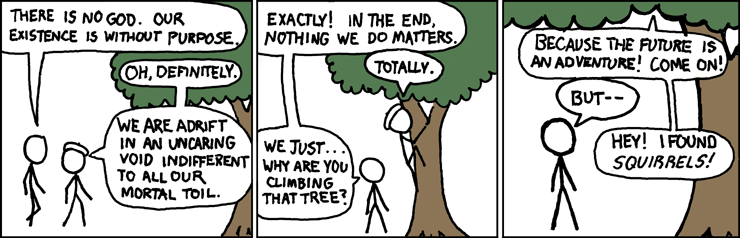
In this moment, I am Ur-phoric. Not because of any phony god’s blessing. But because, I am enlightened by my int score.
-
DSMatticus
- King
- Posts: 5271
- Joined: Thu Apr 14, 2011 5:32 am
-
infected slut princess
- Knight-Baron
- Posts: 790
- Joined: Tue Jun 14, 2011 2:44 am
- Location: 3rd Avenue
Re: I think therefore I am vs. I am therefore I think.
First of all, for the proposition "we adopt the law of contradiction because it is useful" to be true as you say, the contradictory proposition must be false. But then you are saying the logic of your position is somehow above the law of contradiction in general which is merely "useful" and that is incoherent.Whatever wrote:That's asinine. A statement need not be True or False, it can be meaningless, having an unknown, indeterminate, or unknowable truth value. That's pretty much what happens to all statements if you deny the law of contradictions (including the law itself), which is why we accept it in the first place. Not because it's True, but because it's useful.infected slut princess wrote:It is the same as if I were to look at the law of contradiction, and say "it is false." But what does this mean? If the law of contradiction is false, that means it is not true. Its falsehood precludes it from being true. "A and not-A is false" is what the law of contradiction means. So to deny the law of contradiction, I must presuppose that the law of contradiction is true. Fail.
Furthermore, we must assume that we establish that the law is useful with some kind of logic. If we adopt a rule because we consider it useful, we obviously have to be able to find out what that rule entails. And the proposition that "this-and-that is entailed by the rule" can hardly be characterized as merely a rule itself. This knowledge of entailment is structure by the law of contradiction.
Now if you refine the two-value logic by adding adding more truth values, you have not really changed much. You are certainly not an abandoning of the law of contradiction. It is true that the shape I saw today was either a square or not a square -- the "not a square" can allow for many gradations of the word "not". I might never know what specific shape I saw. But the law of contradiction still holds.
Perhaps you could clarify if I misinterpreted you.
Last edited by infected slut princess on Thu Nov 17, 2011 6:48 am, edited 1 time in total.
-
Username17
- Serious Badass
- Posts: 29894
- Joined: Fri Mar 07, 2008 7:54 pm
Language is imprecise and leads us to unwarranted conclusions based on the presuppositions inherent in the language being spoken. For example: in Latin "Cogito" translates to "I think", the word literally does presuppose a singular self that is doing the thinking. If "cogito" is true, then "sum" (literally "I exist") is also true, but it's circular reasoning. There is no reason at all to believe that there is a singular self. Your body does things and your mind thinks things without any conscious involvement at all. The fact that "you" can continue working on a problem and come up with an answer while you're consciously doing something else or asleep and dreaming about snakes should tell you that "you" are at best a composite entity. So the Cartesian supposition is best translated as "If Cogito, then Sum", but "Cogito" is provably false. Which does not by itself disprove "Sum" but is a pretty strong pointer in that direction.
On an incredibly related note: physicists have been kicking themselves for using the word "observation" to refer to the objective macroscopic interactions that collapse wave forms, because in English "observation" implies a conscious observer, while the actual studies involved do not. You get the same data whether you read it or not. It is the act of something being confined to a point where its waveform would give a definite answer that collapses it and makes it definite - not someone actually receiving that answer.
-Username17
On an incredibly related note: physicists have been kicking themselves for using the word "observation" to refer to the objective macroscopic interactions that collapse wave forms, because in English "observation" implies a conscious observer, while the actual studies involved do not. You get the same data whether you read it or not. It is the act of something being confined to a point where its waveform would give a definite answer that collapses it and makes it definite - not someone actually receiving that answer.
-Username17
-
infected slut princess
- Knight-Baron
- Posts: 790
- Joined: Tue Jun 14, 2011 2:44 am
- Location: 3rd Avenue
Bosanquet, following a suggestion from Russell, said that the expression "I think" would be more correctly expressed as "it thinks in me." Bosanquet said that the essence of thought was the "control exercised by reality over mental processes."FrankTrollman wrote:For example: in Latin "Cogito" translates to "I think", the word literally does presuppose a singular self that is doing the thinking. If "cogito" is true, then "sum" (literally "I exist") is also true, but it's circular reasoning. There is no reason at all to believe that there is a singular self. Your body does things and your mind thinks things without any conscious involvement at all. The fact that "you" can continue working on a problem and come up with an answer while you're consciously doing something else or asleep and dreaming about snakes should tell you that "you" are at best a composite entity.