Getting maneuver text down to a reasonable size.
Moderator: Moderators
If you did it properly, you could likely get each of those things to be a sentence (or a paragraph for extra clarity), and thus have fire be a single page.
Come see Sprockets & Serials
How do you confuse a barbarian?
Put a greatsword a maul and a greataxe in a room and ask them to take their pick
How do you confuse a barbarian?
Put a greatsword a maul and a greataxe in a room and ask them to take their pick
EXPLOSIVE RUNES!
-
Pseudo Stupidity
- Duke
- Posts: 1060
- Joined: Fri Sep 02, 2011 3:51 pm
God damnited. Everyone saying "less classes" needs to learn a fucking grammar lesson. It's fewer if you are talking about a thing you can easily count and less if you are talking about something less quantifiable.
"fewer peanuts in this container"
"Less ale in this barrel"
For fuck's sake that bothered me.
On topic:
There's no reason for rules to be super long. 4e had stupid flavor and often bad rules, but its rules text was super concise. Grappling was seriously a tiny sidebar with no flavor whatsoever. It was horrible, but it was the definition of brevity.
For example: In pathfinder the grapple rules should be fucking short.
Grappling: To initiate a grapple you must <shit to start a grapple>
You gain the grappled condition (explained in conditions) unless you initiated and took a -20 to grapple with one limb.
To break a grapple you must either <shit you can do to break a grapple> or <other shit you can do to break a grapple>
Boom, fucking done. Bulleted list, easily fit into a page full of other information and has no damn ambiguity at all.
"fewer peanuts in this container"
"Less ale in this barrel"
For fuck's sake that bothered me.
On topic:
There's no reason for rules to be super long. 4e had stupid flavor and often bad rules, but its rules text was super concise. Grappling was seriously a tiny sidebar with no flavor whatsoever. It was horrible, but it was the definition of brevity.
For example: In pathfinder the grapple rules should be fucking short.
Grappling: To initiate a grapple you must <shit to start a grapple>
You gain the grappled condition (explained in conditions) unless you initiated and took a -20 to grapple with one limb.
To break a grapple you must either <shit you can do to break a grapple> or <other shit you can do to break a grapple>
Boom, fucking done. Bulleted list, easily fit into a page full of other information and has no damn ambiguity at all.
Last edited by Pseudo Stupidity on Tue Dec 27, 2011 7:48 pm, edited 2 times in total.
-
Username17
- Serious Badass
- Posts: 29894
- Joined: Fri Mar 07, 2008 7:54 pm
No. That is a false economy. You focus on the basic uses of fireball, then you focus on the basic uses of a torch, and then you focus on the basic uses of a wall of fire, and then you focus on the basic uses of fireshield... and pretty soon you're using up way more page space to deal with fire effects than you wanted to, and your fire rules are still incomplete. 4e style "just the bare bones" writeups for every effect actually uses up more space than consistent and comprehensive descriptions. For fuck's sakes, the 4e PHB is longer than the 3e PHB and has less classes and less powers.Swordslinger wrote: You want to just focus on basic uses of fireball. That pretty much covers: what happens if you use it on an orc, the orc's equipment, a wooden door, an iron door and a stone wall.
Exactly. You have a page for "Fire". It tells the difference between a flash fire and a sustained fire, and puts in rules for light, pressure, heat, and sound. Then your actual fireball writeup only needs to tell you that it is an explosive flash fire of whatever size and strength and then give you whatever range and targeting information. For ease of use, you'd probably want to copypasta some key data like the damage to creatures caught in the blast, but even then there is no reason for the whole thing to take more than 3 lines, including the title.virgil wrote:If you did it properly, you could likely get each of those things to be a sentence (or a paragraph for extra clarity), and thus have fire be a single page.
The actual writeup for Fireball should look like this:
- Fireball - Elementalist (Fire) 3, Wizard (Evoker) 3, Warlock (Inferlock) 3
6m burst at longe range, grenade-like missile.
A glowing bead flies to the target and detonates, filling the area with a strong (rating 4) explosive flashfire. Creatures in the area will take XDY damage.
-Username17

Right. Hence all the ugly boilerplate.Lago PARANOIA wrote:As long as you close unimaginative and/or storytelling-breaking exploits like casting 'create water' inside of someone's head [..]
"Derp derp derp, my target is the inside of the guy's brain so his medulla oblongata takes XdY damage, derp derp derp."Frank Trollman wrote:The actual writeup for Fireball should look like this:
Fireball - Elementalist (Fire) 3, Wizard (Evoker) 3, Warlock (Inferlock) 3
6m burst at longe range, grenade-like missile.
A glowing bead flies to the target and detonates, filling the area with a strong (rating 4) explosive flashfire. Creatures in the area will take XDY damage.
Last edited by hogarth on Wed Dec 28, 2011 1:04 am, edited 1 time in total.
-
DSMatticus
- King
- Posts: 5271
- Joined: Thu Apr 14, 2011 5:32 am
Less is a totally valid and recognized modifier for quantities of things in pretty much every dictionary you could go out and buy today. The actual history of the debate begins in the 1700's (before that, people used less for countable quantities all the time) when someone said, "I sure wish people would stop using less in that way. It looks like shit to me" (paraphrased). In the three centuries that have followed, people have been mistaking his snobbish whining for appropriate grammar.Pseudo_Stupidity wrote:God damnited. Everyone saying "less classes" needs to learn a fucking grammar lesson. It's fewer if you are talking about a thing you can easily count and less if you are talking about something less quantifiable.
It's a rule that was literally invented out of thin air by the English upper class, gained very little ground anywhere else, and then disappeared again because nobody liked it. It is both imaginary and a ghost. It is an imaginary ghost. But yeah, that's totally off-topic.
Mostly, that's going to be covered by the rules for the target/targeting keyword. E.g., "A target is any square, object, or creature."hogarth wrote:"Derp derp derp, my target is the inside of the guy's brain so his medulla oblongata takes XdY damage, derp derp derp."
"Derp derp derp, so I target the liquid in my enemy's bladder instead and it causes a steam explosion inside him, derp derp derp."DSMatticus wrote:Mostly, that's going to be covered by the rules for the target/targeting keyword. E.g., "A target is any square, object, or creature."hogarth wrote:"Derp derp derp, my target is the inside of the guy's brain so his medulla oblongata takes XdY damage, derp derp derp."
Yes, I know it wouldn't work that way, so it's a poor example. And you could probably write enough stuff in the "this is how magic works" chapter to get one- or two-line damage powers to work just fine. But those aren't the powers that currently have long descriptions anyway! It's the more subtle powers with creative applications like teleportation, matter creation, telekinesis, shapeshifting, etc. that have the long lists of dos and don'ts.
-
RadiantPhoenix

- Prince
- Posts: 2668
- Joined: Sun Apr 11, 2010 10:33 pm
- Location: Trudging up the Hill
Bold mine.hogarth wrote:"Derp derp derp, my target is the inside of the guy's brain so his medulla oblongata takes XdY damage, derp derp derp."Frank Trollman wrote:The actual writeup for Fireball should look like this:
Fireball - Elementalist (Fire) 3, Wizard (Evoker) 3, Warlock (Inferlock) 3
6m burst at longe range, grenade-like missile.
A glowing bead flies to the target and detonates, filling the area with a strong (rating 4) explosive flashfire. Creatures in the area will take XDY damage.
-
DSMatticus
- King
- Posts: 5271
- Joined: Thu Apr 14, 2011 5:32 am
Yeah, in this particular case the spell suggests a projectile, which makes it easier. But some spells will generate effect at target. Another response: line of effect and line of sight. You have neither to the contents of someone's innards, which spells that generate effect at target will pretty much always use.
-
Stubbazubba
- Knight-Baron
- Posts: 737
- Joined: Sat May 07, 2011 6:01 pm
- Contact:
The first page of the powers chapter should include a bit about 'Unless otherwise specified, user must have LoS to target.'
*********
Matters of Critical Insignificance
Matters of Critical Insignificance
That way lies madness. Seriously. This is the way 2E DnD was written, and it so full of mindfuck that no one can predict what happens when a spell is cast without knowing the specific spell in question (the same also applies to monsters and classes). We want two fire spells to have similar effects, we want fire effects to have predictable properties and we want people to be able to predict what happens when someone fireballs something.Swordslinger wrote:That sounds like it would produce a mountain of rules that would be so complicated people wouldn't even want to bother with them. You'd have a full chapter alone just on fire effects. Producing smoke, heating things, melting things, boiling things, burning things, setting things on fire, and producing light.
I prefer just letting the DM decide things like that. Using a fire spell to boil water isn't going to even come up very often that I wouldn't even bother writing a special rule for it. Because even if you do, it's guaranteed that pretty much nobody will even know that rule, so you're going to grind the game to halt as people flip through your 600 page rulebook to find the proper mechanic.
You want to just focus on basic uses of fireball. That pretty much covers: what happens if you use it on an orc, the orc's equipment, a wooden door, an iron door and a stone wall.
So what we want is a physics engine. We want to know the properties of fire, acid, wood, poison, gravity, weight and so on. We want ability descriptions to only contain the most basic of information, so we can consolidate everything else in our physics chapter. In doing so we
- slim down our rulebook considerably
- effortlessly maintain uniformity and predictability
- make it much easier to write up new abilities
- make it much easier to compare abilities (e.g. for balancing them)
- make it much easier to add new physical proeprties and interactions to the game
- cut down on the time needed to look something up
Heck, we even get a basic sanity check on abilities for free. Basically, if it's more than a couple of lines long it is probably in need of fixing. It also gets easier to spot special properties of an ability. If it says "fire 6" it has no special properties, if it says "fire 6, also deals acid 4 on first round" it does. This format also lends itself to hyperlinking, so on a PC/tablet/ereader you can just click on the "fire" keyword and go straight to the rules page for fire effects. Whats more, such formats are easily parseable. Want a list of all fire effects in the game? Easy. DM wants to know whether there is anything in the game capable of straight out melting a stone bridge? Look up rules for fire damage, cross reference with properties of stone and dimensions of bridge, then search for long duration fire effects with a power of 8 or more.
Without a physics section your DM has to make up all of this as he goes. He also has to remember every ruling. And he better be good at this, because once he introduces Alien-style super acid to the game, the players will use it to melt down the overlord's fortress without ever engaging him.
And without keyword-style rules consolidation you inevitably end up with a horrible mess of somewhat similar abilities that all have their little special rules. You get fire spells that set stuff on fire, others that don't and yet others that use their own version of the rules for people being on fire. You get status effects whose stacking depends on the order of casting, spells that create weapons, yet still don't care about weapon immunity and acid arrows that bear no resemblance to either acid or arrows.
And all you get in return is something that easier to write as you go. Really, it's not even less work overall to write special effects into individual abilities. In fact it's more. It's just easier in that you in that you jot down effects right next to the the effect that triggered the idea instead of properly consolidating them in the right chapters.
Murtak
-
Pseudo Stupidity
- Duke
- Posts: 1060
- Joined: Fri Sep 02, 2011 3:51 pm
The English upper class have hijacked the associated press and Oxford dictionary then. While it's not a hard-and-fast rule, it's the generally accepted way. It sounds way better, so maybe I should be an upper class Englishman. Fuck tea and crumpets though, I want to drink less tea and eat fewer crumpets.DSMatticus wrote:Less is a totally valid and recognized modifier for quantities of things in pretty much every dictionary you could go out and buy today. The actual history of the debate begins in the 1700's (before that, people used less for countable quantities all the time) when someone said, "I sure wish people would stop using less in that way. It looks like shit to me" (paraphrased). In the three centuries that have followed, people have been mistaking his snobbish whining for appropriate grammar.Pseudo_Stupidity wrote:God damnited. Everyone saying "less classes" needs to learn a fucking grammar lesson. It's fewer if you are talking about a thing you can easily count and less if you are talking about something less quantifiable.
I like the Frank Fireball Format (or 3F) for spells. Explosive could probably be written up in a few sentences at most. The only thing is, how many different types of fire do we need? Just flash fire and sustained fire? What about ratings? Are they just number bumps or do you have a list of what each category does? The fire thing could turn into a chapter because it does so many things. Does a rating 4 flash flash fire melt iron? Lead? Steel? How many feet of each? What if it's been folded over 1,000 times?
It does turn into a rules cluster fuck that gets super detailed and nobody likes looking up rules.
-
CatharzGodfoot
- King
- Posts: 5668
- Joined: Fri Mar 07, 2008 7:54 pm
- Location: North Carolina
You decide how many kinds of fire you need, and put it in the 'fire' section. If an object reacts to fire in a special fashion (which should be rare or), you put it in that object's section.Pseudo Stupidity wrote: The only thing is, how many different types of fire do we need? Just flash fire and sustained fire? What about ratings? Are they just number bumps or do you have a list of what each category does? The fire thing could turn into a chapter because it does so many things. Does a rating 4 flash flash fire melt iron? Lead? Steel? How many feet of each? What if it's been folded over 1,000 times?
It does turn into a rules cluster fuck that gets super detailed and nobody likes looking up rules.
The great thing about fire ratings is that you can say 'A rating 5 fire burns at 2,000 C. If you need to know how that affects a specific material, look it up online.' Why you think folded steel would have a significantly (for gaming) different melting point than any other steel is beyond me. The difference is probably 150 C at most.
You might want specific rules for explosive flash heating (which causes ablation, shocks, & burns) vs sustained heating (which melts & burns), but they don't have to be complicated (or even factual) to work well.
The law in its majestic equality forbids the rich as well as the poor from stealing bread, begging and sleeping under bridges.
-Anatole France
Mount Flamethrower on rear
Drive in reverse
Win Game.
-Josh Kablack
-Anatole France
Mount Flamethrower on rear
Drive in reverse
Win Game.
-Josh Kablack
You do realize that you are now essentially asking whether it is easier to have rules for fireballs that ignite paper walls or rules for every fire effect and interaction ever, right? If you don't want a 10 page fire chapter, don't write one. It's not like there is 10 pages of secondary fire effects written for fireball or produce flame or even the entirety of all fire effects.Pseudo Stupidity wrote:The only thing is, how many different types of fire do we need? Just flash fire and sustained fire? What about ratings? Are they just number bumps or do you have a list of what each category does? The fire thing could turn into a chapter because it does so many things. Does a rating 4 flash flash fire melt iron? Lead? Steel? How many feet of each? What if it's been folded over 1,000 times?
It does turn into a rules cluster fuck that gets super detailed and nobody likes looking up rules.
Murtak
-
Pseudo Stupidity
- Duke
- Posts: 1060
- Joined: Fri Sep 02, 2011 3:51 pm
If a game told me to google something I would not play that game.
Carth, the folding thing was a katana joke. I did get the number wrong though, darn it.
Anyways, listing keywords and such is great, but those keywords have to mean things. If a flash fire (rating 4) burns at a certain temperature that's worthless to me unless I get information on what it melts and how it interacts with water or any number of things. That creates a ton of rules text so you have to cut something out. You eventually wander into the territory of the DM just making shit up for how fire interacts with things unless you list temperatures and force people to do research.
Also, including all those rules can be a DM headache (uh...sure the door is 2 inches thick and the orc's sword is iron) and makes interactions with items wonky as shit unless you rule that items are unaffected. I mean, magic items damn well should be but you're still hauling some mundane gear around when fireball comes online.
It'd require a shitton of careful balance to have meaningful and realistic fire keywords that don't snap the game in half by letting the wizard melt anything nonmagical by pointing his finger at it.
Edit: What I'm trying to say is, maybe leave the details out a bit to avoid some of that fuckery. Maybe toss in a rule that fire can throw up a smokescreen if a [fire] spell is cast onto water, or that [fire] spells can melt small sheets of ice or difficult terrain created by [ice] spells, but that's about it. Anything more and the game gets way too complicated for any casual gamers.
Carth, the folding thing was a katana joke. I did get the number wrong though, darn it.
Anyways, listing keywords and such is great, but those keywords have to mean things. If a flash fire (rating 4) burns at a certain temperature that's worthless to me unless I get information on what it melts and how it interacts with water or any number of things. That creates a ton of rules text so you have to cut something out. You eventually wander into the territory of the DM just making shit up for how fire interacts with things unless you list temperatures and force people to do research.
Also, including all those rules can be a DM headache (uh...sure the door is 2 inches thick and the orc's sword is iron) and makes interactions with items wonky as shit unless you rule that items are unaffected. I mean, magic items damn well should be but you're still hauling some mundane gear around when fireball comes online.
It'd require a shitton of careful balance to have meaningful and realistic fire keywords that don't snap the game in half by letting the wizard melt anything nonmagical by pointing his finger at it.
Edit: What I'm trying to say is, maybe leave the details out a bit to avoid some of that fuckery. Maybe toss in a rule that fire can throw up a smokescreen if a [fire] spell is cast onto water, or that [fire] spells can melt small sheets of ice or difficult terrain created by [ice] spells, but that's about it. Anything more and the game gets way too complicated for any casual gamers.
Last edited by Pseudo Stupidity on Wed Dec 28, 2011 6:39 pm, edited 1 time in total.
I could probably do some pretty complete d20 fire rules in 1-2 pages as long as the basic item rules had 5-6 pages.
Now, that may seem daunting to read when you'll want 30-40 different core tags, but you have to realize that it's still a third of the spell list in d20 Core right now and it will save at least as many pages as it eats and actually adds to the game and standardizes things nicely.
Also, people are going to read these sections as inspiration for knot-cutting solutions. In a very literal sense, writing up clear smoke rules is going to add player-driven smoke into your battles (for good or ill).
Now, that may seem daunting to read when you'll want 30-40 different core tags, but you have to realize that it's still a third of the spell list in d20 Core right now and it will save at least as many pages as it eats and actually adds to the game and standardizes things nicely.
Also, people are going to read these sections as inspiration for knot-cutting solutions. In a very literal sense, writing up clear smoke rules is going to add player-driven smoke into your battles (for good or ill).
-
Pseudo Stupidity
- Duke
- Posts: 1060
- Joined: Fri Sep 02, 2011 3:51 pm
I don't think anybody has committed much of the spell list to memory, or even bothers looking that shit up (I wrote my wizard spells known in a leatherbound journal because I'm a fucking nerd, and it saved me from learning all those darn rules). There are a few dozen spells people use often, and those are the spells everyone knows the rules for. Nobody knows what the fuck tree shape does because nobody uses that shit unless they explicitly look it up before the game. The rules for fire should be easy enough to commit to memory or extremely painless to search through.
A page or 2 of rules that cover every fire type and keyword would not be daunting, but 50 pages full of keywords would make casual gamers say "fuck this shit" and not even consider it. My table has almost unanimously agreed to not make any grapple-based characters or use heavily grapple oriented monsters because nothing breaks immersion like looking up rules. Now, with fire rules that the wizard/pyromancer/fire dude can memorize on his own that's fine (though some DMs will insist on seeing the rules on paper due to a lack of trust), but making too large of a set of rules is damning the game.
Of course, a lot of my problem stems from pathfinder putting the grapple rules and grappled condition in different sections of the book, but as a player I'd be weary about large sets of rules. A section on keywords would be fine for me if it were short enough or really well referenced with a great index and glossary, but current gaming companies have ruined my faith in tabletop's ability to make rules that aren't a garbled mess.
I'd say 4e had a good formatting idea, they just fucked the game up something fierce in order to achieve brevity.
A page or 2 of rules that cover every fire type and keyword would not be daunting, but 50 pages full of keywords would make casual gamers say "fuck this shit" and not even consider it. My table has almost unanimously agreed to not make any grapple-based characters or use heavily grapple oriented monsters because nothing breaks immersion like looking up rules. Now, with fire rules that the wizard/pyromancer/fire dude can memorize on his own that's fine (though some DMs will insist on seeing the rules on paper due to a lack of trust), but making too large of a set of rules is damning the game.
Of course, a lot of my problem stems from pathfinder putting the grapple rules and grappled condition in different sections of the book, but as a player I'd be weary about large sets of rules. A section on keywords would be fine for me if it were short enough or really well referenced with a great index and glossary, but current gaming companies have ruined my faith in tabletop's ability to make rules that aren't a garbled mess.
I'd say 4e had a good formatting idea, they just fucked the game up something fierce in order to achieve brevity.
Last edited by Pseudo Stupidity on Wed Dec 28, 2011 7:51 pm, edited 1 time in total.
-
CatharzGodfoot
- King
- Posts: 5668
- Joined: Fri Mar 07, 2008 7:54 pm
- Location: North Carolina
If you want to know the point at which steel melts, you can damn' well google it. That kind of shit should not be in a basic rulebook. The last thing anyone needs is the 3e rabbit hole of special energy division/hardness/HP/etc for every material known to fantasy fiction.Pseudo Stupidity wrote:If a game told me to google something I would not play that game.
Carth, the folding thing was a katana joke. I did get the number wrong though, darn it.
Anyways, listing keywords and such is great, but those keywords have to mean things. If a flash fire (rating 4) burns at a certain temperature that's worthless to me unless I get information on what it melts and how it interacts with water or any number of things. That creates a ton of rules text so you have to cut something out. You eventually wander into the territory of the DM just making shit up for how fire interacts with things unless you list temperatures and force people to do research.
Also, including all those rules can be a DM headache (uh...sure the door is 2 inches thick and the orc's sword is iron) and makes interactions with items wonky as shit unless you rule that items are unaffected. I mean, magic items damn well should be but you're still hauling some mundane gear around when fireball comes online.
It'd require a shitton of careful balance to have meaningful and realistic fire keywords that don't snap the game in half by letting the wizard melt anything nonmagical by pointing his finger at it.
Edit: What I'm trying to say is, maybe leave the details out a bit to avoid some of that fuckery. Maybe toss in a rule that fire can throw up a smokescreen if a [fire] spell is cast onto water, or that [fire] spells can melt small sheets of ice or difficult terrain created by [ice] spells, but that's about it. Anything more and the game gets way too complicated for any casual gamers.
If you're too lazy to google it, just act like any other lazy DM and make something up. You'd probably be too lazy to look it up in the rule book anyway.
The law in its majestic equality forbids the rich as well as the poor from stealing bread, begging and sleeping under bridges.
-Anatole France
Mount Flamethrower on rear
Drive in reverse
Win Game.
-Josh Kablack
-Anatole France
Mount Flamethrower on rear
Drive in reverse
Win Game.
-Josh Kablack

Actually, Pseudo already explicitly said he's too lazy to look up rules or read them in the first place. So yeah, he can go play MTP, and we can talk about good ways to write rules for a system that actually has rules.
Unrestricted Diplomat 5314 wrote:Accept this truth, as the wisdom of the Crafted: when the oppressors and abusers have won, when the boot of the callous has already trampled you flat, you should always, always take your swing."
-
Josh_Kablack

- King
- Posts: 5318
- Joined: Fri Mar 07, 2008 7:54 pm
- Location: Online. duh
Which gives you This simple answer.CatharzGodfoot wrote:If you want to know the point at which steel melts, you can damn' well google it.
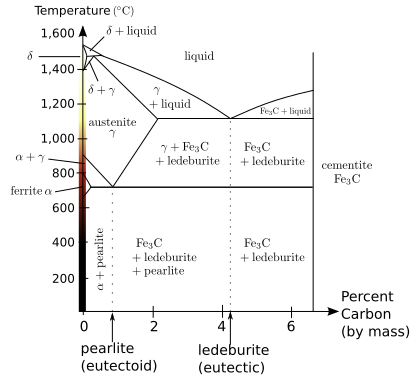
The point of having a game system is to abstract that shit out so that I don't need to argue with the three welders in my f2f group about the carbon content, tungsten alloys, annealing, and martinsitic grain structure of the metals used in their shops and how it applies to psuedo-medieval manufacturing augmented by magic and then engage with the gun-nut about recent developments in anti-tank weapons vs reactive depleted uranium armor and how that relates to scorching ray vs major creation.
You can have a setting where it takes Fire X to melt Bronze, Fire Y to melt Iron and Fire Z to melt Adamant/Questonite/Unobtanium and unless a Fire effect has the [Piercing] keyword, it takes a Stunt with a fire of sufficient rating to melt the metal in question in order to ignite it - and such a system is notably less complicated and easier to understand than the physics of the real world.
"But transportation issues are social-justice issues. The toll of bad transit policies and worse infrastructure—trains and buses that don’t run well and badly serve low-income neighborhoods, vehicular traffic that pollutes the environment and endangers the lives of cyclists and pedestrians—is borne disproportionately by black and brown communities."
Or just recall/rewrite the rules for the tags in a spell that uses them. Using keywords doesn't mean you have to footnote the [fire] keyword and turn to the fire page for specifics. It holds the system to standards, so new spells and such are already balanced. It promotes system mastery as players see the same rules every time [fire] is called out.Pseudo Stupidity wrote:A page or 2 of rules that cover every fire type and keyword would not be daunting, but 50 pages full of keywords would make casual gamers say "fuck this shit" and not even consider it. My table has almost unanimously agreed to not make any grapple-based characters or use heavily grapple oriented monsters because nothing breaks immersion like looking up rules. Now, with fire rules that the wizard/pyromancer/fire dude can memorize on his own that's fine (though some DMs will insist on seeing the rules on paper due to a lack of trust), but making too large of a set of rules is damning the game.
Of course, a lot of my problem stems from pathfinder putting the grapple rules and grappled condition in different sections of the book, but as a player I'd be weary about large sets of rules. A section on keywords would be fine for me if it were short enough or really well referenced with a great index and glossary, but current gaming companies have ruined my faith in tabletop's ability to make rules that aren't a garbled mess.
I'd say 4e had a good formatting idea, they just fucked the game up something fierce in order to achieve brevity.
Come see Sprockets & Serials
How do you confuse a barbarian?
Put a greatsword a maul and a greataxe in a room and ask them to take their pick
How do you confuse a barbarian?
Put a greatsword a maul and a greataxe in a room and ask them to take their pick
EXPLOSIVE RUNES!
-
RadiantPhoenix
- Prince
- Posts: 2668
- Joined: Sun Apr 11, 2010 10:33 pm
- Location: Trudging up the Hill
Perhaps two versions -- the abbreviated rules for people who don't have a lot of money to spend on books, and the verbose version for people who would enjoy having it spelled out very clearly.virgil wrote:Or just recall/rewrite the rules for the tags in a spell that uses them. Using keywords doesn't mean you have to footnote the [fire] keyword and turn to the fire page for specifics. It holds the system to standards, so new spells and such are already balanced. It promotes system mastery as players see the same rules every time [fire] is called out.
-
CatharzGodfoot
- King
- Posts: 5668
- Joined: Fri Mar 07, 2008 7:54 pm
- Location: North Carolina
That's disingenuous. 'I'm feeling lucky' gives you 1,370 C (2,500 F) to 1,510 C (2750 F) (although apparently carbon steel melts slightly hotter). You don't need the most complicated phase change diagram you can find just to play a game (although if you know how to use it, more power to ya).Josh_Kablack wrote:Which gives you This simple answer.CatharzGodfoot wrote:If you want to know the point at which steel melts, you can damn' well google it.
If you go with my previous example of a rating 5 fire burning at about 2,000 C, there's no argument anyway. Make a rating 4 fire burn at about 1,000 C. Still no problem, unless your players start arguing over what the melting point of their red brass lanterns is (at which point you slap them and say that the heat of the fire is approximately equal to the average melting point of the metal). If you're really worried about arguments of this kind, just throw in a rounding rule.
No, it's not, because now you've agreed to include the approximated fantasy properties of magnesium, niobium, uranium, platinum, zinc, aluminum, titanium, adamantium, nickel, brass, mithril, silver, tungsten, bronze, chrome, magnesium, etc in your basic rule book. Which is fucking absurd, even if it's just a list of what rating of fire melts them.Josh wrote:You can have a setting where it takes Fire X to melt Bronze, Fire Y to melt Iron and Fire Z to melt Adamant/Questonite/Unobtanium and unless a Fire effect has the [Piercing] keyword, it takes a Stunt with a fire of sufficient rating to melt the metal in question in order to ignite it - and such a system is notably less complicated and easier to understand than the physics of the real world.
The law in its majestic equality forbids the rich as well as the poor from stealing bread, begging and sleeping under bridges.
-Anatole France
Mount Flamethrower on rear
Drive in reverse
Win Game.
-Josh Kablack
-Anatole France
Mount Flamethrower on rear
Drive in reverse
Win Game.
-Josh Kablack
Well, the d20 grappling rules were a clusterfuck and Pathfinder made them worse.... I would not hold everyone to that standard.Pseudo Stupidity wrote:I don't think anybody has committed much of the spell list to memory, or even bothers looking that shit up (I wrote my wizard spells known in a leatherbound journal because I'm a fucking nerd, and it saved me from learning all those darn rules). There are a few dozen spells people use often, and those are the spells everyone knows the rules for. Nobody knows what the fuck tree shape does because nobody uses that shit unless they explicitly look it up before the game. The rules for fire should be easy enough to commit to memory or extremely painless to search through.
A page or 2 of rules that cover every fire type and keyword would not be daunting, but 50 pages full of keywords would make casual gamers say "fuck this shit" and not even consider it. My table has almost unanimously agreed to not make any grapple-based characters or use heavily grapple oriented monsters because nothing breaks immersion like looking up rules. Now, with fire rules that the wizard/pyromancer/fire dude can memorize on his own that's fine (though some DMs will insist on seeing the rules on paper due to a lack of trust), but making too large of a set of rules is damning the game.
Of course, a lot of my problem stems from pathfinder putting the grapple rules and grappled condition in different sections of the book, but as a player I'd be weary about large sets of rules. A section on keywords would be fine for me if it were short enough or really well referenced with a great index and glossary, but current gaming companies have ruined my faith in tabletop's ability to make rules that aren't a garbled mess.
I'd say 4e had a good formatting idea, they just fucked the game up something fierce in order to achieve brevity.
That being said, a big part of key wording is the not looking up things. One to two pages per keyword really is to outline all the knot-cutting potential, but for most people they should be happy to use their fireballs to hurt orcs and the important info for that is going to be listed right in the spell as a damage number.
This is because keywording should be for the out-of-the-box stuff. I mean, most days you aren't trying to freeze over lakes with cold blasts, so the couple of paragraphs about doing that under the [cold] keyword is pretty useless to you 90% of the time. Toss in a decent indexing system and intuitive layout that's not just a wall of text under a bolded Cold heading, and the 10% of the time that you need the rule it is right there rather than have the DM try to make something up.
Mostly, I expect the DMs to have read the keyword rules because they are going to be cool storytelling devices he's going to want to use. PCs will probably gain a rough idea of what various things do more from DM use than reading and memorizing rules themselves.
-
Username17
- Serious Badass
- Posts: 29894
- Joined: Fri Mar 07, 2008 7:54 pm
That's the bottom line right there. While the rabbit hole of using bolts of fire to light trees to make heat to melt a giant wall of sugar should be something that the rules can give you an answer to, it's not something you need to derive every session or even every campaign. And the rules can give you an answer to that because Fire Bolt is a single target piercing flash fire of rating 4, and a piercing flash fire starts new fires as a one minute exposure to a sustained fire of the same rating, so it can light trees on fire. And a Forest Fire is started when at least three trees are ablaze, and a forest fire is a rating 4 sustained fire over whatever area it covers, and you can jolly well look up the melting point of sugar and compare it to the sample materials and get a melting time for the confection wall.K wrote:This is because keywording should be for the out-of-the-box stuff. I mean, most days you aren't trying to freeze over lakes with cold blasts, so the couple of paragraphs about doing that under the [cold] keyword is pretty useless to you 90% of the time. Toss in a decent indexing system and intuitive layout that's not just a wall of text under a bolded Cold heading, and the 10% of the time that you need the rule it is right there rather than have the DM try to make something up.
The point is that the thing where you should Fire Bolts at things and they take damage and catch on fire is the normal thing you use it for, and that's actually right there in the incredibly short Fire Bolt description. And if you decide to do some funky fire starter knot cutting, the rules can tell you how to do that with a frankly fairly compact set of fire rules.
And the period at the end of this line is that this can be done with considerably less verbiage than 4e spent to not tell us how many fire bolts it took to melt through the walls of a butter brickle mansion.
-Username17
-
Lago PARANOIA
- Invincible Overlord
- Posts: 10555
- Joined: Thu Sep 25, 2008 3:00 am
How's this for a list of necessary player-driven keywords?
Anti-Magic
[*] Dispel
[*] Spell Protection
Creation
[*] Fake
[*] Morphing
[*] Solid
[*] Wall
Curse
Death
Divination
[*] Fortune-Telling
[*] Psychometry
[*] Scry
Duration
[*] Instantaneous
[*] Permanent
[*] Stance
[*] Sustain
Elemental
[*] Acid
[*] Air
[*] Darkness
[*] Earth
[*] Electricity
[*] Force
[*] Fire
[*] Ice
[*] Life
[*] Light
[*] Necrotic
[*] Plant
[*] Sound
[*] Water
Gaze
Illusion
[*] Figment
[*] Glamour
[*] Shadow
Mind-Affecting
[*] Brainwashing
[*] Charm
[*] Dominate
[*] Fear
[*] Possession
[*] Telepathy
Natural
Polymorph
Pathogen
[*] Poison
[*] Disease
Reflection
Reliable
Selective
Special Targeting
[*] Bouncing
[*] No Line of Sight
[*] No Line of Effect
[*] Piercing
[*] Self-Immune
[*] Selective
Summoning
[*] Calling
Teleportation
[*] Gates
[*] Plane Shifting
[*] Recalling
Zone
Anti-Magic
[*] Dispel
[*] Spell Protection
Creation
[*] Fake
[*] Morphing
[*] Solid
[*] Wall
Curse
Death
Divination
[*] Fortune-Telling
[*] Psychometry
[*] Scry
Duration
[*] Instantaneous
[*] Permanent
[*] Stance
[*] Sustain
Elemental
[*] Acid
[*] Air
[*] Darkness
[*] Earth
[*] Electricity
[*] Force
[*] Fire
[*] Ice
[*] Life
[*] Light
[*] Necrotic
[*] Plant
[*] Sound
[*] Water
Gaze
Illusion
[*] Figment
[*] Glamour
[*] Shadow
Mind-Affecting
[*] Brainwashing
[*] Charm
[*] Dominate
[*] Fear
[*] Possession
[*] Telepathy
Natural
Polymorph
Pathogen
[*] Poison
[*] Disease
Reflection
Reliable
Selective
Special Targeting
[*] Bouncing
[*] No Line of Sight
[*] No Line of Effect
[*] Piercing
[*] Self-Immune
[*] Selective
Summoning
[*] Calling
Teleportation
[*] Gates
[*] Plane Shifting
[*] Recalling
Zone
Josh Kablack wrote:Your freedom to make rulings up on the fly is in direct conflict with my freedom to interact with an internally consistent narrative. Your freedom to run/play a game without needing to understand a complex rule system is in direct conflict with my freedom to play a character whose abilities and flaws function as I intended within that ruleset. Your freedom to add and change rules in the middle of the game is in direct conflict with my ability to understand that rules system before I decided whether or not to join your game.
In short, your entire post is dismissive of not merely my intelligence, but my agency. And I don't mean agency as a player within one of your games, I mean my agency as a person. You do not want me to be informed when I make the fundamental decisions of deciding whether to join your game or buying your rules system.