Frank:
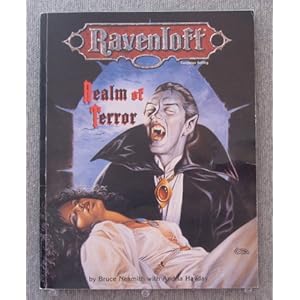
It was requested that K and I do a piece on the Realms of Terror book for the Ravenloft campaign setting, so that's what we're doing. It's important to note that the book we're reviewing is not the oldest school Realms of Terror book. This book was redesigned rather extensively several times. We have the version from the Red Box that came out in 1994, which has a lot of differences from the box that came out in 1990. But that's why the nice lady on the front still has extremely 80s hair. A lot of people don't remember that 80s fashion sense continued well into the early 90s, but it totally did.
K:
This is probably the point to note that the lady on the front of the cover in the book is dead sexy (possibly dead and sexy). As a consumer of RPG products at the time, this was an important selling point for me.
I had yet to realize that hot women on the cover art was a bad sign.
Frank:
Ravenloft was the inspiration for all of the World of Darkness. Rein*Hagen literally decided that he was going to make Vampire: the Masquerade when he saw TSR unveil Ravenloft at GenCon. His earlier draft was apparently just Ars Magica in the grim future of 1999. So for all its faults, Ravenloft is very important historically. I'm not really sure which of us is team nostalgia and which is team rage for this one. Probably a little bit of both for each of us.
K:
I’m definitely on Team Nostalgia. I bought the boxed set, saw that it was unplayable, and then promptly dug into it with the glee of someone who knew that he would never suffer through a Ravenloft game and could enjoy the book on whatever merits remained.
It’s like that feeling you get when you read a Rifts book.
Frank:
Ravenloft comes early in the period when TSR was releasing a new setting to radically rethink how the game should be played every single year. The year before there was Spelljammer, the year after there was Darksun. And all through this period there are “setting expansions” that turn established worlds into new directions. Like Time of the Dragon for Dragonlance, and Al-Qadim and Maztica for Forgotten Realms.
K:
I was happy for a new setting. At the time, I was collecting new settings like there was no tomorrow and I was really happy with the content coming out. RPG designers really were selling to a demo of “kids who have birthday money to spend and made the damned trip to the FLGS into the bad neighborhood and will not be happy if they can’t leave with something.”
Credits & Foreword

Frank:
OK, let's get this out of the way: this is an amateur product. The idea that you would hire actual “writers” or something to write books did not appear to occur to TSR until much later. TSR doesn't even credit “writers” during this period, just “designers”. They come right out and say that the authors met in college while they were working for TSR. Yes, really. Back in the 80s Andria Heyday and Bruce Nesmith apparently did freelance work for TSR while going to school in Wisconsin. Because there wasn't an internet back then and TSR literally recruited their employees by talking to kids at the local gaming clubs and seeing if any of them were passionate enough about their nerdiness to write RPG materials for them. It's pretty boring in Wisconsin, so I gather they got enough takers. And now my glass of Metaxa is all empty again for some reason.
K:
I have nothing to add to the DnD history here. I’ll let Frank continue on for a bit.
Frank:
I've actually met Tracy and Laura Hickman, and I was not favorably impressed. Laura in particular likes to make Gully Dwarf jokes, which are simultaneously offensive and interminable. But the idea of doing Gothic Horror in D&D was genuinely theirs. I mean, it seems rather obvious now, but in 1982 it was a revelation of sorts. The original Ravenloft boxed set was cobbled together in less than a year, and the connection to the work of the Hickmans is rather tenuous – basically they are just appropriating the name to try to drum up sales of their horror setting. The assignment was given in 1989 and it was on shelves in early 1990.
If Ravenloft could be said to have a driving design goal it is to “get the crazy high level stuff out of player hands as much as possible”. People in TSR pretty much knew that the game went to crazy town at high level, so settings from this period try to address that issue in some way. Spelljammer and Darksun just went with the flow, blowing up planets and having ships full of psionic monsters spewing death all over everything. Ravenloft went the other way, trying to torture the game system to keep the “mood” of a gothic horror game. We'll get in to the methods involved as they show up later in the book. But just think about that driving goal as we go through things.
K:
Yes, Ravenloft wanted to do horror in DnD. This seemed like a brilliant idea at the time, but in hindsight we should have known that it would end up like that Van Helsing movie with Hugh Jackman (mostly lame, and with some slightly racist Gypsy caricatures).
Introduction
K:
This is the part where they tell you that Gothic equals more sex and and death.
At this point, I was in. “More sex! More death! Where do I sign?!?!?!” There are also reading lists of people you will never actually bother to read (Byron) and shout-outs to things that you do care about (Dracula).
The prose is appropriately purple and it tells you that Gothic adventures are supposed to be emo journeys into the human soul….completely ignoring that DnD is not designed for that.
Frank:
The Silver Age of Gaming has much to answer for, but pretentious reading lists and pithy literary quotes at the beginnings of chapters was stone cold awesome.
K:
It really was. Nothing communicates flavor better.
Frank:
The “What is Gothic Horror” tirade is pretty weird. On the one hand, it's trying to take the side of cerebral horror over slasher fare. On the other hand, we are still talking about Dungeons & Fucking Dragons. Your characters still carry longswords and have hit points, so poo-poohing “maniac with a knife” style horror seems equal parts pretentious and inane. It is of course equally bizarre to go off on a rant about the gothic horror genre and speak of its emphasis on Evil vs. Virtue and Spiritual Strength bereft of its Christian context. The result is somewhat incoherent, because of course D&D is secular and in this case was in its “desperately attempting to not offend Christians” mode, so they don't even mention the religion angle. This makes discussions of “spiritual strength” and “virtue” rather incoherent.
K:
I just assumed that it was Christian dog-whistling. This was the era when demons had to be called tanari and we all knew that they were fucking demons, so a setting that basically told you do redemption themes while rubbing off all of the Bible-banging serial numbers was par for the course.
(On an unrelated note, my first draft of this section originally said “god-whistling.” I think that should be a term.)
Frank:
I'm not going to say that they are wrong that Vampires are a fundamentally better villain than Freddy Kreuger, although it does sort of date the piece to the late eighties that they use the Nightmare on Elmstreet franchise as an example of “modern” horror that fails to capture fundamental emotional resonance in the way that Dracula does. Indeed, just the fact that talking about Nightmare on Elmstreet makes the piece dated and talking about Dracula fucking doesn't means that they were fundamentally correct. Doesn't mean that their take-home message that “hunchbacks are essential to horror” wasn't batshit crazy though.
K:
They lost me here. Freddy Kreuger would fit perfectly in Ravenloft, but this was the start of the “I went to community college and now I’m going to show off my reading list” in RPGs and pissing on pop-culture is pretty much key to doing that.
I could totally see a Freddy domain where the peasants are all sleep-deprived and brew very strong coffee and teas.
The problem is that not enough Freddy movies have been made. Dracula, and vampires in general, are enough of a genre unto themselves that you get really deep stories mixed in with the splatter. I sincerely doubt that they ever intended for people to use Dracula vs. Frankenstein as source material, but I did watch that movie one Saturday afternoon.
Frank:
The pretentious disdain for “hack n' slash” gamers is probably what attracted Rein*Hagen in the first place.
K:
Well, the core of most 1e and 2e stories that you heard from other gamers tended to sound like mad-libs, so I could see the appeal of wanting to focus on stories.
You can have fun during the adventure where (a medusa) has a plan to (desecrate) a (aquaduct) with a (dwarven bread), but actually taking things a little more seriously and crafting a story with themes and shit has traction that even hacks recognize.
Frank:
One advantage that Ravenloft had over Masquerade was the setting. And I mean that in a literal sense. Ravenloft took place in an imaginary world rather than “Atlanta”. That meant that they could bring gothic landscapes to horror, and that goes a long way. It's just way more evocative when things look like this:

Than if it's just “Atlanta, but you know, at night or something.”
K:
The improbable mists was a tad on the nose, but you have to remember that the Gothic horror TV shows you got the 80s and 90s tended to camp up the setting super hard, sometimes just tossing a dark filter into the middle of an establishing shot to show that the setting was “going to get dark.”
I mean, Tales from the Crypt was literally MCed by a mummy in a crypt/dungeon. Horror was mainstreaming in very unusual and obvious ways.
But I get it. The deep forests of the Carpathian mountains are scary as shit, and that’s just better than anything in Atlanta.
Frank:
Honestly, I think that if you're quoting more than one paragraph of Poe in a single italics block, that you should probably have your citation privileges revoked.
K:
It’s not even a good Poe quote. Fucking community college reading lists.
Frank:
The emphasis on color in their introduction is pretty odd, considering that Ravenloft is like the least colorful setting that TSR ever put out. And also that it's an RPG which rather notoriously is played without much of a visual element. Not really sure where they were going with their tirades about shading.
K:
It was telling people to purple the prose up.
I don’t know how that is supposed to work since DM descriptions need to be brief and evocative and not chew the scenery too much, but as a primer on themes I was pretty happy.
More sex and death!