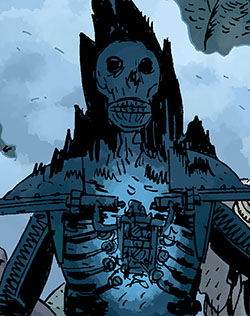
We're now in year 20 of Hellboy, a convention sketch which has grown to include two feature films, three animated specials, hundreds of comics (with spin-off series on their spin-off series), novels, anthologies, an official companion guide, various toys and stuffed animals, a video game, and of course a roleplaying game.

In 2015, this comic is old enough to drink.
Not to scale.
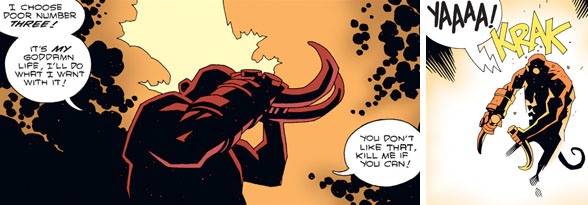
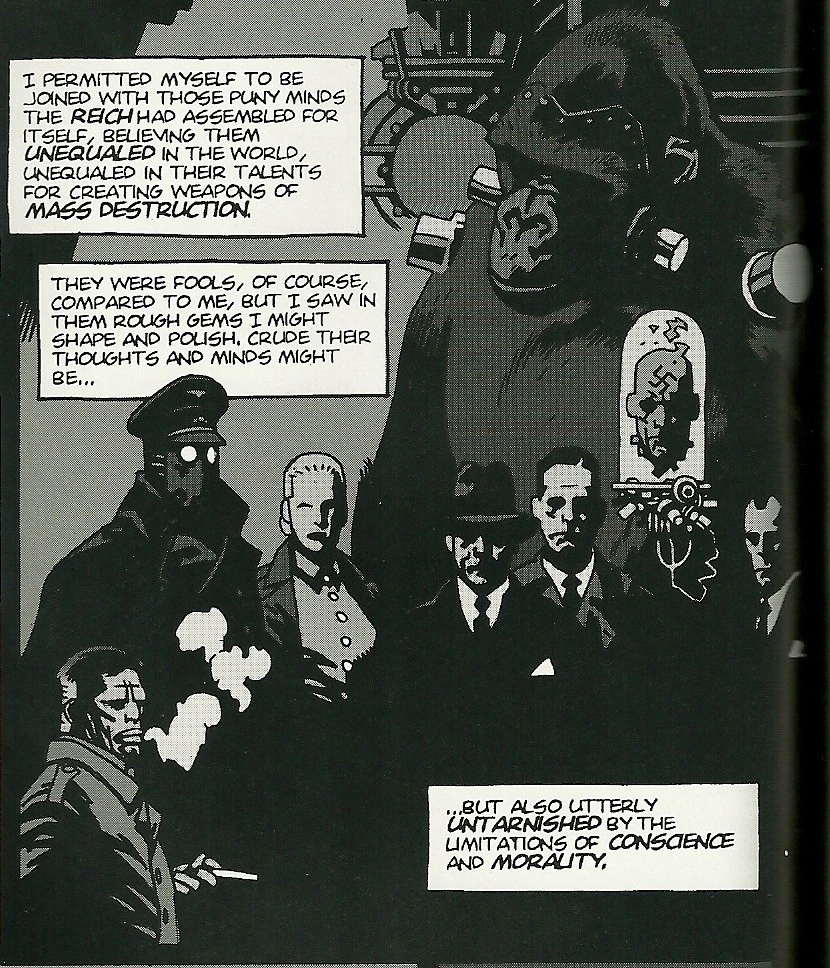
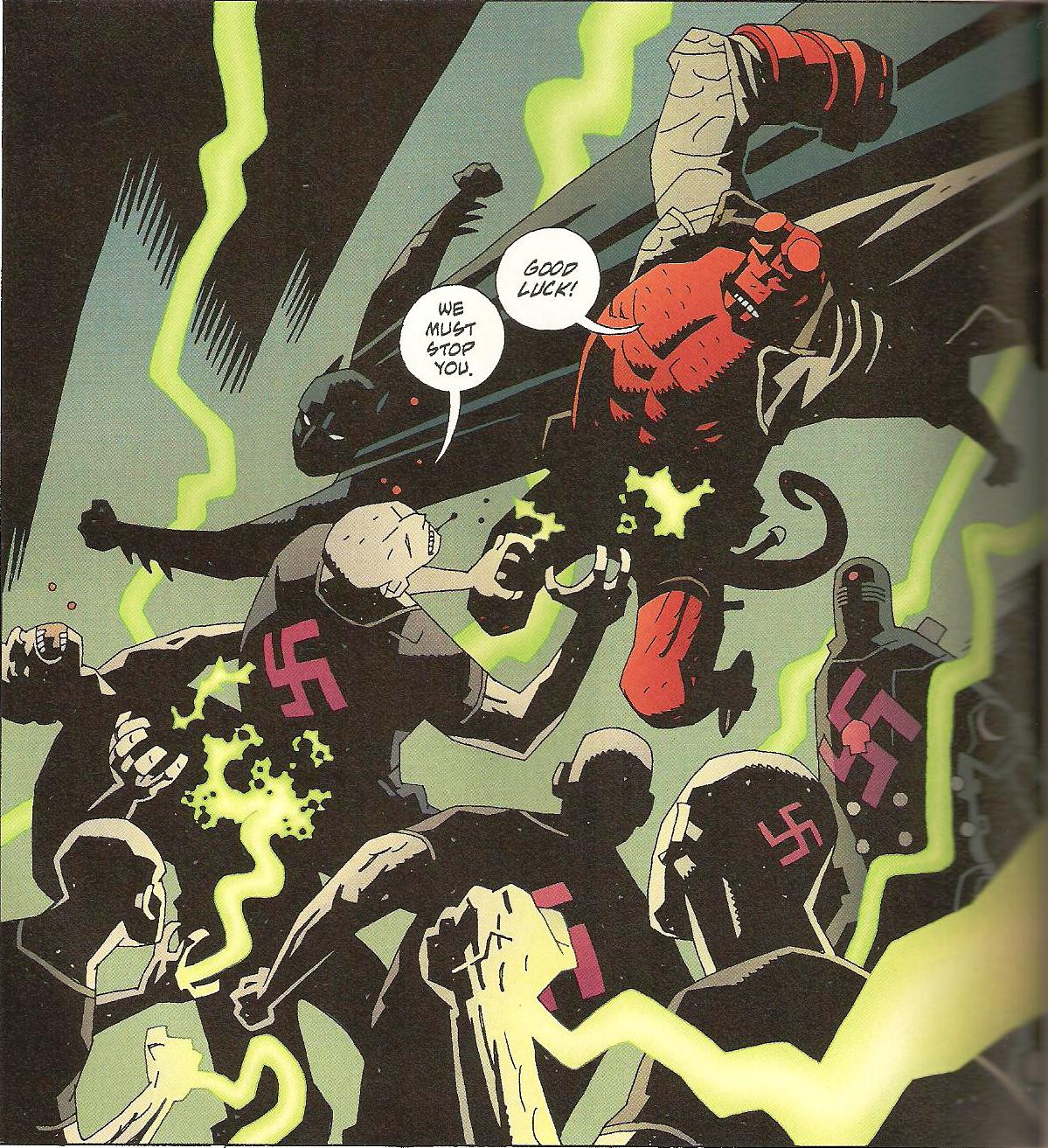
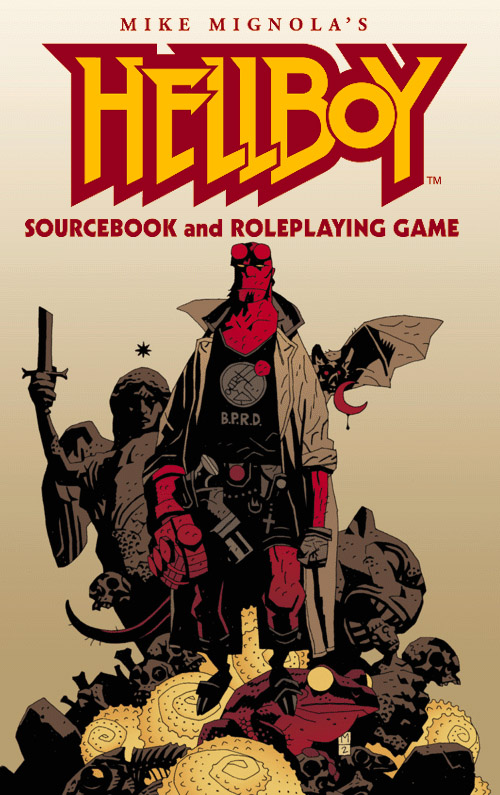
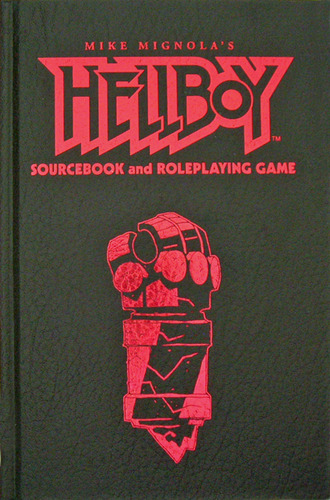
It really does feel like this was a product designed for comic book fans that somehow had not made it into gaming yet; at a time when a lot of GURPS products were still on regular paper stock and illustrated in black-and-white, this is on lush glossy comic-book paper with dozens of images culled from the existing Hellboy material.
I guess I should mention that 2002 was 12 years ago, before Hellboy really started ramping up and Mignola started passing art duties onto other people with gusto, so some perspective: at the time there were only five trade paperbacks of Hellboy out; as of this writing there are 17-18 (depending on whether you count stuff like Hellboy Jr.), and if you include the BPRD and spin-offs there's about twice that. So this RPG only really covers the beginning fraction of the Hellboy universe, and that's okay...because it's powered by GURPS. GURPS Lite to be specific, a reduced ruleset of GURPS 3e with some special stuff borrowed from games like GURPS Cabal. But we'll get into that in a bit.
If you need a refresher on Hellboy, check out the wiki.
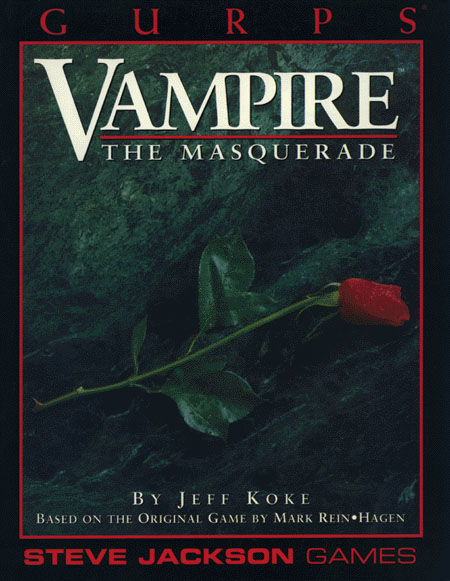
GURPS has done a lot of sourcebooks for specific non-GURPS IP before; some of their most famous were the early GURPS Vampire: the Masquerade and GURPS: Mage the Ascenscion books...
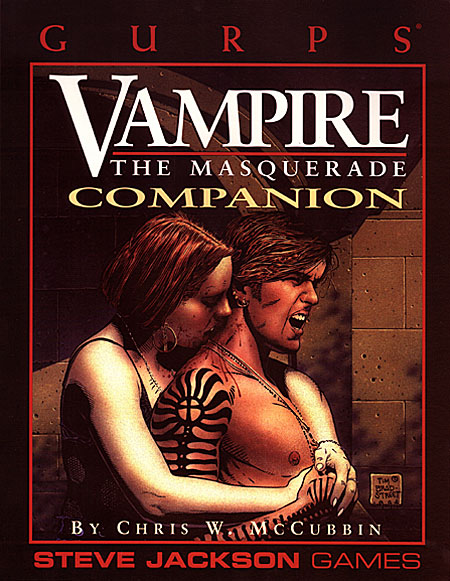
What, no GURPS: Rifts?
...along with War Against the Chtorr and other stuff you might not have heard of. In the early Naughties, however, GURPS tried something different: instead of packaging these books as one-supplement-among-many, they promoted them as their own self-contained RPGs...still powered by GURPS (or really, GURPS Lite), and compatible with other GURPS products, but presumably less scary to new fans who might have been put off by the Stack o' GURPS books in the RPG aisle.
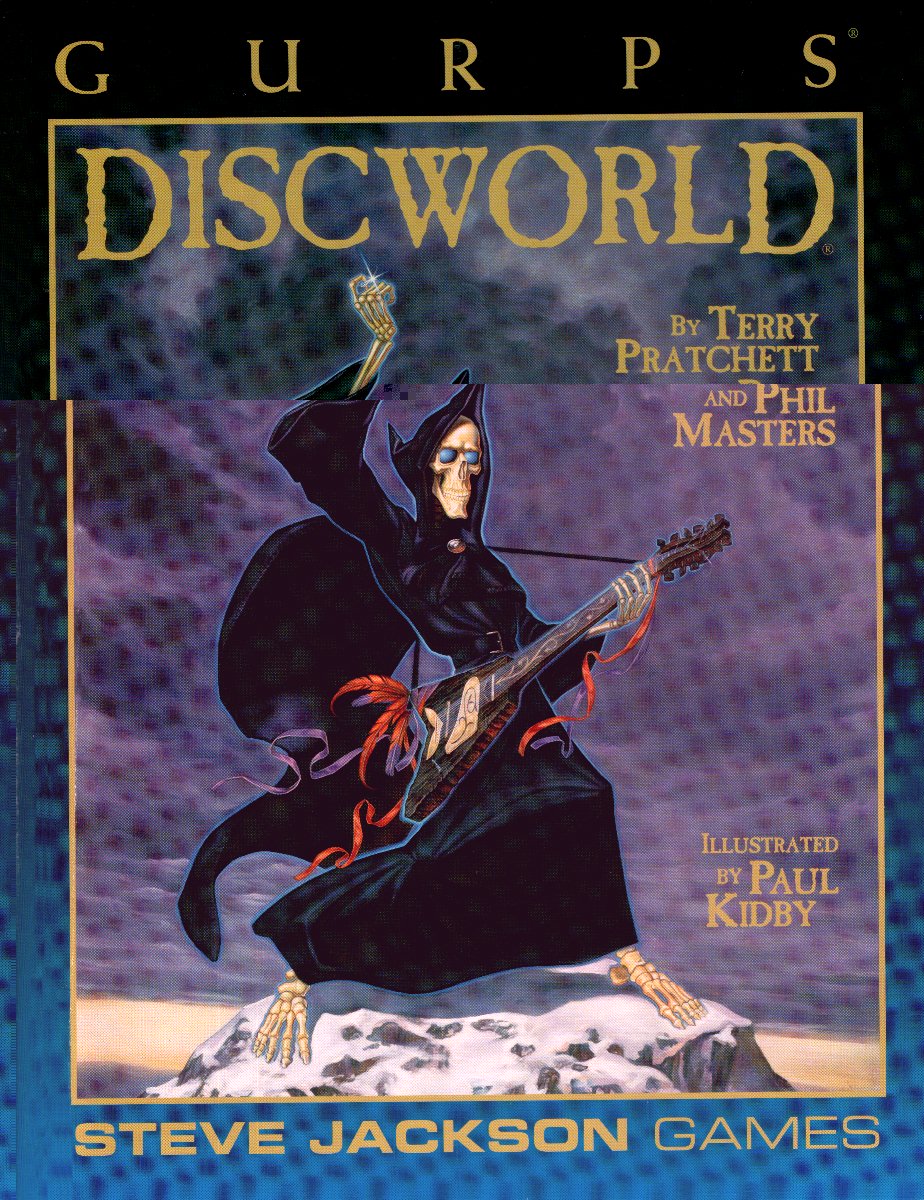
The same people gave us this, which is kind of awesome.
The book was actually written by GURPS mainstays Phil Masters and Johnathan Woodward; these guys are as pro as freelancers get, and know GURPS like the back of their hands, so you at least know Steve Jackson Games was trying not to put out an inferior product. I'm on the fence as to whether or not the layout guy was used to the reduced page format, because the index seems long (breaking things down to 3rd-level headers) but it's really just two facing pages and rather a snug fit.
Anyway, we've got an introduction, eight chapters, a sample adventure, three appendices, and in index in this 206 pages of glossy magnificence, so let's get cracking!
Dakini
This is a short piece of introductory fiction by Christopher Golden, a horror writer known for his occasional partnership with Mike Mignola; he's notable for writing the only only canon non-Mignola short story ("Nucklavee") and the only good Hellboy novel (The Bones of Giants - Hellboy + Mjolnir 4 teh win!). This is...neither his best or worst effort; Hellboy and the Bureau of Paranormal Research and Defense (B.P.R.D) investigate a monster appearing at an apartment building, and find out it's an Indian critter accidentally summoned by a couple having tantric sex; the monster vanishes when Hellboy knocks on the door and interrupts them mid-coitus.
It's neither the best nor the worst introduction you could have. On the one hand, it is undoubtedly a story about Hellboy and the B.P.R.D. fighting a monster-of-the-week, showcasing pulpy action, one-liners, and a bit of humor. On the other hand, most games probably won't have you playing Big Red himself. So, y'know, good for atmosphere, but that's about it.

This hadn't happened yet.
This is actually longer than most GURPS introductions, because it's pretending to be a stand-alone GURPS-powered RPG marketed to non-gamers. So you have the whole "What is a Roleplaying Game?" section, and an entire page dedicated to pimping Steve Jackson Games, and another half-page on "What is GURPS", "Hellboy's World," and joy-of-joys a two-and-a-half page timeline of events from Seed of Destruction through Conqueror Worm and B.P.R.D. Hollow Earth.It's a world where blatant supernatural forces definitely exist, and are fairly widely known about. Ordinary people probably don't encounter them at any time in their lives, and most people who know a little about the subject are quite glad of that. It's also a world in which a small number of heroes have existed since the 1930s to fight these forces wherever they post a threat.

Look Roger, a dead alien.
Chapter One: Creating Characters
I do love GURPS, because this is about as succinct and reasonable an explanation for chapter order as anything you're ever likely to run across in an RPG. Character design in GURPS Lite is pretty simple: you get X number of points (25 - average person; 100 - capable but realistic human being; 300 - suberbeing) and four basic attributes (Strength, Dexterity, Intelligence, Health). Add skills, advantages and disadvantages, backstory, shake well and you're basically ready to play.A game needs rules. TO ensure that the discussion of game-related matters makes sense, we've put them early in the book. This chapter is about creating characters in game terms; the next is about the process of play. Anyone who wants to know more about Hellboy's world is welcome to jump ahead for now, and come back to this mechanical stuff later, and anyone who already knows GURPS can skip these two chapters, but things may be easier if you work through the book in order.
Most of this chapter is taken up with advantages and disadvantages; all the standard GURPS fare on reputation, clerical investment, legal enforcement powers, ambidexterity, wealth, allies...the whole kit and caboodle. A couple things jump out to the GURPS fan: the magic system involves a mix of psychics and ritual magic (a skill-based system I'm pretty sure premiered in GURPS Cabal) among other things. Hellboy-specific advantages include "Spring-Loaded Fist" (12 points).
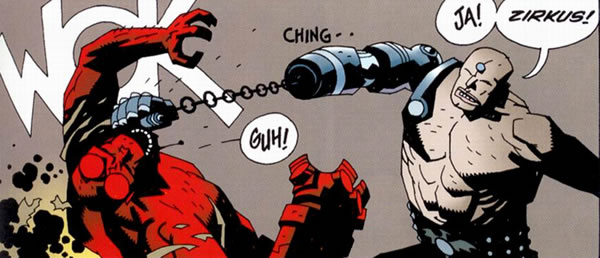
Obamacare doesn't cover this...yet.
Supernatural advantages include Aquatic/Amphibious (for those who want to play Abe Sapien's little sister, Eve), Breathe Fire, Conjoined Twins, etc. and some Hellboy-specific ones like "Modified Arm ST"

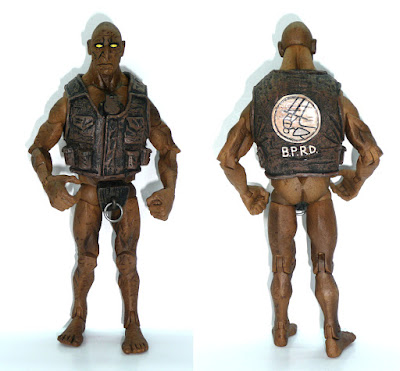
They tried to make him wear pants, but it didn't help. Maybe a kilt?
The skills system is pretty quick-and-to-the point - in GURPS, the cost of a skill is based on whether it is Physical or Mental, and the Difficulty level (Easy, Average, Hard, Very Hard) - Mental skills are generally less expensive, but have higher difficulties. Most skills tend to also have a default.
So, example:
Carpentry is a (Mental/Easy) skill that defaults to IQ-4 or DX-4 (you can use whichever one gives the highest level). So if you have IQ 10 and DX 12, then if you have zero points in Carpentry you still have an effective Skill rating of (12 - 4) of 8. That means you succeed on rolling 8 or lower on 3d6. Yes, yes, roll-unders are weird, and higher attributes give you absurdly high skill ratings in some cases. Anyway.

I don't know what the fuck these are supposed to be.
1) Psychic Skills are their own stand-alone skills, things like Telepathy, Pyrokinesis, etc.
2) Magic Spells (like GURPS Magic) are their own stand-alone skills.
3) Ritual Magic is a skill for performing ritual magic (different from spells), and you have a separate skill for each Ritual Magic Path (like, say, Voodoo, or Runecasting).
4) Complementary skills include Spell Throwing, which is a specialized skill for use with specific Magic Spells (so, for example, you could have the skill Fireball and then the skill Spell Throwing (Fireball) to actually hit anything with it); and Thaumatology which is "the science of magic."
Explaining the difference between Occultism, Paraphysics, and Thaumatology is kind of a tricky one, because honestly this is the kind of detail-oriented multiple-subsystems-that-weren't-really-designed-to-go-together thing that you got in like Shadowrun 3rd edition, where Spell Design was it's own separate skill from Magic Theory and shit. The nitty gritty is that Occultism is supposed to be anthropology and archaeology and the study of folklore and stuff (the academic study of magic, if you prefer); while Paraphysics is the scientific examination of how weird shit works; and Thaumatology is about figuring out how magic and stuff works from a magical perspective.
So if an occultist, paraphysician, and thaumatologist all saw a fireball:
The occult says "That looks like the calling of the fire demon rite from that Maori subsect that supposedly died out in the volcanic eruption of '36."
The paraphysician says "The fire is burning asbestos - if you throw water on it you'll just feed the flames!"
The thaumatologist says "Such an evocation of the fire element takes power - more power than that mortal should be able to contain in his frail frame. Perhaps if I can find the source of that power, I can cut it off."
On the other claw, you don't actually need any of those theory skills for whatever you want to do.
...anyway, they do weird shit with unarmed combat too (skills are Boxing, Brawling, Judo, and Karate); and they have a highly abbreviated version of the Tech levels chart here; most Hellboy stories are supposed to be TL7 (1951-2000) or TL6 (1901-1950).
Most of the combat stuff is straight cut-and-paste, although Hellboy's guns are included in the Ranged Weapon table.
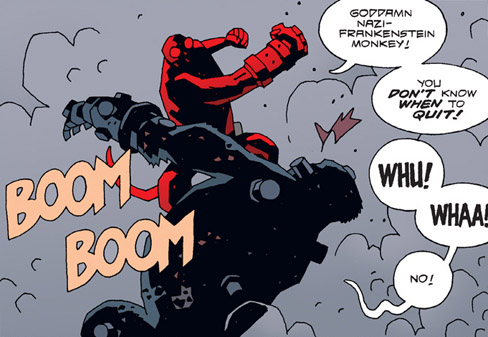
Although really, guns are pretty much useless against a Kriegaffe.
...Speed, Encumbrance and Movement are basically a paragraph; character improvement is about 3/4 of a page; and the chapter ends with a one-page character sheet.
It's GURPS in a nut shell, and even GURPS in a nut shell is like folding a piece of paper four times instead of six. Crunchier than you'd expect, but giving the feeling of being all-pervasive. Next up is Chapter Two: Playing the Game, and those are some deep waters.