All of these work so here is our selection of different clans.Longes wrote:Or you can use bits of Kuei-Jin and Grim Fandango. You were True Neutral in your life, and when you died Powers That Be sent you back, and gave you magic powers so that you can help people and ghosts and work off your own sins and go to heaven. Or full Kuei-Jin: you died, went to hell, clawed your way out and now you need to hunt and eat bad people to stay alive.TheFlatline wrote:Incidentally, the historical Sin Eater concept would make a cool WOD game:
You are a bad person. You know this. You died, saw hell, and have been very much assured that you're damned.
But you came back.
And others like you have found you, and showed you that as bullshit as the system is, you can cheat it. You're damned. Nothing that can be done about that. But you can take the sin of others onto you. You can rob Hell of it's prize and cheat Heaven of it's rules.
There's something appealing about this cosmic "fuck you". But it comes with it's perils. There are those who see power in what you do, and would like to harvest that power. There are philosophical differences among the Sin Eaters causing schizms. Then there are the angels and demons who are out to restore balance and put the old rules back. You're in their way. Something will have to be done about that. It's not your fight. But that's okay: You've sort of gotten used to taking on other peoples' burdens by now.
OSSR: Orpheus v. Geist
Moderator: Moderators
-
TheFlatline
- Prince
- Posts: 2606
- Joined: Fri Apr 30, 2010 11:43 pm
-
Ancient History

- Serious Badass
- Posts: 12708
- Joined: Wed Aug 18, 2010 12:57 pm
muChapter Two:
Chapter Three:
Character Creation

Some lands of the dead are classier than others.
This section's musical accompaniment will be The Stand.
Character creation rules in oWoD were reinvented in every book. They were basically the same idea one book to the next, but since they were being rewritten from scratch each time and many of the authors were hacks or passive aggressive assholes or both, a lot of minor changes piled up from one storyteller game to another. Some of this was simple telephone, and sometimes it was a deliberate attempt to make characters built with one book stronger (Vampire: Dark Ages) or weaker (Ghouls: Fatal Addiction) than others. In nWoD, by contrast, character generation is very defined. The chargen rules are almost all in the core book, with the only leeway being allowed in “Step Five: Apply Supernatural Template.” So with nothing to define except the “Geist Template” and provide a page citation to the World of Darkness corebook, you'd think that Geist would have a very short chargen chapter indeed.
And you'd be wrong. The Character creation chapter in Orpheus is a completely obscene and absurd 88 pages. But the character creation chapter in Geist is 112 fucking pages. And remember: Geist is written in 10 point font with over a thousand words per page! Geist's chargen chapter is a full length novel by itself.
1) Choose Concept
2) Select Attributes
3) Select Skills
4) Select Skill Specialties
5) Add Sin-Eater Template
6) Choose Merits
7) Determine Advantages
8) The Spark of Life
1-4 are okay, even if I'd have combined 3 & 4 in the same step and probably move "Sin-Eater Template" to step 1. However, the shit hits the fan with Step 5, because what that really means is that all of the normal shit in oWoD chargen is being squeezed into a single step, and it gets nuts. Archetype, Threshold, Psyche, Manifestations, Keys...there's five or six sub-steps just in Step 5, and character generation isn't over yet. Not by a long shot.
Orpheus takes longer on getting started, but that's because it feels the need to explain what Traits are and devotes an entire page to explaining what the fuck everything on the character sheet means, and that's okay. (They also give the Storyteller an entire half-page on their role in character creation, which is less okay). But the thing is, Orpheus only has five steps to character creation. Five!
1) Character Concept
2) Select Attributes
3) Select Abilities
4) Record Advantages
5) Finishing Touches
Really, Orpheus could and does basically squeeze all of chargen into a 3-page quick reference; most of the rest of the chapter just has to deal with what all your choices of Shade and Lament and whatever fucking mean.
Geist begins its chargen chapter with a rant about how Geists are made rather than born. Wait... didn't they spend much of the previous chapter ranting at us about how Geists had to be born into bad touch from death magic? Yes. Yes they did. This book is made by so many people and so few fucks are given between them that even high level and foundational facts aren't kept straight on a chapter by chapter, page by page, or even sentence by sentence basis. There are a lot of words on one of these ten point font pages, and a lot of those words are spent walking back or simply contradicting other words on the same page.

I google searched for “can't keep story straight,” which might make this picture of Rob Ford overly specific to our time period. But somehow I think this guy is going to be emblematic of this sort of thing for a long, long time.
Every WoD game, new or old, has worked in some weird mechanic to chargen, and these games are no exception. The one I actually like in Geist is that you can sacrifice points from your Synergy rating to gain free XP for buying up other shit. I'm generally in favor of point-shifting schemes like this, especially since I don't really give a fuck about what a Synergy rating is and just want to buy up things I do care about like Merits/Advantages and powers.
Orpheus doesn't have a comparable mechanic, but I like that characters can start out as humans or ghosts, and ghosts as disembodied spirits at least have a few options they can't take.

Orpheus is part of the oWoD and as such it's supposed to be stand alone. This manifests as an attempt begin the character generation chapter with a brief description of what roleplaying is and how traits work and how characters in the story are represented with numbers in the system. This is really puzzling on a number of levels. First of all, there is no way in hell that Orpheus is going to be anyone's first RPG, or even their first World of Darkness RPG. And secondly, if it was someone's first RPG, the description of how game systems work are too little and too late. Anyone who spent the last one hundred and eighteen pages of this book without knowing that characters were going to be defined by traits with a number of dots in them and that those dots would translate into modifiers to die rolls to determine whether actions succeeded or not is going to probably already have put the damn book down. But even if they haven't, these descriptions aren't super helpful. One wonders how far into the bubble you'd have to be to think that writing this was a good idea.
On the one hand, you've put the descriptions of basic game concepts so deep into the book that you have to be assuming that the reader will already know all of them. But on the other hand, you're putting them in anyway out of some sort of cargo cult idea that these affirmations of White Wolf mechanics and RPG system foundations must be in every stand alone book. Orpheus is so far into the decline of White Wolf that the simple act of writing it was reduced to empty ritual. An entire book written simply because writing books in these formats is what was done. Is it any wonder that just a year later they scrapped the whole thing and made a new format? Is it any wonder that the new format was fucking terrible and empty of everything that people once cared about? By 2003, White Wolf was a dead husk, endlessly repeating mantras that had lost all meaning even to itself.
The only thing anybody familiar with oWoD or nWoD wants to know is which species/clade their character joins and what their powers are. Unlike Shadowrun, White Wolf never gave a fuck about equipment or money to a large extent, so you're allowed to start off the game with anything the Storyteller says you can have. The kick in the ass of course is that every game's mechanics are different enough that you probably do need to read enough of the rules to make a character that doesn't suck, because sometimes you can't just be the dude in a trenchcoat with a shotgun, because this is Wraith Orpheus Geist and you need to take the Firearms skill with the Shotgun specialty, not the Shotgun skill with the Headshot specialty.

But when you get down to picking your clade/species (called Shades and Laments in Orpheus, Archetype and Threshold in Geist), it actually gets more complicated because each one has a bunch of special attributes unique to that game, and various associated powers and whatsits that interact with those in weird ways - and I'll be honest, some of these things are just not decisions you want to make. For example, in Orpheus you have to pick an "Archetype" (different than a Geist Archetype, but the concepts are related) which hooks into the oWoD Nature and Demeanor system.

This is literally the shit that turns people away from RPGs.
Geist has a lot of... stuff... in its template. You have keys, you have manifestations, you have a keystone, you have mementos, you have a threshold, and you have an archetype. And those are all little toggles, which do various stuff. Some of that stuff is... not very much. The primary effect of “Archetype” is just to act as a roleplaying gateway on how often you regain plasm. Yes, the power points are called “plasm.” I hadn't even gotten to the non-toggle shit you have like plasm, psyche, and synergy. Basically: it's fairly obvious that different contributors were using extremely different concepts of what the spaces in the nWoD madlibs even were when writing this book. And the end result is a bizarre cobbled together word salad with many redundancies, contradictions, and extraneous pieces of bullshit.

Often when you're reading a White Wolf book, there will be glaring errors that you can easily fill with mind caulk by interpreting it in light of the “rules as intended.” For Geist, that's simply impossible. It's obvious that there are so many contributors and so few fucks given that literally every statement in the book is a minority report. You aren't reading a consensus document or even a parliamentary compromise. This book is a stream of consciousness argument between nearly two dozen people. You honestly might as well be reading an argument on an internet forum. There's no possible way to divine what any of this shit was “supposed” to say.
Also, I'm just going to throw this out here, in Orpheus and Geist the assumed character gender is male ("he" pronouns - you could make an argument for he as default generic gender neutral, but no.) This isn't wrong, it's just a little language thing, but it's kinda weird because at one point - I think it was Vampire: the Masquerade 3rd edition, I might be wrong - they were using she a lot instead. Not exclusively or anything, but I think it was part of the thing where WoD was a bit more appealing to female roleplayers. Or I might be insane and have gender language on the brain.

Welcome to the table.
Both Orpheus and Geist stress that you need to work out with the other players reasons for your characters to cooperate. This is important stuff, but the advice falls rather flat in both cases because both games suffer tremendously from a lack of motivation for any of the characters individually. I'm not really given any reason why I might want to work for Orpheus instead of getting a job in accounting, nor am I given any particular reason why I might want to investigate the company I'm working for or go pick fights with off-mission strangers instead of picking up my paycheck and hitting the titty bar circuit. So given the serious question mark of why any individual character would want to do any of this shit, the question of why the group should pursue group goals together seems like it would warrant a lot more consideration. Geist is basically even worse about this, because while Orpheus does at least lay out what the group goals are (uncover the conspiracy, fight the power, save the world), the Krewes in Geist don't even have that. You're supposed to decide on your own krewe's goals and then... profit? I don't even fucking know.

Orpheus has a plot, and even though it greedily hides most of that plot from you for five more books and is severely lacking in hooks, it does exist. Geist doesn't have a plot or any hooks. It's kind of amazing to me that someone could waste this much wordcount without actually saying anything, but there it is.
I will say this: Orpheus and Geist do at least come up with an excuse for the PCs to be together as a group. In Orpheus, you're being paid to work together and get assigned to a group; in Geist, the mystic death spirit scuttling among the remnants of your soul likes to gather together with other death spirits in krewes and touch dicks.

Unfortunately, this suggests that people should be filling in some sort of established roles in the group, and that's just not happening. There aren't any real cleric/mage/fighter roles, and not even a Shadowrun-style techie/street samurai/mage/face approach. You could do a B.P.R.D. or Avengers-style approach, but the problem is that none of the characters has a unique power set, so again that falls flat.

One of the ways that RPGs can waste a lot of space and wordcount is by writing sample character backstories. But for sheer word padding, Geist has the bit that I think wins all comparisons:
One of the hallmarks of World of Darkness - the thing that set Vampire apart from D&D - was its layout. In the core rulebooks for Vampire, each playable clan was given its own entire page (or pages) to itself; it was set apart from the others and this drew attention to it in a way that preserving page flow would not. Orpheus doesn't really do this, probably because the character concepts are too loose to really support all the skimmers drinking the same kool aid.

Geist does do this, though by the time you get to that portion of the game you wish it didn't.

You can't play Randall in Orpheus and Geist, really. That's kinda sad.
The Orpheus character sheet is an adapted Wraith character sheet. Which means, among other things, that it really doesn't make any fucking sense for the actual characters in Orpheus. The characters in Orpheus are humans that get into spirit projector machines, while the Orpheus sheet has shit like this:
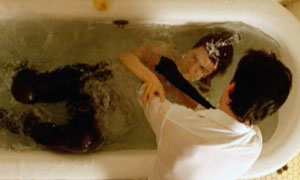
Do you see the light?
Also, and this is part of the whole game concept/metaphysics/cosmology thing, apparently Archetypes in Geist are...things. Like, a spiritual aspect akin to the avatar for Mage or the ancient Egyptian concept of the soul. This is really weird and does not, as far as I'm aware, have much of a parallel elsewhere in WoD because the function of the archetype in Geist is more or less the same as the Nature/Demeanor in oWoD games, except with the added tangle of interacting with the crappy Virtue/Vice system in nWoD. So I don't know what they gain from that.
One of the conceits of role playing games is that you are doing amateur improv theater in addition to playing a game. White Wolf titles have historically stressed this more than most RPGs, but the idea has been with us since the beginning. “Role Playing” is the R and the P in RPG. And so one of the things systems have tried to do is to come up with ways to encourage players to have their characters act “in character.” The early systems were extremely terrible and almost everything that came later has been an improvement. Seriously, in the late 70s you picked one of 9 ill-defined teams with unparseable names like “Neutral Good” or “Lawful Neutral” and then whenever your character did something that the MC personally believed was associated with a different ill-defined team you got punished with having your advancement suffer a set back. It is so easy to do better than that that even games which have no mechanics at all and just have a paragraph telling the players that they'll have more fun if they have their characters act “in character” are doing better. Much better.
Still, White Wolf early on came up with one of the better systems for that: Nature and Demeanor. The idea was that you had arbitrarily defined ways of behaving and deep personal motivations; and when you acted in accordance with those you got rewarded with quasi-meta-game currencies. This was in no way fair, obviously having it be “in character” for you to act was going to get you a lot more bonuses than having it be in character to be passive. And having it be in-character to do stuff during confrontations when you need to spend metagame currencies to stay alive is going to be more useful than getting refills while you are at home counting soap or whatever. But the point was that it succeeded at the core goal of getting players to develop their characters through actions and soliloquy. And so Old World of Darkness games just use that shit all the time. And even though it's only a really great fit for the game called “The Masquerade” for whom having a separate Nature and Demeanor is a central game theme, it did work “at all” in the other titles and we were pretty much OK with it. Orpheus has Natures and Demeanors simply because that is what White Wolf games did when it came out. It's cargo cult gaming at its finest, but it turns out that if you make some things out of coconut shells, they actually work. Happy John Frum Day. But of course, Orpheus also is written by way too many people and has extraneous bullshit on every page. So now the natures and demeanors affect your stats. Because they just weren't unfair enough.
NwoD, by contrast, had a shitty system. It was essentially the same idea as Nature and Demeanor, but there were only 7 things on each list and they were all weird adaptations of Christian sin theory. So they didn't end up encouraging actions that were very in character for almost any character and also they required all the players to buy into a moral framework that is so outside the modern mainstream that most people can't even describe how it's supposed to work. No one knows why they did this, but like almost every major change introduced by the nWoD it was ultimately terrible.

NWoD really did have terrible RP prompts.
Geist introduces a list of role playing prompts called “archetypes.” These are motivations that are hopefully somewhat more inspiring as roleplaying prompts than “faith” or “sloth.” They are things like “Celebrant” and “Bonepicker.” And clearly, they were intended as a replacement for the stupid virtues and vices of nWoD. But then they ran into the “backwards compatibility” wall that all suggestions to improve shitty nWoD mechanics run into. And so they walked it back and these things only trigger when the vices do, which means that there's honestly no reason for them to even be in the final product. But if I keep stressing about all the stuff in the Geist book that has no reason to exist, I'll die of booze overdose. These Archetypes may be totally pointless, but they do take up ten fucking pages. That's not a joke. It goes on about these things for ten pages even though in the final draft they were removed from the game in all but name.
Orpheus also has ten pages of "Archetypes," but it covers a lot more of them because each entry is a paragraph instead of a page. It's shovelware in action. Some got paid to write up a bunch of nonsensical crap in Geist. It boggles the mind.
In case you haven't guessed yet, this is about where trying to do an apples-to-apples comparison of character creation in Geist and Orpheus breaks down. While the two chapters share many of the same elements, the ordering and pacing from the two are way off - as noted, Orpheus is actually fairly straightforward and crunch-heavy, while Geist rambles around like Zadok Allen rambling about the Third Oath of the Esoteric Order of Dagon.

When you're staving off the DTs, everybody has the Innsmouth Look.
Even when it does get down to brass tacks and hard numbers, the concepts are hard to parse. For example:

It's not widely known, but the ankh gets its shape from the stone anchors that the Egyptians used on their boats while plying the Nile; it's literally supposed to be the anchor for the ship that Osiris sails through the land of the dead at night. Hell, the English word "anchor" is thought to ultimately derive from "ankh." Much was made of this in Tim Power's excellent novel Declare.

Orpheus is an oWoD product, and one forgets how truly, amazingly, uncompromisingly baroque that shit got. Each person has a shade, and the shade is what pops out when you go ghost-form. So it determines what powers you get and can't get. And it also determines how many free pre-assigned stat points you get for no reason. As a Banshee, you just get less free Willpower than if you're a Will-o-Wisp. Why? I don't fucking know. There are simply too many fiddly details in here, and the layout is spectacularly unhelpful. You can really see how this was written by a dozen people and edited by one.

Depending on how you choose your personality and shade projection, this could be very much higher or lower than other characters. Probably horribly unbalanced. I doubt anyone really cared.
Of course, Geist was written by almost twice as many people and was edited by a web site. So it gets fiddly in its own ways. I think at this point I might be able to play bull and matador by jingling keys at Ancient History.
Grr. One of the major image motifs for Geist are keys. Literally, old 18th-century keys. Keys keys fucking keys. They're on the fucking cover, they're on the inside cover, they're on the borders of just about every fucking page...and when you get down to it, this makes about as much sense as calling the supernaturals "Sin-Eaters" - i.e. none at all. The thing about "Keys" is that your character gets a couple "Keys" which represent affinities for certain powers. That's it. It's not a major part of the metaphysics or cosmology, it doesn't refer to the Keys of Heaven or any other use of keys in superstition or mythology, it's literally just some image that somebody thought would look cool and it became the major visual for the entire fucking game.

I mean, I didn't need a tortured metaphor about how each Geist has certain keys to the Gates of Death or something - that's how fucking Demon: the Fallen worked it - but I'd like something to justify it more.
Mechanically Keys are vaguely interesting in that unlike other World of Darkness games, in Geist your powers aren't set by your clade/species - rather, you can pick up (pretty much) any Manifestation, but you only get one or two Keys, and the Keys determine how you use that power. That sounds interesting, but it turns out to be a fucking mess. Even on the face of it, it means you've got different characters using different Skills with the same powers.
In oWoD games, you got a pile of “freebie points” that could be spent to buy shit in different categories. These were bought at a different rate than you got them in character advancement and some things could only be bought during chargen. So they were totally unfair. Like, whoah. But in those games where there wasn't a one true path to spend all your freebie points on, they did make starting characters a little bit more different. And more importantly, they made you feel like you were less of a rat in a cage. In nWoD the whole concept was dropped and everyone starts out with exactly the same number of stat points. You might think that would make things more balanced, but it does not. Mostly it just pisses people off.
And again, in Geist they actually circumvent their own nWoD design by including a rule letting you trade Synergy for XP.
One of the biggest uses of pagecount in both Orpheus and Geist is walking players through backstory generation. Sorry, I kid. One of the biggest uses of pagecount in both Orpheus and Geist is telling players to make a backstory. Actually walking players through the process would require giving players the requisite information to actually make a backstory. Neither book does a good job at that. Orpheus wants you to talk about what branch you work at and who you report to and shit, but if they ever explained what branches exist or even what the company structure was for you to do your reporting to, I must have missed it. Geist wants you to work in all your Krewe politics and shit, but instead of talking about what your options are, the last chapter rambled on about Asian Voodoo assassin cults that probably don't exist.

Although like many of the toss-off concepts, that seems like it could have been way cooler than what they actually came up with.
Geist and Orpheus both need to be cut in pagecount by like half. But one place they do need expansion is the providing of character hooks and plot hooks. There just isn't anything to connect characters to the world, nor to connect the characters to the adventures.
I don't know if we've actually covered everything we want to say here, because part of me wants to rant about the stupid fucking Threshold which are the Geist clans, and I definitely want to see Frank rant about the Manifestations, and I kinda feel the need to talk about Stains in Orpheus so...next post is going to be Character Gen Part II.
Chapter Three:
Character Creation
Some lands of the dead are classier than others.
This section's musical accompaniment will be The Stand.
FrankT:
Character creation rules in oWoD were reinvented in every book. They were basically the same idea one book to the next, but since they were being rewritten from scratch each time and many of the authors were hacks or passive aggressive assholes or both, a lot of minor changes piled up from one storyteller game to another. Some of this was simple telephone, and sometimes it was a deliberate attempt to make characters built with one book stronger (Vampire: Dark Ages) or weaker (Ghouls: Fatal Addiction) than others. In nWoD, by contrast, character generation is very defined. The chargen rules are almost all in the core book, with the only leeway being allowed in “Step Five: Apply Supernatural Template.” So with nothing to define except the “Geist Template” and provide a page citation to the World of Darkness corebook, you'd think that Geist would have a very short chargen chapter indeed.
And you'd be wrong. The Character creation chapter in Orpheus is a completely obscene and absurd 88 pages. But the character creation chapter in Geist is 112 fucking pages. And remember: Geist is written in 10 point font with over a thousand words per page! Geist's chargen chapter is a full length novel by itself.
AncientH:
I've read that a bunch of times, and it's just not a good sentence, but it encapsulates the Geist character generation attitude. It kind of starts off as solid as WoD products ever do, but goes off into crazy territory pretty quickly. For those following, here's the 8-step process:Creating a Geist character is a combination of pure creativity and the hard numbers that allow you to approximate your ideas within the setting by approximating traits.
1) Choose Concept
2) Select Attributes
3) Select Skills
4) Select Skill Specialties
5) Add Sin-Eater Template
6) Choose Merits
7) Determine Advantages
8) The Spark of Life
1-4 are okay, even if I'd have combined 3 & 4 in the same step and probably move "Sin-Eater Template" to step 1. However, the shit hits the fan with Step 5, because what that really means is that all of the normal shit in oWoD chargen is being squeezed into a single step, and it gets nuts. Archetype, Threshold, Psyche, Manifestations, Keys...there's five or six sub-steps just in Step 5, and character generation isn't over yet. Not by a long shot.
Orpheus takes longer on getting started, but that's because it feels the need to explain what Traits are and devotes an entire page to explaining what the fuck everything on the character sheet means, and that's okay. (They also give the Storyteller an entire half-page on their role in character creation, which is less okay). But the thing is, Orpheus only has five steps to character creation. Five!
1) Character Concept
2) Select Attributes
3) Select Abilities
4) Record Advantages
5) Finishing Touches
Really, Orpheus could and does basically squeeze all of chargen into a 3-page quick reference; most of the rest of the chapter just has to deal with what all your choices of Shade and Lament and whatever fucking mean.
FrankT:
Geist begins its chargen chapter with a rant about how Geists are made rather than born. Wait... didn't they spend much of the previous chapter ranting at us about how Geists had to be born into bad touch from death magic? Yes. Yes they did. This book is made by so many people and so few fucks are given between them that even high level and foundational facts aren't kept straight on a chapter by chapter, page by page, or even sentence by sentence basis. There are a lot of words on one of these ten point font pages, and a lot of those words are spent walking back or simply contradicting other words on the same page.
I google searched for “can't keep story straight,” which might make this picture of Rob Ford overly specific to our time period. But somehow I think this guy is going to be emblematic of this sort of thing for a long, long time.
AncientH:
Every WoD game, new or old, has worked in some weird mechanic to chargen, and these games are no exception. The one I actually like in Geist is that you can sacrifice points from your Synergy rating to gain free XP for buying up other shit. I'm generally in favor of point-shifting schemes like this, especially since I don't really give a fuck about what a Synergy rating is and just want to buy up things I do care about like Merits/Advantages and powers.
Orpheus doesn't have a comparable mechanic, but I like that characters can start out as humans or ghosts, and ghosts as disembodied spirits at least have a few options they can't take.
...well, it's the thought that counts.Note that ghosts (hues and spirits) cannot take Detective License or Personal Trainer.
FrankT:
Orpheus is part of the oWoD and as such it's supposed to be stand alone. This manifests as an attempt begin the character generation chapter with a brief description of what roleplaying is and how traits work and how characters in the story are represented with numbers in the system. This is really puzzling on a number of levels. First of all, there is no way in hell that Orpheus is going to be anyone's first RPG, or even their first World of Darkness RPG. And secondly, if it was someone's first RPG, the description of how game systems work are too little and too late. Anyone who spent the last one hundred and eighteen pages of this book without knowing that characters were going to be defined by traits with a number of dots in them and that those dots would translate into modifiers to die rolls to determine whether actions succeeded or not is going to probably already have put the damn book down. But even if they haven't, these descriptions aren't super helpful. One wonders how far into the bubble you'd have to be to think that writing this was a good idea.
On the one hand, you've put the descriptions of basic game concepts so deep into the book that you have to be assuming that the reader will already know all of them. But on the other hand, you're putting them in anyway out of some sort of cargo cult idea that these affirmations of White Wolf mechanics and RPG system foundations must be in every stand alone book. Orpheus is so far into the decline of White Wolf that the simple act of writing it was reduced to empty ritual. An entire book written simply because writing books in these formats is what was done. Is it any wonder that just a year later they scrapped the whole thing and made a new format? Is it any wonder that the new format was fucking terrible and empty of everything that people once cared about? By 2003, White Wolf was a dead husk, endlessly repeating mantras that had lost all meaning even to itself.
AncientH:
The only thing anybody familiar with oWoD or nWoD wants to know is which species/clade their character joins and what their powers are. Unlike Shadowrun, White Wolf never gave a fuck about equipment or money to a large extent, so you're allowed to start off the game with anything the Storyteller says you can have. The kick in the ass of course is that every game's mechanics are different enough that you probably do need to read enough of the rules to make a character that doesn't suck, because sometimes you can't just be the dude in a trenchcoat with a shotgun, because this is Wraith Orpheus Geist and you need to take the Firearms skill with the Shotgun specialty, not the Shotgun skill with the Headshot specialty.
But when you get down to picking your clade/species (called Shades and Laments in Orpheus, Archetype and Threshold in Geist), it actually gets more complicated because each one has a bunch of special attributes unique to that game, and various associated powers and whatsits that interact with those in weird ways - and I'll be honest, some of these things are just not decisions you want to make. For example, in Orpheus you have to pick an "Archetype" (different than a Geist Archetype, but the concepts are related) which hooks into the oWoD Nature and Demeanor system.
This is literally the shit that turns people away from RPGs.
FrankT:
Geist has a lot of... stuff... in its template. You have keys, you have manifestations, you have a keystone, you have mementos, you have a threshold, and you have an archetype. And those are all little toggles, which do various stuff. Some of that stuff is... not very much. The primary effect of “Archetype” is just to act as a roleplaying gateway on how often you regain plasm. Yes, the power points are called “plasm.” I hadn't even gotten to the non-toggle shit you have like plasm, psyche, and synergy. Basically: it's fairly obvious that different contributors were using extremely different concepts of what the spaces in the nWoD madlibs even were when writing this book. And the end result is a bizarre cobbled together word salad with many redundancies, contradictions, and extraneous pieces of bullshit.
Often when you're reading a White Wolf book, there will be glaring errors that you can easily fill with mind caulk by interpreting it in light of the “rules as intended.” For Geist, that's simply impossible. It's obvious that there are so many contributors and so few fucks given that literally every statement in the book is a minority report. You aren't reading a consensus document or even a parliamentary compromise. This book is a stream of consciousness argument between nearly two dozen people. You honestly might as well be reading an argument on an internet forum. There's no possible way to divine what any of this shit was “supposed” to say.
AncientH:
Case in point, this is in Step 8, and it is bullshit. Pretty much every step before this emphasized how your choices were supposed to reflect your character concept, not just another number/dot scribbled on a character sheet.Aside from the basic character concept, character creation up until now has focused on defining your character in terms of her capabilities: what he can do, and what he knows.
Also, I'm just going to throw this out here, in Orpheus and Geist the assumed character gender is male ("he" pronouns - you could make an argument for he as default generic gender neutral, but no.) This isn't wrong, it's just a little language thing, but it's kinda weird because at one point - I think it was Vampire: the Masquerade 3rd edition, I might be wrong - they were using she a lot instead. Not exclusively or anything, but I think it was part of the thing where WoD was a bit more appealing to female roleplayers. Or I might be insane and have gender language on the brain.
Welcome to the table.
FrankT:
Both Orpheus and Geist stress that you need to work out with the other players reasons for your characters to cooperate. This is important stuff, but the advice falls rather flat in both cases because both games suffer tremendously from a lack of motivation for any of the characters individually. I'm not really given any reason why I might want to work for Orpheus instead of getting a job in accounting, nor am I given any particular reason why I might want to investigate the company I'm working for or go pick fights with off-mission strangers instead of picking up my paycheck and hitting the titty bar circuit. So given the serious question mark of why any individual character would want to do any of this shit, the question of why the group should pursue group goals together seems like it would warrant a lot more consideration. Geist is basically even worse about this, because while Orpheus does at least lay out what the group goals are (uncover the conspiracy, fight the power, save the world), the Krewes in Geist don't even have that. You're supposed to decide on your own krewe's goals and then... profit? I don't even fucking know.
Orpheus has a plot, and even though it greedily hides most of that plot from you for five more books and is severely lacking in hooks, it does exist. Geist doesn't have a plot or any hooks. It's kind of amazing to me that someone could waste this much wordcount without actually saying anything, but there it is.
AncientH:
I will say this: Orpheus and Geist do at least come up with an excuse for the PCs to be together as a group. In Orpheus, you're being paid to work together and get assigned to a group; in Geist, the mystic death spirit scuttling among the remnants of your soul likes to gather together with other death spirits in krewes and touch dicks.
Unfortunately, this suggests that people should be filling in some sort of established roles in the group, and that's just not happening. There aren't any real cleric/mage/fighter roles, and not even a Shadowrun-style techie/street samurai/mage/face approach. You could do a B.P.R.D. or Avengers-style approach, but the problem is that none of the characters has a unique power set, so again that falls flat.
FrankT:
One of the ways that RPGs can waste a lot of space and wordcount is by writing sample character backstories. But for sheer word padding, Geist has the bit that I think wins all comparisons:
That's 31 words to describe how the sample player making a sample character gets their sheet approved by a sample storyteller.Geist wrote:Kat gives her character sheet to Eloy for approval, and discusses how she’ll fit into the game. He’s happy with the character, and Zita Vargas is ready to join the game.
AncientH:
One of the hallmarks of World of Darkness - the thing that set Vampire apart from D&D - was its layout. In the core rulebooks for Vampire, each playable clan was given its own entire page (or pages) to itself; it was set apart from the others and this drew attention to it in a way that preserving page flow would not. Orpheus doesn't really do this, probably because the character concepts are too loose to really support all the skimmers drinking the same kool aid.
Geist does do this, though by the time you get to that portion of the game you wish it didn't.
You can't play Randall in Orpheus and Geist, really. That's kinda sad.
FrankT:
The Orpheus character sheet is an adapted Wraith character sheet. Which means, among other things, that it really doesn't make any fucking sense for the actual characters in Orpheus. The characters in Orpheus are humans that get into spirit projector machines, while the Orpheus sheet has shit like this:
Seriously? You couldn't come up with a better word for the line you write “Human” on than Lament? What the actual fuck? That is not what that word means, you assholes!Orpheus wrote:Lament: Your Lament identifies what type of being your character is, whether a living projector (skimmer and sleeper) or a dead ghost (spirit and hue).
AncientH:
Okay, I'm just going to leave that there, because that's fucked up. And not in a "funny ha ha" sense, but in a "I didn't know where else to cram this fucking idea except the character generation section talking about Archetypes."One Christian krewe revolves around the idea that the only way to be born again in Christ is to die first.
Do you see the light?
Also, and this is part of the whole game concept/metaphysics/cosmology thing, apparently Archetypes in Geist are...things. Like, a spiritual aspect akin to the avatar for Mage or the ancient Egyptian concept of the soul. This is really weird and does not, as far as I'm aware, have much of a parallel elsewhere in WoD because the function of the archetype in Geist is more or less the same as the Nature/Demeanor in oWoD games, except with the added tangle of interacting with the crappy Virtue/Vice system in nWoD. So I don't know what they gain from that.
FrankT:
One of the conceits of role playing games is that you are doing amateur improv theater in addition to playing a game. White Wolf titles have historically stressed this more than most RPGs, but the idea has been with us since the beginning. “Role Playing” is the R and the P in RPG. And so one of the things systems have tried to do is to come up with ways to encourage players to have their characters act “in character.” The early systems were extremely terrible and almost everything that came later has been an improvement. Seriously, in the late 70s you picked one of 9 ill-defined teams with unparseable names like “Neutral Good” or “Lawful Neutral” and then whenever your character did something that the MC personally believed was associated with a different ill-defined team you got punished with having your advancement suffer a set back. It is so easy to do better than that that even games which have no mechanics at all and just have a paragraph telling the players that they'll have more fun if they have their characters act “in character” are doing better. Much better.
Still, White Wolf early on came up with one of the better systems for that: Nature and Demeanor. The idea was that you had arbitrarily defined ways of behaving and deep personal motivations; and when you acted in accordance with those you got rewarded with quasi-meta-game currencies. This was in no way fair, obviously having it be “in character” for you to act was going to get you a lot more bonuses than having it be in character to be passive. And having it be in-character to do stuff during confrontations when you need to spend metagame currencies to stay alive is going to be more useful than getting refills while you are at home counting soap or whatever. But the point was that it succeeded at the core goal of getting players to develop their characters through actions and soliloquy. And so Old World of Darkness games just use that shit all the time. And even though it's only a really great fit for the game called “The Masquerade” for whom having a separate Nature and Demeanor is a central game theme, it did work “at all” in the other titles and we were pretty much OK with it. Orpheus has Natures and Demeanors simply because that is what White Wolf games did when it came out. It's cargo cult gaming at its finest, but it turns out that if you make some things out of coconut shells, they actually work. Happy John Frum Day. But of course, Orpheus also is written by way too many people and has extraneous bullshit on every page. So now the natures and demeanors affect your stats. Because they just weren't unfair enough.
NwoD, by contrast, had a shitty system. It was essentially the same idea as Nature and Demeanor, but there were only 7 things on each list and they were all weird adaptations of Christian sin theory. So they didn't end up encouraging actions that were very in character for almost any character and also they required all the players to buy into a moral framework that is so outside the modern mainstream that most people can't even describe how it's supposed to work. No one knows why they did this, but like almost every major change introduced by the nWoD it was ultimately terrible.
NWoD really did have terrible RP prompts.
Geist introduces a list of role playing prompts called “archetypes.” These are motivations that are hopefully somewhat more inspiring as roleplaying prompts than “faith” or “sloth.” They are things like “Celebrant” and “Bonepicker.” And clearly, they were intended as a replacement for the stupid virtues and vices of nWoD. But then they ran into the “backwards compatibility” wall that all suggestions to improve shitty nWoD mechanics run into. And so they walked it back and these things only trigger when the vices do, which means that there's honestly no reason for them to even be in the final product. But if I keep stressing about all the stuff in the Geist book that has no reason to exist, I'll die of booze overdose. These Archetypes may be totally pointless, but they do take up ten fucking pages. That's not a joke. It goes on about these things for ten pages even though in the final draft they were removed from the game in all but name.
AncientH:
Orpheus also has ten pages of "Archetypes," but it covers a lot more of them because each entry is a paragraph instead of a page. It's shovelware in action. Some got paid to write up a bunch of nonsensical crap in Geist. It boggles the mind.
In case you haven't guessed yet, this is about where trying to do an apples-to-apples comparison of character creation in Geist and Orpheus breaks down. While the two chapters share many of the same elements, the ordering and pacing from the two are way off - as noted, Orpheus is actually fairly straightforward and crunch-heavy, while Geist rambles around like Zadok Allen rambling about the Third Oath of the Esoteric Order of Dagon.
When you're staving off the DTs, everybody has the Innsmouth Look.
Even when it does get down to brass tacks and hard numbers, the concepts are hard to parse. For example:
This is, believe it or not, calling all the way back to World of Darkness: Mummies by way of fetters from Wraith: the Oblivion. But even though they already have a word for this thing (memento) they insist on calling it something else (anchor) even though there's something already out there with the same name (anchor). So really, this is just to fuck with you.Experienced Sin-Eaters use anchors to empower their highly-refined Psyches. They vary from ghost’s anchors (World of Darkness, pg. 209) in nature, even if they’re very similar in function. A Bound’s anchor is a memento (as the Merit) that has become so central to the Sin-Eater’s functioning that it serves as a direct link between her (and her geist) and the power of the Underworld. This anchor allows the Sin-Eater to absorb so much plasmic energy that she is capable of superhuman feats — that is, to attain a Psyche rating of 6 dots or more, which in turn opens access to traits of 6 or higher — but it also becomes a potential vulnerability.
It's not widely known, but the ankh gets its shape from the stone anchors that the Egyptians used on their boats while plying the Nile; it's literally supposed to be the anchor for the ship that Osiris sails through the land of the dead at night. Hell, the English word "anchor" is thought to ultimately derive from "ankh." Much was made of this in Tim Power's excellent novel Declare.
FrankT:
Orpheus is an oWoD product, and one forgets how truly, amazingly, uncompromisingly baroque that shit got. Each person has a shade, and the shade is what pops out when you go ghost-form. So it determines what powers you get and can't get. And it also determines how many free pre-assigned stat points you get for no reason. As a Banshee, you just get less free Willpower than if you're a Will-o-Wisp. Why? I don't fucking know. There are simply too many fiddly details in here, and the layout is spectacularly unhelpful. You can really see how this was written by a dozen people and edited by one.
Depending on how you choose your personality and shade projection, this could be very much higher or lower than other characters. Probably horribly unbalanced. I doubt anyone really cared.
Of course, Geist was written by almost twice as many people and was edited by a web site. So it gets fiddly in its own ways. I think at this point I might be able to play bull and matador by jingling keys at Ancient History.
AncientH:
Grr. One of the major image motifs for Geist are keys. Literally, old 18th-century keys. Keys keys fucking keys. They're on the fucking cover, they're on the inside cover, they're on the borders of just about every fucking page...and when you get down to it, this makes about as much sense as calling the supernaturals "Sin-Eaters" - i.e. none at all. The thing about "Keys" is that your character gets a couple "Keys" which represent affinities for certain powers. That's it. It's not a major part of the metaphysics or cosmology, it doesn't refer to the Keys of Heaven or any other use of keys in superstition or mythology, it's literally just some image that somebody thought would look cool and it became the major visual for the entire fucking game.
I mean, I didn't need a tortured metaphor about how each Geist has certain keys to the Gates of Death or something - that's how fucking Demon: the Fallen worked it - but I'd like something to justify it more.
Mechanically Keys are vaguely interesting in that unlike other World of Darkness games, in Geist your powers aren't set by your clade/species - rather, you can pick up (pretty much) any Manifestation, but you only get one or two Keys, and the Keys determine how you use that power. That sounds interesting, but it turns out to be a fucking mess. Even on the face of it, it means you've got different characters using different Skills with the same powers.
FrankT:
In oWoD games, you got a pile of “freebie points” that could be spent to buy shit in different categories. These were bought at a different rate than you got them in character advancement and some things could only be bought during chargen. So they were totally unfair. Like, whoah. But in those games where there wasn't a one true path to spend all your freebie points on, they did make starting characters a little bit more different. And more importantly, they made you feel like you were less of a rat in a cage. In nWoD the whole concept was dropped and everyone starts out with exactly the same number of stat points. You might think that would make things more balanced, but it does not. Mostly it just pisses people off.
AncientH:
And again, in Geist they actually circumvent their own nWoD design by including a rule letting you trade Synergy for XP.
FrankT:
One of the biggest uses of pagecount in both Orpheus and Geist is walking players through backstory generation. Sorry, I kid. One of the biggest uses of pagecount in both Orpheus and Geist is telling players to make a backstory. Actually walking players through the process would require giving players the requisite information to actually make a backstory. Neither book does a good job at that. Orpheus wants you to talk about what branch you work at and who you report to and shit, but if they ever explained what branches exist or even what the company structure was for you to do your reporting to, I must have missed it. Geist wants you to work in all your Krewe politics and shit, but instead of talking about what your options are, the last chapter rambled on about Asian Voodoo assassin cults that probably don't exist.
Although like many of the toss-off concepts, that seems like it could have been way cooler than what they actually came up with.
Geist and Orpheus both need to be cut in pagecount by like half. But one place they do need expansion is the providing of character hooks and plot hooks. There just isn't anything to connect characters to the world, nor to connect the characters to the adventures.
AncientH:
I don't know if we've actually covered everything we want to say here, because part of me wants to rant about the stupid fucking Threshold which are the Geist clans, and I definitely want to see Frank rant about the Manifestations, and I kinda feel the need to talk about Stains in Orpheus so...next post is going to be Character Gen Part II.
-
TheFlatline
- Prince
- Posts: 2606
- Joined: Fri Apr 30, 2010 11:43 pm
RE: the gender pronoun thing.
By revised, WoD intentionally alternated between "he" and "she". I think it was every section that alternated. It might have been every paragraph. They did that at the time they claimed explicitly because only using male pronouns were bullshit. If WoD was having it's heyday today I suspect they'd be seriously on the bandwagon for the non-male/female gender un-specific pronouns starting to bounce around now more frequently.
By revised, WoD intentionally alternated between "he" and "she". I think it was every section that alternated. It might have been every paragraph. They did that at the time they claimed explicitly because only using male pronouns were bullshit. If WoD was having it's heyday today I suspect they'd be seriously on the bandwagon for the non-male/female gender un-specific pronouns starting to bounce around now more frequently.

-
Ancient History
- Serious Badass
- Posts: 12708
- Joined: Wed Aug 18, 2010 12:57 pm
Synergy is unique to Geist. Vampires and mortals have Humanity, Mages have Wisdom, Werewolfs have Clarity (I think) and Sin-Eaters have Synergy. A morality scale by any other name...Ancient History wrote:Really? I was pretty sure Synergy was unique to Geist. But I'm too fucking lazy to look it up in the godawful core book, so I'll take your word for it.
Yeah, I definitely recall being given the option to have a Mage be less Enlightened (or Wise or whatever it was) in return for having enough Ability dots to feel like a real person, but fortunately our ST just flat-out gave us extra stuff - "You went to school and finished year 12? Great, have two dots in Academics, one dot in Computer Use, one dot in Science and one dot in Politics."
Likewise I'm pretty sure Vampires could choose to start with lower Humanity, or possibly lower Blood Potency or something.
Likewise I'm pretty sure Vampires could choose to start with lower Humanity, or possibly lower Blood Potency or something.
Count Arioch the 28th wrote:There is NOTHING better than lesbians. Lesbians make everything better.
You start at Blood Potency (and every other power stat) of 1, so it's Humanity.Koumei wrote:Yeah, I definitely recall being given the option to have a Mage be less Enlightened (or Wise or whatever it was) in return for having enough Ability dots to feel like a real person, but fortunately our ST just flat-out gave us extra stuff - "You went to school and finished year 12? Great, have two dots in Academics, one dot in Computer Use, one dot in Science and one dot in Politics."
Likewise I'm pretty sure Vampires could choose to start with lower Humanity, or possibly lower Blood Potency or something.
My ST was a dick, and made us roll for derangements for every Morality dot sacrificed. So I started with two derangements >_<
EDIT:
Admittedly, if your ST is not a dick, and doesn't give you derangements, then there is zero downside to lowering your Humanity (there might a bit for Sin-Eaters, but I don't quite remember). High humanity limits you, and prevents you from killing people. Lower is better
Last edited by Longes on Mon Apr 21, 2014 6:00 pm, edited 2 times in total.
-
JigokuBosatsu

- Prince
- Posts: 2549
- Joined: Tue Aug 10, 2010 10:36 pm
- Location: The Portlands, OR
- Contact:
Maxus wrote:I remember some urban fantasy I read that had a sin-eater in it.
He had his father's sins, and his grandfather's sins...actually I can't remember how many generations of sins on him, as well as those of all the incidental people they'd taken on the sins of.
Which means to people sensitive to the right things, this guy was like a black hole of sin. Standing-on-the-edge-of-a-pit-and-can't-see-the-bottom.
I thought about it, it could make an interesting sort of D&D class--making yourself a sort of...overwhelmingly evil presence by taking on the sins of others, with all that entails.
WOD would also be cool. I support this idea.

Oswald of Carim wrote:Good tidings, thou art welcome. Laudable is thy dedication to sin.
Last edited by JigokuBosatsu on Mon Apr 21, 2014 11:14 pm, edited 1 time in total.
Omegonthesane wrote:a glass armonica which causes a target city to have horrific nightmares that prevent sleep
JigokuBosatsu wrote:so a regular glass armonica?
-
Ancient History
- Serious Badass
- Posts: 12708
- Joined: Wed Aug 18, 2010 12:57 pm
Chapter Two: Part Two
Chapter Three: Part Two
Moar Character Creation

There's a lot of bullshit to wade through in these chapters.
This section's musical accompaniment will be Voodoo.
We didn't really get to the big question of chargen in these games: What can your character actually do? So let's hop to it.
One of the advantages of nWoD was that by having a shared book pool with all the other nWoD titles is that there is a shared NPC pool. This means that despite the fact that Geist really lacks any consistent internal reference point for how powerful your characters are, it actually does have such a reference point when you include the other books. There actually are stats for policemen, fire fighters, and soldiers. Unfortunately, what that information tells you is that aside from your magical power, a character in Geist (or any nWoD game for that matter) is fairly incompetent. At best, you're an idiot savant, and if you didn't remember to hyper specialize you're probably just kind of a schmuck. NWoD characters have few skills and stats compared to moderately competent normal people.
OWoD didn't even have that. Since each game line was nominally distinct, apples to apples comparisons of things were essentially impossible. The difficulty of basic actions were slightly different from one game line to the next, so the inherent value of a dot of strength or subtefuge was obviously not the same, and thus obviously the number of dots it was appropriate for a reference character like a librarian or a street thug to have would change as well. So you couldn't really transplant reference NPCs from line to line, and few books had enough reference NPCs to make a coherent guess as to what your characters could really do relative to other people in the world. Certainly Orpheus sure as fuck doesn't.

They probably didn't even mean that.
One thing that WoD games (both old and new) do is to give proclamations about what it means to have two dots of Leadership or four dots of Athletics. These declarations use a lot of page space, and they are literally less than worthless. The basic mechanics are that you roll a number of dice equal to your number of dots in an attribute added to the number of dots in a skill. So if you have a high skill and a low attribute, your number of dice could very plausibly be exactly the same as if you have a low skill and a high attribute. Or medium attributes and skills. Or whatever. So when it says that having five dots in Animal Ken means that you are “Master: You are the beast-master” that is a god damn lie. Having five dots in Animal Ken just makes you have four more dice than if you had one dot. What you can actually accomplish with the skill would depend on your total dicepool, of which your dots in Animal Ken are just a contributing factor. The list of totally misleading information about how good you are if you have various specific dot levels in various attributes and skills goes on for many pages in Orpheus. In nWoD, all that horse shit is moved to the World of Darkness corebook. It's still there in Geist, it's just that the book has to find other ways to waste page count. Which of course, it does.

I think we can all agree that the game would be better if having five dots of Animal Ken actually did make you the BeastMaster.
The weird thing is that this basic problem was there in Vampire: the Masquerade back in 1991. By the time Orpheus came out, this flaw in the system and presentation was twelve years old. By the time Geist came out in 2009, the problem was old enough to vote. And it wasn't just confined to White Wolf. Shadowrun 5th edition does exactly the same fucking thing, and that came out this year. The problem is now old enough to legally drink, and people are still doing it. There's just something fundamentally wrong with the people who write for dicepool systems where they insist on defining peoples' actual abilities in terms of X + Y but nonetheless making charts that attempt to explain how badass people are in terms of X or Y alone. Did all these assholes fail 8th grade algebra?
We like to go on about how the Storyteller system was derived by Mark Rein*Hagen listening to Tom Dowd explain how Shadowrun works in his car, and...well, we stand by it. The basic concept of oWoD and nWoD is supposed to be that your stats max out at 5 and your skills max out at 5, so except for bonuses from magic guns or disciplines or something, you shouldn't have any dicepools higher than 10. That's nice, except (in oWoD) you've got fluctuating Target Numbers which are more or less pulled out of the gamemaster's well-used asshole, and of course half of your supernaturals have stats that go higher than 5 even before you get to bonus dice from disciplines and stuff so...really, it was all about maximizing your dicepool or finding edges where you didn't have to roll dice.
Also, there are skill specialties - these basically give you a chance for dice to explode when you hit 10 so you can rack up some extra successes.
Orpheus is actually pretty straightforward in that there are limited ways to nerf your character; Geist on the other hand is a fudging nightmare. There are 10 keys and 7 manifestations and a hideous number of power permutations. It's the kind of system where there's so much crap in there some of it has to be broken; you literally couldn't write enough PCs to test out all the combinations and playtest them, and we know the editing was outsourced to a website.

All part of the service.
I kinda get the feeling that the people cobbling together the “Character Generation” system for Geist: The Sin Eaters didn't believe that that is the chapter they were making. There is just... stuff in here that doesn't make any sense. There's a bit about what it means to have a very high “Psyche” (which is the stat that operates exactly like Vampiric Blood Potency because it's a nWoD product and they are required by law to have one – in the Abominable example I did, that stat was called “Cthonus”), which is somewhat odd because you aren't allowed to have Psyche values that high during character generation. This gets even weirder because there are “anchors” that start kicking in at Psyche 6 (I think the maximum Psyche possible in character generation is 4), and it's very hard to remember while reading about these fucking things that we're still in the character generation. And then they start going into wound healing rules, and we're still in the character generation chapter, and I feel that the authors are just trolling at this point.

In this picture, the rubber ducky represents the information in the character generation chapter that is in any way directly relevant to generating a character.
I think you can pump your Psyche if you cash in your Synergy, but I'll start doing shots of white spirit before I go back and look it up.

My dad had an adult novel that was all about how ghosts could gain more ectoplasmic substance by drinking whiskey; the oldest ghost and the one who learned of it was an old bootlegger buried in ground that had been soaked for years where a still had been. They mainly used their powers to fuck. I've forgotten the title, but it was a better premise than either of these games. In fact, I might just steal it for something else! Yeah, I'll make my own ghost RPG except with blackjack and hookers...in fact, forget the ghosts.
Aside from power combos, Keys also have thematic and sometimes mechanical effects. Frank noted that the Industrial Key gives you a bonus if you can prove a piece of tech was invented over 100 years ago - surprisingly easy for things like firearms, not so much for paperclips - and the Stigmata Key gives you the amazeballs power to take a point of unsoakable damage instead of spending a point of Willpower. That's better than most of the actual Manifestations.
When you're fiddling through the skill lists in Orpheus, one of the things that jumps out at you is that they start talking about meditation checks that are difficulty 9. Difficulty Nine? Nothing in oWoD is Difficulty 9. That's just not a real number in the system! And then you realize... nothing is Difficulty 9 in the Revised Edition. In the Old old World of Darkness, Difficulty went up to 10 (at which point incredibly stupid shit happened due to very shitty botch rules). Now you can't confirm this growing sense of dread until you get to the system chapter that starts on page 206 where it tells you what the actual dice rolling mechanics are. But sure, I guess I should spoiler it for you: Orpheus is not a revised edition oWoD game. At all. The Revised Edition came out in 1998, and Orpheus came out in 2003, but for some reason it uses the pre-revised mechanics. This is doubly bizarre, because as you'll recall Wraith the Oblivion had its swan song in 1999, meaning that people literally can't have been floating a game to eulogize it with before the Revised Edition was a thing. I have no idea what's going on here. Orpheus isn't compatible with fucking anything. It's loaded down with legacy mechanics that White Wolf authors had successfully recognized as being terrible during the Clinton administration. Is this someone rebelling against the direction White Wolf had gone for the last five years? Is this someone trying to make something backwards compatible with Wraith first edition? Do the authors just consider themselves too fucking cool to bother reading what the rules team has been doing for the last decade? Are they just old fashioned? No one knows.

Orpheus skips the bitters and just pours whiskey on a marachino cherry. Fuck those guys.
But the long and the short of it is that no one can actually play Orpheus, because a considerable amount of the game is actually left unsaid and it very specifically isn't defaulting to any ruleset that White Wolf had made since before the turn of the century. So the authors are defaulting to their house ruled versions of amalgamated systems from many years ago, and unless you can read their god damned minds there are a lot of rules questions that just don't have answers in this or any other book.
I wouldn't put it past Orpheus to have started out as somebody's homebrew campaign that they pitched to White Wolf; a lot of the basic game concepts and mechanics are clearly derived from Wraith and refer to Wraith, so like Ghostwalk...wait a minute, Orpheus and Ghostwalk both came out in 2003. That's gotta be a terrible coincidence. Two half-baked, between-editions-looking-backwards products involving PC ghosts in the same year. Urgh.

Some editions should stay down.
Geist spends a lot of time attempting to adapt game mechanics from nWoD into something, anything that was less stupid. And then someone else spent a lot of time reverting that shit back for the purposes of backwards compatibility. I think we've made this point a few times, but fucking hell this book pulls this stunt a lot. Synergy is exactly like Humanity in Vampire. But it spends an entire page ranting at you about how it isn't a moral code and then another page ranting at you about how it works exactly the same way. And when you get down to it, this is a thing that dings you for “murder” but not for “killing,” so it's obviously making some kind of moral judgments.

This actually comes up on an image search for “moral judgment.” The non-sequitur nature of it is a better statement on White Wolf's attempt to discuss morality than more traditionally relevant pictures would have been.
The thing about morality in both games is that they're actually a step backwards. Vampire at least had gotten into its head that alternate moral systems existed and you could pick your Road/Path and be fucking done with it; the other games never even got that far.
You have special ghost stats in Orpheus. I'm not sure how much these are supposed to be worth because the relative cost of them is wildly different in different parts of the book. Sometimes Vitality costs the same as Willpower, sometimes it costs a lot more. Sometimes Willpower or Spite is given to you for free, sometimes it costs points. There would probably be a lot of powergaming you could do with theis fucking system if anyone gave a shit. One thing that happens is that if your Spite rises higher than your Vitality you get extra chaos mutations Stains. Stains are things where your spirit form has weird inhuman traits which are supposedly
good and bad – but like every mutation list ever some of them are pretty much all good and others pretty much all bad. Having a beetle carapace as a turtle shell for your back gives you a bonus die for soak and a penalty to difficulty to dodge, which means you straight up take more damage from a nominally defensive stain. On the other hand, being transparent makes you harder to find when you want and gives you a penalty to social rolls with other ghosts unless you choose to use opaque sweater technology to circumvent all the problems.
I mentioned that when your Spite rises above your Vitality that you gain these Stains. I don't know how much, because it is described as linear and triangular in two immediately adjacent sentences. It is literally impossible to tell from this description whether having a Vitality of 5 and a Spite of 7 entitles you to two extra Stains or three. It says both things back to back. Further, reading through it, I can't tell if these Stains are supposed to be on all the time or not. The Hues (the techno ghosts who are incoherently made out of paint somehow) have special abilities to call upon their stains, but the the actual stain descriptions mostly seem to imply that they are simply passively on. Only one of the twelve people writing this book ever tried to run a game of it, so it's not like there's any body of lore out there from which these questions can be answered.
Stains are sortof a holdover from Wraith, where they were called Deathmarks, but here they're more like the bodyshaping in Beetlejuice.

Can you believe this was a kid's cartoon?
The high point is some of the stains are pretty cool; I want pseudopods.
Part of the reason (but only part) that Geist is umpteen pages longer than Orpheus for this chapter is that Geist crams in all their Manifestations/powers. The basic concept I've mentioned before - different Key/Manifestation combos unlock different powers - which is intriguing as it should give you a shitload of powers and save space, because some powers should just be "Okay, you have the Cold Wind Key, Pyre-Flame Key and Boneyard Manifestation 4 - do you want to kill it with a killing wind or fire?" Instead, they chose quite literally the least concise method available, where every motherhumping Key/Manifestation combo at each dot level above the first is a separate, unique power. That's insane.

A note on the Elemental Keys: Cold Wind, Pyre-Flame, Tear-Stained, Grave-Dirt...I think they were taking them more or less from Ravenloft Elementals.
Also worth mentioning: the Keys are tied to specific skills. So if you want to get the most out of the Industrial Key, you need to ramp up your Crafts skill. That sounds straightforward, but some skills are better than others. The Occult skill, for example, works for all four Elemental Keys and some of the Stigmata Key manifestations. Stealth works for pretty much all the Stillness Key powers, making it the go-to for undead ninja.

Put me back in coach, I'm ready.
Orpheus' power rules are actually in the next chapter, but the list of Horrors is much more manageable.
We've mentioned how much fucking space is taken up with the fucking stupid categories of the dead, and how the categories are stupid and even the authors are forced to admit in a sidebar that they aren't very effectively distinguished. Anyway, let's talk a bit about what they do. What they do is give you a choice of two of one of your two starting keys. Yes, really. So if you have two keys that you want to start with, there will most likely be two death categories to choose from to get access to both. There are ten key types, and each death category gets two of them to choose from for your one mandatory pick. This is supremely uninteresting.

Giant eyelashes, on the other hand, are interesting.
What each key actually does is to unlock the key related powers of each manifestation. You start with three dots worth of manifestations, and each dot value of each manifestation has ten different things it does, one for each key you might have. What this means for a character is that as a Geist, the number of powers you have access to a number of powers equal to your dots in manifestations times your number of keys. Whenever you get a new key, that adds another power for every dot in every manifestation you have, and whenever you add a dot to a manifestation, you get a number of powers equal to the number of keys you have. You only start with three manifestation dots and two keys, which is six total powers and not too many to keep track of – but you can easily see how this would get horrendously hard to deal with in just a few sessions. When you have four keys and ten manifestation dots, that's forty fucking powers to track.
What it means for the book is that there are five dot levels listed for each of seven manifestations, and ten keys, meaning that the powers section writes up: 7 * 10 * 5 == 350 powers. [AH Note: 290, actually - they share the first-dote powers] Seriously. That is not a joke. And it gets better, because you see, manifestations don't actually stop at five, there just aren't any manifestations past five in the book. Manifestations can actually have up to 10 dots, which means that those 350 listed powers are actually only half the powers that would be required to complete the game. And that's not including the Ceremonies and Mementos and shit. That's just unlocked manifestations. And woe betide you if they ever wrote more content for this fucking game by making new manifestations or keys, because that would quadratically increase the number of powers you'd have to read.
Of course, this power bloat and quadratic advancement really gives the lie to the idea that players could mix and match a monster squad game. A Geist who took his three starting manifestations to five dots and picked up the associated keys for his two starting keys would have more distinct powers than all the basic disciplines in the Vampire book have combined. By a considerable margin.
It's simultaneously munchkin heaven and hell, because as I mentioned, each key (and it's associated powers) are tied to different skills. So while you can have all the powers, you're going to suck at most of them at any given time.
The amazing thing (to me) is that if I were writing up this system I'd probably just trawl the already-existing shitload of Wraith Arcanoi, necromantic discplines, ghost-related Gifts, mummy spells, mage rotes and whatnot to fill shit out. I could probably scrape through a couple editions of stuff and still have room to spare for a few new powers - in all of Wraith there were only 37 Arcanoi (Jesus fuck!), and at five dots each that works out to 185 powers (with overlap and admittedly some powers go up to 10 and alternate powers, but that's still probably less than 225). Geist literally has more powers in one gods-be-damned book than Wraith: the Oblivion ever published in its entire fucking run.
...and, amazingly, most of them aren't actually relevant to, y'know, ghost-stuff. Most of these abilities are rather generic arcane powers like cursing people and setting shit on fire and creating homunculi. It looks like a reject for a Mage: the Sorcerers sub-game, not a Wraith dickwag. It gets really annoying because, as I think I've mentioned, by the end of Vampire 3rd Revised edition, they actually had a solid system for Necromancy. It really should have been the model they used going forward, having an over-discipline that capped ratings and rituals and then individual paths full of related effects. Instead, they broke it down into a bunch of shitting disciplines, most of which were restricted to specific bloodlines so that you really did need like four vampire necromancers to do any serious necromancing. And having said that, Geist is still shittier - you need to get to 4 dots in the Marionette manifestation to raise a Cthulhu fhtagn zombie! 4! Dots! If I can't raise a motherhumping zombie from session 1, there is something serious wrong with your fucking game.

Karl Rove is still arguing Geist is a good game, the polls from the West Coast aren't in yet.
Orpheus powers, by contrast, are relatively contained. There are “horrors” which you either have or don't. That means that unlike most powers in any World of Darkness product, there do not appear to be dots to track. That doesn't mean that they are confined to a small number of pages. Oh goodness no. There might be only ten Horrors to choose from, but their descriptions are long. More than a page each. The Horrors description are 16 pages long, and they have a lot of text and special cases in them. Of course, they also aren't in the character creation chapter (while weird things like experience points are in the chargen chapter). So I guess we should lay off that particular rant for the moment.
In addition to Manifestations as if there weren't enough fucking powers in this game, Geist has Ceremonies. These are basically magical rituals which you learn as point-based Merits, because fuck you. These rituals pretty much are stolen from oWoD vampire Necromancy rituals, but they're written in a painfully expanded, low-information content format. Sort of like how D&D3 went from the hypercondensed magic item descriptions that could fit about twenty items a page to the monstrous things that could only handle two or three per page in the Magic Items Compendium.

None of this ends well.
There's actually a three-dot ceremony for creating a zombie, but it's bullshit and makes me shake my fist bitterly at the PDF.
Orpheus spends a lot of time telling you how to spend your points if you wanted to play a former police officer or firefighter or skin flautist or whatever. However, there is no indication as to whether you were are a particularly good police officer. This is a really important point of character conceptualization that this book totally fails on. Without having a baseline of what a “typical” police officer looks like, there's no indication at all whether my character is expected to be a badass Dirty Hairy or one of the fuckups from 21 Jump Street.
It is wholly incomplete characterization to explain that a character used to be a cop. You must also explain whether they were any good at it.
As such, page after page of character template goes by and none of it means dick diddly. It's an awe inspiring waste of space.
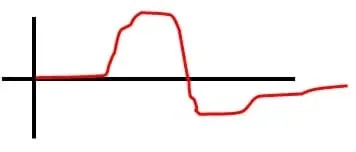
Is that good? Bad? The axes are unlabeled, so we have no idea!
The high end of the ceremonies - a five-dot merit - is called "Wings of the Moth." Basically you expend a Willpower point over a reasonably intact recently dead body, and it becomes alive again and you can stick a ghost in it and they can walk around as a mortal. It only lasts a week, at which time the body dies again in some way related to how they died the first time, because of Karma or some shit. This is supposed to "not be taken lightly," but fuck that. With the Stigmata Key you can basically keep your fuckbuddy around indefinitely as long as you have a good supply of fresh corpses.
This is the kind of thing that pisses me off, because buried in the mountains of shit you have little gems that could be the basis around which you play an adventure or a game - the Scooby Gang gets into an accident, and Velma's a ghost and the rest of the guys came back as Sin-Eaters, and now they need to learn what they need to either bring her back in the flesh...or help her move on. That's an interesting story. But nothing like that is ever presented here, there's never any real motivation to do personal stories and no real antagonists to go up against...at least in Call of Cthulhu you have some vague idea of what to expect for your investigator in terms of solving a mystery; in Geist nobody really has a clue what the fuck a Sin-Eater is supposed to do except fuck with dead people, and that kind of behavior is a misdemeanor in Florida.
NSFW

I was going to go for a funny image, but Cause of Death: Silicone Poisoning illustrates my point better.
It's a problem because in Geist, you're making a character, and they emphasize the concept, but you never figure out what your concept is there for. You can minmax all you want, but if there's no point to the thing, no obvious goal for a character...then how the heck are they supposed to build a PC? Why should they care which powers they take, except that these seem cooler than those? What does a Threshold matter except which Keys it gives access to? If you can't answer those questions in your chargen chapter or before, that's a fail.
In Orpheus, at least you have a job. They don't always tell you what the job is going to be, but you know what it entails: working with dead people. That's okay, lots of people work with dead and dying people.
They're not so bad, once you get to know them.
The chargen rules in both books are incredibly, absurdly, ricockulously over long. And at the same time, both books bit off rather more than they could chew and are horribly incomplete. I've heard that people claim to
have successfully played these games, and I scratch my head. These games simply can't be played as written. You'd just sort of have to ignore some of the gaping inconsistencies and fill it all up with mind caulk.
Part of the problem is that the very length of these chapters hides how incomplete they are. After page 15 of skills that could have been chopped out of any other White Wolf product or page 30 of powers you're not going to bother scribbling on your character sheet, trying to keep track of actually using this stuff becomes a nightmare. Each player would have to make their own crib sheet on how to play their fucking character, and they've probably get lost two or three times doing that.
Anyway, it's time to move on. So next up, we're looking at the Systems chapters.
Chapter Three: Part Two
Moar Character Creation
There's a lot of bullshit to wade through in these chapters.
This section's musical accompaniment will be Voodoo.
FrankT:
We didn't really get to the big question of chargen in these games: What can your character actually do? So let's hop to it.
One of the advantages of nWoD was that by having a shared book pool with all the other nWoD titles is that there is a shared NPC pool. This means that despite the fact that Geist really lacks any consistent internal reference point for how powerful your characters are, it actually does have such a reference point when you include the other books. There actually are stats for policemen, fire fighters, and soldiers. Unfortunately, what that information tells you is that aside from your magical power, a character in Geist (or any nWoD game for that matter) is fairly incompetent. At best, you're an idiot savant, and if you didn't remember to hyper specialize you're probably just kind of a schmuck. NWoD characters have few skills and stats compared to moderately competent normal people.
OWoD didn't even have that. Since each game line was nominally distinct, apples to apples comparisons of things were essentially impossible. The difficulty of basic actions were slightly different from one game line to the next, so the inherent value of a dot of strength or subtefuge was obviously not the same, and thus obviously the number of dots it was appropriate for a reference character like a librarian or a street thug to have would change as well. So you couldn't really transplant reference NPCs from line to line, and few books had enough reference NPCs to make a coherent guess as to what your characters could really do relative to other people in the world. Certainly Orpheus sure as fuck doesn't.
They probably didn't even mean that.
One thing that WoD games (both old and new) do is to give proclamations about what it means to have two dots of Leadership or four dots of Athletics. These declarations use a lot of page space, and they are literally less than worthless. The basic mechanics are that you roll a number of dice equal to your number of dots in an attribute added to the number of dots in a skill. So if you have a high skill and a low attribute, your number of dice could very plausibly be exactly the same as if you have a low skill and a high attribute. Or medium attributes and skills. Or whatever. So when it says that having five dots in Animal Ken means that you are “Master: You are the beast-master” that is a god damn lie. Having five dots in Animal Ken just makes you have four more dice than if you had one dot. What you can actually accomplish with the skill would depend on your total dicepool, of which your dots in Animal Ken are just a contributing factor. The list of totally misleading information about how good you are if you have various specific dot levels in various attributes and skills goes on for many pages in Orpheus. In nWoD, all that horse shit is moved to the World of Darkness corebook. It's still there in Geist, it's just that the book has to find other ways to waste page count. Which of course, it does.
I think we can all agree that the game would be better if having five dots of Animal Ken actually did make you the BeastMaster.
The weird thing is that this basic problem was there in Vampire: the Masquerade back in 1991. By the time Orpheus came out, this flaw in the system and presentation was twelve years old. By the time Geist came out in 2009, the problem was old enough to vote. And it wasn't just confined to White Wolf. Shadowrun 5th edition does exactly the same fucking thing, and that came out this year. The problem is now old enough to legally drink, and people are still doing it. There's just something fundamentally wrong with the people who write for dicepool systems where they insist on defining peoples' actual abilities in terms of X + Y but nonetheless making charts that attempt to explain how badass people are in terms of X or Y alone. Did all these assholes fail 8th grade algebra?
AncientH:
We like to go on about how the Storyteller system was derived by Mark Rein*Hagen listening to Tom Dowd explain how Shadowrun works in his car, and...well, we stand by it. The basic concept of oWoD and nWoD is supposed to be that your stats max out at 5 and your skills max out at 5, so except for bonuses from magic guns or disciplines or something, you shouldn't have any dicepools higher than 10. That's nice, except (in oWoD) you've got fluctuating Target Numbers which are more or less pulled out of the gamemaster's well-used asshole, and of course half of your supernaturals have stats that go higher than 5 even before you get to bonus dice from disciplines and stuff so...really, it was all about maximizing your dicepool or finding edges where you didn't have to roll dice.
Also, there are skill specialties - these basically give you a chance for dice to explode when you hit 10 so you can rack up some extra successes.
Orpheus is actually pretty straightforward in that there are limited ways to nerf your character; Geist on the other hand is a fudging nightmare. There are 10 keys and 7 manifestations and a hideous number of power permutations. It's the kind of system where there's so much crap in there some of it has to be broken; you literally couldn't write enough PCs to test out all the combinations and playtest them, and we know the editing was outsourced to a website.
All part of the service.
FrankT:
I kinda get the feeling that the people cobbling together the “Character Generation” system for Geist: The Sin Eaters didn't believe that that is the chapter they were making. There is just... stuff in here that doesn't make any sense. There's a bit about what it means to have a very high “Psyche” (which is the stat that operates exactly like Vampiric Blood Potency because it's a nWoD product and they are required by law to have one – in the Abominable example I did, that stat was called “Cthonus”), which is somewhat odd because you aren't allowed to have Psyche values that high during character generation. This gets even weirder because there are “anchors” that start kicking in at Psyche 6 (I think the maximum Psyche possible in character generation is 4), and it's very hard to remember while reading about these fucking things that we're still in the character generation. And then they start going into wound healing rules, and we're still in the character generation chapter, and I feel that the authors are just trolling at this point.
In this picture, the rubber ducky represents the information in the character generation chapter that is in any way directly relevant to generating a character.
AncientH:
I think you can pump your Psyche if you cash in your Synergy, but I'll start doing shots of white spirit before I go back and look it up.
My dad had an adult novel that was all about how ghosts could gain more ectoplasmic substance by drinking whiskey; the oldest ghost and the one who learned of it was an old bootlegger buried in ground that had been soaked for years where a still had been. They mainly used their powers to fuck. I've forgotten the title, but it was a better premise than either of these games. In fact, I might just steal it for something else! Yeah, I'll make my own ghost RPG except with blackjack and hookers...in fact, forget the ghosts.
Aside from power combos, Keys also have thematic and sometimes mechanical effects. Frank noted that the Industrial Key gives you a bonus if you can prove a piece of tech was invented over 100 years ago - surprisingly easy for things like firearms, not so much for paperclips - and the Stigmata Key gives you the amazeballs power to take a point of unsoakable damage instead of spending a point of Willpower. That's better than most of the actual Manifestations.
FrankT:
When you're fiddling through the skill lists in Orpheus, one of the things that jumps out at you is that they start talking about meditation checks that are difficulty 9. Difficulty Nine? Nothing in oWoD is Difficulty 9. That's just not a real number in the system! And then you realize... nothing is Difficulty 9 in the Revised Edition. In the Old old World of Darkness, Difficulty went up to 10 (at which point incredibly stupid shit happened due to very shitty botch rules). Now you can't confirm this growing sense of dread until you get to the system chapter that starts on page 206 where it tells you what the actual dice rolling mechanics are. But sure, I guess I should spoiler it for you: Orpheus is not a revised edition oWoD game. At all. The Revised Edition came out in 1998, and Orpheus came out in 2003, but for some reason it uses the pre-revised mechanics. This is doubly bizarre, because as you'll recall Wraith the Oblivion had its swan song in 1999, meaning that people literally can't have been floating a game to eulogize it with before the Revised Edition was a thing. I have no idea what's going on here. Orpheus isn't compatible with fucking anything. It's loaded down with legacy mechanics that White Wolf authors had successfully recognized as being terrible during the Clinton administration. Is this someone rebelling against the direction White Wolf had gone for the last five years? Is this someone trying to make something backwards compatible with Wraith first edition? Do the authors just consider themselves too fucking cool to bother reading what the rules team has been doing for the last decade? Are they just old fashioned? No one knows.
Orpheus skips the bitters and just pours whiskey on a marachino cherry. Fuck those guys.
But the long and the short of it is that no one can actually play Orpheus, because a considerable amount of the game is actually left unsaid and it very specifically isn't defaulting to any ruleset that White Wolf had made since before the turn of the century. So the authors are defaulting to their house ruled versions of amalgamated systems from many years ago, and unless you can read their god damned minds there are a lot of rules questions that just don't have answers in this or any other book.
AncientH:
I wouldn't put it past Orpheus to have started out as somebody's homebrew campaign that they pitched to White Wolf; a lot of the basic game concepts and mechanics are clearly derived from Wraith and refer to Wraith, so like Ghostwalk...wait a minute, Orpheus and Ghostwalk both came out in 2003. That's gotta be a terrible coincidence. Two half-baked, between-editions-looking-backwards products involving PC ghosts in the same year. Urgh.
Some editions should stay down.
FrankT:
Geist spends a lot of time attempting to adapt game mechanics from nWoD into something, anything that was less stupid. And then someone else spent a lot of time reverting that shit back for the purposes of backwards compatibility. I think we've made this point a few times, but fucking hell this book pulls this stunt a lot. Synergy is exactly like Humanity in Vampire. But it spends an entire page ranting at you about how it isn't a moral code and then another page ranting at you about how it works exactly the same way. And when you get down to it, this is a thing that dings you for “murder” but not for “killing,” so it's obviously making some kind of moral judgments.
This actually comes up on an image search for “moral judgment.” The non-sequitur nature of it is a better statement on White Wolf's attempt to discuss morality than more traditionally relevant pictures would have been.
AncientH:
The thing about morality in both games is that they're actually a step backwards. Vampire at least had gotten into its head that alternate moral systems existed and you could pick your Road/Path and be fucking done with it; the other games never even got that far.
FrankT:
You have special ghost stats in Orpheus. I'm not sure how much these are supposed to be worth because the relative cost of them is wildly different in different parts of the book. Sometimes Vitality costs the same as Willpower, sometimes it costs a lot more. Sometimes Willpower or Spite is given to you for free, sometimes it costs points. There would probably be a lot of powergaming you could do with theis fucking system if anyone gave a shit. One thing that happens is that if your Spite rises higher than your Vitality you get extra chaos mutations Stains. Stains are things where your spirit form has weird inhuman traits which are supposedly
good and bad – but like every mutation list ever some of them are pretty much all good and others pretty much all bad. Having a beetle carapace as a turtle shell for your back gives you a bonus die for soak and a penalty to difficulty to dodge, which means you straight up take more damage from a nominally defensive stain. On the other hand, being transparent makes you harder to find when you want and gives you a penalty to social rolls with other ghosts unless you choose to use opaque sweater technology to circumvent all the problems.
I mentioned that when your Spite rises above your Vitality that you gain these Stains. I don't know how much, because it is described as linear and triangular in two immediately adjacent sentences. It is literally impossible to tell from this description whether having a Vitality of 5 and a Spite of 7 entitles you to two extra Stains or three. It says both things back to back. Further, reading through it, I can't tell if these Stains are supposed to be on all the time or not. The Hues (the techno ghosts who are incoherently made out of paint somehow) have special abilities to call upon their stains, but the the actual stain descriptions mostly seem to imply that they are simply passively on. Only one of the twelve people writing this book ever tried to run a game of it, so it's not like there's any body of lore out there from which these questions can be answered.
AncientH:
Stains are sortof a holdover from Wraith, where they were called Deathmarks, but here they're more like the bodyshaping in Beetlejuice.
Can you believe this was a kid's cartoon?
The high point is some of the stains are pretty cool; I want pseudopods.
Part of the reason (but only part) that Geist is umpteen pages longer than Orpheus for this chapter is that Geist crams in all their Manifestations/powers. The basic concept I've mentioned before - different Key/Manifestation combos unlock different powers - which is intriguing as it should give you a shitload of powers and save space, because some powers should just be "Okay, you have the Cold Wind Key, Pyre-Flame Key and Boneyard Manifestation 4 - do you want to kill it with a killing wind or fire?" Instead, they chose quite literally the least concise method available, where every motherhumping Key/Manifestation combo at each dot level above the first is a separate, unique power. That's insane.
A note on the Elemental Keys: Cold Wind, Pyre-Flame, Tear-Stained, Grave-Dirt...I think they were taking them more or less from Ravenloft Elementals.
Also worth mentioning: the Keys are tied to specific skills. So if you want to get the most out of the Industrial Key, you need to ramp up your Crafts skill. That sounds straightforward, but some skills are better than others. The Occult skill, for example, works for all four Elemental Keys and some of the Stigmata Key manifestations. Stealth works for pretty much all the Stillness Key powers, making it the go-to for undead ninja.
Put me back in coach, I'm ready.
Orpheus' power rules are actually in the next chapter, but the list of Horrors is much more manageable.
FrankT:
We've mentioned how much fucking space is taken up with the fucking stupid categories of the dead, and how the categories are stupid and even the authors are forced to admit in a sidebar that they aren't very effectively distinguished. Anyway, let's talk a bit about what they do. What they do is give you a choice of two of one of your two starting keys. Yes, really. So if you have two keys that you want to start with, there will most likely be two death categories to choose from to get access to both. There are ten key types, and each death category gets two of them to choose from for your one mandatory pick. This is supremely uninteresting.
Giant eyelashes, on the other hand, are interesting.
What each key actually does is to unlock the key related powers of each manifestation. You start with three dots worth of manifestations, and each dot value of each manifestation has ten different things it does, one for each key you might have. What this means for a character is that as a Geist, the number of powers you have access to a number of powers equal to your dots in manifestations times your number of keys. Whenever you get a new key, that adds another power for every dot in every manifestation you have, and whenever you add a dot to a manifestation, you get a number of powers equal to the number of keys you have. You only start with three manifestation dots and two keys, which is six total powers and not too many to keep track of – but you can easily see how this would get horrendously hard to deal with in just a few sessions. When you have four keys and ten manifestation dots, that's forty fucking powers to track.
What it means for the book is that there are five dot levels listed for each of seven manifestations, and ten keys, meaning that the powers section writes up: 7 * 10 * 5 == 350 powers. [AH Note: 290, actually - they share the first-dote powers] Seriously. That is not a joke. And it gets better, because you see, manifestations don't actually stop at five, there just aren't any manifestations past five in the book. Manifestations can actually have up to 10 dots, which means that those 350 listed powers are actually only half the powers that would be required to complete the game. And that's not including the Ceremonies and Mementos and shit. That's just unlocked manifestations. And woe betide you if they ever wrote more content for this fucking game by making new manifestations or keys, because that would quadratically increase the number of powers you'd have to read.
Of course, this power bloat and quadratic advancement really gives the lie to the idea that players could mix and match a monster squad game. A Geist who took his three starting manifestations to five dots and picked up the associated keys for his two starting keys would have more distinct powers than all the basic disciplines in the Vampire book have combined. By a considerable margin.
AncientH:
It's simultaneously munchkin heaven and hell, because as I mentioned, each key (and it's associated powers) are tied to different skills. So while you can have all the powers, you're going to suck at most of them at any given time.
The amazing thing (to me) is that if I were writing up this system I'd probably just trawl the already-existing shitload of Wraith Arcanoi, necromantic discplines, ghost-related Gifts, mummy spells, mage rotes and whatnot to fill shit out. I could probably scrape through a couple editions of stuff and still have room to spare for a few new powers - in all of Wraith there were only 37 Arcanoi (Jesus fuck!), and at five dots each that works out to 185 powers (with overlap and admittedly some powers go up to 10 and alternate powers, but that's still probably less than 225). Geist literally has more powers in one gods-be-damned book than Wraith: the Oblivion ever published in its entire fucking run.
...and, amazingly, most of them aren't actually relevant to, y'know, ghost-stuff. Most of these abilities are rather generic arcane powers like cursing people and setting shit on fire and creating homunculi. It looks like a reject for a Mage: the Sorcerers sub-game, not a Wraith dickwag. It gets really annoying because, as I think I've mentioned, by the end of Vampire 3rd Revised edition, they actually had a solid system for Necromancy. It really should have been the model they used going forward, having an over-discipline that capped ratings and rituals and then individual paths full of related effects. Instead, they broke it down into a bunch of shitting disciplines, most of which were restricted to specific bloodlines so that you really did need like four vampire necromancers to do any serious necromancing. And having said that, Geist is still shittier - you need to get to 4 dots in the Marionette manifestation to raise a Cthulhu fhtagn zombie! 4! Dots! If I can't raise a motherhumping zombie from session 1, there is something serious wrong with your fucking game.
Karl Rove is still arguing Geist is a good game, the polls from the West Coast aren't in yet.
FrankT:
Orpheus powers, by contrast, are relatively contained. There are “horrors” which you either have or don't. That means that unlike most powers in any World of Darkness product, there do not appear to be dots to track. That doesn't mean that they are confined to a small number of pages. Oh goodness no. There might be only ten Horrors to choose from, but their descriptions are long. More than a page each. The Horrors description are 16 pages long, and they have a lot of text and special cases in them. Of course, they also aren't in the character creation chapter (while weird things like experience points are in the chargen chapter). So I guess we should lay off that particular rant for the moment.
AncientH:
In addition to Manifestations as if there weren't enough fucking powers in this game, Geist has Ceremonies. These are basically magical rituals which you learn as point-based Merits, because fuck you. These rituals pretty much are stolen from oWoD vampire Necromancy rituals, but they're written in a painfully expanded, low-information content format. Sort of like how D&D3 went from the hypercondensed magic item descriptions that could fit about twenty items a page to the monstrous things that could only handle two or three per page in the Magic Items Compendium.
None of this ends well.
There's actually a three-dot ceremony for creating a zombie, but it's bullshit and makes me shake my fist bitterly at the PDF.
FrankT:
Orpheus spends a lot of time telling you how to spend your points if you wanted to play a former police officer or firefighter or skin flautist or whatever. However, there is no indication as to whether you were are a particularly good police officer. This is a really important point of character conceptualization that this book totally fails on. Without having a baseline of what a “typical” police officer looks like, there's no indication at all whether my character is expected to be a badass Dirty Hairy or one of the fuckups from 21 Jump Street.
It is wholly incomplete characterization to explain that a character used to be a cop. You must also explain whether they were any good at it.
As such, page after page of character template goes by and none of it means dick diddly. It's an awe inspiring waste of space.
Is that good? Bad? The axes are unlabeled, so we have no idea!
AncientH:
The high end of the ceremonies - a five-dot merit - is called "Wings of the Moth." Basically you expend a Willpower point over a reasonably intact recently dead body, and it becomes alive again and you can stick a ghost in it and they can walk around as a mortal. It only lasts a week, at which time the body dies again in some way related to how they died the first time, because of Karma or some shit. This is supposed to "not be taken lightly," but fuck that. With the Stigmata Key you can basically keep your fuckbuddy around indefinitely as long as you have a good supply of fresh corpses.
This is the kind of thing that pisses me off, because buried in the mountains of shit you have little gems that could be the basis around which you play an adventure or a game - the Scooby Gang gets into an accident, and Velma's a ghost and the rest of the guys came back as Sin-Eaters, and now they need to learn what they need to either bring her back in the flesh...or help her move on. That's an interesting story. But nothing like that is ever presented here, there's never any real motivation to do personal stories and no real antagonists to go up against...at least in Call of Cthulhu you have some vague idea of what to expect for your investigator in terms of solving a mystery; in Geist nobody really has a clue what the fuck a Sin-Eater is supposed to do except fuck with dead people, and that kind of behavior is a misdemeanor in Florida.
NSFW
I was going to go for a funny image, but Cause of Death: Silicone Poisoning illustrates my point better.
In Orpheus, at least you have a job. They don't always tell you what the job is going to be, but you know what it entails: working with dead people. That's okay, lots of people work with dead and dying people.
They're not so bad, once you get to know them.
FrankT:
The chargen rules in both books are incredibly, absurdly, ricockulously over long. And at the same time, both books bit off rather more than they could chew and are horribly incomplete. I've heard that people claim to
have successfully played these games, and I scratch my head. These games simply can't be played as written. You'd just sort of have to ignore some of the gaping inconsistencies and fill it all up with mind caulk.
AncientH:
Part of the problem is that the very length of these chapters hides how incomplete they are. After page 15 of skills that could have been chopped out of any other White Wolf product or page 30 of powers you're not going to bother scribbling on your character sheet, trying to keep track of actually using this stuff becomes a nightmare. Each player would have to make their own crib sheet on how to play their fucking character, and they've probably get lost two or three times doing that.
Anyway, it's time to move on. So next up, we're looking at the Systems chapters.
-
Username17
- Serious Badass
- Posts: 29894
- Joined: Fri Mar 07, 2008 7:54 pm
-
JigokuBosatsu
- Prince
- Posts: 2549
- Joined: Tue Aug 10, 2010 10:36 pm
- Location: The Portlands, OR
- Contact:
The funny thing about Geist is that for a game about ghosts they actually give you "Care: Y/N" switch. If you take Stigmata and rage/marionette keys, then you can dick around with ghosts as you want - you are just better than them.
EDIT:
Speaking of rituals. Healing ritual (2 dots, I think) combined with Pyre-Flame + Caul allows you to make infinite ectoplasm loop.
EDIT:
Speaking of rituals. Healing ritual (2 dots, I think) combined with Pyre-Flame + Caul allows you to make infinite ectoplasm loop.
Last edited by Longes on Tue Apr 22, 2014 6:13 am, edited 1 time in total.
-
Ancient History
- Serious Badass
- Posts: 12708
- Joined: Wed Aug 18, 2010 12:57 pm
muChapter Three & Four
Working the System
Systems

At the limit of infinite page count, there will be a system for everything.
This section's musical accompaniment will be Down in the Ground Where the Dead Men Go.
Geist has a systems chapter because White Wolf games have a systems chapter so that's what is going to get written. Many things in this book probably could have gone in this chapter, like the rules for gaining and losing synergy and plasm and shit. But those all went into the character generation chapter for no reason. Further, most of the concrete mechanics of nWoD games are by definition in the World of Darkness corebook. While there are a couple of things in this chapter that are descriptions of how to use the nWoD mechanics to do stuff (which could generously be called “systems” in this context), most of the chapter is taken up by three things. A rambling subsystem for leveling up your Krewe, a magic item list, and some tangential essays about how it feels to see ghosts. This all takes 44 pages.
Orpheus, on the other hand, has a systems chapter because it's a stand alone game. Not that it is a game which actually stands, on its own or otherwise. But it doesn't have any other books to tell you what the basic mechanics are, so everything you get you get in this book. So obviously they need a chapter to tell you what dice are rolled and what the die results mean and shit like that. I think it's pretty fucked up to wait until page 207 of the book to get around to telling players this sort of high level information, but they did have to place it somewhere. All of this fits into 43 pages, which is one less than Geist used for a bunch of trivial bullshit. So economy of language points definitely go to Orpheus.
Orpheus advertises this is an essential chapter by having pictures of a line of nuts and bolts across the page borders. This is acceptable.
Geist starts the chapter with the word "Symbiology." That is a war crime.

Next on the docket: The People v. White Wolf
Geist compounds this error by quoting Nietzsche out of context in paragraph three.

I haven't been this pissed since I found out the Queen of the Zombies lays eggs.
Frank goes on a bit of a tear about Orpheus in this one, so I'll be focusing on Geist. It's a shorter chapter and the material is less interesting, so I'm probably going to be wringing the dregs for points of humor and insight by the end. Please bear with us, because after this is Storytelling.
The star line of every edition and version of the World of Darkness is Vampire. It's what makes the money and gets young women with gothic pretensions to take their clothes off. It's also the first book of any new edition, for obvious reasons. When nWoD came out, it had five clans of vampires, and the two shittiest clans had the clan disadvantage that they had to use old White Wolf die mechanics on certain kinds of rolls. Now, those two clans were the worst clans because their unique disciplines didn't do anything good, but there was a running joke among White Wolf fans that they were the worst because “having to use old White Wolf die mechanics is too harsh.” And the point of this shaggy dog story is that it was generally acknowledged even by its fans that White Wolf's old mechanics were a special kind of terrible.

Also I had an onion on my belt.
So having mechanics that mimic older White Wolf editions would seem like a thing that would be so obviously a bad idea that I don't understand why it would happen. And yet the core system of Orpheus is a heavily house ruled version of a system that was retired and replaced with a better one five years before it was published. This is a point where there is ample room for speculation. I mean, was this book sitting unpublished for more than five years? Was this book produced by a core group of rebels who refused to accept the Revised Edition? Was this book a deliberate attempt at backwards compatibility with Wraith books from nearly a decade before? I don't know. But it's weird as fuck. Orpheus runs on a core engine that even White Wolf fanatics had grudgingly agreed was too shitty to use anymore, and that fight had been had and decided five years earlier.

So at its core, in pre-revised oWoD, you roll a variable number of d10s against a variable target number. Stupid shit happens on 1s, so the maximum target number you can have before the game's math breaks open like an egg full of foul vapors is 9. If one of your dice comes up equal to or greater than the target number, you succeed at your task (subject to stupidity with 1s). Orpheus mostly drops the 1s stupidity, so it can nominally accept a target number of 10 – but the difficulty chart only goes up to 9. A difficulty of 9 is supposedly “extremely difficult.” But... is it? Not really, no. If you roll only 1 die, you succeed 20% of the time. You succeed more than half the time on four dice. Dicepools are measured from one to ten. What “extreme difficulty” does mean, is that there is a significant chance of failure. Even untrained hobos can usually succeed at such rolls, but even people with ten dice fail more than one in ten times. Fundamentally, what the oWoD pre-revised system delivered was a system in which no one could ever seem all that competent, because no matter how many dice you rolled you still failed often enough to notice, and no matter how nominally out of your depth you were there just weren't any tasks in the game that you couldn't have a reasonable chance of succeeding at. Every so often, people talked about joke game lines like Stooge: The Nyuking or whatever, and the sad thing is that these would be a much better fit for the game engine than what they actually ended up making for serious.
Right. As you may recall, Geist loaded all most of its player character powers in the insanely bloated and ill-organized character generation chapter, and of course they're using nWoD as the core system and there's already an entire book for that, so what they call their Systems chapter is really a hodgepodge of convoluted metaphysics and "I'm different" rules to differentiate themselves from other games. It does not actually add value to the product, and I think if you just killed the book at the end of the last chapter it would have been considerably shorter and no-one would have missed what came after...and even then it would be a shitty game.
"Symbiology" <shudder, shake fist> basically explains that because the character is bonded to a geist, their actual mortal biology is different.

Clive Barker had an eyepatch before Samuel L. Jackson.
The gist is that in World of Darkness, normal humans are generally presented a bit like Kool Aid man - mobile bags of red fluid that are tremendously fragile and will bleed out in half a heart beat.

I've used two of these images so far.
Where Vampires and werewolves can soak damage and regenerate, normal humans tend to fair badly in WoD games, and they need a leg up to keep from dying every damn fight. Cue this chapter, which is basically a lot of ways that the game cheats to keep the Sin-Eater in the game.
For one, the Geist never lets the player fall unconscious from wounds. Which means that if you saw off their arms and legs, they'll still be awake and feel every minute of it as you bring out the power drill. Likewise, the ghost snot coursing through a Sin-Eater's body acts as a supernatural immune system, adding dice to resist disease, drugs, and poisons, and the Sin-Eater can spend Plasm instead of taking boxes of damage.

It's not quite Death Becomes Her, although for the life of me I can't figure out why the fuck not.
Likewise, Sin-Eaters can heal up by absorbing death energy. You'd think that would mean something in terms of already-defined terms, or maybe some storyteller-saving-throw like "there's a cemetery/morgue/old folks home nearby!"...

Look, a canal!
...but really what it means is that you can either drain a Memento or murderize a person. Yes, getting your stab on can bring you back from the brink of death. Jason Vorhees is an awesome Sin-Eater.

It explicitly has to be murder for it to work. Killing somebody in self-defense doesn't count. In Florida, Sin-Eaters are SOL...unless they're black.
Also, you're supposed to lose a point of Synergy when you murder someone for their warm, chewy death energy, but I don't understand why. I mean, you're giving yourself over to death...shouldn't that make the bond with the death spirit stronger?
Unfortunately for anyone looking for a quick way out of a game of Geist that they find themselves trapped in, even death is not an escape because unless you die of old age, you get resurrected the next dawn or dusk. Nominally if you do this five or six times in a row you descend to 0 Synergy and all that entails, but honestly, one can be forgiven for going Groundhogs Day at that point.

Worse, each time you manage to fuck up and die, the geist inside has to "balance" the equation by killing someone else.

Wonder where they got that idea.
So you're not immortal, but if you get near to death you can murder a person for their quickening death energy, and if you don't or can't murderize another person then you end up killing some poor innocent schlub. Even if you say it "fuck it" to the whole geist thing your MC could decide at any time that you have a cerebral hemorrhage or heart attack, and you wake up the next day with a hangover and a dead hooker. It's like Vegas all over again.
In the original Vampire, 1s counted as negative hits, and if you got a net negative success, you got a “botch.” That's where the stupidity at TN 10 came in, because of course rolling more dice increased your chances of success and botching increased together. Orpheus uses a later formulation, where 1s don't subtract success, but if you fail to get any successes and roll at least one 1 on one of your dice, you get a botch. This means that the percentage of failures that are botches rises as people get more nominally competent. That guy with one die attempting an “extremely difficult” task succeeds 20% of the time and 11% of his failures are botches. The guy who attempts the same task with 10 dice succeeds 90% of the time, but 70% of his failures are also botches. Not only do characters described as “masters” lose to hobos pretty often, but when they fail they fail spectacularly and hilariously more often than not. Note that there are a lot of tests in this game that you can simply “try again” until you succeed or botch – and that shortens the distance between the “worst” and “best” even more (93% chance of success before botch for the dicepool 10 character, 67% chance of success before botch for the 1 die character). There have never been a really good set of fumble mechanics for a dice pool game. Believe me, I've looked. But Orpheus chooses to use one that was already known to be bad. The writers of Orpheus acknowledge that botches happen way too often, and suggest that storytellers might want to just let some of them slide. The rules aren't good, but at least the writers tell you not to use them.
nWoD went to a kind of crazy place with its botch mechanics. Called “dramatic failure,” they quite simply cannot happen on most rolls you'd be inclined to make. The way they happen is that there are sometimes dicepool penalties for injuries or special circumstances or whatever, and if those penalties obliterate your entire dice pool, you are still allowed to roll a “chance die” that succeeds on a 10 and dramatic failure's on a 1. So for the vast majority of actions, dice pool penalties sufficient to call for a chance die simply don't exist. And for those actions where such penalties could be found, players will normally elect to do something else when penalties that large apply. Most players aren't going to try to shoot a gun while they are temporarily blind, for example. You could play a weekly nWoD game for an entire year and never see a chance die rolled, let alone actually see a dramatic failure generated. But for whatever reason, nWoD formating rules are such that every ability or skill use or magic power that gets described gets an entire list item dedicated to telling you what would happen if hypothetically a dramatic failure were to occur. It's kind of like dedicating a line in the book for every described die roll to having a procedure in case Jesus returns or a meteor strikes the city while you are making any particular die roll. It's an edge case that will never gonna happen, but when you tally up all the text that nWoD books have wasted on this concept, it's staggering. And so it is with Geist. There's three lines of text dedicated to telling you what happens if you roll poorly after rolling a negative number of dice on a Wits + Occult + Psyche test to spot a ghost doing his ghost shit.
In addition to Keys, Manifestations, and have ghost-snot running through their veins, Sin-Eaters have a collection of random death-related powers. Because obviously the writers were worried that the PCs weren't going to have enough to keep up with their bold, vaguely defined setting. This actually goes back a little ways to Wraith, because Wraiths start out with a handful of basic abilities which are along the line of "Deathsight" and "Lifesight" so they can tell how people died, how close they are to death, if they're sick or injured, peer through the misty Veil between worlds, etc., and each Arcanos gave the wraith a couple of basic non-dot-based abilities in addition to the dot-based powers. It was actually a kind of welcome change of pace from Werewolf gifts and Vampire disciplines, but given that Geist is already a bloated pig of a game when it comes to powers, I think I'd have to run up a chart to keep track of all this shit.
Anyway, without any Keys or Manifestations or ceremonies, Sin-Eaters can:
1) See ghosts
2) Talk to ghosts
3) Touch/interact with ghosts (by spending plasm)
4) Sixth sense that alerts them to ghostly activity
5) Occult magnet for ghosts and ghostly activity
6) Heal/stabilize ghosts by infusing them with plasm
7) Eat ghosts and geists to gain their rich, tasty plasm
8) Sense how healthy/close to death a human is
9) Pick up information on a "death stain" left by death
10) Discern the cause of death of a corpse
...Jesus, I take it back. That's two Necromancy disciplines worth of free abilities, and the chapter's not even done.
Random thought: No characters in this game are ever depicted as having fun. Where's the gleefully morbid characters that revel in death?
NSFW

This does make sense in context, but I couldn't find the Chaykin image I wanted to use. Anyway. Yes, this was a PSA about how to use a condom with Death of the Endless and John Constantine. The 90s were a weird time.
Geist gets to outsource most of its stupid rules to the World of Darkness corebook. If you want to know what the rules for being electrocuted or falling down the stairs or whatever are, you can go to that other book. Geist doesn't afraid of anyone and can't be bothered to rub two fucks together. Orpheus, on the other hand, has all these kinds of shitty rules right here where they bother you. And it's important, because Orpheus isn't compatible with anything so this is all you ever get. So for example, Orpheus has some minimal vehicle rules, which are kind of garbage. There are fifteen vehicles on the chart, which include such inscrutable choices as “Midsize” (… midsize what?) and “Tank (WWII).” And that's all you get. That's all you will ever get, because Orpheus is so stand alone it doesn't even use a compatible ruleset with the World of Dakrness it sometimes claims to be part of. So if you're kind of annoyed that limousines and tractors and shit didn't make the cut, go fuck yourself.
Now, the vehicle rules are bad. You get a penalty to driving difficulty for each 10 miles per hour you are driving over the “safe speed.” If you are in a racing car, the maximum safe speed and the maximum speed are 100 MPH apart. That creates 10 difficulty shifts. Problem is: there are only eight difficulty shifts, you assholes! Target number 1 and 11 do not and cannot exist in this system.

Also we learn that it is totes safe to drive sports cars at 110 MPH. Zoom safely!
Next bit in Geist is about founding a Krewe. This is delivered with all the pomp and detail of creating an initiatory group in Shadowrun and oh fuck me joining a krewe gives you even more powerz. Anyway, forming a krewe is less like declaring your own masonic lodge or wicca coven and more like creating your own officially sponsored after-school club. You get a Mentor (mystic death spirit), decide on the funny handshakes and trapping, create a body of rules (Codex), and then you go through the initiation/binding ceremony and get the powers. Krewes are lumped into tiers, because in a moment of complete insanity they decided to out-and-out steal a bunch of terminology and rules from Hunter: the Vigil.

I hit the wrong button and found out H:tV has a trailer video because WW held a contest. I need images of happy goths to get this out of my brain.
Anyway, Tier 1 is <10 members, which makes it equivalent to your gaming group. Tier 2 is a pyramid scheme where each founding member has a clique, or about the size of your average LARP event. Tier 3 is a "conspiracy" or "cult" of 100+ members across two continents, or basically a Humans vs. Zombies event. Facebook doesn't count, or else Mark Zuckerberg would stage extinction events to harvest the plasm and souls to build his personal afterlife.

On second thought, let's not give him any ideas.
Anyway. Players in krewes gain bonus experience (I think it's bonus, it's a little hard to follow), and gain certain benefits depending on the tier of their krewe. Some of the bennies are automatic, others are merits you have to buy. You can join multiple krewes, but then the system tells you to bend over so it can insert the XP penalty suppository.
The bennies vary "this sounds like it should be a Background" to "yet more fucking death powers." For example, Flesh Fair (1-3 dot Merit) lets you call in more participants for your orgy ceremony, because it's very important to have more people around for a "frenetic celebration of life." To make things more complicated, these bennies don't really follow any of the established rules and each is their own specific fucking snowflake, so some of them have individual ranks and dots, some have drawbacks and others don't, some have prerequisites and others don't, yadda yadda.
Also, some of these powers are insane. Mythic Avatar is a power you're never going to get because you have to be the Founder of a Tier 2 Krewe with a minimum Psyche of 5 and it's a 5-point Merit, but holy shit you get a +4 bonus to one attribute. That...fuck.

Attributes are normally on a scale of 1-5, with 5 being Olympian.
Some of the powers are just openly bullshit. There's a Tier 3 power called Forge Key where, you guessed it, you get to create a new Key. I don't know how that's supposed to work, because it means you and your MC just assigned yourself the homework of designing a new fucking Key power for each fucking Manifestation. I don't know why they made it hard to do, the prospect of that alone is enough to keep me from ever using that power.

"I am the Keymaster!"
"Hey everybody, we're all gonna get laid!"
"No, you didn't translate the scroll right. It says 'we're all fucked.'"
Orpheus has a combat system that has too many die rolls. You have an attack roll, a dodge roll, a damage roll, and a soak roll. You could easily halve the number of rolls and make everything run much more smoothly. It doesn't help that all of those rolls potentially have different difficulty levels, nor does it help that in the rest of the system you're mostly trying to get “a success” while in combat you're comparing numbers of dice that hit target numbers like they were penis sizes. People fail a lot in combat, because there are a lot of ways to fail in combat. Also, with four rolls per attack, botches happen. Like, whoah. One can certainly see how someone would look at this and decide that it needed to be pared way down. And in nWoD, the pendulum swung the opposite direction. Too far in the opposite direction. Combat is handled with single rolls, with each hit inflicting a wound box. This means that “dramatic failures” basically do not happen of course, and it also means that combats are horribly boringly predictable. Law of Averages comes in pretty hard when you're rolling dice until you hit 8 successes to drop a dude – and when you're rolling until you accumulate 46 successes to drop six dudes, you might as well not roll dice at all.

Seems like a happy medium would not have been hard to envision. Still isn't.
But what this really means is that magical effects that are fashioned like “save or die” effects in D&D make you fucking win in nWoD. You just roll a pile of dice and if you roll a single 8+ on any of the dice you win. The suckers running around with pistols or even magical .30-30 rifles are still trying to pick up dozens of successes to win a combat while someone with a battle ending magic power is trying to get only one.
There's a section on Mementoes. I'm about at my can't-give-fuck-point, but here's the gist: in addition to dying and coming back with ghost-snot in your veins, you start collecting little kitschy death-related objects. Like when your grandparents go on a cruise and come back with a bunch of shrunken heads and bits of gravestones they weren't supposed to chip off and illegal Mayan artifacts and the guns used by authentic serial killers.

What next, the ancient arcane art of gaining power through scrapbooking?
This actually goes on for several pages and there appears to be a fine line between "item charged with death energies because it is related to death," and "mystic artifact that holy shit I can't buy on eBay." It's really just an excuse to drop a bunch of "spontaneous" magic items in the game, with the basic concept that all the gothy kitsch crap at Hot Topic is worthless, if you look hard enough and get lucky you can find or make something that vaguely resembles the kind of awesome shit you see in movies but not the real world and that will have some genuine magical power...because ghost knows you don't have enough fucking death magick already.

I never thought I'd see the day I'd get tired of necromancy.
Basically, the bigger, creepier, and more time and energy that are put into making the memento, the more juice it has. So if you take a dead animal's skull from the nearby roadkill and dip in sugar, that's a 1-point charm (no, seriously, that's in here); if you make a wall collage of clippings about a local student shooting that makes your roommate start dialing the police, that's a 2-pointer. 3-pointers actually have a ghost bound within them and are called fetters, even though they're not-quite-related to Wraith fetters and are actually also anchors, at which point I hate my life for bringing me to this point. 4-pointers are called "Deathmasks" and are the keystones left by geists that have been destroyed or faded away. So your go-to method of making these is to turn on your fellow player characters, kill them and eat their geists. It's for the best, really. Memorabilia are historical artifacts associated with death.
One can only imagine the nigromantic power of ABBA's turd.
You can totally tell that Orpheus is ultimately made out of old Vampire DNA. For fuck's sake, the maneuver list has an entry for biting people in combat. But Orpheus does provide an economy of writing that Geist really doesn't. Basically, you get the impression that Orpheus' writing staff simply felt that all this “rules” shenanigans was simply something that was required of them and they were going to speed through it as quickly as possible so they could get to the good stuff. Geist on the other hand, is langorous gurge and regurgitation of word salad. For the Geist writers, filling up the wordcount requirements was the goal. Both teams are basically going through the motions, but the Orpheus team wrote something that was a lot more approachable. If Orpheus was actually a system you would ever use, the fact that they get to the damn point eventually would be a huge thingy in its favor.

What this ends up with is Orpheus having one of the most elegant computer hacking systems I have ever seen (not that this is a high bar). You roll Intelligence + Computers against a difficulty. If you succeed, you hack that thing, and move on. If someone is trying to stop you from hacking in, they can roll and have their successes cancel yours. That's it. That's the whole system. That's shockingly elegant, and it's in a fucking throwback OSR White Wolf game. What the fuck were CP2020 and Shadowrun doing all these years? On the flip side: Geist has these magic items called Deathmasks that give you a +1 to a skill. The overview of those things is 644 words. Then sample Deathmasks go on for three fucking pages.
Okay, I've basically run out of Geist chapter, because it has some pithy bullshit about how to design mementoes and all the mementoes they have are basically shit. They're not even at the level of low-tier SCP-wiki items, because there's not a lot of detail here - it's a bunch of churned-out stories of "haunted" items and armor-piercing screwdrivers that give you nightmare visions like something out of one of the Stephen King novels he churned out between bottles of scotch 4 and 5.

It's basically the same spontaneous magic item bullshit that White Wolf has been trying to push since Vampire 1st edition, it's never good or interesting and I have no idea why they decided to cram five different types of spontaneous magic items into a single five-dot rating scale except sheer laziness. At least I take solace in someone making a quick buck out of this chapter.
Way back in Werewolf the Apocalypse, they introduced the idea of “pack totems,” which were spirits that everyone in the pack would chip in for and which would provide bonuses for the whole pack. These Krewe advancement things are basically the same idea.
Frank and I are still a bit out of sync, he's conflating the Mentor spirits of Krewes with the Totem spirits of the Changing Breeds. Which isn't wrong, but it's a slightly different dynamic. I mean, obviously both look like they're stealing left, right, and center from Shadowrun's Grimoire first edition, but the krewes suggest that you can make your own death-cult for fun, power (oh gods more powers), and profit.

Sure, sounds like fun. Let's all meet here again in ten years.
Even more than the vehicle list, I feel that the weapon list in Orpheus is bullshit. The game is set in a near future sci-fi horror world with necro-tech and cryo tubes and shit. This weapon list needs proton packs and laser rifles and liquid nitrogen sprayers and and sonic stunners and shit. If you were hoping for anything like that, you're going to be sorely disappointed. All you get is ten guns, four of which are pistols that I am unclear as to why they are differentiated.

You said crossing the streams would be bad.
Geist so myopically refers to the specific rather than the general that its coverage manages to be even worse. It spends 339 words describing a specific rusty can that lets you shoot banshee wails at people because the ghost of a raped and murdered jogger has been bound into it. That's extremely specific, just a bit morally reprehensible, and not a super great ratio of wordcount to explaining what the shitfuck the stuff in the gameworld does.
...aaand we're caught up!
All in all, we have the same mandatory chapters from late in two White Wolf periods, and you can see that they've become decadent and cargo cultish in both cases. It's interesting mostly in the different directions that oWoD and nWoD took the act of “phoning it in.” Neither chapter is particularly worth reading, but either one could be used as “Exhibit A” in “why White Wolf was about to get liquidated as a company.”

Keep in mind, at this point Orpheus still hasn't detailed its Horrors and Geist still hasn't explained what the fuck you're supposed to be doing or why except that the death-pimp in your skull tells you to. If you expect answers to either of those questions you'll have to keep reading. But maybe not this next chapter, because they're both on Storytelling.
 Look, if I can't have a fucking talking skull in my game of necromancy and superghosts, you've just made poor life choices.
Working the System
Systems
At the limit of infinite page count, there will be a system for everything.
This section's musical accompaniment will be Down in the Ground Where the Dead Men Go.
FrankT:
Geist has a systems chapter because White Wolf games have a systems chapter so that's what is going to get written. Many things in this book probably could have gone in this chapter, like the rules for gaining and losing synergy and plasm and shit. But those all went into the character generation chapter for no reason. Further, most of the concrete mechanics of nWoD games are by definition in the World of Darkness corebook. While there are a couple of things in this chapter that are descriptions of how to use the nWoD mechanics to do stuff (which could generously be called “systems” in this context), most of the chapter is taken up by three things. A rambling subsystem for leveling up your Krewe, a magic item list, and some tangential essays about how it feels to see ghosts. This all takes 44 pages.
Orpheus, on the other hand, has a systems chapter because it's a stand alone game. Not that it is a game which actually stands, on its own or otherwise. But it doesn't have any other books to tell you what the basic mechanics are, so everything you get you get in this book. So obviously they need a chapter to tell you what dice are rolled and what the die results mean and shit like that. I think it's pretty fucked up to wait until page 207 of the book to get around to telling players this sort of high level information, but they did have to place it somewhere. All of this fits into 43 pages, which is one less than Geist used for a bunch of trivial bullshit. So economy of language points definitely go to Orpheus.
AncientH:
Orpheus advertises this is an essential chapter by having pictures of a line of nuts and bolts across the page borders. This is acceptable.
Geist starts the chapter with the word "Symbiology." That is a war crime.
Next on the docket: The People v. White Wolf
Geist compounds this error by quoting Nietzsche out of context in paragraph three.
I haven't been this pissed since I found out the Queen of the Zombies lays eggs.
Frank goes on a bit of a tear about Orpheus in this one, so I'll be focusing on Geist. It's a shorter chapter and the material is less interesting, so I'm probably going to be wringing the dregs for points of humor and insight by the end. Please bear with us, because after this is Storytelling.
FrankT:
The star line of every edition and version of the World of Darkness is Vampire. It's what makes the money and gets young women with gothic pretensions to take their clothes off. It's also the first book of any new edition, for obvious reasons. When nWoD came out, it had five clans of vampires, and the two shittiest clans had the clan disadvantage that they had to use old White Wolf die mechanics on certain kinds of rolls. Now, those two clans were the worst clans because their unique disciplines didn't do anything good, but there was a running joke among White Wolf fans that they were the worst because “having to use old White Wolf die mechanics is too harsh.” And the point of this shaggy dog story is that it was generally acknowledged even by its fans that White Wolf's old mechanics were a special kind of terrible.
Also I had an onion on my belt.
So having mechanics that mimic older White Wolf editions would seem like a thing that would be so obviously a bad idea that I don't understand why it would happen. And yet the core system of Orpheus is a heavily house ruled version of a system that was retired and replaced with a better one five years before it was published. This is a point where there is ample room for speculation. I mean, was this book sitting unpublished for more than five years? Was this book produced by a core group of rebels who refused to accept the Revised Edition? Was this book a deliberate attempt at backwards compatibility with Wraith books from nearly a decade before? I don't know. But it's weird as fuck. Orpheus runs on a core engine that even White Wolf fanatics had grudgingly agreed was too shitty to use anymore, and that fight had been had and decided five years earlier.
So at its core, in pre-revised oWoD, you roll a variable number of d10s against a variable target number. Stupid shit happens on 1s, so the maximum target number you can have before the game's math breaks open like an egg full of foul vapors is 9. If one of your dice comes up equal to or greater than the target number, you succeed at your task (subject to stupidity with 1s). Orpheus mostly drops the 1s stupidity, so it can nominally accept a target number of 10 – but the difficulty chart only goes up to 9. A difficulty of 9 is supposedly “extremely difficult.” But... is it? Not really, no. If you roll only 1 die, you succeed 20% of the time. You succeed more than half the time on four dice. Dicepools are measured from one to ten. What “extreme difficulty” does mean, is that there is a significant chance of failure. Even untrained hobos can usually succeed at such rolls, but even people with ten dice fail more than one in ten times. Fundamentally, what the oWoD pre-revised system delivered was a system in which no one could ever seem all that competent, because no matter how many dice you rolled you still failed often enough to notice, and no matter how nominally out of your depth you were there just weren't any tasks in the game that you couldn't have a reasonable chance of succeeding at. Every so often, people talked about joke game lines like Stooge: The Nyuking or whatever, and the sad thing is that these would be a much better fit for the game engine than what they actually ended up making for serious.
AncientH:
Right. As you may recall, Geist loaded all most of its player character powers in the insanely bloated and ill-organized character generation chapter, and of course they're using nWoD as the core system and there's already an entire book for that, so what they call their Systems chapter is really a hodgepodge of convoluted metaphysics and "I'm different" rules to differentiate themselves from other games. It does not actually add value to the product, and I think if you just killed the book at the end of the last chapter it would have been considerably shorter and no-one would have missed what came after...and even then it would be a shitty game.
"Symbiology" <shudder, shake fist> basically explains that because the character is bonded to a geist, their actual mortal biology is different.
Even from a fantasy standpoint, this fails basic anatomy hard. "The strength of death?" I mean, these guys aren't fucking EctoKid.Ectoplasm begins to flow through the bloodstream, the strength of death suffuses muscle, sinew tissue, and bone, and the sense of the geist begin to overlap with that of the Sin-Eater.
Clive Barker had an eyepatch before Samuel L. Jackson.
The gist is that in World of Darkness, normal humans are generally presented a bit like Kool Aid man - mobile bags of red fluid that are tremendously fragile and will bleed out in half a heart beat.
I've used two of these images so far.
Where Vampires and werewolves can soak damage and regenerate, normal humans tend to fair badly in WoD games, and they need a leg up to keep from dying every damn fight. Cue this chapter, which is basically a lot of ways that the game cheats to keep the Sin-Eater in the game.
For one, the Geist never lets the player fall unconscious from wounds. Which means that if you saw off their arms and legs, they'll still be awake and feel every minute of it as you bring out the power drill. Likewise, the ghost snot coursing through a Sin-Eater's body acts as a supernatural immune system, adding dice to resist disease, drugs, and poisons, and the Sin-Eater can spend Plasm instead of taking boxes of damage.
It's not quite Death Becomes Her, although for the life of me I can't figure out why the fuck not.
Likewise, Sin-Eaters can heal up by absorbing death energy. You'd think that would mean something in terms of already-defined terms, or maybe some storyteller-saving-throw like "there's a cemetery/morgue/old folks home nearby!"...
Look, a canal!
...but really what it means is that you can either drain a Memento or murderize a person. Yes, getting your stab on can bring you back from the brink of death. Jason Vorhees is an awesome Sin-Eater.
It explicitly has to be murder for it to work. Killing somebody in self-defense doesn't count. In Florida, Sin-Eaters are SOL...unless they're black.
Also, you're supposed to lose a point of Synergy when you murder someone for their warm, chewy death energy, but I don't understand why. I mean, you're giving yourself over to death...shouldn't that make the bond with the death spirit stronger?
Unfortunately for anyone looking for a quick way out of a game of Geist that they find themselves trapped in, even death is not an escape because unless you die of old age, you get resurrected the next dawn or dusk. Nominally if you do this five or six times in a row you descend to 0 Synergy and all that entails, but honestly, one can be forgiven for going Groundhogs Day at that point.
Worse, each time you manage to fuck up and die, the geist inside has to "balance" the equation by killing someone else.
Wonder where they got that idea.
So you're not immortal, but if you get near to death you can murder a person for their quickening death energy, and if you don't or can't murderize another person then you end up killing some poor innocent schlub. Even if you say it "fuck it" to the whole geist thing your MC could decide at any time that you have a cerebral hemorrhage or heart attack, and you wake up the next day with a hangover and a dead hooker. It's like Vegas all over again.
FrankT:
In the original Vampire, 1s counted as negative hits, and if you got a net negative success, you got a “botch.” That's where the stupidity at TN 10 came in, because of course rolling more dice increased your chances of success and botching increased together. Orpheus uses a later formulation, where 1s don't subtract success, but if you fail to get any successes and roll at least one 1 on one of your dice, you get a botch. This means that the percentage of failures that are botches rises as people get more nominally competent. That guy with one die attempting an “extremely difficult” task succeeds 20% of the time and 11% of his failures are botches. The guy who attempts the same task with 10 dice succeeds 90% of the time, but 70% of his failures are also botches. Not only do characters described as “masters” lose to hobos pretty often, but when they fail they fail spectacularly and hilariously more often than not. Note that there are a lot of tests in this game that you can simply “try again” until you succeed or botch – and that shortens the distance between the “worst” and “best” even more (93% chance of success before botch for the dicepool 10 character, 67% chance of success before botch for the 1 die character). There have never been a really good set of fumble mechanics for a dice pool game. Believe me, I've looked. But Orpheus chooses to use one that was already known to be bad. The writers of Orpheus acknowledge that botches happen way too often, and suggest that storytellers might want to just let some of them slide. The rules aren't good, but at least the writers tell you not to use them.
nWoD went to a kind of crazy place with its botch mechanics. Called “dramatic failure,” they quite simply cannot happen on most rolls you'd be inclined to make. The way they happen is that there are sometimes dicepool penalties for injuries or special circumstances or whatever, and if those penalties obliterate your entire dice pool, you are still allowed to roll a “chance die” that succeeds on a 10 and dramatic failure's on a 1. So for the vast majority of actions, dice pool penalties sufficient to call for a chance die simply don't exist. And for those actions where such penalties could be found, players will normally elect to do something else when penalties that large apply. Most players aren't going to try to shoot a gun while they are temporarily blind, for example. You could play a weekly nWoD game for an entire year and never see a chance die rolled, let alone actually see a dramatic failure generated. But for whatever reason, nWoD formating rules are such that every ability or skill use or magic power that gets described gets an entire list item dedicated to telling you what would happen if hypothetically a dramatic failure were to occur. It's kind of like dedicating a line in the book for every described die roll to having a procedure in case Jesus returns or a meteor strikes the city while you are making any particular die roll. It's an edge case that will never gonna happen, but when you tally up all the text that nWoD books have wasted on this concept, it's staggering. And so it is with Geist. There's three lines of text dedicated to telling you what happens if you roll poorly after rolling a negative number of dice on a Wits + Occult + Psyche test to spot a ghost doing his ghost shit.
AncientH:
In addition to Keys, Manifestations, and have ghost-snot running through their veins, Sin-Eaters have a collection of random death-related powers. Because obviously the writers were worried that the PCs weren't going to have enough to keep up with their bold, vaguely defined setting. This actually goes back a little ways to Wraith, because Wraiths start out with a handful of basic abilities which are along the line of "Deathsight" and "Lifesight" so they can tell how people died, how close they are to death, if they're sick or injured, peer through the misty Veil between worlds, etc., and each Arcanos gave the wraith a couple of basic non-dot-based abilities in addition to the dot-based powers. It was actually a kind of welcome change of pace from Werewolf gifts and Vampire disciplines, but given that Geist is already a bloated pig of a game when it comes to powers, I think I'd have to run up a chart to keep track of all this shit.
No, I'm pretty sure that's a 2-dot spell at most. Hell, even most of the nVampire necromantic disciplines have some way of sensing/interacting with ghosts as dot one or two.Aided by their geists, Sin-Eaters can interact with Twilight and the creatures therein on a level beyond the abilities of all but the most powerful occultists.
Anyway, without any Keys or Manifestations or ceremonies, Sin-Eaters can:
1) See ghosts
2) Talk to ghosts
3) Touch/interact with ghosts (by spending plasm)
4) Sixth sense that alerts them to ghostly activity
5) Occult magnet for ghosts and ghostly activity
6) Heal/stabilize ghosts by infusing them with plasm
7) Eat ghosts and geists to gain their rich, tasty plasm
8) Sense how healthy/close to death a human is
9) Pick up information on a "death stain" left by death
10) Discern the cause of death of a corpse
...Jesus, I take it back. That's two Necromancy disciplines worth of free abilities, and the chapter's not even done.
Random thought: No characters in this game are ever depicted as having fun. Where's the gleefully morbid characters that revel in death?
NSFW
This does make sense in context, but I couldn't find the Chaykin image I wanted to use. Anyway. Yes, this was a PSA about how to use a condom with Death of the Endless and John Constantine. The 90s were a weird time.
FrankT:
Geist gets to outsource most of its stupid rules to the World of Darkness corebook. If you want to know what the rules for being electrocuted or falling down the stairs or whatever are, you can go to that other book. Geist doesn't afraid of anyone and can't be bothered to rub two fucks together. Orpheus, on the other hand, has all these kinds of shitty rules right here where they bother you. And it's important, because Orpheus isn't compatible with anything so this is all you ever get. So for example, Orpheus has some minimal vehicle rules, which are kind of garbage. There are fifteen vehicles on the chart, which include such inscrutable choices as “Midsize” (… midsize what?) and “Tank (WWII).” And that's all you get. That's all you will ever get, because Orpheus is so stand alone it doesn't even use a compatible ruleset with the World of Dakrness it sometimes claims to be part of. So if you're kind of annoyed that limousines and tractors and shit didn't make the cut, go fuck yourself.
Now, the vehicle rules are bad. You get a penalty to driving difficulty for each 10 miles per hour you are driving over the “safe speed.” If you are in a racing car, the maximum safe speed and the maximum speed are 100 MPH apart. That creates 10 difficulty shifts. Problem is: there are only eight difficulty shifts, you assholes! Target number 1 and 11 do not and cannot exist in this system.
Also we learn that it is totes safe to drive sports cars at 110 MPH. Zoom safely!
AncientH:
Next bit in Geist is about founding a Krewe. This is delivered with all the pomp and detail of creating an initiatory group in Shadowrun and oh fuck me joining a krewe gives you even more powerz. Anyway, forming a krewe is less like declaring your own masonic lodge or wicca coven and more like creating your own officially sponsored after-school club. You get a Mentor (mystic death spirit), decide on the funny handshakes and trapping, create a body of rules (Codex), and then you go through the initiation/binding ceremony and get the powers. Krewes are lumped into tiers, because in a moment of complete insanity they decided to out-and-out steal a bunch of terminology and rules from Hunter: the Vigil.
I hit the wrong button and found out H:tV has a trailer video because WW held a contest. I need images of happy goths to get this out of my brain.
Anyway, Tier 1 is <10 members, which makes it equivalent to your gaming group. Tier 2 is a pyramid scheme where each founding member has a clique, or about the size of your average LARP event. Tier 3 is a "conspiracy" or "cult" of 100+ members across two continents, or basically a Humans vs. Zombies event. Facebook doesn't count, or else Mark Zuckerberg would stage extinction events to harvest the plasm and souls to build his personal afterlife.
On second thought, let's not give him any ideas.
Anyway. Players in krewes gain bonus experience (I think it's bonus, it's a little hard to follow), and gain certain benefits depending on the tier of their krewe. Some of the bennies are automatic, others are merits you have to buy. You can join multiple krewes, but then the system tells you to bend over so it can insert the XP penalty suppository.
The bennies vary "this sounds like it should be a Background" to "yet more fucking death powers." For example, Flesh Fair (1-3 dot Merit) lets you call in more participants for your orgy ceremony, because it's very important to have more people around for a "frenetic celebration of life." To make things more complicated, these bennies don't really follow any of the established rules and each is their own specific fucking snowflake, so some of them have individual ranks and dots, some have drawbacks and others don't, some have prerequisites and others don't, yadda yadda.
Also, some of these powers are insane. Mythic Avatar is a power you're never going to get because you have to be the Founder of a Tier 2 Krewe with a minimum Psyche of 5 and it's a 5-point Merit, but holy shit you get a +4 bonus to one attribute. That...fuck.
Attributes are normally on a scale of 1-5, with 5 being Olympian.
Some of the powers are just openly bullshit. There's a Tier 3 power called Forge Key where, you guessed it, you get to create a new Key. I don't know how that's supposed to work, because it means you and your MC just assigned yourself the homework of designing a new fucking Key power for each fucking Manifestation. I don't know why they made it hard to do, the prospect of that alone is enough to keep me from ever using that power.
"I am the Keymaster!"
"Hey everybody, we're all gonna get laid!"
"No, you didn't translate the scroll right. It says 'we're all fucked.'"
FrankT:
Orpheus has a combat system that has too many die rolls. You have an attack roll, a dodge roll, a damage roll, and a soak roll. You could easily halve the number of rolls and make everything run much more smoothly. It doesn't help that all of those rolls potentially have different difficulty levels, nor does it help that in the rest of the system you're mostly trying to get “a success” while in combat you're comparing numbers of dice that hit target numbers like they were penis sizes. People fail a lot in combat, because there are a lot of ways to fail in combat. Also, with four rolls per attack, botches happen. Like, whoah. One can certainly see how someone would look at this and decide that it needed to be pared way down. And in nWoD, the pendulum swung the opposite direction. Too far in the opposite direction. Combat is handled with single rolls, with each hit inflicting a wound box. This means that “dramatic failures” basically do not happen of course, and it also means that combats are horribly boringly predictable. Law of Averages comes in pretty hard when you're rolling dice until you hit 8 successes to drop a dude – and when you're rolling until you accumulate 46 successes to drop six dudes, you might as well not roll dice at all.
Seems like a happy medium would not have been hard to envision. Still isn't.
But what this really means is that magical effects that are fashioned like “save or die” effects in D&D make you fucking win in nWoD. You just roll a pile of dice and if you roll a single 8+ on any of the dice you win. The suckers running around with pistols or even magical .30-30 rifles are still trying to pick up dozens of successes to win a combat while someone with a battle ending magic power is trying to get only one.
AncientH:
There's a section on Mementoes. I'm about at my can't-give-fuck-point, but here's the gist: in addition to dying and coming back with ghost-snot in your veins, you start collecting little kitschy death-related objects. Like when your grandparents go on a cruise and come back with a bunch of shrunken heads and bits of gravestones they weren't supposed to chip off and illegal Mayan artifacts and the guns used by authentic serial killers.
What next, the ancient arcane art of gaining power through scrapbooking?
I never thought I'd see the day I'd get tired of necromancy.
Basically, the bigger, creepier, and more time and energy that are put into making the memento, the more juice it has. So if you take a dead animal's skull from the nearby roadkill and dip in sugar, that's a 1-point charm (no, seriously, that's in here); if you make a wall collage of clippings about a local student shooting that makes your roommate start dialing the police, that's a 2-pointer. 3-pointers actually have a ghost bound within them and are called fetters, even though they're not-quite-related to Wraith fetters and are actually also anchors, at which point I hate my life for bringing me to this point. 4-pointers are called "Deathmasks" and are the keystones left by geists that have been destroyed or faded away. So your go-to method of making these is to turn on your fellow player characters, kill them and eat their geists. It's for the best, really. Memorabilia are historical artifacts associated with death.
True story: the National Enquirer snuck a camera into Elvis Presley’s funeral. They paid Presley’s cousin to carry the camera in and snap a shot of Elvis in the coffin. He did, and that shot ended up on the front page of the tabloid. Money-wise, it was the most successful front page the paper had ever run, netting them a Herculean profit. Here’s the
twist, though: the Enquirer claims the photo got shredded during an anthrax probe of their offices. Except, that’s not true. The photo still exists as a memento, a piece of death memorabilia for a Sin-Eater to use. Those who hold onto the photo when making an Expression roll can, after concentrating, feel the unfettered, can-do spirit of Elvis the entertainer.
One can only imagine the nigromantic power of ABBA's turd.
FrankT:
You can totally tell that Orpheus is ultimately made out of old Vampire DNA. For fuck's sake, the maneuver list has an entry for biting people in combat. But Orpheus does provide an economy of writing that Geist really doesn't. Basically, you get the impression that Orpheus' writing staff simply felt that all this “rules” shenanigans was simply something that was required of them and they were going to speed through it as quickly as possible so they could get to the good stuff. Geist on the other hand, is langorous gurge and regurgitation of word salad. For the Geist writers, filling up the wordcount requirements was the goal. Both teams are basically going through the motions, but the Orpheus team wrote something that was a lot more approachable. If Orpheus was actually a system you would ever use, the fact that they get to the damn point eventually would be a huge thingy in its favor.
What this ends up with is Orpheus having one of the most elegant computer hacking systems I have ever seen (not that this is a high bar). You roll Intelligence + Computers against a difficulty. If you succeed, you hack that thing, and move on. If someone is trying to stop you from hacking in, they can roll and have their successes cancel yours. That's it. That's the whole system. That's shockingly elegant, and it's in a fucking throwback OSR White Wolf game. What the fuck were CP2020 and Shadowrun doing all these years? On the flip side: Geist has these magic items called Deathmasks that give you a +1 to a skill. The overview of those things is 644 words. Then sample Deathmasks go on for three fucking pages.
AncientH:
Okay, I've basically run out of Geist chapter, because it has some pithy bullshit about how to design mementoes and all the mementoes they have are basically shit. They're not even at the level of low-tier SCP-wiki items, because there's not a lot of detail here - it's a bunch of churned-out stories of "haunted" items and armor-piercing screwdrivers that give you nightmare visions like something out of one of the Stephen King novels he churned out between bottles of scotch 4 and 5.
It's basically the same spontaneous magic item bullshit that White Wolf has been trying to push since Vampire 1st edition, it's never good or interesting and I have no idea why they decided to cram five different types of spontaneous magic items into a single five-dot rating scale except sheer laziness. At least I take solace in someone making a quick buck out of this chapter.
FrankT:
Way back in Werewolf the Apocalypse, they introduced the idea of “pack totems,” which were spirits that everyone in the pack would chip in for and which would provide bonuses for the whole pack. These Krewe advancement things are basically the same idea.
AncientH:
Frank and I are still a bit out of sync, he's conflating the Mentor spirits of Krewes with the Totem spirits of the Changing Breeds. Which isn't wrong, but it's a slightly different dynamic. I mean, obviously both look like they're stealing left, right, and center from Shadowrun's Grimoire first edition, but the krewes suggest that you can make your own death-cult for fun, power (oh gods more powers), and profit.
Sure, sounds like fun. Let's all meet here again in ten years.
FrankT:
Even more than the vehicle list, I feel that the weapon list in Orpheus is bullshit. The game is set in a near future sci-fi horror world with necro-tech and cryo tubes and shit. This weapon list needs proton packs and laser rifles and liquid nitrogen sprayers and and sonic stunners and shit. If you were hoping for anything like that, you're going to be sorely disappointed. All you get is ten guns, four of which are pistols that I am unclear as to why they are differentiated.
You said crossing the streams would be bad.
Geist so myopically refers to the specific rather than the general that its coverage manages to be even worse. It spends 339 words describing a specific rusty can that lets you shoot banshee wails at people because the ghost of a raped and murdered jogger has been bound into it. That's extremely specific, just a bit morally reprehensible, and not a super great ratio of wordcount to explaining what the shitfuck the stuff in the gameworld does.
AncientH:
...aaand we're caught up!
FrankT:
All in all, we have the same mandatory chapters from late in two White Wolf periods, and you can see that they've become decadent and cargo cultish in both cases. It's interesting mostly in the different directions that oWoD and nWoD took the act of “phoning it in.” Neither chapter is particularly worth reading, but either one could be used as “Exhibit A” in “why White Wolf was about to get liquidated as a company.”
AncientH:
Keep in mind, at this point Orpheus still hasn't detailed its Horrors and Geist still hasn't explained what the fuck you're supposed to be doing or why except that the death-pimp in your skull tells you to. If you expect answers to either of those questions you'll have to keep reading. But maybe not this next chapter, because they're both on Storytelling.
-
Ancient History
- Serious Badass
- Posts: 12708
- Joined: Wed Aug 18, 2010 12:57 pm
muChapter Four or Five
Storytelling
Storytelling the Dead
Chapter titles were pretty much fixed in major splats long before nWoD was even a thing, but the Orpheus authors liked to spice it up a bit by putting caveats like “The Dead” on them. Even six years later, the format is much the same, and Geist plays it straight because The Sin Eaters is a paint by number book.

I heard you like storytelling... of the dead!
This section's musical accompaniment will be Dead Souls. We're using the NIN cover because White Wolf.
Orpheus and Geist both suffer tremendously from not being written for their audience.
And that's basically the core complaint about Orpheus. It's written by people who don't understand the strengths and limitations of the cooperative storytelling medium, and probably couldn't be fucked even if they did. Yes, Orpheus has too many authors, and they can't agree on basic world building ideas. In the opening fiction, the Orpheus Group is portrayed as so retarded that when one of their executives dies mysteriously and someone claiming to be her father shows up to take the body right away they are like “Looks legit” even though the executive in question was known to be an orphan. Other parts of the book talk about Orpheus as if they were at least semi-competent. That kind of basic disagreement about what was being written was probably inevitable as soon as it was no longer possible to count the authors on your fingers. But the real issue is that Lucien Soulban doesn't seem to think there needs to be player-targeted information at all. It's all part of his film theory experiment, and it's fucking wrong.

Try that at Orpheus' Turkish branch, I double dog dare you.
Geist, of course, continues its fine tradition of not being written for the readers simply by continuing to shovel out drivel. This is a paint by numbers book, and the twenty three people who produced it just wanted to put in enough wordcount to get some resume padding before the company ceased to exist. The Storytelling section of Geist: The Sin Eaters is 42 pages long, which is actually three pages shorter than Orpheus' 45. But remember the much denser font, and Geist actually has more words. But then you remember that Orpheus has much better economy of language, and it actually covers more ground.
Geist...doesn't have the same advantage. Geist really needed a strong Storytelling chapter, because for all that they're quasidead hybrids with powers that would make a starting mage blush, there's no story set up to go with all the mechanics. You're a Sin-Eater and you have a Krewe...but what the fuck do you do? Unlike vampires, Sin-Eaters don't have immortal politics or basic bloodsucking needs to fuel their endless nights of personal horror; unlike werewolves or changelings there isn't a larger tribe/social structure and established duties/enemies; unlike mage there isn't even a central conflict that can define a game; hell, unlike Prometheans you're not even working toward personal advancement so you can stop playing the fucking game.
Ostensibly the whole point of being a Sin-Eater is to be the go-to-guy to deal with dead people...and you group together in krewes because that's a thing you do, apparently...but the why isn't there. The different thresholds aren't antagonistic, like a vampire clan; they complementary like wraith guilds or werewolf tribes. They don't represent a particular ethos, really, it's just sort of how you died.
So really, what Geist needed was to set up some conflict between krewes, establish how Sin-Eaters interact with the rest of the world and come into conflict with others (and each other), maybe give Mister Cavern some clue as to the end-goal. Hell, if this was a game of personal horror (the by-line is "A game of second chances"), then you need to establish some central conflict of a character's death that needs to be resolved - sort of like how Wraith did - but it doesn't really do that either.
Geist has a Storytelling chapter because it is The Program. White Wolf products have a “Storytelling” chapter after they have the “Systems” chapter, so that is what they are going to do. It's cargo cult RPG writing, the template simply has a space for a forty to fifty word chapter called “Storytelling” and it gets filled with wordcount that looks like it's about “storytelling” until the pages have text on them.
And then you have text that is book shaped and you can sell it for money!
So if you actually wanted to run or play in a game of Geist, you'd have to come up with the very basics of story. You need plot, you need hooks, you need conflict. None of that shit is particularly forthcoming from Geist's world. There are other Krewes who have different bullshit they believe, but there doesn't seem to be any reason to get involved with their shit. There are the underworld monsters from Pan's Labyrinth, but the book can't even pretend anyone actually cares what they do. You can go do the Yu Yu Hakusho thing and police the dead if you want, but there doesn't seem to be any special reason to do that. You really need some sort of ground rules for what you give a damn about and why. That's not really forthcoming.
What this book does instead is literally talk about storytelling. Not how to make a story compelling or how to get the players to involve themselves in the story, but the raw mechanics of story framing itself. Like, how you could have a “letters” motif, where you began each chapter with an excerpt from a letter like we were Bram fucking Stoker and not at all like we were living in 2009. Although it would be kind of interesting to update that concept so that every scene opened with someone's Facebook update. Another idea is to start with the end where everyone is dead or whatever and then play the whole story as prologue. But the thing is that these sorts of gimmicks are, well, gimmicks. They don't take the place of an actual set of plot hooks. It's like the authors haven't even considered that there might be a difference between doing something that would hook the reader of a book and something that would hook the character in the story. For an RPG you have to do both, and the Geist authors don't seem to acknowledge that. They are simply writing a chapter because there is a chapter 4 shaped hole and that is what they do.

I've already used this joke, but happy John Frum Day anyway.
I will give these props to Orpheus: there's a little sidebar that basically says "We know this is a limited series with a set chronicle, but seriously, you don't have to follow just the shit we write. Feel free to do your own thing."

It's not a perfect chapter. It does contain some Storyteller-only spoilers like "Oh shit, there's no Dark Kingdoms and Wraith society because this isn't an official Wraith sequel." But it's a much more useful and complete chapter. It doesn't wank on about storytelling as much as give you some concrete ideas about things storytellers need to know.

Comics, RPGs, eh, all the same.
Orpheus delivers much more of the goods in the storytelling section than it did in the entire rest of the book so far. Ghosts in this setting do not travel back and forth between any land of the dead. They are physically here,
just potentially invisible. Most of them are stuck in little loops of activity and don't know they are dead. So here on page two hundred and fucking fifty of this ghost themed book we get down to brass tacks: in Orpheus we are apparently talking about Patrick Swayze / Sixth Sense ghosts. Which really raises the question: why was the chargen system so full of weird Beetlejuice-style grostequery powers? This chapter lays the groundwork for an actual game, and it would have been really nice if the previous hundreds of pages of this book had been written in reference to the vision laid out here. As is, I assume the other stuff was written simultaneously by some of the other eleven people working on this project – so there was never any chance of this book being united behind a coherent vision.
I'm not saying that the Orpheus laid out in the Storytelling the Dead chapter is a great vision, it certainly has its share of absurdities (apparently irreplaceable flatliner agents are willing to temporarily kill themselves in order to ghost project and assassinate wealthy and powerful people on the orders of a shadowy and amoral company for $70,000 a year – which really doesn't seem like a lot of money for that sort of thing even in 2003), but at least it's a vision. It's something. You have character hooks, you have plot hooks, you have some minimal world building, you have the basis of an actual game where you could get player characters quickly involved in an actual plot and tell stories and have adventures. The big stumbling blocks of course are firstly that all this shit is information that players would absolutely need before they could have a hope in hell of even making a character, and that the other chapters aren't exactly compatible with the vision laid out here.
But if you did a minor rewrite of this chapter so that it addressed all the players and not just the storyteller, and put it at the beginning of the book, and then did a complete rewrite of the entire rest of the book so that it was in some way compatible with this information, then you could have something that was passably mediocre. And I mean that with all sincerity.

Basically, Orpheus should go back to this.
Geist has something they call "starters" for event-based chronicles. These are ostensibly synopses to inspire entire campaigns. Not...so much. Here's an example:

Geist has a rant about how awesome Geist is and how much you should totally buy other nWoD books because they are still available as they didn't sell through their original print run.
There's an interesting thing to Orpheus that sets it apart from most other White Wolf games and which is kind of interesting: the supernatural is brought somewhat into the public eye. People become aware of the idea of ghosts, necrotech is a thing people become aware of like the crap in Skymall catalogs. It's not quite a "fantastic mundane" setting, but it's kind of amazing to see a game where the veil between the muggle and wizardly worlds is drawn back a bit, without either being destroyed. People just sort of role with it. Professional exorcists seem to be kind of a thing you could reasonably hire to get rid of a troublesome spirit. Kids playing with ouija boards might actually get something, but that's no more dangerous than underage drinking.

Fucked up idea: some early skimmers are discovered through the choking game.
It's a real step out of the World of Darkness. It's kind of interesting in it's implications. I'd like to have seen it pursued a little further. Ah, well.
Orpheus lays down a couple of in-world ghost-relevant companies that are various levels of dickish and various levels of militant. It lays down some reasonably solid adventure seeds. No matter what company the characters work for, there's a reason that player characters would do monster of the week missions while the mystery unfolds. So that's not bad. Much better than the shoulder shrug we get from Geist.
Where Orpheus rather falls down is the lead in to the big mysteries. It's well explained why your character gets a mission briefing to go do some Ghostbusters work (split intelligently into “Retrieval,” “Removal,” and “Fumigation” missions depending on the intended dispensation of the target ghost at the end of the mission). But why you would take your own initiative to investigate the big conspiracy or the mystery of Pigment is left rather up in the air. The lead-in to act 2 just really isn't there.
It really doesn't help that the Storyteller is admonished to actually not go anywhere with any of the mysteries the players are supposed to start picking up loose threads from. Those are supposed to be handled in the remaining five books of the series, so for now there's basically nothing to do but do monster of the week missions and cock tease that another shoe might eventually drop if the Storyteller keeps the campaign in the air long enough for the other books to come out.
What really really doesn't help is that when the later books finally do come out, it's all bullshit that no one gives a fuck about. The second to last book is called “The Orphan Grinders” which sounds totally badass. But
if you were hoping for a big reveal about children getting juiced in big machines by the evil corporations in order to make the necrotech the player characters depend on – you're gonna be sorely disappointed. There's actually just a group of evil spirits and their gang is called The Orphan Grinders because it's a gang name that sounds bad ass. The end of the conspiracy thriller is just “there's a bunch of monsters and they are bad.” Fucking pathetic, and totally not worth a five book wait for “Endgame.”
It's kinda the downside of cinematic games: they fall into the same traps that movies do. In the case of Orpheus, the problem is that there is no great revelation to accompany the climax or anticlimax of the ending. The PCs don't have a higher purpose, the big bad isn't defeated, they don't really learn anything. What made the Sixth Sense work - fuck, it defined M. Night Shamalamadingdong's career - was the reveal. It was a great reveal that made the movie, made people think back over the rest of the movie and see things in a new light. That's hard to do well, and it's not easy - players tend to be savvy that there's something going on that they don't know - but it can be done. More difficult is the to build in a fundamental reveal, a fact about the nature of the setting that changes what players think of the setting. Imagine, as Frank said, that necrotech depended on the purposeful destruction of "expendable" souls, like orphans or death-row prisoners, destroying their spirits entirely to fuel necrotech. Imagine the company is building custom afterlives for the wealthy, but all the glories and marvels are built from soulsteel and white jade made from the poor of the 3rd world. It's the kind of thing that can cause PCs to stop and re-evaluate, and that's solid. Or you could just find out what really happens beyond death, or some other key bit of metaphysics...but Orpheus doesn't do that, and the game is the poorer for that.

No, seriously, what the fuck?
Geist fills a lot of wordcount by recounting unfinished plot ideas. One of the tropes that gets trotted out in half-assed story seeds a lot is people doing various shit to upset the natural order of death. This is supposed to be bad somehow, but the book can't make up its mind as to what exactly the problems are supposed to be. I don't just mean that every time there's a writeup of things going wrong with the process of death that different potential outcomes are discussed – although that is definitely a thing that happens in this fucking book. The thing is that they can't even commit themselves to what the fallout of Death being denied might be in any particular scenario! Some guy in hospice care just refuses to become dead after he dies through sheer bloody mindedness and... what? The book suggests that “maybe” ghosts in the area get more powerful. Or maybe the players' powers are disrupted in the area of the guy. You know, whatever. But you should totally get the guy to accept being dead because otherwise stuff that might be bad might happen? I don't fucking know, and neither do the authors.

The results of mixing life and death should be fairly clear, but they are not.
If you're going to have “the undead police the boundary between life and death” as a thing your game does, you pretty much have to commit to some actual concrete BadStuff happening if that job doesn't get done. With 23 people making the fucking book, it's clear that there were a lot of ideas of what that might be, but they never had a meeting where there they hacked out what that might be. Even if it was supposed to be variable, they could have easily spent a page or two talking about level 1 death cycle disturbances, level 2 death cycle disturbances, and level 3 death cycle disturbances. So things just sort of escalate from Final Destination up to Rhyme of the Ancient Mariner and R.I.P.D. Or whatever. As is, the book just goes on for dozens of pages failing to convince me that this is a job that actually needs to get done.
Orpheus gives you a rundown of different ghost-monsters that might cause a problem, as well as the Orpheus' corporation's main evil corporate competition.

This is good because the antagonists have different powers, advantages, and disadvantages than the players, with stuff like "Ghostshot ammo" and "Labyrinth Cages," but they also have very different motivations. You have phantom hackers and animal ghosts and drug addicts and a criminal group called the Black Steel Centipede Triad. There are optional rules for psychics that are short and useful, including a shout-out to Thomas Carnacki. It's really a bunch of building blocks and examples for storytellers of Orpheus games, and it's the sort of shit Geist really could have used.
A big problem of both games is that more than two hundred pages into the book we don't really have a handle on what our antagonists are supposed to be or want or do. The Geist storyteller section writes up a bunch of new ghost powers (because we didn't have enough powers in this fucking book) and reprints some ghost powers from other book (because plagiarism is like free wordcount). But there's still nothing here to make me give a fuck. Orpheus does much better with its “random ghost generator” but still all we can really do with this game is essentially fight random ghosts.

Which puts Orpheus at about the level of a SIMS expansion.
The sad thing is, there are a couple things crammed into the Geist storyteller chapter that are vaguely interesting. There's a thing called the Vacant, who are Sin-Eaters that managed to eat or destroy their own Geist. That actually sounds kind of appealing for people looking for a "normal life," but apparently they lose all their keys and manifestations and suck at life like Danny Ketch without the Ghost Rider.

Considering how powerful Sin-Eaters are, it's actually interesting to provide this as a basic idea for something to do with the character. Likewise, there are Abmortals, who are pretty much immortal, which compared to the surrounded-by-death Sin-Eaters might make for an interesting villain or counterpoint...and then I remember that World of Darkness: Immortals exists and I'm sad.

The Kerberoi - the Del Toro-esque monsters in the depths of the Geist underworld - I'm of mixed minds about. The obvious inspiration for them are the less-human-looking ghosts in Ghostbusters, Poltergeist, and Beetlejuice; it's the basic idea that death twists some spirits into inhuman caricatures, and that maybe there are even things that were never human to begin with. But for all the pagecount devoted to it, they aren't really covered very well. There's a couple examples, which is good, but we still don't really get an idea about why the PCs should have fuck-all to do with them. I think it's a problem of basic occult metaphysics: they're unique to this setting, so they don't interact with real-world occultism or religious traditions in any way, and Geist never makes any fucking attempt to actually incorporate them into the mythology of the setting and powers. So they don't really fit into the whole "summon up a demon to use its powers to do something you can't" role, or the "this guy controls certain ghosts for a bizarre underworld economy and you have to go deal with him" role, and of course none of the other games mention these fuckers at all. So it's just sort of...who gives a fuck? Sums up the chapter, really.
The Geist chapter wraps up with even more powers, because the various supernatural creatures introduced in this book that you have no reason to care about also have to have their own powers. I think it's important to note that there are powers players totally can get that haven't been written up in this book. Fuck.
Geist ends up with a description of how the characters talk about spectral threats in-character. Which is again something that totally belongs in the book, but totally should have been at the beginning of the fucking book, and not hidden away in the Storyteller's section.
Technically, we're through the bulks of the book and into the appendices. This is pretty much the end of the side-by-side comparisons - the books follow basically the same format, the Orpheus group because they were on autopilot making an oWoD game and the Geist group because they were following the Program, but appendices are usually where the Program breaks down. There can literally be anything in the appendices. I mean, you have to consider that these books aren't written linearly, so it's not like someone sat back and said "Oh shit, I guess I should cover this, but I don't want to go foul up the cut-and-paste job, so I'll just make it an appendix." On the other hand...fuck it, I'll finish that thought in the next post.
Storytelling
Storytelling the Dead
Chapter titles were pretty much fixed in major splats long before nWoD was even a thing, but the Orpheus authors liked to spice it up a bit by putting caveats like “The Dead” on them. Even six years later, the format is much the same, and Geist plays it straight because The Sin Eaters is a paint by number book.
I heard you like storytelling... of the dead!
This section's musical accompaniment will be Dead Souls. We're using the NIN cover because White Wolf.
FrankT:
Orpheus and Geist both suffer tremendously from not being written for their audience.
The thing that really leaves your jawbone on the floor with that statement is that understanding the world in which the characters exist is critical to understanding the characters themselves. That's why it's critical for the players to have this information! If the players can't understand their own characters, how the fuck are they supposed to play them? Orpheus really is sort of lost in its own film theory essay motif. The fact that it's supposed to be a cooperative storytelling game is pretty much totally lost on the writers, and the fact that they need to give considerable exposition to the players so that they are able to contribute to the story is not something they appear to have given serious thought to. As far as they are concerned, the kinds of movies they are interested often leave much of the world building exposition until later in the film, so they can do that as well. And they are fucking wrong. The players are characters in the world, not the audience of a movie, and you literally can't just string them along. That doesn't work. At all.Orpheus: Don't Look Back wrote:Understanding the world in which the characters live (or, in some cases, exist) is critical to understanding the characters themselves, and therefore to running the game.
And that's basically the core complaint about Orpheus. It's written by people who don't understand the strengths and limitations of the cooperative storytelling medium, and probably couldn't be fucked even if they did. Yes, Orpheus has too many authors, and they can't agree on basic world building ideas. In the opening fiction, the Orpheus Group is portrayed as so retarded that when one of their executives dies mysteriously and someone claiming to be her father shows up to take the body right away they are like “Looks legit” even though the executive in question was known to be an orphan. Other parts of the book talk about Orpheus as if they were at least semi-competent. That kind of basic disagreement about what was being written was probably inevitable as soon as it was no longer possible to count the authors on your fingers. But the real issue is that Lucien Soulban doesn't seem to think there needs to be player-targeted information at all. It's all part of his film theory experiment, and it's fucking wrong.
Try that at Orpheus' Turkish branch, I double dog dare you.
Geist, of course, continues its fine tradition of not being written for the readers simply by continuing to shovel out drivel. This is a paint by numbers book, and the twenty three people who produced it just wanted to put in enough wordcount to get some resume padding before the company ceased to exist. The Storytelling section of Geist: The Sin Eaters is 42 pages long, which is actually three pages shorter than Orpheus' 45. But remember the much denser font, and Geist actually has more words. But then you remember that Orpheus has much better economy of language, and it actually covers more ground.
AncientH:
This chapter could have been written on automatic pilot. Indeed, this chapter could have been commissioned for another game and then someone went behind and filled in the blanks. That's bad, but it's bad in ways that are different from Orpheus. In Orpheus, you're mercenary employees of a corporation playing with necrotech and standard corporate shenanigans; even if the worldbuilding isn't up to snuff, the basic setup is familiar enough and interesting enough that you can easily steal or imagine scenarios for it.Geist wrote:If you're reading this chapter, congratulations. You've got the hard job.
Geist...doesn't have the same advantage. Geist really needed a strong Storytelling chapter, because for all that they're quasidead hybrids with powers that would make a starting mage blush, there's no story set up to go with all the mechanics. You're a Sin-Eater and you have a Krewe...but what the fuck do you do? Unlike vampires, Sin-Eaters don't have immortal politics or basic bloodsucking needs to fuel their endless nights of personal horror; unlike werewolves or changelings there isn't a larger tribe/social structure and established duties/enemies; unlike mage there isn't even a central conflict that can define a game; hell, unlike Prometheans you're not even working toward personal advancement so you can stop playing the fucking game.
Ostensibly the whole point of being a Sin-Eater is to be the go-to-guy to deal with dead people...and you group together in krewes because that's a thing you do, apparently...but the why isn't there. The different thresholds aren't antagonistic, like a vampire clan; they complementary like wraith guilds or werewolf tribes. They don't represent a particular ethos, really, it's just sort of how you died.
So really, what Geist needed was to set up some conflict between krewes, establish how Sin-Eaters interact with the rest of the world and come into conflict with others (and each other), maybe give Mister Cavern some clue as to the end-goal. Hell, if this was a game of personal horror (the by-line is "A game of second chances"), then you need to establish some central conflict of a character's death that needs to be resolved - sort of like how Wraith did - but it doesn't really do that either.
FrankT:
Geist has a Storytelling chapter because it is The Program. White Wolf products have a “Storytelling” chapter after they have the “Systems” chapter, so that is what they are going to do. It's cargo cult RPG writing, the template simply has a space for a forty to fifty word chapter called “Storytelling” and it gets filled with wordcount that looks like it's about “storytelling” until the pages have text on them.
And then you have text that is book shaped and you can sell it for money!
So if you actually wanted to run or play in a game of Geist, you'd have to come up with the very basics of story. You need plot, you need hooks, you need conflict. None of that shit is particularly forthcoming from Geist's world. There are other Krewes who have different bullshit they believe, but there doesn't seem to be any reason to get involved with their shit. There are the underworld monsters from Pan's Labyrinth, but the book can't even pretend anyone actually cares what they do. You can go do the Yu Yu Hakusho thing and police the dead if you want, but there doesn't seem to be any special reason to do that. You really need some sort of ground rules for what you give a damn about and why. That's not really forthcoming.
What this book does instead is literally talk about storytelling. Not how to make a story compelling or how to get the players to involve themselves in the story, but the raw mechanics of story framing itself. Like, how you could have a “letters” motif, where you began each chapter with an excerpt from a letter like we were Bram fucking Stoker and not at all like we were living in 2009. Although it would be kind of interesting to update that concept so that every scene opened with someone's Facebook update. Another idea is to start with the end where everyone is dead or whatever and then play the whole story as prologue. But the thing is that these sorts of gimmicks are, well, gimmicks. They don't take the place of an actual set of plot hooks. It's like the authors haven't even considered that there might be a difference between doing something that would hook the reader of a book and something that would hook the character in the story. For an RPG you have to do both, and the Geist authors don't seem to acknowledge that. They are simply writing a chapter because there is a chapter 4 shaped hole and that is what they do.
I've already used this joke, but happy John Frum Day anyway.
AncientH:
I will give these props to Orpheus: there's a little sidebar that basically says "We know this is a limited series with a set chronicle, but seriously, you don't have to follow just the shit we write. Feel free to do your own thing."
It's not a perfect chapter. It does contain some Storyteller-only spoilers like "Oh shit, there's no Dark Kingdoms and Wraith society because this isn't an official Wraith sequel." But it's a much more useful and complete chapter. It doesn't wank on about storytelling as much as give you some concrete ideas about things storytellers need to know.
Comics, RPGs, eh, all the same.
FrankT:
Orpheus delivers much more of the goods in the storytelling section than it did in the entire rest of the book so far. Ghosts in this setting do not travel back and forth between any land of the dead. They are physically here,
just potentially invisible. Most of them are stuck in little loops of activity and don't know they are dead. So here on page two hundred and fucking fifty of this ghost themed book we get down to brass tacks: in Orpheus we are apparently talking about Patrick Swayze / Sixth Sense ghosts. Which really raises the question: why was the chargen system so full of weird Beetlejuice-style grostequery powers? This chapter lays the groundwork for an actual game, and it would have been really nice if the previous hundreds of pages of this book had been written in reference to the vision laid out here. As is, I assume the other stuff was written simultaneously by some of the other eleven people working on this project – so there was never any chance of this book being united behind a coherent vision.
I'm not saying that the Orpheus laid out in the Storytelling the Dead chapter is a great vision, it certainly has its share of absurdities (apparently irreplaceable flatliner agents are willing to temporarily kill themselves in order to ghost project and assassinate wealthy and powerful people on the orders of a shadowy and amoral company for $70,000 a year – which really doesn't seem like a lot of money for that sort of thing even in 2003), but at least it's a vision. It's something. You have character hooks, you have plot hooks, you have some minimal world building, you have the basis of an actual game where you could get player characters quickly involved in an actual plot and tell stories and have adventures. The big stumbling blocks of course are firstly that all this shit is information that players would absolutely need before they could have a hope in hell of even making a character, and that the other chapters aren't exactly compatible with the vision laid out here.
But if you did a minor rewrite of this chapter so that it addressed all the players and not just the storyteller, and put it at the beginning of the book, and then did a complete rewrite of the entire rest of the book so that it was in some way compatible with this information, then you could have something that was passably mediocre. And I mean that with all sincerity.
Basically, Orpheus should go back to this.
AncientH:
Geist has something they call "starters" for event-based chronicles. These are ostensibly synopses to inspire entire campaigns. Not...so much. Here's an example:
This isn't much to go on. This isn't the plot of a series of movies, this isn't the plot of a movie. This isn't a premise of any kind. This is a description of a bunch of myth-types like something out of Joseph Campbell. Here's a question: what the fuck does it matter if the PCs in any of these scenarios are Sin-Eaters, as opposed to vampires or werewolves or mages?The Storyteller introduces the concept of the Underworld and how to travel there early on in the chronicle. Perhaps the characters have a contact or mentor who is a seasoned traveler (and, though they don’t know it, is hopelessly addicted to the pleasures of Vice in the Great Below), or perhaps they stumble through an Avernian Gate that was somehow left open for them. In any case, every story includes a trip to the Underworld, perhaps to rescue, perhaps to learn. As the chronicle goes on, the characters battle Kerberoi and eventually cross one or more of the Rivers of the Underworld, passing through strange Dominions. They meet ghosts of people who died centuries or millennia before the characters’ time, people who can unlock some of the greatest secrets of history — if the characters can ask the right questions, obey the right laws, and make the right offerings.
FrankT:
Geist has a rant about how awesome Geist is and how much you should totally buy other nWoD books because they are still available as they didn't sell through their original print run.
OK, first of all, we have a review of Midnight Roads. It is not a good book. It is a book that can't be fucked to connect the dots between some half-assed ideas. But here's the thing: the only way that the authors can think of to tie a story seed (which is still not the same as a plot hook) into a Geist campaign is to dangle some XPs at the players. There's really nothing to do other than get bigger bonuses on your numbers. That sidebar is 369 words, and the only information it conveys to me is that the authors are having difficulty meeting their wordcount obligations, so they just started writing meandering essays about how maybe you could turn to other White Wolf books for plot advice. Which of course, you cannot. Because those books are empty cargo cult shovelware too.Geist wrote:You can run a long and successful Geist chronicle with nothing more than this book and the World of Darkness Rulebook. Now, with that said, the World of Darkness line includes a host of really excellent resources for Storytellers, and that’s without even considering the other game lines. Of course, they aren’t written with Geist in mind, specifically (because if they were, they’d be Geist sourcebooks), and that means that if you use material from these books, a bit of massaging might be in order.
To wit: consider World of Darkness: Midnight Roads. This sourcebook concerns travel and the out-of-the-way places in the World of Darkness (highways, little towns, truck stops, etc.). The book includes a story hook about a man who runs a “Reptile Land,” a little roadside attraction full of poisonous snakes and ugly-looking lizards. The characters find him dead of
snakebite, his eyelids taped up, and a note on his forehead that says, “Can you pray with your eyes open?”
In order to make this story hook work for a Geist chronicle, the Storyteller has to consider a few points. Obviously, she needs a way to get the characters out to this roadside attraction, but that’s true no matter where she takes her inspiration from. More specifically, she needs to figure out what killed the man, who wrote the note, and what it means. The answers to these questions in, say, a Mage: The Awakening chronicle will be very different than the answers in a Geist chronicle.
Just so we don’t leave you hanging, here’s a possibility: the proprietor was a Sin-Eater, a member of a krewe whose channel concerned humility before the power of death. Much of their adopted symbolism was from the Old Testament, and this particular member has a serpent fixation. Over time, he grew apart from the other members and left… and they finally tracked him down. The note on his forehead was an admonition to be humble before God. A bit of investigation reveals the man’s geist hanging around the area, and it would love revenge. It might even show the characters how to kill and devour the krewe’s founders, which would enable them to steal the power (see p. 192).
AncientH:
There's an interesting thing to Orpheus that sets it apart from most other White Wolf games and which is kind of interesting: the supernatural is brought somewhat into the public eye. People become aware of the idea of ghosts, necrotech is a thing people become aware of like the crap in Skymall catalogs. It's not quite a "fantastic mundane" setting, but it's kind of amazing to see a game where the veil between the muggle and wizardly worlds is drawn back a bit, without either being destroyed. People just sort of role with it. Professional exorcists seem to be kind of a thing you could reasonably hire to get rid of a troublesome spirit. Kids playing with ouija boards might actually get something, but that's no more dangerous than underage drinking.
Fucked up idea: some early skimmers are discovered through the choking game.
It's a real step out of the World of Darkness. It's kind of interesting in it's implications. I'd like to have seen it pursued a little further. Ah, well.
FrankT:
Orpheus lays down a couple of in-world ghost-relevant companies that are various levels of dickish and various levels of militant. It lays down some reasonably solid adventure seeds. No matter what company the characters work for, there's a reason that player characters would do monster of the week missions while the mystery unfolds. So that's not bad. Much better than the shoulder shrug we get from Geist.
Where Orpheus rather falls down is the lead in to the big mysteries. It's well explained why your character gets a mission briefing to go do some Ghostbusters work (split intelligently into “Retrieval,” “Removal,” and “Fumigation” missions depending on the intended dispensation of the target ghost at the end of the mission). But why you would take your own initiative to investigate the big conspiracy or the mystery of Pigment is left rather up in the air. The lead-in to act 2 just really isn't there.
It really doesn't help that the Storyteller is admonished to actually not go anywhere with any of the mysteries the players are supposed to start picking up loose threads from. Those are supposed to be handled in the remaining five books of the series, so for now there's basically nothing to do but do monster of the week missions and cock tease that another shoe might eventually drop if the Storyteller keeps the campaign in the air long enough for the other books to come out.
What really really doesn't help is that when the later books finally do come out, it's all bullshit that no one gives a fuck about. The second to last book is called “The Orphan Grinders” which sounds totally badass. But
if you were hoping for a big reveal about children getting juiced in big machines by the evil corporations in order to make the necrotech the player characters depend on – you're gonna be sorely disappointed. There's actually just a group of evil spirits and their gang is called The Orphan Grinders because it's a gang name that sounds bad ass. The end of the conspiracy thriller is just “there's a bunch of monsters and they are bad.” Fucking pathetic, and totally not worth a five book wait for “Endgame.”
AncientH:
It's kinda the downside of cinematic games: they fall into the same traps that movies do. In the case of Orpheus, the problem is that there is no great revelation to accompany the climax or anticlimax of the ending. The PCs don't have a higher purpose, the big bad isn't defeated, they don't really learn anything. What made the Sixth Sense work - fuck, it defined M. Night Shamalamadingdong's career - was the reveal. It was a great reveal that made the movie, made people think back over the rest of the movie and see things in a new light. That's hard to do well, and it's not easy - players tend to be savvy that there's something going on that they don't know - but it can be done. More difficult is the to build in a fundamental reveal, a fact about the nature of the setting that changes what players think of the setting. Imagine, as Frank said, that necrotech depended on the purposeful destruction of "expendable" souls, like orphans or death-row prisoners, destroying their spirits entirely to fuel necrotech. Imagine the company is building custom afterlives for the wealthy, but all the glories and marvels are built from soulsteel and white jade made from the poor of the 3rd world. It's the kind of thing that can cause PCs to stop and re-evaluate, and that's solid. Or you could just find out what really happens beyond death, or some other key bit of metaphysics...but Orpheus doesn't do that, and the game is the poorer for that.
No, seriously, what the fuck?
FrankT:
Geist fills a lot of wordcount by recounting unfinished plot ideas. One of the tropes that gets trotted out in half-assed story seeds a lot is people doing various shit to upset the natural order of death. This is supposed to be bad somehow, but the book can't make up its mind as to what exactly the problems are supposed to be. I don't just mean that every time there's a writeup of things going wrong with the process of death that different potential outcomes are discussed – although that is definitely a thing that happens in this fucking book. The thing is that they can't even commit themselves to what the fallout of Death being denied might be in any particular scenario! Some guy in hospice care just refuses to become dead after he dies through sheer bloody mindedness and... what? The book suggests that “maybe” ghosts in the area get more powerful. Or maybe the players' powers are disrupted in the area of the guy. You know, whatever. But you should totally get the guy to accept being dead because otherwise stuff that might be bad might happen? I don't fucking know, and neither do the authors.
The results of mixing life and death should be fairly clear, but they are not.
If you're going to have “the undead police the boundary between life and death” as a thing your game does, you pretty much have to commit to some actual concrete BadStuff happening if that job doesn't get done. With 23 people making the fucking book, it's clear that there were a lot of ideas of what that might be, but they never had a meeting where there they hacked out what that might be. Even if it was supposed to be variable, they could have easily spent a page or two talking about level 1 death cycle disturbances, level 2 death cycle disturbances, and level 3 death cycle disturbances. So things just sort of escalate from Final Destination up to Rhyme of the Ancient Mariner and R.I.P.D. Or whatever. As is, the book just goes on for dozens of pages failing to convince me that this is a job that actually needs to get done.
AncientH:
Orpheus gives you a rundown of different ghost-monsters that might cause a problem, as well as the Orpheus' corporation's main evil corporate competition.
This is good because the antagonists have different powers, advantages, and disadvantages than the players, with stuff like "Ghostshot ammo" and "Labyrinth Cages," but they also have very different motivations. You have phantom hackers and animal ghosts and drug addicts and a criminal group called the Black Steel Centipede Triad. There are optional rules for psychics that are short and useful, including a shout-out to Thomas Carnacki. It's really a bunch of building blocks and examples for storytellers of Orpheus games, and it's the sort of shit Geist really could have used.
FrankT:
A big problem of both games is that more than two hundred pages into the book we don't really have a handle on what our antagonists are supposed to be or want or do. The Geist storyteller section writes up a bunch of new ghost powers (because we didn't have enough powers in this fucking book) and reprints some ghost powers from other book (because plagiarism is like free wordcount). But there's still nothing here to make me give a fuck. Orpheus does much better with its “random ghost generator” but still all we can really do with this game is essentially fight random ghosts.
Which puts Orpheus at about the level of a SIMS expansion.
AncientH:
The sad thing is, there are a couple things crammed into the Geist storyteller chapter that are vaguely interesting. There's a thing called the Vacant, who are Sin-Eaters that managed to eat or destroy their own Geist. That actually sounds kind of appealing for people looking for a "normal life," but apparently they lose all their keys and manifestations and suck at life like Danny Ketch without the Ghost Rider.
Considering how powerful Sin-Eaters are, it's actually interesting to provide this as a basic idea for something to do with the character. Likewise, there are Abmortals, who are pretty much immortal, which compared to the surrounded-by-death Sin-Eaters might make for an interesting villain or counterpoint...and then I remember that World of Darkness: Immortals exists and I'm sad.
The Kerberoi - the Del Toro-esque monsters in the depths of the Geist underworld - I'm of mixed minds about. The obvious inspiration for them are the less-human-looking ghosts in Ghostbusters, Poltergeist, and Beetlejuice; it's the basic idea that death twists some spirits into inhuman caricatures, and that maybe there are even things that were never human to begin with. But for all the pagecount devoted to it, they aren't really covered very well. There's a couple examples, which is good, but we still don't really get an idea about why the PCs should have fuck-all to do with them. I think it's a problem of basic occult metaphysics: they're unique to this setting, so they don't interact with real-world occultism or religious traditions in any way, and Geist never makes any fucking attempt to actually incorporate them into the mythology of the setting and powers. So they don't really fit into the whole "summon up a demon to use its powers to do something you can't" role, or the "this guy controls certain ghosts for a bizarre underworld economy and you have to go deal with him" role, and of course none of the other games mention these fuckers at all. So it's just sort of...who gives a fuck? Sums up the chapter, really.
FrankT:
The Geist chapter wraps up with even more powers, because the various supernatural creatures introduced in this book that you have no reason to care about also have to have their own powers. I think it's important to note that there are powers players totally can get that haven't been written up in this book. Fuck.
Geist ends up with a description of how the characters talk about spectral threats in-character. Which is again something that totally belongs in the book, but totally should have been at the beginning of the fucking book, and not hidden away in the Storyteller's section.
AncientH:
Technically, we're through the bulks of the book and into the appendices. This is pretty much the end of the side-by-side comparisons - the books follow basically the same format, the Orpheus group because they were on autopilot making an oWoD game and the Geist group because they were following the Program, but appendices are usually where the Program breaks down. There can literally be anything in the appendices. I mean, you have to consider that these books aren't written linearly, so it's not like someone sat back and said "Oh shit, I guess I should cover this, but I don't want to go foul up the cut-and-paste job, so I'll just make it an appendix." On the other hand...fuck it, I'll finish that thought in the next post.
Last edited by Ancient History on Thu Apr 24, 2014 5:56 am, edited 1 time in total.
-
Foxwarrior
- Duke
- Posts: 1672
- Joined: Thu Nov 11, 2010 8:54 am
- Location: RPG City, USA
-
Username17
- Serious Badass
- Posts: 29894
- Joined: Fri Mar 07, 2008 7:54 pm
Well, there are a dozen writers on Geist. Probably all of them were doing it in full hack-mode and putting out about 30,000 words a week. That means that primary writing was done in about a week. Well, probably 2, because freelance writers never turn anything in on time. Based on the redundancies, the omissions, and the hedging, I would say that chances are very high that the various writers were not particularly talking to each other while making their drafts. Based on the fact that editing was outsourced to a website, we know for a fact that very little effort was spent getting the different drafts to agree with each other after the fact. Geist is over three hundred thousand words, but the whole thing was probably done in two months from initial concept meeting to layout.Foxwarrior wrote:So how many man-hours were put into making these books? 50 each?
-Username17
-
Ancient History
- Serious Badass
- Posts: 12708
- Joined: Wed Aug 18, 2010 12:57 pm
muAppendices
Ghost Stories
Descent into the Underworld
The Modern Gomorrah (New York City)
Chapter Two: Shades, Laments, and Other Horrible Things

Hopefully your appendix isn't adjacent to some bleeding cecal tissue.
This section's musical accompaniment will be Vlad the Impaler. You need your daily dose of Hammer Horror.
This section is actually about four separate chapters in two books. But they are all short and composed of shit that didn't exactly fit elsewhere. And here's where we see the first real difference between the format of nWoD books and oWoD books: nWoD books have two appendices, while oWoD books had only one appendix but had an extra chapter at the chapter two position to tell you what the playable factions were about. In nWoD, the second appendix is always a city writeup (Hunters get Philadelphia, Mages get Boston, Vampires get New Orleans, and Geists get New York). The oWoD “factions” chapter made rather more sense for Vampire (where it is called “Clans and Sects”) than it does for Orpheus (which doesn't actually have the whole “politics of the night” deal going at all).
Orpheus' “Shades and Laments” chapter is being treated like an appendix in this case because it is a vestigial chapter. It's in this book because at the time World of Darkness books had a chapter devoted to the things that worked just like Vampire Clans, so when they arranged to have this book written, someone (or more likely three or four people, because this book has twelve fucking authors) got assigned to writing it. But Orpheus is trying to get away from the whole clan structures thing, so this chapter really really doesn't belong. Indeed, now that we've read the storyteller's section and seen the direction this was actually supposed to go – most of this chapter just doesn't belong at all. What few mechanics or observations shouldn't have been scrapped altogether really should have been put into the chargen chapter. Unfortunately, I suspect that White Wolf might have made the same observation in 2004 – which could actually be the reason that the chargen chapter in Geist is so... bloody... long.
Orpheus spends 28 pages on shade and (sigh) lament types, and then another 16 pages on their Ghost Stories appendix. Geist spends 30 pages on their Descent into the Underworld appendix, and then another 18 pages on their New York City appendix. So you can really see how little changed in the book format formula between 2003 and 2009. The company killed the old games, rebooted the setting, made a new edition, went bankrupt, got sold to Icelanders, and became an empty imprint, but through it all the format changed very very little. The recounting of the contents of a new World of Darkness book is as formalized an artform as noh theater or classical ballet.

Interestingly, the later works of White Wolf were also called 'shite,' but it's pronounced differently.
Although for my money, the World of Darkness is and always shall be centered around Chicago, with the minor league teams sent off to the distant wilderness of Gary, Illinois.

I'm not sure where the idea for cramming a city setting into a WoD gamebook actually came from. Certainly the idea of putting a specific local setting together with a larger fictional world wasn't new, Shadowrun 1st edition came out with a chunk devoted to Seattle, which was the default metropolis for shadowrunning for about twenty years. The whole thing about giving different game lines a different setting is, of course, just laziness; it avoids the different freelancers having to talk to each other because they don't have to worry about stepping on anyone's toes, and no-one has to think about how different confluences of occult influence shaped the history and nature of any given region. Then again, that's the same reason why Shadowrun's Seattle has been a living setting etched into the brains of players for over two decades and nWoD failed to make any real impression on anyone besides "Wow, that was a shitty research job."

I may be a little biased.
Orpheus chapter 2 is like a time warp: back to not only to oWoD formating standards, but also to early in the design process of Orpheus. Characters are divided up into Shades (the type of ghost you are and thus what powers you get) and Laments (the reason that you are running around as a ghost in the first place). Obviously, this was drawn up early in the design process, before it was decided that Orpheus was going to go off-script and have the players be techno-magical spirit projectors who did ghost busting work in the near future where necrotech was well established. This is perhaps most apparent from the fact that your reason for being a ghost is called a “lament” despite the fact the default choice is that you're not actually dead and just get to project your spirit. So there's really nothing for you to be “lamenting” and no reason for it to be called that in the final draft. In some earlier draft, your reason for being a ghost was doubtless more personally tragic and more akin to the Thresholds of Geist. But that concept of required personal tragedy did not survive to the monster hunter game they ended up going to print with, but the term “lament” did. Because Orpheus is badly, badly in need of a major rewrite in light of the tangential direction they ended up deciding to go with it.

Only five of these are playable in Orpheus, but it's way more solid than the thresholds or archetypes of Geist.
The five shade types are pretty decent. When I say that my shade is a Poltergeist or a Banshee, you pretty much know what that means without looking at the rules. Which is good, because these concepts are introduced well before any of the rules are in the book. Stranger still, the rules for your “Horrors” are in this chapter as well. Those are one of the types of powers you can have. I assume the rules for those are in here because that way it got the chapter to the appropriate page count, because otherwise it really really makes no sense. The rules for the powers are in chapter 2, but the rules for actually getting the powers are in chapter 3, and the description of what any of these rules actually mean is in chapter 4. Frankly, Orpheus pretty much makes a lot more sense if you literally read it backwards. That would be way more helpful than reading it forwards.

Start at the end, and stop when you reach the beginning. That's some seriously zen or seriously stupid shit you got there.
There's a hanging plot thread where one of the types of ghosts you get to be is a “hue.” That's someone who took the evil future drug that's kind of like heroin mixed with MDMA and lets you see ghosts called “Pigment” and then died. This turns you into a special ghost. How are you special? Uh... that's supposed to be a secret for a later book. The big reveal of course is that bad people are distributing it in order to make there be ghosts they can eat. It's a pretty boring revelation, actually. Primarily, a hue is just a weak ghost, which means that you will not actually play one, although you are allowed to do so if that's what you really want to do.

Hues are like other ghosts but they are weak and looked washed out.
Ultimately, there isn't much to say here. This chapter shouldn't exist, and the contents were made obsolete by later design choices. But the division of ghost types is, I think, pretty decent and plausibly salvageable. The chart that says that everyone has two powers that they can't get except Skin Walkers because fuck you for not playing a Skin Walker is the kind of thing that obviously needed some more design work, and at more than a page per Horror the powers are badly in need of some fucking brevity. But the basic conceit that people have different kinds of ghosts and teams of spirit projectors are going to want people on their team with different kinds of ghost powers seems workable and their list of ghost types and ghost powers are for the most part pretty much alright.
The thing about Horrors is that they weren't dot-based, unlike every other White Wolf primary player ability. Instead, you got your Horror, and each time you use it you spent a variable number of Vitality points to fuel it - the more points the more powerful the effect, and some effects required more points than others. The actual outcome of using the power required a roll and successes. So the individual powers tend to be very versatile and flexible in use, but individual applications can be a bit hard to keep track of.
Most of these powers are based directly on Wraith arcanos, and so there's a bit of overlap with Geist powers - right down to the standard non-Horror "I sense dead people" bit - but where Geist has over 300 powers, Orpheus has like 10. So, well done Orpheus.
Geist has an Underworld. It's basically the underworld of Greek myth as seen through the lens of things like Orpheus and Eurydice or Pan's Labyrinth. This is the kind of underworld you might expect to be in a game called “Orpheus” but instead it's in a book where the ghosts have German names and the organizational structure of Gulf Coast gentleman's clubs. Orpheus doesn't have an underworld at all, and Geist was part of the nWoD which already had a bunch of alternate dimensions. This underworld isn't Stygia or the Abyss from Mage. It isn't the Hedge from Changeling. It isn't whatever the fuck it was that Hunters dealt with. This sort of proliferation of extra dimensional places is one of the biggest problems the oWoD had, and you'd think that doing a full reboot would have been the time to fix it and hash out exactly what universe the dead go to and exactly what universe demons come from and whether or not those are the same universes, and all that council of Nicea shit. But no. nWoD was way worse about this because they didn't even try to connect the lines. For fuck's sake, the pagan witch vampires of the Circle of the Crone have their own set of spirits to fuck with using their own sorcery. That's different from the spirits that the mages, werewolves, and now Geists are also fucking around with. The nWoD was supposed to clean up the world with the reboot, but instead they just turned the content clutter spigot on full blast and walked away.
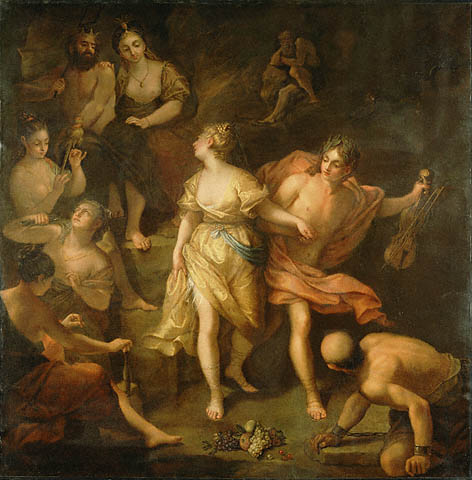
If we made people guess whether this was a picture of the underworld as described in “Geist” or “Orpheus,” every single person with any classical education would choose the wrong one.
Because we're basically looking to Orpheus and Eurydice and Pan's Labyrinth for our descriptions of the underworld in Geist (but not in Orpheus), we are told that this is a cthonic place where the underworld is literally under ground in addition to being figuratively underneath. This leads to unintentional hilarity, where they wax all poetic about how the ghosts are so far underground that they never see the sky... and then immediately have to walk it back by noting that actually ghosts do leave the land of the dead and that most of this book has been talking about various means and circumstances by which they might do that.
Despite still not being the book with the Greek name, the Greek Underworld theme of Geist is full of people in little pockets of debauchery and you go there to rescue dead people you care about or get information. It is even has the rivers Styx and Phlegethon in it. I mean, it literally is exactly the Hades described in the opera of Orpheus and Eurydice.

Or from Wonder Woman comics, if you use the Nu52 continuity.
The entrances to the Underworld are called “Avernian Gates,” which is from the Greek “αορνος” which is one of the ways into the Greek underworld. Seriously, why the fuck is this underworld so fucking Greek? Did whoever got this writing assignment not get the memo that they were doing a Voodoo death watch deal with the rest of the book? Fuck! This whole appendix is so weirdly out of place that it is driving me to drink. Anyway, there are a lot of mechanics for how to open an Avernian Gate. But while you can sacrifice a human being and shit for bonus dice on the test, there's no reason to do that. This is a nWoD test, it's seriously not very likely to fail and if for some reason it did you can try again in three fucking seconds by spending one more point of plasm. There are also magic keys that open portals to the netherworld, but again you don't actually care because opening doors to the underworld is in fact extremely easy.
When I read about their various deathlords and deeper mysteries and shit, the thing that keeps going through my mind is that they make a big distinction between Geists and Ghosts. That is literally the same word, just in German and English respectively. If they did a German translation of this book, it would be awesome. You'd have sentences that compared “Ja fur des Geistes und nein fur des Geistes.” That kind of bullshit would be so hilarious that it would almost be worth Geist: the Sin Eaters existing in English.
My guess is the underworld in Geist is Greek because early in its lifecycle it was intended to be a Wraith reboot, and of course the Dark Empire of Steel in Wraith was a Greco-Roman nightmare ruled by a guy named Charon with a big fucking scythe-sword and the screaming coins of ghost-flesh were called obols.

Where's your toll?
None of that matters because Geist decided to go another way, by which I mean it is a hollow and pointless game where the player characters are never given any motivation for anything they are supposed to do or have done, and the Underworld is literally a "fuck off, who cares" kind of holiday destination for when you get too bored of pimp-slapping mage characters and vampires.

This book doesn't even have the decency of putting a skull on the cover, so I can't put pennies on its eyes when I finally bury it. It will wander the lonely shores, never finding rest.
Total aside, if you ever did want to spend your money on a much better book about the underworld to use in your games, I recommend Alice K. Turner's The History of Hell, which gives a rather nice (and illustrated!) guide to how the concept of the Underworld has developed in Western culture, from ancient Sumer to now.
Orpheus' one official appendix is called “Ghost Stories” and it's actually some sample adventures. There's also a little bit of world building and there's a tiny bit of storyteller advice. Orpheus numbers their missions, and the author levels with you that talking about missions in terms of mission numbers helps the techno-thriller vibe along. They also point out that players will successfully deduce that very low mission numbers were from a long time ago and that if they find out that some of the low mission numbered missions are still technically open that's cause for concern. This may not seem like much, but it's literally the first hook they've dangled to get player characters to start investigating the big conspiracy. It is on page 295.
We'd better look closely... there might be an actually salvageable game here.

Ah well.
The missions are for the most part sketchy, but fairly serviceable. Find the ghosts of agents killed in the line of duty, uncover the remains of a high tech submarine, retrieve the extra-dimensional rock whose appearance caused a “ghost quake,” shit like that. These missions are one page affairs, and vary from “pretty good plot hook” to “not very good plot hook.” But unlike the crap in Geist (or for that matter, Midnight Roads), they are actual plot hooks. Hard to really do anything with them though, because they are hooks that lead to the deeper mysteries. And this book won't tell you what those are! That's a serious problem. Basically, your choices here are to either say “Fuck it!” and make your own mysterious mystery for the puzzle pieces to fit into, or just flail about giving non-commital answers until you pick up Crusade of Ashes. Spoiler alert: it's almost inconceivable that you couldn't come up with better big reveals than the Orpheus canon books did, so anyone who ran a memorable and cool Orpheus game probably did the former.
But you know... as long as you ignore the rules, and the plot, and much of the setting, there's something kind of neat in Orpheus.

Not that this would be a lot of work or anything.
If I had a real complaint, other than that this shit never went anywhere cool, it's that the dates in this are all messed up. You're using necrotech to solve the mystery of a lost supersub, why the fuckity fuck are you name checking events in 1997? It's pulling a Lain, where everything is all present day, present time, but the world has been changed somewhat with the creation of magitech and crap. So talking about specific dates for the recent past made this book seem weird and anachronistic even when it came out. Now of course, the dates seem even more absurd. Remember when we started doing seafloor aquaculture? Me neither.

I wish Max were here.
Nominally, the missions at the back of the book are a lead-in to the actual "limited run" campaign that is part of Orpheus' big cinematic push, but I kind like to think of them as webisodes or a pilot that was aired before the main series was approved.

Abandon all hope, ye who enter here.
I'm going to take a moment and talk about the visual decor of the books. Of the two, Orpheus has the better layout and Geist has the better art. This isn't saying a lot, since the art in both books is the kind of two-tone, washed-out fuzzy-around-the-edges stuff that always looks unfinished and crap even when new, much less ten years later, but Geist's layout is boring and in many places confusing because of multiple stacked headers and poor font/effect choice, like a webpage circa 1996, while Orpheus at least tries to spice things up by changing the way they present information in the scrapbook style that became popular at White Wolf as the End Times drew near.
Having said all that, Orpheus looks like a better book; it may not have glossy pages but the black-and-white art holds up a hell of a lot better than the "let's drown everything in blue ink" approach that Geist took. And, of course, I hate Geist for featuring keys on like every fucking page for no reason. I could take skulls. I like a good skull. Keys? No'somuch. However, both books fall far short of the visual distinctiveness and style which Wraith was and still is known for. Seriously, it was one of the things most associated with the game, and neither Orpheus or Geist managed to capture a tenth of it.

Granted, at this point how many games could afford a Brom cover?
Geist has a city chapter in the appendix because that is what nWoD splats do. There is no deeper meaning or explanation than that. This book uses New York because other cities were taken. Like Nightlife, it dumps some wikifacts of New York on you, but that's not even the meat and potatoes of the formulaic expenditure of wordcount. There are sample characters who take up more than a page. These guys aren't vampiric princes or werewolf caern leaders or whatever the fuck. These are just dudes you could talk to if you happen to need some Mesopotamian writing translated. I'm not actually sure why you'd need that, because I still don't know what you're supposed to do! But if it came up, there's an app for that.
This is really just an underline on how White Wolf was fucking retarded about trying to squeeze blood from a stone. They were constantly attempting to repeat the rituals that made Vampire a success, without any understanding of what made those things successful in the first place. Vampire has place writeups with characters in them, not because that is an empty ritual that can be recapitulated to make money, but because Vampire has a fucking political structure and it needs people and places to act as fulcrums for political leverage. If you don't have political games and supernatural society to influence, these people are just empty page space.
I'm having trouble finding anything in the appendices worth talking about, but I think this is worth mentioning: it's hard to make New York boring, but Geist manages it. Seriously, anyone that's live in New York knows it's expensive and busy and fucking eats people in a way that you don't really get anywhere else in the 'States, some say the world. It's an old city with a huge population - more if you count the surrounding metropolitan area, because I'm not sure humans were ever supposed to try and live in Manhattan itself without mortgaging their souls and a spare pair of legs.
Anyway, what you and your krewe are supposed to do in New York is unknown, and that's kind of unforgettable. When you have world-wide networks of ultra-powerful necromancers communicating by graffiti on tombstones, you know you've slipped a mental cog somewhere. I mean just think about it: at minimum you should talk about the City Morgue and maybe Hart Island, the biggest potter's field in the United States, where prisoners under the direction of the Department of Corrections inter the unidentified and unwanted dead of the five boroughs and the public is not fucking welcome. There's a fucking obelisk from Ancient Egypt and slave cemeteries in the Bronx and old Indian burial grounds and shipwrecks off the coast. Hell, NY is one of the most haunted cities in North America; you don't even have to make shit up to find something for player characters to do here...you just have to work it into the game world and give them a reason to go interact with it.
And that's really the whole book. Both whole books. We'll probably do a wrapup post later on.
After 303 pages, there's an index for Geist, though for the life of me I can't imagine fucking why except that the headers make it really easy to do that. Each single ceremony is given a separate page number. Then we have a character sheet and a couple ads, one of which is for the next Geist World of Darkness tome, "Book of the Dead," which for all I know was finished by the time this one hit print.

Moon Knight is supposed to rip you off, Batdude, not the other way around.
The final page says "All things are born of darkness." Well I'm not a mushroom, so stop feeding me shit and keeping me in the dark.
Orpheus also finishes with a character sheet and an index, but it's a shorter, saner index, and no ads. A-fucking-men.
Ghost Stories
Descent into the Underworld
The Modern Gomorrah (New York City)
Chapter Two: Shades, Laments, and Other Horrible Things
Hopefully your appendix isn't adjacent to some bleeding cecal tissue.
This section's musical accompaniment will be Vlad the Impaler. You need your daily dose of Hammer Horror.
FrankT:
This section is actually about four separate chapters in two books. But they are all short and composed of shit that didn't exactly fit elsewhere. And here's where we see the first real difference between the format of nWoD books and oWoD books: nWoD books have two appendices, while oWoD books had only one appendix but had an extra chapter at the chapter two position to tell you what the playable factions were about. In nWoD, the second appendix is always a city writeup (Hunters get Philadelphia, Mages get Boston, Vampires get New Orleans, and Geists get New York). The oWoD “factions” chapter made rather more sense for Vampire (where it is called “Clans and Sects”) than it does for Orpheus (which doesn't actually have the whole “politics of the night” deal going at all).
Orpheus' “Shades and Laments” chapter is being treated like an appendix in this case because it is a vestigial chapter. It's in this book because at the time World of Darkness books had a chapter devoted to the things that worked just like Vampire Clans, so when they arranged to have this book written, someone (or more likely three or four people, because this book has twelve fucking authors) got assigned to writing it. But Orpheus is trying to get away from the whole clan structures thing, so this chapter really really doesn't belong. Indeed, now that we've read the storyteller's section and seen the direction this was actually supposed to go – most of this chapter just doesn't belong at all. What few mechanics or observations shouldn't have been scrapped altogether really should have been put into the chargen chapter. Unfortunately, I suspect that White Wolf might have made the same observation in 2004 – which could actually be the reason that the chargen chapter in Geist is so... bloody... long.
Orpheus spends 28 pages on shade and (sigh) lament types, and then another 16 pages on their Ghost Stories appendix. Geist spends 30 pages on their Descent into the Underworld appendix, and then another 18 pages on their New York City appendix. So you can really see how little changed in the book format formula between 2003 and 2009. The company killed the old games, rebooted the setting, made a new edition, went bankrupt, got sold to Icelanders, and became an empty imprint, but through it all the format changed very very little. The recounting of the contents of a new World of Darkness book is as formalized an artform as noh theater or classical ballet.
Interestingly, the later works of White Wolf were also called 'shite,' but it's pronounced differently.
AncientH:
Although for my money, the World of Darkness is and always shall be centered around Chicago, with the minor league teams sent off to the distant wilderness of Gary, Illinois.
I'm not sure where the idea for cramming a city setting into a WoD gamebook actually came from. Certainly the idea of putting a specific local setting together with a larger fictional world wasn't new, Shadowrun 1st edition came out with a chunk devoted to Seattle, which was the default metropolis for shadowrunning for about twenty years. The whole thing about giving different game lines a different setting is, of course, just laziness; it avoids the different freelancers having to talk to each other because they don't have to worry about stepping on anyone's toes, and no-one has to think about how different confluences of occult influence shaped the history and nature of any given region. Then again, that's the same reason why Shadowrun's Seattle has been a living setting etched into the brains of players for over two decades and nWoD failed to make any real impression on anyone besides "Wow, that was a shitty research job."
I may be a little biased.
FrankT:
Orpheus chapter 2 is like a time warp: back to not only to oWoD formating standards, but also to early in the design process of Orpheus. Characters are divided up into Shades (the type of ghost you are and thus what powers you get) and Laments (the reason that you are running around as a ghost in the first place). Obviously, this was drawn up early in the design process, before it was decided that Orpheus was going to go off-script and have the players be techno-magical spirit projectors who did ghost busting work in the near future where necrotech was well established. This is perhaps most apparent from the fact that your reason for being a ghost is called a “lament” despite the fact the default choice is that you're not actually dead and just get to project your spirit. So there's really nothing for you to be “lamenting” and no reason for it to be called that in the final draft. In some earlier draft, your reason for being a ghost was doubtless more personally tragic and more akin to the Thresholds of Geist. But that concept of required personal tragedy did not survive to the monster hunter game they ended up going to print with, but the term “lament” did. Because Orpheus is badly, badly in need of a major rewrite in light of the tangential direction they ended up deciding to go with it.
Only five of these are playable in Orpheus, but it's way more solid than the thresholds or archetypes of Geist.
The five shade types are pretty decent. When I say that my shade is a Poltergeist or a Banshee, you pretty much know what that means without looking at the rules. Which is good, because these concepts are introduced well before any of the rules are in the book. Stranger still, the rules for your “Horrors” are in this chapter as well. Those are one of the types of powers you can have. I assume the rules for those are in here because that way it got the chapter to the appropriate page count, because otherwise it really really makes no sense. The rules for the powers are in chapter 2, but the rules for actually getting the powers are in chapter 3, and the description of what any of these rules actually mean is in chapter 4. Frankly, Orpheus pretty much makes a lot more sense if you literally read it backwards. That would be way more helpful than reading it forwards.
Start at the end, and stop when you reach the beginning. That's some seriously zen or seriously stupid shit you got there.
There's a hanging plot thread where one of the types of ghosts you get to be is a “hue.” That's someone who took the evil future drug that's kind of like heroin mixed with MDMA and lets you see ghosts called “Pigment” and then died. This turns you into a special ghost. How are you special? Uh... that's supposed to be a secret for a later book. The big reveal of course is that bad people are distributing it in order to make there be ghosts they can eat. It's a pretty boring revelation, actually. Primarily, a hue is just a weak ghost, which means that you will not actually play one, although you are allowed to do so if that's what you really want to do.
Hues are like other ghosts but they are weak and looked washed out.
Ultimately, there isn't much to say here. This chapter shouldn't exist, and the contents were made obsolete by later design choices. But the division of ghost types is, I think, pretty decent and plausibly salvageable. The chart that says that everyone has two powers that they can't get except Skin Walkers because fuck you for not playing a Skin Walker is the kind of thing that obviously needed some more design work, and at more than a page per Horror the powers are badly in need of some fucking brevity. But the basic conceit that people have different kinds of ghosts and teams of spirit projectors are going to want people on their team with different kinds of ghost powers seems workable and their list of ghost types and ghost powers are for the most part pretty much alright.
AncientH:
The thing about Horrors is that they weren't dot-based, unlike every other White Wolf primary player ability. Instead, you got your Horror, and each time you use it you spent a variable number of Vitality points to fuel it - the more points the more powerful the effect, and some effects required more points than others. The actual outcome of using the power required a roll and successes. So the individual powers tend to be very versatile and flexible in use, but individual applications can be a bit hard to keep track of.
Most of these powers are based directly on Wraith arcanos, and so there's a bit of overlap with Geist powers - right down to the standard non-Horror "I sense dead people" bit - but where Geist has over 300 powers, Orpheus has like 10. So, well done Orpheus.
FrankT:
Geist has an Underworld. It's basically the underworld of Greek myth as seen through the lens of things like Orpheus and Eurydice or Pan's Labyrinth. This is the kind of underworld you might expect to be in a game called “Orpheus” but instead it's in a book where the ghosts have German names and the organizational structure of Gulf Coast gentleman's clubs. Orpheus doesn't have an underworld at all, and Geist was part of the nWoD which already had a bunch of alternate dimensions. This underworld isn't Stygia or the Abyss from Mage. It isn't the Hedge from Changeling. It isn't whatever the fuck it was that Hunters dealt with. This sort of proliferation of extra dimensional places is one of the biggest problems the oWoD had, and you'd think that doing a full reboot would have been the time to fix it and hash out exactly what universe the dead go to and exactly what universe demons come from and whether or not those are the same universes, and all that council of Nicea shit. But no. nWoD was way worse about this because they didn't even try to connect the lines. For fuck's sake, the pagan witch vampires of the Circle of the Crone have their own set of spirits to fuck with using their own sorcery. That's different from the spirits that the mages, werewolves, and now Geists are also fucking around with. The nWoD was supposed to clean up the world with the reboot, but instead they just turned the content clutter spigot on full blast and walked away.
If we made people guess whether this was a picture of the underworld as described in “Geist” or “Orpheus,” every single person with any classical education would choose the wrong one.
Because we're basically looking to Orpheus and Eurydice and Pan's Labyrinth for our descriptions of the underworld in Geist (but not in Orpheus), we are told that this is a cthonic place where the underworld is literally under ground in addition to being figuratively underneath. This leads to unintentional hilarity, where they wax all poetic about how the ghosts are so far underground that they never see the sky... and then immediately have to walk it back by noting that actually ghosts do leave the land of the dead and that most of this book has been talking about various means and circumstances by which they might do that.
Despite still not being the book with the Greek name, the Greek Underworld theme of Geist is full of people in little pockets of debauchery and you go there to rescue dead people you care about or get information. It is even has the rivers Styx and Phlegethon in it. I mean, it literally is exactly the Hades described in the opera of Orpheus and Eurydice.
Or from Wonder Woman comics, if you use the Nu52 continuity.
The entrances to the Underworld are called “Avernian Gates,” which is from the Greek “αορνος” which is one of the ways into the Greek underworld. Seriously, why the fuck is this underworld so fucking Greek? Did whoever got this writing assignment not get the memo that they were doing a Voodoo death watch deal with the rest of the book? Fuck! This whole appendix is so weirdly out of place that it is driving me to drink. Anyway, there are a lot of mechanics for how to open an Avernian Gate. But while you can sacrifice a human being and shit for bonus dice on the test, there's no reason to do that. This is a nWoD test, it's seriously not very likely to fail and if for some reason it did you can try again in three fucking seconds by spending one more point of plasm. There are also magic keys that open portals to the netherworld, but again you don't actually care because opening doors to the underworld is in fact extremely easy.
Fuck you, Geist. Fuck you so hard.Geist wrote:Here’s a rumor. Maybe it’s true. Maybe it isn’t.
When I read about their various deathlords and deeper mysteries and shit, the thing that keeps going through my mind is that they make a big distinction between Geists and Ghosts. That is literally the same word, just in German and English respectively. If they did a German translation of this book, it would be awesome. You'd have sentences that compared “Ja fur des Geistes und nein fur des Geistes.” That kind of bullshit would be so hilarious that it would almost be worth Geist: the Sin Eaters existing in English.
AncientH:
My guess is the underworld in Geist is Greek because early in its lifecycle it was intended to be a Wraith reboot, and of course the Dark Empire of Steel in Wraith was a Greco-Roman nightmare ruled by a guy named Charon with a big fucking scythe-sword and the screaming coins of ghost-flesh were called obols.
Where's your toll?
None of that matters because Geist decided to go another way, by which I mean it is a hollow and pointless game where the player characters are never given any motivation for anything they are supposed to do or have done, and the Underworld is literally a "fuck off, who cares" kind of holiday destination for when you get too bored of pimp-slapping mage characters and vampires.
This book doesn't even have the decency of putting a skull on the cover, so I can't put pennies on its eyes when I finally bury it. It will wander the lonely shores, never finding rest.
Total aside, if you ever did want to spend your money on a much better book about the underworld to use in your games, I recommend Alice K. Turner's The History of Hell, which gives a rather nice (and illustrated!) guide to how the concept of the Underworld has developed in Western culture, from ancient Sumer to now.
FrankT:
Orpheus' one official appendix is called “Ghost Stories” and it's actually some sample adventures. There's also a little bit of world building and there's a tiny bit of storyteller advice. Orpheus numbers their missions, and the author levels with you that talking about missions in terms of mission numbers helps the techno-thriller vibe along. They also point out that players will successfully deduce that very low mission numbers were from a long time ago and that if they find out that some of the low mission numbered missions are still technically open that's cause for concern. This may not seem like much, but it's literally the first hook they've dangled to get player characters to start investigating the big conspiracy. It is on page 295.
We'd better look closely... there might be an actually salvageable game here.
Ah well.
The missions are for the most part sketchy, but fairly serviceable. Find the ghosts of agents killed in the line of duty, uncover the remains of a high tech submarine, retrieve the extra-dimensional rock whose appearance caused a “ghost quake,” shit like that. These missions are one page affairs, and vary from “pretty good plot hook” to “not very good plot hook.” But unlike the crap in Geist (or for that matter, Midnight Roads), they are actual plot hooks. Hard to really do anything with them though, because they are hooks that lead to the deeper mysteries. And this book won't tell you what those are! That's a serious problem. Basically, your choices here are to either say “Fuck it!” and make your own mysterious mystery for the puzzle pieces to fit into, or just flail about giving non-commital answers until you pick up Crusade of Ashes. Spoiler alert: it's almost inconceivable that you couldn't come up with better big reveals than the Orpheus canon books did, so anyone who ran a memorable and cool Orpheus game probably did the former.
But you know... as long as you ignore the rules, and the plot, and much of the setting, there's something kind of neat in Orpheus.
Not that this would be a lot of work or anything.
If I had a real complaint, other than that this shit never went anywhere cool, it's that the dates in this are all messed up. You're using necrotech to solve the mystery of a lost supersub, why the fuckity fuck are you name checking events in 1997? It's pulling a Lain, where everything is all present day, present time, but the world has been changed somewhat with the creation of magitech and crap. So talking about specific dates for the recent past made this book seem weird and anachronistic even when it came out. Now of course, the dates seem even more absurd. Remember when we started doing seafloor aquaculture? Me neither.
I wish Max were here.
AncientH:
Nominally, the missions at the back of the book are a lead-in to the actual "limited run" campaign that is part of Orpheus' big cinematic push, but I kind like to think of them as webisodes or a pilot that was aired before the main series was approved.
Abandon all hope, ye who enter here.
I'm going to take a moment and talk about the visual decor of the books. Of the two, Orpheus has the better layout and Geist has the better art. This isn't saying a lot, since the art in both books is the kind of two-tone, washed-out fuzzy-around-the-edges stuff that always looks unfinished and crap even when new, much less ten years later, but Geist's layout is boring and in many places confusing because of multiple stacked headers and poor font/effect choice, like a webpage circa 1996, while Orpheus at least tries to spice things up by changing the way they present information in the scrapbook style that became popular at White Wolf as the End Times drew near.
Having said all that, Orpheus looks like a better book; it may not have glossy pages but the black-and-white art holds up a hell of a lot better than the "let's drown everything in blue ink" approach that Geist took. And, of course, I hate Geist for featuring keys on like every fucking page for no reason. I could take skulls. I like a good skull. Keys? No'somuch. However, both books fall far short of the visual distinctiveness and style which Wraith was and still is known for. Seriously, it was one of the things most associated with the game, and neither Orpheus or Geist managed to capture a tenth of it.
Granted, at this point how many games could afford a Brom cover?
FrankT:
Geist has a city chapter in the appendix because that is what nWoD splats do. There is no deeper meaning or explanation than that. This book uses New York because other cities were taken. Like Nightlife, it dumps some wikifacts of New York on you, but that's not even the meat and potatoes of the formulaic expenditure of wordcount. There are sample characters who take up more than a page. These guys aren't vampiric princes or werewolf caern leaders or whatever the fuck. These are just dudes you could talk to if you happen to need some Mesopotamian writing translated. I'm not actually sure why you'd need that, because I still don't know what you're supposed to do! But if it came up, there's an app for that.
This is really just an underline on how White Wolf was fucking retarded about trying to squeeze blood from a stone. They were constantly attempting to repeat the rituals that made Vampire a success, without any understanding of what made those things successful in the first place. Vampire has place writeups with characters in them, not because that is an empty ritual that can be recapitulated to make money, but because Vampire has a fucking political structure and it needs people and places to act as fulcrums for political leverage. If you don't have political games and supernatural society to influence, these people are just empty page space.
AncientH:
I'm having trouble finding anything in the appendices worth talking about, but I think this is worth mentioning: it's hard to make New York boring, but Geist manages it. Seriously, anyone that's live in New York knows it's expensive and busy and fucking eats people in a way that you don't really get anywhere else in the 'States, some say the world. It's an old city with a huge population - more if you count the surrounding metropolitan area, because I'm not sure humans were ever supposed to try and live in Manhattan itself without mortgaging their souls and a spare pair of legs.
Anyway, what you and your krewe are supposed to do in New York is unknown, and that's kind of unforgettable. When you have world-wide networks of ultra-powerful necromancers communicating by graffiti on tombstones, you know you've slipped a mental cog somewhere. I mean just think about it: at minimum you should talk about the City Morgue and maybe Hart Island, the biggest potter's field in the United States, where prisoners under the direction of the Department of Corrections inter the unidentified and unwanted dead of the five boroughs and the public is not fucking welcome. There's a fucking obelisk from Ancient Egypt and slave cemeteries in the Bronx and old Indian burial grounds and shipwrecks off the coast. Hell, NY is one of the most haunted cities in North America; you don't even have to make shit up to find something for player characters to do here...you just have to work it into the game world and give them a reason to go interact with it.
FrankT:
And that's really the whole book. Both whole books. We'll probably do a wrapup post later on.
AncientH:
After 303 pages, there's an index for Geist, though for the life of me I can't imagine fucking why except that the headers make it really easy to do that. Each single ceremony is given a separate page number. Then we have a character sheet and a couple ads, one of which is for the next Geist World of Darkness tome, "Book of the Dead," which for all I know was finished by the time this one hit print.
Moon Knight is supposed to rip you off, Batdude, not the other way around.
The final page says "All things are born of darkness." Well I'm not a mushroom, so stop feeding me shit and keeping me in the dark.
Orpheus also finishes with a character sheet and an index, but it's a shorter, saner index, and no ads. A-fucking-men.
-
Username17
- Serious Badass
- Posts: 29894
- Joined: Fri Mar 07, 2008 7:54 pm
Ancient and I had a little argument over whether it counted as a new power or not that you used a completely different dicepool for your level 1 powers when you had different keys. When you use Boneyard 1 with Industrial key, you roll based on crafts and how long ago you can convince your storyteller that "defined areas of space" were invented and then the boneyard itself gives skill bonuses to craft - while if you have the Stillness key your dicepool is based on subterfuge and the boneyard gives bonuses to subterfuge. There's only one writeup for the first manifestation dot, but enough of it is function calls to key trait variables that it's an open question whether that's 1 power or 10. But regardless of whether it's 350 or 287 powers in the key/manifestations matchups, it's clearly way too fucking many. And more importantly: you're supposed to be able to add keys and add manifestations, which would require exponentially more work. With the addition of the Stygian key, that created somewhere between 28 and 35 powers depending on how you look at it. Adding a new manifestation would then add between 45 and 55 new powers. For fuck's sake, the ten non-sorcery disciplines in Vampire: the Requiem only have fifty powers between them.
Geist's power accumulation system was so nuts that you could basically make a whole splat out of the powers of one mid-level character.
-Username17
Geist's power accumulation system was so nuts that you could basically make a whole splat out of the powers of one mid-level character.
-Username17
-
Ancient History
- Serious Badass
- Posts: 12708
- Joined: Wed Aug 18, 2010 12:57 pm
And there's that stupid 5-dot ceremony that lets you make new Keys. oMage technically has more powers because one dot in anything just gives you infinity abilities, but even they didn't try to cram 350 rotes into the core book. It's really the most overpowered White Wolf basic character concept I've ever seen, and that's counting playing an Elder character in Elysium where you could spend points on a background that gave you more points to spend.
-
TheFlatline
- Prince
- Posts: 2606
- Joined: Fri Apr 30, 2010 11:43 pm
nWOD generally exemplified the "why bother" conundrum of game design. I know we discussed it, but did we ever OSSR Changeling The Lost?
oWOD Changeling was... funky. I think as far as unsavory/uncomfortable implied themes Changeling wins out on Werewolf/dog rape because pedophilia is totally a thing that happens and has to be dealt with in Changeling.
oWOD Changeling was... funky. I think as far as unsavory/uncomfortable implied themes Changeling wins out on Werewolf/dog rape because pedophilia is totally a thing that happens and has to be dealt with in Changeling.
-
Username17
- Serious Badass
- Posts: 29894
- Joined: Fri Mar 07, 2008 7:54 pm
I personally will not be doing a full OSSR of Changeling v Changeling. oWoD Changeling is a game that rewards you mechanically for playing a child with sex powers. That's just a line I'm not willing to cross, even for a rageview.TheFlatline wrote:nWOD generally exemplified the "why bother" conundrum of game design. I know we discussed it, but did we ever OSSR Changeling The Lost?
oWOD Changeling was... funky. I think as far as unsavory/uncomfortable implied themes Changeling wins out on Werewolf/dog rape because pedophilia is totally a thing that happens and has to be dealt with in Changeling.
I'm curious what you have to say about Demon: the Fallen (and maybe Demon: the Descent).FrankTrollman wrote:I personally will not be doing a full OSSR of Changeling v Changeling. oWoD Changeling is a game that rewards you mechanically for playing a child with sex powers. That's just a line I'm not willing to cross, even for a rageview.TheFlatline wrote:nWOD generally exemplified the "why bother" conundrum of game design. I know we discussed it, but did we ever OSSR Changeling The Lost?
oWOD Changeling was... funky. I think as far as unsavory/uncomfortable implied themes Changeling wins out on Werewolf/dog rape because pedophilia is totally a thing that happens and has to be dealt with in Changeling.