Also, I have to note: Spain's conquest of the New World kinda overrates Spanish military prowess. Yes, they conquered big swathes of land from much more populous enemies, but it bears remembering that these North/south American "empires" were founded on a fragile polity and were often in the midst of internal civil strife (in some cases the strife can be justifiably described as low intensity civil war).
Technology and martial prowess were factors, but I don't think they are trumped by the fact that Spain's enemies were more busy hating each other and the epidemics that wiped out vast portions of the populace didn't help either. Heck, the British in the 19th Century weren't particularly good militarily (disguised primarily by present-day British historians whitewashing a litany of British military incompetence), but they still managed to have an empire where the sun never set; guarded primarily by an army officered by British troops but manned by the "martial" peoples of the empire.
How did iron/roman/medieval/renaissance regulate travel?
Moderator: Moderators
It's arguably true in the early 20th century. The combination of their military excursionism and not getting flattened during WWI left them very scary in the 1930s. They almost certainly had the strongest navy at the start of WWII, and quite likely the strongest military overall.FrankTrollman wrote: There is no point in history where Japan fields the most powerful military on Earth. It simply never happens.
-Username17
Which is more in the way of an interesting footnote than a substantive disagreement.
Vebyast wrote:Here's a fun target for Major Creation: hydrazine. One casting every six seconds at CL9 gives you a bit more than 40 liters per second, which is comparable to the flow rates of some small, but serious, rocket engines. Six items running at full blast through a well-engineered engine will put you, and something like 50 tons of cargo, into space. Alternatively, if you thrust sideways, you will briefly be a fireball screaming across the sky at mach 14 before you melt from atmospheric friction.
I must respectfully differ. Let's take a simple head-for-head comparison of hull numbers between the Royal Navy and the Imperial Japanese Navy.fectin wrote:It's arguably true in the early 20th century. The combination of their military excursionism and not getting flattened during WWI left them very scary in the 1930s. They almost certainly had the strongest navy at the start of WWII, and quite likely the strongest military overall.
Japan is behind on capital ships, ahead on carriers*, and massively behind on cruisers and destroyers. That's not "almost certainly the strongest", that's "about head and head, with arguments popping up depending on whether you believe naval strength is about pitched battles or about cruising and sealane control."Capital ships (BB and BC):
Royal Navy: 15 plus 5 building
IJN: 10 plus 3 building
Aircraft carriers (CV and CVL):
Royal Navy: 2 plus 5 building
IJN: 6 plus 7 building
Cruisers (CA and CL):
Royal Navy: 66 plus 23 building
IJN: 36 plus 6 building
Destroyers (DD):
Royal Navy: 184 plus 32 building
89 plus 43 building
Submarines (SS):
Royal Navy: 60 plus 9 building
IJN: 68 plus 50 minisubmarines
Other escorts:
Royal Navy: 45 plus 29 building, not including armed merchant ships
IJN: 90 including armed merchant ships
What is true is that Japan probably had the strongest local navy, since the Royal Navy was split up among three different seas trying to protect her extremely strung-out sea lanes, whereas Japan's fleet was all in the Pacific.
---
* Of which two were converted capital ships (Akagi and Kaga), and one was a CVL as opposed to a true CV (Ryujo.)
-
deaddmwalking

- King
- Posts: 6064
- Joined: Mon May 21, 2012 11:33 am
I think that ties into what 'military power' means in this context. With the Washington Naval Treaty limiting Great Britain/United States and Japan to a ratio of 5:5:3 on Battleships, but the Western Powers active in the Atlantic and Pacific, it certainly implied a local superiority in the Pacific.
Of course, military power relies on manufacturing capability for resupply. Even if Japan had been the most powerful military in the 1930s (not that I'm conceding the point, but if I were) the fact that they did not have major oil reserves left them with a major Achilles' Heel. If I remember correctly, after Pearl Harbor, the Japanese never again had as much fuel - despite seizing the Dutch East Indies. The Battleship Yamato highlights this strategic concern pretty well.
Edit - Like the South in the American Civil War, Japan didn't really have any expectation of a military victory over the United States - their strategy was to continue the war beyond the opponent's will to fight.
Last edited by deaddmwalking on Wed Jun 04, 2014 3:52 pm, edited 1 time in total.
However, Japan's navy was carrier heavy (as you acknowledged), in an era when air superiority overtook naval gunfire as the main form of sea combat. (even with Leyte distorting those numbers, Mahain was just plain wrong). Further, Japan's navy was more highly trained and had recent, successful combat experience, and their pilots were notably skilled.
Wikipedia even lists the Imperial navy behind both Britain and the US, but this is not supported by contemporary accounts or by modern analysis*.
Even if you assume that the Royal Navy was more formidable than the Imperial Navy though, Britain's Army was nowhere near Japan's Imperial Army.
*I said that authoritatively; on consideration, I can only speak to war college classes.
Vebyast wrote:Here's a fun target for Major Creation: hydrazine. One casting every six seconds at CL9 gives you a bit more than 40 liters per second, which is comparable to the flow rates of some small, but serious, rocket engines. Six items running at full blast through a well-engineered engine will put you, and something like 50 tons of cargo, into space. Alternatively, if you thrust sideways, you will briefly be a fireball screaming across the sky at mach 14 before you melt from atmospheric friction.
That's why I said "depending on whether you consider pitched battles or sea lane control to be more important." Given both Britain and Japan's massively vulnerable supply lines, I feel that an assumption that the war would be settled by a Clauswitzian pitched battle is a rash one.fectin wrote:However, Japan's navy was carrier heavy (as you acknowledged), in an era when air superiority overtook naval gunfire as the main form of sea combat. (even with Leyte distorting those numbers, Mahain was just plain wrong). Further, Japan's navy was more highly trained and had recent, successful combat experience, and their pilots were notably skilled.
However, I agree with you that the sun had set on big gun ships. It's interesting to note that Japan doubled her carriers from 6 to 12 during the period 1939-1941, possibly as a result of lessons learned from Taranto or as a leadup to the victory at Pearl Harbour.
Even in Japan though, nobody actually knew this. The IJN was heavily divided between big gun advocates and carrier advocates, the former of whom were influential enough to be able to build stupid wasteful white elephants like Yamato. It's not like the Swedish gun line where that nation was legitimately ahead of the rest of the world; every nation was fumbling blindly into the future in search of the optimal strategy and Japan happened to find it.
I'd be interested to read staff college stuff of it. I'm not a strategist but I adore good analytics.Wikipedia even lists the Imperial navy behind both Britain and the US, but this is not supported by contemporary accounts or by modern analysis*.
On ground that I do know something about, Japanese naval engineering was decades behind that of Britain. Pagoda masts and wire-wound guns were things that were pointed out at the time as being worse solutions than everybody else's. The wire-wound guns were done due to Japan's industrial base being small and primitive compared to the west; I don't know the reasoning behind pagoda masts but there must have been one.
That I definitely will not dispute, especially during the mid 1930s.Even if you assume that the Royal Navy was more formidable than the Imperial Navy though, Britain's Army was nowhere near Japan's Imperial Army.
@deaddmwalking -
I think you're mistaken. Japan seized most of the pacific rim before Pearl Harbor, specifically to secure their oil and rubber supplies. One impetus for retaking the Phillipines was to cut those supply lines, but I don't think that was really successful until late in the Formosa campaign.
Japan's major resource problem was people. At the start of the war, they were highly trained and experienced (especially the naval air forces), but they never cycled veterans back to the mainland to train a new generation. That's one reason you saw Japan move to kamikaze and Baka-boats at the end of the war - they simply didn't have anyone left who was capable of doing more.
Many people don't realize, but the US's original Pacific strategy was not at all aggressive. Nimitz's orders were to hold Japan off until we could negotiate a treaty, not to win. That was true for a very long time too; I don't remember when that changed for sure, but I want to say it wasn't until after Guadalcanal.
Vebyast wrote:Here's a fun target for Major Creation: hydrazine. One casting every six seconds at CL9 gives you a bit more than 40 liters per second, which is comparable to the flow rates of some small, but serious, rocket engines. Six items running at full blast through a well-engineered engine will put you, and something like 50 tons of cargo, into space. Alternatively, if you thrust sideways, you will briefly be a fireball screaming across the sky at mach 14 before you melt from atmospheric friction.
-
nockermensch

- Duke
- Posts: 1900
- Joined: Fri Jan 06, 2012 1:11 pm
- Location: Rio: the Janeiro
I'm not even a WWII buff but I want to call this bullshit. Japan's major resource problem had to be metals. (iron and aluminium)fectin wrote:Japan's major resource problem was people.
Last edited by nockermensch on Wed Jun 04, 2014 5:13 pm, edited 1 time in total.
@ @ Nockermensch
Koumei wrote:After all, in Firefox you keep tabs in your browser, but in SovietPutin's Russia, browser keeps tabs on you.
Mord wrote:Chromatic Wolves are massively under-CRed. Its "Dood to stone" spell-like is a TPK waiting to happen if you run into it before anyone in the party has Dance of Sack or Shield of Farts.
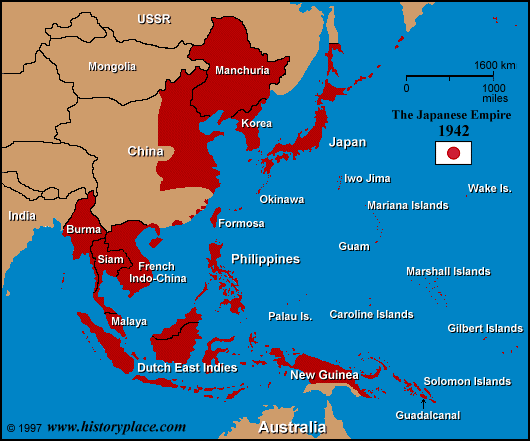
That's because you're thinking of Japan the island, not Japan the sprawling pacific rim empire.
http://www.historyplace.com/unitedstate ... pacwar.gif
http://www.historyplace.com/unitedstate ... pacwar.gif
Vebyast wrote:Here's a fun target for Major Creation: hydrazine. One casting every six seconds at CL9 gives you a bit more than 40 liters per second, which is comparable to the flow rates of some small, but serious, rocket engines. Six items running at full blast through a well-engineered engine will put you, and something like 50 tons of cargo, into space. Alternatively, if you thrust sideways, you will briefly be a fireball screaming across the sky at mach 14 before you melt from atmospheric friction.
I have to agree with Frank.
Consider: The Japanese got their defeated so badly by the Russians in the middle-late 30's that even when the Nazi's had the Russians in what can be generously called "dire striaghts" they didn't want to fight a heads up conflict with another major power.
Indeed, the grand strategy of Japan in many ways was "If we take all these south asia stuff from the Americans and Britts really quick they won't want to fight us for it."
Also, the Japanese inter-service cooperation was so bad it makes the Germans look like they were all one-big happy family (and thats a military that had an airforce that was looking to purchase TANKS, not tanks that could be air dropped, just MBTs because the SS and Kriegsmarine had them so they should too).
One of the Japanese carriers was owned and operated by the ARMY.
This is not to disparage the courage of their soldiers, or the courage of those of faced them or anything stupid like that. However, even the Japanese didn't think they could win any kind of protracted war against another major power.
In fairness, I think fectin's point was more aimed at Japan during the pre- Marco Polo Bridge Incident era than Japan by the time of Khalkin Gol. By that time the Japanese had lost their relative military lead over the west, and the USSR and Germany had become the big guys.souran wrote:Consider: The Japanese got their defeated so badly by the Russians in the middle-late 30's that even when the Nazi's had the Russians in what can be generously called "dire striaghts" they didn't want to fight a heads up conflict with another major power.
-
OgreBattle
- King
- Posts: 6820
- Joined: Sat Sep 03, 2011 9:33 am
And this is very effective, much like its effective in Axis & Allies for Japan to invade Canada while the Britts are not looking.OgreBattle wrote:Whenever I play Axis & Allies, I use Japan and aim for Russia.
Its also complete infeasable in a more realistic WWII game like Third Reich/Rising Sun and even a game like World in Flames makes this at least hard enough to make it so it doesn't happen every game.
Also, looking back at this thread and people who still care about the "is the Katana important" debate:
The Katana was not the highest art of Bushido, Archery and later spear fighting were consider martial arts that offered higher social status. Further, as people have discussed the Katana was never the primary battlefield weapon of the Samurai.
However:
The Katana was an important part of Samurai life, and even in the early period sword fighting was used as a way of settling certain kinds of disputes between men of Samurai standing. Other martial arts were MUCH less often selected for settling these disputes (although a small number of women who were part of the gets to kill people club would often use naginatas in this "social" situation)
This is one of the things that the cracked article doesn't seem to get.
A varient M4 is the primary weapon of the IDF. Therefore, the best "soldier" in the IDF is the guy who is "best" with an M4. However, that soldier would not assume that he is "better" than the guy who teaches Krav to the IDF special operations teams. Yes, the top spot in the pecking order of lorded samuari goes to the best horse archer. That guy, however, NEVER pisses in the coffee of the best swordfighter.
Drawing the parallel that has been done so many times before between cowboys and samurai:
The weapon that "won" the west is the Colt .45 pistol. However, thats also total bullshit. The sharp's and Henry rifles and the winchester model 1886 and 1894 sold more often than the Colt. Thats partially because a rifle is more GENERALLY useful than a pistol. However, gunfighers, who were nothing like the movies but did exist, loved pistols. If you are going to be in a gunfight at short ranges pistols have lots of advantages.
The Katana is the Colt Pistol of Japan. Its a weapon that is iconic, and was important but it is not the weapon that won battles.
Thought of one more good example:
The Muskeeters of the Guard were light cavalry armed with early carbines or later dragoons. This was their battlefield role. They used guns on the battlefield. However, their prowess as sword fighters is well documented, if not quite so grand as Dumas made it out to be.
This might have been becuase the regiment contained lots of lesser nobels. It might be because the regiment gained social status as a favorite of the Kings of France. Whatever the reason, they became more well known for their sword-fighting than for their musketry even though they were effective in their battle field role (thus earning them the prestige to become good sword-fighters),
[Note, a quick google check does indicate that on a coule of notable occassions they were used as line infantry or as light shock cavalry so they were not "soley" firearms fighters on the battlefield]
Last edited by souran on Wed Jun 04, 2014 8:00 pm, edited 1 time in total.
-
deaddmwalking
- King
- Posts: 6064
- Joined: Mon May 21, 2012 11:33 am
I'm not. I did research on this in college - I honestly can't remember the 'high water mark' for Japan's oil/gasoline on hand - whether it was BEFORE or AFTER the US Oil Embargo, but I know that it continued to decline throughout the war. Here's a website I found with quick googling that I wouldn't cite for a college paper, but the numbers look correct on first blush:fectin wrote:@deaddmwalking -
I think you're mistaken. Japan seized most of the pacific rim before Pearl Harbor, specifically to secure their oil and rubber supplies. One impetus for retaking the Phillipines was to cut those supply lines, but I don't think that was really successful until late in the Formosa campaign.
http://ww2-weapons.com/History/Producti ... erials.htm
This other page (same site) shows a precipitous decline in oil imports between 1943 and 1944
http://ww2-weapons.com/History/Production/Japan/
In any case, Japanese production (including seized territories) amounted to less than 1/2 of 1% of the US production during each year of the war. It turns out that conquest isn't usually the best way to get production out of new territories.
I'm not going to disagree that training isn't important. That said, other nations have suffered major attrition and been forced to conscript both the young and old. Japan's soldiers at the end of WWII maintained a reputation for solid discipline. I'm sure that a scarcity of trained pilots was particularly acute, but I don't accept that a lack of available 'people' was a major issue in their defeat or surrender. Even the Wikipedia article on Kamikaze cites industrial production as a major reason:fectin wrote: Japan's major resource problem was people. At the start of the war, they were highly trained and experienced (especially the naval air forces), but they never cycled veterans back to the mainland to train a new generation. That's one reason you saw Japan move to kamikaze and Baka-boats at the end of the war - they simply didn't have anyone left who was capable of doing more.
Regarding the British, they would not have sought a large-scale conflict. Their naval strategy could be summarized as 'fleet in being'. Essentially, having a large fleet required enemies to consider it at all times - as long as it existed, even if it was not in active use, it posed a real threat to their enemies, allowing for attacks nearly anywhere in the world. Even if they were assured of a naval victory, if it obliterated their enemy, but caused significant loss to themselves, it would have crippled their ability to maintain this threat.Wikipedia wrote: These attacks, which began in October 1944, followed several critical military defeats for the Japanese. They had long lost aerial dominance due to outdated aircraft and the loss of experienced pilots. On a macroeconomic scale, Japan experienced a decreasing capacity to wage war, and a rapidly declining industrial capacity relative to the United States. The Japanese government expressed its reluctance to surrender. In combination, these factors led to the use of kamikaze tactics as Allied forces advanced towards the Japanese home islands.
http://en.wikipedia.org/wiki/Kamikaze
There's a decent book called To Rule the Waves by Arthur Herman which covers the British Naval History for roughly 500 years. I found it an excellent, engaging and educational read.
http://www.amazon.com/To-Rule-Waves-Art ... +the+waves
...maybe I should actually establish some goalposts. Is "during the 1930s" specific enough, or does the Sino-Japanese war throw it off enough that I need more specificity?
Vebyast wrote:Here's a fun target for Major Creation: hydrazine. One casting every six seconds at CL9 gives you a bit more than 40 liters per second, which is comparable to the flow rates of some small, but serious, rocket engines. Six items running at full blast through a well-engineered engine will put you, and something like 50 tons of cargo, into space. Alternatively, if you thrust sideways, you will briefly be a fireball screaming across the sky at mach 14 before you melt from atmospheric friction.
-
deaddmwalking
- King
- Posts: 6064
- Joined: Mon May 21, 2012 11:33 am
In the 1930s, prior to seizing the Dutch East Indies, the Japanese didn't have a reliable source of crude oil, with most of their supply coming from the United States. If you accept the dubious claim that they were 'the most powerful military' you have to recognize the logistical limit to that claim.
Comparing power is difficult but we have a 'tortoise and the hare' fable for a reason. A demilitarized United States (as was practiced after every major war prior to Korea) might appear less powerful than a fully militarized nation at the start of the conflict, but with natural defenses (oceans) and a powerful industrial base and rich in raw materials, ultimately the 'stronger' military is the one that can expand into the more powerful fighting force. You shouldn't discount 'potential' because when conflict starts, it actually matters.
Nobody rates the Swiss military very highly, but nobody wants to mess with them, either.
Japan was only grabbing headlines in the 1930s because they were hyper-aggressive; not because their military was particularly well-equipped or even competent.fectin wrote:It's arguably true in the early 20th century. The combination of their military excursionism and not getting flattened during WWI left them very scary in the 1930s. They almost certainly had the strongest navy at the start of WWII, and quite likely the strongest military overall.
Which is more in the way of an interesting footnote than a substantive disagreement.
The IJN was still ultimately just the third most powerful fleet in the world in 1941, behind both the Royal Navy and the United States Navy. They had more carriers, but the key to carrier aviation is the number of pilots; not the number of carriers - as without trained air crew carriers are just large and very vulnerable targets (indeed by 1944 Japanese carriers were just being used as decoys). In this regard the Kido Boutai raised a force of 600 excellent pilots - but with no real program to replace or maintain this force; much less the capability to expand it in wartime. When they were gone, the IJN was done, which was pretty much the case by 1944. The United States by comparison had a comparably-sized naval air arm and the ability to expand it tenfold.
The Army on the other hand was, except in the field of massacring civilians, largely a joke. Though disciplinary practices were savage it was for the most part out of control - often acting against the explicit orders of its government (this is what you get for drilling ideology into the heads of Captain and Majors, and then letting them assassinate your government Ministers willy-nilly).
Moreover, the Japanese Army was ill-equipped with no real heavy artillery (stuck with 1900s guns), little armor, a paucity of machine guns, and there were even supply issues with rifle ammunition (hence their obsession with bayonet use and banzai charges).
The IJA succeeded early in the war primarily because it was fighting stripped-down colonial forces, whose fightiest elements had been sent to Europe to fight the Nazis. Later in the war, for all the fanaticism, the average Japanese soldier was simply distressingly ineffective. People keep harping on about the "savagery" of Pacific War battles (and they were pretty brutal), but at the end of the day for every US Marine killed there were usually three to five Japanese soldiers who died in every battle.
It was a 19th Century army fighting a 20th Century foe; and where the restricted terrain of the Pacific islands did more to prolong the fighting than the Japanese soldiers themselves. Out in Manchuria, where there was no terrain favoring the defenders, the Soviet Army simply overran Japan's best army in a matter of days in 1945.
Germany had significant increases in aircraft production. Japan I'm not certain of - but at this point any aircraft "production" was illusory. All they were really producing by 1944 was manned bombs destined for a one-way trip to the American fleet - as there simply wasn't enough fuel for sustained combat operations or training by this point.kzt wrote:IIRC, both Germany and Japan had significant increases in aircraft production in 1944 over 1943. In 1945 Japanese aircraft production collapsed, the burning down of the cities and the distributed industry there had dramatic effects.
Germany's production increases moreover were the result of sustained investment in aircraft production facilities since the mid 1930s. Germany did not go from having almost no domestic air production to one of the largest military air forces overnight - that required sustained investments over a decade; much of which came into fruition in 1942-44.
Even at the height of Japanese conquests in 1942 - before Midway - Japan's economy was already imploding. Sure, they "conquered" Malaysian rubber and Dutch East Indies oil, but the problem is that they need merchant shipping in order to bring that back to the Home Islands.fectin wrote:@deaddmwalking -
I think you're mistaken. Japan seized most of the pacific rim before Pearl Harbor, specifically to secure their oil and rubber supplies. One impetus for retaking the Phillipines was to cut those supply lines, but I don't think that was really successful until late in the Formosa campaign.
And the reality of Japan's merchant shipping situation is that it actually started the war with several million tons of shipping in the hole. Before the war, the shipping was provided primarily by United States merchant ships - who were now understandbly not going to ship supplies for an enemy nation.
So even though Japan now theoretically had oil, it was just piling up uselessly in Brunei and only a limited amount reached the home economy. US submarines then began their deadly work and reduced what little there was to a trickle. That's the problem with the "conquer to be strong" mindset. Economically speaking, it doesn't actually work in the 20th Century with the world's interlocking economies.
-
darkmaster
- Knight-Baron
- Posts: 913
- Joined: Fri Apr 29, 2011 5:24 am
This is why you always build sea ports in all of your coastal cities in civilization guys. Also If you're playing as the original build of Tokugawa you get half priced court houses so you can cut those expenses for far away cities down, and of course that stacks with Versailles and getting great light house and the colossus up are pretty much required for an island nation. Basically, Japan was just run by a noob it seems.Zinegata wrote:So even though Japan now theoretically had oil, it was just piling up uselessly in Brunei and only a limited amount reached the home economy. US submarines then began their deadly work and reduced what little there was to a trickle. That's the problem with the "conquer to be strong" mindset. Economically speaking, it doesn't actually work in the 20th Century with the world's interlocking economies.
I mean, come on, they probably didn't even have iron working until china traded them the tech and you need iron working to get to steel, and to make those island cities good production spots you need that extra production from the iron works. But steal also leads to optics which leads to astronomy. How are you supposed to run an island empire if you can't even enter ocean squares? It's just a big mess. And I can't imagine it got any better from there.
Kaelik wrote:Fuck you Haruhi is clearly the best moe anime, and we will argue about how Haruhi and Nagato are OP and um... that girl with blond hair? is for shitters.darkmaster wrote:Tgdmb.moe, like the gaming den, but we all yell at eachother about wich lucky star character is the cutest.
If you like Lucky Star then I will explain in great detail why Lucky Star is the a shitty shitty anime for shitty shitty people, and how the characters have no interesting abilities at all, and everything is poorly designed especially the skill challenges.