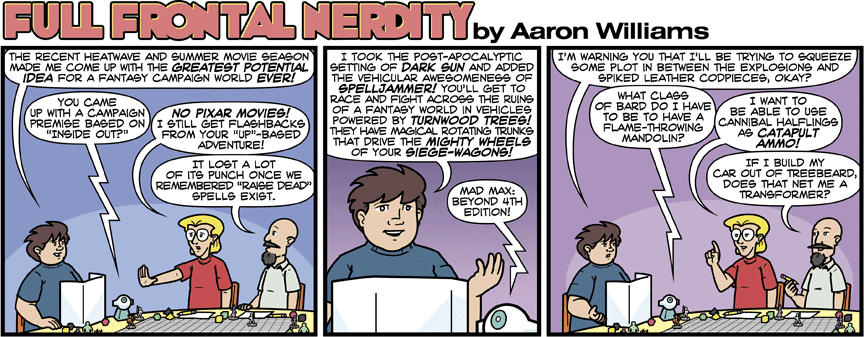
Watched Mad Max. Want a car pursuing game.
Moderator: Moderators
-
mlangsdorf
- Master
- Posts: 256
- Joined: Fri Jun 06, 2008 11:12 pm

Had a thought for vehicle to vehicle combat- Assuming that all vehicles involved are moving the same speed, they can be treated as platforms that various character have control over. So, instead of writing rules for the vehicles moving, you write rules for a moving ground. You of course need rules to handle moving the platforms, but that seems reasonable enough. Hell, the rules for the moving ground can just be that falling from the platforms is considered a fall of a distance equal to speed of the vehicles.
So something like-
Vehicle Combat (for d20)
If a character falls moving between the vehicles, or is knocked from one, they may make a reflex save to attempt to catch themselves at a DC of (15+1 per ten feet of speed at which the vehicles are moving). They may make a single such save immediately. If they fall on their turn and have a standard action available, they may use this standard action to attempt the save again.
Falling and speed: In six seconds, a human will fall about 1000 feet. It is unusual that vehicles will be tall enough for this to matter, and by unusual, I mean fucking rare. It is, however, possible that the vehicles might be air vehicles and 1000 ft in the air, but if this is the case, characters will need to be creative about what they do once they've fallen 1000 feet and the vehicles are 1000 feet above them and several hundred miles away.
Falling Damage: When a character falls from a vehicle and fails to catch themselves, they take damage as if falling from their height on the vehicle to the ground, plus the speed of the vehicle. For example, a large truck may be 20' tall. Falling from the top of such a truck that is stationary deals 2d6 damage. If the truck is traveling at 60 mph, however, a character who falls will suffer 8d6 damage.
If the character purposefully jumps, the first 10 ft worth of damage is converted to nonlethal. If the character falls onto a soft, yielding surface, such as mud or sand, 10 ft of damage is converted into nonlethal. A DC 20 Jump or Tumble check allows the character to avoid taking any damage from the first 10 ft, and converts the damage from the second 10 ft to nonlethal. These conversions and reductions are cumulative. If a character purposefully jumps from the example truck and beats the DC and lands on soft ground, they take only 5d6 lethal and 1d6 nonlethal damage.
If the character falls or purposefully dives into water that is at least 10 feet deep, the first 20 ft deal no damage, and the next 20 ft deal nonlethal damage. If they make a DC 20 Swim or Tumble check into water that is at least 10 ft deep per 30 ft of fall (both height and speed) they take no damage at all, though the DC is increased by 5 per 50 ft of dive.
Maneuvering: It is generally assumed that all vehicles are being driven in the same direction at the same speed. Vehicles which have a top speed lower than that at which the main mass of vehicles are being driven will fall behind at a rate equal to the difference in speed each round. Vehicles have individual maneuverabilities which dictate the turns they can take. A vehicle with sufficient speed and maneuverability can be moved as space allows. Of course this requires that someone be driving the vehicle.
Driving the vehicle with no attempts to be tricky or change position is a move action, and the driver can take other actions provided they make a successful Drive check (DC 10+1/10 ft of speed+1 per action made) at the end of the round. Failing this role indicates that the driver lost control of the vehicle, see Losing Control.
If the driver wishes, they may attempt to change their position in relation to the mass, provided they have sufficient speed and turning ability. To maintain pace with the mass, a vehicle must retain at least the mass' speed of it's movement, plus speed sufficient to compensate for any movement backwards. Moving back in relation to the mass, however, is free, as it requires only deceleration. For example, a driver wishes to move to their same position on the opposite side of the mass. They can either accelerate to get ahead, cross and then fall back to get back into position, or they may fall back, cross, and speed up to get back into position. If they are in the middle on the side of a 60' long mass of vehicles that is 40' wide, they can decelerate to move 30' back, then turn and travel 40' across, and speed up to move 30 forward. This car would need a top chase scale speed of 70 or higher to pull this off. Moving around the back is the safer choice, but moving in front of the mass is possible as well, just risky. When moving in the path of moving vehicles with 10 ft of clearance, make a DC 20 Drive check. Each 10 ft of space between you and the vehicle lowers this DC by 5. If you have only 5' of clearance, the DC is 30, and if you are adjacent, the DC is 40. Failing this check means your vehicle is struck by the vehicle it is in in the path of.
Losing Control: Failing a Drive check means you have lost control, even if just momentarily. Roll a d8 to determine the direction of the lost control, starting with 1 being directly in in the path of movement of the vehicle, and then counting clockwise. Front drive vehicles use the front-most space of the driver's side as the center to count around, while rear drive vehicles use the rear-most space of the driver's side. All wheel drive vehicles, and other vehicles with their drive either both front and back on in the middle use middle-most space on the driver's side.
Collisions: Any time there is an obstacle in a vehicle's path in a round, whether another vehicle, a wall, debris, a person, whatever, the vehicle collides with the obstacle. The vehicle and the obstacle are each treated as a falling object against the other, and both will take damage accordingly. Damage is also dealt to people inside the vehicle- anyone adjacent being directly struck, ie, passangers on the struck side of a t-boned car, take full damage. Every 5 feet of distance between the collision and the passenger reduces the damage by 1d6.
Ducking: Ducking refers to hard breaking in a mass of vehicles. This requires a DC 25 Drive check and assumes you don't have a vehicle directly behind you, but if make the check, which can be done as an immediate action, you immediately move back any distance up to the speed at which the mass is traveling- ie, if the mass is traveling at 60 mph (528 fpr), and you successfully make your Drive check to duck, you can move up to 528 feet back as part of the swift action. If you fail, you swerve as if you had failed the roll to perform actions while driving, and lose control, which may cause a collision. If there is a vehicle behind you, you must make a DC 30 Drive check to avoid it while ducking, and failure means collision.
Swerving: As an immediate action, you may swerve a vehicle you are driving. This can be to avoid a collision, cause one, or even just avoid an attack. Make a DC 20 Drive check, where failure causes you to lose control.
Roll Overs: Any time you lose control of a vehicle and roll a 4-6 to determine direction of lost control, or a vehicle is bull rushed sideways by at least it's width, you risk a roll over. There is a percentile chance that the vehicle will roll over based on it's category- motorcycles are fast and agile, but not known for stability, and have a 50% chance to fall over in these circumstances. Trucks, including vans, minivans and SUVs, are stable, but tend to be top heavy, and have a 40% chance to roll over. Cars, ie, sedans, coupes, wagons, and sports vehicles, are stable, comparatively low to the ground, and seldom top heavy, and thus have only a 20% chance to roll over. Cars that have been bull rushed have an increased chance to roll over, at a rate of +5% per 5' bull rushed. So a motorcycle (5' space) that would be bull rushed sideways 20 ft would have a 70% chance to flip over.
When a vehicle rolls over, and character standing on top of it is thrown (see below) unless they are secured in some way. Characters who are straddling the vehicle, such as a motorcycle, have a 50% chance to be thrown, otherwise they are caught. Characters that are inside a rolled vehicle or caught under it as it rolls take damage as if the vehicle struck a stationary object.
Being Thrown: Whenever a vehicle's movement is arrested, typically by striking an obstacle, making a hard stop or rolling over, a character standing on top is likely to be thrown, as if being bull rushed--use the modifier of the vehicle the character is on top of, plus 10 for an average roll. The character cannot resist this, and is automatically thrown 5'+5' per 5 points of the vehicle's modifier, taking damage when they land as if they had fallen the distance they were thrown. The only way for the character to prevent being thrown is to be secured to the vehicle in some manner.
I've never read the normal d20 Vehicle Combat rules but a quick glance says they're shit. You'll want some manner of chase rules, but based on the original three Mad Max movies, I think this would suffice for Mad Max d20. Could probably use a clarity revision or two, and maybe some tweaking of lethality, especially in the damage reduction for position in a struck vehicle, but I think this is pretty sound if you wanted to run
Mad Max in d20.
So something like-
Vehicle Combat (for d20)
In vehicle combat, the vehicles can be considered to be platforms that are stationary with regards to one another and the ground moving beneath them. Combat takes place between these platforms as if they were not moving.Miles Per Hour and Feet Per Round
No one cares enough to dick around with precise conversion of miles per hour to feet per round. Instead, use the approximate conversion of multiplying mph by 10 to get feet per round. It works. 60 mph is 600 feet per round and no one cares enough to get more precise.
However, if someone's got a stick up their ass, and really wants a precise conversion, multiply the mph by 5280 to get feet per hour, and then divide by 600 to get feet per round (and yes, you can also multiply by 528 then divide by 60, or just multiply mph by 8.8.
If a character falls moving between the vehicles, or is knocked from one, they may make a reflex save to attempt to catch themselves at a DC of (15+1 per ten feet of speed at which the vehicles are moving). They may make a single such save immediately. If they fall on their turn and have a standard action available, they may use this standard action to attempt the save again.
Falling and speed: In six seconds, a human will fall about 1000 feet. It is unusual that vehicles will be tall enough for this to matter, and by unusual, I mean fucking rare. It is, however, possible that the vehicles might be air vehicles and 1000 ft in the air, but if this is the case, characters will need to be creative about what they do once they've fallen 1000 feet and the vehicles are 1000 feet above them and several hundred miles away.
Falling Damage: When a character falls from a vehicle and fails to catch themselves, they take damage as if falling from their height on the vehicle to the ground, plus the speed of the vehicle. For example, a large truck may be 20' tall. Falling from the top of such a truck that is stationary deals 2d6 damage. If the truck is traveling at 60 mph, however, a character who falls will suffer 8d6 damage.
If the character purposefully jumps, the first 10 ft worth of damage is converted to nonlethal. If the character falls onto a soft, yielding surface, such as mud or sand, 10 ft of damage is converted into nonlethal. A DC 20 Jump or Tumble check allows the character to avoid taking any damage from the first 10 ft, and converts the damage from the second 10 ft to nonlethal. These conversions and reductions are cumulative. If a character purposefully jumps from the example truck and beats the DC and lands on soft ground, they take only 5d6 lethal and 1d6 nonlethal damage.
If the character falls or purposefully dives into water that is at least 10 feet deep, the first 20 ft deal no damage, and the next 20 ft deal nonlethal damage. If they make a DC 20 Swim or Tumble check into water that is at least 10 ft deep per 30 ft of fall (both height and speed) they take no damage at all, though the DC is increased by 5 per 50 ft of dive.
Maneuvering: It is generally assumed that all vehicles are being driven in the same direction at the same speed. Vehicles which have a top speed lower than that at which the main mass of vehicles are being driven will fall behind at a rate equal to the difference in speed each round. Vehicles have individual maneuverabilities which dictate the turns they can take. A vehicle with sufficient speed and maneuverability can be moved as space allows. Of course this requires that someone be driving the vehicle.
Driving the vehicle with no attempts to be tricky or change position is a move action, and the driver can take other actions provided they make a successful Drive check (DC 10+1/10 ft of speed+1 per action made) at the end of the round. Failing this role indicates that the driver lost control of the vehicle, see Losing Control.
If the driver wishes, they may attempt to change their position in relation to the mass, provided they have sufficient speed and turning ability. To maintain pace with the mass, a vehicle must retain at least the mass' speed of it's movement, plus speed sufficient to compensate for any movement backwards. Moving back in relation to the mass, however, is free, as it requires only deceleration. For example, a driver wishes to move to their same position on the opposite side of the mass. They can either accelerate to get ahead, cross and then fall back to get back into position, or they may fall back, cross, and speed up to get back into position. If they are in the middle on the side of a 60' long mass of vehicles that is 40' wide, they can decelerate to move 30' back, then turn and travel 40' across, and speed up to move 30 forward. This car would need a top chase scale speed of 70 or higher to pull this off. Moving around the back is the safer choice, but moving in front of the mass is possible as well, just risky. When moving in the path of moving vehicles with 10 ft of clearance, make a DC 20 Drive check. Each 10 ft of space between you and the vehicle lowers this DC by 5. If you have only 5' of clearance, the DC is 30, and if you are adjacent, the DC is 40. Failing this check means your vehicle is struck by the vehicle it is in in the path of.
Losing Control: Failing a Drive check means you have lost control, even if just momentarily. Roll a d8 to determine the direction of the lost control, starting with 1 being directly in in the path of movement of the vehicle, and then counting clockwise. Front drive vehicles use the front-most space of the driver's side as the center to count around, while rear drive vehicles use the rear-most space of the driver's side. All wheel drive vehicles, and other vehicles with their drive either both front and back on in the middle use middle-most space on the driver's side.
Collisions: Any time there is an obstacle in a vehicle's path in a round, whether another vehicle, a wall, debris, a person, whatever, the vehicle collides with the obstacle. The vehicle and the obstacle are each treated as a falling object against the other, and both will take damage accordingly. Damage is also dealt to people inside the vehicle- anyone adjacent being directly struck, ie, passangers on the struck side of a t-boned car, take full damage. Every 5 feet of distance between the collision and the passenger reduces the damage by 1d6.
- If the objects collide directly going opposite directions, then treat both objects as having fallen a distance equal to 10 ft/10 mph of their combined speed- ie, if two cars collide head on at 60 mph, then each deals damage to the other as if it fell 120 ft., dealing 1d6/200 lbs/10 ft. of speed, maxing out at 20d6. The average car weighs 4000 lbs, and so would do 20d6 per 10 feet of speed, but since the max is 20d6, it just does 20d6. If a car traveling 60 mph collides head on with a motorcycle, then the car deals the max of 20d6 to the motorcycle, and the motorcycle (800 lbs) deals 4d6 per 10 ft of speed for a total of 24d6, but maxes out at 20d6.
- If the objects collide in a perpendicular fashion, or only one is moving, both take damage according to the other's weight, but only the speed of striking vehicle is taken into account- the struck vehicle deals only 1d6 per 200 lbs as if it only "fell" 10 ft. Using the previous example of a car and a motorcycle, the car striking the side of the motorcycle head on deals 1d6/200 lbs (20d6), while the motorcycle deals only 4d6 to the car as if it had been standing still.
- Glancing and sideswiping collisions deal damage to one another according to their weight as if they were moving only 10 ft, ie, just 1d6 per 200 lbs. Two motorcycles (avg weight 800 lbs) that sideswipe one another deal 4d6 damage to each other, including their riders.
Ducking: Ducking refers to hard breaking in a mass of vehicles. This requires a DC 25 Drive check and assumes you don't have a vehicle directly behind you, but if make the check, which can be done as an immediate action, you immediately move back any distance up to the speed at which the mass is traveling- ie, if the mass is traveling at 60 mph (528 fpr), and you successfully make your Drive check to duck, you can move up to 528 feet back as part of the swift action. If you fail, you swerve as if you had failed the roll to perform actions while driving, and lose control, which may cause a collision. If there is a vehicle behind you, you must make a DC 30 Drive check to avoid it while ducking, and failure means collision.
Swerving: As an immediate action, you may swerve a vehicle you are driving. This can be to avoid a collision, cause one, or even just avoid an attack. Make a DC 20 Drive check, where failure causes you to lose control.
Roll Overs: Any time you lose control of a vehicle and roll a 4-6 to determine direction of lost control, or a vehicle is bull rushed sideways by at least it's width, you risk a roll over. There is a percentile chance that the vehicle will roll over based on it's category- motorcycles are fast and agile, but not known for stability, and have a 50% chance to fall over in these circumstances. Trucks, including vans, minivans and SUVs, are stable, but tend to be top heavy, and have a 40% chance to roll over. Cars, ie, sedans, coupes, wagons, and sports vehicles, are stable, comparatively low to the ground, and seldom top heavy, and thus have only a 20% chance to roll over. Cars that have been bull rushed have an increased chance to roll over, at a rate of +5% per 5' bull rushed. So a motorcycle (5' space) that would be bull rushed sideways 20 ft would have a 70% chance to flip over.
When a vehicle rolls over, and character standing on top of it is thrown (see below) unless they are secured in some way. Characters who are straddling the vehicle, such as a motorcycle, have a 50% chance to be thrown, otherwise they are caught. Characters that are inside a rolled vehicle or caught under it as it rolls take damage as if the vehicle struck a stationary object.
Being Thrown: Whenever a vehicle's movement is arrested, typically by striking an obstacle, making a hard stop or rolling over, a character standing on top is likely to be thrown, as if being bull rushed--use the modifier of the vehicle the character is on top of, plus 10 for an average roll. The character cannot resist this, and is automatically thrown 5'+5' per 5 points of the vehicle's modifier, taking damage when they land as if they had fallen the distance they were thrown. The only way for the character to prevent being thrown is to be secured to the vehicle in some manner.
I've never read the normal d20 Vehicle Combat rules but a quick glance says they're shit. You'll want some manner of chase rules, but based on the original three Mad Max movies, I think this would suffice for Mad Max d20. Could probably use a clarity revision or two, and maybe some tweaking of lethality, especially in the damage reduction for position in a struck vehicle, but I think this is pretty sound if you wanted to run
Mad Max in d20.
Cuz apparently I gotta break this down for you dense motherfuckers- I'm trans feminine nonbinary. My pronouns are they/them.
Winnah wrote:No, No. 'Prak' is actually a Thri Kreen impersonating a human and roleplaying himself as a D&D character. All hail our hidden insect overlords.
FrankTrollman wrote:In Soviet Russia, cosmic horror is the default state.
You should gain sanity for finding out that the problems of a region are because there are fucking monsters there.
Your units are fucked up
Etc, etc, all the way through.
If "chase scale speed" is equal to their speed less the speed of the mass, then 10 mph of extra speed will mean 100 ft of movement. If you only care about speed to the nearest 10 mph (which seems likely), vehicles will practically always have multiples of 100' to spend.
What does " moving in the path of moving vehicles" mean? Does it include following? What direction is the collision assumed to happen in? If you are trying to drift through the gap between to vehicles, how is the collision speed and type determined?
The rules for collisions also seem to fail to spell out what happens when a vehicle rams another from behind.
If all positions are relative to the speed of the mass, why can't a stationary object push a moving vehicle back (with respect to the mass)?
Similarly if I roll my vehicle where does it end up?
Prak wrote:Hell, the rules for the moving ground can just be that falling from the platforms is considered a fall of a distance equal to speed of the vehicles.
Prak wrote:use the approximate conversion of multiplying mph by 10 to get feet per round. It works. 60 mph is 600 feet per round
So at 60mph that's a DC 75 check?Prak wrote:If a character falls moving between the vehicles, or is knocked from one, they may make a reflex save to attempt to catch themselves at a DC of (15+1 per ten feet of speed at which the vehicles are moving)
Etc, etc, all the way through.
What is "chase scale speed" and how is this different from regular speed?Prak wrote:Maneuvering: [...] If the driver wishes, they may attempt to change their position in relation to the mass, provided they have sufficient speed and turning ability. To maintain pace with the mass, a vehicle must retain at least the mass' speed of it's movement, plus speed sufficient to compensate for any movement backwards. Moving back in relation to the mass, however, is free, as it requires only deceleration. For example, a driver wishes to move to their same position on the opposite side of the mass. They can either accelerate to get ahead, cross and then fall back to get back into position, or they may fall back, cross, and speed up to get back into position. If they are in the middle on the side of a 60' long mass of vehicles that is 40' wide, they can decelerate to move 30' back, then turn and travel 40' across, and speed up to move 30 forward. This car would need a top chase scale speed of 70 or higher to pull this off.
If "chase scale speed" is equal to their speed less the speed of the mass, then 10 mph of extra speed will mean 100 ft of movement. If you only care about speed to the nearest 10 mph (which seems likely), vehicles will practically always have multiples of 100' to spend.
I think you mean "Each 5 ft less space between you..."Prak wrote:When moving in the path of moving vehicles with 10 ft of clearance, make a DC 20 Drive check. Each 10 ft of space between you and the vehicle lowers this DC by 5. If you have only 5' of clearance, the DC is 30, and if you are adjacent, the DC is 40. Failing this check means your vehicle is struck by the vehicle it is in in the path of.
What does " moving in the path of moving vehicles" mean? Does it include following? What direction is the collision assumed to happen in? If you are trying to drift through the gap between to vehicles, how is the collision speed and type determined?
The rules for collisions also seem to fail to spell out what happens when a vehicle rams another from behind.
How far do they move?Prak wrote:Losing Control: Failing a Drive check means you have lost control, even if just momentarily. Roll a d8 to determine the direction of the lost control, starting with 1 being directly in in the path of movement of the vehicle, and then counting clockwise. Front drive vehicles use the front-most space of the driver's side as the center to count around, while rear drive vehicles use the rear-most space of the driver's side. All wheel drive vehicles, and other vehicles with their drive either both front and back on in the middle use middle-most space on the driver's side.
If I get in front of someone and slam on the breaks, what value do I use for my speed? If the answer is zero, then explain how I get better at pushing the other vehicle back if I only slow down rather than stop?Prak wrote:Finally, all collisions are effectively bull rushes made by the moving vehicle against the obstacle it strikes. Vehicles (should) have base strengths, and gain a +4 bonus to bull rush per 10 mph of speed. Moving vehicles are considered to be charging, and any vehicle with more than 3 wheels, or which moves on treads, is considered exceptionally stable. For example, two midsize cars (str 30) collide at 60 mph. Each car is considered to be charging, stable and each car is huge. So on top of the +10 bonus from strength, each car receives +2 from charging, +4 from stability and +8 from size. Each car gains +4 per 10 mph, for another +24. Thus, in the bull rush, each car rolls 1d20+48. The car with the greater check pushes the other back 5'+5' per 5 points it beat the other car's Bull Rush check. If a midsize car of this sort struck a stationary object, or another moving vehicle perpendicular to the other's direction of motion, then only the struck object has a chance of being pushed back, but it still opposes the bull rush as normal, without any bonuses for charging or speed.
If all positions are relative to the speed of the mass, why can't a stationary object push a moving vehicle back (with respect to the mass)?
So that's a a DC 30 check for me to avoid them - if I succeed on the check what happens to my path?Prak wrote:Ducking: Ducking refers to hard breaking in a mass of vehicles. This requires a DC 25 Drive check and assumes you don't have a vehicle directly behind you, but if make the check, which can be done as an immediate action, you immediately move back any distance up to the speed at which the mass is traveling- ie, if the mass is traveling at 60 mph (528 fpr), and you successfully make your Drive check to duck, you can move up to 528 feet back as part of the swift action. If you fail, you swerve as if you had failed the roll to perform actions while driving, and lose control, which may cause a collision. If there is a vehicle behind you, you must make a DC 30 Drive check to avoid it while ducking, and failure means collision.
If I swerve, where does my vehicle end up?Prak wrote:Swerving: As an immediate action, you may swerve a vehicle you are driving. This can be to avoid a collision, cause one, or even just avoid an attack. Make a DC 20 Drive check, where failure causes you to lose control.
Similarly if I roll my vehicle where does it end up?
Thanks. It's supposed to be 10 mph=10 ft for the purposes of falling. The units are still screwy because it makes sense to talk about mph for crashes and such, but positioning and maneuvering work better in feet.Roog wrote:Your units are fucked up
Prak wrote:Hell, the rules for the moving ground can just be that falling from the platforms is considered a fall of a distance equal to speed of the vehicles.Prak wrote:use the approximate conversion of multiplying mph by 10 to get feet per round. It works. 60 mph is 600 feet per roundSo at 60mph that's a DC 75 check?Prak wrote:If a character falls moving between the vehicles, or is knocked from one, they may make a reflex save to attempt to catch themselves at a DC of (15+1 per ten feet of speed at which the vehicles are moving)
Etc, etc, all the way through.
Chase Scale is bullshit from d20 modern. These rules would need their own vehicle stats. I was looking at d20 Modern and M&M, but there's no real reason to use any of that shit.What is "chase scale speed" and how is this different from regular speed?Prak wrote:Maneuvering: [...] If the driver wishes, they may attempt to change their position in relation to the mass, provided they have sufficient speed and turning ability. To maintain pace with the mass, a vehicle must retain at least the mass' speed of it's movement, plus speed sufficient to compensate for any movement backwards. Moving back in relation to the mass, however, is free, as it requires only deceleration. For example, a driver wishes to move to their same position on the opposite side of the mass. They can either accelerate to get ahead, cross and then fall back to get back into position, or they may fall back, cross, and speed up to get back into position. If they are in the middle on the side of a 60' long mass of vehicles that is 40' wide, they can decelerate to move 30' back, then turn and travel 40' across, and speed up to move 30 forward. This car would need a top chase scale speed of 70 or higher to pull this off.
If "chase scale speed" is equal to their speed less the speed of the mass, then 10 mph of extra speed will mean 100 ft of movement. If you only care about speed to the nearest 10 mph (which seems likely), vehicles will practically always have multiples of 100' to spend.
Umm... well, the more space you have, the easier the check is supposed to be, and the less space you have the harder. Let me know if the revision makes more sense.I think you mean "Each 5 ft less space between you..."Prak wrote:When moving in the path of moving vehicles with 10 ft of clearance, make a DC 20 Drive check. Each 10 ft of space between you and the vehicle lowers this DC by 5. If you have only 5' of clearance, the DC is 30, and if you are adjacent, the DC is 40. Failing this check means your vehicle is struck by the vehicle it is in in the path of.
Thanks, I missed that. Following and ramming from behind now included.What does " moving in the path of moving vehicles" mean? Does it include following? What direction is the collision assumed to happen in? If you are trying to drift through the gap between to vehicles, how is the collision speed and type determined?
The rules for collisions also seem to fail to spell out what happens when a vehicle rams another from behind.
Added in a roll, 1d4x10 ft per 10 mph of speed.How far do they move?Prak wrote:Losing Control: Failing a Drive check means you have lost control, even if just momentarily. Roll a d8 to determine the direction of the lost control, starting with 1 being directly in in the path of movement of the vehicle, and then counting clockwise. Front drive vehicles use the front-most space of the driver's side as the center to count around, while rear drive vehicles use the rear-most space of the driver's side. All wheel drive vehicles, and other vehicles with their drive either both front and back on in the middle use middle-most space on the driver's side.
If you slam your breaks on, you're treated as a stationary object. Now the rules actually say it.If I get in front of someone and slam on the breaks, what value do I use for my speed? If the answer is zero, then explain how I get better at pushing the other vehicle back if I only slow down rather than stop?Prak wrote:Finally, all collisions are effectively bull rushes made by the moving vehicle against the obstacle it strikes. Vehicles (should) have base strengths, and gain a +4 bonus to bull rush per 10 mph of speed. Moving vehicles are considered to be charging, and any vehicle with more than 3 wheels, or which moves on treads, is considered exceptionally stable. For example, two midsize cars (str 30) collide at 60 mph. Each car is considered to be charging, stable and each car is huge. So on top of the +10 bonus from strength, each car receives +2 from charging, +4 from stability and +8 from size. Each car gains +4 per 10 mph, for another +24. Thus, in the bull rush, each car rolls 1d20+48. The car with the greater check pushes the other back 5'+5' per 5 points it beat the other car's Bull Rush check. If a midsize car of this sort struck a stationary object, or another moving vehicle perpendicular to the other's direction of motion, then only the struck object has a chance of being pushed back, but it still opposes the bull rush as normal, without any bonuses for charging or speed.
If all positions are relative to the speed of the mass, why can't a stationary object push a moving vehicle back (with respect to the mass)?
You just avoid them. I think it's fair to assume you can whip around the car and duck straight back from your original position.So that's a a DC 30 check for me to avoid them - if I succeed on the check what happens to my path?Prak wrote:Ducking: Ducking refers to hard breaking in a mass of vehicles. This requires a DC 25 Drive check and assumes you don't have a vehicle directly behind you, but if make the check, which can be done as an immediate action, you immediately move back any distance up to the speed at which the mass is traveling- ie, if the mass is traveling at 60 mph (528 fpr), and you successfully make your Drive check to duck, you can move up to 528 feet back as part of the swift action. If you fail, you swerve as if you had failed the roll to perform actions while driving, and lose control, which may cause a collision. If there is a vehicle behind you, you must make a DC 30 Drive check to avoid it while ducking, and failure means collision.
Added in a statement about positioning. It's basically a vehicular 5' step.If I swerve, where does my vehicle end up?Prak wrote:Swerving: As an immediate action, you may swerve a vehicle you are driving. This can be to avoid a collision, cause one, or even just avoid an attack. Make a DC 20 Drive check, where failure causes you to lose control.
This now refers to losing control for direction and distance.Similarly if I roll my vehicle where does it end up?
Cuz apparently I gotta break this down for you dense motherfuckers- I'm trans feminine nonbinary. My pronouns are they/them.
Winnah wrote:No, No. 'Prak' is actually a Thri Kreen impersonating a human and roleplaying himself as a D&D character. All hail our hidden insect overlords.
FrankTrollman wrote:In Soviet Russia, cosmic horror is the default state.
You should gain sanity for finding out that the problems of a region are because there are fucking monsters there.
-
martian_bob

- 1st Level
- Posts: 34
- Joined: Thu Apr 15, 2010 7:21 am
There's a Mad Max participation game that gets brought to local wargames shows with some really kickass scratchbuilt models that the local wargames club put together. It's based on the truck chase from Mad Max 2 and has a fairly simple system based on relative speed to the truck. Players choose movement based on the maneuverability of their vehicle in secret and then all movement is carried out simultaneously, which leads to plenty of mayhem and collisions in keeping with the source material.
Another touchstone would be Dark Future. Put out by Games Workshop it uses Matchbox/Dinky-scale for the cars which allows you to put together a post-apocalyptic gang from your old battered toys:

The actual system isn't that great, but we had fun playing a stripped-down homebrew version as teenagers.
Another touchstone would be Dark Future. Put out by Games Workshop it uses Matchbox/Dinky-scale for the cars which allows you to put together a post-apocalyptic gang from your old battered toys:
The actual system isn't that great, but we had fun playing a stripped-down homebrew version as teenagers.
Last edited by Red_Rob on Mon Jun 08, 2015 3:57 pm, edited 1 time in total.
Simplified Tome Armor.
Tome item system and expanded Wish Economy rules.
Try our fantasy card game Clash of Nations! Available via Print on Demand.
“Those Who Can Make You Believe Absurdities, Can Make You Commit Atrocities” - Voltaire
Tome item system and expanded Wish Economy rules.
Try our fantasy card game Clash of Nations! Available via Print on Demand.
“Those Who Can Make You Believe Absurdities, Can Make You Commit Atrocities” - Voltaire


Wow, those minis surely kick ass.
I've look at Atomic Highway and found it interesting but too generical and meh from a rules standpoint. I've just met Mutant Year Zero and found it much more evocative, though I don't know id it has vehicle chasing rules.
By the way, I watched Snowpiercer the other day and found it really good. Even better than the new Mad Max in my opinion. Recommended.
The traditional playstyle is, above all else, the style of playing all games the same way, supported by the ambiguity and lack of procedure in the traditional game text. - Eero Tuovinen
Cuz apparently I gotta break this down for you dense motherfuckers- I'm trans feminine nonbinary. My pronouns are they/them.
Winnah wrote:No, No. 'Prak' is actually a Thri Kreen impersonating a human and roleplaying himself as a D&D character. All hail our hidden insect overlords.
FrankTrollman wrote:In Soviet Russia, cosmic horror is the default state.
You should gain sanity for finding out that the problems of a region are because there are fucking monsters there.
-
TheFlatline
- Prince
- Posts: 2606
- Joined: Fri Apr 30, 2010 11:43 pm
My friend did this once with model cars. He and his friends pooled all their military model bits and bobs and they went out and bought model cars and modeled Car Wars cars. They scaled the turn key up to scale and used soldering irons to model the damage real time as the game went on. So if you got shot with a machine gun you'd dot the doors with bullet holes or a laser was like a butane pencil torch burn mark. He kept the resulting damaged car for years and it was pretty badass.Red_Rob wrote:There's a Mad Max participation game that gets brought to local wargames shows with some really kickass scratchbuilt models that the local wargames club put together. It's based on the truck chase from Mad Max 2 and has a fairly simple system based on relative speed to the truck. Players choose movement based on the maneuverability of their vehicle in secret and then all movement is carried out simultaneously, which leads to plenty of mayhem and collisions in keeping with the source material.
Another touchstone would be Dark Future. Put out by Games Workshop it uses Matchbox/Dinky-scale for the cars which allows you to put together a post-apocalyptic gang from your old battered toys:
The actual system isn't that great, but we had fun playing a stripped-down homebrew version as teenagers.