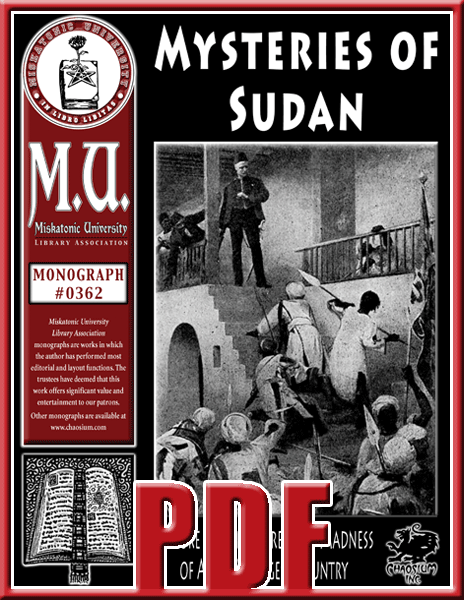
I honestly couldn't find a picture of the physical product. 0/1 San loss.
It's been a while since we've done a Call of Cthulhu-in-Africa book. From the Congo to Cairo, from North Africa to Kenya and Morocco...it's that time again.
First off: this is a Miskatonic University Monograph, which means essentially a fan product which was published by Chaosium, who provides a little bit of branding and keeps most of the money. Production values are about what you can manage on your home laptop or school desktop computer, for the obvious reasons.
The author is Jason Williams, who has also done some other stuff for Chaosium. That's kind of amazing to me, because he did Mysteries of the Raj AND Secrets of Tibet, yet managed to not include any real points of reference between either. Wow. Moving on.
The book opens up with a TOC, and then a full-page black-and-white map stolen from some period source. Mysteries of Sudan is set during the "Gaslight" era (1890s), when Sudan was the largest country in Africa, if you don't count the fact that it was invaded and occupied by first the Egyptians and then the British. The wartorn region is most remembered for the siege of Khartoum by the forces of the Mahdi and the death of "Chinese" Gordon. Robert E. Howard wrote an erotic novella about it called "Guns of Khartoum."
The book gives a little recent history, then goes on to briefly describe the peoples. I'm going to give wikipedia credit here for someone trying and realizing how impossible it is to really encapsulate how diverse some of these regions are:
It's pure data. It may not be a lot to go by as far as how to actually use that information in the game, but it is there, and that was very useful...in the 1970s, 80s, and 90s when that sort of information was not a few keyclicks away. I'll give Williams credit for doing at least a modicum of research; this really is a product that tries to give a very condensed overview of the Sudan for simulationist roleplayers in Gaslamp adventures. But it doesn't really get into anything particularly interesting until we get to...Nubia!In the 1960's Sudan recognized a total of fifty-six tribal groups consisting of 597 separate tribes. There were 115 languages spoken in Sudan with the majority of people speaking Arabic as a common language. Many languages in Sudan are distinctive enough that neighboring tribes might not be able to communicate except in Arabic.
The Sudan is located at the upper (southern) end of the Nile, just south of Egypt, so the Nile (and the White Nile and the Blue Nile) flow through it, and historically the region had ties to Egypt, but ancient and modern, sometimes as Nubia and sometimes as the kingdoms of Kush and Meroe. This makes it an interesting area for archaeologists and Egyptologists, and as Egypt was veritably swarming with Mythos material (they did the Cairgo Guidebook, remember?)...Williams offers two rather lackluster "Cthulhu Mythos Options," one of which reads:
That's...it. That's not even a couple of adventure seeds. I really have to stop and wonder at this point of what the point is; this is copyright 2008. We already had wikipedia. This needs to be more than wikipedia, it needs to 1) present the Mythos in Sudan; 2) provide reasons for investigators to go to the Sudan; and 3) provide game resources to support investigators in the Sudan. I get that we're still in the preliminary stage of "doling out raw information," but there just doesn't appear to be any real effort to present the Mythos as integrated to the Sudan in any way. It's barely an afterthought. We're 13 pages in an there's been a grand total of three "Cthulhu Mythos Options" sidebars, only three of which actually mention the Mythos.An intact bowl has been discovered that has a prepared spell inscribed on it. To activate the spell the bowl must be smashed.
Investigators could find ritual milk vessels that are inscribed with mysterious markings. A search for information about the inscriptions reveals a connection to a shub-niggurath cult.
Brief (very) descriptions are also given of Darfur, Kordofan, Khartoum, Omduman, and Suakin. This is followed by roughly five pages of timeline covering major events in the Sudan, with a heavy focus on the 1800s. It's relatively detailed and covers lots of major events from the British/European perspective, but it doesn't actually cover any Mythos events. Although it does give two optional Mythos events, neither of which are given in any real detail. Example:
Which would be interesting...Williams ever developed it, which he does not. You might as well suggest that Woodrow Wilson was a cultist of Nyarlathotep. That sounds nifty, but does it actually change anything?The Mahdi and his followers can be run as a mythos cult with an inner circle manipulating the masses toward a nefarious goal. The doctrine of Yaum al-Qiyamah (Day of resurrection) could be used by the cultists to refer to the time when the stars are right.
After that there's a very brief look at the Sudan in different periods (Gaslight - 1890s, regular - 1920s/30s, CthulhuNow - 1980s-90s), which includes the wondrous piece of advice:
Followed by a list of "Leaders of Sudan" by year from 1825-1916. That's page 20 out of a 90-page softcover, so let's stop there for tonight, and meditate on: what the fuck is the point of a setting book for a real-life place? Should it focus on information that can be (today) relatively easily obtained? Shadowrun did the tour-guidebook style explicitly, but they focused on locations of direct interest to the audience (shadowrunners). What is in Sudan of interest to investigators? I still don't fucking know! To find out, tune in next time...same tentacle time, same squamous channel...Keepers that wish to use Sudan in a modern setting are encouraged to obtain the excellent travel guide Sudan the Bradt Travel Guide by Paul Clammer ISBN 9781841621142.
The book covers all areas of the country with travel tips, bits of history, and locations of ferry's, hotels, markets and security issues. There is also an information section about the current political situation in Sudan. It includes details about the various factions in the north and south, information about border crossings, guerilla groups and about how and where travel permission can be contained.