Introduction
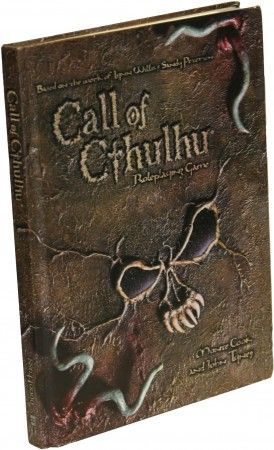
In 2001, Wizards of the Coast released a d20 hack of Call of Cthulhu. In addition to creating d20 rules for the Cthulhu Mythos, CoC d20 was also made to a be compatible with D&D 3rd edition.
The game faded into obscurity and as far as I can tell, very little content was made for it. I did find some third-party content for system, including Resident Evil and Silent Hill. Yeah, I wasn’t expecting that either. No, they're not very good, why do you ask?
CoC d20 was largely rejected by the Call of Cthulhu community, most likely because d20 is associated with the high fantasy world of D&D and thus was deemed inappropriate for a horror game.
When I initially looked into the system, I was honestly expecting something on the level of Monte Cook’s World of Darkness or Big Eyes Small Mouth d20. While CoC d20 is definitely flawed, I don’t think it’s as irredeemably bad as those two games.
And since at the end of the day, d20 is a functional system, I think it’s superior to Chaosium’s take of the Cthulhu Mythos. Not much of an accomplishment, really, but I really do believe it’s an improvement.
The book opens with a (mercifully brief) “What is a roleplaying game” segment before jumping straight into character creation.
Character Creation
We get an explanation of what ability scores and what they mean, pretty basic stuff to anyone with a passing knowledge of d20. Though I am amused the book illustrates ability score values with Cthulhu Mythos monsters. I don’t think it’s terribly meaningful to the reader that a Shoggoth has a CON score of 30-31.
We’re expected to roll 4d6 and drop the lowest to generate our ability scores. Bleh. I’m not a fan of rolling for stats, but sadly, I don’t see any options for point buy here.
Strength is about as useless here as you’d expect in a modern/semi modern horror setting with firearms, while Dexterity is much more important since it adds to your to hit with all ranged weapons.
Wisdom is extremely important in CoC d20, since you multiply your WIS score by 5 to determine your sanity points. We’ll cover the sanity system when we get to that chapter of the book, but I hope your expectations are low.
It’s worth noting that the errata for this book tells us that you don’t get languages based on your INT mod in this game, you’re expected to invest individual ranks in “Speak Language.” Fuck that noise. Intelligence is also your key stat for casting magic in this game, not that you’ll want to cast magic in the first place.
In addition to seducing NPCs powering social skills, Charisma also is a key stat for the Psychic Feats that CoC d20 has. We’ll look into those in more detail when we get to the feat chapter.
This game only has a single class, called Investigator. In D&D terms, they’re something of a mashup between a Commoner and an Expert. D6 hitdice and 8 skill points per level. The Investigator is more customizable to make up for the fact it’s the only class in the entire game.
You can choose a defensive option with two good saving throws of your choice and poor BAB, or an offensive option with a single good save and medium BAB. You will take the defensive option, because taking the offensive one is a ticket to a quick death.
Much like Chaosium’s Call of Cthulhu, you have list of professions to choose from that determine which skills you can start with more points in. They’re the sort of careers you’d expect for CoC, Archeologist, Professor, Doctor, Psychologist, and so forth.
Most of these aren’t horrible or anything, but I’d prefer to just let players pick whatever skills they want for their characters. For some bizarre reason, Dilettante is the only profession that has Drive as a class skill. And priest is listed as a career choice. I’m not sure what a priest is supposed to do in a CoC game, but it’s there if you want it.
Say what you will about how shitty d20 Modern’s classes are, it at least had a couple to pick from. CoC d20 doesn’t even afford you that luxury. Nor are there any prestige classes in this game. This means that a lot of the characters in a party are going to feel the same. Because they have no class features to speak of, unless you count the fact that everyone can cast magic.
The last bits of this chapter are devoted to fleshing out your character’s personality/background, education (which has no mechanical effects, near as I can tell) and money.
What you’re supposed to do is roll a d6, modified by your profession, then compare it to a table based on what era you’re playing in. Lastly, you multiply your die result by the amount indicated by the era table.
For example, let’s say I’m a Doctor. My modifier to my income is +2. So, I roll a d6 and add +2, for an average result of around 5.5. I’m playing in the 1901-1920 era, and looking at the table, I see that means my starting money in savings is $1000 and my yearly income is $500. I multiply those numbers by 5.5 and get $5500 in savings and a yearly income of $2750.
This sounds like far more bookkeeping than necessary and I honestly think they should have taken a more abstract approach to equipment, perhaps something like the 2017 Delta Green RPG does.
Making CoC d20 characters is extremely similar to making characters in any other d20 game. For a system that’s supposed to be as lethal as Call of Cthulhu is, that’s not a good thing. It takes a decent chunk of time to make characters in d20, having PCs drop left and right is going to bog the game down when their players need to replace them. Unless you insist that everyone has 2-3 backup characters. Which is what I did when I ran a one shot using this system.