So I watched the 1993 Disney
Three Musketeers last night. It's been a while since I've read the novel but fair to say there are a lot of changes to the source material. The thing is, even if you have players that are interested in swashbuckling, they're more likely to have seen a general release movie from Disney than just about any other source. Incidentally, that's part of the reason that representation matters - people really are more likely to be able to imagine themselves in a world that they've seen on screen - even more if they see people that look like them inhabiting that world.
In any case, while watching the movie I was asking myself whether (and how) Honor + Intrigue would handle each scene. There are a lot of things that the rules can recreate pretty well. For example the first scene is D'Artagnan dueling Gerard who believes his sister's honor has been besmirched. The duel ends with the Gerard defeated, but no blood drawn; you can almost see the stages of En Garde, Retreating, Scrambling, and Defeated. This was immediately followed by a Chase Scene where Gerard's four brothers come charging up on horseback. There are a series of 'obstacles' and each side must overcome them. In the film, each obstacle takes out one of the pursuers (rather than letting D'Artagnan outpace them) and it generally seems like the person being chased gets to pick the obstacles and/or make them more difficult for the pursuers, but largely the chase scene(s) can be recreated using these rules fairly faithfully. I still have concerns and I'll be talking about them, but perhaps they'll be addressed with the
Tome of Intriguing Options.
The Tome of Intriguing Options
The first (main book) was 230 PDF pages including Cover, etc. This book is longer at 261. One of those pages is a list of Kickstarter Backers. The first page is split between Acknowledgements and Contents, so the book doesn't waste a lot of space. The content pages are laid out professionally and seem like a good amount of text per page where it's not overly dense like a textbook, or too sparse. This is essentially a compendium of several books combined together. The major sections of this book are:
Rules + Story (Random Generators, New Rule Options)
Duelist's Guide (New Maneuvers and More Dueling Styles)
Blasters + Intrigue (Swashbuckling in Space)
Nonhuman Characters (Fantasy Races like Elves, Centaurs etc and stranger things like aliens and robots)
Spells + Spellcasters (A new Career [Spellcaster] and 100+ Spells perhaps more like what you'd see in D&D)
This means I could have saved $8 by not purchasing Duelist's Guide individually and it also means that DriveThruRPG really should update the bundle. We'll be looking at each sub-book in order, but for most sections it'll be a cursory look. Just as I didn't exhaustively list every Maneuver from the original book my focus is going to be on what's different or really changes the game as I've explained it so far. But that does mean we'll probably cover
Rules + Story in significantly more detail than the later books.
The book starts with two pages of weapons that were introduced in modules including Katana's and light pistols and a light musket (carbine). The weapon descriptions here are like what you'd see in the 3.5 Players handbook, but it does include damage and special rules in the description. They're summarized again on a table at the end of the book (along with tables for modern and future weapons taken from the other books).
There's a Plot Generator (roll a d10) and each plot has random elements that are rolled on a sub-plot. For example (PERSON) is planning a heist or sting to steal or recover (MAGUFFIN). Our randomly generated plot is: Scavenger Hunt! A
scholar of member of the clergy needs PCs to acquire several items for a craft or a
play, opera or concert. Other random categories besides Person, Event, Maguffin include Crime, Duel, Location, Antagonist, Motivation and Twists.
I'm all for giving GMs a starting point, and there's all kinds of reasons you can't just pull the plot from four different versions of
The Three Musketeers.
We next get Random Overland Travel Encounters. Our Encounter is: Wildcard - Patch of Herbs Worth 2 Craft Points worth of materials for alchemy.

Surely some players think this is a worthy encounter
The first table has a list of 10 sub-tables; it could have been just organized as d100. At first I thought you just roll on each sub-table, which actually works out kinda well. If we did that we'd have met a Gentleman Highway man who was wanted for crimes in a major hailstorm while a horse and rider charged toward a cliff, and clergy would have blessed us. Figuring how those disparate elements fit together could work, too.
Barroom Brawls and Nonlethal Damage
In a normal fight, when you would get hit, you can yield advantage (and later recover advantage) so one side 'winning' can be time consuming. If the GM declares
Standing Room Only, no one can yield advantage. If you get hit, you take damage. But this damage recovers more quickly than normal Lifeblood, and losing all of it just makes you unconscious.

Standing Room Only
The base game includes a Random Character Generator, and this offers a new version that's intended to be better. The original version had us roll 2d3-3 for each Quality, Combat Ability, and Career followed by a random career generator (6x6 grid). The new roll has us roll 4d4 for Qualities and 4d4 for Combat Abilities, each number rolled is a +1 to that category. Careers are still a 6x6 grid and roll 4d4 and assign 1s to the first career, 2s to the second, etc.
New Random NPC:
Might 1, Daring 1, Savvy 0, Flair 2;
Brawl 0, Melee 1, Ranged 2, Defense 1.
Careers: Alchemist 0/Highway Man 1/Charlatan 1/Farmboy 2
Old Random NPC:
Might -1, Daring 1, Savvy 0, Flair 1;
Brawl 0, Melee 0, Ranged 1, Defense 2.
Careers: Spy 1/Brute 0/Duelist 0/Farmboy 3
The new method helps ensure that characters actually have positive values where they should, so I'll certify that the new method qualifies as 'improved'.
Fixed Damage Option
In the original Optional Rule for fixed damage, weapons started with average damage and it went up from there. This rule aims to create the variability that exists when a weapon rolls badly for the base damage. Under this rule if you hit exactly or by 1, each d6 is treated as having rolled a 1; if you hit by 2-4 you take average damage (3 on a d6), and if you hit by 5+ you get max damage. This also means that a Dodge action (+2 Defense for all melee attacks for the round) can reduce damage further. This rule eliminates the extra +1 damage for every point above the target's defense you roll. There's a level of complexity over the original suggestion but it does keep maximum damage in line with random damage, so I'll certify this replacement optional method as 'improved'.
Gambits
A stunt under the base rules is a full action (Major + Minor) and is used to defeat groups of pawns. A Gambit is a little like a minor stunt. It's something you do, and if you succeed, you get a bonus on an action following and it can be used against anyone (pawns, retainers, or villains). There's a list of benefits you might get as well as a list of potential risks in case you fail.
This is a good thing.
Yes, you can swing from a tapestry, crash through the window, lunge at your enemy, and parry his attack all in a single turn.
The main question in my mind is
why would I do those things? Obviously swinging on a chandelier or a tapestry or stabbing a dagger into a sail and falling safely to the deck below are genre appropriate activities that players
should do. The problem is that walking down the stairs and cautiously approaching your enemy before thrusting is also an option - not as
interesting, but likely more
effective. If the tapestry rips from the wall dumping you on the ground, or someone cuts the rope holding the chandelier while you're on it your action is ruined. And if you succeed? You're just doing an attack that you could have done
anyway.
This is something that should have been included in the initial book, and basically players should be looking for chances to use gambits all of the time. As presented, the consequences of failure MAY outweigh the benefits of success. For example, if you can get a Bonus Die for success, but you take a Penalty Die if your gambit fails there's a question of whether the benefit or penalty is more likely and whether you need the benefit or not. That offloads a lot to the GM and there's loads of ways to go wrong, but this addresses was I feel was my biggest concern with the options presented in the base game.
Boss Monsters
Monsters, even big monsters, can be little more than bags of hit points. These are a list of optional benefits you can give a monster to make them more interesting in combat. It feels a little 5th edition inspired to me, but there was little in the way of rules for creating monsters, so a few new toggles to adjust monsters are welcome, even if, once again, there's nothing about how much challenge PCs should be expected to be able to handle or how these new abilities.
One of the examples is a Vampire Lord; at night he may take 2 turns per round and has extra Fortune to spend; he has 1d6 Protection against any attacks that aren't from a Blessed weapon and weapon damage rolls are at Disadvantage in his castle. A Stake through the heart gives him a Penalty Die (Disadvantage) on all rolls. He can shapeshift into Giant animal forms instead of regular ones.
Transforming doesn't appear to be defined, I assume it's character replacement with an entirely separate hit point total because nothing says. The Bestiary doesn't have a giant wolf or any form of bat. Wolf exists, and there's some guidelines for what values a creature should have based on size. If a normal Wolf is Medium, is a Giant Wolf Large (the size of a gorilla) or Very Large (the size of a Horse)? Each size increase is effectively +1 base damage, but nothing is mentioned about Qualities (except damage and attack are based on size rather than Qualities). Basically, if the PCs aren't fighting a character (Villain, Retainer or Pawn), the rules are almost, but not quite, non-existent.
Players Roll
To make life easier for the GM, this is an optional rule that takes advantage of symmetry. Instead of the GM rolling to attack, the player rolls a defense based on the attacking score. Ie, if the attacker has a +4 to attack (say +2 Daring and +2 Melee), the player needs to make a Defense roll with a -4 for the enemy's skill. I still don't like adding your bonus and then subtracting the enemy's relevant ability - I'd rather say 'make a defense roll TN 13' and keep the subtraction out of it as I've said and probably will say even if I try to keep that bottled up.
Unusual Weapons
There are no weapon proficiencies in the base game. For weird weapons, it suggests treating them like Maneuvers - you can spend 5 AP to master the weapon - and if you do not you can't use it as effectively. The assumption is that weird is culturally determined - an Amazon tribe wouldn't have to spend AP to master blow darts or bolas, but a PC might.
Mass Combat, Revisited
The base game had armies rolling against each other, and suggested that players could take Heroic Actions that modify the larger action. This rule suggests that Players make a Quality + Defense roll and depending on the level of success they deal with a certain number of enemies; with the goal to take out a predetermined number (like 50, or 10 per PC).
Timers
Indicating that an event will occur in a certain number of rounds and counting down toward it is suggested as a way to ratchet up tension.
Montages
This is like skill challenges. Roll two different skills to represent how well you do. You can also do a group test. Success is normally a 9, so you take the number of people and that becomes the number required for success. If 3 people participate the TN would be 27. In this case, someone failing to get a 9 would still contribute toward success. Simply roll all the checks, sum them together, and if the AVERAGE result is more than 9 (ie, A + B + C > or equal to 27) the check is a success. There's some fudging in that if a task is really hard for one person (like lifting a portcullis is -6), but easier for three people, that penalty is reduced - possibly to -4.
An Extended Task Roll works similarly - if something would normally take 5 checks to overcome the TN is 45; the character makes 5 checks but 'failures' still count toward eventual success. If you rolled a 6 and a 12, you'll have 18, which is effectively the same as rolling 9 + 9 = you're on track.
Alternate Chase Rules
These rules are credited to Mark Sullivan and John Bell and are intended to make Chase Scenes faster to resolve while still providing opportunities for stunts. Under the original rules, each side rolls initiative, and the winning side establishes a challenge; winner advances one category toward the success state. If each side were to take turns winning, the chase could continue indefinitely, never really changing.
Under the alternate rule, each side loses Composure (which cannot be regained during the scene) until one or the other is defeated. This makes Chases work a little like Social combat. During the chase each participant makes a check (Quality + Career, determined by the GM). The Quarry's roll essentially sets the TN. Any pursuer that fails the check (their roll is lower than the Quarry's) is subject to being 'shaken'. If the Pursuer's win the roll by a small margin, they can make a ranged attack; if they win by a large margin they can make a melee or ranged attack (their choice). In addition to damage, anyone hit loses composure.
As written, there's something very confusing to me. The Difficult of the Shake Check is based off of the roll closest to the Quarry's roll. Ie, if the Quarry rolled a (10) and had two Pursuers who rolled a (8, 6), the 'nearest' failed by 2, so the Shake check they roll has a Penalty of -2 (effectively a TN 11). If the Quarry rolled a 10 and the two pursuers rolled (8, 12), the 'nearest' won. The one who failed still has to make a check, but is that at +0, +2 (effectively a TN 7)? The example does not provide a case where the Pursuers were both above and below the Quarry.
In any case, these Chase Rules appear a little more dynamic with characters getting close and falling behind in a relative sense round by round, but someone that was 'behind' last round could be 'in melee range' - the tracking of range and building a lead is reduced. I'll say it looks more interactive and interesting than the original rule, but I think it needs some tweaking. Especially in a case where there's 2+ Quarries, there needs to be some option for 1 to hide (dropping out of the chase while their companion leads the Pursuers away). Somewhere there are blog posts that might help me here, but I didn't find the ones that are clearly the inspiration quickly through Google.
At this point we're about half-way through
Rules + Story and 10% of the way through the book. More to come....
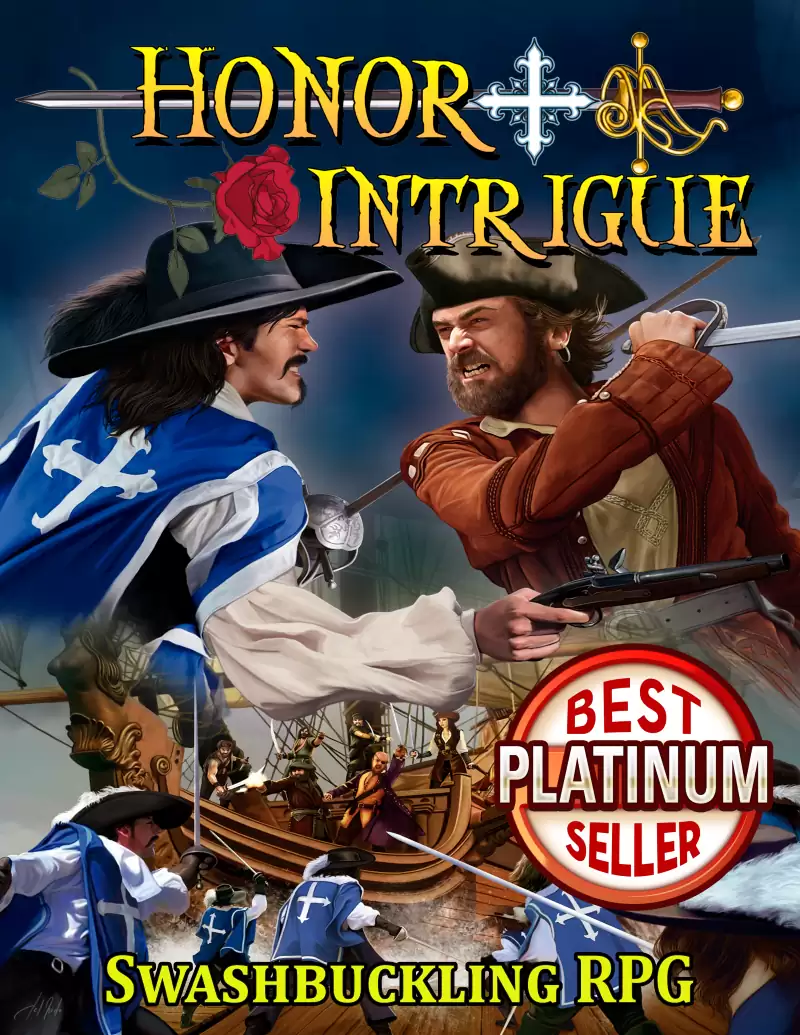 What do they say about themselves?















 But 1d6+2 equates to 1d10 and 1d6+3 equates to 1d12. That increases variability with some weapons and lets people use neglected dice. Personal preference, I would have liked to see Polyhedral damage as a base rule with higher amounts of LifeBlood. If you make damage bigger, but you also make hit points bigger, you can still make everything take just as long, but it feels perhaps more significant. Doing 3 damage in Honor + Intrigue may be better than doing 30 damage with a fireball in Dungeons and Dragons, but it doesn't feel impressive or heroic.