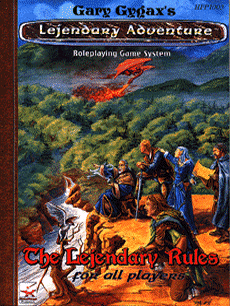
The Lejendary Journey Continues

Not to be confused with Kung-Fu: The Legend Continues
Usually, when a game talks about what role-playing is, usually there's a reference to a game of make-believe and a question about what actually happened when imaginations collide - and the provision of rules to guide that imaginary play. Gygax takes a bit of a different approach:
"This game will allow participants to engage in all manner of fantasy play, limited only by the imaginations of the players themselves. Role playing is simply an exercise in imagination coupled with the use of the rational mind. Imagination and reason are used in conjunction to assess information, solve make-believe problems posed, optimize potential gains, and minimize potential losses in play."
I'm literally not sure if he's talking about role playing or filing my taxes. I actually don't mind Gygaxian language, but it is clearly not the most concise way of saying things. To be fair, he does reference Cops and Robbers and almost immediately the mythic quest described by Joseph Campbell. Characters are called Avatars, and the game claims that beginning characters 'will be quite strong, able, and well-equipped'.
The next section is a 2-page glossary, many with acronyms. Here we learn that rounds are Ability Blocks (ABs) of 12 seconds each, and each AB is composed of four 3-second Ability Block Counts (ABCs). I read ahead that when you activate an ability, it typically doesn't activate immediately - some amount of additional time will pass - so this will certainly feature later.
Ability Scores (also called 'Score') is a rating from 1-100 (though it can be higher). The game uses 1d100
roll under for resolving most tasks. That is not my favorite resolution mechanic...
Avoidance is the term used for general 'resist checks'.
Base Rating - These are the three fundamental stats for each character; Health (H), Precision (P) and Speed (S). Intellect is an optional 4th stat.
Orders - We'll learn more about these later, but they sound like classes - groups of skills that you'll want to advance together to match an archetype, but players don't have to belong to an order (presumably meaning they advance whatever skills they want without regard to standard archetypes). If you have an order, as you advance you gain rank, meaning you have power within the order. Characters without an order don't have rank.

This may be true in the game...or being a murder-hobo may be the best life choice. We'll see!
The game has both merits and demerits. Merits are used to advance characters, so they're good, and you want to get them. Demerits are bad - I don't know if you actually lose abilities you have or if you just have to pay them off before you get merits. Generally, I think it's better to just have merits - and give few or none if players play poorly. What qualifies as good or poor play hasn't been defined yet, but I'm generally not a fan of incremental advance tracking (like XP) and instead prefer to give the entire party a chance to advance together.
Avatars (Character Creation)
There are five essential areas that th player must deal with in creating an Avatar, and twelve steps that deal with those areas. The race of the Avatar must be chosen, the Base Ratings must be generated, for those determine the broad capabilities of the character. Specific Abilities are then chosen, showing what skill areas the Avatar has some proficiency with. The character's background is then described and the basics of the character's personality decided. Finally, the player must choose equipment for the Avatar, prepatory [sic] to play. These are the essential areas to be dealt with when creating an Avatar.

Not this one

Not this one, either
The use of the term Avatar feels like it's an attempt to stake out a term that can be protected as Intellectual Property (IP) so even though it's not trademarked, you just get the sense that Gygax is deliberately avoiding words that he used before. He makes it clear that Game Characters are exactly what these are. In the sense that you're projecting yourself into a role-playing game, the character being 'your avatar' makes sense, but I'm not wholly convinced that's what the game should be encouraging. A character doesn't have to reflect you, and focusing on the 'controlled by a person sitting at a table' aspect seems counter to the immersive experience. This is one of those things that I've thought about because what you call things in game does matter, and that's one I had considered myself. Incarnate or Incarnation have some thematic overlap - being 'made flesh' in the game world strikes me as better, but in any case, I'll be using the term 'Character' from here on out except in direct quotes.
Step 1: Race
This step must be taken first because it impacts Base Ratings and choosing abilities. Some races must have certain abilities, some cannot have certain abilities, and some may not have certain abilities at character creation but can purchase them later. Now, races are listed in the Table of Contents, but there's no way you,
as a first time player, know what race you should want to be based on your concept. There are three race groups; human (only 1 race), veshoge (only 1 race), and Alfar (11 races). In the sense that the mythological underpinnings of elves, dwarves, gnomes etc are all the same, putting them into a single group sorta makes sense? The Alfar include Dwarf, Gnome, Ilf, Kobold, Oaf (2 types), Orc (3 types) Trollkin, and Wylf (which it says is an elf). I would have expected the Ilf to be an elf, but surely they'll clear up my confusion in a moment.
Base Ratings
An 'average' NPC human has a 10 for Speed, a 20 for Health, and a 20 for Precision. Human Adventurers will likely have a Speed less than 25, a Health of 50-60 (and eventually reach 200), and probably Precision less than 100. It appears that Health is also hit points; if you have 50 hit points you die when your total reaches -6 (and you're near death at -5). Speed is often used to avoid being hit in combat and avoiding traps (like a Reflex Save), while Precision is used to hit people with pointy sticks and other weapons.
Abilities
This includes ordinary abilities (like sailing) and extraordinary abilities (like spells). Like GURPS, the abilities you choose can increase your Base Ratings. Ie, if you have a lot of martial skills, they could increase your 'reflexes, coordination, and perception' - we'll find out what that means shortly, but it feels like doing my taxes (well, to be honest, my taxes aren't that hard, but when I used to try to do it by hand and I lived in Iowa and had to do State Taxes, too, well, it seemed like I was always adding something from A to B and then taking that number and subtracting it from C, unless it was more than C, in which case I needed to check Table D) - I don't know that character CREATION should be FUN, but it shouldn't be WORK.
Equipment
Each ability you choose grants you access to equipment chosen from a specific list (including money). There's a hierarchy to abilities, the more important an ability is to your character the more choices it will provide you for equipment. Money can also be used to buy equipment that you can't (or don't) select from a list.
There are two copies of the character sheet in the book (and permission given to copy it), but despite that I can't find an exact copy online, but
Dragon's Foot has one that's almost exactly like the one in the book - at least the top half. It's clear that your 'first ability' is prime and matters, and that you have other abilities that aren't prime; and that all three of your Base Ratings have a 'normal value' but that you lose points from them temporarily.
Step 1: Select a Race
The book suggests that you skip ahead and read the racial descriptions and choose one that sounds interesting to you.
Step 2: Distribute Points
You get 100 points to divide among the Base Ratings, but there are restrictions based on your race.
For Humans the following restrictions apply:
Health: MIN 40, MAX 70
Precision: MIN 20, MAX 50
Speed: MIN 8, MAX 12
Off the bat, it looks like speed has such a narrow range that maximizing it makes sense - if relative ability matters at all, you'd think having 66% of the max would hurt you, and since the scores all cost 1 point per bonus.
When you choose Abilities, Humans get 100% of their Base Rating in their first ability, 80% in the their second, 60% in their third, and 40% in their 4th.
Step 3: Augment Base Ratings per Racial instructions
Ilfs (which are like Elves, except Wylfs are ALSO like Elves, and they're the ones that explicitly say so) have the exact same minimums, but they get a random increase; 2d12+2 Health, 1d10+4 Precision, and 1d6 (half-points) to Speed. They only choose two abilities, because three abilities are pre-selected (Hunt, Stealth, and Weapons). If those were abilities you wanted to select, choosing an Ilf seems like a sensible like choice - you get rewarded with higher Base Ratings for a smaller selection.
Radom variations in character creation isn't something that I'm particularly fond of. You could have two Ilfs, (fortunately, auto-correct isn't trying to do anything inappropriate with that word) where one rolls the absolute minimum on the 'random Base Ratings' and the other rolls the maximum. It's ostensibly a 'cooperative game', so on the one hand it doesn't matter which one is higher and which is lower, but on the other hand I think we'd all agree that we'd rather be the player with the higher abilities. Since it's not competitive, there's no reason NOT to let starting characters actually be equal. It has the potential to create resentment or feelings of inadequacy right out the gate.
Step 4: Choose Abilities
Some abilities are extraordinary and include multiple magical disciplines with names like Geourgy and Necrourgy, and also things like Hunt, Stealth, and Weapons (like our Ilf has). Dwarves can't ever have Chivalry. What does that mean?
When choosing Chivalry, 'add two points to Health rating when initially selecting this Ability. All activities having to do with courtly behavior, manners, diplomacy, persuasion, precedence,
castles, fortification and siegecraft, siege engines, command, management of lands, livestock, riding, etc are governed by this Ability. Each five Ability points possessed adds one point to Weapons Ability use and any weapon-based Harm inflicted by the individual' (bold added for emphasis).

Aye, I admit it. I was talking out of my ass when talking about defending the caves.
Look, I have the Rules Cyclopedia, a version of OD&D where Dwarf was a class and it was basically the same as a Fighter (but not as good!), and in AD&D Dwarves could be Clerics but not Wizards. Frankly, that's a failure of imagination of epic proportion. Locking Dwarves out of Siege Craft,
but allowing them to take Waterfaring???* Just kidding - I wouldn't lock them out of that, either. While I don't normally think of Dwarves as a semi-aquatic species, there's no reason they couldn't be, at least in SOME settings.
*Technically they can't take it at character creation, but they can take it later.
Each ability is tied to a Base Rating - it appears that all magical traditions are tied to Speed.
Abilities aren't really relatively equal. You could choose 'creative' and pick up a +2 to Precision, and a bonus of 10% of your Creative ability to nine other abilities that you may not even have, or you can pick up Geourgy (getting +1/2 Speed) and using this ability to summon elemental power or actual elemental spirits.
Step 6: If you forgot weapon skill, add it now at the lowest rating
Seriously, you're not allowed to have a character without weapon skill. If you do have weapon skill because you realized that this was the kind of world where sometimes your sword would have to do the talking for you, you get to choose a different skill.
I have 15 ranks in Intimidate
Step 7: Apply bonuses to your Base Ratings
Every Ability has an associated Base Rating. If you chose an Ability that has Health as the Base Rating, you add +2 to Health; if you chose an Ability that has Precision as the Base Rating, add +2 to Precision; and if you chose an Ability with Speed as the Base Rating, add +.5 to that.
Having skipped ahead, I know that often you're often using your Speed (x4) for various values. Having Speed as a smaller value, increase at a slower rate, and then using a larger value seems
inelegant. Adjusting values so that the three systems use the same scale doesn't seem that hard. I'm a bit disappointed.
Step 8: Optional Rule - Determine Intellect
Intellect is 10 + 2 for each of several listed Abilities (like Learning and Commerce).
Step 9: More Math
Determine your Abilities by multiplying by a percentage. Ie, if you have a skill that's 70% of your Base Rating, figure out what that is and write it down.