I'm not sure that showing that the math works the same as a completely different game is helpful in trying to get people to play this game rather than the one that it apparently emulates.
For me, having the same chance of success without regard to your opposition is simply untenable. I have no interest in a game where pickpocketing an old blind beggar is the same as strealing a jewel from the hand of the master thief.
As for the spell selection, I don’t claim it's impossible to make choices - just to analyze all the choices in a meaningful way in relation to each other without a serious involved analysis without play experience. Reading all of the options, boring and tedious as it may be, is always an option. It's just not one that appeals to me. A short description of each spell in some kind of table wasn't even uncommon at the time this was published. It's an easy point to make regarding a failure of accessibility whether by design or accident.
Review - Lejendary Adventure by Gary Gygax
Moderator: Moderators
-
deaddmwalking

- King
- Posts: 6061
- Joined: Mon May 21, 2012 11:33 am
Re: Review - Lejendary Adventure by Gary Gygax
-This space intentionally left blank
-
lunamancer
- NPC
- Posts: 8
- Joined: Thu Jun 05, 2025 4:13 am
Re: Review - Lejendary Adventure by Gary Gygax
I wanted to address this example specifically. I've already clarified that default checks aren't really a thing other than when specifically stipulated or adjudicated. However, I have to point out, not only are dwarves not barred from siege skills. All Dwarf Avatars have to have skill in that area. One of their Mandatory Abilities is Planning. Planning includes "All activities having to do with command, leadership, preparation for action, exploration, mapping, logistics, supply, attacking, siege machinery operation, military ambush, defending, and so on..."deaddmwalking wrote: ↑Tue Feb 11, 2025 6:27 pmI talked about Chivalry before, and there were a number of abilities that were associated with it (like siege craft). If Chivalry is your 'highest rated skill', it is at 100% of your relevant attribute (Health). But if it is NOT your highest attribute, it is less than 100% of your Health Base Rating. Ie, if it was your second highest skill, you would have a rating of 80% of your Health, etc.
And this is where we come to the first major failure point in my mind. If I invest in a skill, I should be better at it than someone who did not. So if I have Chivalry and the Dwarf (by rule) does not, but we both want to make a Siege Craft check, what do we roll? If the Dwarf is allowed to use his Base Rating, he'll score higher than I will. I could make it an auto-succeed for the person that has the skill (that was suggested above, though this type of situation wasn't given as an example).
Going strictly by what's in LR4AP (not applying any of the sort of judgment GMs would be expected to apply themselves, just pulling literal text from the book), I've done some side-by-side comparisons for some of the abilities.
Where Chivalry and Planning are similar:
- Both abilities provide skill in command and siege engines.
- Chivalry includes skill in fortification and siege craft, Planning includes skill in attacking, defending, preparation for action, military ambush
- Chivalry includes management of lands, and livestock. Planning includes skill in logistics and supply
Where Chivalry and Planning are different:
Social Skills: Chivalry includes skill in courtly behavior, manners, diplomacy, persuasion, and precedence. Planning includes skill in leadership.
Combat Skills: Chivalry includes bonuses in personal combat (+1% to hit/+1 harm per 5 points of Ability). Planning the ability to operate, aim, and discharge all forms of siege engines and machinery
Miscellaneous Skills: Chivalry includes skill at riding and knowledge of castles. Planning includes skills at exploration and mapping.
-
lunamancer
- NPC
- Posts: 8
- Joined: Thu Jun 05, 2025 4:13 am
Re: Review - Lejendary Adventure by Gary Gygax
I was not showing you the math works the same as a completely different game. The point is that the probabilities are just as reasonable as a game enjoyed by millions. Whether or not it's your cup of tea is a matter of taste. This is simply an illustration that as an objective matter of fact the game works. I'm not sure why someone trying to do an honest review would insist on arguing that point and twist it into something else. It's not a mind bondage spell that forces you to like the game. It's just what it is.deaddmwalking wrote: ↑Fri Jun 06, 2025 1:56 amI'm not sure that showing that the math works the same as a completely different game is helpful in trying to get people to play this game rather than the one that it apparently emulates.
That's not what this game does. And you know that. Your review made a few references to situational adjustments. And that's just on the surface level. At the level of application, one of the more obvious factors would be that Scrutiny could be used to counter such surreptitious activity. And lo and behold, Scrutiny is one of the Order Abilities for a Desperado. So the mechanics do in fact support the idea that a master thief is going to be much harder to steal from.For me, having the same chance of success without regard to your opposition is simply untenable. I have no interest in a game where pickpocketing an old blind beggar is the same as strealing a jewel from the hand of the master thief.
Again, every player I've seen has managed to do it. Their selection is meaningful in sense that they get a character they want to play with a selection of powers that If what you mean by "analyze all the choices in a meaningful way" is "serious involved analysis" then obviously that's a tautology. It's literally a true statement regardless of what you're talking about. That's got nothing to do with this game.As for the spell selection, I don’t claim it's impossible to make choices - just to analyze all the choices in a meaningful way in relation to each other without a serious involved analysis without play experience.
To put it into perspective, there are over 200 Enchantment powers included in the game. 80% of them you can get at least a vague sense of what they do just from their name. 20% of them you can have a really good idea of what they do just by the name. Even if your first time you just selected from those 41 or 42 powers, you only need to pick 12-16 of them. Maybe that's how the players are managing to get the job done despite your argument. I don't know. I never actually asked them why they picked what they picked. I just know they picked, they did so quickly and without tons of experience as a prerequisite, and they didn't seem to have any buyers remorse. I call that meaningful selection.
I'm going to agree with you that a short description would have been nice.Reading all of the options, boring and tedious as it may be, is always an option. It's just not one that appeals to me. A short description of each spell in some kind of table wasn't even uncommon at the time this was published. It's an easy point to make regarding a failure of accessibility whether by design or accident.
-
deaddmwalking
- King
- Posts: 6061
- Joined: Mon May 21, 2012 11:33 am
Re: Review - Lejendary Adventure by Gary Gygax
There's a lot of 'GMs will use their common sense' in place of clear guidance. I think I covered that.lunamancer wrote: ↑Fri Jun 06, 2025 3:35 amThat's not what this game does. And you know that. Your review made a few references to situational adjustments. And that's just on the surface level. At the level of application, one of the more obvious factors would be that Scrutiny could be used to counter such surreptitious activity. And lo and behold, Scrutiny is one of the Order Abilities for a Desperado. So the mechanics do in fact support the idea that a master thief is going to be much harder to steal from.
As for understanding the game, examples from play are great. I think your explanation of how Planning and Chivalry overlap to cover Siege Craft is great clarification - better understanding of how the rules work. I also think they help explain why this seems like a confused mess to me. I don't see any reason why a Dwarf can't be 'chivalrous' (EVER) and I don't think it's a good use of space to have abilities that do something other than what it says. It's the overlap of abilities that makes it look like a confused mess. I used Repair and Pantology to make this point in my review. It's not clear where one ends and the other begins.
Barbarians of Lemuria (and Honor + Intrigue) use a 'career system' where you have careers and each time your career applies, you get the bonus.
-This space intentionally left blank
-
deaddmwalking
- King
- Posts: 6061
- Joined: Mon May 21, 2012 11:33 am
Re: Review - Lejendary Adventure by Gary Gygax
Something I wanted to expand on.
A lot of games wear as a badge of pride how much leeway they give the GM. If you're supposed to apply situational modifiers on the fly so that someone with a 70% in an ability succeeds 40% on hard tasks and 90% on easy tasks, you're required to understand intuitively how difficult those things ought to be. Since this is a fantasy world, there are bound to be differences in expectation.
A good GM understands what the players want, as well as what their underlying expectations are in the game. As a result, it almost doesn't matter what system a good GM uses because, tautologically, a good GM produces a good game.
So a game that offloads everything to the GM is almost by definition bad - it doesn't give ENOUGH to new GMs and it doesn't give a good GM ANYTHING that they don't already have.
Brandon Sanderson's laws of magic are worth a read for anyone interested in a fantasy world and intersects with game building significantly. His first law is: An author’s ability to solve conflict with magic is DIRECTLY PROPORTIONAL to how well the reader understands said magic.
There's a lot to unpack (and he does), but you could see how it applies if you change it to read: a player's ability to solve conflicts is directly proportional to how well the player understands the rules. If there are supposed to be ad-hoc adjustments all the time, then a player isn't likely to understand how likely they are to succeed.

Sometimes it's fun to play the Keystone Cops. Rogues have no idea whether they're likely to find traps, and the party reacts as the GM directs one disaster after another their way. There are going to be things that are unknowable by the players, but characters should have a general sense of their capabilities. When considering stealing a gem from a master-thief, what can you do to make success more likely versus less likely? Is there a way that you can shift the odds so far in your favor that success is automatic?
The game should set clear expectations one way or the other. There's no reason to say that the GM can adjust the game. They can do that anyway. But if the game is clear about whether jumping across a 20 foot chasm is possible for a reasonably strong man in decent athletic shape (with or without armor) and the GM plans to adjust from the default, it's much easier to have a conversation with the player.

It's much harder after the character has done 'something stupid' and the character is dead. Clarity from the rules for both the players and the GM are desirable qualities.
A lot of games wear as a badge of pride how much leeway they give the GM. If you're supposed to apply situational modifiers on the fly so that someone with a 70% in an ability succeeds 40% on hard tasks and 90% on easy tasks, you're required to understand intuitively how difficult those things ought to be. Since this is a fantasy world, there are bound to be differences in expectation.
A good GM understands what the players want, as well as what their underlying expectations are in the game. As a result, it almost doesn't matter what system a good GM uses because, tautologically, a good GM produces a good game.
So a game that offloads everything to the GM is almost by definition bad - it doesn't give ENOUGH to new GMs and it doesn't give a good GM ANYTHING that they don't already have.
Brandon Sanderson's laws of magic are worth a read for anyone interested in a fantasy world and intersects with game building significantly. His first law is: An author’s ability to solve conflict with magic is DIRECTLY PROPORTIONAL to how well the reader understands said magic.
There's a lot to unpack (and he does), but you could see how it applies if you change it to read: a player's ability to solve conflicts is directly proportional to how well the player understands the rules. If there are supposed to be ad-hoc adjustments all the time, then a player isn't likely to understand how likely they are to succeed.
Sometimes it's fun to play the Keystone Cops. Rogues have no idea whether they're likely to find traps, and the party reacts as the GM directs one disaster after another their way. There are going to be things that are unknowable by the players, but characters should have a general sense of their capabilities. When considering stealing a gem from a master-thief, what can you do to make success more likely versus less likely? Is there a way that you can shift the odds so far in your favor that success is automatic?
The game should set clear expectations one way or the other. There's no reason to say that the GM can adjust the game. They can do that anyway. But if the game is clear about whether jumping across a 20 foot chasm is possible for a reasonably strong man in decent athletic shape (with or without armor) and the GM plans to adjust from the default, it's much easier to have a conversation with the player.
It's much harder after the character has done 'something stupid' and the character is dead. Clarity from the rules for both the players and the GM are desirable qualities.
-This space intentionally left blank
-
lunamancer
- NPC
- Posts: 8
- Joined: Thu Jun 05, 2025 4:13 am
Re: Review - Lejendary Adventure by Gary Gygax
It's not an accurate assessment of what's going on in LA. I wouldn't have gotten into the game if it didn't provide a solid structure for play, as this was my main peeve about rules-lite games up to the time I first read LA. (I also had issues with skill-based RPGs, which I'll address later.)deaddmwalking wrote: ↑Fri Jun 06, 2025 1:35 pmThere's a lot of 'GMs will use their common sense' in place of clear guidance. I think I covered that.
Now I made two points about this specifically, one you haven't addressed at all, which is counter-Ability use. Since Abilities have numerical ratings, you have known, obvious, quantifiable, and explicit complications. As it pertains to straight up adjustments themselves, the general rules section provides three entire sets of situational modifiers, a generic catch-all one, and then specific tables for combat and activating powers. Much like I've done with Chivalry and Planning, I just place this information side-by-side. So if you're trying to figure out what modifier should be applicable to stealing from a blind man, this is the part of the table that would be most relevant:
Special Enhancements, +16 to +30
- Activating, non-threatening conditions, +20
- Attacking, high weapon precision, +20
- Striking, from behind, +20
Extraordinary Enhancements, +31 and up
- Activating, very favorable conditions, +30 to +50
- Striking, defender unresisting, +60
Striking from behind bonus has a lot to do with the opponent can't see you. If the blind man is otherwise very capable and can hear you coming, then maybe the +20 bonus is the one that is most applicable. However, I think we both know you specifically chose the example of a blind man because you were trying to go to the furthest extreme to make your point. Therefore we both know we're talking about the most favorable of very favorable conditions. +50 would be applicable here. There's no ambiguity to it. That would mean for the Desperado Avatar in question, success is near-certain. Meanwhile, someone with no appreciable Stealing Ability at all would get their 0% boosted to 50% making it a 50/50 affair when you put the least capable thief against the least capable victim.
I noticed that in the review, and I just wasn't sure how to respond to that point without sounding petty. Pantology is a new word to you. You look it up. Find a definition. Then claim the ability has nothing to do with the definition. Despite the fact, like with all Abilities in LA, it's defined succinctly by providing plainly, directly, and clearly a list of all the things it covers. The very first item on the list for Pantology fits the definition directly. The rest of it I'd characterize as the applications of broad but shallow knowledge given the sort of the world, characters, themes, and subject matter of the game.As for understanding the game, examples from play are great. I think your explanation of how Planning and Chivalry overlap to cover Siege Craft is great clarification - better understanding of how the rules work. I also think they help explain why this seems like a confused mess to me. I don't see any reason why a Dwarf can't be 'chivalrous' (EVER) and I don't think it's a good use of space to have abilities that do something other than what it says. It's the overlap of abilities that makes it look like a confused mess. I used Repair and Pantology to make this point in my review. It's not clear where one ends and the other begins.
What's more concerning to me is you find it a "confused mess" on the grounds of not being clear where when ends and the other begins. Who says there is a single line where one ends and the other begins? That's an example of an assumption attributable to mindset baggage that's not established by anything in this game on its own terms. Earlier I mentioned there were two things that predisposed me to being initially skeptical of LA. One was being rules-lite. But the other was being skill-based. The problem I see too often in skill-based games I think is directly related to the point you're raising here.
Say I'm playing a skill-based game. I decide to make a cool 80's action cop. But, oops! I forgot to take the skill that covers jumping. It doesn't dawn on me until mid-game when I'm pursuing the bad guy in a rooftop chase scene. Sucks. And I guess one "solution" is to accept that this is a problem inherent in skill-based games, it's never going to go away, and so the best you can do from a game design end is to define skills as clearly as possible for game purposes. Even if maybe sometimes the delineations don't make perfect logical sense, clarity is the highest priority here.
LA goes a different direction. It addresses the problem by actually solving the problem. It uses broad-based skill-bundles that are bundled not according to how similar an activity is but according to how it would be learned vocationally. Like how I illustrated Chivalry and Planning, noting that each contains combat skills, each contains social skills, etc, rather than just covering one type of activity. This is the first line of defense. If I'm making a Noble avatar and make Chivalry my first ability, I don't later say, "Whoops! I plum forgot to take the skill to know how to manage lands." It's in the bundle.
The second line of defense is that the same skill can sometimes be found in more than one Ability, the more common capabilities being found across many Abilities. So now if my Noble is coming across the 20' chasm, I'm not saying "Shit, I forgot to take Minstrelsy so I know how to jump." Jumping capacity in the game is defined in very specific terms and several Abilities grant capacity above and beyond the human norm. A typical Noble Avatar will also have Weapons, Hunt, and Physique abilities, and those all contribute to jumping ability as they all involve some degree of general athleticism. Even if you don't create the Avatar exactly according to the Noble order, if you take any one of those (or any one of 9 other abilities), you've got above-average jumping capacity.
This two-tier solution requires skill bundles be both broad and overlapping. If you want to call that confusing, by all means, you wouldn't be alone in that. Just be aware that you're criticizing an actual solution to a recognized problem on the basis that it interferes with the accepted cope for that very problem.
-
deaddmwalking
- King
- Posts: 6061
- Joined: Mon May 21, 2012 11:33 am
Re: Review - Lejendary Adventure by Gary Gygax
lunamancer wrote: ↑Mon Jun 09, 2025 1:02 amSay I'm playing a skill-based game. I decide to make a cool 80's action cop. But, oops! I forgot to take the skill that covers jumping. It doesn't dawn on me until mid-game when I'm pursuing the bad guy in a rooftop chase scene. Sucks. And I guess one "solution" is to accept that this is a problem inherent in skill-based games, it's never going to go away, and so the best you can do from a game design end is to define skills as clearly as possible for game purposes. Even if maybe sometimes the delineations don't make perfect logical sense, clarity is the highest priority here.

Aim for the bushes
Barbarians of Lemuria (and Honor + Intrigue) solve this in a much more elegant way; having careers and allowing players to explain how their career would be relevant.lunamancer wrote: ↑Mon Jun 09, 2025 1:02 amLA goes a different direction. It addresses the problem by actually solving the problem. It uses broad-based skill-bundles that are bundled not according to how similar an activity is but according to how it would be learned vocationally. Like how I illustrated Chivalry and Planning, noting that each contains combat skills, each contains social skills, etc, rather than just covering one type of activity. This is the first line of defense. If I'm making a Noble avatar and make Chivalry my first ability, I don't later say, "Whoops! I plum forgot to take the skill to know how to manage lands." It's in the bundle.
I still think that a 'MacGyver style repair' and a 'real repair' have to have different effects, and that comparing and contrasting them what the intent is isn't clear at all. I know how I'd handle it in game - I'd basically let the first one do a one-time repair and after the device operates it won't work again (at least not without another temporary repair) while I'd let the other one continue to function until some action occurs to cause it to break (like sabotage).
I also still think that adding bonuses to your base ability is absolutely more straightforward than the alternatives (multiplying one score by .80 and another one by .20). Mathematically you can get the numbers to work the same way, and you should. I'm hostile to roll under in part because it requires inconsistency in how you apply bonuses and penalties. Applying a negative bonus and a positive penalty is needlessly confusing (a la THAC0) and there's no need for it.
-This space intentionally left blank
-
lunamancer
- NPC
- Posts: 8
- Joined: Thu Jun 05, 2025 4:13 am
Re: Review - Lejendary Adventure by Gary Gygax
Ehh... That's pretty much how LA works. "The player may suggest the applicability of a specific Ability, but the LM, as always, has the final say in the matter." (LR4AP, pg 183). I think LA provides a lot more guidance for the LM to adjudicate. Of course what is or isn't enough guidance is going to be subjective. Personally, I'm on the fence on Barbarians of Lemuria. It actually would have been a hard pass if not for LA having nudged me in that direction to begin with. But if it's enough for you, fair enough. My only point is if you're happy with the clarity and guidance of Barbarians of Lemuria, then it's probably not accurate to report in your review that LA falls short there when it provides more guidance.deaddmwalking wrote: ↑Mon Jun 09, 2025 2:35 pmBarbarians of Lemuria (and Honor + Intrigue) solve this in a much more elegant way; having careers and allowing players to explain how their career would be relevant.
They are different. In terms of armor repair, Pantology is used for cloth and leather armor, and wood and leather shields while Mechanics is required for metal armor and shields. For other types of items, repairs made via Pantology do not check for success until the item is used, so failed checks tend to be a lot more inconvenient when Pantology is used. In Pantology's favor, though, is the Ability can be used to sharpen knives, daggers, axe-like blades, and swords, increasing their minimum base harm for a limited number of uses.I still think that a 'MacGyver style repair' and a 'real repair' have to have different effects, and that comparing and contrasting them what the intent is isn't clear at all. I know how I'd handle it in game - I'd basically let the first one do a one-time repair and after the device operates it won't work again (at least not without another temporary repair) while I'd let the other one continue to function until some action occurs to cause it to break (like sabotage).
This really isn't part of the game and is only a method for character creation. It's not the only method. It's the featured method and the intent was specifically not to be a sleek, efficient, straight-line method. It was meant to be a back-and-forth, give-and-take method that was meant to be fun. To each his own. It's the first thing I did when I saw the game, and it hooked me. But I've also created my own method intended to be quick, in case a character dies so the player can get back into the game as quickly as possible. And a lot of people complain about that one, too, claiming it's random. It's not. All major decisions are 100% player made. Exact scores are randomized as a time-saving measure to bypass min-maxing and dicking around with where to assign every little point. There's no accounting for taste.I also still think that adding bonuses to your base ability is absolutely more straightforward than the alternatives (multiplying one score by .80 and another one by .20). Mathematically you can get the numbers to work the same way, and you should.
And there it is, Theory rears up its ugly head. I mean it doesn't sound like you're denying at all that you held that opinion prior to reading LA. So it doesn't really have anything to do with this game. It doesn't address the nuances of how this game works. LA does use some negative bonuses and positive penalties. Emphasis on some. It's not all. It's not the general rule. It's used deliberately in a nuanced way that the theory doesn't address. It's more prejudicial than probative. And that's why I said right from the jump that gamers buy into theories that render them incapable of evaluating this game on its own terms.I'm hostile to roll under in part because it requires inconsistency in how you apply bonuses and penalties. Applying a negative bonus and a positive penalty is needlessly confusing (a la THAC0) and there's no need for it.
Here's an example. The Desperado Avatar I created had 15 Weapons Ability. His weapon has 20 Precision. Let's first of all note that the 20 is a bonus that is ADDED to his probability to hit. It's not subtracted at all from anything. Theory fails. Now let's suppose he's facing someone in combat who is dual wielding. Figuring there's a good chance that at least one of those weapons will hit, the Desperado decides to reserve his attack as a parry. When parrying a two-weapon attack, there's a -15 bonus to the parry roll. AH! We got one! Negative. Bonus.
As a sidebar, technically this bonus to parrying two weapon attacks is presented as one of the drawbacks of dual-wielding. This alone ought to start you rethinking the validity of the theory in general. Because isn't that always the case? That there's always two sides to a conflict? And that what's good for one is bad for the other and vice versa? So any time you see a "negative bonus" isn't that just a negative penalty for the other guy? And therefore not counterintuitive? Food for thought. Okay, end of sidebar. Onto the nuance.
In LA's game mechanics, when you roll 1/10 of what you need or under on the percentile, it's a "crit." So our Desperado, having a 35% chance to hit, will score a crit if the d100 is 3 or less. When parrying, a crit means the attack is fully parried and the defender is then allowed a freebie counterstrike. When you apply a -15 bonus to the Desperado's parry, it's not just increasing his odds for success. Sure, if he rolls a 50, which would normally miss, and subtracts 15, that gets 35 and so now he hits. The more important thing is that if he rolls an 18, subtracting 15 makes the roll a 3. Which triggers a crit. That's the nuance. -15 is not just a counter-intuitive bonus. It's telling you that this adjustment is not just increasing your chance of success by 15% but your chance of crit by 15%. It's not really a negative bonus. It's a shorthand indicating it enhances crit probability. As a GM who appreciates greatly abbreviated stat blocks, a theory would have to be a really good to unsell me on a shorthand. A hokey theory just won't cut it.
-
deaddmwalking
- King
- Posts: 6061
- Joined: Mon May 21, 2012 11:33 am
Re: Review - Lejendary Adventure by Gary Gygax
So you're telling me you think that making a crit 600% more likely while only increasing the to-hit chance by 42% is a good thing?
Not sold.
There's no reason you'd be familiar with any of my other reviews, but d100 roll under is my least favorite mechanic and I don’t pretend not to be biased against it.
If success is less than 35, it's just as easy to add 35 to your d100 roll with a TN of 100. I mean, I'd accept an argument that comparing 2 numbers might be slightly easier than adding two 2-digit numbers, but not if you also have to mentally adjust those numbers before doing the compare. Once you do that, all bonuses can be positive. Life is then easier.
Anyways, you are not going to convince me, but I respect that you feel differently. It was in order to include contrasting views that I incorporated your review into my own. Knowing I was taking a cursory look, your more in-depth discussion is valuable. That said, it doesn’t then follow that everybody who reads the rules and fails to appreciate their brilliance is subject to 'theory crafted blindness'. There are a host of valid reasons to find something substandard including but not limited to organization, clarity, presentation, outcomes, and personal preferences.
I like Gygax and if he really thinks that this is his magnum opus and that the third time really is the charm it deserves a look, but I also think that a game like this feels extremely constrained (like forbidding dwarves to have Chivalry and offering few interesting selectable character options outside of spells), so the underlying rules engine has to make up a lot of ground. It may be less clunky than it appears to be with practice, but even if that’s the case there's nothing HERE that makes the game or the setting compelling. And I know this was I tended to be a system that could support many settings, so not providing detailed information about Ilfs and Wylfs (or whatever) was a deliberate choice, but I still feel it was the wrong one.
I really am curious what you think this game does BETTER than other games. Surely you don't find combat cinematic and exciting? Is it just that 'the math just works'? If that's the case, in what way do you find that true? What would it take to leap 30 feet on a single bound, and is that even something you want?
Not sold.
There's no reason you'd be familiar with any of my other reviews, but d100 roll under is my least favorite mechanic and I don’t pretend not to be biased against it.
If success is less than 35, it's just as easy to add 35 to your d100 roll with a TN of 100. I mean, I'd accept an argument that comparing 2 numbers might be slightly easier than adding two 2-digit numbers, but not if you also have to mentally adjust those numbers before doing the compare. Once you do that, all bonuses can be positive. Life is then easier.
Anyways, you are not going to convince me, but I respect that you feel differently. It was in order to include contrasting views that I incorporated your review into my own. Knowing I was taking a cursory look, your more in-depth discussion is valuable. That said, it doesn’t then follow that everybody who reads the rules and fails to appreciate their brilliance is subject to 'theory crafted blindness'. There are a host of valid reasons to find something substandard including but not limited to organization, clarity, presentation, outcomes, and personal preferences.
I like Gygax and if he really thinks that this is his magnum opus and that the third time really is the charm it deserves a look, but I also think that a game like this feels extremely constrained (like forbidding dwarves to have Chivalry and offering few interesting selectable character options outside of spells), so the underlying rules engine has to make up a lot of ground. It may be less clunky than it appears to be with practice, but even if that’s the case there's nothing HERE that makes the game or the setting compelling. And I know this was I tended to be a system that could support many settings, so not providing detailed information about Ilfs and Wylfs (or whatever) was a deliberate choice, but I still feel it was the wrong one.
I really am curious what you think this game does BETTER than other games. Surely you don't find combat cinematic and exciting? Is it just that 'the math just works'? If that's the case, in what way do you find that true? What would it take to leap 30 feet on a single bound, and is that even something you want?
-This space intentionally left blank
-
lunamancer
- NPC
- Posts: 8
- Joined: Thu Jun 05, 2025 4:13 am
Re: Review - Lejendary Adventure by Gary Gygax
I wasn't trying to sell you on it. The point is, I have this option. I happen to like it. But more to the point, it's something you missed because you were running a pre-canned argument without regards to the specific details of the game.deaddmwalking wrote: ↑Tue Jun 10, 2025 2:33 amSo you're telling me you think that making a crit 600% more likely while only increasing the to-hit chance by 42% is a good thing?
Not sold.
It's one thing to have preferences. It's another thing if that bleeds through your review and causes you to miss things. It's the accuracy of the review, not whether it's positive or negative or if your sold on the game or not that I was responding to.There's no reason you'd be familiar with any of my other reviews, but d100 roll under is my least favorite mechanic and I don’t pretend not to be biased against it.
All bonuses can be positive. As I've already explained, the so-called "negative bonus" is really a negative penalty to the opposition and also serves as a shorthand to let you know to apply the bonus to the probability for a special success. And then also you don't even have to use that if you really think 18% of parry and reverse is too crazy and unheard of for some reason. But I also don't have to do much mentally adjusting of the numbers before doing the comparison. What's nice about the so-called "roll under" systems is, if the rest of the game has been well-designed and calibrated, the majority of rolls can and likely will go vanilla without any modifiers at all. Just because a relatively few number of edge cases require extra steps or math or an exception or two does not invalidate that the majority of the game runs quickly and smoothly in a very streamlined way.If success is less than 35, it's just as easy to add 35 to your d100 roll with a TN of 100. I mean, I'd accept an argument that comparing 2 numbers might be slightly easier than adding two 2-digit numbers, but not if you also have to mentally adjust those numbers before doing the compare. Once you do that, all bonuses can be positive. Life is then easier.
I consider simple comparison to be easier than two-digit addition by a good margin. But I don't want to belabor that point too much because there's way too much goofy theory about computation times that are only ever accurate in the broadest of generalizations and rarely relevant to any specific case. I'm going to simply say I probably would not have played LA if the mechanic was anything like you describe. I'm not sure it even matters what dice are involved. I understand a lot of people do like the whole Skill + Roll > Target Number thing even though it's old, boring, monotonous, and played-out. It just baffles me how "Hey, let's do math on every fucking roll" is, in the grand scheme of dice mechanics, simple or intuitive or elegant or helpful or good in any way. It really seems like it's a hobby bubble thing.
This is why I play AD&D. No adding a BAB or proficiency bonus to every hit roll. You get a bonus if you have high strength or a magic weapon. It's also why I have players use the straight up 3d6 method for generating attributes. Because that keeps bonuses a lot more rare. Sure, it's got this weird, random, out-of-left-field target number, just like Skill + Roll does. But at least THAC0 as a target number conveys some information.
Sure. And I can accept differences in personal preference. And I've got a few things of my own that I would have liked to see. I understand quite well that those who fail to appreciate the brilliance of the game has been blinded by theory. The issue is more an empirical one that whenever I scratch the surface, or in the majority of cases it's in full view, it always comes down to one of the same old boring arguments that get recycled on RPG forums over and over and over again, and that the arguments themselves do not actually hold water under close scrutiny and attention to detail.Anyways, you are not going to convince me, but I respect that you feel differently. It was in order to include contrasting views that I incorporated your review into my own. Knowing I was taking a cursory look, your more in-depth discussion is valuable. That said, it doesn’t then follow that everybody who reads the rules and fails to appreciate their brilliance is subject to 'theory crafted blindness'. There are a host of valid reasons to find something substandard including but not limited to organization, clarity, presentation, outcomes, and personal preferences.
I don't know that it is his magnum opus. AD&D 1st Ed (prior to 1.5E) is really tough to beat in my book and I go back and forth between the two games. I find it hard to take it seriously when you say you feel the game is extremely constrained. Even as you try to give an example, it's extremely absurd. 38 Abilities provided in the core book, and the Dwarf can't have one of them, and that's "extremely constrained?" And not even that, but a majority of what the Ability does overlaps with an Ability dwarfs automatically get? Come on. If you really want to replace a dwarf's avarice with courtly behavior, you're just playing a short, stocky human at that point. Which you are of course free to play.I like Gygax and if he really thinks that this is his magnum opus and that the third time really is the charm it deserves a look, but I also think that a game like this feels extremely constrained (like forbidding dwarves to have Chivalry and offering few interesting selectable character options outside of spells), so the underlying rules engine has to make up a lot of ground.
That goes with theory blindness. A weird focus on game mechanics. I've always found the compelling stuff to be the content. I know at the time and i still believe it today that it was the AD&D Monster Manual that really skyrocketed D&D, setting it apart from all other games, that there would be over a hundred different monsters. As you mention in your review, the majority of LR4AP is detailing all the different powers. Likewise, the majority of LML is detailing magic items. The game is definitely not light on content. And in that area, does deliver even more detailed content than AD&D. More varied, too. The setting is detailed in the Lejendary Earth Gazetteer. There's a lot of detail on the races in Beasts of Lejend.It may be less clunky than it appears to be with practice, but even if that’s the case there's nothing HERE that makes the game or the setting compelling. And I know this was I tended to be a system that could support many settings, so not providing detailed information about Ilfs and Wylfs (or whatever) was a deliberate choice, but I still feel it was the wrong one.
#1 would be the Abilities. The specific way skills are bundled logically according to vocation rather than how similar they are. Somewhere along the way in D&D, Pick Pockets became a catch-all for all sorts of sleight of hand. LA has the ability to differentiating picking pockets from a stage magician's trick from concealing and/or retrieving a concealed weapon for sudden attack by having those things covered by Stealing, Minstrelsy, and Tricks respectively, doing it with just 38 Abilities rather than 250+ skills (as in Dangerous Journeys) in order to support that level of detail. It helps keep Avatars seeming logical and well-rounded and avoids the, "Oh, I forgot that exact bit of minutia" problem that skill-based games have.I really am curious what you think this game does BETTER than other games.
I would say combat is extremely cinematic and exciting. I once saw a knight suplex a dragon.Surely you don't find combat cinematic and exciting? Is it just that 'the math just works'? If that's the case, in what way do you find that true?
It's not always a good thing. I don't mean LA. Just "cinematic and exciting" combat in general. It's one of those theory things. If you put combat A side by side with combat B to discuss on an on-line forum, you can see everyone agrees that A seems more interesting, fun, exciting, etc, but in actual play it may take so long that is causes the overall adventure or story to drag. Sometimes less is more. If the adventure is any good, I'm often more interested in finding out what's around the next corner of the dungeon than I am having a dramatic fight.
Are we talking broad jump on an even plane? Because I'm pretty sure the world record in that is under 30'. So it's not an easy thing to do. Avatars could do it by having a lot of points, and I mean a LOT of points in several Abilities that contribute to jumping. But the Incredible Jumping knack by itself would do it. Or magic, of course, such as having Grasshopper Legs cast on you. Most starting Avatars of highly physical sort--nobles, foresters, outlaws, soldiers for sure--if given something like Bracers of Titanic Physique would get pretty close. Like world record range. Oaf Avatars are also nothing to be trifled with.What would it take to leap 30 feet on a single bound, and is that even something you want?
-
deaddmwalking
- King
- Posts: 6061
- Joined: Mon May 21, 2012 11:33 am
Re: Review - Lejendary Adventure by Gary Gygax
How far someone can jump in game should be a simple question. If your experience of fantasy is driven by anime, a leaping jump seems 'reasonable'. If your experience of fantasy is more driven by attending shows at Medieval Times, an acrobatic leap probably seems 'unreasonable' - at least without magic or special abilities. The rules help establish what the shared expectations need to be. Answering the question, how far can I jump? isn't meant to be a hard one.
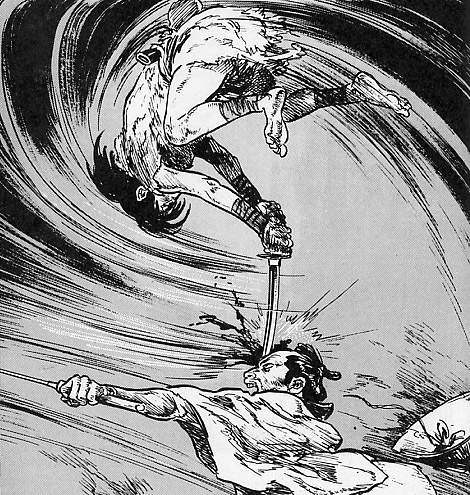
Nothing shone here is physically IMPOSSIBLE, though certainly not EASY
In D&D 3.5, figuring out whether or not you can jump 30 feet is easy. If you have a 20' running jump, you need to make a TN 30 check. To make the check you roll 1d20+STR+Ranks. A first-level Athletic human might have an 18 attribute (+4) and 4 ranks (+4). You can pick up a Synergy bonus or take a feat that provides another bonus. Since the World Record is around 30 feet, it's roughly sensible that the very best 'mundane human' will come very close to that on their very best attempt.
It's also a level based system, and we know that characters will exceed 'real world human norms' by gaining levels. A 20th level fighter might reasonable expect to survive a building collapsing on them, or falling out a 30th floor window. And a 20th level fighter with no magic can have 23 ranks in jump and without magic have a +6 STR; by dint of being high level they can exceed 'human norms' and jumping 50+ feet is absolutely possible, and there's little room for argument about whether that is or isn't possible. Look at your bonus, look at your TN, and if you can hit the TN with your bonus, it's possible.
So how does it work in Lejendary Adevntures?
There is no index, and the word 'jump' doesn't show up in the table of contents. As you say, there should be a relevant Ability that includes jumping.
There is a relatively short list of abilities (31): Alchemia, Arcana, Archery, Chivalry, Commerce, Creativity, Divination, Enchantment, Evaluation, Geourgy, Hunt, Learning, Luck, Mechanics, Metallurgy, Minstrelsy, Necrourgy, Nomadic, Panprobability, Pantology, Physique, Planning, Pretense, Psychogenic, Ranging, Rustic, Savagery, Scrutiny, Sorcery, Stealing, Stealth, Theurgy, Tricks, Unarmed Combat, Urbane, Waterfaring, Waylaying, and Weapons.
The only one that SOUNDS relevant is Physique, but you could argue that the 'chase' function of 'hunt' should include jumping, or that the 'hazardous travel' of 'ranging' applies. But let's keep it easy and say Physique applies.
Now what?
I can read that I make an ability check, and if I roll less than 80 'I perform the function correctly'. I'm not tied up or 'constrained' so applying a penalty doesn't make sense. But surely jumping 20' is easier than 30'! Can I do either if I roll less than 80? How about 40'? Or 50? Or 5?
Is the GM just going to decide that 30' is the absolute maximum for a normal (strong) human without magic or frog legs and that my character has an 80% chance of hitting that, and even if I bump that score to 90% that only covers jumping 30' and never increases total distance?
Now even though there hasn't been anything that says how far I can jump under the Ability description, or Movement, or the general explanation of using abilities, maybe it's defined in relation to what I can do with magic?
I honestly don't believe I'm misrepresenting the rules or missing anything that's relevant. I literally believe that this book doesn't even tell you how far your character can jump when confronted with a chasm. If the chasm is 20' across and players have a Physique of 50, 40, 30, and 20, I don't know what their odds of success are. If that chasm is only 10', I don't see anything that tells me how to adjust that.
Which means that this isn't so much a 'rule book' as a 'rule of thumb' for GMs to consider when 'letting' players attempt something.
Nothing shone here is physically IMPOSSIBLE, though certainly not EASY
In D&D 3.5, figuring out whether or not you can jump 30 feet is easy. If you have a 20' running jump, you need to make a TN 30 check. To make the check you roll 1d20+STR+Ranks. A first-level Athletic human might have an 18 attribute (+4) and 4 ranks (+4). You can pick up a Synergy bonus or take a feat that provides another bonus. Since the World Record is around 30 feet, it's roughly sensible that the very best 'mundane human' will come very close to that on their very best attempt.
It's also a level based system, and we know that characters will exceed 'real world human norms' by gaining levels. A 20th level fighter might reasonable expect to survive a building collapsing on them, or falling out a 30th floor window. And a 20th level fighter with no magic can have 23 ranks in jump and without magic have a +6 STR; by dint of being high level they can exceed 'human norms' and jumping 50+ feet is absolutely possible, and there's little room for argument about whether that is or isn't possible. Look at your bonus, look at your TN, and if you can hit the TN with your bonus, it's possible.
So how does it work in Lejendary Adevntures?
There is no index, and the word 'jump' doesn't show up in the table of contents. As you say, there should be a relevant Ability that includes jumping.
There is a relatively short list of abilities (31): Alchemia, Arcana, Archery, Chivalry, Commerce, Creativity, Divination, Enchantment, Evaluation, Geourgy, Hunt, Learning, Luck, Mechanics, Metallurgy, Minstrelsy, Necrourgy, Nomadic, Panprobability, Pantology, Physique, Planning, Pretense, Psychogenic, Ranging, Rustic, Savagery, Scrutiny, Sorcery, Stealing, Stealth, Theurgy, Tricks, Unarmed Combat, Urbane, Waterfaring, Waylaying, and Weapons.
The only one that SOUNDS relevant is Physique, but you could argue that the 'chase' function of 'hunt' should include jumping, or that the 'hazardous travel' of 'ranging' applies. But let's keep it easy and say Physique applies.
To stick with our example, a human can have a maximum Health of 70 to start (reserving 30 points for other abilities); this represents our 'pinnacle of normal human ability' similar to 3.x. They get a random +1d20 so TECHNICALLY could have a 90. Then they get to add a +2 when selecting this ability, as well as each other ability that keys off Health. Since they're definitely investing in health, let's assume that they have 5 such abilities and were lucky with their roll; they start with 100 in Health! If they take Physique as their first Ability, they will have 80% of their Attribute, so they have a Physique of 80%.Physique
Add two points to Health Rating when initially selecting this Ability. All activities having to do with carrying weight, endurance, fitness, lifting heavy weigh, muscular development, physical power and strength, etc. are governed by this Ability. Each 10 Ability points possessed provides a bonus of one point to any Harm inflicted by the Avatar when striking with a hand-held or hand-propelled weapon (or otherwise propelling a missile by energy directly related to muscular development, as in drawing and releasing a bow). Note that humans are assumed to be able to carry weight equal to the normal average body weight of a person of their height and bone structure, and that they can lift and/or move thrice such weight (with varying degrees of success). Physique ability then adds 10 pounds of carrying capacity and 30 pounds of lift/move capacity for each 10 points of Ability Scores
Now what?
I can read that I make an ability check, and if I roll less than 80 'I perform the function correctly'. I'm not tied up or 'constrained' so applying a penalty doesn't make sense. But surely jumping 20' is easier than 30'! Can I do either if I roll less than 80? How about 40'? Or 50? Or 5?
Is the GM just going to decide that 30' is the absolute maximum for a normal (strong) human without magic or frog legs and that my character has an 80% chance of hitting that, and even if I bump that score to 90% that only covers jumping 30' and never increases total distance?
Now even though there hasn't been anything that says how far I can jump under the Ability description, or Movement, or the general explanation of using abilities, maybe it's defined in relation to what I can do with magic?
That's not helpful at all. Now if I have this spell I can just refer to the spell description, but it turns out that someone with a Physique of 10 can jump just as far as I can with a Physique of 80 if we're under the same spell. All of my investment didn't do a damn thing. Is there ANY AMOUNT of Physique that would let me jump 80' without magic?Grasshopper Legs: This Preternatural Power enables the Enchanter, or one he has touched, to be able to jump forward in an arc rising 1 foot for every 4 feet traveled forward, to a maximum distance of 80 feet forward with a 20-foot apex of trajectory. The individual can also jump straight up to a height of 20 feet. Landing is not harmful to the individual. The energy lasts for only 11 to 20 ABCs of time before fading away. A subject under this Enchantment adds 4 (20%) to armor protection due to the rapid motion the power engenders.
I honestly don't believe I'm misrepresenting the rules or missing anything that's relevant. I literally believe that this book doesn't even tell you how far your character can jump when confronted with a chasm. If the chasm is 20' across and players have a Physique of 50, 40, 30, and 20, I don't know what their odds of success are. If that chasm is only 10', I don't see anything that tells me how to adjust that.
Which means that this isn't so much a 'rule book' as a 'rule of thumb' for GMs to consider when 'letting' players attempt something.
-This space intentionally left blank
-
lunamancer
- NPC
- Posts: 8
- Joined: Thu Jun 05, 2025 4:13 am
Re: Review - Lejendary Adventure by Gary Gygax
How about Minstrelsy? There's no jumping involved in gymnastics? How about Ranging? No jumping involved in crossing hazardous terrain? How about Stealth? No jumping involved in access to or escaping from buildings? How about Unarmed Combat? No jumping over a leg sweep or dropping an elbow from the top rope?deaddmwalking wrote: ↑Thu Jun 12, 2025 4:09 pmThe only one that SOUNDS relevant is Physique, but you could argue that the 'chase' function of 'hunt' should include jumping, or that the 'hazardous travel' of 'ranging' applies. But let's keep it easy and say Physique applies.
As I mentioned previously, the game has specific guidelines for jumping and lists 12 Abilities that apply. Everyone is assumed average jumping ability, which for a running broad jump is 9'. Score in the listed Abilities adds to that capacity.
The Abilities are: Hunt, Minstrelsy, Nomadic, Physique, Ranging, Rustic, Savagery, Stealth, Unarmed Combat, Waterfaring, Waylaying, and Weapons. Technically by the book it boosts capacity by 10% for each 10% of Ability. For example, I have a Wylf Outlaw Avatar I created a few years back and played a few times, but I believe these were the original starting stats: Health 63, Precision 46, Speed 16, Waylaying 63, Archery 40, Ranging 38, Stealth 32, Scrutiny 23, Weapons 10. So that's +10% for Weapons, +30% for Stealth, +30% for Ranging, +60% for Waylaying, for a total of +130%. So just shy of 21 feet.
This is all assuming the individual is unencumbered, of course. And the jumping distance assumes landing on one's feet. If the Avatar were trying to jump a chasm that's slightly wider and the player wants to try to leap and grab onto the far edge, if the difference is within the character's height, that would be possible. So from there I could check the Avatar's climbing ability.
Yeah. 790.Is there ANY AMOUNT of Physique that would let me jump 80' without magic?
Obviously you did miss quite a bit because the book provides more precise guidance than other games you mentioned, down to the tenth of a foot if need be, more precise than what you're asking for, and more sensible in that it's not just subject to the whims of the dice rolls. There's no chance involved. It's a can/can't thing. It used to be understood--and I think it still is as long as the discussion is strictly hypothetical--that calling for dice rolls was something you only did when the outcome wasn't obvious or when you didn't know the answer.I honestly don't believe I'm misrepresenting the rules or missing anything that's relevant. I literally believe that this book doesn't even tell you how far your character can jump when confronted with a chasm. If the chasm is 20' across and players have a Physique of 50, 40, 30, and 20, I don't know what their odds of success are. If that chasm is only 10', I don't see anything that tells me how to adjust that.
AD&D 1E's core rules kind of overlooked jumping. Gary added a simple rule in UA under the Acrobat class, providing jumping capacity for non-acrobats. It's similar to what you find in LA in that it's fact-based. It's just plainly stated what it is. Not ham fisted into some weird game mechanic. Didn't stop designers at TSR from going rogue. In Midnight on Dagger Alley, a different jumping rule was added. Although I rather liked it. It's based on a portion of a character's movement rate, so again it's basically a fixed number, with a check for a bit of additional distance. Because it's tucked away in a module, most people are unaware that rule existed. So jumping was re-written yet again in the survival guides. And those rules were rightly criticized by a lot of gamers as being way too random.
Then WotC D&D comes along, and the jumping rules are even more random. It's an even worse rule. Yet not only is it not criticized, but it's held up as a good way of doing it. How did that happen? Is it because the rule conforms to the game's core mechanic? Whatever the reason, it's another example I'd point to where we often miss what's actually good in the hobby solely on the basis that it deviates from an accepted orthodoxy, even when it's garbage and was widely recognized as such once upon a time.