

Imagination dd a lot of heavy lifting to fill in the 'roleplaying' pieces
Much later, we acquired Eye of the Beholder I. Like Might and Magic it included a first-person view of the game world, a party of up to six characters with different classes and abilities, as well as a number of puzzles and obstacles. The game world was significantly more limited - essentially a single Dungeon with 12 levels - and combat was no longer turn-based - each character could act as quickly as you could click a mouse or hit a keyboard shortcut command with a cool-down before they could reactivate. Enemies would also act simultaneously. In Might and Magic once combat started, you remained in a combat screen until it was resolved. In Eye of the Beholder, enemies move on screen and you can back away from them and ambush them as they step around corners. For the most part, this makes the game pretty easy.

But graphically, this was a big improvement over Might and Magic
One of the things that I liked about the Eye of the Beholder series was the promise that you could migrate characters from the first game to the second game, and from the second game to the third game.
That worked for me moving from the first game to the second game, but never for the third. Until very recently.
Turns out that there is a trick to migrating your characters into the third game that isn't entirely obvious. In the second game, you say you want to pull your characters, it asks for a folder, and you do it. In the third game IT LOOKS LIKE THATS WHAT ITS DOING, but you have to copy the file into a different directory. Or just rename the file and copy it into the EOB3 folder. Not being able to migrate characters always made starting EOB 3 too painful to contemplate.
But having figured out how that could happen, I gave it a try. And the game was laggy as hell. But fortunately, the internet came to the rescue again. Their are DOS-Box settings that improve the performance of games like this. I played through and beat the series with those changes, and then did the whole game (I-III) a couple more times. There were some bugs and issues. In the Eye of the Beholder games there are a bunch of items you can pick up and add to inventory. In addition to 'body slots' for armor, rings, held items, you have 14 items in your backpack. With potions, scrolls, weapons that randomly drop when opponents die, and rations, you will find hundreds of items. Even knowing which items are actually useless, I like to stash everything in a supply depot. For EOB 3, though, if you have too many 'objects' in a 'region', I think it causes the game to fail. That or something else. By being careful to spread out the depots and/or leave useless objects where I found them and upgrading the system engine to a 32 bit instead of a 16 bit I avoided that on the last play-through.
Turns out that EOB III is not a very good game - lacking the charm of the first two games in the series. But you can advance your characters to high level and use 8th and 9th level spells in the game. The spells are very limited and most of the ones you want to use are evocations (like fireball or cone of cold). Spells like hold monster and power word stun are also good, but with all enemies you have to deal hit point damage.
All the games use D&D 2nd edition 'rules'. Mostly what that means is that your characters advance using the XP charts of 2nd edition. And frankly, that's weird.
You can have multi-classed characters (2 or 3 classes).
At 800,000 XP, you could have a level 11 fighter, a level 10 Paladin/Ranger, a level 12 wizard, a level 11 cleric, or a level 13 rogue. If you dual class, each class would have 400k, so a Fighter/Thief would be level 9/12. Essentially, at early levels, multi-classing is a really good deal because you usually need 2x as much XP as the previous level to gain a level, so you are about 1 level behind. Eventually the levels are start requiring fixed advancement (about 300k), and that's when multi-class characters fall behind. If you have 3 classes, in the time it takes you to gain 300k for each class, the single-class characters will gain 900k, advancing 3 times. On the other hand, by that point you're too powerful for anything in the game, at least if you use buffing spells.
In all three games there are ways to milk XP by spawn camping. In the first game, Kenku (level 6) are worth about 600 XP per party member. In the second game, a pair of clerics that constantly respawns is worth 800 XP per party member. In the third game, constantly respawning Earth Elementals are worth 1,666XP each. While watching YouTube videos in another window you can kill about 100 of them in an hour.
I mentioned I did a few play-throughs. There's also a tool that didn't exist as far as I know that does auto-mapping (and potentially more) called 'the all-seeing eye' (ASE). It shows a map of the entire level you're on, and it can show enemies and items. It can also let you teleport (which would qualify as a cheat) but gives you a different experience of the game. The ASE also incorporates hints from online walk-throughs, at least for the first two games. Since the third game uses a different engine, the ASE for it is more limited. But auto-mapping is still nice!
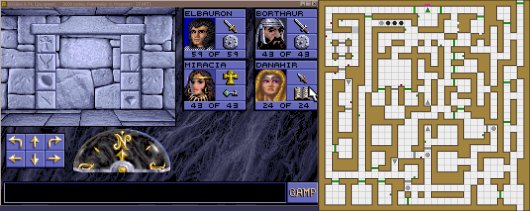
Like this
Anyways, I had fun this past week playing some of the old games, and I enjoyed being able to finally get EOB3 to work properly so I could port my party, and I wanted to share.