Let's Read - Action Movie Physics Core Rules

General questions, debates, and rants about RPGs

Moderator: Moderators

Post Reply
User avatar
deaddmwalking
King
Posts: 6064
Joined: Mon May 21, 2012 11:33 am

Let's Read - Action Movie Physics Core Rules

Post by deaddmwalking »

I was at the high volume used bookstore closest to me (now 90 minutes away instead of 10 - they closed their Knoxville location) looking at the RPG section and I saw this book:
Image


Flipping through it I saw there was a lot of white space and the attributes looked like a D&D clone, so nothing immediately jumped out at me as a reason to pick up a physical copy, but I always maintain a morbid curiosity to see what the state of play is with published TTRPGs, and after getting home I found a PDF copy for $15 online; I figured at that price it was at least worth the review.

John Watts is the sole author credit, with weapon descriptions by Erin Palette. There are five art credits for interior art with most of the pieces being provided by Bradley Warnes. There's an editor, and a cover designer (who also is the cover artist). That's Stephanie McAlea giving us this almost Jason Stratham looking MFer.


Image
My guess for the source of inspiration
About this Book
Welcome to Action Movie Physics!
Action Movie Physics is a game intended to allow you and your players to play in the world of an action
movie. The system used in this game will allow for action packed chases, harrowing combat scenes, and
the ability of your character to be heroic. Action movies are, by their very nature, action packed and full
of adventure and this game will provide that experience!

What you have in front of you is the core rulebook. This will give you the basics of how to run an Action
Movie Physics game. Here we will give you character generation, skills, cars, weapons, and much more in
order for you to run an Action Movie Physics game or to create a hero of your own to allow you to
become part of the action. All you will need is a pair of six-sided dice, a pair of ten-sided dice, a
character sheet, a pencil, these rules, and your imagination.

Action Movie Physics allows you to be the hero!
That's all that we get before we launch directly into character creation. I mean, we get the Table of Contents. It's 9 pages long and it pretends there's more to the book by listing everything exhaustively. Like instead of saying 'Specific Actions' on page 58, it also lists Special Attack, Targeted Blow, Knockout, Pin, Break, Throw and Stand as sections in their own right, also all on page 58.

There's nothing wrong with an RPG being short, but the over-exhaustive Table of Contents combined with the amount of white space makes it FEEL like it's trying to convince you that it's far more substantial than it actually is.

Immediately after the Table of Contents end, we dive in to Characteristics. While this is important information for building a character (which starts on page 35 and we talk about Characteristics AGAIN) this is a new system - it really ought to have some type of description of play, or overall explanation of they types of characters you would expect to see. It probably also should be EXPLICIT in talking about how you make an action game that features an ensemble cast. You can have a bad boy. You can maybe even have Bad Boys.


Image

But once you get past two characters, the number of action movies you can find drops pretty significantly. There are Adventure Plots starting on page 136 - and we'll evaluate them when we get there - but it's a real shame to see people following the format of the D&D Player's Handbook when they're introducing a new game in a single volume.


Image


Anyways, I hope you're ready to dive in with me, and we'll see if there's anything in here worth the visit!
-This space intentionally left blank
WalkTheDin0saur
1st Level
Posts: 49
Joined: Thu May 06, 2021 11:51 pm

Re: Let's Read - Action Movie Physics Core Rules

Post by WalkTheDin0saur »

Definitely interested in seeing where this goes!

Back when I was arguing about D&D on the internet, the idea of "The Action Movie Game" always seemed to come up. Because 80s action hero / buddy cop / superspy games seem like a natural thing for RPGs to try to do, but all the popular systems are bad at it. You can do tactical room clearing where you try to kill all the bad guys in the surprise round and feel cool yelling out abbreviated names of grenades and stuff, that works great. But as soon as you try to do a Mexican standoff or a car chase through downtown it becomes decidedly less cool.
User avatar
deaddmwalking
King
Posts: 6064
Joined: Mon May 21, 2012 11:33 am

Re: Let's Read - Action Movie Physics Core Rules

Post by deaddmwalking »

I'm with you!

I'm not bereft of hope with this system, but I'm going in with low expectations. In all RPGs, it's important that the people at the table share the same expectations. One of the advantages of fantasy is that people are very forgiving of violations of physics because 'magic'. Action games have to resolve the paradox of the gun to the head - it's both an automatic kill and a chance for a protagonist (or major antagonist) to escape from 'certain death'. It's like sneaking down a hallway with an alert guard looking right at you - mostly DMs think that all PCs will be spotted, and most PCs think that the guard will have to have a momentary lapse of attention. Point is, getting danger level right is not easy. I know that we have Hero and Villain Points, so there's hope. Let's see how they did.

Basics

Basics begins on page 11 (immediately after the Table of Contents) explaining that all characters have eight attributes (called Characteristics) that range from 2 (terrible) to 12 (amazing). It's possible to advance a characteristic to 15 for humans, but that will presumably be explained in 25 pages when we learn how to make characters. It takes more than a page to list out the characteristics and provide a one- to two-sentence definition without any game-relevant information. For example 'Endurance (END) shows the character's ability to stick with a physical task or test and continue to last despite fatigue and stress'. LOTS of White Space.

In fact, just so I can stop saying it, I'm going to show you what I mean:


Image


The whole book is like that, though it doesn't seem quite as bad when there are several longer paragraphs on a page. Immediately after Characteristics, we learn that Skills represent a character's ABILITIES. But even though we're on page 12 it tells us to look to page 13 for more on skills, because it needed to interrupt that description to let us know about REPUTATION and HERO AND VILLAIN POINTS.

Like the prior section, it just defines what Reputation is without any game mechanical information and lets us know that we'll ACTUALLY learn about it when we get to page 75. Hero (and Villain) points do mention that they can be used to directly modify die rolls, reduce damage, turn a fall into a survivable landing, and make impossible shots. HOW will be left to page 76.


Image
I guess they didn't spend their Hero Points


Skills

This is where I start crying real tears. Skills are a d100 roll under system. Personally, I don't like those kinds of systems. Like what's the difference, really between a 91% and a 92%? Mountaineering (one of the 36 skills detailed) isn't going to come up enough in your game where anyone can tell the difference with that level of granularity. But I'm getting ahead of myself. We haven't talked about how you determine whether you HAVE a 91% or a 92%. And that is a little convoluted.

First off, most skills have TWO relevant attributes. For example, Mountaineering is STRENGTH & ENDURANCE. Driving is DEXTERITY & PERCEPTION. A relatively small number of skills (12 of the 36) have a single attribute. If a skill has two attributes, you add up your relevant attributes and then divide by 2 (ie, you get half your STR and half your END to determine how good you are at Climbing). Now, you already know that normal attributes are between 2 and 12, and the rules specify that '7' is completely average. So if you have a STR 7 and END 7 and you add those up and divide by 2, you're at a 7 to start with Mountaineering. With a d100 roll under that would be VERY BAD, so there are additional steps.

It hasn't been explained how one gets skill ratings, but there is an example where someone is driving and they have a Skill of 4. In their example, DEX is 9, PERCEPTION is 6 (9+6=15, divided by 2 is 7.5, rounded up to 8) and Skill is 4, so they have a DRIVE of 12.

Now, 12 is also WAY TOO LOW a chance to succeed on a d100. So there's ANOTHER STEP!

The GM applies a difficulty factor. The easiest possible task gets a x10, while the most difficult task gets a x0.5. This is applied to your skill to determine what you roll under. So someone with a DRIVE of 12 needs to roll under 120 on a d100 to put the car in park, but making a high speed turn would be RELATIVELY DIFFICULT, so that gets a x4; the driver would need to roll under 48 to succeed.

An entire page is dedicated to providing a multiplication table for skill levels from 2 to 30 against a Difficulty Factor of .5 and 1-10.

But we still don't know how we get skill points (and technically we don't know what the skills are, but I've skipped ahead. But we have ANOTHER STEP!

A 100 is always a failure (so 1% of the time our Driver doesn't know how to put the car in Park, I guess), but beyond that, we care about SUCCESS QUALITY.

A Level 1 Success is the MOST SUCCESSFUL, and a Level 4 Success succeeded, but barely.

There's another full page chart, and it has 'success chances' that range from 1-10 to 281-290. So if we have a DRIVE chance of 48 like in our example we look at the '41-50' chart. If we roll a 1-5 on our d100, it is a Superb (level 1) success. If we roll a 6-10, it's a level 2 success; if we roll a 11-25 it's a level 3 success, and if we roll a 26-48 it's a level 4. Now, why should you CARE what level of success you have?

That is an excellent question, and there's a PARTIAL ANSWER.

You see, if you get a Level 1 success, the GM should give you a positive bonus as a result of your awesomeness. Outside of that, the point is to help the GM narrate the action - if it's level 4 you 'barely avoid a crash'. What's the difference between a 2 or 3 success? I guess how much you grit your teeth as you make the turn? I may be being a little unfair - some skills do care what your success level is because of how they work. For example, if you use Cryptography, the more successful you are the harder it is to decrypt.

I still don't know how you get skill points, but if you haven't applied skill points to a skill, you take a -3 penalty on it. So if you hadn't learned to drive but you had an average of 8 for your DEX/PER, you'd have a base 5% chance. You're 50% likely to be able to put a car into parked, and a 2.5% chance of doing whatever the most difficult thing you can do in a car (probably parallel park while your parents are watching you).


Image
Or this!


The 36 skills are: Administration, Boating, Carouse, Computers, Cryptography, Demolitions, Disguise, Diving, Draw, Driving, Evasion, Fire Combat, Flying, Forgery, Gambling, Hand to Hand Combat, Interrogation, Intrusion, Investigate, Language, Local Customs, Mechanic, Medic, Mountaineering, Parachuting, Persuade, Pickpocket, Recon, Remote Operations, Riding, Science, Sixth Sense, Stealth, Streetwise, Survival, Swimming

I bolded the ones that are combat skills.

The next 17 pages have descriptions of the skills. Some of these are a single sentence like Administration: Administration is the art of dealing with bureaucracies, filing the correct paperwork, and navigating the obstacles, disasters, and politics of the office.. Some, like Gambling, have multiple additional sections explaining how Baccarat, Blackjack, and Poker work using multiple rounds of d100% roll under.

The skill descriptions aren't particularly interesting, but it's important to note that 'success quality' sometimes matters. For example, if you have a Level 1 Quality Disguise Check, people have a -5 on the Difficulty Factor to see through your disguise. If you fail your disguise check, they have a +2.

What it doesn't explain is whether disguising yourself as an electrician is 'easy' or 'hard'. And if someone is trying to see through your disguise, even if I know they have a base chance of '10', that could be anywhere from a 5% to a 100% of success, depending on how hard the GM thinks it should be. When I say there are NO GUIDELINES, I mean, there are NO GUIDELINES.

With 4 levels of success (1-4) and 11 levels of Difficulty (0.5-10) there's no way to map something simple like 'a level 1 success requires a 'most difficult (0.5) PERCEPTION success' and a level 2 success requires a 'difficult (4) PERCEPTION success'. There are lots of games where TNs are a GM asspull, so this isn't exactly surprising.

Some skills are more grounded, but not necessarily a LOT more grounded.

Carouse (one of their two versions of Diplomacy; the other is Persuade) uses CHARISMA as the only attribute, so if you have a CHARISMA of 12 and a skill of 4, you should have a BASE CHANCE of 16. But it isn't. Because 12 is such a high CHARISMA, you get another +1, so your Base Chance is 17. And if your CHARISMA is 13, you would expect that your BASE CHANCE increases to 18. Except that 'unusually high charisma' grants another +1 bonus, so now your chance is 19. Once again, there are Difficult Factor Modifiers ranging from +2 to -6, but nothing to indicate HOW DIFFICULT a particular interaction should be. Is convincing Pussy Galore to betray Goldfinger easy (x10 to my Base Chance) or Near Impossible (x0.5)?


Image
I'm not sure I believe her


Cryptography is one skill that explains how to use Difficulty. When you ENCRYPT a message, you decide how difficult you want to make it to DECRYPT. If you make it a Difficulty Factor 4, you need to succeed at 'Quality Level 3' at your Cryptography. If you have a Base Skill of 15 for Cryptography, than you would be rolling against a 60 for success, but because you need a level 3 success you're actually rolling against a 30%. If you succeed, the person decrypting it just has to have a normal success. That seems weird to me - encrypting something is harder than decrypting it. If the person fails, they can try again, but instead of at Success Level 4, they have to try at Success Level 3. They can keep trying until the Success level is 0.5.

So if you successfully encrypt something (30%) and your clone tries to decrypt it, they have a 60% the first time, a 45% the second time, a 30% the third time, a 15% the fourth time, and a 7.5% (8%) the fifth and final time. Put another way, they have a .40 x .55 x .70 x .85 x .92 chance of failing, or 12%. That's a whopping 88% chance of success.

Let me know if you want me to talk about any specific skills, otherwise we'll stop here and tackle Character Creation (page 35) where hopefully I'll learn how to acquire skill ranks.
-This space intentionally left blank
User avatar
deaddmwalking
King
Posts: 6064
Joined: Mon May 21, 2012 11:33 am

Re: Let's Read - Action Movie Physics Core Rules

Post by deaddmwalking »

Character Creation

The character creation system claims that it combines two methods of character generation; (1) a path-based random youth (hopefully one that does not include the possibility of death and (2) a point-based advancement system representing 'adult learning'. Although it does not acknowledge it as a third method, you also roll your starting attributes. The book suggests that the GM determine a starting nationality. At this point, there is nothing to suggest you could ever hope to play a T-800 or a Robocop - you're probably choosing between John McClane (Die Hard) or John Smith (Last Man Standing).


Image
I'm being unfair. You could also aim for John Wick (John Wick), maybe


To generate your attributes, you roll 3d6, drop the lowest 8x, applying the attributes however you like. That shifts the average from 7 to 9 and gives you pretty close to having at least one 12. The example character gets an 11, 11, 10, 10, 9, 8, 7, 7. Randomly in this section it says that the default difficulty factor for a Characteristic Check is '5' (ie, you need to roll less than 5x your attribute on d100 to succeed).

I'm not the biggest fan of randomly generated attributes. I'm even less a fan of randomly generated backstory. You're allowed to just pick what happens to you, or you can roll. Rolling uses 2d6, but rather than adding them you look at each number so a '1' and a '3' is read as '13' and a '5' and a '2' is read as '52'. If you roll a 13 'you are abused and beaten by a member of your extended family (aunt, uncle, cousin, grandparent, etc). The abuse is so severe that the authorities are called in and the abuser is imprisoned. Gain an Enemy'. 52 is 'during your free time, you delve deeply into subjects more advanced than most children would attempt. Gain a level in Science.'

Hard to pass up getting a free +1 to one of your attributes, but if you prefer having been abused, I guess you can roll randomly.

Most of the random options apply to a single combination of die rolls; with 2d6 there are 36 permutations. Maybe that was too many to write, so 6 of those 36 are 'nothing interesting happens' and 6 are 'something interesting happens, so roll on a different table'.

The 'events' table is a 1d6. If you roll a 1 you get a physical trauma and get to skip to page 45. There you get to roll another d6. On a roll of 1 you are 'NEARLY killed'. You get to reduce one physical characteristic by 1d6 and two other physical characteristics by 2 each.


Image


You get to roll twice on the youth table. Then you get to do the same thing on the 'teenage table'. There's no 'nothing happens' option, but there is a 'roll on the events table' that covers 6 of the 36 possibilities. Once again you have things like 'your parents die and you lose 1d6 Education' against options like 'your parents make you exercise, get +1 to an attribute of your choice'.
Even beyond some being bad and some being good, they're not even balanced if they do the same thing.

If you roll 6,4 (64) you get a +1 to Charisma. If you roll a 5,5 (55) you were part of a band and get a +2 to an attribute of your choice (including Charisma. You then roll to see how popular the band was, and if you roll a 6, you get ANOTHER +2 to Charisma and +20 to your reputation. Getting a +4 CHR and +20 REP sounds better than getting +1 Charisma.


Image
If you don't roll a 6, you could have a bad experience.


The Teenage events table is the same as the Youth table, so you could have a childhood illness or physical trauma like 4 times before you go to College. IF you go to college. You have to succeed on an Intelligence Characteristic check to be accepted. If you're not accepted to college, you skip this step and start picking skills. Even if you go to college, you can fail. I don't want to read too much into the author's experience here, but it seems a little harsh.

Let's say you have the maximum starting Intelligence of 12. To succeed at a Difficulty Factor 5 check, you have to roll under 60. So you have a 40% chance of NOT being accepted to a college if you're MENSA qualified. If you do go to college, you need to succeed at another check to graduate (with a 'level 1 success' equating to graduating with honors). If you have a 10, you're basically looking at a coinflip to get in to college followed by a coinflip to graduate - so 25% chance.



Image
Maybe we switched film genres and I didn't notice


You could repeat your band experience, I guess. Maybe launch your solo career. Pick up another +4 to CHR and +20 Reputation. (Obviously since you're capped at 12 for starting Charisma, you actually put the first +2 somewhere else, but point remains, being in a band is WAY BETTER than being abused by a relative).

After we've rolled (or chosen) our background, we get to start choosing skills. Deep sigh.

So you know how NOBODY likes Skill Accounting in 3.x? Well, this is like that, but probably worse.

You get 200 points to buy skills. Buying a skill at all costs 10 points. When you buy a skill, you get Skill Rank 1. If you want to improve a skill, it costs 5 points per level. I assume that means that raising it to 2 costs 10 more points (level 2 x 5), but maybe they mean that raising it to 2 costs 5 more points, so you could raise it to level 3 for 10 points (total of 20 points spent).

But there's another restriction.

Let's say a skill requires two different attributes, and one attribute is a 4 and one attribute is a 12. To determine your success you average those two (so you get a +8 for attributes on your skill check). But the HIGHER attribute caps your max Skill Ranks - you can only have a Skill rank 2 higher than your HIGHEST related attribute.

I'm guessing that buying the skill initially is 10 points, and then it is 5 points each time you raise it; so if I want a +10 skill it'll cost me 55 building points.

You'll notice that there is only two costs - 10 points and 5 points. You'll also notice that you could divide everything by 5 and the math would work out the same. It drives me FUCKING CRAZY when books do stupid shit like that.

Anyways, you can start as an older character if you like. If you do, you get more building points. Each age increase that takes you past age 30 requires you to make an Endurance check or take aging penalties. Every additional age increase ups the difficulty factor.

That's about it for the SELECTION of abilities. Following that you DERIVE ATTIBUTES.

This includes your carrying capacity. If you have a 12 (human maximum) you can carry 210 pounds for a number of minutes equal to your Endurance. If you carry it more more than that, you become exhausted.
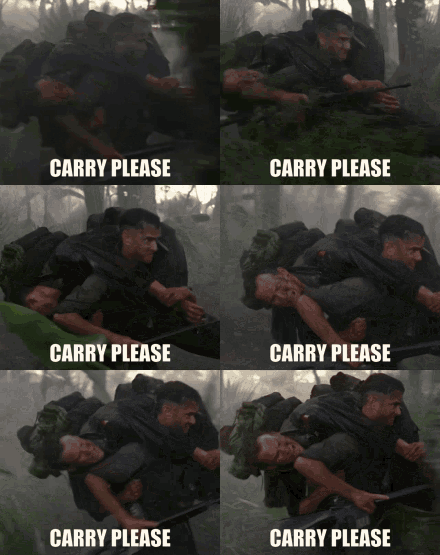


Image
It doesn't look like this game can handle Forrest Gump, action hero


Running/Swimming has a maximum amount of time based on your Endurance. If you have an Endurance of 12 (human maximum) you can run (or swim) at your fastest speed for 30 minutes. This section doesn't tell me what your fastest speed is, or how we figure that out, or how to put it into game terms (maybe later), but I know that people who win marathons maintain a speed of around 13mph for around 2 hours. Usain Bolt runs his 100 meters at about 23 mph with a peak speed of about 27 mph. I guess if he has an Endurance of 15 he could run that speed for 1 hour, so he could run an entire marathon... I'm going to flag this as a potential problem - these numbers should allow for 'real world humans' and possibly beyond - action heroes often seem to do things that we mere mortals couldn't hope to do!

On page 49 it tells me that Speed is based on your Perception + Dexterity. Turns out if you have the natural aptitude to drive, you also have the natural aptitude to get there fast on foot... If you have a 12 in both, you get a speed of '3'. If you have an average 7 in each attribute, you get a speed of 1. It looks like this is Initiative, and really doesn't plug in to how long you can run to figure out how far you can get. Now, maybe that shouldn't matter, because eventually we'll get to mechanics for 'chase scenes', so maybe knowing that Usain Bolt is fast isn't that important, anyway. But I am not impressed...

There's a similar chart that gives you a Damage Rank for unarmed fighting of A (the worst) to C (the best). Gotta say that I don't like it when '1' is the 'best' and 'A' is the 'worst'. Maybe someone just doesn't like letters.


Image
F is for F*ck


There's a similar formula for Stamina - if you have superhuman Endurance and Willpower, you can stay up for 36 hours without becoming exhausted. Gotta say, there are some real-world examples of people in historical war situations that suggest those numbers are...restrictive.

Okay, now we're on page 50, having learned about all the things we need to do, and the book gives us 'Character Generation Sequence'. We've already done the first 12 steps (except for step 1, choosing a NAME in addition to our country of origin). The two steps that we haven't done yet (because this is the first we're hearing about them) is to give ourselves 3 Hero Points and 'Begin the Game'.

I should stop here, but the next section Experience is only 1 page long, and that's followed by Combat.

If you complete an adventure you get 500 XP. If the GM thinks you roleplayed well, you get +500XP. If you failed your mission you lose 375 XP (so definitely roleplay well when things go south). If you succeeded on your mission you get another +500XP. So good mission, success, good RP is 1500 XP. Good session, failure, good RP is maybe 675 XP.

But, you ask, why do I care about XP at all?

So XP buys new skills. It costs 100 XP to buy a skill you don't have. That actually gives you Skill Rank 0. And you would think that if you didn't have a skill, you had Skill Rank 0 (and were subject to a -3 penalty when using the skill), because that's what the book told you like 30 pages ago. I GUESS that the difference is that you're still a Skill Rank 0, but you're not UNSKILLED, so you don't use the -3 anymore (but you don't get a SKILL BONUS). That seems needlessly confusing, especially since +1 is between +0.5% and +10% depending on how difficult the challenge is. But I guess we don't want to be UNREALISTIC that someone might shoot 5% better on average after they spend some time developing that skill....

Raising a skill costs the raise x30. This time it is explicitly the new value. So raising a skill from 5 to 6 costs 6 x 30 XP (180 XP total). Next session (but not this session) she could raise it to 7 by spending 7 x 30 = 210 XP. Again, not sure that I see any real reason that someone might not be able to get 20% better at driving, but that 10% is totally okay.

Raising a Characteristic is the new level x 150 (ie, raising a 10 to an 11 costs 1650 XP).


Image
I plan to cry myself to sleep tonight


Well, that's a lot, and I gotta say, I'm disheartened by some of these choices. Like, I'm not going to go out and watch the Fast and Furious franchise to see how quickly someone they bring into the 'family' goes from Driver's Ed to Tokyo Drift, but my gut says that probably people in these movies advance pretty quickly. Like, even The Naked Gun has faster advancement with decent instruction!


Image

I guess they're just not into that kind of action movie (to be fair, it's not on their list of Action Movies that inspire them). So let me be explicit - getting a +1 to a skill (say going from a 12 to a 13) means going up 5% on 'average Difficulty' - instead of rolling less than a 60 on d100%, you have to roll under a 65 on a d100%.

Even more damning, however, is that Action Heroes SUCCEED on difficult tasks, like, A LOT.

Player Characters are going to do many, many, things. If you have a 95% chance of success (practically guaranteed!) you're going to still fail about 1 in 20 times. If the cost of failure is DEATH, that's not actually good for a game. We like characters that are at least COMPETENT - but we expect our PCs to fail as often as they succeed? I understand that we need UNCERTAINTY to keep the emerging story engaging - there's no point in advancing to a foregone conclusion - but players want to be 'awesome action hero' like 'John Wick' and then we're demanding that they crash their car every week. Like, WT actual F?

Okay, enough for now. Let's tackle combat next time!

-This space intentionally left blank
User avatar
deaddmwalking
King
Posts: 6064
Joined: Mon May 21, 2012 11:33 am

Re: Let's Read - Action Movie Physics Core Rules

Post by deaddmwalking »

Combat

Image
The chapter tells us that fights are deadly, and that the only reason Action Heroes survive is that they use Action Points. A combat round is 5 seconds and has two phases: Declaration then Action.

PCs declare actions from the slowest to the fastest. NPCs don't declare actions (unless they're working with the PCs). After everyone declares, the GM resolves actions from the fastest to the slowest. But if your action becomes useless (like your target is dead) you can choose a different action. Except if the GM thinks it would be funny that you can't. I kid you not.
Characters must now perform the action which were declared in the Declaration Phase unless something
about the situation has changed to make this impossible or unneeded. For instance, if the character had
been going to shoot a member of the opposition who is now dead, the character may change their
declared action. If a character had intended to hide behind a car which has now left the area, the
character may choose to change their declared action. In the end, the Gamemaster is the ultimate arbiter
as to what happens in a situation like this. For instance, in regard to hiding behind the car, the
Gamemaster may choose to force the character to go to where the car once was and they may find that
they are now exposed to enemy fire or force the player to spend a number of Hero Points to have the car
stall and still provide cover for the character.
Sometimes, it's better to STOP TALKING.

After talking about phases, we move immediately into the types of combat actions you might take. If you don't already have a gun in hand, you cold draw one. If you fail, your opponent gets a much easier shot at you. Movement is 10x your speed in feet. That finally lets me figure out 'running'.

If your speed is 3 (the fastest) then you can move 30 feet in 5 seconds or 360 feet per minute. That's 21,600 feet per hour, or about 4 miles per hour... A brisk walk, but well short of a jog. Maybe there's something still missing to determine how actual 'running' works (and it could be in Chases).

If you choose Defensive movement, you only move half as far, and you're supposed to be harder to hit, but it doesn't actually say what difference it makes.


Image

The next section is combat damage. It's helpful to skip ahead and look at the weapon table so this makes sense. Weapons have a Damage Rating from A (the weakest) to L (the strongest). A Rocket-Propelled-Grenade (RPG) has a value of L while a Beretta 82 is an F.

When you hit someone, you determine how well you hit (Level 1 [the best] or Level 4 [barely]). If you score a Level 1 hit with a Beretta, the opponent is incapacitated. If you score a Level 4 hit they get a Light Wound. The RPG deals a Heavy Wound with a level 4 hit, and kills with a level 1 or level 2 hit.

What if you've already got a wound?

Then there's ANOTHER lookup table. If you had a Light Wound and get another Light Wound (Light + Light), that's a Medium. If you had a Medium Wound and got another Medium wound, you'd be Incapacitated.

Hero points reduce a wound level by 1 severity.

The lowest level of wound is 'stun', followed by light, medium, heavy, incapacitated, and finally killed.

If you are stunned by hand-to-hand, you make an Endurance check or fall unconscious for 5-30 seconds. If you are stunned by arms fire, you make a Will check or you take no actions until you succeed on your check.

Heavier wounds also require a check every round to take actions. If you fail you fall unconscious. The more wounded you are the lower the Difficulty Factor (meaning the more difficult the check). There isn't a consistent pattern with the DF. Stun is DF8, Light wound is DF 7, then the DF moves by 2 (5, 3).

Explosions deal damage by how close you are. If you are 40 feet from the biggest explosion (L) you are safe.


Image

Cover reduces the severity of a wound. Ie, if you had a heavy wound, but you were behind a car, you would reduce that 2 steps to a light wound. Body armor works the same way (with more information on page 110).

So how many times can you attack?

Well, if you're using a hand-to-hand weapon, you can attack a number of times per round equal to your speed (0-3). Attacking zero times actually means you get to attack once every other round. Welcome back to fractional attack speeds!

Hitting with a hand-to-hand weapon is a skill check against Difficulty Factor 5, modified by the opponent's speed. For the fastest opponents, you would make the attack at Difficult Factor 2.

There are a list of hand-to-hand maneuvers you can try. Like Knockout Blow - you make an attack at -4 DF and if you succeed the opponent makes an Endurance check at double your success rate (ie, DF 2 if you scored a Level 1 success, or DF 4 if you scored a Level 2 success).

With thrown weapons, they have a 'off target' for grenades and such. Since the game only uses d6s and d10s, the chart uses a d10. I would recommend using a d12 or a directional die if you have one, but there's a handy chart to help you understand what direction '3' or '9' is if you insist on using a d10.

Firing a weapon is default a DF 5 action. If your opponent is in closer range, you get a bonus to the DF (making the shot easier).

For semi-automatic weapons, when you fire more shots you take a DF penalty to each shot.

So there's a lot of charts and table lookups and potentially going back and forth on Difficult Factor adjustments, and then multiplying your skill rank, then determining how successful you were, and with a Tommy Gun on burst fire (10 shots) this seems pretty complicated.


Image

If you heal outside of a hospital, it's one wound level per week. In a hospital you can reduce a wound one level every 3 days. Wounds can leave scars, and scars can increase your Reputation. Which might even be a good thing. That is, if you didn't win at life by being part of a successful band when you were young.

Feel free to ask detailed questions, but otherwise we'll hit Chases next. Before I go, I'll touch on something else.

I watched a YouTube video from The Verve RPG about how many weapons your game needs. The guy is basically making a video journal of design decisions. One of the questions he asks is whether or not you really need MECHANICAL differentiation between different weapons. One of the points he makes is that 'crunch rules' are more important in games with low trust - if the players are fine with the GM riffing on whatever they want and making up the game as they see fit, nobody really needs a ruleset at all. If you're okay with the GM deciding whether your shot hits or didn't, and what the consequences of your declarations are, you don't NEED a resolution system.

In that sense, this system - at least so far - is basically a framework for the GM to decide if '14' is a hit. Essentially you take the character skill, multiply it by 5 and that's the base chance. You can reduce it up or down , then decide if the 'success' was really impressive or not. Mechanically, the system hangs together...

But it doesn't seem to me to produce genre-appropriate results. Or at least, not across the wide variety of action movies.
-This space intentionally left blank
User avatar
deaddmwalking
King
Posts: 6064
Joined: Mon May 21, 2012 11:33 am

Re: Let's Read - Action Movie Physics Core Rules

Post by deaddmwalking »

Chases

Chases involve making skill checks; the specific skill is determined by the type of chase. If you're in a boat, you use Boating. If you're running through the streets of Cairo, you probably use 'Evasion'.

A chase involves two sides, and one side controls the action. To decide who controls the action, each side bids up the difficulty, the one who accepts the most difficulty then determines who goes first. A skill check is made, and, if successful, there is a shooting phase; then the second party goes, and if they succeed on their check, there is another shooting phase.

The skill check is made for a specific maneuver, chosen from a list. Maneuvers include: 180 degree turn; fast turn; follow/escape; ram; and stunt. The GM can add obstacles - their difficulty is fixed and unrelated to the bidding. Failure (or pushing a vehicle beyond its factory specifications) may result in an accident. The initial move difficulty is determined by bidding; the check to avoid an accident is determined solely by the maneuver chosen.

For example, if you choose to make a 180 degree turn, the difficulty of the check is determined by your bid. If you fail, you must succeed on a DF 4 check (drive, boat) to avoid an accident.


Image
Failed Stunt check followed by failed control check, I guess


A vehicle takes damage, based on a lookup table. I originally thought the values on the table corresponded to weapon charts, but they are new abbreviations for the wound levels (Light, Medium, Heavy, Incapacitated, Killed).

The most obvious issue with the chase rules are that you don't really have an incentive NOT to bid up the chase to the most difficult setting, then make your opponent go first. If they fail, you can pretty much cause the chase to end.

So Success Quality comes up again. Remember, that's how 'good' your check was relative to the check you needed to succeed. And it goes in groups of 10, so if you need under a 281-290 a great result is 1-29. If you need to get a 51-60 to succeed, a good result is 10% of the top end (1-6). So let's look at 91-100 in more detail.

A Level 1 Success is 1-10 (10 numbers). A Level 2 success is 11-20 (10 numbers). A Level 3 Success is 21-50 (30 numbers) and a Level 4 Success is everything else (51-Success Chance up to 99, because 100 is always a failure)

Now, I am not a fan of table lookups. Having a formula that's easy to remember and logical really helps. It's nice to know that you can look it up, but figuring out with mental math really should be the goal. Toward that end I would suggest that a Level 1 success gets 10% of the successes; Level 2 gets 20% of the successes, Level 3 gets 30% of the successes, and Level 4 gets the remaining 40% of the successes. To make the math easy, we'll continue 'rounding up' to the nearest 10.

So let's say I need a 58 to succeed. We treat that as a 60. 10% of 60 is 6. A 1-6 is a Level 1 Success (6 numbers). A 6-18 is a Level 2 success (12 numbers), a 18-36 is a Level 3 success (18 numbers), and a 18-58 is a Level 1 success (24 numbers minus the 2 that are failures because I only have a 58).

For a 100, that would be 1-10; 11-30; 31-60; and 61-99, replacing 1-10; 11-20; 21-50; 51-99. I find those numbers significantly more aesthetically pleasing. Of course, then I'm making the mistake of believing that d100 roll under makes any sense at all. *Slaps myself out of it*

I'm not sure that I think the 'you attempt a maneuver, then your opponent attempts a maneuver' is the best way to run a chase. Since this system includes 'quality of success', it seems that having simultaneous resolution of specific obstacles (potentially randomly generated) with quality of success determining a bonus on what happens next (either changing relative distance, or providing a bonus on actions). Allowing relative success to enable someone to directly impact the chase sounds more dynamic and interesting to me.
-This space intentionally left blank
User avatar
deaddmwalking
King
Posts: 6064
Joined: Mon May 21, 2012 11:33 am

Re: Let's Read - Action Movie Physics Core Rules

Post by deaddmwalking »

Reputation

Being recognized is bad if you're trying to hide your identity, and good if you're trying to intimidate people based on your reputation.

If you have a Reputation less than 50, you cannot be recognized, but with a 'superb' Perception at Difficulty 5 you might think they look familiar. If you are recognizing someone with a Reputation of 151 or more, you need a Level 1, 2, or 3 Success; you still don't recognize them on a Level 4 success (but they may seem familiar). Turns out that success isn't always a success. That is a....choice...that designers can make.

You get 3 Reputation for completing a mission, or 100 for going on TV. If you would like to be noticed I guess you have to self-promote.


Hero Points

Characters start with 3; you can get an unlimited number, and you can spend as many as you want (or have) at once. Each 'superb [level 1] result' you roll gets you another one, as does the GM thinking you're awesome. You should get 1-3 for each adventure.

Each Hero Point changes the level of success by 1 step. Ie, you can change a Failure to a Level 4 success by spending 1 Hero Point. If you spend 2 Hero points, you'll bump that to a Level 3 success. If you roll a natural 100, you can't spend Hero Points.

You can also spend Hero Points to reduce a Wound level by a 1 step of severity. Reducing an Incapacitating Wound to a Heavy would would cost 1 Hero point, or 5 points to avoid the wound entirely. PCs can spend their Hero Points for other PCs, but not for NPCs. I'm not sure that I'm a fan of that - people may feel an incentive to spend their Hero Points recklessly, counting on their companions to pitch in when they're out. That potentially allows for someone to steal the spotlight.

Hero Points can also be used to add something helpful to the narrative.


Image
This is the art style used throughout the book.


Next up is NPC interactions.
-This space intentionally left blank
User avatar
deaddmwalking
King
Posts: 6064
Joined: Mon May 21, 2012 11:33 am

Re: Let's Read - Action Movie Physics Core Rules

Post by deaddmwalking »

NPCs

Okay, first off, I thought I might have made a mistake in my prior reading, and was getting ready to do an explanation/retraction. Then I read more and I don't think I need to.

You see, lots of things in this game are handled by skill checks. And you take your Attribute + Skill and multiply that based on the Difficulty of the task. The 'default' difficulty is '5', so you multiply your ability and then that's the Target Number you need to roll under. If your Skill Bonus is 15 (Attribute + Skill) you would need to roll under a 75. Easy peasy.

Now, sometimes it's harder. You can move the Difficulty Factor from a 5 to a 4. Now, instead of multiplying your ability by 5 you use a 4. Now you have a 60 for the TN so you effectively lose 15% of your success rate.

Other times you apply a modifier to your Skill level. Interacting with PCs is one such case. If you meet with a member of the Opposition, you get a -6 on your CHR check rather than the Difficulty. So if you have a 15, that becomes a modified 9, and now you have a 45% chance success (9x5).

I don't know that one is inherently better than the other. I don't even know that you shouldn't use both. But it does seem like there should be some more explanation about when it is appropriate to modify Difficulty Classes, and when it is appropriate to apply modifiers directly to your Skill. An attribute check (as opposed to a Skill check) is always supposed to be at Difficulty Factor 5, so maybe that's my answer.

In any case, this is another place where 'Quality' matters. If the GM doesn't decide on a starting attitude, you make a Charisma check. A Quality 1 success makes the NPC Helpful, a Quality 2 success makes them Friendly; a Quality 3 success makes them neutral, a Quality 4 success makes them Unfriendly, and a failure makes them Oppose you.

So if you have the Maximum Starting Charisma (12) your TN is usually 60. Using Success Quality that means you have a 6% chance of making them Helpful; a 6% chance of making them Friendly; an 18% of Neutral, and a 30% of making them Neutral, with the other 40% of the time making them Oppose you. That seems...harsh.


Image
Hi! I'm an unsupported character concept!


There's some description of types of NPCs, and then a bunch of tables for randomly determining NPCs based on role. For example, 1d10+1d10 on the can give you an Average Citizen with 7s and 8s for attributes and Driving, Flying, and Carouse as skills (3,2,2). That same roll could give you a Goon with all 7s and 7s for attributes and Fire Combat 6, Hand to Hand Combat 6, Driving 5, Evasion 3, Stealth 2.

Once again I am wishing for something to explain to me what we think a starting character IS. Are we John McClane in Die Hard, or are we Winston, his cop friend?

So let's look at that Average Goon if we were creating them using the Character Creation Rules.

The Goon has 5 skills; each skill costs 10 Creation Points to get to Level 1 (50 Points). Raising a skill is 5 points per level. I believe that means 10 points to raise it to level 2, 15 points to raise to level 3, 20 points to raise to level 4, etc. Assuming we go with that those 6 skills cost 10+15+20+25+30 or 100 points each. Driving is only 70 points; Evasion 45 and Stealth 25. That's 340 points added to the 50 to get the initial skill, we're 390 points - basically twice as many as a starting character.

Villain's Main Henchmen have 55 skill ranks (from 7-11) with better stats, to boot. Gotta say, putting point totals for the NPCs suggested would go a long way for helping PCs understand where they fit in the world. I may have to spend some time looking for discussions on character building - maybe I'm misunderstanding the costs at character creation... Even then, it still seems that pegging certain characters to Point Ranges would be helpful for managing expectations.
-This space intentionally left blank
User avatar
deaddmwalking
King
Posts: 6064
Joined: Mon May 21, 2012 11:33 am

Re: Let's Read - Action Movie Physics Core Rules

Post by deaddmwalking »

Equipment

This is actually probably the most important chapter so far. I mean, theoretically we understand that you need to make a skill check to shoot someone in the face, and that based on the weapon it will do some amount of damage. But this gives us the cold, hard numbers to start figuring out whether you're a danger to yourself or others.

The first characteristic that matters is Performance Modifier. This tells you whether a gun is EASIER or HARDER to use. This basically ranges from -1 to +2. A negative number makes it harder to use (2 steps toward 1/2 skill), but I gotta say that the choices seem haphazard. Like, I can see how a Desert Eagle gets a -1 compared to a Beretta Model 92, but is a Sidewinder Missile really easier to use at +2?

We also care about Rate of Fire; how many shots you get per round. Semi-Automatic weapons get two rates of fire; single-shot or burst fire.

For handguns, you get options that fire 2 or 3 times per round. I think the question is whether having 3 shots at level G is better than 2 shots at Level I. Remember that Quality of Success determines damage; so a G can Incapacitate on a Quality 1 or 2 hit; cause a Medium Wound on a Quality 3 hit, or a Light wound on a Quality 4 hit. 3 light hits equals a heavy wound.

A gun that shoots at damage I has kill, kill, incapacitate, or light. I think taking the 3 shots makes the most sense in the most cases, but with body armor and such maybe it's better to bump the damage category. In any case, it's a solvable equation pretty quickly. I may even do it at the end of my review.

Page 91 lists all the weapons, starting on page 92 and through page 96 we have 4 pages of weapon descriptions - remember that gets a separate authorial credit. Here's one:
Most people think that RPG stands for “Rocket Propelled Grenade”, and while that’s exactly what the RPG-7 is, the nomenclature is actually Russian for Ruchnoy Protivotankoviy Granatomyot (“handheld anti-tank grenade launcher” in English). Both are correct; the RPG-7 is a reusable launcher that fires an unguided rocket with a warhead that will blow up anything that isn’t a tank and will really ruin a tank’s day with a good hit. For the safety of the operator, the warhead doesn’t arm until a minimum distance of 30 feet is reached, and if it doesn’t hit its target it automatically explodes at a distance of 3,000 feet. It comes standard with iron sights, although optics can be mounted. Backblast zone is a 60 ft cone. Those caught in the blast should take a Medium Wound.
The next section is a similar table for vehicles, including the Kia Sorento to a Bugatti Chiron (list price $2.6 million).


Image
I don't think they have this one but you can probably use Fiat 500 stats


There are a lot of Vehicle illustrations so we're on page 105 when we're done with those. Then we go back to weapons and have Grenades followed by special ammo.

Next time we look at Body Armor.
-This space intentionally left blank
User avatar
deaddmwalking
King
Posts: 6064
Joined: Mon May 21, 2012 11:33 am

Re: Let's Read - Action Movie Physics Core Rules

Post by deaddmwalking »

So Equipment jumps around from place to place. We're looking at Body Armor, but that's immediately followed by explosives like C4.

In general, Body Armor reduces damage by a certain number of steps. Level 3 Body Armor (military grade) reduces firearm and shrapnel damage by 4 steps. If you're in an armored car, that armor stacks, so you might be able to reduce the damage 6 steps. It doesn't say your armor is ruined, or anything. So let's say you wear this armor all the time - Killed is reduced to Incapacitated which is reduced to Heavy, which is reduced to Medium and Medium is reduced to Light. Since most weapons don't kill without an extraordinary success (and many not even then) you might be able to take these to stun or nothing!

After explosives we have Holsters and Sights - I'm all for fun ways to modify your gear. Then we have Speedloaders and Suppressors, then Vehicle Modifications. You could add armor, auto-pilot, a bullet-proof screen, drones, an ejector seat, gun ports, a heads-up display, a law enforcement package, a performance modification, and structural reinforcement to your Fiat 500, if you want.


Image
You of all people should know that I am not


That finishes up the Equipment section. Next up - hazards - dangerous things that you might walk into or have splashed on your face as you adventure!
-This space intentionally left blank
User avatar
deaddmwalking
King
Posts: 6064
Joined: Mon May 21, 2012 11:33 am

Re: Let's Read - Action Movie Physics Core Rules

Post by deaddmwalking »

Hazards

Gotta say, the formatting of this book leaves much to be desired. Hazards include Acid, Catching Fire, Disease, Poisons, Radiation Exposure, Starvation and Dehydration, Suffocation, and Weather. The only one that has any sub-categories is Poison, but you can't really tell, since they use the same headers as everything else.

Let's take them one by one.

Unlike D&D acid, exposure is mostly a one and done thing (good), except when you're near a vat of acid, in which case you take damage every other round. This is a great sin and a bad decision - tracking things is hard, and if something isn't every round it's an extra pain in the butt. You're already making an Endurance check to avoid the damage, so surely by making the Difficulty Factor easier you can average the same amount of damage if you even care. I mean, why does 5 seconds of exposure mean nothing but 10 does? And why no variance in how dangerous an Acid is? It's one-size fits all, so be careful adding Citric Acid to your 'fruit drink'.

If you're on fire, you make a Dex check every round to avoid taking a Light Wound. Since a light wound + a light wound is a medium wound, you can die quickly. That mostly works.

Technically there are 4 sub-diseases, but they're in a table, so they don't get their own paragraphs and they're easy to read. Diseass require an Endurance check to resist with a variable Difficulty Factor based on how bad they are; they deal a Characteristic Reduction (or two). You continue to make saves but don't take additional damage - just once you finally pass the save you start recovering. If the disease doesn't take you to 0 immediately, I guess you're safe.

Black Widow poison can kill you if you fail a save. It can kill you if you make your save, but only get a Quality 4 success. It can even kill you if you get a Quality 3 success. You need a Quality 2 or better success to avoid death. That's better than cyanide, which just kills you, no check. Unless you take an antidote, in which case you survive if you make a DF 3 Strength check. Why Strength? I don't know - that doesn't make sense to me, but I'm not an expert on poison.

Hemotoxins are like black widow poison in that you will die if you succeed with only a Quality 3 or 4 check.

Radiation is bad in that you always have to track any radiation exposure you've had. Radiation effectively reduces your Endurance. The text is contradictory in that it says your radiation level can go down, but it doesn't say how.

Not drinking requires a check every hour after 24-48 hours, with the difficulty increasing. Each failure results in a light wound, until you accumulate enough that you die.

Starvation works on a longer timeframe - 3 days then a check every day.

Suffocation is an automatic light wound per minute until death.

All weather (apparently) gives you a -1 Difficulty Factor to skills affected by the weather.


Image
-1 DF


That picture above is also foreshadowing - next us is Animal Encounters. We only have 20 pages left and that apparently covers 9 of them. Then we get 3 pages of adventure plots, and a list of movies 3 pages long and that's it. I'm not sure how Animal Encounters justifies 3x more page count than Adventure Plots and I'm sure we can point to a lot of things that just seem to be completely absent, but we'll take that on after actually dealing with what's here.
-This space intentionally left blank
User avatar
deaddmwalking
King
Posts: 6064
Joined: Mon May 21, 2012 11:33 am

Re: Let's Read - Action Movie Physics Core Rules

Post by deaddmwalking »

Animal Encounters

So I remain convinced that this is a very strange section. I have watched a lot of action movies, and there aren't really that many animal encounters. I mean, outside of say, Snakes on a Plane, it's pretty rare.


Image

Anyways, I'm guessing it says something about the players or the GM that this warranted a pretty robust section. Maybe they really want to test themselves against a black bear or a moose.

There is a 5 step process for making a creature. I'm going to go with trying to make a Moose, and let's see what happens.

Step 1 - Choose a Terrain

I'm going with Swamp/Marsh. That applies a Difficulty Modifier of -2 (making them tougher) and a Size modifier of +4 (making them bigger, I think. Deep Ocean only gets a +2, but swimming creatures can get another +8, so that sounds like a whale. It suggests rolling for 'movement mode', but Moose walk, so that's what we're doing.

Then I roll a 2d6 and I get 'Intermittent Herbivore'. The example creature is Elephant, and the point is that they don't have to eat all the time. Seems right. That gives them Pack +4 (which is like Charisma for animals). Not sure that's appropriate, but I'm not an expert on Moose social relations.

Then you roll 2d6 for size. I got a 7. We have a +4 for the terrain, so we have a modified 11. That gives us a Weight of 3500 pounds, a STR of 5d6, a Dex of 2d6, and an END of 5d6. That's about double the maximum weight of a Moose, so I probably should be looking at a size 9 or 10 creature.

Rather than rolling I'm just going to pick 'horns' at the weapon, since Antlers aren't an option. I could choose Horns and Teeth because I hear Moose bites can be very nasty. I went ahead and rolled the STR and we have a 27. That makes the Hooves Damage Rank D - I have to go back 100 pages and see that this weapon can deal a Heavy Wound with a Quality 1 hit, a Medium Wound with a Quality 2 hit, a Light Wound with a Quality 3 hit, and a Stun with a Quality 4 hit. I resent having to look this up, but I'm a rule-follower. The random table says my Moose should have Armor 1. I'm okay with that. It's a lot of steps, and related sub-tables, but it probably produces game-viable animals. It's weird that you can randomly generate an animal and not know what it is. Like, if I randomly rolled all those things maybe I'd call it a Gnu or a Water Buffalo.

While it surely took a lot of page space to give us animal creation rules, I think they could have been condensed. It also wouldn't be hard to give us 10-20 example animals (one more table!).

Adventures!

We're on page 137 of a 145 page PDF. We finally get word one (barely) about why I'm reading these rules.
So what sort of adventures are Action Movie Physics? While you could likely use the AMP rules for any
sort of adventure that you like, the main focus of the rules is to allow your characters to be part of the
world of action movies. I suppose you could run a Jane Austen themed adventure with these rules but
that’s really not the best use.

The idea behind this game was to have something that allowed a Gamemaster to create a game which
simulates a 1980s action movie. It would be like any of the sorts of films that would star Arnold
Schwarzenegger, Sylvester Stallone, or Chuck Norris. Those sorts of movies would be perfect inspiration
for a one-shot adventure or convention game.

However, for a campaign, it is best to go at this on a different tack. One recommendation would be to
have the characters work for an agency (not necessarily a real world one) that sends the characters out
each game session to perform a certain task. On this adventure, you are stopping a dictator from using a
weapon of mass destruction. Next week, you’ll be rescuing prisoners of war. On the next adventure, your
characters will be stopping the sale of a bioweapon.

Of course, those are only a few suggestions. There is a myriad of possibilities.
Given that premise, I could sort of see how you might make a military squad like in Predator, and I definitely could see how you could make a mercenary company like in Expendables (1, 2, 3 or 4!), but very few action movies really are Team PC versus Team Bad Guy - most of them are individual bad-ass versus Team Bad Guy (as evinced by the single protagonist for each of the movies mentioned!)

The book says that you must like action movies since you bought the book, so use those ideas. But if you REALLY need the book to do the heavy lifting for you, there's one of those 2d6 tables that uses 1,1 to mean '11' and 4,6 to mean '46'. That means we have 36 adventure ideas and it takes just over two pages; each of them gets 2-3 lines.

Let's look at 3 (randomly chosen):

6,4: 64: The leader of a nation has been kidnapped and taken to a shadowy location. For reasons that only the government knows, the characters are chosen to rescue the leader instead of the nation’s military. Is there a secret that they don’t want the military to find out? And will the characters actually make it out alive?


Image
I could make that work


5,3: 53: One of the characters discovers that his/her mentor or other Ally has become a criminal and intends to use their abilities/knowledge/position in an effort to gain money or power. The characters must stop their former ally.

Pretty vague.


2,3: 23: A military officer in a warzone is using the body bags of his fallen comrades as a way to smuggle drugs back to the nation which sent him/her to war. The characters must uncover the smuggling ring and survive attacks by the officer’s troops.

Image
That probably works as an 80s inspired action movie

We're now on page 139 (140 of the PDF) and we hit the 2 pages of movies that we might consider watching. Expendables 1, 2, and 3 are listed, but this was published in 2018 so I'm guessing that Expendables 4 wasn't DELIBERATELY excluded. There's fewer than 200 movies listed. A few of my personal favorites make the list like The Killer (1989), a John Woo Hong-Kong gun-fu flick, but Face/Off didn't make the cut. Hudson Hawk (terribly underrated movie) gets name-checked, but I'm not sure how I would apply these rules to that movie... Same for League of Extraordinary Gentlemen. But every James Bond movie is listed, and 200 points is probably enough to give you a hard-drinking spy with no discernible skills.

And that's the book.

I'll definitely think on it and have some final thoughts, but between now and then, hit me with your questions!
-This space intentionally left blank
User avatar
deaddmwalking
King
Posts: 6064
Joined: Mon May 21, 2012 11:33 am

Re: Let's Read - Action Movie Physics Core Rules

Post by deaddmwalking »

Thoughts on the Resolution System

So on the first page and in the legal information, the book credits the Cepheus Engine. I looked at that, and it uses 2d6+modifier against a TN of 8. So very different from the core resolution for this book.

This is also very different from what I would consider a 'normal' d100-roll-under system. When people advocate for such a system, they usually highlight that it is very easy to see how competent someone is - if you have a 78% you succeed at 'average difficulty' checks at that rate. Normally you'd see modifiers like '-20' to the roll to represent an easier task - if you roll a 97 with a -20 you'll just barely succeed. Or sometimes they write +20 and the TN goes from rolling under 78 to rolling under 98 and it basically works the same way.

The thing is, having a Skill of '15' is not automatically clear how good that person is, or how often they succeed on tasks. How much better is it than a '14' or a '13'? Getting a sense of that is going to come with playing the game and getting more experience with teh engine. I can figure out that a 15 is effectively a '75%' in a 'normal' d100 game, and that instead of +/-20% for an easy task or a hard task, you apply +/- 15% of your skill. If you had a 14, you'd be the equivalent of 70% skill, with each step being +/- 14%. The thing is, a small amount of obfuscation can actually be a good thing - if the math seems complicated and people don't bother analyzing it, it can take them a long time before the game becomes predictable.

I think it's a bigger issue that the math isn't quicker or easier to resolve.

Everyone could print up the chart on page 14 so I know if I have a 15 in a skill that it's 75% at Difficulty Factor 5, and it's 7% at Difficulty Factor 1/2. I can also see that if there is something that gives me a penalty to my skill (say -2) that my skill goes to 13 and my base chances are 65% at DF 5 and 6% at DF 4. It's clear that a small penalty (-2) at this level is less significant than even a change in Difficulty Factor by 1 step. That's true for any Ability above 4 at DF 5. If you have a Skill at level 5, then a -1 at DF 5 would be 20 and a step increase in DF to 4 would also be 20. Above that, the increase in difficulty is also more 'penalizing' than a -1, and even a -2. If your skill is 10, a -2 is the equivalent of a step increase in Difficulty Factor.

Having two axis that you can apply modifiers could be a good thing! If you have a Skill of 10, each step in DF changes the percentage by 10%, so 5% increases wouldn't be possibly unless you used half numbers (an unneeded complication), but that is possible by applying a -1. Going that way, some consistent schema for how modifiers are applied would be worth considering.

In any case, with the possibility of having to calculate your Skill at multiple different Difficulty Factors AND a potential to apply a bonus or penalty in some limited cases, meaning you can't simply pre-calculate that skill is complicated. Then add in needing to track 'Success Quality', it's a lot to track. Since 'superb' and 'great' are always 10% and good is 30%, with Fair being the remaining 50% of successes, it would actually make a lot of sense to remove the table lookup completely and just add a 'Success Quality Die'. If you rolled d100 on matched dice, then always rolled a d10 of a different color, yeah, sometimes a 79 would be a 'superb success' and a 1 would be a 'fair success', but mathematically, it'd come out the same in terms of probability. It would also be much easier to adjudicate - no table lookup. That'd also be a way to potentially adjust the game outputs - if you want 25% of successes fall into each category, you could use a d8 and give them all equal probability. Perhaps that would remove the 'thrill' of rolling a very low number, but I think the reduction in calculation time easily justifies it.

I'm confident there are additional areas for simplification, and I have some ideas about things to try.


Wounds

There are five levels of wounds; Light, Medium, Heavy, Incapacitated, and Killed.

It would be logical that each time you add a Light wound, you move up one step. And you do! Except when you don't.

A light + light is a medium wound. A medium + a light is a heavy wound. A heavy wound + a light is Incapacitation. At that point, light wounds don't have any effect - you remain incapacitated.

If you have a medium wound, you would expect another medium wound to move you up 2 steps, and it does. You would be incapacitated. But if you have a heavy wound, a medium wound only moves you up one step, also to incapacitated.

Put another way, if you have a Heavy Wound, it doesn't matter if the next wound you get is a light wound or a medium wound, either way you're incapacitated.

How characters handle getting shot is a big part of a modern game. I can get behind the general idea that there's a wound track, and wound severity moves you up the track. Still, it seems like the accumulation of Light Wounds should be able to lead to death. It doesn't. I could see an Endurance check to not move up a track - sometimes multiple 'heavy wounds' have the same effect as one 'heavy wound', possibly.

The various Table Lookups for Damage Level and what type of wound it causes DEMANDs simplification.


Expected Power Levels

An AK-47 has a Damage Rating of I (K in burst mode). It Kills on a Quality 1 or 2 hit (20% of successful hits). It incapacitates 30% of the time and causes a light wound the other 50% of hits. An 'Average Goon' should have a 7 for Characteristic and a 5 for Fire Combat, for a total ability of 13. At Close Range (within 70 feet for an AK-47), attackers get a +1 to Difficulty Class (DF 6 instead of 5) and the damage is increased by 1 step (kill/kill/kill/medium wound). A character with an AK-47 can fire up to 3 shots at the same target in a round.

If I have a gang of 4 henchmen and they all fire at the same target that's 12 potential attacks. With a skill of 13 at DF 6, I have a 78% chance of hitting.

Goon Attack: 12#1d100 28 100 31 40 55 18 83 7 74 72 67...

Hit (Good)
Miss
Hit (Good)
Hit (Good)
Hit (Fair)
Hit (Good)
Miss
Hit (Superb)
Hit (Fair)
Hit (Fair)
Hit (Fair)
Hit (Fair)

That works out to 5 killing shots and 5 light wounds which would add up to Incapacitate, but if I apply them 1 at a time after I'm Incapacitated, they don't individually make me worse. That means I need to spend a Hero Point for the first wound to reduce it from Kill to Incapacitate; I need to spend 5 Hero Points on each of the Good or better hits for the other wounds to reduce it to the point where it doesn't automatically kill me. That means spending 21 Action Points to avoid death.

Now, maybe people opening fire on me with 4 AK-47s SHOULD result in me being killed instantly, but is that consistent with Action Movie Physics?


Image
Maybe they're worse shots than average goons?


Making it Work

You've gone through the effort of putting together an RPG. You've built a Resolution Engine and you've worked out how to create characters. What you gotta do next is include some BENCHMARKS. Give us a few sample starting characters. Let us know how they compare. Maybe make a few 'not quite trademarked characters' to show what the characters we expect to play SHOULD look like. If you can't have James Bond, have 'British Spy' and go crazy. If that's what a character looks like after 60 successful missions, TELL US THAT! Setting clear expectations is one of the most important things for getting a game to take off. If I think I should survive falling from an exploding building because I'm tied to a fire hose, but that's not likely to happen, I need to know why? Is it because I built my character badly, or is it because the game assumes that's who I will BECOME, not who I am now.


Image

Keep in mind, in the world of Die Hard, John McClane is just an average New York City copy. He's the 'everyman' action hero. At least at first. He has a rough time with broken glass - he's rugged but he's relatable. Google says that he's shot at 284 times. Those have got to be at LEAST average goons - possibly even ELITE goons. Most GMs don't have the opportunity to play test combat encounters before running them. Making something that seems like an interesting fight and turning it into a Congo-line of death is a disservice to them and to the players.

Final Thoughts

I think this is a playable game. The variable TNs avoid many of the standard pitfalls of d100 games where characters can actually be competent without the game breaking, but the players don't have nearly as much plot armor as you would expect from the movies. Making the physics engine mostly work ends up creating a lot of complexity. Reducing the number of rolls and table lookups seems like a real necessity to get value from the game. That can be done! But it is an open question of whether there's enough here to make this the best starting point.
-This space intentionally left blank
User avatar
deaddmwalking
King
Posts: 6064
Joined: Mon May 21, 2012 11:33 am

Re: Let's Read - Action Movie Physics Core Rules

Post by deaddmwalking »

More Final Thoughts

Among the things I should have been explicit in saying is that using the same advancements for 'shooting' and 'everything else' tends to be a bit of a problem. There is no instance in which shooting better isn't worthwhile. There is practically no character concept that doesn't involve shooting. It might be important to have a group with different skills, and you could potentially make a case for specializing in 3-4 skills that nobody else takes. If you're the Driver you might want to take Boating, Driving, Flying, and Mechanic. If you're the 'face' you might want to take Disguise, Persuade, Pickpocket and Stealth. The thing is, all of those skills might be useful, and if you invest enough resources in them, you might avoid a few firefights. But eventually your character's survival is going to depend on putting down some goon before he puts you down.

Some systems try to weight the different skills so less useful skills are less expensive than more useful skills. It can be nice to be a 'jack of all trades' with a bunch of near useless skills, but, by definition, they're near useless. Or, if a skill actually IS useful, it has been costed incorrectly. Driving is probably more useful than Boating, so making Driving expensive (relatively) might make sense, but Flying probably requires more specialized training, so maybe that should be more expensive even if it is rarely used (by PCs at least).


Image

At the end of the day, if characters need to be good at multiple different things, making sure that they can't neglect one in favor of another is something that the rules need to at least address if not handle.
-This space intentionally left blank
WalkTheDin0saur
1st Level
Posts: 49
Joined: Thu May 06, 2021 11:51 pm

Re: Let's Read - Action Movie Physics Core Rules

Post by WalkTheDin0saur »

I was thinking about source material from the 80s that could justify a whole party. I've got Predator, a couple of Vietnam war movies, The A-Team, and the G.I. Joe cartoons.

Predator doesn't really count because it's a slasher movie with Arnold as the Final Girl. Carl Weathers and Jesse Ventura aren't really 'party members', they're there to die to build up the monster.

The point of Full Metal Jacket or Apocalypse Now or Platoon wasn't "the Vietnam War was so awesome!" so even if the right number of dudes have names and guns in their hands I think that's not what we're looking for.

It'd be hard to write an A-Team premise without being an obvious knockoff. "If you have a problem, if no one else can help, and if Mr T. and co. are doing something more important that week, maybe you can hire... the B-Team."

So basically they made G.I. Joe RPG without meaning to. 7-year-old me is thrilled but they're gonna need a lot more vehicle rules.
WalkTheDin0saur
1st Level
Posts: 49
Joined: Thu May 06, 2021 11:51 pm

Re: Let's Read - Action Movie Physics Core Rules

Post by WalkTheDin0saur »

Oh, and also I'm mad about the poison rules.

Black widow bites don't generally kill healthy adults. We're taught that they're super deadly because they are very dangerous to children and we learn about them as children.

There's a certain kind of person who gets excited talking about the properties of different animal venoms, and it sounds like this section of the rules is for them. That's fine. But if you're gonna use weird one-off mechanics where you can succeed on the roll and die anyway just to put emphasis on special-interest animal facts, at least get your special-interest animal facts right.
User avatar
deaddmwalking
King
Posts: 6064
Joined: Mon May 21, 2012 11:33 am

Re: Let's Read - Action Movie Physics Core Rules

Post by deaddmwalking »

To be fair to the rules, they are specifically saying 'concentrated black widow poison' rather than 'a single bite'. I have never seen anyone concentrate and use black widow venom as a method of attack or, as they suggest here, interrogation. This isn't totally different from the snake venom used in Bullet Train, so it's not totally insane, but I don't think tying it to a real-world animal that isn't particularly dangerous makes a lot of sense. I don't think 'concentrated black widow venom' even exists as something that theoretically could exist (but maybe synthetic black widow poison could).


Image of harvesting snake venom removed


Can you imagine doing that with a spider?
-This space intentionally left blank
User avatar
Dogbert
Duke
Posts: 1145
Joined: Thu Apr 21, 2011 3:17 am
Contact:

Re: Let's Read - Action Movie Physics Core Rules

Post by Dogbert »

Wow... which century was this game written again? Because the more I read, the more convinced I am that It Belongs In A Museum. From ye olde days before Genre Emulation was a thing and people just slapped weeb art on a trad book and call it an "anime game."

Image

...oh wait, that was less than 10 years ago with Fabula Ultima... anyway, have I mentioned how people with no Media Analysis skills selling "genre games" are a pet peeve of mine?
Image
WalkTheDin0saur
1st Level
Posts: 49
Joined: Thu May 06, 2021 11:51 pm

Re: Let's Read - Action Movie Physics Core Rules

Post by WalkTheDin0saur »

Stop it the snake doesn't like that
pragma
Knight-Baron
Posts: 849
Joined: Mon May 05, 2014 8:39 am

Re: Let's Read - Action Movie Physics Core Rules

Post by pragma »

I am inspired to compare this to a few recent RPGs.

Outgunned is the new hotness in action RPGs. It leans heavily on narrative positioning to give players agency and otherwise resembles an elaborate dice rolling game with no choices, but it looks like it hits tropes way better than this. At least it will play fast! The elaborate dice rolling does a nice head game, where it looks like you have long odds, but are actually pretty likely to succeed with rerolls.

The upcoming Neon City Outlaws (a relative of Dusk City Outlaws) uses a dice rolling system called 100AC. It is a percent roll under system, but the wrinkle is that it never uses modifiers to the core skill, instead adding parallel boon and bane dice to represent complications that could arise on each skill check. That sounds a lot like your proposed, parallel "quality of success" die roll. It also evokes action tropes in a kind of nice way: if you're good at something, you are very likely to succeed, but may lose your shoes trying.
User avatar
deaddmwalking
King
Posts: 6064
Joined: Mon May 21, 2012 11:33 am

Re: Let's Read - Action Movie Physics Core Rules

Post by deaddmwalking »

I gotta admit, I'm of two minds about dice rolling.

My general opinion has been that it's good to make it clear why someone is rolling and how likely they are to succeed - giving players information about their relative odds seems like something the character ought to have a sense of, so making it easy is good.

On the other hand, trying to trick players to think that things are difficult but they're awesome and lucky and somehow succeed when it seems like they really shouldn't can keep players engaged where a simple dice resolution system they fully understand might not.

It's a psychology question, not a system question, but with games, those actually matter.
-This space intentionally left blank
Post Reply