Page 1 of 2
Bard Class Revision
Posted: Mon May 26, 2008 5:56 am
by Psychic Robot
So, I'm wondering what you think would make for some cool abilities for the a spell-less bard class. Here's some ideas I had (in addition to inspire courage and the like):
--Give enemies a penalty on attack/damage/skill rolls.
--Allow countersong to be used as a dispel magic effect.
--Grant allies fast healing.
--Boost to inspire competence.
Any other suggestions?
Re: Bard Class Revision
Posted: Mon May 26, 2008 6:13 am
by K
Psychic Robot wrote:So, I'm wondering what you think would make for some cool abilities for the a spell-less bard class. Here's some ideas I had (in addition to inspire courage and the like):
--Give enemies a penalty on attack/damage/skill rolls.
--Allow countersong to be used as a dispel magic effect.
--Grant allies fast healing.
--Boost to inspire competence.
Any other suggestions?
Mmmm, how about none of those.
DnD parties might only be three guys. There really is no room for support roles that aren't as awesome as a full battlefield controller like the Wizard.
I mean, if you whole job is tossing down minor buffs, then you might as well just have your character kill himself and donate his magic items to the party.....they'd get the same effect.
Posted: Mon May 26, 2008 6:33 am
by JonSetanta
Well that was a disappointing K-ism.
I'll break it down as best I can.
The Bard is between archetypes.
Out of the Major 3: Warrior, Caster, Expert, where does a Bard place?
All of them.
Yet not as good a caster/buffer/counterer as a Wizard or Sorc, not as good a tanker/pouncer as a Cleric or Barbarian, not as good a sneaker/sniper as Rogue (or, yet again, Cleric)
It would be best IMO to place the Bard as either Expert or Caster, or one with a small fraction of another for style and flavor, but not all 3.
It would work to keep in mind that Bards cast music-magic, but that's about where the style ends and the suckage begins.
Perhaps it would work best as a full arcane caster with a splash of other class spells (sound-related, deception, counter, buffing, etc), but keep in mind at all times that it must be as good a caster as all the other casters.
It could be a sociomancer, a people-talker, a diplomancer, combining a smattering of skills with magic as it does now, but it must do so at least as good as or better than a Wizard.
And yet, the 'social combat' interactions in D&D are royally fucked. You'd need to redo how Diplomacy, Bluff, and Intimidate work to get anything out of it. So good luck with that. Many try and almost none succeed (or has no one? at least here, we did come close, but not quite.)
So, this means that first and foremost the Bard special 6-level spell slot maximum MUST BE IMPROVED.
Otherwise, the bastard will remain the laughing stock that it always has been; the foppish dillweed in harlequin attire and plumed cap, flaunting his stockings and strumming that lute.
Posted: Mon May 26, 2008 8:35 am
by CatharzGodfoot
As Sigma says, the 'bard' is pretty wonky of an archtype anyway. She's supposed to be a rogue, a magic user, a musical performer, and a diplomat. Even if you take away the magic, it's more like some specific character's schtick than a class.
Euthanize it.
In it's place you could use a cleric with the trickery domain (support magic-using roguish diplomat). Or you could use the Dungeonomicon Jester. Or you could run with the musical aspect and make something that "Bladesinger" sounds like.
Supernatural songs should be a big part of the class, but they should not take more than a swift action to use. I like the idea of something akin to monk fighting styles, except they're area buffs and debuffs that stack up at the bard keeps singing, and disappear after she stops. That fits in with what you're saying already.
Then give her her abilities like 'defensive dance', 'distracting flourish', 'dervish dance', 'astonishing Cha-Cha', and so forth.
I'll try to come up with something more concrete..
Posted: Mon May 26, 2008 8:52 am
by JonSetanta
I dug up some Bard examples. Note similarities.


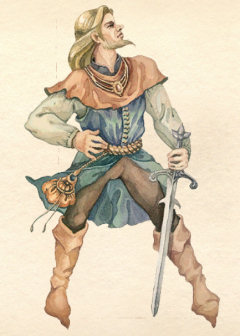

And now think, what does this class do? Is that guy with a sword a warrior or is he bluffing, just holding a sword for image? If he is a Fighter-like character, he has no apparent protections.
Is it a spellcaster? Does it Make Shit Happen with music magic? Or does their music just give a +2 here and there?
What is the Bard's purpose? Stand around and (try to) look cool in entertainer's attire?
Jack of all trades, yet good at nothing.
Maybe Bard should be a template for classes, or a feat or two, rather than a class itself.
Posted: Mon May 26, 2008 2:00 pm
by Voss
What is a bard?
At the basics, the bard is a NPC. Always. This isn't the guy who defeats the dragon and saves the princess. This is the guy that tells stories and sings songs about *other people* killing the dragon and saving the princess. If he's along for the trip at all, he's a young bard with no reputation, hanging back and taking notes so he can write his song about how great these people are, hoping (usually against all evidence) that he's watching the Next Great Saga in the making. But mostly, the heroes come to him later, gold in hand, and pay him to spread their story around.
Seriously, historically these guys are professional musicians and storytellers and all that entails. When they travel, its to go to the court of the local lord, (or if they are new to the gig) town squares, and provide entertainment and 'edutainment'. Stand up historians, if you like. Risking life and limb in pursuit of the next great story would be rather stupid, and way out of their league. The ones with big names will be permanently attached to a court and will be advisers who can pull relevant examples from legend and history out of their ass and apply them to any situation.
So, yeah, the closest thing to adventure most bards have is a low level party escorts them from one town to the next.
Posted: Mon May 26, 2008 2:25 pm
by angelfromanotherpin
Bards were the lowest level of the Druid order. They were scholars and historians, which is why it was their job to wander around telling stories and news. Becoming a bard was a hardcore deal, because they locked you in a stone coffin filled with icy water overnight and gave you poetry homework you had to complete in your head under those conditions.
My favorite heroic minstrel story came from one of the Ars Magica Faerie books, where the lutist played such a lovely song that he captured the fae Queen's heart – literally – and traded it back to her.
There's definitely room for the bard as a class, but K is right - they have to be able to do their own thing as a fully realized character. Honestly, I think a serious de-buffer might not be a bad role, where the enemy is laughing or weeping from the beautiful performance, or the bard is just enough of a scholar to know their weaknesses and how to exploit them.
Posted: Mon May 26, 2008 6:19 pm
by Talisman
K makes a good point...the D&D bard doesn't excel at any one thing (except, perhaps, Diplomacy) enough to warrent inclusion in your typical adventuring party. Now, once you're party has swelled to 6 or 8 people, the bard's buffs increase in value...but that's hardly a common situation, nor does it really justify the bard as he currently is.
I could see the bard class done in two ways. The first would be a spell-less version (as Psychic Robot suggested). Mechanically, he would be a cross between a lightweight warrior (think ranger) and a skillmonkey, with some informational abilities...Bardic Knowledge on steroids. Maybe divination spells as extraordinary abilities, a few debuffs, and Dark Lore (see the Archivist in Heroes of Horror; this feels like a perfect fit).
This bard would never be the tank the fighter, barb or pally can be; he'd be more of a skirmisher or swashbuckler, focusing on hindering, disabling, and frustrating the enemy while tossing swift-action benefits to his allies.
***
The other version of the bard would be a full spellcaster, like a wizard. He would gain access to Enchantment, Illusion and Divination spells, and precious little else...a triple-specialist of sorts. He would gain greater benefits with these spells than a wizard would, since he lacks the wizard's versatility, and would probably have a few other, minor bennies (Bardic Knowledge, suitably buffed; Dark Lore; d6 HD, a few weapon profs).
This bard would never equal a generalist wizard for versatility, or any wizard for blasting/rehaping power, but would be the undisputed master of consfusing the enemy, turning them into friends, and perhaps finding out hidden things.
Posted: Mon May 26, 2008 7:22 pm
by Calibron
The bard shouldn't be a class, not a twenty level class anyway. Maybe a short class like the Knight, but even shorter; 5 levels or so. Otherwise a prestige class or two or three feats(that don't necessarily all need to be taken to be good). We've got the Viking Skald, a light to medium armored full BAB class with excellent knowledge of history and lore and the ability to inspire or induce dread and fear. The court bard, a lightly armored skirmisher who relies more on whit than blade; throws down (Ex) debuffs, buffs, some light battlefield control by literally cajoling the terrain to help him out, and rarely calling on the friendships and contracts he's forged with supernatural creatures over the years especially fey, dragons, and outsiders like
these.
Posted: Mon May 26, 2008 7:24 pm
by Jacob_Orlove
I really like the suggestion of just making "music magic" be a single feat. That way, you can be a less magical, fencer/diplomat Bard (rogue or swashbuckler + bard feat), a more magical spellcasting Bard (druid or wizard + bard feat), or even a hardcore viking style Bard (barbarian + bard feat).
The feat should give you Perform as a class skill, with ranks automatically equal to your level+3. Then I guess just give all the music abilities of the PHB bard. Would you need anything else?
Posted: Mon May 26, 2008 7:47 pm
by Talisman
Maybe a second feat to grant spellcasting? I'd spend a feat for my rogue to gain bardic spellcasting.
Posted: Mon May 26, 2008 7:48 pm
by angelfromanotherpin
Jacob_Orlove wrote:I really like the suggestion of just making "music magic" be a single feat. That way, you can be a less magical, fencer/diplomat Bard (rogue or swashbuckler + bard feat), a more magical spellcasting Bard (druid or wizard + bard feat), or even a hardcore viking style Bard (barbarian + bard feat).
The feat should give you Perform as a class skill, with ranks automatically equal to your level+3. Then I guess just give all the music abilities of the PHB bard. Would you need anything else?
Hell, in
Iron Heroes the Bardic music effects just
are part of the Perform skill.
Posted: Mon May 26, 2008 8:08 pm
by CatharzGodfoot
Bardic songs:
Bardic songs are swift actions to use and maintain. A bard's concentration can be broken, and doing so disrupts the song. When a song refers to a bard's allies or enemies, these are determined by the bard when the song is initiated. When a saving throw is called for use 10 + 1/2 the bard's character level plus her Charisma modifier. A bardic song can affect any creature hearing it.
Song of Fear
Activation: All non-allied individuals must make a will save or become shaken.
Maintainence: Affected creatures must continue saving each round or progress further down the path of fear (frightened and then panicked). A successful save removes the effect completely.
Song of Anger
Activation: All allies gain a +1 morale bonus to attacks and damage.
Maintainence: The bonus increases by one each round to a maximum of 1/2 the bard's class level plus one.
Song of Alacrity
Activation: All allies feel as though a load has been taken from their shoulders; They gain +5' to speed and ignore fatigue.
Maintainence: The bonus to speed increases by 5' each round to a maximum of the bard's class level multiplied by 5.
Song of Warning
Activation: All allies gain a +1 competence bonus to AC and saves, and automatically avoid attacks of opportunity.
Maintainence: The bonus increases by one each round to a maximum of 1/3 the bard's level + 1.
Swashbuckler's Song
Activation: All allies can make special combat maneuver as a swift action.
Song of Befuddlement
Activation: All enemies are treated as staggered unless they make a will save.
Dirge of Despair
Activation: All enemies take a -1 penalty to saves, armor class, and attack rolls.
Maintainence: The magnitude of the penalty increases by one each round to a maximum of 1/3 the bard's level + 1.
How does that sound for actual class abilities?
Posted: Mon May 26, 2008 8:12 pm
by Calibron
If you already have something decent to do with your swift action then Inspire X are usually not going to be worth it. And if you don't have something better to do with your swift action then Inspire X is only going to serve to push you and your allies to the far end of the RNG if not off it entirely.
No we need to rebuild these abilities from the ground up. We could make a bardic music
(Skill) feat for perform.
Something like this:
Bardic Music [Skill]
Your performances make angels weep and fools bleed. (This is a Skill feat that scales with your ranks in Perform.)
Benefit: You may spend a swift action to perform in some manner you are proficient with, this allows you and all allies who can see or hear you(as appropriate to the style of performance) to re-roll one of their die rolls per round; this re-roll can be used at any time whether it is that persons turn or not.
4: When performing as above you and your allies, that benefit from the re-roll, are immune to fear, harmful morale effects, and get a +3 morale bonus against saves versus mind-effecting effects.
9: You may spend a swift or move action to immediately grant an ally who can see or hear you(as appropriate to the style of performance) an extra standard action. You can only use this ability once per round.
14: When an ally who is benefiting from your re-roll effect is struck by an attack or effect that would kill them they may make a Fortitude or Will save, whichever is higher, versus a DC equal to the number of hitpoints they are below -10, in the case of hp damage, or a DC equal to the normal DC of the SoD effect that killed them to return to a number of hp equal to your ranks in perform or ignore the SoD effect as appropriate. Each ally can benefit from this ability once per round.
19: By using a full-round action and a swift action you can make every enemy that can see or hear you(as appropriate to the style of performance) to make a Will save(DC equal to your ranks in perform+your Charisma Modifier) or spend their next turn performing a Coup-de-Grace on themselves, if they make their save they must make a Fort save or be staggered for 1 round, if they make both saves there is no effect. This ability speaks directly to the soul(or reasonable facsimile there of) and thusly effects creatures immune to mind-effecting effects.
19 rank ability may be too powerful, not sure.
Posted: Mon May 26, 2008 9:36 pm
by SunTzuWarmaster
What the hell, I'll take a shot at it since I'm likin' puttin' my neck on the line recently
Bard
"Oh 3-eyed monster of Sartania
Your eyes are like jelly
Your breathe is as fire
but soft is thine underbelly"
Alignment - Travelers of the world come in many alignments. So do bards.
Hit Die - d6
Class Skills As Rogue, without any knowledge skills
Skill Points - 6
Saves - F/R/W Bad/Good/Good
BAB Good
Weapon and Armor Proficiency
A bard is proficient with all simple weapons, plus the longsword, rapier, sap, short sword, shortbow, and whip and 2 other weapons chosen at character creation. Bards are proficient with light, and medium armor and shields (except tower shields).
Class Features
Bonus Feats - at levels 1, 4, and 7, the bard may gain the benefits of any feat he qualifies for. This is done in order to represent combat ability, skill ability, or whatever the bard happens to focus on. F&K feats are good enough that this should add decent fighting abilities to the bard in addition to the decent hit die and full BAB.
Trapfinding - A bard is a master of lore and knows how to spot a trap. Starting at level 1, a bard can find traps.
Bardic Knowledge - Bards know all kinds of things that no one else knows. Starting at level 1 bard may substitute the results of a bardic knowledge check for any knowledge skill roll that would be required. This is a free action that does not permit a reroll. A bardic knowledge check is equal to d20+(# of levels in bard)+(Int, Wis, or Cha modifier). In addition to this ability, a bard may use Detect Magic at will.
Inspire - Bards are known for their abilities to inspire others and persevere miraculously under many situations. A bard of level 2 or above may Inspire his comrades (and himself) by reciting poetry, chanting, singing lyrical songs, singing melodies, whistling, playing an instrument, or playing an instrument in combination with some spoken performance. This is a supernatural effect done as a swift action each round and grants a bonus to hit and damage equal to one half of the bards class level. A wise bard also uses his songs to inform his comrades about the weaknesses and abilities of monsters.
Long-Winded - Bards, for better or for worse, are known for their ability to talk. As long as a bard of 4th level or higher is using his Inspire ability, he may cast a Suggestion effect once per round that has a 1-round duration as a free action. This is a Will save effect with a DC based on either the bards Int, Wis, or Cha modifier.
Survivor - Bards nearly always live to tell the tale of the accomplishments of the heroes. As such, a bard of 4th level or higher is considered to have Spell Resistance equal to 10 + his class level in addition to the Power Slide ability of Jesters.
Lucky Combatant - Bards generally travel in areas or with parties where combat is likely to occur. Instead of becoming better at fighting, the lucky bards are the ones that survive. A bard of 5th level or higher may reroll any roll he makes once per round.
Greater Inspiration - At level 6 a bard may now use his Inspiration ability to add up to his class level as a bonus to hit and damage.
All Knowing - After adventuring for long enough to survive to level 7, a bard is a serious vessel for random knowledge, but the problem is in remembering. A bard may reroll a bardic knowledge check once per four rounds.
Fortuitous Circumstances - Lucky things tend to happen around a bard of level 8 or higher, as such, the bard may use an additional reroll each round that may only be made on a roll that is not his (such as an enemy/ally to hit roll, concentration check, damage roll, grapple check, etc.).
Saw it Coming - A bard is an excellent source of monster identification, but may also serve as an early warning system. Upon successful identification of a monster, a bard may choose one of the monster abilities. The bard, or any ally of the bard, may not be subjugated to any ill effects from the use of that ability (let each character decide if it is an ill effect, but usually it should be clear). This must be a specific ability such as that Ethercaps have Injury Dex-damaging poison, but not a general ability such as that Ethercaps have arms with claws or that wizards typically cast spells. Good abilities are listed as examples: Air Elemental Whirlwind, Medusa petrifying gaze, a dragon's breath weapon, the Rust ability of a rust monster, or the Blasphemy ability of a Pit Fiend.
Easy Win - At level 10, while using his Inspire ability, any ally (including the bard) may take 10 on any skill check as though they were not in danger.
-----------------------------------
You figure that starting at level 3 or so the bard should be filling his combat niche fully. +1 to hit and damage for everyone, a free Suggestion per round (likely a single-target disable), and doing whatever it is that their combat style calls for (I would recommend the Blitz + Point Blank Shot + Sniper combo, if only because the crossbow bard seems to be fairly standard).
Level 6 gets it moving with +6 to hit/damage and his second attack (4th if you go the TWF/Blitz route), one suggestion/round and a reroll if things go bad.
At level 10 he is granting a +10 to hit and damage to himself and his party, 1 Suggestion, 1 self reroll, one other reroll, 1 disabled monster ability, and whatever his Attack and Move actions are getting him. He is decidedly hard to kill with Power Slide and Spell Resistance.
Comments, Questions, Concerns? I am currently of mind that it might be a bit over the top with the +10 to-hit/damage, but +5 doesn't seem to be on par with the fighting abilities of characters at that level.
Posted: Mon May 26, 2008 10:27 pm
by Calibron
The biggest problem is the big untyped bonus to attack rolls. It curb stomps the RNG. It should never go above five, and even that is pushing it. You could easily grant Attack and AC bonuses equal to a third of the Bard's class level, and a damage bonus equal to character level; more than that is just abusing the math. Beyond that I see nothing intrinsically wrong with the abilities, and the class looks fun enough to play; can't tell from a glance if it's even approaching level appropriate though.
Posted: Tue May 27, 2008 12:26 am
by SunTzuWarmaster
I wanted to find a way to work in AC bonuses but I know it was already bordering on too much.
You are saying that at level nine those bonuses should be +3 to hit, +3 to AC, and +9 to damage? All up by one for level 10?
I agree that they need to be typed. The class relies on it taking Combat feats to be doing interesting things in combat in a similar manner to the RoW fighter, but to a lesser extent. Hell, bonus Combat feats like the fighter may not be a terrible idea if the Bardic Music gets toned down, but then you would have a music-themed buff-oriented fighter essentially. *shrug*
Posted: Tue May 27, 2008 1:50 am
by K
For the Bard, there are plenty of concepts that don't work and some that will.
Here are the non-starters:
1. The Buffer: Buffing people with bonuses doesn't work. Some parties are seriously only three people, so tossing down small buffs just isn't enough for a full character(though it's fine for a cohort, who is expected to not contribute as much as a full party member).
2. Skill-based ability user: Skills are broken when they do anything interesting. Diplomancers take a reasonable check, add crap-tons of bonuses, and then achieve ridiculously broken results(BBEG converts to your religion and abandons plan to destroy world, after giving you oral sex, and all after a six second converation). Basically, the skill system has too many ways to buff for it to ever be balanced in 3.x.
3. The Jack of all Trades Who Sucks At Everything: If you can't do level-appropriate things, then you are not a PC. The 3.x Bard is seriously less powerful than a Expert who took Leadership for a Sorcerer cohort who took Leadership for a Cleric.
Things that could work:
A. A Different Kind of Spellcaster. Like a mage or a cleric, it'd be a full caster with its own unique flavor and casting mechanics, and not the leftovers from the arcane and divine list.
B. A Fixed Ability User: He'd look like a Warlock, but with a real theme and mechanic.
C. A True Jack of All Trades. He'd have the level-appropriate options of real combat attacks, spells, and special abilities. His total number of options have to equal a single classes characters. For example, at 10th level he'd be able to cast two spells opf each level from 1st to 5th, and have some Bard-type weapon attacks like Dance of Deception and Singing Blade, and a few abilities like Confusing Oratory and Song of Fascination.
Posted: Tue May 27, 2008 3:23 am
by JonSetanta
K wrote:
3. The Jack of all Trades Who Sucks At Everything: If you can't do level-appropriate things, then you are not a PC. The 3.x Bard is seriously less powerful than a Expert who took Leadership for a Sorcerer cohort who took Leadership for a Cleric.
Actually, change the name Bard to Commoner or Citizen and you have yourself a nice NPC class right there.
Except the fact that hardly over 5% of any population knows or even cares about playing instruments, singing, dancing, poetry, or some form of personal expression.
Posted: Tue May 27, 2008 4:18 am
by MartinHarper
Jacob_Orlove wrote:The feat should give you Perform as a class skill, with ranks automatically equal to your level+3. Then I guess just give all the music abilities of the PHB bard. Would you need anything else?
I think it would be good to have some type of Eschew Materials type thing where the character with the bardic music feat can substitute a performance for the various components of a spell.
Posted: Wed May 28, 2008 11:47 pm
by Bigode
Catharz: what you did looks similar enough to
Frank's bard that you might be interested.
And for going spell-less, I'd recommend the marshal in the
Tome .pdf.
Posted: Fri May 30, 2008 6:18 am
by Username17
I don't think Bards should play music in combat. Combat rounds are 6 seconds long, and it's just not enough time to get a real song going. Consider the song
Rough Sex by Lords of Acid. In the first six seconds, all that happens is that they play seriously four notes. Even if you fast forward to where he starts singing, all he says is "Love. Love. Is the answer..." That doesn't get the point of the song across
at all. The entire song is forty-eight combat rounds long.
A Bard's music should be relegated to non-combat situations. Bards should use their music to influence crowds, change the weather, alleviate fatigue, protect campsites, open locked doors, and so on and so forth. In combat, they should be tossing down illusions, stuns, and sword slashes, not
songs.
I'm fine with them having a "tricksy" combat style where they dish out small amounts of rapier or whip damage and delay people. Disarming strikes, tripping strikes, dazing strikes, and so on. But they shouldn't be singing in combat. It undermines the concept of the singing adventurer.
-Username17
Posted: Fri May 30, 2008 7:16 pm
by Bigode
FrankTrollman wrote:I don't think Bards should play music in combat. Combat rounds are 6 seconds long, and it's just not enough time to get a real song going.
(...)
I'm fine with them having a "tricksy" combat style where they dish out small amounts of rapier or whip damage and delay people. Disarming strikes, tripping strikes, dazing strikes, and so on. But they shouldn't be singing in combat. It undermines the concept of the singing adventurer.
-Username17
Mostly true, but I could still see it working with a) taunts and shouts (jester/marshal/skald), or b) the bard has the habit of starting singing before battles start. But when you made that bard, did you envision its spell components as what, then?
Posted: Fri May 30, 2008 8:10 pm
by Orion
I'm actually kind of attached to the "jack of all trades" thing. Let's see if we can't make this work.
Possible roles for a Bard without being "the best" at anything:
ExTreme multitasker:
suppose that bards got auto-quicken on all thier spells, and a semi-reasonable combat portfolio. A 6th-level bard who threw down the dps of a 4th-level Rogue and the crowd control of a 4th-level Illusionist *at the same time* would be a valid character, right? Or one with the tanking/field control of a 4th Tome fighter and the buff/heals of a 4th level Marshal?
Sideways Objectives
So D&D is a specialists game where you generally don't want to do something unless you're totally hardcore at it. But we want Bards to jump into situations they suck at. the solution? Make them succeed at something unrelated to what their action looks like it should accomplish.
For instance:
Inspire Courage: When the Bard makes a melee attack, allies in sight get +xd6 damage until his next turn. This gets him in melee, even though he doesn't fight well enough to actually win.
Cunning Ambush: When you attack a sneak-attackable enemy, gain a spell slot.
Battlefield Inspiration: Whenever you fight defensively, gain a bonus spell slot.
Daredevil
Bards should be doing crazy crap that gets them in over their heads.
Daring: get one action point at the end of any turn you tumble past an enemy.
Sidekick/Leader
The bard can have party buffs, but they should be generally single-target, so they don't scale endlessly, they should be tactical so the bard desn't sit back with his loot, and they should have benefits for the bard as a solo character.
Some could put the bard in the role of sidekick:
Harrying Shot: your ranged attack makes target flat-footed
While some put him in the role of a hero:
Taunting Strike: your melee attack or ranged perform check allows all your allies to roll hide against the target.
I think picking one or two of these and rolling them together could make a fun bard.
Consider an ability like:
Rattling Strike: maybe through jeers and taunts, a sinuous war-dance, or just the way people get at the sight of thier own blood, your melee attacks give the target a cumulative -2 to saving throws.
This ability gets the bard into the fight without needing to make him a good fighter in the classical sense. It works as a teamwork ability, setting up targets for the wizards, or as a solo ability to weaken and then subdue foes, especially if he has quickened spells.
What do you all think?
Posted: Mon Jun 02, 2008 3:00 am
by Orion
I Put a draft of a Bard over in the Invention forum.