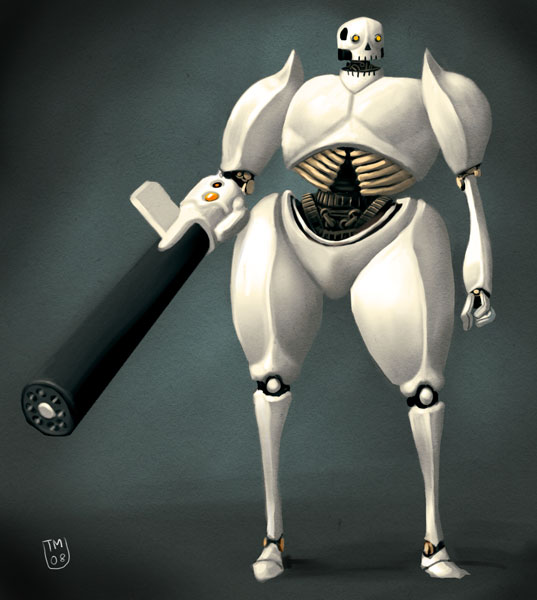
Conquest is the working title of what I'm calling an Evolving Card Game. It's the same thing as a Living Card Game but not copyrighted.
In Conquest, players take on the role of maniacal villains bent of conquering the world, known as Adversaries, so that they can further their own power as they go on to conquer more in a vicious cycle of conquest. Whether they conquer worlds to turn into bases of operations and factories or crack them open for the warm gooey quintessence within makes no difference.
The Four Evils
Adversaries work their schemes through four main tools, known as the Four Evils--Avarice, Delusion, Wrath and Terror.
Avarice- The hunger for more drives all life. Animals seek food. People seek money to acquire food and security. Even Plants seek the sun. When this hunger overreaches it's need, it becomes Avarice, the desire to horde resources. The currency of Avarice is Gold, the metal which drove so many people throughout history to kill one another for it's shine.
Delusion- Belief is a powerful tool. It was man's first explanation for the mechanisms of the universe. It was the rallying cry for many wars and resistances throughout history. It was one of the earliest shackles on man's natures and desires. When that belief is false--that is to say a belief in something untrue, rather than fake belief--it becomes Delusion, the resistance to reason, and the denial of truth. The currency of Delusion is Essence, the mystical energy which drives and wells from it's many bewitching spells.
Wrath- Anger serves good purpose in living things. It can allow a wounded, weakened creature to fight for it's life. It can drive a mother to protect her children. It is the natural outgrowth of the survival instinct. When that anger grows strong, and defies reason or cause to become a drive to wreak vengeance and punishment, it becomes Wrath, the raw desire to destroy. The currency of Wrath is Blood, the precious life fluid which pounds through the veins of the wrathful and spills from the wounds of their victims.
Terror- Some might call fear the purest emotion. Regardless of accuracy, it is a useful emotion. Fear of death can turn to anger. Fear of starvation drives hunger. Fear is also a useful tool. Just causing a hostile opponent to fear for their life can convince them to break off an attack before either party becomes too wounded. When the natural fear response slips the bonds of reason, overpowering thought and rendering the being incapable of thought or action, fear becomes Terror, the destruction of reason and action. The currency of Terror is Fear, an oily black energy like solidified smoke which accumulates when great numbers are terrified.
Card TypesHeroes in Conquest wrote:One of the hypothesized reasons for the failure of Hecatomb was that it was all evil and no good. One persistent player speculation during the mayfly life of the game was that a fifth colour would be added to round out the Magic colour equivalency, and that fifth colour would allow for heroes.
Conquest will, ideally, have heroes which players can take the role of. I'm currently planning on having it be a separate release using the same rules with mirrors to the Evils-- Generosity, Dream, Creation, Courage.
- Adversaries Adversaries are the characters which players take on the role of in a game of Conquest. Each Adversary is tied to one or more evils, and has a modest base of power and influence which generates colourless currency each turn. Adversaries begin the game in play, and cannot be discarded, destroyed, or otherwise removed from play through any method short of defeating the player who controls it.
Adversaries have counters called Lairs. When you capture a Keystone, place your adversary's lair on it. The lair will give a Combat Strength, and often an ability. - Devices Whether by spell or steel, Adversaries often craft objects to hold their power and aid their schemes and minions. From spell-engines to plasma pistols to simple iron swords. Devices are played from the hand to the table, and are Continuing--that is to say, they remain in play until a later effect removes them.
- Lair Enhancers Adversaries often build elabourate mansions and palaces as their bases of operations. They also will frequently incorporate traps and defense systems into these lairs. A Lair Enhancer is a special kind of Device which can only be played on a controlled Keystone which you have lair on.
- Events Events are fleeting moments in which something happens and concludes. The result may be Continuing, such as a spell which calls forth a dragon, or earthquake which destroys a major landmark, but the event comes and goes. When an event is played, it is discarded immediately after resolving.
- Keystones Keystones are sites of power scattered throughout worlds. They often have powerful effects if they can be harnessed, and if a sufficient number of Keystones can be acquired the world can be conquered. Keystones are set out at the start of the game, face down, uncontrolled by either player, and must be won through combat.
- Minions Minions are the creatures and soldiers of adversaries, their most direct way to combat each other and seize their objectives. Minions are Continuing. Minions can also be fused together, replacing the parts of one with those of another. Each Minion card has, usually, a Head, two Arms, and a "Legs," the top, left and right, and bottom edges of the card. Each will usually have a Fusing cost--the cost you pay to fuse the piece onto another creatures--and a combat strength modifier. They may also have additional abilities granted to a creature to which they are fused.
- Resources Resources are holdings, rituals and sites which provide an adversary with an income of currency. Resource cards are not shuffled into your deck, but rather set aside out of game. During a player's acquisition phase, they may spend currency to purchase a Resource card and put it into play expended. Resources are aligned to one, sometimes more, Evils, and produce the currency of that Evil each turn. Resources are Continuing.
Your objective is to gain control of all of a world’s keystones, thereby enabling yourself to destroy it, or save it from destruction.
Starting the Game
To start the game, each player sets aside their resource deck, and their keystones. They then shuffle their play decks, and cut their opponent's.
The Keystone cards are then shuffled, and a length of game is decided upon- short, standard, or long. Each player then places 2-4 keystone cards down, depending on game length decided upon, 2 for short, 3 for standard, and 4 for long. These cards are placed between the players in a single row (or as close to as space permits). Keystones are not controlled by any players until they are seized in game.
Finally, determine order of play. (roll a die, compare bottom card cost, shuffles resource cards and reveal top card to compare cost or a RNG, whatever)
Phases of the Turn
Start of turn- Adversary produces Currency, Unexpend cards
Acquisition- Draw card, purchase [resources], unexpended [Resources] produce currency.
Deploy- play cards from hand
Combat- declare attackers as desired
--Opponent declares interceptors
Rally- Minions and controlled Keystones are healed of damage. Second chance to play cards from hand
End of turn
Start of Turn
Acquisition
Deploy
Combat
During your combat phase, you may decide to attack with some or all of your minions. If you do, declare which minions are attacking, expend them, and declare targets (it is perfectly acceptable to declare targets as you declare each attacker). Targets can be opponents, minions controlled by opponents and Keystones.
Once you have finished declaring attackers, you opponent(s) may declare interceptors. Minions targeting a player or other minions may only be intercepted by minions controlled by the targeted player or controller of the targeted minions. Minions targeting a Keystone may be intercepted by any opponent. Only non-expended minions may be used to intercept others.
Once interceptors have been declared, attackers deal damage to their interceptors and vice versa simultaneously. The controller of the attacking minion decides how damage from the attacking will be distributed amongst intercepting minions. If damage taken by a minion exceeds its combat strength, the minion is killed and placed in the discard pile. Minions recover from damage at the end of the turn.
Rally
End of Turn
Fusing
You may combine two creatures on your field during any phase of your turn. First you select one as the base, and another as the augmentation, choosing a specific part (usually head, arm or legs). Pay the augmentation cost associated with that part and place the augmentation under the base such that the augmentation description can be seen (see below, fg.X).
Fusing from hand- Anytime you could play a creature, you may instead play that creature as an augmentation, paying only the augmentation cost for the part.
Multiple and Full Augmentation- You may augment a base with more than one part from an augmentation. This is just like replacing both arms, save that the augmentation is placed under the base such that two augmentation descriptions are visible (both description lines on one side to replace both arms, head and one or more arms, one or more arms and legs, head and legs, or head, one or more arms and legs, see below, fg.X.)