Machine and Man in Cyberpunk

General questions, debates, and rants about RPGs

Moderator: Moderators

Username17
Serious Badass
Posts: 29894
Joined: Fri Mar 07, 2008 7:54 pm

Post by Username17 »

Red_Rob wrote:Guns, drones, and vehicles could all be given standard stats for their type without affecting the core experience of the game I think, and it would encourage things such as ditching your gear after every mission to avoid leaving a trail, which is thematic.
The stats don't even need to be completely standardized, or there could be an options pool to fiddle with their stats so that the gun guy can get a better firearm out of his saturday night special just as the hacker can presumably get more out of his burner phone. Encourage players to rant about how the Česká Zbrojovka 808 has a distinctive sound signature, so you want to put some tape on the side to create ambiguity in gunfire locators when firing it in cities. Or whatever. Characters should have opportunities to technobabble their specialty field, and a setup where the assumption is that people get burner equipment for each job lends itself to that quite well.
Verbyast wrote:It also feels a lot like the classic summoner/necromancer/artificer characters from DND, where the character's role is "provides useful doohickies" and its abilities are directed toward ensuring that the doohickies (summons, skeletons, gadgets) are always available and useful. The drone guy is the closest to this (doohickies = drones, availability = rebuild them from salvage, usefulness = do nifty things with drones), but you could make a shooty character on the same framework (doohickies = guns, availability = can get good guns, usefulness = can shoot good guns). They're on the same "power schedule", if that's the right word, as summoner and necromancer builds.
I think I agree with you, although I think "power schedule" is probably not the right word. The summoner or necromancer certainly does different stuff to get their spirit allies for the mission, and they quite possibly have different resource expenditures to do it. But the fact that the things they are providing in the legwork phase are now comparable to the things that the summoner and necromancer are providing makes the different power schedules be something that can at least potentially be balanced.
kzt wrote:It hardly seems overly demanding to expect that some guy being paid to write rules and another guy being paid to edit those rules understands what a dictionary is and knows how to look at up what the word "velocity" means and what it doesn't.
Meh. Movement is always going to be weirdly abstracted in a game with distinct turns, and the terms used for that movement are necessarily going to be used in a way that is not identical with reality. In D&D, your "speed" is actually your displacement and not your speed. I mean, consider how fucked up from a physics perspective the statement "When you run, you can move up to four times your speed in a straight line" is. Running increases your speed, it doesn't let your speed happen more than once. But still, you fucking knew what they meant, and everything is fine. The vehicle rules in SR4 are terrible because they don't work well, not because they use physical terms incorrectly. Besides, they basically use the word "velocity" correctly, it's acceleration that they use in a manner that doesn't make sense.
Sigil wrote:If you wanted your characters to feel more like special Ops instead of shady criminals, you could go with some sort of wealth system instead of discrete money. Your rigger would simply primarily invest his Revenue Points into Drones and Computers, while your street samurai would have most of his invested into Cyberware and Combat Gear. Between missions you could allow the characters to decide what that expenditure actually represents for that time frame, and could even have them incur minor penalties or bonuses for destroyed equipment during the prior mission.

Implemented poorly, though, such a system has its own problems (see D20 Modern).
Actual Spec Ops teams could have gadget pools like Q in James Bond. Each Mission they get to requisition some stuff for being Spec Ops guys.

The wealth level system of D20 Modern was a war crime. I like abstracted wealth, and you're basically going to have to abstract wealth in at least some way (lifestyle costs, for example), but you're going to have to do it very differently from what D20 Modern provided.

-Username17
kzt
Knight-Baron
Posts: 919
Joined: Mon May 03, 2010 2:59 pm

Post by kzt »

FrankTrollman wrote:The vehicle rules in SR4 are terrible because they don't work well, not because they use physical terms incorrectly. Besides, they basically use the word "velocity" correctly, it's acceleration that they use in a manner that doesn't make sense.
Well, that is true. But I was thinking about the gun rules (dating back before SR4) where they also used the word "velocity" in a manner that doesn't make sense.

SR's Humpty Dumpty approach to words just doesn't add anything to the game.
Last edited by kzt on Sat May 18, 2013 10:23 pm, edited 1 time in total.
User avatar
angelfromanotherpin
Overlord
Posts: 9752
Joined: Fri Mar 07, 2008 7:54 pm

Post by angelfromanotherpin »

Would you want to put magicians on a similar method, i.e. instead of magic being a thing you pull out of the astral with your bare hands you need ritual components, and criminal magicians would be hitting up pawn-shops/used-bookstores, and disassembling commercial hoodoo products for spare toe of frog?
User avatar
Whipstitch
Prince
Posts: 3660
Joined: Fri Apr 29, 2011 10:23 pm

Post by Whipstitch »

I wouldn't mandate spell components on standard casting tests for flavor reasons, but an abstracted setup could work rather well for binding spirits or even introducing a focus "maintenance" mechanic. Because as currently stands, mages are given a lot of incentive to go big or go home. If you bother with the Binding skill, you want to get your BP's worth and that often involves messing about with Edge and binding something that will give the MC a headache because otherwise the costs involved just aren't terribly rational compared to on-the-fly summoning. And if you go for focuses--which, you should--it's either a couple of choice Sustainings or the biggest, nastiest Power Focus you can manage. Just blowing your nuyen on the materials to bind piddly spirits isn't very attractive when you could be saving up for the new hotness instead. By contrast, if you went with a more modest but flexible use-it-or-lose-it-monthly pool and nerfed some of the more obvious power picks then you might actually see a scenario in which keeping a Force 3 spirit in your back pocket for the month is a solid default choice if you have no idea what to expect that evening.
Last edited by Whipstitch on Sat May 18, 2013 11:45 pm, edited 1 time in total.
Strung Nether
Journeyman
Posts: 153
Joined: Fri May 21, 2010 7:34 pm

Post by Strung Nether »

Whipstitch wrote:I wouldn't mandate spell components on standard casting tests for flavor reasons, but an abstracted setup could work rather well for binding spirits or even introducing a focus "maintenance" mechanic. Because as currently stands, mages are given a lot of incentive to go big or go home. If you bother with the Binding skill, you want to get your BP's worth and that often involves messing about with Edge and binding something that will give the MC a headache because otherwise the costs involved just aren't terribly rational compared to on-the-fly summoning. And if you go for focuses--which, you should--it's either a couple of choice Sustainings or the biggest, nastiest Power Focus you can manage. Just blowing your nuyen on the materials to bind piddly spirits isn't very attractive when you could be saving up for the new hotness instead. By contrast, if you went with a more modest but flexible use-it-or-lose-it-monthly pool and nerfed some of the more obvious power picks then you might actually see a scenario in which keeping a Force 3 spirit in your back pocket for the month is a solid default choice if you have no idea what to expect that evening.
Is there a way to abstract this so that the book-keeping can be kept to a minimum? my initial ideas are some kind of "pocket quota" of things you can just have at the start of each mission. an example for a street sam:

pick 2 gun templates and add 3 points to each(semi->full auto, loud->silent, magazine->drum,etc)
pick 1 armor template and add 1 point to it
pick 2 points of software
pick 5 points of comsumables (slap-patch, nade, super ammo,etc)
pick 6 points of anything from vehicle or drone lists.
Last edited by Strung Nether on Sun May 19, 2013 7:42 pm, edited 1 time in total.
-Strung
Username17
Serious Badass
Posts: 29894
Joined: Fri Mar 07, 2008 7:54 pm

Post by Username17 »

Strung Nether wrote:Is there a way to abstract this so that the book-keeping can be kept to a minimum? my initial ideas are some kind of "pocket quota" of things you can just have at the start of each mission.
That is a damn good question. While things that are similar to Spell Preparation have many things about them that are great for mission-based gaming and storytelling, it's undeniable that they take up a shit tonne of table time. And combining Spell Preparation with Catalog Shopping is a recipe for game paralysis: See Clerics and Druids with expansion spells enabled for a sufficiently horrible example.

There are ways to speed up the process. You could draw cards or roll up on charts to see what was available and then you'd get to take it or leave it, for example. Or you could severely abstract the available equipment so that players actually only had a few options to juggle. Or a combination of the two.

I do not like that asking players to go through the entirety of a two hundred page Rigger book to find the vehicle to use today is a good idea. That is just asking option paralysis to slow the game to a crawl.

-Username17
Strung Nether
Journeyman
Posts: 153
Joined: Fri May 21, 2010 7:34 pm

Post by Strung Nether »

FrankTrollman wrote:
Strung Nether wrote:Is there a way to abstract this so that the book-keeping can be kept to a minimum? my initial ideas are some kind of "pocket quota" of things you can just have at the start of each mission.
That is a damn good question. While things that are similar to Spell Preparation have many things about them that are great for mission-based gaming and storytelling, it's undeniable that they take up a shit tonne of table time. And combining Spell Preparation with Catalog Shopping is a recipe for game paralysis: See Clerics and Druids with expansion spells enabled for a sufficiently horrible example.

There are ways to speed up the process. You could draw cards or roll up on charts to see what was available and then you'd get to take it or leave it, for example. Or you could severely abstract the available equipment so that players actually only had a few options to juggle. Or a combination of the two.

I do not like that asking players to go through the entirety of a two hundred page Rigger book to find the vehicle to use today is a good idea. That is just asking option paralysis to slow the game to a crawl.

-Username17
Wouldn't 3d printers make the abstraction not that abstract? You would download/pirate different designs, then buy/steal stock, and then have your semi/dsiposable items to use. You would need to implement some limits on what you can take with you, for example you can only "control" x number of drones, and can only wear 1 set of body armor. I'm not sure how to make a "magical" analog for this, or if we even need one. of course this requires hand-waving how a 3d printer can make a fully functional hand grenade.

I don't think that we would need to randomly restrict access to limit paralysis. Decent sub-categories will make getting what you want from a list easy.

Weapon
-Pistol
--Revolver
--Semi-auto
--Auto
-SMG
--???
--???
-Shotgun
--Pump
--Magazine
-Rifle
--Assualt
--Battle
--Carbine
--Sniper
--Anti-Material
-Machine Gun
--Light
--Heavy
-'Nade Launcher
--Under-barrel
--Revolver
--Magazine
-Non-Lethal
--???
--???

Just add a sentence/picture explaining what each one is and a table of "upgrades" and you are done.
Last edited by Strung Nether on Sun May 19, 2013 9:35 pm, edited 2 times in total.
-Strung
User avatar
Whipstitch
Prince
Posts: 3660
Joined: Fri Apr 29, 2011 10:23 pm

Post by Whipstitch »

You say that it's easy, but I saw how long your list was just for guns and felt agitated.

Anyway, I think if anything magic would be easier to abstract since it's well, magic, and thus already built on pixie dust and bullshit. The reason you can't have more than X force three bound spirits prepped in time for the run could simply be that your character is not a bad enough dude.
User avatar
Sigil
Knight
Posts: 472
Joined: Thu Jan 17, 2013 4:17 am

Post by Sigil »

FrankTrollman wrote:There are ways to speed up the process. You could draw cards or roll up on charts to see what was available and then you'd get to take it or leave it, for example. Or you could severely abstract the available equipment so that players actually only had a few options to juggle. Or a combination of the two.
I've been thinking about ways to abstract it, and here's the rough idea I've had in mock up form so far, even though I really have no intention to develop it further.

First, break up everything you could spend money on into a few arbitrary categories and subcategories (these subcategories have no mechanical function other than to divide equipment in groups for the player), for a cyberpunk heart-breaker, it could look something like this:
  • Cyberware (Implanted cybernetic augmentations)
    -Defense
    -Offense
    -Utility
    Drones (Autonomous robot allies)
    -Assault
    -Brute
    -Recon
    Equipment (Armor, weapons, other gear)
    -Armor
    -Tools
    -Weapons
    Transport (Air, land, and sea vehicles)
    -Air
    -Land
    -Sea
    Wetware (Neural enhancements)
    -Tactics
    -Uplink
    -Whatever
When you level up (or whatever your RPG's equivalent for advancement is) you gain X Requisition Points (RP). You then assign your RP to the five (in this case) categories as desired. Once assigned, RP are semi-permenant, staying put at least until a level up.

Each of the subcategories is built out of a list of "packages" each with an RP value. Each package contains a number of predetermined items or enhancements, and there should be, probably, 5 or so packages for every subcategory for each RP value. You could even put these packages on cards for ease of use.

So, lets do a mock example, a rigger. Our rigger has 10 RP, divided like so: Drones 4, Transport 3, Equipment 2, Wetware 1. These packages probably look something like this.

Mini Mech (3 RP)
Drone - Brute
"This 8' tall bipedal drone yadda yadda etc."
Rules and Shit: Some rules. Probably a stat block.
Requirements: Requires a dedicated land transport of 2 rp or more, or a dedicated air transport of 1 rp or more.

Rotor UAV (1 RP)
Drone - Recon
"Remember those annoying thins in Metal Gear Solid 2?"
Rules Rules Rules: It flies and shit, has a camera.

Cargo Van (2 RP)
Transport - Land
"It's a van that stuff can be transported in."
Stats and Things: Speed, turning, color, comfort factor, number of cupholders.

This will be the transport used to move the mini mech.

Exfiltration Copter (1 RP)
Transport - Air
"A small helicopter that can be called to your location via homing beacon, short range and flight time."
Statxorz: Can fly, can sorta land.

Self Defense Package (1 RP)
Equipment - Weapons
Items Included: 1 Revolver, 24 revolver rounds, 2 fast loading whatever those things are called for revolvers.

Discount Cyberdeck (1 RP)
Equipment - Tools
"Provided for free, unfortunately ad-supported, which kind of slows you down."
Rules: Hackin' and shit.

Remote Implant (1 RP)
Wetware - Uplink
Stuff: Allows you to receive data feeds from drones, and to send basic instructions at a minus whatever penalty.
So, that's 7 packages/cards, chose from 150 options (assuming 15 packages per RP amount per Category). Keep in mind this is a mock up, but it's what I've got. There should probably be some RP 0 packages that you can straight up just have if you're willing to carry them around, or maybe just basic items that for the sake of abstraction cost no resources.
Last edited by Sigil on Mon May 20, 2013 2:11 am, edited 1 time in total.
TheFlatline
Prince
Posts: 2606
Joined: Fri Apr 30, 2010 11:43 pm

Post by TheFlatline »

kzt wrote: Assumption 3: There is no huge well-known hacker networks producing effective pre-built attack tools for anyone to download or even to buy. It’s treated more like child porn is these days. No legal protection outside of use by “authorized” people. It exists and people trade tools and exploit, but with spectacular busts of entire networks occurring from time to time, while every PD runs occasional or constant undercover operations. Hackers need to know people who know people, would-be hackers who use goggle or craigslist will find an undercover police team a significant percentage of the time.
Oddly enough, there *are* huge well-known hacker networks producing effective pre-built attack tools for purchase (and in some cases even free to download). In fact, I can think of three distinct "networks" off the top of my head I could dig into if I wanted that kind of shit.

You just don't hear about it as a normal user, and it's never talked about. Law enforcement gets involved whenever it can, but lurking on the interwebs is tough to do, especially when these communities get to know their constituents. And even if you do get in, and buy a virus, you have a single virus for 30,000 bucks. The virus that infects you on the other hand is this other virus that was sold for 30k.

I will agree that reputation is more important for a hacker than anyone else, but this links back to my statement that the real world of computers and security is way, way more complicated than you'd imagine.
TheFlatline
Prince
Posts: 2606
Joined: Fri Apr 30, 2010 11:43 pm

Post by TheFlatline »

FrankTrollman wrote: If you're a tech specialist and your opponents go the full cromagnan,, you should own them. To the same extent and for the same reason that a man with an assault rifle should be able to cut down considerable numbers of unarmored pacifists if they decide to do that.
I agree that in a larger sense you should be able to pwn them. In the larger picture you can't "drop out" of the Matrix entirely, there's always *something* watching, so I agree there.

But in a short-term/tactical perspective, Bob the Meat Virgin with some cheap former soviet bloc dental work and some nasty tats is going to be immune to fucking his hotlinked scope or VR up, because he doesn't use that. He's effectively in the information equivalent of an anti-magic zone.

And that awards certain benefits. It also opens your ass up for long-term pwning.

So instead of sending the eject command to his hotlinked Assault Rifle, you focus every camera in six block on Bob and send all that information off to the police, along with Bob's latest hideout because you dox'd him during that firefight. Sure it means nothing if he dies, but if he lives and runs away, at some point in the future that's going to bite him in the ass.

Which is an issue in RPGs: Long term impacts rarely have much of an impact.
TheFlatline
Prince
Posts: 2606
Joined: Fri Apr 30, 2010 11:43 pm

Post by TheFlatline »

FrankTrollman wrote:Cypherpunks are people like Julian Assange. People who have a smug and utopian vision about how ubiquitous unbreakable cryptography is going to empower the individual against the tyranny of corporations and nation states.

The first thing is that their vision is actually shockingly naive, I personally wouldn't bet a dollar against the NSA having already broken AES when they approved it over a decade ago. When they approved DES in 1974, they suggested tweaks that made it resilient to attacks the rest of the world discovered in 1994 and more vulnerable to attacks the rest of the world put together in 1999. The NSA is literally at least a quarter century ahead of world civilian cryptography, and if you think you're pulling one over on them you're probably wrong.

The second thing is that their vision is not really compatible with most stories. It's a weird bullshit vision about marble jawed individualists being able to say what they want (to incredibly limited audiences) without the government knowing about it or being able to track them. But you know what? Fuck that! Having to move because the fuzz is tracking your position is the second act of most cyberpunk stories.

Basically, the cypherpunks are people who stamp their foot and demand that the future has to work one particular way because they can't imagine the fact that they are in fact in a Red Queen style competition all the time in everything they do. And this attitude hurts cyberware (by making it converge) and it hurts net running (by making it suck ass).

-Username17
By definition *anything* approved by NSA has either a back door or is already able to be brute-forced by their server farm in a "reasonable" amount of time.

Which is why PGP freaked out the NSA when it came out and for a long time certain levels of crypto were illegal to export out of the US. I'm sure the NSA "solved" some of that crypto way before it relaxed it's view (false sense of security anyone?), but for a time it was a real problem.

There's a book called Crypto by Stephen Levy which is a really fascinating read on the history of cryptography. I needs updating, as it's 12 years old now, but basically, post WW2, a few diehard math enthusiasts completely recreated the last 2000 years of cryptography independently (because the government wasn't helping) and surpassed government advances in it in a few areas.

I still think focusing on crypto is painfully granular though. It's either a speed bump in your hacking attempt, solvable in a reasonable time with enough brute force (renting a beowulf cluster from your local mobster to brute the file in 3 days), solvable with some special resource, or above and beyond your ability, whether using quantum mechanics, one time pads, or whatever else. The technobabble will change in the next 70 years so who gives a shit what the technobabble is?
TheFlatline
Prince
Posts: 2606
Joined: Fri Apr 30, 2010 11:43 pm

Post by TheFlatline »

Blade wrote:You can hate cypherpunks all you want, but blaming the expectation of realism on them is absurd.

Many people - and not only cypherpunks - want their Matrix to be realistic, or draw comparison with existing computer systems and networks. Or at least, they want an explanation to why things work. Encryption and everything that goes with it is jut one part of the problem, and I know at least of one cypherpunk who has no problem with playing a totally abstract Matrix or a realistic Matrix where encryption is broken.
What is realistic though? We're talking about a paragidm that is 60 years in the future. 60 years ago, computers were the size of an entire office room, ran on vacuum tubes, and required specific punch cards to do basic math functions, and operated at the hundreds of computations per second.

Look at how science fiction viewed computers then: Even larger, and able to do things like synthesize speech!

15 years later is a better comparison point: computers had shrunk to the point where they were about the size of a large disel engine, had made the *revolutionary* leap to solid state transistors, and could do 500,000 calculations per second. This was the Apollo Guidance Computer, one of the most advanced computers of it's age ever built. It literally was a revolution in computers.

Let's put that into perspective:

My phone has 4 cores, each about a 4,000 faster than the computer that took us to the moon. Imagine telling someone from the 60's your phone had a thousand times the total computing power on the earth. They'd think you were fucking insane. Shit the amount of progress in the last 10 years alone has been unpredictable.

Trying to predict what is going to be realistic in 70 years is impossible when it comes to technology. We need to treat the Matrix the same way we treat magic: Internally consistent but not necessarily "realistic".

And even if you place your Hacker system in modern day earth, your "realism" approach fails on first blush with reality completely.
TheFlatline
Prince
Posts: 2606
Joined: Fri Apr 30, 2010 11:43 pm

Post by TheFlatline »

FrankTrollman wrote: Actual Spec Ops teams could have gadget pools like Q in James Bond. Each Mission they get to requisition some stuff for being Spec Ops guys.
Spycraft 1.0 did this, you had equipment points and gadget points, and it was the essence of hell for a DM. We got to the gear phase and... literally spend about 4 hours real time in the gearing up phase. And this was a group of players not exactly known for decision paralysis. But for some reason, single-mission equipping bogged down the game almost universally.

The kludge I came up with was that you could buy gadgets and equipment for cost pre-mission, and points carried over into the mission, where you could requisition them on some appropriate time-delay basis, usually a day, for 1.5 times the cost, or pull something more or less out of thin air for 2x the cost (think "oh it's a good thing I grabbed that laser cutter watch I never mentioned or used up until this point, it'll get us out of here"). Painful? Yes, but it kept the game moving.
kzt
Knight-Baron
Posts: 919
Joined: Mon May 03, 2010 2:59 pm

Post by kzt »

TheFlatline wrote: Oddly enough, there *are* huge well-known hacker networks producing effective pre-built attack tools for purchase (and in some cases even free to download). In fact, I can think of three distinct "networks" off the top of my head I could dig into if I wanted that kind of shit.
I know perfectly well that they exist. There are also far more then three, particularly if you speak Russian.

However for the purposes of the game they have to not exist. If effective attack tools are widely disseminated allowing bored 12 year olds to hack banks there are several possible logical outcomes:

1) Every bored 12 year old (and hence every PC) has a billion bucks in their checking account. How much is Mr Johnson planning on offering for this job?

2) The only thing that you can find to hack on-line are restaurant menus, as nobody will place anything vaguely valuable on-line. Oh, and bring cash, because nobody accepts electronic money.

If the PCs don't have unique skills and tools, why are they being hired for this instead of someone just downloading Auto-PwnV5.4a?
kzt
Knight-Baron
Posts: 919
Joined: Mon May 03, 2010 2:59 pm

Post by kzt »

TheFlatline wrote: What is realistic though? We're talking about a paragidm that is 60 years in the future. 60 years ago, computers were the size of an entire office room, ran on vacuum tubes, and required specific punch cards to do basic math functions, and operated at the hundreds of computations per second.
To a certain extent, it's "you know it when you see it."

Anything based on stories of computer hacking written by a guy on a mechanical typewriter who had never used a computer or movies in 1982 about PONG is pretty definitely going to qualify as unrealistic. As are dungeon crawls or anything else that requires you send the rest of the players out to have a leisurely dinner at the slowest restaurant across town while you "hack". Anything that proposes a human with responses in tens of miliseconds having some sort of twitch oriented conflicts with a computer that can perform trillions of operations during that time is pretty clearly not very reasonable.

Part of coming up with a solution is scoping the problem. What are computers capable of, and more importantly, not capable of? If you extend the trend of MIPS out by 60 years you get seemingly absurd increases, like things being more then 10^30 times faster than today. Is that what is being proposed under the hood? It seems unlikely that the performance trend-lines can hold up, or can they?
Username17
Serious Badass
Posts: 29894
Joined: Fri Mar 07, 2008 7:54 pm

Post by Username17 »

TheFlatline wrote:
FrankTrollman wrote: Actual Spec Ops teams could have gadget pools like Q in James Bond. Each Mission they get to requisition some stuff for being Spec Ops guys.
Spycraft 1.0 did this, you had equipment points and gadget points, and it was the essence of hell for a DM. We got to the gear phase and... literally spend about 4 hours real time in the gearing up phase. And this was a group of players not exactly known for decision paralysis. But for some reason, single-mission equipping bogged down the game almost universally.
Yeah. The combination of spell preparation plus catalog shopping makes the phase take a really long time. The concept is something that fits the genre extremely well, but in practice something has to be done to speed it up, because otherwise you're asking every player to make a customized Cleric spell preparation list from scratch for every adventure, and that is fucked.
The kludge I came up with was that you could buy gadgets and equipment for cost pre-mission, and points carried over into the mission, where you could requisition them on some appropriate time-delay basis, usually a day, for 1.5 times the cost, or pull something more or less out of thin air for 2x the cost (think "oh it's a good thing I grabbed that laser cutter watch I never mentioned or used up until this point, it'll get us out of here"). Painful? Yes, but it kept the game moving.
Certainly a possibility is to announce that people are equipped specially for each mission, and then give them points that they can spend during the game to pull useful items out of their ass. Or you could deal out items from a deck like in Arkham Horror. Both have clear simulationist problems, but they speed up play immeasurably.
kzt wrote:Anything that proposes a human with responses in tens of miliseconds having some sort of twitch oriented conflicts with a computer that can perform trillions of operations during that time is pretty clearly not very reasonable.
And yet, in the time it takes Open Office to save one of the chapters my wife is translating, I can go to the kitchen, get a glass of milk, and come back. Obviously, I can win a twitch reflex game with the computer by the expedient of me inputting a bunch of commands while it's doing that.

Computers are actually really shitty and slow at certain kinds of tasks that humans are not. And the human twitching against the computer doesn't have to do all the calculations, they are twitching to input the "launch red.exe" command followed by the "launch blue.exe" before the target computer has completed checking all its files for corruption from red.

Again and still, you keep drawing lines in the sand of things that are not and could never be reasonable in the future that are in fact already true, right now. Your personal suspension of disbelief needs tighter springs because your personal incredulity is a shitty compass.

-Username17
kzt
Knight-Baron
Posts: 919
Joined: Mon May 03, 2010 2:59 pm

Post by kzt »

FrankTrollman wrote: And yet, in the time it takes Open Office to save one of the chapters my wife is translating, I can go to the kitchen, get a glass of milk, and come back. Obviously, I can win a twitch reflex game with the computer by the expedient of me inputting a bunch of commands while it's doing that.
Yeah, and itunes also takes 5 minutes to play back a 5 minute song. Obviously that's because computers are really terrible at playing back audio files.

I'd bet really big money that file saves in open-source word processors are not exactly optimized for speed. It would be pretty dumb to put much effort into that, as they are primarily I/O bound, not CPU bound. So that's a complete straw man. Network security systems ARE optimized for speed. They have to be, because the things they do involve actually handling every packet of the traffic stream that is being sent by every user, examining it in context of other packets, determining if it meets any of a few thousand rules that say it requires special handling, then forwarding it is it does.
Username17
Serious Badass
Posts: 29894
Joined: Fri Mar 07, 2008 7:54 pm

Post by Username17 »

kzt wrote:Network security systems ARE optimized for speed.
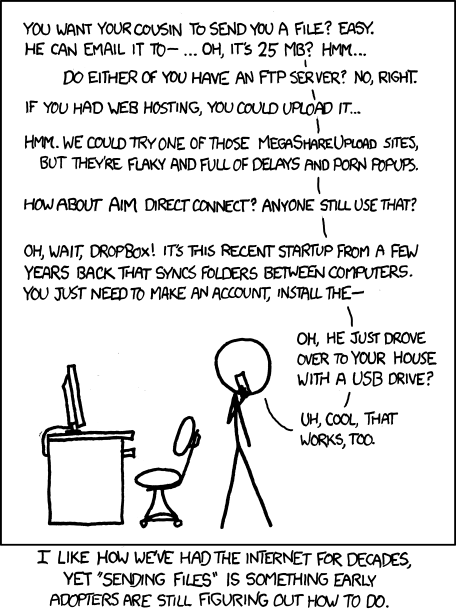
And yet, I can take a flash drive full of movies and physically carry it across town faster than I can send it via the network. Again and still, your personally incredulity is faulty and obviously a broken compass even for determining what is realistic. Let alone for things being playable or narratively satisfying.

Image

-Username17
talozin
Knight-Baron
Posts: 528
Joined: Thu Jan 06, 2011 8:08 pm
Location: Massachusetts, USA

Post by talozin »

Strung Nether wrote: Weapon
-Rifle
--Assualt
--Battle
--Carbine
--Sniper
--Anti-Material
This is way too many "basic" options. No one except gun nerds gives a shit about the difference between an assault rifle and a battle rifle. Just have the basic "rifle" chassis be a modestly powered, low capacity, non-autofire weapon -- the Shadowrun equivalent of a deer rifle. Basic options (like maybe High Capacity, Telescopic Sights, High Powered Ammo, or Autofire) can just be added for money, so you can get a basic AK-47 (base rifle + Autofire + High-Capacity) without needing Guns skill to speak of. But to stack more than x options, or to select advanced option y, you need z level of skill.

Also, some options probably require other options, like you can't take Anti-Materiel Ammo until you already have High-Powered, so it effectively counts as two.
TheFlatline wrote:This is like arguing that blowjobs have to be terrible, pain-inflicting endeavors so that when you get a chick who *doesn't* draw blood everyone can high-five and feel good about it.
Pulsewidth
Apprentice
Posts: 81
Joined: Thu Jan 21, 2010 8:54 am

Post by Pulsewidth »

TheFlatline wrote: Let's put that into perspective:

My phone has 4 cores, each about a 4,000 faster than the computer that took us to the moon. Imagine telling someone from the 60's your phone had a thousand times the total computing power on the earth. They'd think you were fucking insane. Shit the amount of progress in the last 10 years alone has been unpredictable.
You're demonstrating how humans are no good at visualizing large numbers. It's like that Douglas Adams quote about space:
Douglas Adams wrote: Space is big. You just won't believe how vastly, hugely, mind- bogglingly big it is. I mean, you may think it's a long way down the road to the chemist's, but that's just peanuts to space.
You can look at the progress of computer hardware and think "that's a big number", and then look at the work required to break symmetric ciphers and get the exact same "that's a big number" feeling. It's horribly misleading, because in this case we're talking about differences in magnitude that make the difference between a trip to the chemist's and a trip to another galaxy look like a rounding error.

Humans are simply incapable of thinking about encryption intuitively. The only option is to do the math, and the math says everybody wanting breakable encryption (without using side channels attacks) is wrong. Luckily for us, side channel attacks can make for a fun game.
Username17
Serious Badass
Posts: 29894
Joined: Fri Mar 07, 2008 7:54 pm

Post by Username17 »

Pulsewidth wrote:Humans are simply incapable of thinking about encryption intuitively. The only option is to do the math, and the math says everybody wanting breakable encryption (without using side channels attacks) is wrong.
No. The math does not say that. You can approach math in an incredibly stupid way and attempt to make it say that. But that is math as used in a stupid fashion by people who are stupid. That's literally exactly the argument made by Answers in Genesis to explain how evolution couldn't possibly produce a human within the apparent lifespan of the universe.

There is no reason at all to believe that cryptography has to be broken by attempting every possible key and seeing which is the most likely fit. That would indeed take an arbitrarily long time, but actual puzzles in the actual world are not solved that way. Extremely long genetic codes are solved in very short amounts of real time because there are in fact short cuts to solving problems of this sort.

You are literally applying creationist logic to futurism and getting the same "we need a divine intervention shortcut to ever get to the end" conclusion as them. But it's patently ridiculous to believe that is in fact the case.

-Username17
echoVanguard
Knight-Baron
Posts: 738
Joined: Fri Apr 01, 2011 6:35 pm

Post by echoVanguard »

Frank is correct. This article may help illustrate the concept.

echo
Pulsewidth
Apprentice
Posts: 81
Joined: Thu Jan 21, 2010 8:54 am

Post by Pulsewidth »

FrankTrollman wrote: There is no reason at all to believe that cryptography has to be broken by attempting every possible key and seeing which is the most likely fit. That would indeed take an arbitrarily long time, but actual puzzles in the actual world are not solved that way.
Actual puzzles involving correctly used modern ciphers are solved by social engineering or side channel attacks. Nobody breaks AES, and a lot of highly skilled people have put a lot of effort into trying. While it's somewhat plausible that a specific individual cipher has some as yet unknown weakness, it's not at all plausible that every possible cipher does.
echoVanguard wrote: Frank is correct. This article may help illustrate the concept.
This has absolutely nothing to do with people breaking modern symmetric ciphers. This is yet another example of people failing to intuitively understand cryptography and thinking "qeadzcwrsfxv1331" is a strong password. Compare with Diceware (https://en.wikipedia.org/wiki/Diceware) passphrases, where you can mathematically calculate exactly how many bits of entropy you have and set it high enough that no imaginable technology will break it before the heat death of the universe.
User avatar
Ice9
Duke
Posts: 1568
Joined: Fri Mar 07, 2008 7:54 pm

Post by Ice9 »

The thing that gets problematic about computing tasks (like breaking cryptography) that take an amount of time between "seconds" and "centuries" is that suddenly your abstraction of computing power is put under a lot more scrutiny.

If things are nearly instant, or take time that needs scientific notation to write, then you can simply say that computers have "a bunch" of processing power, that having an entire distributed network applied to a problem gives you some kind of defined bonus, and not really go into specific numbers.

But if you say that the file will take three hours to decrypt, questions arise. Questions like - "So if it'll take three hours on a Commlink, how about if I buy 60 Commlinks and do it in three minutes?" or "How much faster would it be on a high-end system?" And handwaving all that is probably going to seem clumsy, or even ridiculous.

Of course, this doesn't only apply to encryption - any computing task with a time you can measure and care about has the same issue. I think there are some things that work better in this regard, like dealing with external factors. For example, it might take three hours to hack into Aztlan's server, because attempting connections more rapidly than a certain rate will trigger an alarm, not because of how fast your personal system is.
Last edited by Ice9 on Tue May 28, 2013 10:43 pm, edited 2 times in total.
Post Reply