 Design Goal
: Have goblinoids be ubiquitous and very morphologically diverse. At least some variants should basically be monsters while other variants should be playable. That said, this morphology shouldn't be something that affects a player's character mid-campaign; these aren't Warhammer greesnskins who grow larger and greener and tougher as they age. Therefore the morphology should stop varying by the age a character would go adventuring.
Designer Notes: I decided it would be more interesting and exotic to have all the goblinoid "species" (goblin, hobgoblin, bugbear) able to interbreed freely to really play up the fast-and-loose nature of gobinoid morphology. Also, I don't like the name bugbear. It's dumb. The actual conceptual space the bugbear inhabits is fine, so that's being kept and even built on a bit, but I hate the name so I'm replacing it. As is the case in most of these revisions, I'm borrowing liberally from the Frank and K Tomes. "Dai Bakemono" and "O-Bakemono" I'm stealing from Dominions 3 and 4, because that's a great game and those are cool names. Also, I know that DnD goblins are orange and Warhammer/Warcraft goblins are green. This is an outgrowth of DnD, so I should go orange, but frankly the green version is the one people think of most often and shows up both higher and more frequently in an image search. I'm just going to let people play orange gobbos or green gobbos as they see fit.
Goblinoids
No matter where you go, there they are.
Goblinoid is an umbrella term to refer to any particular member of the species which has four distinct body types and countless individual differentiations based on climate, parentage, and diet. The four body types are the Hobgoblin, which is medium sized and has an inherent sense of hierarchy, the Dai Bakemono, which is medium sized, mostly carnivorous, and known for violent xenophobia, the O-Bakemono, which is large, dim-witted, and mostly herbivorous, and the Goblin, which is the smallest and most common example of the species.
Despite the wide range of physical differences between individual goblinoids, there are some qualities which are shared by all members of the race. Goblinoids are innately very precise in their movements, making the whole race very quiet. When combined with the heightened dexterity possessed by all goblinoids, the race is quite adept at moving stealthily. All varieties reach physical maturity in their early teens and usually die from old age in their fifties. They are also possessing of a robust constitution and a gastrointestinal tract that is capable of digesting nearly any organic matter swallowed. As a result, goblinoids are immune to ingested poisons and are very capable omnivores, though some body types have a preference for animal or vegetable matter. Goblinoids eyes vary in color from red to yellow and skin coloration lies on a continuum between green and orange (except for Hobgoblins, who are only orange); some individuals are vividly one or the other extreme while still others are a muddier middle color. With the exception of the Hobgoblin, all goblinoids are born adapted to the temperature and lighting of their surroundings. Those from frigid caverns will have heavier fur and darkvision. Those from hot surface regions will have superior heat tolerance and excellent low-light vision. This adaptability has allowed the various types of goblinoids to populate nearly every corner of the globe.
All varieties of goblinoid can interbreed with one another, and the variety of goblinoid born depends on the type, diet, and health of the parents at the time of conception. Healthy and well-fed goblinoids who've predominately eaten meat will tend to sire Dai Bakemono. Healthy and well-fed goblinoids who've predominately eaten plants will tend to sire O-Bakemonos. If both parents are a Hobgoblin, the offspring will always be Hobgoblins. If only one parent is a Hobgoblin then only about one in eight offspring will be Hobgoblins. Any other combination of health, diet, and type will result predominately in Goblins. This is because while Goblins are neither as large, strong, nor fierce as the other goblinoid types, they are the most versatile. They are the best at stealth and are capable of living on both less food and a wider range of food than the others. The eyes of a young goblinoid will quickly and permanently adapt to either darkvision or low-light vision, depending on whichever is most advantageous for their surroundings, though Hobgoblins defy this and only ever possess darkvision. Non-Hobgoblins born in areas of extreme temperatures will become adapted to comfortably live in either cold or heat, though at the cost of finding the other extreme more difficult to cope with. An under-nourished goblinoid will become slightly but noticably shorter, while a healthy one will stand a little taller. Meat consumption tends to enhance aggression in goblinoids, regardless of the type.
Goblinoid Traits
* +4 racial bonus to Move Silently
* Darkvision 60' or Low-Light Vision
* Immunity to Ingested Poisons
* Optionally, one of the following:
** Cold Endurance and Heat Weakness: a +4 racial bonus on Fortitude saves made to resist the effects of cold weather or exposure, and a -4 racial penalty on Fortitude saves made to resist the effects of hot weather
** Heat Endurance and Cold Weakness: a +4 racial bonus on Fortitude saves made to resist the effects of hot weather, and a -4 racial penalty on Fortitude saves made to resist the effects of cold weather or exposure
 Goblins:
The most common type of goblinoid, a goblin (also called a gobbo or gob) ranges from slightly less than three feet to three-and-a-half feet tall and weighs thirty five to fifty pounds. That range of height and weight can apply to the same adult goblin over the course of a year, depending on their health and diet. Goblins are predisposed towards mild xenophobia, and so they tend to get along with other races poorly. However, of all the types of goblinoids, goblins exhibit the widest range of personalities, being about on par with that of humans in terms of variety. Simply put, it is practically guaranteed that goblins live wherever it is you care to name, and if they don't it is only because they were driven out. The goblinoid species has easily been the most successful humanoid species at spreading across the globe, and the goblin is the most widespread of the goblinoids. They may not always be in charge, they may not always be respected, sometimes they may even be in hiding, but they are almost always present.
Because of their size and racial advantages in stealth, most goblins become rogues, though goblin wizards and barbarians are known to also benefit from superior hiding and sneaking.
Stats: Small Size, Move Speed 20, +2 dex, +2 con, -2 str, -2 cha
 Hobgoblins:
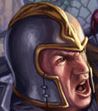
The Hobgoblins (also called hobbos or hobs) grow to a little less than the size and mass of an adult human. They have brownish-orange skin and short, coarse hair over their shoulders, neck and head but they are completely hairless from the chest down. They have triangular shark-like teeth that are yellow by default and a brown, flat, pug-like noses which become blue or red colored for adult males. They are omnivorous, preferring a combination of meats (mostly fish and insects), grains, nuts, and a few bitter fruits. Cherries, cherry blossoms and the fermented products thereof are potent intoxicants for the Hobgoblins. Hobs are a curious exception to many of the truisms about goblinoids. They do not adapt to extreme heat or cold, nor do possess anything other than darkvision. Their size varies less based on health and diet than the other goblinoids, and hobs only arise when at least one parent is itself a hob.
Most significantly of all, they have an inherent sense of hierarchy which instinctively informs an individual whether it ranks above or below each other nearby creature. This is not an official rank (though hobgoblin society and military does tend to structure itself using this ranking instinct) but rather a subjective sense of superiority or inferiority based on a wide range of subconscious cues. This sense seems to have sublimated the goblinoid penchant for xenophobia, so hobgoblins have no inherent dislike of other species, though non-hobgoblins tend to be perceived as inferior. It is speculated by some that the hobgoblin type was created artificially by some powerful, interested party. The hobgoblins certainly have the most difficult time resisting magical charms and compulsions, and they do have a long history of serving under powerful warlords and casters. Regardless, the hobs can and do form their own civilizations, including the sprawling Great Khanate.
Hobgoblins have an inborn disinterest to magic, so hobgoblin casters are rare. The largest hobgoblin society, the Great Khanate, places an emphasis on controlled martial prowess and direct combat, so most hobgoblins are fighters or samurai.
Stats: Medium Size, Move Speed 30, +2 dex, +2 con, -4 wis, darkvision only, no Heat or Cold endurance
 Dai Bakemono:
Easily the most widely disliked goblinoid, the Dai Bakemono (or daibo for short) are extremely aggressive, very anti-social, and fiercely xenophobic. The daibo are slightly larger and more heavily built than a hobgoblin, and possess the morphological variety characteristic of the goblinoid race, looking like muscular, 6+ feet tall goblins. A daibo receives little sustenance from plant matter compared to other goblinoids and by choice will subsist entirely on meat. Daibo tend to congregate into packs of up to twenty individuals and then lay claim to a swath of territory of a size sufficient to feed them, either by hunting, theft, or, in a friendly goblinoid society, offerings of food. The pack will feel compelled to patrol this territory in shifts day and night, and will attempt to ambush, kill, and possibly eat any non-goblinoids that enter it.
Dai Bakemono are, to non-goblinoids, brigands, assassins, and serial killers. Even other goblinoids can find their sociopathy unnerving. The fact that a well-fed and prosperous goblin family, no matter how friendly and naturalized, can give rise to this variant has done more than any other factor to ensure goblins are pushed to the margins of society. In the overwhelming majority of non-goblinoid societies, daibo are considered "kill on sight". Since the Hobgoblin Khanate is so inclusive of non-goblinoids, it has to employ the daibos as shock troops in remote locations or drive the daibos out entirely. Only in purely goblinoid societies are daibos permitted. If fed and kept occupied, they will leave the other goblinoids alone and continue their patrols. This makes them virtually indistinguishable from a very energetic volunteer army, except one that you can't tell to stand down and one you can only barely direct. However, should the daibos run out of food and foes, they will turn on whatever goblinoids happen to annoy them, including other daibos.
Dai Bakemono is not generally considered a playable race. Those with class levels are usually rogues or rangers.
Stats: Medium Size, Move Speed 30, +2 dex, +2 con, +2 str, -6 cha
 Yes, this art is from a sprite game. Just squint and make the best of it.
O-Bakemono:
The largest and strongest of the goblinoids, O-bakemono (or obo for short... yes, pronounced like the reed instrument) are physically imposing, though they rarely attack unprovoked. An obo can stand between eight and ten feet tall and weigh as much as 600 pounds. They have a large, squarish jawline that juts out noticeably and it is rare for an obo to stop eating for any length of time; they continue to chew even while sleeping. Obos primarily eat plants and their powerful jaw, large molars, and elongated digestive tract enables them to subsist on greenery too tough or nutrient-poor to support their smaller brethren. They commonly carry great clubs which they will use as weapons, but most commonly use as tools to break apart or uproot larger plants; the club itself is often a large tree limb the obo has eaten all the leaves off of.
O-Bakemono are the least intelligent and shyest of the goblinoids and generally prefer to avoid contact with non-goblinoids altogether. An obo's personality can generally be described as "placid yet child-like". They are noted for a short attention span and occasional, extreme shifts in mood. Though uncommon, it is never wise to be near an obo during a tantrum. Despite their immense size and bulk, the obo retains the innate stealth of its race, and though it isn't as dexterous as the smaller goblinoids, it is very nimble for it's size. Obos tend to live in groups of up to eight individuals who all share a shelter, usually a shallow cave or large lean-to, but they tend to forage singularly or in pairs. The members of the group will wander off if the area becomes threatening or if the food supply has been exhausted. These individuals will join or form new groups wherever they decide to inhabit next. In most civilized areas, obos are driven off and patrols are typically needed to keep them from sneaking back and eating a swath through farmed crops. Goblinoid societies typically use them as heavy laborers and immense shock troops. The same attempts have been made by other societies, but the obo is too wary of non-goblinoids to cooperate without magical coercion or goblinoid handlers.
O-Bakemono is not considered a playable race. Those with class levels are usually barbarians, though a minority become druids or rangers.
Stats: Large Size, Move Speed 40, +6 str, +4 con, -4 int, -4 cha, -2 wis