Listening To: My Rifle, My Pony, and Me by Dean Martin
The next chapters cover character creation in-depth. The 'basic characters' are designed to get you into a shooting match ASAP, but it turns out that they don't really represent characters as they exist in the game very well. Real character creation involves rolling attributes and spending Building Points. While it's broken out into seven chapters, it really makes more sense as sub-sections. Chapter 4 explains the process, and the chapters following provide the details.
It is not simple. It is so not simple that there's a flow-chart. It is so not simple that it's difficult to explain why it's complex, but let's start with Building Points generally. Lots of games use building points (BPs) to create characters - Shadow Run famously. In Shadowrun (at least some editions) you prioritized certain things like a race or class and you got less points for other categories. Choosing from a limited menu
is good design - it allows players to make choices (good!) without being overwhelmed by considering all of the possibilities at once (good!).
Aces & Eights doesn't give you a certain number of Building Points for each category - you get one big pile to start and you get to decide how you spend them. The one caveat is that only the first BPs you get (40 for everyone, plus a bonus depending on some ability score placement) can be spent to raise attributes.
You can spend your BPs on raising attributes, purchasing skills and talents, re-rolling certain bad random options that may occur in character creation, and converting to starting money. How many skills is 'appropriate' for a starting character? Is it better to raise your stats? You get BPs when you adventure, so how important is it to buy things up front versus waiting until later? Oh yeah, you can bank them!
Ability Scores
You generate 7 ability scores by rolling 3d6. With each ability score you roll a d%, so your Strength might be 10.76. The first number represents your actual Strength score, the second number how close you are to raising it to an 11. If you keep your stats in the order you roll them you get 50 BP (enough to add +2.5 to your attributes if they're between 10-16; it costs less if they're low and more if they're high). Unlike 3.x where attributes provide a consistent bonus, you have to look up each ability. Most ability modifiers range from -3 to +3, but some range from -5 to +7. Most ability scores only care about a full +1 bonus, but some care bout .50 bonuses.
For example, a Strength of 13 and 13.50 are both +1 on damage, but the 13.50 gives you an additional bonus on 'feats of strength', as well as higher carrying capacity. The fact that you can get a +7 on damage from a high STR but you're limited to an accuracy of +3 for high Intelligence may be a recognition that some ability scores are more valuable - instead of making one less expensive on the front end, they're making the benefit of raising it higher on the backend, and that's more confusing, really. The one thing is that once you have your scores on a character sheet, you don't have to look back at the charts for reference - but for people with 3.x experience you're going to long for a consistent bonus for each attribute.
Even worse, modifiers may be either positive or negative. High Strength and Intelligence give you positive numbers, but Wisdom, Dexterity, and Constitution give you negative numbers (which are good when they apply).
The Attributes
I mentioned that you had seven ability scores, and the reason is that you have the six attributes you think of from D&D (Str, Dex, Con, Int, Wis, Chr) plus
looks. Since Charisma is obviously the most important ability score it had to be broken up into two separate abilities.
In addition to the abilities helping when you take an action that uses that abilities, having a high score for Intelligence, Wisdom, and Charisma give you bonus BP. A high looks gives you a bonus to Charisma (but later if you get disfigured your Charisma drops).
These types of things reward system mastery. It's possible to figure out where the good deals are, but it's not easy or intuitive. Raising Wisdom from a 14 to a 15 costs 20 BP, but it gives you an extra +5 BP, so the net cost is only 15; raising it from a 15 to a 16 costs 20 but gives you an extra 6, but it doesn't increase your Speed Modifier.
Your most important attribute is Dexterity. Dexterity has a major impact on your Speed
and Accuracy. Wisdom has a lesser impact on Speed and provides a BP bonus; Intelligence has a lesser impact on Accuracy and provides a BP bonus; Constitution affects how you heal; Looks has a major impact on your Charisma and Reputation, Charisma has a lesser impact and provides extra BP.
Example Characters
Character 1: S12.09; I10.42; W7.05; D8.83; C12.23; L13.78; Cha9.26
Character 2: S13.96; I15.64; W10.85; D14.10; C14.80; L7.59; Cha13.21
In this case, Character 2 is definitely the better character. Focusing there; if I keep the scores as rolled I get 50 bonus BP. The only score that's bad is Looks, raising that to a 10.04 costs 25, leaving me with 65. I get 10 Bonus BP for my Int*, and I'm going to spend 8 of them to raise my INT to 16 (giving me 5 more BP), so I'm at 73. My wisdom doesn't qualify for bonus BP, while raising it to 11 would give me +1 BP it doesn't increase any modifiers, so I leave it. My Charisma gives me +3 BP, and raising it to 14 would cost me 16 BP and give me an extra 3, I leave it so I now have 74 BP. I definitely want to raise my Dex to 16 which costs me 38. My character stats now appear as:
S13.96; I16.04,; W10.85; D16.00; C14.80; L10.04; Cha 13.21. I still have 21 (of the 40 original BP), plus 15 'bonus BP'. The next increase for Dexterity modifiers is at 17.50 which would cost 50 BP.
Note: I can't spend BP I get later (for example from quirks and flaws on ability scores. I also can't spend bonus BP for high Int here, they have to be spent later on Int skills. That's a pretty good reason to spend them all now and worry less about other things I could buy - more on that as we get into those other options. Now, skipping ahead, your Reputation is also going to give you BPs that can be used for things other than attributes. Your Reputation is based on the average of your abilities. Add them all up and divide by 7. For me that's a 14.12. If I was just shy of 14 (like 13.99) it would probably be worth it to make sure I bump them enough to cross the line.
More Point Shenanigans
I opted to keep my ability scores in the order I rolled them for the 50 extra BP. If I had swapped two scores but left everything else where it was rolled I would have gotten 25 BP (ie, if for Character 1 I swapped Looks for Dex). If I decide to arrange as desired I qualify for no extra BP.
I can also burn ability scores to generate BP; dropping an ability be 1 point earns me 7 BP. Since raising a Stat costs 20 BP it's a bad trade. A slightly less bad option is directly trading between ability scores. Like so much else, there's a chart. If I'm raising a score that's between 8 and 10, I can subtract 2 from any other ability for a +1 (ie, Character 1 could take a -2 STR for a +1 Dex.
Ability Checks
So Ability Scores modify things like Speed and Accuracy, but only Strength and Dexterity have a real 'modifier'. That is, sometimes you make a Strength Check (feat of Strength) or a Dex Check (feat of Agility) and you roll a d20 and add your modifier. Most checks don't work like that. Instead you roll UNDER your ability score. If you make a CON check, you roll a d20 and I'm looking to get under a 14. A particularly difficult check might be 1/2 CON, meaning I have to roll a 7 or lower. That's a lot to keep straight!

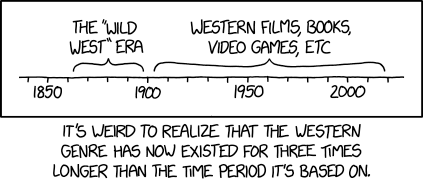
And we haven't even decided how anachronistic we're going to be
Reputation
With my average ability score of 14 and a +1 Reputation Bonus for my Charisma, I have a Reputation of 15, which gives me 35 BP. I can't use them to raise my stats, but I still have 21 BP from character creation, plus 15 Int Bonus BP. Since they have to be used differently, I basically have to keep them separate. Basically from this point on I'll spend my 'new BP' and then if I have anything left at the end from my 'original BP' I can invest them in bumping my attributes by a few tenths of a point.
Covered in the Advanced Scrapes is the effects of Reputation. With a Reputation of 15, I'm 'low reputation'. If I'm in a gunfight and I lose 25% of my hit points, I must take cover, and if I'm shot
at I must flee. Telling players how they need to play their character usually doesn't go over well. In order to get out of Low Reputation, I need to get to 20 - now I flee if I lose 50% of my hit points. To have full choice about whether to stay or run, I need to get to a Reputation of 70.
There's a whole lot of things that gain or lose reputation. This is the primary method of enforcing genre conceits. If you allow an opponent to pick up a dropped weapon, you get +3 Reputation. If you shoot a man in the back, you lose 5 reputation. Since you want to have enough Reputation to control your character, you mostly want to do things that give you Reputation.
You can opt to spend Reputation for a reroll. At 10 points per re-roll (and you're not guaranteed a better result) spending Reputation is foolish and you should never do it. At least not until you've attained 'Great Reputation' of 70+. At that point you get a free re-roll once per session that doesn't cost you, and if you're enough above 70 you could buy the re-roll without dropping a category.

When you have to shoot, shoot! Don't talk
If you get negative reputation, it becomes infamy. It works basically the same way, where the ABSOLUTE VALUE of your score matters. Taking the absolute value of a negative number isn't a particularly difficult mathematical concept, but it's a little more figurin' than I figured to do in my cowboy shooting game.
Fame
While it's covered in the same chapter, and accumulates in the same way (but some things that lose you reputation gain you fame) it works a little more like
level. If you fight someone that has a low reputation (below 20) or average reputation (below 70) your fame differential gives you an advantage over them. Essentially, your fame awes them and they suffer a penalty to accuracy and speed based on the difference. It's a +2/-2 for every 25 points of fame DIFFERENCE for low-rep and +1/-2 for every 25 points of fame DIFFERENCE for average-rep. Again, with a Reputation of 70+ you don't have to worry about Fame causing you a problem. Unlike reputation, fame fades (-1 point per game month) but never goes away completely.
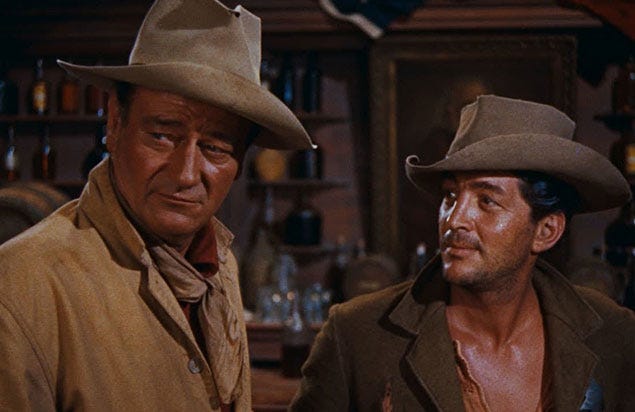
And here he is, the most famous cowboy of them all, with Dean Martin in the movie where he sang our starting song
Priors and Particulars
Chapter 6 is background information like height and weight. There are 27 tables that you'll be rolling on, and most of them don't matter. If you don't like a result, you can re-roll for 1 BP. One of the tables is birthplace, and it does include the countries they made up, so TECHNICALLY it came up again, but since it doesn't do anything, I'm not sure I should count it. You probably have siblings, and most of them are probably dead, but if you were lucky enough to have been born first you get bonus starting money. Upbringing is probably the first table worth spending a BP for a re-roll. There are 3 good results (+1 BP, +3 BP, +5 BP), 1 neutral result, and 2 bad results (get a quirk but get fewer BP than usual for them). I got the +1 BP result, so I won't re-roll and risk a worse result. That leaves me with 72 BP (half that can be used for attribute bonuses).
Social class is a d100 roll with an 80% chance of a bad result, a 27% chance of a neutral result, and a 3% chance of a good result. My first roll would have reduced my reputation by 3 and resuced my starting money, so I spent on BP for a re-roll and ended up Middle Middle Class, which doesn't give me any bonuses or penalties and lets me roll on an occupation table that has generally good options - I got Civil Engineer so I get Engineering, Design, and Mathematics for free. I got a decent roll on Starting Money, so I get $35 to start. I can convert 1BP to $5, so once I know whether $35 is enough I'll go back and increase that as necessary.
Quirks and Flaws
Choosing a quirk or flaw gives you an in-game penalty, but rewards you with extra BP. The game assumes you're going to roll randomly for quirks and flaws. If you prefer, you can choose a flaw (one that you think won't impact you too much) but you don't get as many BP. Abstaining from something (sex or alcohol or some others determined randomly) is worth 30 BP if you roll it randomly, 15 if you pick it, or 10 if you've already selected a different quirk/flaw.
A random roll is a d1000 and there's roughly 100 quirks/flaws you can get saddled with, giving you between 10-60 BP. Since you will get more BP for successfully adventuring and you can't spend these BP to raise your stats, I don't see much reason to bother with them. 'Cherry Picking' for the half-BP might be fun if you wanted to play a character that was 'honest to a fault' anyway, but otherwise you could randomly roll something really unhelpful, like Blind-in-one-eye for a -2 on accuracy. There's no reason you would take these at this point, though, because you haven't spent your BPs on Skills and Talents. After you get the full buffet of options, maybe you'll be tempted to go point-whoring.
We'll look at ways to spend BPs outside of attribute re-rolls next time when we hit Skills and Talents.