[Review]7th Sea & Swashbuckling Adventures

General questions, debates, and rants about RPGs

Moderator: Moderators

User avatar
deaddmwalking
King
Posts: 5352
Joined: Mon May 21, 2012 11:33 am

[Review]7th Sea & Swashbuckling Adventures

Post by deaddmwalking »

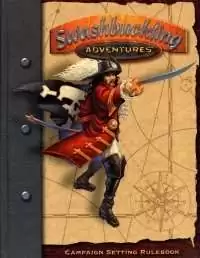
I have mentioned a time or two that I keep an eye out for relatively inexpensive used RPG books, and years and years ago I picked up Swashbuckling Adventures - not just the main book but at least 11 total, including many regional books.


Image
This Guy


Now, it's worth mentioning that Swashbuckling Adventures was published in 2003 - this was early in the d20 boom - by Alderac Entertainment Group (AEG). If you were a publisher that had a lot of world material, you might do well to update it to d20 and release it. The buying public was eating that stuff up! It wasn't exactly shovelware, where they were just procedurally generating content. It's only mostly shovelware where they were procedurally generating content to fit the d20 system, but there was also a lot of material that drew on their world setting of Théah. So let's call it a conversion, and for anyone publishing RPGs at the time, I can't fault them for doing it.

What I never really came across was much in the way of 7th Sea Adventures, published in 1999 by AEG. That was a time when D&D didn't dominate the industry, and games like Vampire: the Masquerade were sharing shelf-space with AD&D 2nd Edition. I was in college experimenting with Deadlands (originally published in 1996), which also ended up doing a d20 edition. Around this time I don't think anyone knew how big the d20 boom would be, or that D&D would once again dominate the market, and it'd be hard to find games. So, I think 7th Sea was published at a rather unlucky time to carve itself a niche in the gaming hobby world. But even though that might be true, I know I heard of it!


Image

Let's just say that when I first encountered 7th Sea it wasn't what I was looking for, and it certainly wasn't what my compadres was looking for. I played Shadowrun and Rifts and GURPS and Deadlands and so, so, so much D&D. I know I looked at my Swashbuckling Adventures books, but it was quite a lot different from D&D. Freeport offered a chance to be pirates with the normal D&D rules, so we may have experimented with that setting a time or two, but we just never made it to Théah.

I've also mentioned that I'm working on a Western RPG, and there are some things about Westerns that don't necessarily lend themselves to the d20 system. There were times I thought that making a pirate-RPG would be easier; guns aren't quite as important in the setting, so swinging a cutlass is still a huge part of combat - basically if I could get a pirate-RPG right it would be a smaller step to then get a Western right. It would also be more work and I've not made nearly the type of progress I should, but it's worth looking at what other RPGs did. And while I realized that I hadn't found the books in physical form (my preferred method of reading) I could get them in PDF. So I did!

So what are we looking at, anyway? Well, there's a 2nd printing of the 7th Sea Player's Guide from February 2000. There's a 'compendium' that appears to update the first printing rules to the 2nd printing rules, but since this version appears to have already incorporated all of that, I'm only referring to it to see what the original rule was and speculate on why it might have changed. There's also a Compendium from Oct 2001 that is like an SRD - it has all the rule information but none of the fiction and is presented in a more of a text book style. When I get confused I'll look at that. But first, we'll do a quick run through of the d20 version - since I know we're all familiar with the d20 system we'll make that quick and sort of use it as a baseline for comparing whether the original system achieved it's goals better or worse than the d20 conversion.
-This space intentionally left blank
User avatar
deaddmwalking
King
Posts: 5352
Joined: Mon May 21, 2012 11:33 am

Re: [Review]7th Sea & Swashbuckling Adventures

Post by deaddmwalking »

The original version of 7th Sea was written by Jennifer and John Wick.



Image
I don't know that this ISN'T him - or maybe that the character is based on him?


The d20 conversion is principally written by Erik-Jason Yaple, and the Wicks get 'additional material' credit along with a host of other people (presumably people that helped expand the line and write travelogues of the various not-European-pastiche counties. There are also about 10 play testers, while the original had like 10 that had last names starting with 'B'. We have a map, an open gaming license, the table of contents and Introduction. The Introduction is a half-page of fiction followed by a promise that you can use the book as your default setting, or just dumpster-dive to feed your other d20 campaign. It's up to you!


Since the PHB starts with Races, this book does, too! But it's Races and Nationalities, so it might be helpful to look at the map.


Image


What you're seeing above is almost exactly the map in the book, except the book doesn't have 'occupied Castille'. Just from the names of the countries it should be pretty obvious that we have Not-England (Avalon), Not-Vikings (Vestel), Not-Russia (Ussura), Not-China (Cathay), Not-Arabia (Empire of the Crescent Moon), Not-Italy (Vodacce), Not-Spain (Castille), Not-France (Montaigne), and Not-Germany (Eisen). Now, you're probably asking what Vikings are doing in a Renaissance not-Europe, and my response to you is, have you even been to a Renn Faire?


Image
People like Vikings


The Not-Vikings have kin who are adapted to modern times, but the traditionalists don't get along with them. So in addition to Vikings, we have some Nordic-Dutch based sea-traders. Since this adaptation of Europe is VERY SIMILAR, there are countries that are 'traditionally religious' (analog to Catholic) and those that are 'Objectionist' (analog to Protestant) and religious wars have rent the continent. Everything has a different name, but the basic history is mostly what you'd expect except that the not-Vatican (Vaticine City) is in non-Spain instead of not-Italy or not-Avignon in Not-France. The stereotypes are not deep - Voddace is mafia-coded machismo hot-blooded Mediterraneans, and Motaigne are effeminate and style-conscious. They've also had their revolution, but not all the nobles are dead, and the whole country is excommunicated for blatant sorcery. Mechanically, everyone in Théah is a normal human; but instead of 4 bonus skill points at 1st level, they get 2. In place of the two skills they lose, two skills are added to their skill list regardless of class.

Skill points in 3.x are basically a pile of accounting-fail and class/cross-class skills are hot garbage. Skills aren't important enough that they needed gate-keeping, so when I played 3.x it has been a long, long time that we maintained that divide, but in a standard 3.x campaign having skills as class-skills regardless of class might actually be meaningful.

Classes
In keeping with the 'you can use this book for any campaign' they have advice for using Clerics, Druids, Sorcerers and Wizards in other settings, but in Théah spell-casting is by blood-line so those classes are out. Other classes that have incidental spell-casting like Ranger and Bard use a non-spell-casting equivalent. So the only core classes that exist as written are barbarians, fighters, monks, and rogues. They add to this a dozen new classes. Let's take a look!

First off, the bard loses magic. They keep bardic music and the quasi-magical effects. They gain an ability that let's them take a full-round action to potentially stun an enemy for one round. Eventually he can do it 4/day. At 17th level he gains command once per day. There is only one spell-casting base class (Witch) but at 17th level she can cast hold person 5/day and charm person 5/day and finger of death once per day, so even though it's a caster that only gets 6th level spells, casters are better than you. The Paladin gets Religious Fury in place of spell casting - a bonus to attack/damage equal to your Charisma bonus and the ability to move and full-attack, but you also count as flat-footed and lose all dodge bonuses to AC, so hope that +4 to attack and damage is worth getting hit for +3d6 sneak attack you're getting hit with. The Ranger gets 'healing herbs' which let you spend an hour to find plants with curative properties that work over night while resting. The witch gets cure light wounds at 4th level, so at level 3 when you first get this ability you might care, but probably not.

The first new class is their version of the alchemist. The alchemist can brew potions up to 9th level from any spell list (provided it makes sense as a potion). Outside of that, they can make daily elixirs that function as spells from a very restricted list. Next up is the Assassin - a sneak-attack class with poison use and death attack. At 15th level their sneak attack also does 1d6-1 STR damage. Since there are no fireballs in Théah, losing evasion is probably not too big a price to pay. The Courier gets a +4 bonus to social interactions at 1st level, so works as a Diplomancer chassis even though their other abilities are all pretty lame. The Highwayman is a 3/4 BAB class that gets abilities that mostly emulate feats, so they might as well be a fighter and take those feats as bonus feats. And if you're aspiring to be a fighter, well, you've failed at life. The Inquisitor gets Special abilities at almost every level, but most special abilities an't be taken until you're over a certain level (like 10th or 16th). So they get Sneak Attack +5d6 by 10th level. But you could have that being an assassin - it's all the abilities to call on church resources that mean a damn thing and that's going to probably mean asking the GM for special permission to use your class abilities. The Musketeer is another Fighter-wannabe with a good will save instead of Fort and a bunch of bonus feats, but instead of regular bonus feats to start you get Expertise with the Rapier and Two-Weapon Fighting. Then once/day you get a +2 to a single roll, so hard to say you're better than a regular Fighter. You do get more skill points and some are for better skills. The Noble is another social class with abilities related to commanding people but is not nearly as good as spellcasting. The Pirate is another fighter like class, but it gets an ability EVERY SINGLE LEVEL. With a good Fort and Reflex save, the question is whether the abilities are better than feats. Mostly they are not - weapon specialization and Two-weapon fighting are some of the abilities, and every odd level is just +2 skill points. The spy is another sneak attack class that has special abilities about getting information. And finally we get to the Swashbuckler. Since this is Swashbuckling Adventures you'd maybe expect that this is the best class. It is not. It's another fighter-like class with bonus feats and the ability to add Charisma Modifier to damage at high levels a few times per day.

Two more to go!

The Wanders gets all the defensive abilities that a rogue gets (like Evasion, Uncanny Dodge), some bonus feats, and a few random abilities like automatically succeeding on a saving throw 1/week at 18th level. You're definitely better off with a vanilla rogue. Finally the witch - you get 6th level spells and cast them like a sorcerer.

Personally, I'm not a fan of class-plosion. Each class has to justify it's existence against every other class - if it's very similar to a rogue but better, everyone who wants to play a rogue should pick that; if it's very similar to a rogue but worse, everyone should just play a rogue. If you have a class ability that is worth anything at all, it could probably be a feat. I know that 3.x characters didn't get ENOUGH FEATS, but a few of these class abilities and just saying 'in Théah everyone gets a feat every level' you'd solve a lot of the problems.

In any case, none of the abilities directly evoke SWASHBUCKLING. Of course, if they did, that'd be a problem - you can't have Musketeers unable to buckle their swash because it's a Swashbuckler's exclusive class ability. And 'Iron Glare' as an ability that overwhelms people with your awesomeness really should just be something anyone with Intimidate might be able to do.


Image
I'm filled with derring-do even when I'm not a pirate


So I said that we'd have the d20 to use as a baseline - we're all familiar with the classes style and this quick run-down confirms what you'd expect. There's some variations in attack bonuses and skill lists, and the classes have a few special abilities that are mostly unique.

The original 7th Sea book gives an overview of Heroes (all characters in 7th Sea are Heroes) early in the book, but then has the actual character creation section start on page 103/258. Every character gets 100 building points and they spend it on Traits, skills, knacks, Advantages and Backgrounds (and potentially other things). It has you spending your points before you understand what things do - like do you want to spend 40 points to be a potent sorcerer, or 20 points to be a half-blood sorcerer (much more limited).

The 7th Sea book uses d10s added together to determine success. Usually a roll is based on your Trait (1-3 to start) and your Knack (also potentially 1-3 to start). TNs are variable from 5 (easy) to 40 (legendary). Often you are limited to how many dice you use, so you might see 8k1 (roll 8d10, keep 1) or 5k3 (roll 5d10, keep 3). Numbers are added together, so a 5, 7, 3, is a 15. D10s explode, so a 10, 7, 3 is 20 + another roll on the d10 which could also explode.

We'll come back to that, but basically to swing a sword a character is going to roll a trait + skill and they're going to keep some number of dice, and how they invest their resources is going to determine whether they're really good or really bad. Trait determines how many dice you keep, but it costs more than raising your skill.

As a result of differences in how you allocate your points, you can be significantly better or worse than another character in a variety of ways. There are also advantages you can purchase that affect the cost. For example, martial skills cost 2 building points, but Academy Training costs 4, but reduces the cost of martial skills to 1 point. If you're planning on buying 4 martial skills you can either pay 8 points (2 points for each skill) or buy Academy (4 points) and pay 1 point for each skill. On the other hand, the more points you put into skills, the less you have for Traits.

One review I looked at the reviewer bragged that he could make a character in less than 30 minutes because of his intimate familiarity with the rules. It would take me significantly longer, I'm sure.
-This space intentionally left blank
User avatar
deaddmwalking
King
Posts: 5352
Joined: Mon May 21, 2012 11:33 am

Re: [Review]7th Sea & Swashbuckling Adventures

Post by deaddmwalking »

Prestige Classes

There are 91 pages of Prestige Classes in Swashbuckling Adventures. This includes 17 'universal' prestige classes and roughly 5-10 region specific prestige classes for 9 regions, plus secret societies and the church in general. Since this is a d20 product, most of them you don't care. I've already complained about class-plosion with BASE CLASSES, and it's worse with Prestige Classes. How is a Buccaneer different from a pirate? Well you can stop gaining pirate abilities and get abilities that work only if someone else is ALSO a buccaneer. Do you really need a 5-level prestige class to distinguish between The Helmsman and the Midshipman? Most of the abilities are things that a professional probably ought to be able to do with their skills and training, but nobody sat down to explain what a sailor does when 'tending the sails' under cannon fire.

The book identifies three prestige classes as 'a different power level', and those are worth mentioning. One is a knock off of the Dread Pirate Roberts.


Image
I'm not the real Dread Pirate Roberts


It comes with a +1 1/2 BAB (ie, +15 in 10 levels) and lots of abilities that cause fear and abilities that automatically crit frightened opponents. You need Reis's scythe and coat (and he must be dead) to take on the mantle, but otherwise you could qualify for this at 2nd level.

The second of the three 'uber' prestige classes is Champion of the Lady of the Lake - it gives you a sword that deals extra damage against non-good opponents, so it's not EXACTLY like Elothar, but it's not too far off.

The third uber prestige class is the Chosen One.


Image
I am not John Wick this time

The Chosen One gets clerical spell casting up to 6th level spells at first level, and has 9th level spells by 7th. With a BAB+7 requirement this would actually be a good option for martial characters to transition into mid-levels of play (provided you can convince the GM that you should qualify). Since there's only one EVER at a time, just qualifying and making sure the current one is dead isn't enough to guarantee entry.


Anyways, skipping all the 40 or so 'regional place name swordman' and other similarly boring things, we're at the half-way point in the d20 book, moving to chapter 4, Feats.
-This space intentionally left blank
User avatar
deaddmwalking
King
Posts: 5352
Joined: Mon May 21, 2012 11:33 am

Re: [Review]7th Sea & Swashbuckling Adventures

Post by deaddmwalking »

Feats

So if there's anything more mind-numbing than reading dozens of prestige classes that will never see play, it's reading lists of feats. Especially if these feats are similarly never going to be used. A couple of examples are:

1) Barterer - Prereq: 4 ranks in Appraise; you get a +3 on Bluff and Sense Motive when haggling
2) Beat - Prereq: Str13+, BAB +1; if your opponent is using a defensive stance and you hit, your attack doesn't do damage but prevents them from making their primary attack on their next turn, also losing armor or dodge bonuses; finally they must make a REF save DC 10 or become disarmed.

While there's a lot going on in the second one, losing damage for potentially disarming a foe isn't really a good trade. With 22 pages of feats and roughly 8 each page, that's 172 feats that aren't bad compared to feats published at a similar time. But you're still not going to use most of them. With 5 players and a mid-level campaign (say 12th level) with all humans and several classes with bonus feats you'd be LUCKY to use 40 feats. And even if a feat is kinda cool, very few of them provide a MARGINAL benefit to justify their cost.


Image
Miracle Worker doesn't let you bring back people from being mostly dead


For example, Weapon Mastery - Ranged Weapons - requires that you have exotic weapon proficiency in two ranged weapons. And if you have that you can take one feat and have proficiency with ALL exotic ranged weapons. While that's cheaper than taking 10 or 15 exotic weapons individually, what's the point of having proficiency in 3+ ranged exotic weapons when you're going to virtually always use your primary weapon.

As much as I am a fan of a level-based system for helping ensure that characters are BALANCED (receiving appropriate bonuses to attacks, defenses and special abilities), the original game allows you to take advantages by spending XP. Theoretically, you could eventually choose all of the advantages (definitely all the ones you wanted, anyway) if you play (and survive) long enough.

The original game has approximately 30 advantages, and they have variable costs (often a reduced cost based on national heritage). Many of these allow you to buy particular skills at a lower cost, often only for starting characters. These types of things really allow someone to 'win' at character creation - if you consider and evaluate each option you can calculate a 'break-even point' so the same collection of skills/knacks could cost significantly less based on these choices.

As far as knowing what the choices do, that's not easy. One of the things Username17 said that I agree with - it's either important that the developer's understand the probabilities that the game is balanced to or they should be clear enough that players can understand those probabilities.

I found a 'cheat sheet' for probabilities created by Stephen D'Angelo at what was the Crystal Keep, and it's helpful. The base game proposes TNs in steps of 5 from 5 (5, 10, 15, 20, 25, 30, 35, 40). A 'normal character' might have 5k3 in an area of specialty at level 1 (trait 3, skill 2). Against a TN 20 they'd succeed 72% of the time, against a 25 that drops to 42%. A 4k2 character is at 29% and 15% respectively. While it's possible to intuit that more rolls and more keeps equate to better results, directly comparing, say, 5k3 versus 8k2 is not obvious. Against a TN of 25, 5k3 is 42% and 8k2 is 34%. A rule of thumb that'll do is K1 is worth +2 dice. Ie, if you have a choice between raising 3k2 to 5k2 or 3k3 those are about equivalent in benefit.

Buying up an attribute costs 8 building points at creation; buying a martial skill costs 2 BP, then 3 BP per rank of Knack (with basic knacks starting at 1, and advanced knacks needing to be purchased separately, costing 3 each). Just like D&D 3.x, accounting for skill point expenditures is REALLY hard. They have quite a few 'sample characters' and it's not clear to me if they're all supposed to represent starting characters (100 BP) or more advanced characters.

One flaw in many Point-Buy Games (and repeated here) is that equipment, especially the best equipment, costs building points. If you want the best armor in the game you could spend 40 BP on it, or you could plan to make sure your friend dies early and you loot the corpse.

Ultimately, arbitrarily determining skill lists and attribute costs and letting the player figure things out is easy for the designer, but it isn't that much harder to design it to be easy for the PLAYER. Shadowrun does a decent job with this by having you prioritize your expenditures and gives you a budget for each one based on that prioritization. Some elements MUST be prioritized in order to provide any benefit. Variations like National Origin can give you bonus points to be spent on specific categories to reinforce the intended flavor (ie, if not-French people are diplomats, they can get Courier (Skill) and one advanced knack (Diplomacy, Gaming, Gossip, Lip Reading, Mooch, Politics, Scheming, Seduction, Sincerity) for free. That would allow for significant variety, and help reinforce the concepts that nationalities are supposed to represent. Since Montaigne (not-French) don't have any discount for those skills, or any advantage that lets them choose those skills at reduced cost, there's really no reason for the Not-French to be perceived as more diplomatic than the Not-Vikings.


Image
Which may be appropriate since the Normans were French Vikings


There are definitely a few more things that I want to talk about from the original game, and I'll cover some more of the d20 version. But it won't be tomorrow - tomorrow I'm trekking to Nashville to watch the Iowa Hawkeyes play Mizzou (the Hawkeyes are expected to lose, but I'm going to support them anyway).
-This space intentionally left blank
pragma
Knight-Baron
Posts: 839
Joined: Mon May 05, 2014 8:39 am

Re: [Review]7th Sea & Swashbuckling Adventures

Post by pragma »

deaddmwalking wrote:
Fri Dec 27, 2024 2:30 pm
I've also mentioned that I'm working on a Western RPG, and there are some things about Westerns that don't necessarily lend themselves to the d20 system. There were times I thought that making a pirate-RPG would be easier; guns aren't quite as important in the setting, so swinging a cutlass is still a huge part of combat - basically if I could get a pirate-RPG right it would be a smaller step to then get a Western right. It would also be more work and I've not made nearly the type of progress I should, but it's worth looking at what other RPGs did.
In the spirit of looking at other RPGs, you might want to check out Honor and Intrigue. It is based on a pretty spare 2d6 roll over system, but I hear dueling system is really good at emulating Errol Flynn nonsense. It's on my short list of systems to test out.
User avatar
deaddmwalking
King
Posts: 5352
Joined: Mon May 21, 2012 11:33 am

Re: [Review]7th Sea & Swashbuckling Adventures

Post by deaddmwalking »

pragma wrote:
Mon Dec 30, 2024 6:34 am
In the spirit of looking at other RPGs, you might want to check out Honor and Intrigue. It is based on a pretty spare 2d6 roll over system, but I hear dueling system is really good at emulating Errol Flynn nonsense. It's on my short list of systems to test out.
I will make a point of taking a look. Thank you!
-This space intentionally left blank
User avatar
deaddmwalking
King
Posts: 5352
Joined: Mon May 21, 2012 11:33 am

Re: [Review]7th Sea & Swashbuckling Adventures

Post by deaddmwalking »

So in swashbuckling adventures of various kinds, very few people wear armor. Good armor was expensive and with the advent of gunpowder weapons, not very effective. But in a world where people still swing swords, armor is GOOD - your rapier wielding master swordsman can struggle to hit anyone with serious armor, and then it begs the question, is he even a master?


Image
He is because there is something I know that you do not know


Even worse, running around without any protection means you're getting hit with actual bullets an awful lot. Now the original version of the game that used Attribute+Skill used a defense value (based on 5x the applicable skill) so it would actually be difficult to hit someone with good 'footwork' (at least relative to D20). The d20 game offers 3 feats that give you an AC bonus when you're not wearing armor (beginner, intermediate, and master). There's no formula that I can decipher, but it gives you an increasing bonus depending on your character level. The beginner level is +3 to +9 (+6 at 10th level), the intermediate is +5 to +13 (+9 at 10th level), and the Master is +7 to +17 (+12 at 10th level).

It's clearly a kludge to try to reconcile a world where people walk around without any armor at all and a game that has attack bonuses that scale along with presumed defense bonuses, and most of those are expected to come from armor. It's also a feat tax - if you want to be able to stand toe-to-toe with your enemies and expect to survive in a world with extremely limited healing magic, you really want to avoid being hit. So essentially, it becomes a feat-tax to play the character you're SUPPOSED to play, but if you just wear armor you can save the feats and be immune to most of what the world throws at you (at least all the fencers, if not the musketeers).

In addition to the general feats, the d20 game has a special category of feat called Aracana. The original version also had these, and they're like advantages, but they are either a virtue or a tragic flaw (hubris). In the base game doing something virtuous lets you spend a point do accomplish something a little better than normal; and a hubris is activated by the GM to increase drama. In both cases there are limits to how much you can use them.

Making these Feats makes sense with d20 in that it's a currency used to buy advancements, and they basically work like background feats. Virtues are good for you, and they let you do something good once per day. For example, if you take the Victorious Virtue, you can automatically confirm a critical hit without rolling the confirmation roll once per day. Not exactly game changing! Talkative (a flaw) can allow the GM to reveal your plans when you really shouldn't.

And that covers feats. Having selectable features that allow you to customize your character is a really good thing. Having millions of them to choose from and only a very small number to select, isn't. Making 'basic things' that pretty much everyone should be able to do with a week of training require them because they're one of the few 'character currencies' available to players is also bad. It's worse when you have to take 5 levels of a prestige class to be a midshipman, but you also shouldn't have to take a feat - a rank of [Profession] ought to handle that easily enough. Those problems aren't this books fault, but it doesn't really solve them in a way that a character built using these rules is appreciably more 'swashbuckling' than someone who doesn't.

A 1st level Swashbuckler has a special ability that they can add their INT or Wis to AC without armor (whichever is higher), but a 1st level Fighter can just have leather armor and spend their bonus feat on whatever they want. At 2nd level a Swashbuckler gains Weapon Finesse as a virtual feat; a Fighter could have just taken that at 1st level with the bonus feat they didn't spend on getting a +2 armor bonus, and still have another feat to out swashbuckle the swashbuckler. It's a limitation built into the base rules, but nothing up to this point has really opened up the game to encourage the types of actions that you'd want to see. Up to this point, my general feeling is that there were no benefits to converting this game to d20 in terms of GAMEPLAY - my observations about trying to make money and potentially draw a section of the audience back to the original game stand.
-This space intentionally left blank
User avatar
deaddmwalking
King
Posts: 5352
Joined: Mon May 21, 2012 11:33 am

Re: [Review]7th Sea & Swashbuckling Adventures

Post by deaddmwalking »

Taking Damage

In the original game, there are 8 weapon categories, so there are 8 damage categories. All blades are either knives, fencing swords, or heavy swords. All weapons keep 2 dice of damage except gunpowder weapons which keep 3. With exploding dice it's possible that damage will go up forever, but mostly it's 2-20 (11) or 3-30 (17). There are no hit points. When you take damage, you make a save based on your Brawn. If you roll more than the damage, nothing happens (but you keep track of that damage). The next time you're hit, you make a save equal to the damage taken PLUS THE PRIOR DAMAGE. Ie, if you are hit with a sword you might make a TN 11 check after the first hit, and a TN 22 check after the 2nd hit, and a 33 after the third. If you fail the check you get a 'dramatic wound', which can actually kill you. How many wounds you can take is equal to your Resolve (mental toughness attribute), and when you take that many you are 'crippled' (their version of a death spiral), and when you take 2x that number you're 'out' (dead or knocked out). If you fail your check badly, you can take 'extra wounds'.

This does create uncertainty about how many attacks you can survive. If a single attack does a significant amount of damage and you fail your check badly enough, a single attack can drop you. At least for PCs and major enemies.


Image


Brutes are a minion concept that came directly from Legend of the Five Rings - a single hit kills a brute. If you are attacked by 6 brutes at once, if you exceed the TN to hit by 5, you hit 2; if you exceed the TN by 10, you hit 3 (etc) so you can potentially clear all the brutes quickly.

Henchmen are like heroes, but instead of going down when you deal 2x their Resolve in Dramatic Wounds, they fall when the number of wounds equals their Resolve.

This whole system is a major difference from d20, and it's not easy to make a direct comparison. I think there's a lot to recommend the system - making a save to determine if a wound is a 'real wound' or a 'flesh wound' seems like a good way to help players avoid the cognitive dissonance of a 'hit' with a bullet not being a bleeding wound. I'm definitely going to spend some time stewing on this as something to potentially inspire a similar mechanic in my western.
-This space intentionally left blank
User avatar
deaddmwalking
King
Posts: 5352
Joined: Mon May 21, 2012 11:33 am

Re: [Review]7th Sea & Swashbuckling Adventures

Post by deaddmwalking »

The d20 version spends some of their mechanical complexity on equipment, particularly on weapons. The book doesn't repeat the rules on Renaissance Weapons, instead defaulting to the DMG rules. They don't appear to be open source, but the DMG treats firearms as regular weapons - meaning they have to hit the full normal Armor Class of an opponent to deal any damage, and the damage they deal isn't particularly good. A Renaissance pistol deals 1d10 damage; a Renaissance Musket deals 1d12. The DMG also indicates that powder weapons take a round to reload; the d20 conversion suggests that for realism you may want to consider making it 10 rounds for a musket and 8 rounds for a pistol. They recognize that for the purposes of a game, that's potentially excessive, so you should only do it if you really want to.


Image

I am BAFFLED how they think that they're going to get people to use gunpowder weapons in a meaningful way. They still require Exotic Weapon Proficiency, they still require hitting your opponent's full normal AC, they still don't get any bonus damage based on STR or other attributes. Throw in a 10-round reload time and it doesn't even begin to make sense. And if everyone wears armor because it's good at stopping bullets, you don't have nimble fighters swinging on chandeliers (unless they invested in 3 feats to have I can't believe it's not armor (Trade Mark pending).

From a historical perspective (and the world of Théah is supposed to be at least semi-historical), firearms took over from weapons like longbows because of how easy they were to use (at least relatively speaking). They were 'point and shoot' before we had pocket cameras. Learning to load a weapon involved a modicum of training, but nothing as complicated as learning fencing. For a d20 campaign like this, firearms need to be simple weapons - everyone should be able to use them - and they need to bypass armor somehow - I'd recommend making them Touch Attacks. Once again, this book doesn't make any effort to incorporate derring-do into the rules.

The next chapter that covers Wondrous Items also doesn't make characters swashbuckling rakes. It does however allow the authors to pad out 17 additional pages of procedurally generated content.
With the increased technological development of a swashbuckling era, some of the classic combat rules must be adjusted, and new rules added. This chapter contains additional guidelines for swashbuckling combat and other forms of mayhem
So next time we'll look at the new rules and hope to find something that transforms our game. But we won't hope too hard because (spoiler) we're going to be disappointed.
-This space intentionally left blank
User avatar
deaddmwalking
King
Posts: 5352
Joined: Mon May 21, 2012 11:33 am

Re: [Review]7th Sea & Swashbuckling Adventures

Post by deaddmwalking »

Advanced Rules (d20 Version)

The original version of 7th Sea includes rules for witty repartee including actions to charm (convince), intimidate, and taunt your opponent. These are interesting actions and because of the way the initiative system works, potentially worthwhile. While d20 has some basic rules on intimidate, they don't really cover the gamut of what we'd expect to see. I was hoping to see some rules in this chapter that help flesh out these rules.

Instead, we get bombs.


Image
Blowing shit up is IMPORTANT, but shouldn't be mechanically difficult to explain


And the bomb rules appear to be incomplete. Things like a small gunpowder keg are explosives, but it doesn't list what the base damage would be. It also has building ratings to determine whether the building is likely to be destroyed, but doesn't link the bomb types to the ratings. Is a large gunpowder keg enough to blow up a city wall (Rating 40)? I have no idea. What I do know is that if you craft a bomb that does 6d4 the TN to create it is 20 ((6+4)x2). A bomb that does 6d6 would be TN 24. The center square of the blast takes full damage; every surrounding square takes 1/2 damage and the radius is determined by how long it takes for half damage to be less than 1. Their example explosion does 24 damage, so you take damage if you're 1 (12), 2, (6), 3 (3), or 4 (1) squares away. The TN to take half damage is exactly the same regardless of where you are in the blast, but obviously taking 1/2 of 1 is less worrisome than 1/2 of 24. Still, I consider bombs underwhelming.

New Combat Options

These potentially qualify as swashbuckling actions. Binding a weapon is somewhere between disarming and grappling - you're leaning on the weapon.

Image
Like this

Now, since it's no more difficult than disarming, I'm forced to wonder why you would do that instead.

Ranged Disarm is actually alright - you take a -4 penalty and roll damage +1d20 and that's the STR check for the opponent to retain the weapon. Shooting a weapon out of someone's hand is totally appropriate and the rule is pretty straightforward.

Dramatic Criticals allow you to increase your critical range (by up to 5 points) but if you roll low (a 1-5) you suffer a fumble automatically. A fumble means ending your turn, provoking a free attack from everyone threatening you (which doesn't count against their limit of AoOs), and being flat-footed until your next turn. This is also a dramatically appropriate action, even though the penalty for failure is exceedingly punishing. Called Shots allow you to convert a critical into a disabling attack instead of rolling double damage. The fact that you declare them AFTER a critical is a little weird, but the effects actually allow you to do something besides deal damage to an opponent. Scoring a 'called shot to the leg' might allow you to outrun an ogre, for instance.

This is followed by rules for prosthetics, then dueling. The major change to dueling is that you add your BAB to weapon damage. I don't know that it makes sense from a simulationist perspective - it's not clear how dueling is different than a normal fight, but it makes them end faster, essentially making them deadlier.

This is followed by mass combat rules and ship-to-ship combat, which are important enough that I can't fault them for being included, but they don't do much to give individual characters more options.

Both the mass combat and ship rules essentially create a character that fights other characters basically using the normal rules, but they're machines fighting machines.


Image
There's precedent for this


The ship combat rules for d20 are essentially the same as the 7th Sea - ships are characters and they fight other ship characters. The next two chapters are world-specific, but the Appendix has Tips for Playing a Swashbuckler, so we'll be taking a closer look at that.
-This space intentionally left blank
User avatar
deaddmwalking
King
Posts: 5352
Joined: Mon May 21, 2012 11:33 am

Re: [Review]7th Sea & Swashbuckling Adventures

Post by deaddmwalking »

Well, tips for swashbucklers is a little disappointing. Much of it essentially boils down to making bad mechanical choices because that's what Swashbuckler's do. But it doesn't actually address how prioritizing Intelligence allows you to embarrass a character that focused on Strength. There are suggested feats (like Disarm) that are appropriate, and play advice like being reckless, but without mechanical support or plot-armor, these characters are likely to die. Essentially, it is advice to the player to play in a non-optimal way and the GM to reward non-optimal play for the sake of genre conventions.

And that's the d20 7th Sea conversion!

I'm going to go back through the Original Game using a more streamlined presentation of the rules - the 7th Sea Players' Compendium version 1.10 from October 4th, 2001 - this appears to have the same information as the '2nd printing' I've been looking at, but reorganized and better laid out to make reference easier. Or maybe just to make the fonts easier to read. During/After that thorough read-through I'll emphasize some of the mechanics that I've already mentioned above and tease out what I like best and least.
-This space intentionally left blank
User avatar
deaddmwalking
King
Posts: 5352
Joined: Mon May 21, 2012 11:33 am

Re: [Review]7th Sea & Swashbuckling Adventures

Post by deaddmwalking »

2001 7th Sea Player's Compendium

The layout really is better and easier to read. In the hero creation section it includes tips to make creating your character easier. For example, it recommends having a 2 in every Trait (40 points) and raising 2 traits to 3 (8 points, plus a free +1 based on your Country of Origin), but also advises that you may have to make some careful trade-offs if you spend almost half your points on traits. Another hint - advanced knacks cost less to advance after character creation, so it recommends waiting to buy advanced knacks until after you start play (except for the ones that are really critical to character concept). This is good information and I'm glad that they added it to the revised presentation!

When detailing skills and knacks, they could really benefit from a table of what the skills are and where you can find them. For example, Footwork is a basic knack that is used to determine your defense from most attacks. It's a basic knack for Athlete and Pugilism, and that's it. You might expect it to be a basic knack for Fencing, but they get Parry instead. Figuring out what knacks exist and why you might want them is a chore. Such a list exists online, but it appears to incorporate material from other sources.

The Action Economy
In D&D, you roll initiative, and when your turn comes up you take your action(s), subject to limitations on the number and type (like Move + Standard, or full attack). It's pretty obvious that more actions are good, so having more characters on your side or the ability to take extra actions are extremely powerful. It's potentially easier to get 'extra actions' in 7th Sea. One of the 5 traits is Panache, and you're able to take a number of actions each round equal to your Panache. Essentially, you roll a number of dice equal to your Panache and they represent which 'phases' you are active during. For example, if you roll a 3, 5, 9, and 10, you would take actions on initiative count 3 and again on initiative count 5.

Of course, that doesn't mean that you necessarily get to attack 4 times. Other actions, like moving, or opening a door, would take your actions. Likewise, if someone hits you you can make an active defense and change it to a miss. Since all characters have the same pressures to try to increase all traits, having more actions doesn't necessarily mean that you can SUCCEED at more actions. Overall, my gut sense is that multiple actions spread out across multiple beats should keep players focused to take their next action and create the sense of chaotic action, rather than the staid 'turn-by-turn'. Something like this would be extremely off-putting for a play-by-post (which already suffers enough trouble from asynchronous action), but I'm cautiously optimistic that this could work.

Wounds (and Dramatic Wounds)
In D&D, every time you take damage you mark off hit points, and when they get to 0, you drop. In 7th Sea, essentially every time you take damage you make a saving throw against the cumulative damage, and as long as you're successful, you avoid taking a wound. Each time you fail a save, the cumulative damage resets to zero. Bad things happen when you take 1x, 2x, and 3x your Resolve Trait (ie, if you have a Resolve of 2, you can take 2, 4, and 6 wounds to hit the various thresholds; if you have a Resolve of 3, you can take 3, 6 and 9 wounds).

At 1x Resolve, your dice no longer explode. If you're making a roll like 5k3, your maximum result in now 30 (and you're going to get there less than 1% of the time), while with exploding 5k3 results in a 30 24% of the time and has a 1% chance of hitting a 50. Effectively, it's a major reduction in your power-level, which is why I referred to it as their version of a death spiral. Once you hit this point you're more likely to fail future rolls without that extra cushion that an exploding die provides.

At 2x Resolve, you're unconscious. That's pretty limiting, though there are some relatively easy ways to rejoin the combat. You have 'drama dice' equal to your lowest Attribute (so probably 2 dice to start) and you can spend one to wake up from being unconscious.

At 3x Resolve, you're dead. There's a downside to getting up too much if you've been knocked out.

While I implied that each time you take damage you potentially take 1 wound, there's a chance that you take more. If you fail your check by 20 points, you take an ADDITIONAL wound. To make firearms more deadly, for every 10 points you fail a check against a firearm attack, you take an additional wound.

So if you're hit by a musket (5k3) there's a 24 chance that you're making a TN 30 save to avoid taking 'real damage'. You could potentially roll all 1s for a total of 3 and take 3 'dramatic wounds' from a single hit. While I'm not a fan of the terminology, I think that this generally works to make firearms and other wounds feel serious while allowing characters to potentially shrug off a relatively large number of 'minor hits' as appropriate in a swashbuckling campaign.

Minions and More
I believe I already mentioned that the rules above apply to PCs and major villains. There are also NPCs (Henchmen) that work the same way but they fall unconscious at 1x and die at 2x and the lowest level of NPC (Brute) that have a minion rule. Each time they're hit, they just die. The TN to hit a brute might be pretty low (like 10 or 15) and for every 5 points you beat the TN you hit another. Thus when six guards rush Inigo, if he achieves a 35 he could drop all of them with a single action (TN 10 for the first, and +5 for each of the next 5 for a total of 35).

I like not having to worry about hit point totals for Minion characters. For Henchmen and Villains you're still tracking total damage (to determine the TN to save against wounds). Still, overall it seems like a good way to balance the need for actions to 'succeed' without having characters constantly needing access to an intensive care unit after each fight.

Armor
In the 7th Sea Game, medium and heavy armor subtract one or more dice from your Finesse rolls (used to make attacks). If your skill is high enough, that's not necessarily a penalty, and you could still have lucky rolls. So while 5k3 is better than 4k3, your odds of hitting a 25 are only about 10% less. Armor subtracts from damage rolled (essentially lowering the TN to prevent a 'dramatic wound'). Weapons have a minimum damage (bigger weapons equal a higher minimum) so even heavy armor doesn't prevent you from making a roll. That said, the lower value makes it easier, and the text indicating armor is 'mostly useless' seems to be incorrect.
-This space intentionally left blank
User avatar
deaddmwalking
King
Posts: 5352
Joined: Mon May 21, 2012 11:33 am

Re: [Review]7th Sea & Swashbuckling Adventures

Post by deaddmwalking »

Frequently when looking at a game and dice mechanics, it's helpful to know what the odds are of hitting any particular value. I mentioned that I downloaded a cheat sheet for the probabilities, but I often look to anydice to calculate and evaluate probabilities.

7th Sea and Legend of the 5 Rings use x keep y (ie, 5k3). There's a function for that: output [highest y of xd [explode d10]].

So for 5k3 it would read: output [highest 3 of 5d [explode d10]]

These take longer to calculate and anydice cuts off the exploding dice at 10 iterations; but the odds of a single d10 exploding more than 10 times in a row are infinitesimal, so that's pretty good.

Anyway, in the article library that explains this, there's a better version.
function: convert SUM:n {
if SUM >= 1000 {
TENSROLLED: SUM / 1000
result: SUM - TENSROLLED * 990 + TENSROLLED d [explode d10]
}
result: SUM
}

output [convert [highest 3 of 5d{1..9, 1000}]] named "5k3 exploded after keeping"
Just plug that full thing into the calculation field (adjusting the number of dice kept and rolled as appropriate in the last line). I think it's pretty clever what it's doing behind the scenes. Instead of a d10 it's a 1-9 with the last field as 1000. That makes it very clear that those are the 'highest numbers', so it counts how many 1000s are rolled, then turns them back into 10s to explode them.

Legend of the Five Rings - Keeping Dice Article.

The reason I mention this is that D'Angelo at Crystal Keep calculated a lot of the odds, but for some reason left a few items off the table. For example, 10k2 only lists the probabilities up to TN 15. Using this formula I can fill in the missing values up to TN 60 (0.03% incidentally). There were 42 missing values on the cheat sheet, and now there don't have to be.
-This space intentionally left blank
User avatar
deaddmwalking
King
Posts: 5352
Joined: Mon May 21, 2012 11:33 am

Re: [Review]7th Sea & Swashbuckling Adventures

Post by deaddmwalking »

So I've been doing a deep dive into the probabilities. While anyone can look at a table and extract the odds, it's also helpful to have some general guidelines in your head to set TNs. Thinking in probabilities is hard, after all. But it's important to determine whether characters succeed often enough to feel heroic. 7th Sea (original version) passes that test.

As a general rule, the number of dice you keep x5 represents where you have a decent chance of success. Ie, if you keep 1 die you're likely to succeed on a TN 5 check, but mostly fail TN 15+, with TN 10 being roughly a coin-flip. If you keep 2 dice you can expect to make TN 10 most of the time, but a TN 20 is a stretch, with TN 15 in the being a little more variable.

Extra dice you don't get to keep push up the odds the more of them you get (after all, it's another chance for an exploding die), but as a general rule, it's pretty good; even with a lot of extra dice the TN 10+ the 'rule of thumb' falls off pretty sharply. After having lots of fun with AnyDice and their advanced functions, I think we can answer the question - does the 7th Sea core mechanic do what it's supposed to do - that is, can characters achieve success at the things that they're supposed to be good at often enough to make the game interesting. With TNs around 15 as 'standard' yes, beginning characters work. A character with a 2 in an attribute and a 2 in a skill (4k2) hits a 15 62% of the time. With the advice given that characters should aim for at least a 2 in every attribute that's pretty reasonable. And if you don't have a knack to apply? 2k2 is still 28% success - certainly a little frustrating but that's for a character attempting something that they're not particularly skilled at.

If you focused on that attribute and had 2 skill ranks you'd have 5k3 so you'd succeed 93% of the time. If it was based on an attribute that qualified for a bonus based on your race you might have 6k4 for 99% success rate. Basically characters that are SUPPOSED to be good at something can actually expect to be good at that thing.

In D&D, the d20 is pretty big at small levels. A character with a +0 compared to a character with a +4 wins in a head-to-head challenge 1/3 of the time.

A lot of players like the idea that there's always a CHANCE of success. In D&D often you can count on a natural 20 being a success, even if the modifiers would put normally have that as a failure. In 7th Sea a 2k2 versus a 4k4 could win, but it's about 2% of the time. For those that want 'a chance' but they expect the better character to reliably win, this seems acceptable. The real caveat is that it's possible to increase TNs too quickly if a GM isn't careful, and that something that is challenging to a character with that as a weakness quickly becomes predictably easy for a more skilled character - you're not going to challenge the entire party with a leap across a chasm - either half the party can practically guarantee success or half the party is virtually guaranteed to fail. Having 'voluntary raises' to allow you to achieve something 'spectacularly' can help in that regard.

So mechanically things hold up pretty well. Counting up a pile of d10s can be a bit of a challenge, but since you know how many you keep and it's usually a small number, you mostly just have to determine which are your highest rolls and add a relatively small number (assuming it's not obvious). I think there are some more things you could do with 'excess success' that would be fun, especially with damage rolls (ie, each 'raise [5+ over the TN] could be an extra unkept die when rolling damage - thus a musket (5k3) would be 6k3 if you hit the higher TN. But that's probably just me looking for ways to tweak things to suit my personal tastes.

At some point in the future I may look more at the magic system, which is pretty much the only thing that I feel like I really haven't touched on outside of the costs.
-This space intentionally left blank
User avatar
deaddmwalking
King
Posts: 5352
Joined: Mon May 21, 2012 11:33 am

Re: [Review]7th Sea & Swashbuckling Adventures

Post by deaddmwalking »

Magic in 7th Sea

At character creation you can purchase Sorcerous Heritage for 40 BP. This allows you to learn magic with the fewest restrictions. You can advance each magical 'knack' to rank 5. If you only purchased half-blooded magic (or twice blooded which is two different halves) you can only raise your knack to 3.

There are three levels of magical skill; apprentice, adept, and master. You advance by having a large number of spells at higher level knacks. Ie, to be an adept you need Rank 4 in 4 Knacks; to reach Master you need 5 ranks in 5 knacks, so these are limited only to full-blooded sorcerers.

The Guide suggests that you'll earn 1-5 XP per session, not including 'unspent Drama Dice' that are converted to XP. Since casting a spell costs drama dice, it would be reasonable to expect that you're not converting drama dice to XP. There are no specific instructions on the cost of advancing a spell casting knack, so the general rule that raising a knack costs 2x the new rank (ie, raising a rank from 2 to 3 costs 6 XP). A full blooded sorcerer gets 7 points to spend on knacks at character creation when they cost a single point each. That means it should cost roughly 60 XP to reach 'adept' - or 12-60 sessions of play.

Each nationality has access to a single magical heritage, so six different magical systems. I think the best way to handle this is take them one by one in alphabetical order by nationality.
-This space intentionally left blank
User avatar
deaddmwalking
King
Posts: 5352
Joined: Mon May 21, 2012 11:33 am

Re: [Review]7th Sea & Swashbuckling Adventures

Post by deaddmwalking »

Glamour - Avalon

So there's a Reputation system that I didn't talk about, but for every 10 points of Reputation you get a Reputation die - a special die that can be used in social situations or to call upon aid that shows up in a dramatically important way. I mention this because you can use those Reputation dice to activate your Glamours, in addition to using drama dice. Being able to use Reputation to power Glamours is your 'apprentice benefit'. When you achieve Adept Degree, the GM gets fewer Drama Dice (used to create problems for the players). It never gets rid of them completely. At the Master Degree you get additional Drama Dice (meaning you can power your abilities more often and/or save some for XP).

Each of the spells is based on the legend of a particular person, and each person is associated with a trait. A Knack like 'Ann o' the Wind' or 'King Robert the Dark' doesn't convey any meaning directly the way 'fireball' or 'shield of faith' might. Each spell has three actions that you can take, depending on your mastery level.

There are 15 spells, but each is tied to a Trait (Attribute) and you are limited to 1 selection from each attribute, but there's a special item that you can spend XP on to be able to learn two per trait.

Since each spell is tied to a story, there isn't really any rhyme or reason, and the spell benefits don't necessarily directly relate to the legend. Anne o' the Wind raced the wind and won, so you can 1) add to your initiative total (meaning that you go first when your initiative dice are called); 2) add your spell rank to your sprinting knack for 1 round; or 3) trade all your actions to immediately go first, interrupting other actions allowing you to make an attack or such.

Blackcloak was a thief, so you can 1) hide traces of your passage like pass without trace in D&D; 2) make a climb TN much, much, easier; or 3) make a lock-picking check much, much easier.

There are spells that give you bonuses to calling on aid from the Sidhe, some that give aid to your allies (a bonus on all checks, or close a dramatic wound), that make you stronger for a single action, increase your defense, give yourself another appearance (with a small benefit depending on which type you choose), to dimension door, return from the dead, luck (keep more dice or re-roll a failed check), get better at using a bow, get better at sailing, remain immune to death and dying as long as you stay in one spot, resist other magic or even dispel it.

So with magic, you're not 'playing a different game'. You're investing some of your future XP into spells and possibly also advancing other abilities (mundane skills, traits, etc). Since there's no limit to how much power you can get, having magic is 'more power', and there are some abilities that you can't get any other way, but most of them are limited or restricted in what they can do. 'Not dying' is nice, but if it doesn't keep your friends from also not-dying it has limited benefits in a team game. But this is just 'Glamour' which isn't as illusion focused as I expected - we'll look at El Fuego Adentro next - Fire Magic.
-This space intentionally left blank
User avatar
deaddmwalking
King
Posts: 5352
Joined: Mon May 21, 2012 11:33 am

Re: [Review]7th Sea & Swashbuckling Adventures

Post by deaddmwalking »

El Fuego Adentro - Castille

While Voddace is Italy/Sicily, in Théah Castille/Spain is the heart of the church. And the church doesn't like fire magic. Inquisitors will hunt down people who use this magic publicly (ie, there are GM fiat restrictions on your power). This also means that survivors of the blood line are supposed to be relatively rare. Sounds promising!

With the Apprentice level you are immune to fire damage - you can swim in a river of lava. You can also control fire that's 10' away from you. Adepts can treat fire as a solid object, climbing flames and throwing fire. Masters can animate flames.

The spells (knacks) are much more straight-forward than the Glamours we looked at. There are a number of 'control' powers, then a 'stunt' power that is a general catch-all for specific cool fire-theme powers.

Knacks: Concentrate (control more than 1 fire), Extinguish (put out fire), Range (affect fires from further away).

Stunts: Fire Starting, Flaming Blade (add rank x mastery level to blade damage), Hurl Fire, Fireflies (a minor area of effect fire cloud), Flame Serpent (an animated fire that is invulnerable to any damage except immersion in water), Firebird (an animated fire mount that can transform into a fireball.

The damage-dealing powers inflict damage to the sorcerer, and for ongoing effects the damage cannot be healed until the effect ends. The damage you take for using a power is a fixed amount, while the extra damage you deal is usually a function of mastery level x rank. A Flaming Sword Apprentice (1st level of mastery) and 3 ranks deals 3 extra damage each time they hit, but they take 6 damage at the start of each round. Extra damage makes the same against a 'Dramatic Wound' more difficult, and damage from different sources stacks. The benefit of using this magic is going to depend in part on how much damage you're taking from other sources.
-This space intentionally left blank
User avatar
deaddmwalking
King
Posts: 5352
Joined: Mon May 21, 2012 11:33 am

Re: [Review]7th Sea & Swashbuckling Adventures

Post by deaddmwalking »

Montaigne - Porté

This magic is based on portals. When you open a portal the doorways bleed and there is a presumed non-dimension that you're passing through that maybe gets developed somewhere, but here appears to be just flavor.

At the Apprentice level you can pull a marked object through a fist-sized portal from anywhere in the world. At the Adept level you can step through the portal to an object you've marked, or bring a bigger object to you. At Master Rank you can teleport others. They need to succeed on a Brawn 10 check or cease to exist.

Knacks include attunement (knowing where a marked object is), Blooding (marking an object), Bring, Catch (open a portal to capture a ranged attack targeting you), Pocket (like a bag of holding), Walk (physically traverse the distance).

All of these spells just have TNs - there doesn't seem to be any damage or limitation on using dice to activate a spell.

Being able to teleport between places or transport items between individuals quickly certainly opens up avenues for play especially in heist scenarios. Getting your 'blooded object' into the vault would be a challenge, and there are multiple ways to completely nullify some of the best uses. But being able to open a portal to save you from falling is cool.
-This space intentionally left blank
User avatar
deaddmwalking
King
Posts: 5352
Joined: Mon May 21, 2012 11:33 am

Re: [Review]7th Sea & Swashbuckling Adventures

Post by deaddmwalking »

Ussura - Pyeryem

Not-Russia gets beast-forms. While there's no real limit to the number of animals you can transform into, the GM gets to decide whether you successfully convince an animal to lend you it's 'spirit skin'. Activating a power uses a Drama Die, and requires a successful check (more powerful forms require a higher TN). At Apprentice Level you can turn into the animal fully. At Adept level you can gain a benefit of being an animal without fully transforming (ie, if you want to see in the dark but not actually BE an owl). At master you can gain those abilities without any obvious magical effect.

There are roughly 25 animals, and you need ranks in each animal skill, so you're probably going to pick 2-3 like a flying form, a climbing form, and a bear for fighting. Each animal has a collection of abilities, often something good paired with something bad - like being stronger but losing the ability to manipulate objects.
-This space intentionally left blank
User avatar
deaddmwalking
King
Posts: 5352
Joined: Mon May 21, 2012 11:33 am

Re: [Review]7th Sea & Swashbuckling Adventures

Post by deaddmwalking »

Vendel/Vesten - Laerdom

The Vendel are 'civilized' Vikings (based on the Dutch) and the Vesten are 'traditional' Vikings. They both use rune magic, but only the Vesten can be 'masters'.

At Apprentice level your rune magic is very temporary; at adept level you can inscribe runes that last for a year; at Master Level you can inscribe the runes on yourself and they're permanent.

There are 24 runes/spells. The TN for the temporary/semi-permanent/permanent vary, but they all do the same thing. Most of the spells add unkept dice to a specific event, like avoiding being deceived, or in social encounters. If the specific event is broad, it's usually one die; if it is specific it is usually 2 dice.

This is probably the closest to traditional D&D magic - you pick some of the spells, and you make a skill check and if you're successful, they work. Extra dice for attacks or skill checks are pretty straightforward. If you fail to cast a spell (roll poorly on the check) you take damage. You may invoke a number of runes each day based on your Wit score (so 2-4 spells per day for beginning characters).
-This space intentionally left blank
User avatar
deaddmwalking
King
Posts: 5352
Joined: Mon May 21, 2012 11:33 am

Re: [Review]7th Sea & Swashbuckling Adventures

Post by deaddmwalking »

Vodacce - Sorte

This is fate magic based on the version of fate as a weaver. Apprentices can identify relationships (threads) between people. Adepts can 'tug' on the threads to motivate characters and affect chances of success/failure. Masters can create and destroy fate strands.

Witches can give blessings (extra kept dice) or curses (extra dice that SUBTRACT from the total). There's a 10% chance of the blessing/curse to expire each time it is used. Witches get curses the more they use their magic (but they don't necessarily last long).

Knacks are in suits, based on the Tarot deck, plus the Arcana.

And that's all the magical traditions.
-This space intentionally left blank
User avatar
angelfromanotherpin
Overlord
Posts: 9752
Joined: Fri Mar 07, 2008 7:54 pm

Re: [Review]7th Sea & Swashbuckling Adventures

Post by angelfromanotherpin »

The big problem with El Fuego Adentro is that your ability involves control over fire... and the game does not have rules for fire.

Image
Fuckin' oops!

So your magic is a pointer to a 404 error and might do nothing or anything depending on how good the MC is at homebrew subsystems.
User avatar
deaddmwalking
King
Posts: 5352
Joined: Mon May 21, 2012 11:33 am

Re: [Review]7th Sea & Swashbuckling Adventures

Post by deaddmwalking »

I'm not sure I fully agree with that. Fire, like all weapons, does dice of damage. Extinguish describes maintaining a 6 die fire (ie, 6k6), and while it's a little unclear what a 6 die fire represents it's not hard to determine how the rules interact once you've established what that looks like.
Fire Movement Although fire under the control of a sorcerer can defy wind and water, it cannot move very quickly. A fire being directed by a Sorcerer can only move 5 feet, +5 feet more for each Mastery Level the Sorcerer has attained, each Round. Sometimes it can be simply faster to let the wind direct the fire for you.
Since you aren't harmed by flame you can just walk into the middle of the fire and move it with you. You're limited to a maximum of 20 feet at Mastery level (Mastery counts as level 3).
Range Example A Sorcerer with Range 5 would be able to affect fires up to 200 feet away.
So if you had a 6k6 fire (maybe you established how big it was when you used feed and the GM determined how much damage you took preventing it from being extinguished) and 5 ranks in range, you could move that fire from 200 feet away, but you're still only moving it 20 feet per round and arguing with the GM about whether there's enough fuel so you don't have to continue to feed it (thus taking more damage), but the damage is small enough that you can do that for a while.

The issue is that 6d6 (33 damage) isn't really that meaningful. With 4 action die and a 4k2 rapier you're going to do 64 damage (16 avg x 4 attacks) and more smaller attacks is actually better because it forces more saves. One attack for 100 damage causes a single save and, when failed, a single 'dramatic wound'. Each 16 damage forces a save that could be failed. If they're likely to take a dramatic wound from the fire, they're also likely to take 2 dramatic wounds from the rapier but could potentially take 4.

Directing a fire to kill someone using El Fuego is really no more effective than using flaming sphere in 3.x, but it's pretty clear how you could do it.

The rules for picking up fire and throwing at someone are pretty clear, but you're limited to 4k4 at the highest Mastery level (23 damage). This would cause the Sorcerer to take 8 damage. If the Sorcerer had the Feed Knack at rank 5, he'd take only 3 damage. Throwing multiple bits of hurled fire in a round is just like using a rapier, so once it's established that a burning church is 12k12 dice, you know that each church can feed you 3 firebolts.

It certainly would be much clearer if they gave examples of how much damage a fire SHOULD do, or how a big fire differs from a little fire.

For house rules I'd probably rule that a 'normal fire' like a campfire takes 1 square and does 1k1 damage. The size of a fire in dice is equal to the size of the fire in squares (ie, a 10x10 fire would be 100 squares and would count as 100 dice). Fires can be more intense, dealing extra damage in their square. I'd probably set 5k5 as the limit per square representing the hottest possible fire (highly combustible materials burning as rapidly as oxygenation allows). None of this is planned around what's good for Fuego characters or bad for the neighborhood, but seem pretty reasonable with the limited information given.
-This space intentionally left blank
User avatar
angelfromanotherpin
Overlord
Posts: 9752
Joined: Fri Mar 07, 2008 7:54 pm

Re: [Review]7th Sea & Swashbuckling Adventures

Post by angelfromanotherpin »

Yes, if you make up that a 6 die fire is 6k6 damage per round (not stated anywhere in the actual rules) and also make up a scale for how many dice a fire of any given size is, then there are rules for fire, that you have made up! As a homebrew subsystem. The having to do of which was my critique.
User avatar
deaddmwalking
King
Posts: 5352
Joined: Mon May 21, 2012 11:33 am

Re: [Review]7th Sea & Swashbuckling Adventures

Post by deaddmwalking »

The rules for taking an existing fire and using it to cast fire spells are clear. The rules for establishing what an existing fire looks like are missing. But since we know what the end state looks like (fire deal dice of damage, and you can 'scoop' those dice and throw them) implies what the beginning state must look like, but you're right - there's nothing about how big or how quickly you can build up a fire, or any examples of what various types of fires ought to look like.

Still, in my mind it doesn't rise to the level of game-breaking.
-This space intentionally left blank
Post Reply