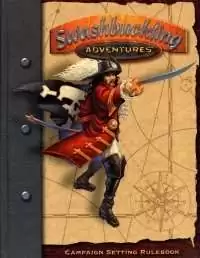
The original version of 7th Sea was written by Jennifer and John Wick.

I don't know that this ISN'T him - or maybe that the character is based on him?
The d20 conversion is principally written by Erik-Jason Yaple, and the Wicks get 'additional material' credit along with a host of other people (presumably people that helped expand the line and write travelogues of the various not-European-pastiche counties. There are also about 10 play testers, while the original had like 10 that had last names starting with 'B'. We have a map, an open gaming license, the table of contents and Introduction. The Introduction is a half-page of fiction followed by a promise that you can use the book as your default setting, or just dumpster-dive to feed your other d20 campaign. It's up to you!
Since the PHB starts with Races, this book does, too! But it's Races and Nationalities, so it might be helpful to look at the map.

What you're seeing above is almost exactly the map in the book, except the book doesn't have 'occupied Castille'. Just from the names of the countries it should be pretty obvious that we have Not-England (Avalon), Not-Vikings (Vestel), Not-Russia (Ussura), Not-China (Cathay), Not-Arabia (Empire of the Crescent Moon), Not-Italy (Vodacce), Not-Spain (Castille), Not-France (Montaigne), and Not-Germany (Eisen). Now, you're probably asking what Vikings are doing in a Renaissance not-Europe, and my response to you is, have you even been to a Renn Faire?

People like Vikings
The Not-Vikings have kin who are adapted to modern times, but the traditionalists don't get along with them. So in addition to Vikings, we have some Nordic-Dutch based sea-traders. Since this adaptation of Europe is VERY SIMILAR, there are countries that are 'traditionally religious' (analog to Catholic) and those that are 'Objectionist' (analog to Protestant) and religious wars have rent the continent. Everything has a different name, but the basic history is mostly what you'd expect except that the not-Vatican (Vaticine City) is in non-Spain instead of not-Italy or not-Avignon in Not-France. The stereotypes are not deep - Voddace is mafia-coded machismo hot-blooded Mediterraneans, and Motaigne are effeminate and style-conscious. They've also had their revolution, but not all the nobles are dead, and the whole country is excommunicated for blatant sorcery. Mechanically, everyone in Théah is a normal human; but instead of 4 bonus skill points at 1st level, they get 2. In place of the two skills they lose, two skills are added to their skill list
regardless of class.
Skill points in 3.x are basically a pile of accounting-fail and class/cross-class skills are hot garbage. Skills aren't important enough that they needed gate-keeping, so when I played 3.x it has been a long, long time that we maintained that divide, but in a standard 3.x campaign having skills as class-skills regardless of class might actually be meaningful.
Classes
In keeping with the 'you can use this book for any campaign' they have advice for using Clerics, Druids, Sorcerers and Wizards
in other settings, but in Théah spell-casting is by blood-line so those classes are out. Other classes that have incidental spell-casting like Ranger and Bard use a non-spell-casting equivalent. So the only core classes that exist
as written are barbarians, fighters, monks, and rogues. They add to this a dozen new classes. Let's take a look!
First off, the bard loses magic. They keep bardic music and the quasi-magical effects. They gain an ability that let's them take a full-round action to potentially stun an enemy for one round. Eventually he can do it 4/day. At 17th level he gains
command once per day. There is only one spell-casting base class (Witch) but at 17th level she can cast
hold person 5/day and
charm person 5/day and
finger of death once per day, so even though it's a caster that only gets 6th level spells, casters are better than you. The Paladin gets
Religious Fury in place of spell casting - a bonus to attack/damage equal to your Charisma bonus and the ability to move and full-attack, but you also count as flat-footed and lose all dodge bonuses to AC, so hope that +4 to attack and damage is worth getting hit for +3d6 sneak attack you're getting hit with. The Ranger gets 'healing herbs' which let you spend an hour to find plants with curative properties that work over night while resting. The witch gets
cure light wounds at 4th level, so at level 3 when you first get this ability you might care, but probably not.
The first new class is their version of the alchemist. The alchemist can brew potions up to 9th level from any spell list (provided it makes sense as a potion). Outside of that, they can make daily elixirs that function as spells from a very restricted list. Next up is the Assassin - a sneak-attack class with poison use and death attack. At 15th level their sneak attack also does 1d6-1 STR damage. Since there are no
fireballs in Théah, losing evasion is probably not too big a price to pay. The Courier gets a +4 bonus to social interactions at 1st level, so works as a Diplomancer chassis even though their other abilities are all pretty lame. The Highwayman is a 3/4 BAB class that gets abilities that mostly emulate feats, so they might as well be a fighter and take those feats as bonus feats. And if you're aspiring to be a fighter, well, you've failed at life. The Inquisitor gets Special abilities at almost every level, but most special abilities an't be taken until you're over a certain level (like 10th or 16th). So they get Sneak Attack +5d6 by 10th level. But you could have that being an assassin - it's all the abilities to call on church resources that mean a damn thing and that's going to probably mean asking the GM for special permission to use your class abilities. The Musketeer is another Fighter-wannabe with a good will save instead of Fort and a bunch of bonus feats, but instead of regular bonus feats to start you get Expertise with the Rapier and Two-Weapon Fighting. Then once/day you get a +2 to a single roll, so hard to say you're better than a regular Fighter. You do get more skill points and some are for better skills. The Noble is another social class with abilities related to commanding people but is not nearly as good as spellcasting. The Pirate is another fighter like class, but it gets an ability EVERY SINGLE LEVEL. With a good Fort and Reflex save, the question is whether the abilities are better than feats. Mostly they are not - weapon specialization and Two-weapon fighting are some of the abilities, and every odd level is just +2 skill points. The spy is another sneak attack class that has special abilities about getting information. And finally we get to the Swashbuckler. Since this is Swashbuckling Adventures you'd maybe expect that this is the best class. It is not. It's another fighter-like class with bonus feats and the ability to add Charisma Modifier to damage at high levels a few times per day.
Two more to go!
The Wanders gets all the defensive abilities that a rogue gets (like Evasion, Uncanny Dodge), some bonus feats, and a few random abilities like automatically succeeding on a saving throw 1/week at 18th level. You're definitely better off with a vanilla rogue. Finally the witch - you get 6th level spells and cast them like a sorcerer.
Personally, I'm not a fan of class-plosion. Each class has to justify it's existence against every other class - if it's very similar to a rogue
but better, everyone who wants to play a rogue should pick that; if it's very similar to a rogue
but worse, everyone should just play a rogue. If you have a class ability that is worth anything at all, it could probably be a feat. I know that 3.x characters didn't get ENOUGH FEATS, but a few of these class abilities and just saying 'in Théah everyone gets a feat every level' you'd solve a lot of the problems.
In any case, none of the abilities directly evoke SWASHBUCKLING. Of course, if they did, that'd be a problem - you can't have Musketeers unable to buckle their swash because it's a Swashbuckler's exclusive class ability. And 'Iron Glare' as an ability that overwhelms people with your awesomeness really should just be something anyone with Intimidate might be able to do.
I'm filled with derring-do even when I'm not a pirate
So I said that we'd have the d20 to use as a baseline - we're all familiar with the classes style and this quick run-down confirms what you'd expect. There's some variations in attack bonuses and skill lists, and the classes have a few special abilities that are mostly unique.
The original 7th Sea book gives an overview of Heroes (all characters in 7th Sea are Heroes) early in the book, but then has the actual character creation section start on page 103/258. Every character gets 100 building points and they spend it on Traits, skills, knacks, Advantages and Backgrounds (and potentially other things). It has you spending your points before you understand what things do - like do you want to spend 40 points to be a potent sorcerer, or 20 points to be a half-blood sorcerer (much more limited).
The 7th Sea book uses d10s added together to determine success. Usually a roll is based on your Trait (1-3 to start) and your Knack (also potentially 1-3 to start). TNs are variable from 5 (easy) to 40 (legendary). Often you are limited to how many dice you use, so you might see 8k1 (roll 8d10, keep 1) or 5k3 (roll 5d10, keep 3). Numbers are added together, so a 5, 7, 3, is a 15. D10s explode, so a 10, 7, 3 is 20 + another roll on the d10 which could also explode.
We'll come back to that, but basically to swing a sword a character is going to roll a trait + skill and they're going to keep some number of dice, and how they invest their resources is going to determine whether they're really good or really bad. Trait determines how many dice you keep, but it costs more than raising your skill.
As a result of differences in how you allocate your points, you can be significantly better or worse than another character in a variety of ways. There are also advantages you can purchase that affect the cost. For example, martial skills cost 2 building points, but Academy Training costs 4, but reduces the cost of martial skills to 1 point. If you're planning on buying 4 martial skills you can either pay 8 points (2 points for each skill) or buy Academy (4 points) and pay 1 point for each skill. On the other hand, the more points you put into skills, the less you have for Traits.
One review I looked at the reviewer bragged that he could make a character in less than 30 minutes because of his intimate familiarity with the rules. It would take me significantly longer, I'm sure.