Expanding AWOD
Moderator: Moderators
-
JigokuBosatsu

- Prince
- Posts: 2549
- Joined: Tue Aug 10, 2010 10:36 pm
- Location: The Portlands, OR
- Contact:
Are we wanting more art? Like, if I got inspired to make some weird b/w shit would it have a place in this thing?
Omegonthesane wrote:a glass armonica which causes a target city to have horrific nightmares that prevent sleep
JigokuBosatsu wrote:so a regular glass armonica?
-
Username17
- Serious Badass
- Posts: 29894
- Joined: Fri Mar 07, 2008 7:54 pm
Ultimately, a Grayscale pdf for e-reader use is in the works. And it wants to have grayscale images in it to break up the "wall of text" feeling.JigokuBosatsu wrote:Are we wanting more art? Like, if I got inspired to make some weird b/w shit would it have a place in this thing?
So yeah, if you can contribute grayscale pictures that would enhance the narrative, that would be excellent.
-Username17
-
CatharzGodfoot

- King
- Posts: 5668
- Joined: Fri Mar 07, 2008 7:54 pm
- Location: North Carolina
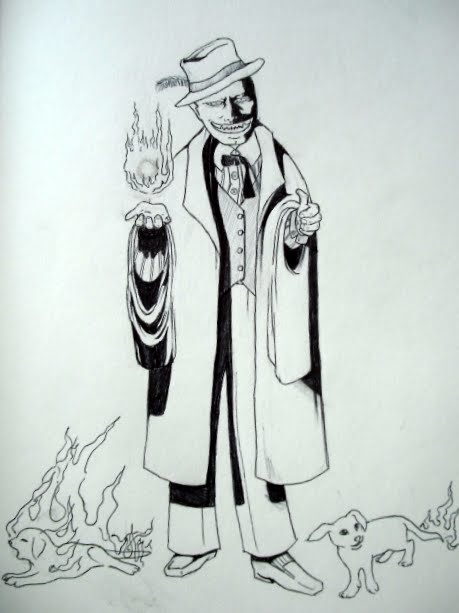
-
JigokuBosatsu
- Prince
- Posts: 2549
- Joined: Tue Aug 10, 2010 10:36 pm
- Location: The Portlands, OR
- Contact:
I'm better at freaky textures and background shit than I am at figures... you mind if I try to give your drawing a background, CG?
Omegonthesane wrote:a glass armonica which causes a target city to have horrific nightmares that prevent sleep
JigokuBosatsu wrote:so a regular glass armonica?
-
Username17
- Serious Badass
- Posts: 29894
- Joined: Fri Mar 07, 2008 7:54 pm
Sounds reasonable. People seem to want some fiddly filigree in the corners of an RPG book. I'm not entirely sure why, they just do. Makes it feel more like a tome illuminated by monks. Now it doesn't have to be as weirdly memory consuming as whatever the fuck they did to the Changeling: The Lost pdf (that thing is fucking unreadable it loads so slow), but I think some sort of page scrawl would be useful.JigokuBosatsu wrote:I'm better at freaky textures and background shit than I am at figures... you mind if I try to give your drawing a background, CG?
-Username17
-
JigokuBosatsu
- Prince
- Posts: 2549
- Joined: Tue Aug 10, 2010 10:36 pm
- Location: The Portlands, OR
- Contact:
I did this recently as a doodle to kickstart my atrophied drawing habits: I've been doing some paper engineering with my daughter, making some little characters, etc.
 I want to keep practicing, and I'm always making weird filigrees and crap in my moleskine, so I'll see what I can come up with that would look good reduced and in a margin. That was always one of the most charming parts of the Fighting Fantasy books- the little skulls and swords and vines and shit that seperated the entries.
Omegonthesane wrote:a glass armonica which causes a target city to have horrific nightmares that prevent sleep
JigokuBosatsu wrote:so a regular glass armonica?
-
Username17
- Serious Badass
- Posts: 29894
- Joined: Fri Mar 07, 2008 7:54 pm
OK, right now I'm still calling the hybrid Advanced options "Devotions". Which is a perfectly adequate name for the concept, but might be a little close.
Vampirism
Time is an abyss. Profound as a thousand nights... Centuries come and go... To be unable to grow old is terrible. Death is not the worst... There are things more horrible than death. Can you imagine... Enduring centuries... experiencing each day with the same futile things?
Vampirism is passed from one person to the next voluntarily on the part of the vampire passing on the trait. The vampire drinks the blood of the victim until it is gone and puts some of their own blood into the dying victim's mouth. Vampires drink the blood of the living in order to maintain their existence as the living dead night after night for as long as the Earth continues to turn.
How you can tell someone is a vampire varies from story to story. And it is this difference between vampires which we are recognizing in this game as the primary marker of bloodlines. Various games and book series have at times attempted to differentiate vampires on other criteria as well (such as the amount of sparkling they do or how long they can be played as characters before they go crazy), but this has not been overly successful. So we're recognizing a few common, and three variable ways to detect vampires. All vampires are the living dead, so their body temperature is below that of a living human even if they have recently eaten. Also, their blood doesn't move around their body at the behest of a pumping heart, so they have no detectable heart beat and their wounds don't bleed. Beyond that, they can be detectable by a number of means which vary by vampiric “type”. The Nosferatu are hideous, the Daeva are beautiful but have distinct animal traits, and the Strigoi can't leave knots alone.
All vampires drink blood to regain power points. And all vampires can at least potentially live forever. In Dead of Night, it is this facility with not dying that most effectively defines a vampire. So long as they keep draining life from others, their own unlife need never end. Any vampire can sprout teeth sufficient to pierce the toughest arteries on a victim. A Daeva can produce fangs like a vampire bat, a Strigoi can exude serpent-like fangs, and the teeth of a Nosferatu are as ghastly and varied as imagination can allow.
Vampires suffer aggravated damage from Wood, and most of them have Master Passion Hunger. Every subtype of Vampire has a Feeding Power Schedule. Vampires are created by another vampire draining the life out of a Luminary and then passing the corpse a power point with Gift of Health before the body has become cool. They can attempt this process with Extras, but the result is always disappointment and the creation of a near mindless Vampire Spawn. A victim whose lifeblood is drained to the point of death and then allowed to cool without being fed a power point is simply dead.
The Nosferatu: Grotesques of the Imagination
That fate which condemns me to wallow in blood has also denied me the joys of the flesh. This face - the infection which poisons our love. This face which earned a mother's fear and loathing, a mask: my first unfeeling scrap of clothing. Pity comes too late, turn around and face your fate, an eternity of this before your eyes!
Nosferatu are social pariahs. Many of them look monstrous, animalistic, or deformed. While others look reasonably human, there is a certain otherworldly air about them which frightens small children. Any human who sees a Nosferatu's face will be instantly convinced that they are dealing with something monstrous. Young women will recoil, priests will present crosses, that kind of thing.
The Nosferatu are considered great information brokers by other supernaturals, and this is not an unreasonable assumption, as Nosferatu can pass unseen in all but the most observant company. Upon transforming into a Nosferatu, a character gains a specific monstrous caste to their appearance. Some are lucky enough to have a face that can pass for a human that simply happens to be forbiddingly cruel looking, while others look like nothing so much as rabid beasts. Whether subtle or complete, the Nosferatu's appearance is morphed by the time they first open their eyes as a vampire. Nosferatu who persist for many nights sometimes find themselves gradually transforming into forms yet more monstrous.
A Nosferatu's feeding maw is unique to themselves. One might protrude a mosquito's proboscis while another might extend a lamprey's wheel of teeth or a leech's beak. There is no guaranty that a newly created Nosferatu will have a method of feeding that is the same or in any way less disgusting than their sire's.
A Nosferatu has an Astral power source and a Feeding power schedule.
| The First Nosferatu? |
| The secret histories abound with unidentified bogie men and monsters of the night. Nosferatu are only first called out as such in the 6th century with Krampus the Child Eater of what is now Northern Austria. With their natural abilities to hide from notice and their proclivities for avoiding social situations, it is generally unknown how long Nosferatu have skulked in the night. |
- Nosferatu Starting Powers
- Core Discipline: Fortitude - - Patience of the Mountains (Basic Fortitude)
- Revive the Flesh (Basic Fortitude)
- Basic Powers - - Vigor (Basic Clout)
- Feral Whispers (Basic Track of Beasts)
- Gift of Health (Basic Path of Blood)
- Hide From Notice (Basic Obfuscate)
-Advanced Powers - - Restoration (Advanced Fortitude)
- Indomitability (Advanced Fortitude)
Distinctive Flaw: Eerie Presence
-
Username17
- Serious Badass
- Posts: 29894
- Joined: Fri Mar 07, 2008 7:54 pm
Lycanthropy: Ruled by Rage
A man may live for forty years, and a wolf only seven. But at the end of their lives, which one knows more of the tundra?
The man and the wolf know the same.
Lycanthropy is a disease that passes from lycanthropes to people that are nearly killed at their jaws. All that is necessary to become a lycanthrope is to be bitten, nearly die, and yet survive the ordeal. It's like rabies. Only your heart has to stop at least for a little while.
Once afflicted, a newly created Lycanthrope will find their wounds closing rapidly. The essentially deadly injuries suffered in the initial attack heal without leaving a scar or discoloration to mark their passing. The victim will feel feverish to the touch and chilled in the chest – a condition which will follow them until the end of their days.
Lycanthropic Culture: There really isn't any ancient lycanthrope culture. For the vast majority of time a lycanthrope would come into being only by surviving an attack by another lycanthrope. As such, most lycanthropes came into the world with their creator either defeated or hostile. The vast majority of lycanthropes either learned the ins and outs of their condition on their own or had it explained to them by someone else in the know (usually another supernatural). So it is quite common for lycanthropes to be adapted into the cultures of other supernatural creatures. A werewolf who was taken in by gypsy witches would generally have the same traditions and prejudices as those gypsy witches, not those of whatever werewolf tore into him with its fangs and left him for dead.
An exception to that generalization can be found in small family groups. Lycanthropes often go all crazy with rage and are a severe danger to their families and friends. A loved one pushed nearly to death by the rampages of a wererat is rather likely to spurn the creature which transformed it, running off and ultimately forming a new “culture” of one. However it is not unheard of for such a victim to stay on and create a pack of lycanthropes. These groups tend to avoid contact with humans and supernaturals alike and have strange views.
Lycanthropes take aggravated damage from silver weapons. Every type of Lycanthrope has a Lunar power source. Most Lycanthropes are dominated by Master Passion Rage, a fact that leads them to sometimes go berserk when the moon rises. Lycanthropes of all kinds are well advised to avoid fragile things and people.
Werewolves
The better to eat you with, my dear.
Somewhere in the howling wilderness of Scandinavia a “wolf warrior” of the North became darkly fused with a wolf pelt he was wearing while fighting the Huns – an event which places the creation of the Werewolf at approximately 600 CE. Passed from warrior to enemy warrior and conquered victims, the curse spread throughout the lands of Europe and beyond along the warpaths of the Huns and later the Vikings. In later nights, it spread itself throughout the world on the backs of European conquistadors and imperial marines. By the twelve hundreds it had spread as far as Central Asia, and the Wolf Mother Asena led the Syndicate of the Bumin Horde of Ergenekon to rule much of Eurasia until her presumed death and the dissolution of the Syndicate in 1844.
Werewolves are instilled with a love of combat and destruction even in their human forms. In their monstrous forms they take the shape of awkwardly toothy man-wolves. Glistening with drool and usually fast covered with speckles of blood, the claws and fangs of a monstrous formed werewolf are a terror. Every Werewolf can transform into a “regular” canine as well as a huge canid beast. Not all Werewolves transform into an actual wolf when they become a mundane animal. For whatever reason, some become dogs, coyotes, foxes, or even hyenas.
Though they gain no magical power or sustenance from it, Werewolves are quite drawn to eating human flesh, and will often succumb to this temptation while in a frenzy. The curse of Lycanthropy comes with unusual and often unwanted hair growth on various parts of the body for Werewolves. In the era of waxing and depilatories, a Werewolf can keep this under control, but changing into the War Form causes hair to come back no matter what has been done. On the plus side: baldness is totally curable through infection with Lycanthropy.
Werewolves have an Astral power source and a Lunar power schedule.
The Nezumi: Plague on the world of Men
“Tear him up.”
The most frequently told story of the origins of the plague of the Nezumi is that originally someone turned their back on the teachings of the Buddha and was cursed with reincarnating in a lower form during their own life. If even partially true, this would mean that the plague started no earlier than about 500 BCE. Once afflicted, a Nezumi Lycanthrope begins to twitch their nose like Elizabeth Montgomery and click their tongues nervously.
A Nezumi's animal form is that of a large rat. Nezumi are immune to the effects of diseases, but carry virtually every disease they come into contact with. Unlike other lycanthropes, Nezumi have no monstrous war form, though nothing is stopping them from eventually learning one and some certainly do. While most Nezumi lack the brutal jaws or rending claws of other lycanthropes, their bites are still often quite deadly because of the pestilence they carry. Still, it is important to note that even their animal form is of little help in a fight, being as it is just a large rat.
Most Nezumi are mastered by the same all-consuming rage of the other Lycanthropes. However, they don't normally possess any great strength, a fact which frequently causes them to become quite cowardly and fearful of authority. Many Nezumi become quite resigned from the world: hiding in sewers, jumping at sounds; knowing that the heat of battle runs in their veins and feeling dreadfully afraid that it will eventually drive them to a suicidal battle over nothing. Interacting with the world of men seems to be a never ending river of frustrations, and many choose to simply not do it. Those who master their rage usually do so only by trading it for Master Passion Fear.
A Nezumi has an Infernal power source and a Lunar power schedule.
The Bagheera: The Lady or the Tiger
“You can fool everybody, but landie. Dearie me, you can't fool a cat. They seem to know who's not right.”
The origins of the Bagheera are confused. The legends say that the Bagheera were formed when a Bengali priestess refused to abandon her gods and goddesses when the Mughals took control of the province and banned idolatry, calling upon Shiva for a mighty boon. And yet the legends also say that the Bagheera were formed first by a jaguar warrior pledged to Huitzilopochtli fighting against Cortez, an event which would necessarily push the formation of the line over fifty years back. When consulted on the subject directly, the Stellar Oracles enigmatically state that both stories are true. Regardless, once infected a Bagheera is a creature of Death and finds that their mere presence alarms and angers animals of all types, especially cats.
A Bagheera's War Form is that of a great and ghostly cat. Perhaps a tiger, jaguar, or leopard. Most Bagheera do not have the ability to transform into a remotely reasonably sized cat that can pass as something “not terrifying.” It has been suggested that the beast inside a Bagheera isn't really an animal at all, since they seem to show less than no affinity for the mundane beasts they appear as – a marked departure from other Lycanthropes
A Bagheera has an Orphic power source and a Lunar power schedule.
A man may live for forty years, and a wolf only seven. But at the end of their lives, which one knows more of the tundra?
The man and the wolf know the same.
Lycanthropy is a disease that passes from lycanthropes to people that are nearly killed at their jaws. All that is necessary to become a lycanthrope is to be bitten, nearly die, and yet survive the ordeal. It's like rabies. Only your heart has to stop at least for a little while.
Once afflicted, a newly created Lycanthrope will find their wounds closing rapidly. The essentially deadly injuries suffered in the initial attack heal without leaving a scar or discoloration to mark their passing. The victim will feel feverish to the touch and chilled in the chest – a condition which will follow them until the end of their days.
Lycanthropic Culture: There really isn't any ancient lycanthrope culture. For the vast majority of time a lycanthrope would come into being only by surviving an attack by another lycanthrope. As such, most lycanthropes came into the world with their creator either defeated or hostile. The vast majority of lycanthropes either learned the ins and outs of their condition on their own or had it explained to them by someone else in the know (usually another supernatural). So it is quite common for lycanthropes to be adapted into the cultures of other supernatural creatures. A werewolf who was taken in by gypsy witches would generally have the same traditions and prejudices as those gypsy witches, not those of whatever werewolf tore into him with its fangs and left him for dead.
An exception to that generalization can be found in small family groups. Lycanthropes often go all crazy with rage and are a severe danger to their families and friends. A loved one pushed nearly to death by the rampages of a wererat is rather likely to spurn the creature which transformed it, running off and ultimately forming a new “culture” of one. However it is not unheard of for such a victim to stay on and create a pack of lycanthropes. These groups tend to avoid contact with humans and supernaturals alike and have strange views.
| Therianthropes? Fuck that noise! |
| It is important to note that the word “lycanthrope” literally comes from Greek words for “wolf” and “form” but that it is an English word which means a human who transforms into a wolf or other beast. Many people will try to get you to use the word “Therianthrope” or “Zoanthrope” because of a misguided attempt to use Greek root words correctly. Those words are however not English, and using them is not “technically correct” – it is retarded. The plural of Octopus is “Octopuses” and not “Oktopodes” like it would be if we were speaking Greek, because if you are reading this document the chances are excellent that you are not an ancient Greek. |
Lycanthropes take aggravated damage from silver weapons. Every type of Lycanthrope has a Lunar power source. Most Lycanthropes are dominated by Master Passion Rage, a fact that leads them to sometimes go berserk when the moon rises. Lycanthropes of all kinds are well advised to avoid fragile things and people.
Werewolves
The better to eat you with, my dear.
Somewhere in the howling wilderness of Scandinavia a “wolf warrior” of the North became darkly fused with a wolf pelt he was wearing while fighting the Huns – an event which places the creation of the Werewolf at approximately 600 CE. Passed from warrior to enemy warrior and conquered victims, the curse spread throughout the lands of Europe and beyond along the warpaths of the Huns and later the Vikings. In later nights, it spread itself throughout the world on the backs of European conquistadors and imperial marines. By the twelve hundreds it had spread as far as Central Asia, and the Wolf Mother Asena led the Syndicate of the Bumin Horde of Ergenekon to rule much of Eurasia until her presumed death and the dissolution of the Syndicate in 1844.
Werewolves are instilled with a love of combat and destruction even in their human forms. In their monstrous forms they take the shape of awkwardly toothy man-wolves. Glistening with drool and usually fast covered with speckles of blood, the claws and fangs of a monstrous formed werewolf are a terror. Every Werewolf can transform into a “regular” canine as well as a huge canid beast. Not all Werewolves transform into an actual wolf when they become a mundane animal. For whatever reason, some become dogs, coyotes, foxes, or even hyenas.
Though they gain no magical power or sustenance from it, Werewolves are quite drawn to eating human flesh, and will often succumb to this temptation while in a frenzy. The curse of Lycanthropy comes with unusual and often unwanted hair growth on various parts of the body for Werewolves. In the era of waxing and depilatories, a Werewolf can keep this under control, but changing into the War Form causes hair to come back no matter what has been done. On the plus side: baldness is totally curable through infection with Lycanthropy.
Werewolves have an Astral power source and a Lunar power schedule.
| The First Werewolf? |
| The secret histories are fairly clear about the source of the canine form of Lycanthropy. There was a Norse warrior at the beginning of the 7th century who got cursed and every single Werewolf in the whole world traces their condition back to him. However, while this story is fairly well documented and has a lot of evidence behind it, there are still those who insist that there were earlier Werewolves or that canine Lycanthropy has occurred more than once. It is certainly true that the exact mechanics of the wolf pelt curse are unknown to modern sorcery, so it is within the realm of possibility that it could happen again. Or that it already has. |
- Werewolf Starting Powers
- Core Discipline: Track of Beasts - - Beast Form (Basic Track of Beasts)
- Feral Whispers (Basic Track of Beasts)
- Basic Powers - - Revive the Flesh (Basic Fortitude)
- Vigor (Basic Clout)
- Quickness (Basic Celerity)
- Dread Gaze (Basic Presence)
-Advanced Powers - - War Form (Celerity / Clout Devotion)
- The Beckoning (Advanced Track of Beasts)
Distinctive Flaw: Temperamental
The Nezumi: Plague on the world of Men
“Tear him up.”
The most frequently told story of the origins of the plague of the Nezumi is that originally someone turned their back on the teachings of the Buddha and was cursed with reincarnating in a lower form during their own life. If even partially true, this would mean that the plague started no earlier than about 500 BCE. Once afflicted, a Nezumi Lycanthrope begins to twitch their nose like Elizabeth Montgomery and click their tongues nervously.
A Nezumi's animal form is that of a large rat. Nezumi are immune to the effects of diseases, but carry virtually every disease they come into contact with. Unlike other lycanthropes, Nezumi have no monstrous war form, though nothing is stopping them from eventually learning one and some certainly do. While most Nezumi lack the brutal jaws or rending claws of other lycanthropes, their bites are still often quite deadly because of the pestilence they carry. Still, it is important to note that even their animal form is of little help in a fight, being as it is just a large rat.
Most Nezumi are mastered by the same all-consuming rage of the other Lycanthropes. However, they don't normally possess any great strength, a fact which frequently causes them to become quite cowardly and fearful of authority. Many Nezumi become quite resigned from the world: hiding in sewers, jumping at sounds; knowing that the heat of battle runs in their veins and feeling dreadfully afraid that it will eventually drive them to a suicidal battle over nothing. Interacting with the world of men seems to be a never ending river of frustrations, and many choose to simply not do it. Those who master their rage usually do so only by trading it for Master Passion Fear.
A Nezumi has an Infernal power source and a Lunar power schedule.
| The First Nezumi? |
| Opinion is divided as to the historicity of the Buddha offending story in the secret histories. The oldest living Nezumi is Hamamoto Yoshi, who was born in the 8th century CE in Nagaokyo, Japan and now lives in cryptic hermitude in Kyoto's sewers. Most Nezumi do in fact die of old age, and when Yoshi has deigned to answer such questions at all, he has denied being the first. |
- Nezumi Starting Powers
- Core Discipline: Track of Beasts - - Beast Form (Basic Track of Beasts)
- Feral Whispers (Basic Track of Beasts)
- Basic Powers - - Abyss of the Body (Basic Descent of Entropy)
- Hide From Notice (Basic Obfuscate)
- Learn the Heart's Pain (Basic Names of the Blasphemies)
- Revive the Flesh (Basic Fortitude)
-Advanced Powers - - Hide in Plain Sight (Advanced Obfuscate)
- The Beckoning (Advanced Track of Beasts)
Distinctive Flaw: Red Taped
The Bagheera: The Lady or the Tiger
“You can fool everybody, but landie. Dearie me, you can't fool a cat. They seem to know who's not right.”
The origins of the Bagheera are confused. The legends say that the Bagheera were formed when a Bengali priestess refused to abandon her gods and goddesses when the Mughals took control of the province and banned idolatry, calling upon Shiva for a mighty boon. And yet the legends also say that the Bagheera were formed first by a jaguar warrior pledged to Huitzilopochtli fighting against Cortez, an event which would necessarily push the formation of the line over fifty years back. When consulted on the subject directly, the Stellar Oracles enigmatically state that both stories are true. Regardless, once infected a Bagheera is a creature of Death and finds that their mere presence alarms and angers animals of all types, especially cats.
A Bagheera's War Form is that of a great and ghostly cat. Perhaps a tiger, jaguar, or leopard. Most Bagheera do not have the ability to transform into a remotely reasonably sized cat that can pass as something “not terrifying.” It has been suggested that the beast inside a Bagheera isn't really an animal at all, since they seem to show less than no affinity for the mundane beasts they appear as – a marked departure from other Lycanthropes
A Bagheera has an Orphic power source and a Lunar power schedule.
| The First Bagheera? |
| The origins of the Bagheera are clouded I mystery, but not in particularly ancient mystery. Bagheera are not present in the secret histories before the 16th century, and they came on the scene quite rapidly with sightings all over the world in 1578 CE. Most stories appear to agree that the first Bagheera was female, but beyond that little is known for sure. |
- Bagheera Starting Powers
- Core Discipline: Celerity - - Quickness (Basic Celerity)
- Nimble Feet (Basic Celerity)
- Basic Powers - - Vigor (Basic Clout)
- Hide From Notice (Basic Obfuscate)
- Touch of Darkness (Basic Lure of Destruction)
- Revive the Flesh (Basic Fortitude)
-Advanced Powers - - War Form (Celerity / Clout Devotion)
- Alacrity (Advanced Celerity)
Distinctive Flaw: Offensive to Animals
-
Quantumboost
- Knight-Baron
- Posts: 968
- Joined: Fri Mar 07, 2008 7:54 pm
...does this mean that there are canonically Deep One ninjas named after Renaissance artists in the gameworld?FrankTrollman wrote:
The First Nezumi? Opinion is divided as to the historicity of the Buddha offending story in the secret histories. The oldest living Nezumi is Hamamoto Yoshi, who was born in the 8th century CE in Nagaokyo, Japan and now lives in cryptic hermitude in Kyoto's sewers. Most Nezumi do in fact die of old age, and when Yoshi has deigned to answer such questions at all, he has denied being the first.
-
JigokuBosatsu
- Prince
- Posts: 2549
- Joined: Tue Aug 10, 2010 10:36 pm
- Location: The Portlands, OR
- Contact:
I think that's exactly what it means. Congrats on your 666th post, by the way.
Omegonthesane wrote:a glass armonica which causes a target city to have horrific nightmares that prevent sleep
JigokuBosatsu wrote:so a regular glass armonica?
-
Username17
- Serious Badass
- Posts: 29894
- Joined: Fri Mar 07, 2008 7:54 pm
Yes it does.
Also, I discovered that when doing lightboxing over pornography, that shrinking the image afterward makes my whole "I fucking suck and my mouse is dying" technique a lot less obvious.
Edit: Example:

-Username17
Also, I discovered that when doing lightboxing over pornography, that shrinking the image afterward makes my whole "I fucking suck and my mouse is dying" technique a lot less obvious.
Edit: Example:
-Username17
Last edited by Username17 on Wed Apr 13, 2011 9:45 pm, edited 1 time in total.
-
JigokuBosatsu
- Prince
- Posts: 2549
- Joined: Tue Aug 10, 2010 10:36 pm
- Location: The Portlands, OR
- Contact:
-
CatharzGodfoot
- King
- Posts: 5668
- Joined: Fri Mar 07, 2008 7:54 pm
- Location: North Carolina
"the most dangerous wolves are hairy on the inside"
Patience of the Mountains really comes in two flavors: unliving and undying. Vampires and Prometheans are unliving while Leviathans are undying, but it's not clear which some other sort of potentate becomes when she acquires the power. There are already implied mechanical differences, for example Frozen Note.
It could be dictated by the monster type which a newly immortalized potentate becomes, or it could be up to the player, but it should be made explicit.
The law in its majestic equality forbids the rich as well as the poor from stealing bread, begging and sleeping under bridges.
-Anatole France
Mount Flamethrower on rear
Drive in reverse
Win Game.
-Josh Kablack
-Anatole France
Mount Flamethrower on rear
Drive in reverse
Win Game.
-Josh Kablack

That makes sense considering the way I've spent most of my drawing time since first grade. Cool characters in action poses it is.Frank Trollman wrote:That has an active, comic-booky feel. I could definitely see spicing up the combat section with a pile of cartoons of characters in action poses doing stuff.
I'll probably try to stretch my muscles a little bit style-wise as well.
-
Username17
- Serious Badass
- Posts: 29894
- Joined: Fri Mar 07, 2008 7:54 pm
.
The World at Night
The world is a dark and lonely place. And it is full of monsters.
Ciudad de Mexico by Night
Since I am a Mexican, I can do anything I want.
Built into the caldera of a volcano, Ciudad de Mexico is the third largest city on the planet and clearly the secret base of some kind of supervillain. However, despite its vast size, Ciudad de Mexico is virtually paralyzed by crime, rampant poverty, and mismanagement. These crippling problems push the city down to being merely the 8th largest metropolitan economy on Earth. All told, the city has roughly the population and GDP of Saudi Arabia. The people of Mexico see themselves as a vibrant “peasant” culture and practice a syncretic faith that is nominally Roman Catholic, but which nevertheless embraces witchcraft, honors Queztlcoatl, and includes men dressing up as jaguars fighting each other to encourage rain.
Something that jumps right out at supernatural creatures from other parts of the world is that the Archbishop of Ciudad de Mexico does not enforce or even acknowledge The Vow of Silence as such. The rules here are that creatures not allowed to tell the world at large how magic actually works or how to get to the other worlds or the actual organizations of the damned. But they're perfectly allowed to curse people in public or even announce on national television that they're a Witch. And they do. You can turn on the TV and seriously watch an actual Leviathan sitting in a chair explaining that he mutated into a monster and now he has these awesome claws. The Mexican people are sufficiently credulous about this sort of thing that other countries are convinced that these creatures are laughable charlatans.
It's not just the giant parades of skull-puppets every Dia de los Muertos or the fact that people consult with Cultists and Seers before conducting major business moves. It's that you can seriously call yourself a vampire in public and neither the Covenant Inquisitors nor the Federal Police will even take interest. The part that is hardest to understand about the situation is that luchadores – literally people in Mexican wrestling outfits will take an interest in supernatural creatures that operate “without honor.” And if a supernatural creature just guns them down, then the Covenant Inquisition will get super pissed.
City Statistics
Ciudad de Mexico has over twenty million people in it and over 5000 members of the Covenant alone. The Makhzen has a presence with about 200 at any given time, but they are more associated with the major Makhzen cities of Houston and Los Angeles. Their presence in Ciudad de Mexico is demanded by the amount of trade between those regions, but it's always kind of strained. The World Crime League has a task force here of 300 members, and many members of the Covenant flock neither know nor care that it is there. For much of their shared history, Communes were “kill on sight” in Ciudad de Mexico, what with the war and all. But with the peace treaty, Communes can nominally come and go as they please, so long as they don't stir up trouble. What with the Communes having taken over Havana and Caracas, they have gotten bolder and have been making some inroads in Ciudad de Mexico as well. While their numbers are scarcely a hundred, nearly half of those are converts.
The city as a whole is nominally 89 different municipalities, only one of which is technically Ciudad de Mexico. Some of them aren't even in the State of Mexico (not to be confused with the Federal District of Mexico that contains “only” about 8 million residents). And by some of them, we mean 29 of them are across the border into Hidalgo. The metropolis is about 8000 kilometers square, and it is about 100 kilometers across the long way. There are over twenty million humans here, and while poverty is off the hook, the people of this city are enough richer than the national average to cause some resentment elsewhere.
City History
The Aztec people were unspeakably brutal, and they set up shop in Tenochtitlan because their practice of kidnapping princesses of neighboring kingdoms, skinning them, and then wearing the skins as suits offended their neighbors. It offended them so much, that the Aztecs lost war after war, and had to move their entire civilization several times before setting up shop in the middle of Lake Texcoco in the Valley of Mexico in 1325. This was a turning point for them, because by connecting their city to the mainland only by causeways and retractable bridges, they were pretty much immune to external assault. And they were still under external assault a lot, because they kept kidnapping people and cutting their skin off.
The Aztecs developed their fortress in a swamp in a volcano into not only the coolest temple of death ever, but also a military powerhouse. Constant training and the sponsorship of their magical Rain Kings, Aztec warriors were able to repeatedly humiliate the kingdoms surrounding them, and add them to the Empire. Soon, the people of all neighboring cities were forced into tributary status and were compelled to send thousands of people a year to be sacrificed on the top of the giant pyramid, powering the magics of death and demonic malevolence that kept the Kings of Rain strong and kept everyone else afraid. At it's height, the metropolis of Tenochtitlan had about a quarter million people in it, and controlled an empire with more than 8 times that many people. Which isn't that much by today's standards, but in the 16th century that was crazy talk.
In 1521 that all changed, when Nahuatl armies led by Malintzin and backed up by her consort Hernán Cortés and a team of Spanish hardasses crushed the city, looted its riches, and murdered its leaders. Malintzin's victory was short lived, as subsequent forces of Spaniards came and put both Aztec and Mayatec to the sword. The place was quickly renamed New Spain, and Spanish forces fought many wars over what is now Mexico (and surrounding countries, for a time they owned everything out to Venezuela and California). And through this period, the Spanish did their best to replace the blood drinking torture worship of Azteca with Christianity (and its own brutal blood drinking and torture worship).
And while these wars between men were burning the countryside, wars between monsters raged in the dark. The Covenant had declared war on both the Empire and the False Face, and they sent magical beasts by the hundreds into the New World to conquer and convert. And they had iron weapons that the New World Syndicates had no answer for. And it was during this period that the native supernatural creatures began to join the Covenant. At first at the point of the steel saber or the silver lance, but within a hundred years or so it was simply because the Archbishop was simply the supernatural authority to be had.
In the early 19th century, the rapidly growing Communes Movement began taking power in sections of Spain, and the French people actually conquered the place. Ciudad de Mexico became the go-to place for Covenant flock who wished to flee the Covenant-Communes wars, and a major rallying point for Covenant members on a global scale. Mexico became an independent empire in 1821 and grudgingly became a republic a few years later.
The republic was... rocky... and was overthrown many times. Santa Anna himself became President of it eleven times. And through this period there was a sharp divide within the Covenant between the Conservativos and the Liberales. These groups had only the barest of connection with the human political movements of the time (although they several times allied on the field of battle). The Conservativos argued that supernatural creatures should rule as lords of their own haciendas – similar to the feudal system employed by the Bumin Horde. The Liberales held that supernatural creatures should disappear into society like the Communes. Much intrigue, dueling, and even battles were had over this dispute throughout the 19th century, and the title of Archbishop changed several times from Conservativo to Liberale Padre and back again. The really worldshaking event, as far as the Covenant globally is concerned – is that through these conflicts the Territory of Mexico just sort of forgot to ask for anti-papal approval for these Archbishop appointments. To this night, it is the Padres of Ciudad de Mexico who select the Archbishop when the old Archbishop dies or steps down.
Ciudad de Mexico has been occupied by armies dozens of times. And supernatural society has pretty much rolled with it. Sometimes those armies are peasant armies from the hinterlands, sometimes they are mercenary armies purchased by landholders. Sometimes they are foreign powers like the French or the United States. But the effect on the supernatural residents has always been pretty minor. Ciudad de Mexico is so vast that even modern home-grown governments lack the reach to really control it, how much did conquering armies really think they could accomplish past putting up their favorite flag? The harsh truth is that even the Covenant hasn't been able to really control the supernatural creatures of Ciudad de Mexico. The Syndicate here is not very much like it is in other places.
The modern Republic of Mexico has existed since the Diaz dictatorship was overthrown in 1911. Yes, the entire country is going to have its 100th anniversary of existence just before the Mayan calendar runs out. And numerologists frickin love that shit. The 20th century has seen the population of Ciudad de Mexico swell beyond recognition. At the turn of the century it was a thriving metropolis of half a million. As the century progressed, and people moved in and the city burst its limits and absorbed other cities like a hungry amoeba, it grew to forty times that. And so it was that at the end of the night, the position of the Liberales won out basically by default. The city had simply grown so large that supernatural creatures cannot help but fade into the background. La Llorona kills a child every Sunday and the government of man hasn't even noticed, because it has seriously faded into the background static of violence.
Mexico was pretty much run by a single party almost all the way through its existence. The PRI (literally: institutional revolution party) lost a lot of credibility in their Katrina-like inaction to an earthquake in 1985 that destroyed a lot of buildings and killed over ten thousand people. To this night there are still crevasses, collapsed buildings, and vacant lots around – especially in poorer districts. But the stunning ambivalence of the national government brought real political reform and at this point you can actually vote for different candidates and you don't know who is going to end up stealing the election.
And it is this reality that Archbishop Nochhuetl presides over. He's a Troglodyte of essentially pure Aztec stock, and looks kind of like a hairless wrinkled rodent. And he represents an ambitious, even nationalistic faction within the Covenant. Mexico treats itself as if it were the capital of the Covenant. And when you compare the real power of Ciudad de Mexico and Rome, that may really be true. Conflict between the Heresiarchs and the Padres of Mexico seems inevitable.
Power
The chief of police of the city makes less than a thousand dollars a month. Nevertheless, more than one of them has managed to retire a billionaire (with a B). Those who refuse to take bribes on that scale are literally gunned down in the street and quickly replaced by those who will. The police literally kidnap people and hold them for ransom or simply execute them in the desert away from the city. The narcotics shipments (and transshipments) to the United States comprise an industry that makes over $40 billion per year (roughly the economy of Lithuania), and if someone could unite that criminal enterprise under a single banner, it would come in at roughly 200th on the Fortune 500 (roughly the rank of Motorola's worldwide holdings). As it is, it's split about seven ways, which would barely get the criminal syndicates into the Fortune 500 at all. Several of the cartels have made an alliance which is called “The Federation” that is making pretty compelling progress towards creating a syndicate of syndicates. And this Federation is sponsored by the World Crime League. This has mostly squeezed Covenant flock out of the drug cartel business in the city, which has largely pushed them into other kinds of crime. And while you'd think that a drug business worth tens of billions of dollars (not Pesos) would be enough to send the Covenant into a panic spin, the fact is that it's less than 10% of the city's legal GDP and the Covenant flock have bigger things to chase like corruption in construction and oil shipments.
The Covenant itself has about 500 Priests and Monks (collectively called Padres in Ciudad de Mexico), and it does not recognize the sovereignty of Orders Contemplative nor Militant. There are no less than two Military Ordinals and four Prelates, but the Archbishop claims – and enforces – his commands over all of them. The military orders are the Caballeros Rojos and the Familia de la Cisne. They differ politically drastically, but compete to provide the most visibly successful defense of the city from enemies. There are three Glossators, and they have a flock of their own who are collectively La Investigación. These days, Padres fall into roughly five political factions.
The Nativos are mostly anti-Rome and have a tendency to support a return to native traditions as they remember them (which according to the actual immortals seems to have little bearing on the actual history). Archbishop Nochhuetl is an unapologetic member of them, and was made Archbishop during their ascendancy in the 1940s. The Conservativos want to increase the power and visibility of supernatural creatures. The Liberales want to integrate further into mortal society and blend further into the background. The Ocultamientos hold that supernatural creatures have exposed themselves too much already and need to withdraw from the world of men. And the Católicos want to mend things with the Anti-pope and have the Anti-pope go back to appointing Archbishops.
There are lots of police organizations in Mexico, and most of them are corrupt and underfunded. A policeman gets outright killed in just the federal district once a week on average. And the police really have learned to not see things that they don't know how to deal with. And the supernatural falls under that umbrella completely. As soon as the popos find out that there are vampires involved they throw their hands up and say “to hell with this!” Policing of the supernatural is mostly down by luchadores. Yes, really. The Covenant in Mexico has convinced human luminaries to dress up in capes and masks to literally wrestle supernatural creatures that cross “the line” (whatever that is, it's perhaps deliberately unclear). And the supernatural creatures have rules of their own when dealing with them. No matter what they do or say to normal people, they are not allowed to deliberately kill luchadores and if challenged to unarmed combat they have to either run away or engage in unarmed combat. La Investigación doesn't care about much, but behaving with dishonor towards a Luchador is grounds for final death.
There are fifteen hundred street gangs in Ciudad de Mexico. And really only 12 of them are based around an actual Covenant Padre.
Places to Go
While there are places that you can drive around ruthlessly, clear in the knowledge that you are desperately unlikely to be stopped by traffic police, the mere fact that this is true leads traffic to be an unconscionable mess. Figuring out a way to not drive in Ciudad de Mexico is probably the best way to start enjoying the place. After all, it's not like you were going to be able to park anywhere. Ciudad de Mexico boasts an impressive subway system, the cars run on rubber tires and are amazingly quiet for subway trains.
The Zócalo is one of the largest city squares in the world. It's seriously a quarter of a kilometer on a side. And if you go at the right time, it still fills up with people. It's where the people of Mexico go for major celebrations and protests. In Aztec days, this is where the really really big sacrifice ceremonies went down, and when the Spanish took over this is where the mass inquisitions took their place. The middle of the square is actually aspected quite strongly to Mictlan and it is in serious danger of world-shifting to The Gloom. Covenant Monks spend a considerable amount of time making sure that does not happen. Major buildings surround the square of course, but of special note is the Metropolitan Cathedral – the largest and oldest cathedral in the Americas. It actually has a bunch of secret rooms and such in it, and the Covenant used to run their rituals right out of the building, but that became too much of a hassle and in modern nights they only use it like an attic to store stuff in.
Chapultepec Park is fairly nice as parks go, and is the largest park in the city. It is here that the more feral and nature-loving monsters go when they need to be near trees. There are several rather nice museums in the area, including Chapultepec Castle, which is in fact the Halls of Montezuma that was successfully stormed by both the Spanish against the Aztecs and the United States Marines. Tonight it is a history museum and there are a set of residences prepared for supernatural creatures that want to live in the park itself and still have a bed to sleep in.
El Ángel is probably the most recognizable landmark in Ciudad de Mexico. A large victory column topped with a golden winged victorious angel, it's a pretty inspiring edifice. The statues of lions and stuff around the outside are pretty cool too. And it sits in the middle of a roundabout smack dab in Paseo de la Reforma, the city's most important street. It's a very important place. Not because of any magical effects, but simply because a whole bunch of embassies and corporate headquarters are within spitting distance of the thing. The HSBC building is literally just a crosswalk away. Look both ways before crossing though, because cars take the roundabout too fast and in weird directions all the time.
The “Floating Gardens” of Xochimilco are not actually floating. They are a series of canals where the areas between the canals are gardens and restaurants and such. You can paddle around in brightly colored boats, watch birds, and get serenaded by floating mariachi bands. It's kind of like the quainter parts of Venice with mariachi bands. The fact that many of the garden areas are only accessible by water creates an incredible form of natural privacy, and that is used extensively by the Covenant. The main chapel of the Covenant is simply a boat house with no other obvious entrances than the water. The fact that it's a beautiful spot and there are live axolotls in the water is gravy.
The tianguis of Tepito is a barrio that is essentially a giant flea market. There are about a hundred thousand people who live in the market, and there are tens of thousands of people who come and go every day to buy and sell. A seemingly endless array of shops and tents hawk wares of every conceivable type. The local saying is “en Tepito todo se vende menos la dignidad” which means “In Tepito, everything but dignity is for sale.” It is considered totally normal to go to sorcerers (or “curanderas” as they are called) here for aid, and there is even an alley given over to their works, which in the local vernacular is called “el camino de la brujas” or simply “campo bruja.” It's kind of a maze to get there, as there are at least 12 streets worth of unmanaged market in every direction before you get to something that people would consider driving on. There's a hellmouth somewhere in there, and there is a thriving trade in Limbo artifacts as well as a bustling smuggling business through the Dark Reflection.
Ampliación is a Michoacana neighborhood known for high crime, crappy and unlicensed construction, and a lack of car-traversable roads. Basically, it's a good old fashioned shanty town. But it's an important place for Troglodytes, because this is where the Carniceria is. It's an unlicensed, unrefrigerated meat market. And while that may sound wholly unappetizing, the truth is that they are even less appetizing and associated ragpickers collect corpses for those who are willing to eat the other other white meat. Which is great news for the Troglodytes, many of whom make their homes in tunnels beneath this neighborhood for that reason.
Ciudad de Mexico in Horror
After watching a few Rodriguez movies like Once Upon A Time in Mexico or From Dusk til Dawn you might be disappointed to find out that in fact Ciudad de Mexico is not a non-stop action movie with bullets flying everywhere, things exploding, and a body count you need to take off your shoes to tabulate. This is because the city is a big place. Nevertheless, there are about twenty murders every day in the city, which means that some balls to the wall action extravaganza is going most of the time. Something explodes every couple of minutes in the sprawl, and police are powerless to do anything about it. Which means that if you come to Ciudad de Mexico, the question you need to ask yourself is: are you a bad enough dude?
All kidding aside, Mexican film has an entire set of horror classics using Lycanthropes, Vampires, Witches, Animates, Leviathan, and Transhumans. And... the heroes of these films are Luchadors. Seriously, Lucha Libre wrestlers, in masks, fighting robots and Aztec mummies. That's not a joke, and people in Ciudad de Mexico take it pretty seriously. Men will seriously dress up like a man-jaguar and fight supernatural crime. These guys are often Luminaries or even Transhuman, meaning that actual werewolves will take the guy in the rainbow mask and yellow cape more seriously than police officers with guns. Outsiders find the whole thing kind of surreal.
And yet, it's demonstrably not all about explosions, car chases, and piles of corpses. That stuff happens every day and all, but not everyone runs into it. Indeed, even among supernatural society, most creatures manage to not be in the areas with flaming trucks spinning out of control while Colombian assassins jump motorcycles over cars while shooting automatic weapons into crowds long enough to miss that pulse pounding action. But remember that this is also the place that brought us Guillermo del Toro – and while Pan's Labyrinth is set in Spain, that's a thoroughly Mexican feeling to the cinema. When it's not throwing over-the-top havoc at the audience, it gets pretty disturbing. 21st century life doesn't adapt to being in constant war without some serious psychological issues. And when things elevate themselves over the essentially medieval cultural expositions of overacting and brightly colored outfits, the Mexican stories of Ghosts and Fey are as complex as any Dead of Night source material you're likely to find.
Houston by Night
Welcome to Houston. That's in Texas.
Everything is larger in Texas, and if you talk to any Texan for more than a few minutes they are virtually guaranteed to remind you of this fact. At length. Even when things are objectively smaller, Texans will endeavor to arrange things such that they are at the very least, as large as possible. And so it is that Houston is the fourth largest city in the US, despite being the ninth largest city. Semi-connected neighborhoods which by the standards of Washington-Baltimore would be in another city's limits or even in another state are all joyfully thrown into the nominal city limits of Houston proper, and the result is one massively large mayoral office.
Houston is in many ways the third city even just in Texas. Dallas-Fort Worth is more populous and more dangerous, while Austin is the political capitol and more culturally and technologically relevant. And yet, no Houstoner (sometimes pronounced “Hew Stoner”) would ever describe it that way, because they are Texans and they think about things in the way that they are big and not in the way that they are small. Houston is the major port in the area, dwarfing even the throughput of New Orleans (especially since those nasty hurricanes the last couple of years). Houston is so important as a cargo port that it dwarfs the strategic importance of any other Texan city – a fact that any Houstoner worth their belt buckle will be certain to bring up in any conversation about the city.
When speaking like a Texan, remember to describe things in the ways in which they are big and not in the ways in which they are small. It's part of the mindset. It's not lying, it's bragging. So a Houstoner would say that “Houston is bigger than Dallas” while a Dallas resident would say “Dallas-Ft. Worth is bigger than Houston.” Both statements are true, but the subtle differences in the statements change the meaning. The local accent is loud and slow, but it's not ignorant.
City Statistics
Houston is a sprawling metropolis that has absorbed a tremendous amount of land around itself. The entire city metropolitan area is about five and a half million, and nearly half of those live in the actual city limits of Houston. On the supernatural side, there are about 800 Makhzen members in town, with Covenant, World Crime League, and Communes contingents supplying about 100 members each.
The city has an enormously important port, that handles about 200 million tonnes of cargo a year. The port complex is 40 kilometers of shoreline, and has rail and road connections that allow it to serve as a way point for much of the state and even the nation as a whole.
Houston is filled with violence and crime, having the highest murder rate of any city with over a million residents. Back in the 80s, Houston was the murder capital of the whole country, but a narrow nod to a modicum of law and modernity brought that into sufficient control that there are now numerous cities in the quarter-million range that have more murders per capita than Houston does. Still, other crime is largely unchecked and ignored. A car is stolen every 10 minutes in the Houston area, no one thinks this is weird.
The original part of Houston are the 6 “Wards” (of which the first four are somewhat more original than the other two). But as the city has grown and annexed more territory, it has become 9 districts. And even that doesn't cover everything, because some people aren't really in any of the districts even now.
City History
Houston was created out of whole cloth by some real estate speculators n 1837 following the events of the Texian secession conflict. As such, Houston does not have a history separate from that of the Texas Republic and the State of Texas. Even its name is taken from general Sam Houston of the Texan separatist army. But these carpetbaggers weren't just corporate whores looking to make a buck on land speculation and a cheap allusion to the name of a recent war hero – they were also sponsored by supernatural creatures associated with the Makhzen. One Baali named Archibald Corll ended up fronting much of the seed money and so it was that the city had its first Prince before there was a single standing structure or living soul in the domain.
Texas was originally a slave state, and in the first few decades of Houston's existence, the Makhzen leadership were allowed to explicitly own people, and brought in humans from Africa for the express purpose of being human beasts of labor and in some cases food. Some of the immortal “old timers” get all misty eyed and nostalgic talking about these “good old nights” and that's more than a little creepy. There was even an abortive attempt to keep things like that after the civil war ended, but it was eventually considered too dangerous and abandoned on June 19th, 1865 (still more than 2 months after Lee's surrender at Appomattox).
In the years following the Civil War, Houston's Mehtar Council invested heavily into industry and transportation, and by the beginning of the twentieth century the city was the largest rail hub in Texas. In the year 1900, Storm Lords pitched in to send a hurricane to devastate Galveston. This shattered Galveston as a port, and Houston received investment to expand its port facilities from all over the region and the nation. With millions of dollars of national monies, the Houston development projects proceeded ahead and Houston has been the port of record in Texas ever since.
The city has had a lover affair with things that go all through the 20th century and continuing to this day. Ship building facilities become a major industry during World War II. The city airport has become a major connection point for numerous airlines, and of course the Manned Spacecraft Center is so famous that people in space characteristically talk to “Houston” whenever they have a problem.
Population booms have not been continuous, but rather came in distinct waves. In the 1950s, air conditioning made the city seem livable to a lot of people who had not otherwise considered the place as fit for human habitation. And in 2005, almost a quarter of the population of New Orleans was forced to up stakes and move to Houston after a hurricane made landfall right in New Orleans.
Power
Houston has one of the wealthiest Princeps in human terms in all the Makhzen. In no small part, this is because much of the Makhzen rests in the poorer parts of the world, but in no small part this is because Makhzen members got in on the ground floor of the city and simply have always owned large sections of it (at least, as far back as the city existed as an incorporated entity). The Princeps controls a substantial amount of real estate in the area, and has interest in a not insubstantial amount of Texas oil wealth. The net result is that whoever the Princeps happens to be at the moment gets to live in a McMansion that looks like it's from the set of Dallas and every member of the region's Makhzen government draws an actual wage for doing so. And the higher you get in the Makhzen, the more money you make. Mehtar pull 7 figures, and some of the higher ranked Harpies get similar salaries.
The Makhzen in Houston was set up by supernatural creatures that were consciously emulating the escapades of the railroad barons of the early 19th century. As such, the domain as a whole is called a “Barony” and while the Prince wields incredible wealth and power, the Mehtar Council retains the ability to recall and replace them at any time with a simple voice vote. The Mehtar are called “The Board” or “The Senior Partners” when in mixed company to avoid breaking the Vow of Silence, and the names carry over even to discussions amongst supernaturals. There are 8 members of the Mehtar Council, and each one is the head of a “department.” Each department has rules on how one goes about replacing the department head. The departments are named by the numbers 1 through 9 (for historical reasons, there is no longer a 6th department), and the businesses covered by each are pretty scattershot and bizarre. Each department has a name other than a number in the charter, but these names are not used because they are now almost wholly irrelevant and in some cases embarrassing (such as the “Department of Indian and Negro Management” that is currently engaged mostly in dealing with agricultural properties and military contracting and whose members are much happier to be called “Unit 3”).
The Storm Lords have their North American head office located in downtown Houston, and while many members are also members of the Makhzen, the heads of the organization in town maintain a separate existence. They have a lot of connections in the news and aerospace worlds, and the independent Storm Lords are tolerated within the Prince's domain.
Places to Go
Houston is titanic. The land area is simply not even comprehensible to people who haven't been to Los Angeles or Oklahoma City. There simply is no sense of connectivity between anything outside of the downtown area except through the expediency of getting into a car (or an SUV, this is Texas) and driving there. Within downtown Makhzen domination is so complete that pedestrians travel through tunnels six meters under the ground where they are protected from direct sunlight and there are extra super secret tunnels that you need a Makhzen distributed electronic keycard to unlock and travel through.
The Lyndon Johnson Space Center in Houston is such an iconic piece of of the space program that people just call it “Houston” and everyone knows what is being talked about. There is no way you could ever get there on accident, since it's divided from the rest of town by a substantial amount of basically empty space. Still, there are totally tours of the facilities often enough that there's a visitor's parking lot and showing up without having any NASA credentials is not even weird. There are about a hundred buildings on the compound, and only one of them houses the Madness Network's Evil Plant Research Facility.
The Houston Grand Opera is a justifiably award winning opera company with the kind of old world feel that makes you want to capitalize the word “Culture.” It may seem out of place in Texas, the land of cowboy boots and giant belt buckles, but the fact is that Houston is very urban. The truth is that the Grand Opera is perfectly at home here, and it is the cowboy boots that people wear that are an act. The name of the building is the “Wortham Theater Center” but people mostly call it “The Opera.” As all good operas, it has its own phantom. Supernatural sources refer to him as “kind of a dick.”
The River Oaks Garden Club is housed in the old Forum on Civics that used to be run by Boss Hogg (seriously). The Hogg estate donated it to the University of Texas and it has since gone on . It is the most important historical building in Upper Kirby. This is a distinction that even most residents don't understand or care about, because it is manifestly obvious that they live in “River Oaks” since everything in the area had the words “River Oaks” put on them by the Hoggs. The Garden Club is ridiculously exclusive, and isn't like Boss Hogg's organization in The Dukes of Hazard. It's way classier than that. It's more like The Skulls.
George Bush International Airport is one of the largest airports in North America, and is the fastest growing airport in North America. It is the headquarters of Continental Airlines and serves over forty three million passengers a day. It sends planes to more destinations in Mexico than any other US airport. And – this is important – it is named after Bush Senior not Bush Junior. Houston residents get kind of testy about that.
The Old Imperial Sugar Refinery is a factory that got shut down in the satellite town of Sugar Land. The power is still on, and Imperial Sugar displays a giant cross there at night in order to disrupt the sleep of unbelievers. Also it's basically “The Factory” from Buffy. Monsters are given free reign there, and can plug anything they want into sockets. Power and water are not monitored, and the good old boy cops do not respond to calls to go out there. So seriously a succession of monsters just sets up camp there to do supervillain stuff. If something weird is going down, “Let's go check The Refinery” is a pretty reasonable suggestion.
Houston in Horror
When you say “Texas” and “Horror” in the same sentence, people immediately think Texas Chainsaw Massacre. Which is fine and all, because it is a classic of the genre. And while it does not actually take place in Houston or in a part of Texas that is particularly similar to Houston, it is a good bet that any Houston based campaign will have the obligatory ride out of town to the backward wilderness part of Texas where people like Leatherface live in squalor with the rest of their ill-bred families of Mutants. There are seriously six movies in that franchise, and some of them are even pretty decent. The lonely wilderness of the Texas Desert is also home to such movies as No Country For Old Men and Blood Simple, and you can really drive home the relentless isolation that everyone has out there.
But the great empty places are a place for Houstoners to visit. Actually living in Houston is more like Office Space. If you go out of town, you're in Giant Gila Monster or Rocky Horror Picture Show territory, but in town it's pretty much Reality Bites and Urban Cowboy. There is also the undeniable Mexican influence, especially in nearby cities that were actually part of Mexico before the Texian War. You can get cheapo stuff like Cemeterio del Terror if you like. Actual Horror set in actual Houston is pretty rare. Houston is traditionally the “big city” that people go to escape the horrors of the desert where no one is there to hear you scream. Still, there are some second rate movies to look up for ideas: The Outing is a movie set in Houston about an Ifrit who has laser eyebeams because he is an Iraqi bard; and The Swarm is a terrible movie about a Swarm composed of bees that attacks Houston for no reason.
Houston has tried to make itself look futuristic since the seventies, and many of the sets for the original Logan's Run are just regular buildings there. Houston is also known for not being taken seriously, and a good portion of the “horror” films with Houston in it actually comedy films such as Student Bodies and My Best Friend is a Vampire (where vampires are the heroes).
You can really hammer in these themes, and probably should because it's how supernatural society feels about itself in that city. The corporate monster culture of Houston is seen as an island of stability and civility that is surrounded and under siege by monsters that don't “get it” and want to break everything they have worked to create. The Sheriff regularly sends teams out into the wilderness to take down monsters and criminal gangs that are causing enough problems in the boonies to cause the baleful eye of public investigation to fall on the Big T (that's for Texas). And outright monsters come to town to make trouble on a fairly regular basis.
Kuala Lumpur by Night
According to Lao Tse, the reality of a hollow object is in the void and not in the walls that define it.
In the heart of Malaysia beats Kuala Lumpur, a bastion of economic power that pumps power and wealth through the veins of Southeast Asia. Kuala Lumpur is The Klang Valley Metropolitan Area, and has about 7.8 million people in it. It contains two separate federal districts containing Malaysia's twin capitals of Kuala Lumpur and Putrajaya. Areas outside the federal district (but still in the contiguous metropolis) are technically in Selangor, which is a province of Malaysia that is itself a constitutional monarchy with its own Sultan.
It is important to note that Kuala Lumpur is incredibly hot. It's built on a river in a tropical rainforest, and if temperatures drop even close to 20 degrees people put on jackets. And yes, you're in Southeast Asia, so you can buy pirated DVDs on the street or a plate of fried insects from a stall.
City Statistics
Kuala Lumpur itself has about 1.6 million people in it. Putrajaya has only fifty thousand. Shah Alam has about six hundred thousand. Nationally speaking, about two thirds of the country's residents are Bumiputeras (that's a category of ethnic groups, of which the only one you have heard of is the Malay people after whom the entire country is named), with two thirds of the rest being ethnically Chinese, and two thirds of the rest of that being ethnically Indian. In the sprawl, the numbers of Chinese and Indians are much higher. In the sprawl itself, Chinese actually outnumber Bumiputeras people. Similarly, on a national level 3 out of 5 people are of the Muslim faith and only 1 in 5 are Buddhist. In Kuala Lumpur it's about 40% for each.
There are about 1500 supernaturals in Kuala Lumpur, and fully a third of them work for the World Crime League's global bureaucracy. Most of the rest are members of the World Crime League whose interests happen to be more local. The Covenant maintains an Apostolic Exarch named Rokiah. She is the ambassador to the entire WCL, and her staff is pretty small: just 4 monks and a “flock” of six. Makhzen members are more numerous and have their own Mehtar Council of five members that is pretty much dominated by Nabau, an ancient Leviathan who apparently stays in a giant War Form at all times and rarely leaves its pit. The Makhzen boasts ranks of about 150 in Kuala Lumpur, and there has been some talk of them breaking Putrajaya off as their own City with Nabau as Priceps. Members of the Communes Movement are not counted in the census at all, though they conduct business in Kuala Lumpur frequently enough that there are usually a couple dozen of them around. Unlike the Covenant, the Communes maintain a rotating ambassadorial position that changes every month or so based on the whims of the Revolutionary Committee.
City History
Kuala Lumpur is a young city by Asian standards. It's a young city by any standards, but it really stands out in a region where people seriously begin sentences with “Two thousand years ago...” It was created as a tent city around a tin mine in the 1850s and only became a major city after a group of Chinese metal prospectors bought it for a song after the local Malay chief was convinced that the area was haunted. This kind of Scooby Doo land deal sounds exactly like something that the White Lotus would do, because it's something the White Lotus did. This blatant grab for power, territory and wealth did not go unnoticed, and World Crime League representatives quickly came in to take their share of the cut.
Having quickly forced White Lotus hucksters to provide kickbacks to triad enforcers, the World Crime League pumped a fair amount of those resources back into development of the territory. Within a few generations, Kuala Lumpur was a much richer and nicer place than surrounding Sultanates. While it was a lawless frontier zone, it had modern plumbing and electricity long before that became standardized anywhere nearby. By 1890 the region was run explicitly by foreign pirates. The local pirate council kept things in line through fear, but the burgeoning economy kept the city as a beacon of hope for Malays and libertarians both.
Kuala Lumpur changed hands several times. Being conquered by the British, the Nippon Empire, and then the British again from 1895 until 1945. But in each case, the city was able to cut itself a special deal guarantying local autonomy and power in exchange for bribes. Indeed, from 1896 onward, occupying empires asked the people of Kuala Lumpur to run the entire Malay Peninsula on their behalf in exchange for a cut of the profits – something the World Crime League was all too happy to endorse. And when the country left the British Empire in 1957, Kuala Lumpur remained the seat of power.
The turning point of Kuala Lumpur however, came in the early 1955, when the World Crime League moved their headquarters out of Saigon to escape the purges following the collapse of the State of Vietnam and the ensuing purges of the Republic of Vietnam. As the Vietnam War intensified, the World Crime League sunk more and more resources into maintaining Kuala Lumpur as a crime-ridden but relatively stable enterprise.
From the 1970s onward, Kuala Lumpur has flourished as the main city of both Malaysia and the World Crime League. Whole cities have been created as planned enterprises all around it to accommodate the population flocking to the golden hand of the Peninsula. Shah Alam, Petaling Jaya, Subang Jaya, and more recently Putrajaya and Cyberjaya have been designed and erected to have a place to put all the people and institutions that wish to dwell in Kuala Lumpur but are willing to settle for living in the Kuala Lumpur area. These planned cities actually contain most of the population that people think of as being “in” Kuala Lumpur.
Power
The temporal power bases of Kuala Lumpur are staggering in their complexity. The high sultan of Malaysia has his palace here, and the parliament of the national government also meet in KL proper. The satellite TV system that provides media for the entire country, Astro, also operates out of Kuala Lumpur. The Petronas Twin Towers (now just called the “Twin Towers” as they are the only buildings remaining worthy of the title) is home to the Petronas corporation, that has a hammer lock on the nation's energy resources. The financial control of the country is Bank Negara Malaysia, which is also in Kuala Lumpur. But as soon as you step outside the city limits there's a different sultan of Selangor whose palace is in the city of Klang – and he also runs the police department in Kuala Lumpur, so he has actual powers in the federal district in addition to being the constitutional monarch of the surrounding province. All the metropolitan area outside of the federal districts is run from the provincial capital of Shah Alam. The head of state and the judiciary of the country meet in the other federal district of Putrajaya which is an aggressively Islamic area whose recent architecture marks it as being something from the Middle East and not in Malaysia at all. And this is only slightly surprising, because the country's most powerful religious leader – the Great Imam – operates from Putra Mosque. And the nations dozens of off shore banks conduct business right in Putrajaya in jovial contempt of Islamic concerns because the place's status as a Federal District has left them functionally immune to taxation and prosecution. Meanwhile, the country's informational infrastructure has been centralized in its own planned city next to Putrajaya that is consciously patterned on San Jose and literally named “Cyberjaya” (that is not a joke).
And if you thought that was complicated... you were right. Also, the World Crime League has its headquarters – all four of them – in Kuala Lumpur and the surrounding metropolitan area as well. The Captains Council meets in the offices of the Kuala Lumpur Train Station, and have since 1967. The Quartermasters Council meets in Subangjaya some 30 kilometers away in a nondescript office building that they (of course) control the entire floor of. But the global bureaucracy that runs the Wealth Ministries of the World Crime League has its own building that is a server farm in Kuala Lumpur proper – you might think that it would be an adjunct to the Quartermasters Council, but it's not. The Territory Ministries have a central data bank as well that is actually in the Thean Hou Buddhist Temple.
It is important to note that the country has a set of “Religious Police” whose duties are to enforce morality and harsh Islamic laws – but are only allowed to use their powers on Muslims. As a member of the World Crime League you get an actual membership card that you can flash to the Religious Police that makes them go away. You read that correctly, you can get thrown in jail for drinking booze or sleeping with a woman, but only if you are (or are suspected of being) a Muslim. The WCL issued proof of non-Islamic status by itself gives you free reign to send the most vicious of the police forces packing. The reverse side has a set of parliamentary phone numbers to call, and will make most other police go away as well.
Places to Go
Kuala Lumpur is in many ways a shockingly American city. For one thing, you drive everywhere. This is largely because everything you want to go to is technically in another city that is 20 kilometers away and the only way to get there is by highway. Mass transit blows, and surface streets are filled with impromptu gray and black markets and pedestrians. The elevated roads are a sign of affection from the Buddha, and because of them many residents never really get a good grasp on what is actually “between” any two places they are familiar with.
The Thean Hou Buddhist Temple is one of the largest and most beautiful Buddhist temples anywhere. It was erected just over twenty five years ago as some sort of inscrutable PR move by a shifty and ill-defined group of Chinese businessmen. It is, of course, a Triad money laundering scheme. If your first guess was that it was created to conduct World Crime League business in, your first guess was pretty good. Large sections are open to the public, but equally large sections are not, and the Ministries of Sorcery meet here regularly.
Kuala Lumpur Train Station is where you will probably have to go if you want to go anywhere else in Malaysia. All those swell highways just take you around the sprawl. The roads to other sprawls are kind of... not good. It's architecturally rewarding, having been built in a crazed Indian style with Chhatris sticking up every which way. In 1967 portions of it were converted into offices, and the Captain's Council of the World Crime League meets in those.
The Red Pearl is a restaurant that fronts for a brothel that fronts for a World Crime League monitored portal to the Dark Reflection. If you go downstairs from the mainland-style Chinese Restaurant, there's a shockingly high-class brothel there. Normally, Malaysia is a “receiving” country for human trafficking from Indonesia, Cambodia, Thailand, Burma, and China, but here they have prostitutes from as far away as Russia and Somalia. And they aren't even kept in boxes, so they are in reasonably good health. But behind that there's a bluish wall mirror that is big enough to drive a truck through – and they do.
The Petronas Twin Towers don't just show up in every single picture of Malaysia and numerous spy movies and video games, they also have an office of the Hollow Ones.
Kuala Lumpur in Horror
Chances are, you haven't seen any Malaysian horror movies. This is in general because Baliwood looks down on the Malaysian movies for being “lame.” Poor production values, confusing writing, wooden acting, and atrocious dubbing are all there for your viewing pleasure if you check out pretty much any of Malaysia's offerings from before the 21st century. But the internet age is changing all that. Easy access to high quality digital film and high-end steady-cam technology has really dropped the barriers to entry on good filmmaking, and the result is a Malaysian film industry that can mimic the production values of a standard J-Horror piece.
Puaka Tebing Biru is an atmospheric rumination on guilt and madness and the thin boundary that keeps them from overwriting reality in personal experience. You can tell it's Asian because the fact that the protagonist's mother doesn't approve of the main character's job working in the forensics department of a hospital is something that drives her to insanity as much as the ghosts. On the other hand, Jangan Pandang Belakang is a ghost story about a man whose fiance was haunted to death by a spirit with serious plot holes, and it still revolves around the main character going back to the village from the big city and being haunted by evils from the past. This is a huge theme in Kuala Lumpur horror, because despite the glittering sky scrapers and broadband internet, everyone has family members who still live in 3rd world villages outside the major cities. These themes of familial loyalty and the pull between the old ways of village life and the new ways of city life have a lot of homology with South Asian and East Asian themes. Even if you can't get ahold of genuine Malaysian content, you can do yourself a great favor watching Chinese, Korean or Japanese ghost movies and some good old fashion trashy Indian monster movies. Kuala Lumpur has a lot in common with both.
New York by Night
I want to be a part of it all, in the city, county, and state of New York.
New York has perhaps the greatest claim of any city for being the center of the world. That's why everyone loves it, and that's why terrorists keep trying to blow it up. New York has a yearly GDP of well over a trillion dollars, making the city have approximately the total net worth of the entire Russian Federation.
New York is portrayed in songs and stories. In movies, TV shows, and radio plays. The New York skyline is perhaps the most recognized on Earth, and landmarks throughout New York are considered treasures by people all over the world. New York gets trade from all over the world and beyond, and it is said that there is literally nothing that cannot be acquired in The City. This is very nearly true; as things, people, and ideas are constantly flowing into New York. The City never sleeps is something of a catchphrase, but it's an important cultural concept there. The subways runs all night, and so do nightclubs. There is no time of the night or day when you can't listen to live music or eat a slice of pizza.
And there's a cost for all this. People want to live in New York. And the market has spoken: rents are obscene. New Yorkers live in cramped apartments with no kitchen table, and they pay out the nose even for that. You're throwing down four digits to live in a cramped studio in Hoboken, and people are OK with it. Because people would seriously rather live in a tiny flat in New York than an actual mansion in Alabama.
City Statistics
New York is several things. It's the City of New York, it's the State of New York, it's the Five Boroughs, it's the Twelve Counties, and of course it's the Tristate area metropolis. The Five Boroughs by themselves are more than 8 million people, with the entire tri-state area encompassing more than twenty. Its sheer size leads to hilarious statistics: there are more Irish in New York than in the Republic of Ireland; more Jews in New York than in Israel. New York ranks number one in the world as a city that people would like to live in or near, and a goodly number of people have made good on that desire, more so than any city other than Tokyo.
New York has no dominant Syndicate, and indeed many residents do not feel that they need a Syndicate, on the grounds that local protection is provided by non-Syndicate organizations such as Cults or even disorganized gangs. The largest of the major Syndicates is the Communes Movement, who boast about 2400 members (which ironically makes New York one of the largest Communes cities on the planet even though they don't actually control the city), but the Communes in New York sort of behave like two different Syndicates and are more concerned with their own schism than they are with most other goings-on. The Syndicate that can probably exert the most force is the Makhzen, with about 1900 members and an infernally disciplined regime. The richest Syndicate in terms of dollars is the World Crime League, who are actually based across the river in what is technically New Jersey with about 1500 members. The Covenant is the smallest of the major Syndicates in New York, with a total flock of about 1000.
The King with Three Shadows has a satellite fiefdom here under the iron and silver gauntlets of Baron Capac. They have about 600 magical beings in fealty to the Baron, but they are mostly Mirror Goblins, so it's not quite as big a threat as that sounds. The Shattered Empire has maybe 100 actual supernaturals, but they have nearly a thousand humans and ghosts in their weird theocracy. The Marduk Society has a division in New York, and it appears that they have perhaps 200 actual Men in Black.
Because of the lack of total control by any Syndicate, other forms of organization hold various territory. About 1500 supernatural beings are formally unaligned, but nearly half of them have allegiance to organizations that are Cults everywhere else. All the Cults maintain an independent presence, of which the largest is probably the Ulmi (at 120 members running their territory) and the smallest is the Bacchanites (with only a couple dozen). The remaining 800 or so “unaligned” are often members of various supernatural gangs that are relevant only within New York. The Morlocks, the Sharks, the Spiders, and the Jets are all gangs that have made a name for themselves to one degree or another. But not a few creatures have simply elected to stay loners and fade into the background of New York as other peoples' problems. It's not entirely clear how many of these “monsters of the week” there might be.
The Special Threats Bureau has about 40 detectives in it, but their firepower is way in excess of that would imply since they run joint operations with NYPD. The House of Murphy has about 30 supernaturals working for it in town. Significantly more mortals, many of whom have been indoctrinated into Sorcery to become Cultists. The Blue Star Faction appears to have about 50 Triffid Soldiers, maybe 10 normal Earthly supernaturals, and perhaps a hundred armed human fanatics. More worryingly, no one has a guess as to how many Pods or Mantraps are running the show from their base(s) of operations.
City History
As the song says, New York was once New Amsterdam, a possession of the Dutch Crown. The city was so German that it nearly pushed German as the official language of the country (it failed by one vote). But years of Irish and Italian immigration followed by the harsh cultural reprisals against Germans during WWI have all but erased New York's German speaking past. Tonight, New York is the most multicultural city in the world, with more languages spoken than any other city on Earth (claims made by London and Toronto boosters notwithstanding).
New York was famously once the stomping grounds of the Manhattans, a tribe from whom the island gets its name. And it was first visited by Europeans in 1524. New Amsterdam got its start in 1609 and was fought over by the Dutch and British starting in the 1650s and lasting for two decades before it was finally absorbed into New York as a British possession. This makes the city substantially older than the vast majority of permanent settlements in the Americas, and a good bit of the architecture gives that away.
New York has gone through numerous subway systems, with the first demonstration line going up (down?) in 1869. New York City ended up taking Edison's side in the battle between him and Tesla in the 1880s and to this day the New York MTA runs on direct current instead of the AC that everything else runs on. But there are also numerous tunnels left over all over the place down there from various aborted or terminated projects. Like in Ghostbusters II. But it's not just old subways. The City has replaced its gas lines, water pipes, electricity connections, sewer outlets and much more on numerous occasions.
New York has been on the forefront of city planning and going back to the drawing board of those city plans in social as well as engineering progress. New York was already a major international metropolis when the modern concept of the Police and Fire Department were invented. And the scars of those early experiments are still clearly visible in the modern order. New York has gone through a past where Fire Fighters were rival gangs that fought each other over the right to put out fires and charge the victims for the service. New York has been through a past where order was maintained by having self interested armed gangs run protection rackets. And New Yorkers take their civil servants pretty seriously as a result.
Power
No specific Syndicate lays enforceable claim to New York as a whole. The city is simply too large, and functions more like a series of cities or even a series of nations than a single metropolitan area from the standpoint of supernatural governance. There are enough supernatural creatures in the New York area that it is simply unreasonable to expect that even a long term resident know the names of even all the major power players of the sprawling metroplex. However, while one can think of the city as being divided into multiple domains, each under the control of a different Syndicate (or cult, or in some cases coterie), it is difficult indeed to map the city out along those lines. A single city block may have the streets claimed by a branch of the Black Spot, while the offices in the building above are Makhzen territory and the subways below are crawling with the skulking members of the Church of Set.
Because New York is such an “every werewolf for himself” kind of place, every major Cult operates regions of actual control as if they were Syndicates themselves. The Daziban have a vault on 42nd Street near 5th Avenue, but unlike in other cities, the area around there is treated as Daziban territory, and their rules apply as totally as Syndicate laws. The Codicier there is an Android named Susan Calvin, and she is rather mad with power. But the thing is that that sort of thing just isn't rare. There are gangs that patrol individual regions and even just powerful individuals who refuse to acknowledge the authority of other groups. And with the balance of power so precarious, it is often not worth the attention of any of the larger groups to enforce their writ. Of course, sometimes a creature will push their luck too far and get an entire Syndicate or even more than one to come down on them simultaneously. This was the case of “The Whisper War” where the Covenant, the World Crime League, and the Black Hand allied to take down The Whisperer in Darkness.
The Mayor's Office of New York City is astoundingly powerful, and the Mayor personally wields as much social and economic clout as the heads of state of many nations. At any given time, the Mayor of New York is a major public figure on a national and even international scale. You probably can even remember some New York Mayors like Giuliani or Koch. This is because the Mayor is simply more important than the Governor of Alabama or the Taoiseach of Ireland. And so it is relatively unsurprising that the Mayor's Office constitutes its own supernatural group which acts as a miniature Syndicate and operates under the auspices of the city government. This organization, which is called the “Special Threats Bureau” is headed up by a Nosferatu known as “Anchor” who is sometimes called “The General.” All supernatural creatures under his command rise rapidly to the rank of “Lieutenant Detective Commander” and are empowered to call in regular human police to enforce the Mayor's will.
The House of Murphy is a group of body snatchers and assassins who operate as an Irish alternative to the predominantly Italian Ulmians. They were originally a family of necromancers and ne'erdowells that was recruited into the Ulmi sometime in the 19th century, but Father Murphy got too big for taking orders from Venice and broke off, forming his own crime syndicate around 1914. They've been independent operators ever since, growing in power and reach and becoming justifiably feared. The leadership of the faction always passes to the eldest son of the last Murphy, even if that person is not a luminary. Indeed, the current Murphy head is merely a cultist who does the paperwork. But he's really mean, and his little brother is a Khaibit who appears to be played by Ron Pearlman.
Wall Street is a force to be reckoned with even while hiding behind the veil of the Vow of Silence. While many supernatural creatures trade in public companies or appear to through the pre-arranged selling of stock on the “open market,” the fact remains that Forex is as a whole blissfully unaware that vampires are anything more than a metaphor for what they do. And pretty much everyone behind the mask has agreed to keep it that way. The use of magic of any kind is by mutual agreement totally banned in the financial sector, and hunting parties are fast assembled to eradicate any monster that blows that. The bankers are simply too well connected in the mortal realm, and all rational magical creatures fear the kind of armed response those bankers could pull down if they panicked.
The World Crime League in New York runs their things from across the river in Jersey, amongst a set of factories and refineries called “The Chemical Coast.” The local Captain is an albino Mi Go known as “The Swede” by people who respect him and as “The Swedish Chef” by those less favorably disposed. The local Quartermaster is a Golem made of brownish limestone and flint named Iztli. The WCL mostly does shipment embezzlement and drug running to fund itself in New York, and it is pretty well funded.
The Communes in New York have two separate social experiments going. One of them is a cult of personality inspired by Fallen visionary Amelie Goudarte. They hold inspirational meetings in the Long Island City Ice Pavilion and follow her 7 point plan for success. The other major faction is an informal set of meetings that occur at some apartments, cafés, and a record store around 7th Avenue and W25th. They call themselves such evocative titles as “Coffee Night,” “Taco Time,” and “The Upright Citizen's Brigade.” These loose knit meetings have no clear overall leadership, and have literally dozens of Demagogues, often with purviews that are seemingly quite limited.
Makhzen activities in New York have a tendency to take place on the 13th floors of buildings, because Cayuga, the Daeva Prince of the Bronx has noticed that a lot of elevators in New York don't officially go to the 13th floor, thus leaving the possibility of renting out actual 13th floors and requiring special keys or button combinations to get there. The Prince apparently thinks this is awesome, because the Makhzen uses this setup all over town. The Mehtar Council meets in different locations on different days. Unusually for a Makhzen domain, the Bronx Domain has a couple of Asura in its Council.
The Covenant in New York have an insular and paranoid church whose cathedral is located underground in a now defunct area of a previous generation of New York's subway system. The Apolostolic Exarch is a Fallen named Vigo who stores people in paintings. Vigo wants his Priests to prepare their flock for a war that he believes is coming, a series of demands that have served to alienate the clergy from the leadership.
Baron Manco Capac has a demonic fiefdom in North Brooklyn. It's apparently associated feudally to The King with Three Shadows, and it is run out of a series of nominally abandoned buildings in Crown Heights. The Goblins and Spriggans at his command seem to not care a whit about accumulated filth, and the human residents are generally convinced that it is a series of meth labs. They are kind of right, in that the Barony does sell meth to finance itself with human dollars.
Port Ivory in Staten Island is host to a chapter of the Shattered Empire. They have a cult going called the Temple of the Rain Dragon, which they use to get ordinary people to worship what appears to be a Deep One as the prophet of the “Rain Dragon.” They move around and operate in secret, but their indoctrination of ordinary humans has left them with the kind of media presence that makes other supernaturals very nervous.
The Marduk Society has infiltrated the FBI field office in New York. Their offices are on the 24th floor of the Federal Building, and they have convinced the local Bureau chief that they are a top secret investigative branch charged with taking over any cases with the “X-” or “Fringe” designation. They also have some sort of bio labs off site, but their location is at least currently a successfully hidden secret.
The Blue Star Faction is a group of zealots who appear to work for Pods. Inductions are forced, and they appear ambivalent about taking casualties. They have contacts somewhere in Central Asia from whom they get weaponry and heroin which they use to finance themselves. Blue Star soldiers appear to not eat well or sleep often, but are generally highly motivated and frighteningly well armed. Some of their equipment appears to be otherworldly. The location where they actual convert people into soldiers is probably somewhere in Riverdale.
Places to Go
Getting around New York is something of a trial. On the one hand, chances are good that wherever you're going isn't actually that far away – there are literally millions of people within a couple of kilometers of you at any time, and if you want to go to an Ethiopian restaurant or a Korean bakery, you can just do that. And yet, the place is just long enough that the place you're going could very plausibly be 5 or 10 kilometers away. People end up taking the subway a lot, and yet there are still places that the subway does not go. People would like to drive a lot of places, but there is seriously nowhere to park. Actually owning a car is madness, and most apartments don't even have available street parking, so using cabs is considered respectable and normal. The average New Yorker takes so many cab trips that they won't even blink on sharing a cab with a total stranger. And most cab drivers won't blink at taking a weird monster across town. Werewolves in war form might not even be the worst they've seen.
Mr. Wing's Antiques is a hub of sorcerous trading, and an excellent place to barter for magic or information. The place is just off Mott street in Manhattan's crumbling Chinatown, and there are some completely unrelated apartments upstairs. Mr. Wing does not take American Express (or any other credit card), but he is willing to part with mere historical relics for cash (especially White Lotus Hell Money) or kittens. Agree to proper feeding and care and putting down the right price, he might even sell you a Mirror Goblin.
P*ONG is an upmarket and impossibly hip eatery in Greenwich Village where patrons get small plates of impossibly weird cuisine. The proprietor is a reasonably well known chef named Pichet Ong. The gimmick is that sweet and savory are mixed together to make delicious and unique cuisine. And unique is right, because the Thai culinary superstar is entirely willing to cater to the even more unique tastes of supernatural creatures that order off menu. Ong's staff are willing to literally bleed to make the perfect dishes for the establishment's pickier clientelle.
It's the realm of horror, you know there are alligators in the sewers of New York! Well, sort of. New York City has an archaic system of storm drainage called the Combined Sewage System. It is a single set of tunnels that receive effluvia from the sewage outlets of buildings and also receive storm water runoff from the street. This has several effects, most notably that these tunnels are incredibly gross, but totally traversable during dry weather. Also this means that during storms, all the water and untreated sewage mixes together and has to be stored in underground reservoirs to keep it from overflowing directly into the Hudson. And as you might imagine, these reservoirs do not cover the entire tunnel system, so after every major rain there's a bunch of untreated sewage popping out of the combined sewage overflow anyway. So yes, a rain storm sends poop into the water, and yes there are massive cyclopean underground structures that have brown waterfalls into voids and albino alligators. But he alligators don't technically live in the sewer pipes, they live in the Combined Sewage Overflow Reservoir. Tunnel dwelling supernatural residents call it the “Sea Sore” and get totally snooty if outsiders call it “the sewer.”
Nowhere better embodies the Yogi Berra quote of “No one goes there anymore, it's too crowded!” than Times Square. Traffic became such a nightmare that the Mayor's office shut it down to vehicular traffic altogether. The place is now a pedestrian mall, and getting a hot dog or kebab at Times Square is still a least a dollar more expensive than getting it elsewhere in town.
Central Park is likely the most famous urban park. It's very large, and comes in at 3.4 square kilometers. It has its own zoo, more than one ice skating rink, and a famous carousel. Cenral Park appears in more movies than you can count, and wherever you live, you've probably seen parts of it. The park gets about 25 million visitors a year, which works out to about 3000 visitors an hour. Needless to say, wherever you are in the park, you're not actually alone. As such, Central Park really doesn't host much in the way of outdoors magic. When sorcerers want to do stuff amongst trees, they leave the boroughs and find a discrete place to do it in Jersey. Which is not to say that supernaturals don't do stuff around there, because they do. But they do it inside, either in the basement of the Natural History Museum (where the Church of Set keeps a magic golden tablet) or The Met (where the Hashshashin have regular meetings), or the Guggenheim (where the Rolnicy have some sort of laboratory). Central Park is considered a high value target to control, but actually fighting or using powers in Central Park is considered to be insane.
The Hot Lap Dance Club is, according to a number of reliable reports, the number one strip club on the planet. It was shut down by a paramilitary assault stemmed from a pissed off police commissioner attempting to suppress the owners (who are themselves high powered lawyers and liberal political activists). None of the charges stuck, but the damage was done, and the Hot Lap Dance Club now operates only unofficially in a shallow dark reflection of a Hell's Kitchen loft. The red, fire themed decor is particularly apt considering that is in fact in Limbo. Which means that whatever you think of the rest of the top ten list, the Hot Lap Dance Club is definitely not the best strip club on Earth, because it's not on Earth at all.
The Goblin Market is well accessible from an alleyway that is near the Brooklyn Bridge. Despite being a major part of Limbo, it does not seem to be part of Baron Capac's domain.
The building with the crazy gate in it from Ghostbusters is a housing cooperative at 55 Central Park West. And yes, it has a locked Shadow Gate in it. So if do things right you can pull through a bunch of Poltergeists.
New York in Horror
New York is one of the two major centers of media production in the United States, and is probably second only to Los Angeles in terms of international media impact. As such, it's in a lot of movies, and a lot of them are very bad. But it's the centerpiece for Ghostbusters and that counts for a lot.
Gremlins only takes place in New York proper during the scenes at Mr. Wing's, with the rest taking place in a New Jersey Suburb called Kingston Falls. The second movie takes place in New York pretty much the whole time. This is as good a time as any to talk about the freneticness of life in New York, and how films portray this in terms of monster attacks. Whether it's a horde of ghosts in Ghostbusters or a horde of mirror goblins in Gremlins, New York is metaphorically overrun by things you have to deal with all the time, so having it actually overrun by monsters makes emotional sense. The place is so frickin huge that these sorts of things can actually be covered up later – Gremlins II pretty much takes place in one building, so despite the incredible carnage, that's something that might not make the news if creatures were pulling the right strings.
But it's not just little monsters that attack New York, indeed the city is second only to Tokyo in being threatened by giant monsters. Whether it's Groverfield or King Kong himself, New York is a classic giant monster target. Possessed of some of the most iconic giant buildings, New York is an ideal playground for the titans to scuffle in. That tree thing from Hellboy 2 or the Stay Puft Marshmallow Man are classic examples. People feel small walking through New York, and nothing brings that out in people like taking on a 17 meter tall ape.
New York is also a good metaphor for isolation, perhaps ironically considering its status as the second most populous city on Earth. But that metaphor totally works, because everyone is aggressively aware at all times that there are millions and millions of people all around them and they literally can't share a thought with all of them – or even look them all in the eye before they die of old age. So New Yorkers have something of a “not my problem” field protecting them at all times. And that really works as a good source for horror. Many movies capitalize on that sense of social isolation to good effect, such as Rosemarie's Baby or Cat People.
And lest we forget, New York is the template for a very large amount of superhero movies. Spiderman, Batman, and so on. Yes, Gotham is identifiably New York. Superheroics work well in the context of New York's constant rain of problems and total anonymity for the individual. That is: first there are 8 million stories in the naked city, and this story is just one of them; so your prospective hero never has to wait around for something to do, there's a monster of the week every week; and secondly people seem ugly when you're alone; and in New York you're totally a stranger. You could fight crime without a mask on, and people might still never figure out who you are.
Paris by Night
Change is Constant. If you find that Terrifying, it is because you are sane.
Paris is the capital of the Sixth French Republic. It has been the capital of all five previous republics and the seat of all three recent attempts at having a monarchy of Metropolitan France, and both French Empires. Of all the nations that called themselves “France” in the last three hundred years, only the brief lived fascist government elected to place their capital anywhere else (they put it in Vichy instead). The current nation is over fifty years old, putting it in second place after the Third Republic which persisted for seventy whole years. There has never been a nation that has owned Paris that did not have at least one woman born before the country's inception live to see its death.
City Statistics
“Paris” is defined many different ways. It is of course a city, but it is also the administrative heart of the country – and in this aspect it is called the Île-de-France. The City of Paris has about 2.5 million people in it, but the contiguous urban area that surrounds it called the “aire urbaine” has another 10 million. The French definition of the aire urbaine requires that all parts of it contain at least 40% of their population that commutes into Paris, so on a typical workday it is no exaggeration that the city center will swell by more than four million or so people. It gets crowded.
The urban extent of greater Paris is divided into sections that are called “Communes” (linguistically related but ultimately distinct from the Communes Syndicate) and they are individually distinct from Paris in almost exactly the way that Colma is distinct from San Francisco or Harlem is distinct from New York. A Parisian commune is often defined historically and so they range in size from a few hundred to over a hundred thousand people each. Some communes are basically just neighborhoods, while others are large and important enough to have many neighborhoods in them. But hey, there are over fifteen hundred communes in total and they can't all be gems. Heck, there are relatively few people who even know all the communes of Paris, and the government itself seems to have forgotten about more than a handful of them.
But it also gets filled with the Supernatural. France is big noise in the secret world mastery department, as well as medical research and of course it is perpetually near the top the art and fashion scene. And that attracts supernatural creatures. The Communes Movement alone claims a membership of about 2000, and if anything that number is a bit low since there are a number of cells of the Communes that follow the instructions of the Revolutionary Committee in a double-secret fashion, and the Movement seriously doesn't know exactly how many of these guys there are.
Paris is well acknowledged to be under the complete “control” of the Communes by the other major Syndicates and none of them really try to exercise much in the way of control in the city. The World Crime League hosts an embassy and shipping business that hosts about 120 League members. The Covenant is very weak and ill-trusted in the city, and the Apostolic Exarch has just a couple dozen in his flock. The largest foreign Syndicate is the Makhzen, who have about 200 members. But they are extremely poorly organized, and actually have three different Mehtar councils that meet in three different languages (Arabic, French, and Hausa) and don't seemingly acknowledge each other. Currently when the Inner Circle wants to send a communique to the Revolutionary Committee they do so through the French-speaking Mehtar Council that meets in Clichy-sous-Bois, but that has changed at various times and may well change again.
Paris is the 17th largest economy of the world, falling comfortably between Turkey and Holland. If you compare it to cities instead of whole countries it comes in 5th. It has millions of square meters of office space and is easily and contemptuously the most important and richest city in Europe. While there are many groups and individuals who go to Paris and never make it, it is a simple fact that any organization that doesn't have a presence in Paris simply does not matter on the world stage. So it should come as no surprise at all the Shattered Empire, the Marduk Society, and The King Three Shadows all have a presence in Paris as well.
City History
Paris has been held by three Syndicates. At the dawn of the Common Era it was a minor Makhzen outpost deep in Gallia. But just eight hundred years later it was firmly under Covenant control. Less than 800 years later the Cardinal had renounced the Covenant and the city was under the sway of the Ash Walkers. All out supernatural war ripped the city apart, and ultimately the remaining Ash Walkers fled to Switzerland. The devastated supernatural population recovered mostly from immigration, and within two centuries the replacement Cardinal had been executed and the city was under control of the Communes.
The history of Paris as a city is well over two thousand years in the making, and from the human end the rise of the might of Paris is pretty much synonymous with the creation of France as a nation and the development of French nationalism and national identity. The King of France was once basically just the mayor of Paris, and as he extended his reach, the borders of modern France became a reality. But in terms of supernatural history and politics, almost none of that matters. By the late 1600s, the Red Crusade had one way or another basically emptied the town of supernaturals of all types. The Ash Walkers had not been kind to those members of the Covenant who had not accepted the reforms, and when the Covenant had retaken the city they were at least as harsh to those who had. By the end, seemingly every native supernatural creature of Paris had fled or perished. At that point, Paris' status as one of the richest and most powerful cities in Covenant territory made its resettlement a high priority. And while new generations of Transhumans, Witches, and Leviathan rose from human stock, the Covenant nevertheless sent many members of the flock to live in Paris and re-establish control against their inclinations. The Anti-Pope vowed not to lose the city again, and employed methods of control on the flock of Paris so severe that less than a hundred years later the city was again in open revolt.
Communes history is tied closely with the French Revolution. Both because the early Communes made common cause with mortal revolutionaries and because the general anti-church fervor is pretty similar across both groups. It's important to realize that there are crucial differences in that the Communes Movement really only had one enemy: the Anti-Papacy and the Priests who spoke for it. They didn't have a three headed dragon of King/Noble/Priest to fight, and so the Communes never got as paranoid as the mortal revolutionaries did. However, the opposition they faced in other nations was no less complete – for the beheading of the Blue Cardinal was a rallying cry that hardened the position of the Heresiarch Council and they bade every Covenant City to form military orders to fight the Communes. And fight they did, though it went surprisingly badly for the crusaders. The Communes took major cities all the way from the Low Countries to the Iberian Peninsula. As the 18th century wound to a close, mortal agents of the Communes smuggled Communes warriors into Rome and the Heresiarch Council was almost expunged. Romanian Blood Knights turned them back, and lines of truce were drawn. The Communes of Paris called for military excursions elsewhere and their agents toppled the Bumin Horde altogether. But between the Covenant and the Communes there was peace, and thus Paris itself did not feel the sting of supernatural war all through the 19th century.
But even that peace was not long lasting, in the early part of the 20th Century the Black Crusade began and Covenant forces began in earnest to attempt to reconquer Paris and destroy the Communes at their core. They had forgotten nothing, and they had learned nothing. This invasion was brutal and destructive, but ultimately futile. Not only did the Communes end up in control of basically all of Deutschland and Scandinavia, but the Anti-Pope's position in Rome was almost completely discredited both in and out of Europe. But perhaps the most important fallout as far as the supernatural citizens of Paris are concerned is that any feelings of sympathy that the average supernatural Parisian had towards the Covenant were squeezed out like blood from a stone.
Mortal government has changed over a dozen times since the Communes first raised their banner. But supernatural society tends to mostly ignore it these days. The mortals that the Communes made common cause with over two centuries ago to attempt the seemingly impossible task of toppling the church are all dead. And these nights the Communes lack an identity with the French Nation, and there hasn't seemed any pressing need to tie their fates to those of any member of the seemingly endless parades of human governments. The Communes have in their way become the disinterested and out of touch creatures of darkness they took arms against when musket-balls were cast by hand.
Power
When pushed far enough, the crowd will accept nothing less than blood. And why should they?
Paris is an interesting mix of nationalism and internationalism. On the one hand, Communes ideology strongly supports expansion and cooperation with supernaturals from other places. On the other hand, the wounds left from the “Resettlement” after the Red Crusade and the outright war of the Black Crusade are still pretty fresh in the minds of many of the older Parisian supernaturals. Xenophobia is pretty common amongst the magical creatures of Paris, and while they have reasons, it's definitely incongruous with the internationalist rhetoric that gets everyone fired up around here.
Politics in Paris are really... complicated. And that's hardly surprising in its way, because the entire political system basically runs on the personal charisma of whoever happens to say that they are running it today. Outside the direct sphere of influence of the Revolutionary Committee, Paris is an anarchist Communes grown to about the limit of what that system can support. Anyone who wants to put a project together pretty much just has to convince enough other members that it's a good idea for them to help with the project. Quite often who is “in charge” of a project may not be especially clear – more than one creature who is thought of as a demagogue by another actually thinks that the other is actually the demagogue!
The really important thing is that the Communes have no problem with supernatural stuff showing up on the TV, so long as no one can track it down to anyone in particular. Anonymity isn't just government, it's a way of life. And it's the soul of the Communes' Silence. So sometimes the news will just report a strange sighting of a huge ghost cat or a crawling mass of murderous shadow. As long as it stays rumor and no names are named, the Communes are totally happy to just let the story die in a newscycle or two and not name any names. If anyone gets named or specified however, they can expect the Vanguard to come looking for them with sharp knives.
Second to the Revolutionary Committee, the largest power base is the Committee for Public Safety. They are the self appointed guardians of order in Communes society. Not just in Paris, but the whole world. The Paris Committee for Public Safety gives marching orders (in the form of “suggestions”) to Communes Vanguards all over the globe. And these are basically followed, despite not being theoretically binding, because being thought of as a Vanguard pretty much implies that you follow the suggestions the committee gives, and being thought of as being on the committee pretty much implies that Vanguards follow the suggestions you give. While there are nominally no leaders, rules, or binding orders, the Vanguard is the most regimented and tightly disciplined Communes in the Communes Movement.
Other communes certainly exist, and they are usually drafted as either an advisory committee (like the Revolutionary Committee or the Committee for Public Safety), or as social clubs without even acknowledged informal leadership. These tend to have names that represent their function or goals such as the “Independent Artist's Salon” or the “Ensemble of Dangerous Madmen.” Coming in all sizes, it is generally expected that even Coteries in Paris will name themselves, because if they don't, others will find a name that fits for them.
Places to Go
The Paris Metro goes around central Paris with pretty good coverage. But the aire urbaine has been expanding much faster than new Metro stations have been put up. If you get out of the City of Paris, and certainly once you're out of the Île-de-France, you're pretty much required to get into a car and drive somewhere. Once you're in Paris proper, traffic and especially parking is a nightmare from which there is no respite or escape. For this reason, many Parisians drive to the outskirts and then park their cars and switch to mass transit or bicycle.
The Catacombs of Paris are a creepy testament to something or other. They are the remains of a spiderweb of stone mining tunnels underneath Paris, and some of them have been converted to other uses. Most famous of course is the ossuaries, which are tunnels that have been filled up with the bones of the dead, both in jumbled piles and in neatly arranged rows. But that's just the part on the map. There are secret tunnels that lead to chambers that are used by criminals as full service movie theaters and literally underground fight rings (seriously). And if you go to the right part of the caverns, there's a way to straight up walk into Mictlan. Many Leviathan and Vampires of all types make their homes in the catacombs where the light of the sun and the eyes of the law never reach them.
The Louvre is possibly the greatest art museum that will ever exist. It's huge, and it has works seized from all over Europe and the world. Like the British Museum, walking through it like an active crime scene. A beautiful crime scene. The Louvre had been a palace for centuries, but it became a museum in 1793 when the Revolutionary Government and the Communes Movement needed a place to store all the shit they had taken from the previous power groups. It's served by two metro stops, it has tens of thousands of priceless objects of artistic and historical significance, and it has a secret underground portion called “The Vault” where the Communes Movement keeps all the magic stuff that they don't know what to do with or that they think needs to stay under lock and key. Above ground and below, The Louvre is perhaps the greatest monument to the might of France and the Communes.
Moulin Rouge is one of the oldest and most influential nightclubs ever. It's not just a movie where Australians and Scots play French people, it was literally the center of the world wide decadence movement in the 19th century. Over the top burlesque, absinthe by the glass, and sound-proof rooms. What more cold you want? It's also the home of a group of totally dead-serious “whore witches” who really seem like they belong in the pages of Tarot. Expect to drop a fair amount of change, because while the area is glamorous as anything you've seen, it costs a hefty pile of euros to even get a plate of d'œuvres.
L'Ile Saint-Denis is a suburb North of Paris proper, but the Communes is actually on an island in the Seine and is only a few kilometers out from Paris. There is no metro or rail connection here, and the area has become a ghetto for Africans and Arabs. The majority religion is Muslim, and most people here don't speak French. The French authorities don't really try to enforce order, and it probably wouldn't go well for them if they did. Missing people are pretty common, and thieves from all over the city come to trade their hauls back and forth. It's just across part of the river from the regular Saint-Denis, which is the industrial Communes where the football stadium is. It's important to realize that you can cross over from what is apparently the heart of France to what looks like a Moroccan black market just by crossing a bridge.
Le Depot is the largest gay sex club in Europe, not counting BDSM micro nations like Other World Kingdom, Llanrwst, or the Dominion of Melchizedek. It is dark, huge (over 1400 sqm), and rather... strong smelling. There are theme rooms and an actual on-site maze. It attracts sex tourists from all over the world and gets a lot of vampire traffic. Every wannabe Lestat simply has to make an appearance here, and the proprietor plays the Marquis de Sade role as well as anyone. If you prefer to have lace and ruffles at your collar or just like wearing black leather straps, this is a place to visit. For others, the high prices, rampant pick pocketing, and probable std threat will make it somewhat distressing. Still, supernatural creatures can and do get a lot of business done here, as it is a place where you can be overheard saying absolutely anything about supernatural politics by “normal” people and still be completely ignored.
Paris in Horror
If you're from the US, there is a good chance that you think of Paris as romantic and sophisticated. Certainly, that is the way it is portrayed in a great many movies. And that's not unreasonable, considering that Paris is genuinely a hub of art and artists, both of whom are known for sophistry and romance. Actual French horror cinema probably gets the most props for having brought the concept of “erotic horror” to the fore in a way that is way less gross than the offerings of Tokyo. Las Comtesse Noir and Le Viol du Vampire are famous movies that feature our two favorite things: vampires and naked ladies. But it's not all sexy vampires, there's La Morte Vivante (which inspired the excellent Rob Zombie song “Living Dead Girl”), which is about zombies and naked ladies.
But it's not all even about naked ladies. You can get some good old fashioned paranoia and distrust out of Eden Log, Malefique, or Cache, and you probably should. There is an amazing amount of reanimated Nazis and the dangers of “chemicals.” Pesticides in French movies raise the dead, chemical concoctions transform normal people into Mr. Hydes, and so on. From Le Lac Des Morts Vivants to L'Ambime des Morts-Vivants, the Nazi-Zombie problem in France is apparently pretty intense. And indeed, it is. Between super science and a large number of Death Gates, Parisian supernaturals have to deal with Castle Wolfenstein reduxes fairly often.
French Film also gave us some of the greatest chase scenes in history. If you are willing to take a step back from specifically Horror, District B13 is probably mandatory viewing for anyone wishing to describe any action scene. Hell, one of the premiere car chase scenes is in The French Connection, which isn't really French Film, but it is connected anyway (sorry, had to be said).
Prague by Night
Countries come and go. Institutions last forever.
Prague is a small but historically important city located smack-dab in the middle of Central Europe on the banks of the Vltava River. It seems incomprehensible that you could attempt to conquer Europe without taking Prague along the way, and so it is that the city has changed hands six times in the twentieth century alone. Tonight it's part of NATO and the EU, but it is a good bet that the moment another power struggle breaks out in Europe that Prague will change hands a few more times. And yet throughout the political turmoil the Bohemian people have pretty much gone about their business. They have a bureaucratic system that works for them, and they see no reason to change how they do things just because there are foreign soldiers marching through their city again. And while the parks are crowded with monuments to the might of the Germans, the Russians, the Italians, and even the United States – from the perspective of the Bohemian on the street the bare fact of the matter is that their bridges, university, and theater system predate Columbus' expedition to the New World.
City Statistics
There are about 1.9 million human people living in the greater Prague area. Prague is divided into a series of sub-cities that all have names, but while under Communist occupation they were also numbered for postal considerations. So rather than worry overmuch about whether you're in Motol or Střešovice, a visitor can simply get by being in Prague 5 or Prague 6. Prague 1 is in the middle, and the numbers go out to 20 in a rough spiral, but people hardly even think of the areas outside the core 8 as being in Prague. The city is small enough that you could walk across it if you wanted to. And between the twisty medieval streets and the gleeful disregard of stop lights, traffic is bad enough that if it weren't for the comprehensive mass transit system you seriously might want to do that.
There are about 400 supernatural creatures living permanently in Prague, and most of them are members of the Covenant. It is of historical note that the “modern” methods of making every single kind of Animate were developed in Prague, and so it is perhaps unsurprising that the Animate population of Prague is disproportionately large, with nearly a hundred of them walking around. The largest secondary Syndicate is the Communes Movement, with about fifty members in town (most from Russia or France), with a quite small and relatively recent immigrant community of World Crime League members (mostly from Vietnam) and Makhzen members (mostly from Turkey or Bulgaria).
City History
The city was the capitol of the Holy Roman Empire in the 14th century, and there was a serious attempt to get the Covenant papacy moved to Prague at that time. In anticipation of this, Cardinal Čáslav of Prague created a number of bureaucratic institutions intent on making running things easier. It is from this point that the Faculty of Sorcery was created, which is a monastic order dedicated to magical research. The Covenant hierarchy in Prague has changed remarkably little since then, weathering Bohemia's absorption into the Hussite Territories, Austria, Poland, Moravia, Lusatia, Silesia, Hungary, Germany and Russia. The Cardinal of Prague has always adopted a “wait and see” approach to politics and an ambivalent attitude to religion in general, attitudes that have in recent nights been brought into mainstream Covenant culture. And yet in times of crusade (such as the infamous Black Crusade of the 1930s and 40s), Prague's lack of action to advance the faith has been seen as a mark of betrayal. In 1941, Cardinal Čáslav had to go into hiding for several years when the Antipope sent in a more fervent replacement in the form of Cardinal von Moltke. But even in those days, the Prague Covenant went on pretty much as before, with priests loyal to Čáslav simply carrying on in secret. When Soviet vampire hunters took out von Moltke in 1945, the old regime came back with barely a hiccup. The religious leaders of the city weren't especially concerned even when von Moltke's black clad inquisitors were actively hunting them because Čáslav had been “deposed” seven times previously.
While the oldest Golem in Makhzen records was an idol brought to life in Libya that was ultimately destroyed in a war with the Maltese Troll Kingdom, the modern clay + power runes system was developed in Prague by a Rabbi. The first recorded Frankensteins were mummies made in Egypt with mystic oils, but the modern system of corpses and lightning bolts was invented by Viktor Frankenstein while he was studying at the Faculty of Sorcery in Prague. The first Android on record was a Greek hollow marble statue filled with blood, but the modern robot (and indeed the word “Robot”) again comes from Prague. The city's supernatural community is justifiably proud of their life creation work, but they have several times been decried as heretics and blasphemers for doing it (most recently in 1938 and before that in 1848).
After the surrounding country became Communist, a fair number of Communes moved to Prague and attempted to get the domain to revolt against the Covenant altogether. But while external Covenant elements had done some pretty atrocious things to the city inhabitants, this was not enough to shake the traditional trust in Čáslav. The Cardinal famously reported that the Inquisition and the harm it had done were “von Moltke's problem.” The Communes haven't really stopped trying to take the place over, but the local Covenant's take on the matter seems to mostly be “meh.” It's their response to most policy disagreements.
In the 1970s, Czechoslovakia opened its borders to enemies of the West. And as a result a noticeable number of Vietnamese and Bulgarian people came into the city. And with them came representatives of the World Crime League and the Makhzen. The Cardinal's statement to the newcomers has simply been “What you do and what you believe are your problem. Do not spill my beer.” And as such, diplomatic relations have been fairly positive. During this period people (and to a much lesser degree supernaturals) from all over the Soviet sphere of influence also appeared in town, and as a result the city boasts a Mongolian Criminal Syndicate. If that has any supernatural underpinnings, it hasn't come clean about them to the rest of supernatural society.
In modern nights, the Czech Republic is a member of the European Union. And while it hasn't really changed the way its internal institutions work in a manner that the EU finds satisfactory, it has opened its borders with the West. Now you can get on a train and travel from Paris or Rome to Prague without ever showing an ID or a passport. It means that the number of supernatural creatures wandering in and out of town at any given time is pretty large. With access to world famous beer, theater, and nightclubs, many members of the Covenant (and other Syndicates) make it a point to visit Prague.
Power
There are no Military Ordinals or even any Orders Militant operating in Prague. There is simply the main religious branch and the Faculty of Sorcery. As such, almost everyone comes under the purview of Cardinal Čáslav, who has been mostly in control of the situation for over six hundred years. He's a Nosferatu of renowned apathy and cowardice. He doesn't collect tithes, but he does take bribes. Not secretly either, there is seriously a “bribe bowl” right on his desk. The Faculty of Sorcery is run by Prelate Korvin, a Khabit who achieved immortality some time in the late 19th century. He was appointed Prelate in 1919 by Čáslav, a move that apparently quite angered the Antipope. The city pays only the loosest possible attention to antipapal bulls, and the city has 4 Glossators on hand that are treated pretty much exactly like they held the rank of Palatine – much to the annoyance of actual Palatines.
The headquarters of the Covenant are in a chapel built under the Church of Jan Hus in the middle of Old Town Prague. The building has been closed for decades, and the Covenant floats various fake plans to convert the historic building into something or other (such as a shoe store or a museum of Michael Jackson memorabilia), but these plans always collapse, lost somewhere in Czech bureaucracy and financial ruin. As such, the building has been a construction zone for decades and none of the locals seem to think this is at all weird. There is an elevator behind a pile of drywall too large to easily steal and it goes down to a posh church and office suite carved out of the catacombs beneath the city. Most of the Cardinal's employees are actually humans whose loyalties have been guaranteed by Čáslav's considerable mental powers. There are currently 45 Priests that work for the Cardinal, but they mostly don't keep a terribly close eye on their flock.
The police in Prague are incredibly corrupt. Rather serious offenses can be wiped away with the expenditure of a few thousand crowns (maybe a hundred Euros). It's really just a matter of knowing who to bribe. And the Covenant offices know exactly who to bribe. And for a mere 100% markup, they'll make those payments on your behalf. As such, Covenant members in Prague can get away with murder. As long as they get the chump change flowing and don't spill the beer.
The Faculty of Sorcery is a research and teaching body that serves as kind of a Hogwarts for Central Europe. It employs 17 professors who hold the rank of Monk. Their primary work area is actually just a couple blocks away from Prague Castle, meaning that you could seriously stick you head out of the window and look at the country's presidential building. But let's face it: the President of Czech Republic is a laughingstock, and Prelate Korvin is not. They have a Shadow Gate, and have constructed a small fortress in Mictlan to keep hauntings to a manageable level in the city.
The Communes have a considerably larger main office, which is basically the contents of a gray Stalinist apartment block (called a Panelak in the local vernacular) off in Prague 4 (this is the South East of the city, well away from the Vltava). The Communes use it as an actual place of business.
Places to Go
The primary draw of Prague is the beer. You can get that literally anywhere. Cheaper than soda, and better than any other beer on the planet, it's a substantial draw. Also of importance is classical culture. The stately buildings of symphonies and opera houses stand in glorious testament to the Bohemian's proud history of standing at the forefront of European Culture for nearly a thousand years. One can see a world-class presentation of a Mozart opera literally any day of the week simply by deciding to go. And the immortals of society seem to like it that way. Anyone who wishes to swan around in a tuxedo performing James Bondish style hijinks can do so in Prague on a moment's notice.
The twisting medieval streets of Old Town are crowded with glorious architecture, expensive boutiques, and shoulder to shoulder crowds. This area does not look like Disneyland, because Disneyland actually looks like Old Town Prague (Walt himself was so taken by the place that he designed the castle and Mainstreet Disneyland to be reminiscent of Old Town Prague). Crime is completely out of control here. Gangs of thieves steal forty passports a day. Random killings are not well tolerated by the city establishment, but an extra fight here and there or a few thefts are going to be so lost in the statistics that the church might not even notice, let alone care. Old Town Square itself has a set of dark crosses in the pattern of the cobbles. This marks the place where a couple dozen knights were burned at the stake for heresy, and now represents a weakness in the universe where gates from Limbo are periodically opened.
If you cross over the Vltava to the North you get into Holešovice, a region of Prague 8 that is surrounded on three sides by a bend in the river. This area is a bizarre mix of Art Nouveau and Cyberpunk sensibilities. The club from Blade is a real place, it's in Prague 8, and it's called Mecca. It's generally open from 23:00 until 5 in the morning. The film somewhat exaggerates, as even when the place is closed down to the public for vampire parties there are usually no more than about a dozen vampires present, and even then most of them are from out of town. A few blocks away there's the train station, and next to that is The Cross, which is an Art Communes that runs a bar and dance club that is filled with drugs, goths, and sexual deviants. The main creator is a Nezumi that collects junk from old Soviet factories and scrapyards and then welds them into shapes. He made the beer garden and the bar entirely out of industrial equipment and bus seats. You can get drugs as well as booze, and relax in atmospheric heavy metal or drum-n-bass while shady goings-on go on. The upstairs is a much better lit art gallery, featuring the kinds of tortured paintings you'd think a couple of Fallen would come up with.
If you cross the Vltava to the Southwest you get to Anděl, which is a soul-crushing capitalist dreamland. Shiny shopping malls have sexy young women strutting around with trays of cigarettes for sale like they were in a 1930s movie, and just a few blocks away you have Big Sister – the legendary free brothel. Yes, really. It's like a normal brothel, only you have the option of signing away your rights to the film they make of you sleeping with prostitutes (note: they will make a film of you anyway). Then they will sell the DVD of your exploits to whoever wants to buy a copy, and they make money on that instead of from fees from individual Johns. Unsurprisingly, there are a number of other pornography studios in this area.
If you follow the river south from Old Town you come to Charles Square. Here you can see the church where Bohemian partisans took out Heydrich during the death throws of the Reich. But for the supernaturally inclined, the big deal is the Faust House (called the Faustův Dům in the local vernacular, making it sound even more ominous). It used to house a group of alchemists who worked for the Emperor and they did a bunch of infernal sorcery. There's another weakness to the Dark Reflection here, and the city morgue is right across the street. The front end of the building is now a mundane pharmacy, but the back is still filled with crazy sorcery. And offices.
Prague in Horror
Prague is used for the filming of many horror films because of the cramped alleys, the gothic architecture, and the corrupt city administrators who will allow filming companies to close down streets for filming with the scantest of bribes. And honestly, that makes it a great setting to actually have horror take place in as well.
San Francisco by Night
I left my heart in a locked box, which I then dumped into the trench.
San Francisco is a name to conjure with, being “The City” that people talk about when they are in the fifth largest metropolitan area in North America. Which being North America is kind of a big deal, since that puts the place as slightly more populous than Austria. It's richer too. Than the entire country of Austria. San Francisco has a reputation for being liberal, technically advanced, and gay. By the standards that apply, all of these are true. San Francisco is one of the most liberal areas in the United States, and one of the hottest places on Earth for scientific research and man on man sex. Of course, it's important to note that the place is also big, so it's still entirely possible to hang out there for a whole day and never see a new computer chip or lip locked mustaches. Indeed, being the gayest city on Earth still only means that about 1 in 6 people are gay.
City Statistics
The Bay Area extends for 120 kilometers of California coastline from Santa Cruz in the south up through Vallejo to the north, the Bay Area has over eight and a half million people in it. But the crown jewel of this burgeoning mega city is San Francisco. Built in a nearly square patch at the end of the Peninsula and the mouth of the San Francisco Bay, San Francisco proper is 10 kilometers on a side and has 750,000 people in it. And more than half of the metropolitan area's two thousand or so supernatural creatures live there. It makes the town itself a pretty magical place. Of special note is the fact that the Bay Area does not have a majority “race” – while there are more “white” people than anyone else, they don't have a majority.
The city is a World Crime League stronghold and has been for almost a hundred and fifty years. The area is a land not just of immigrants, but of recent immigrants, so the fact that Daevas and Bagheera are the original supernatural creatures here is barely a blip in the demographics of modern nights. The WCL boasts a membership of about 800 supernaturals in San Francisco proper with another 500 members located around the Bay Area. The Covenant maintains a small holding in San Francisco, but remember that “small” out here still means that the Bishop has 100 supernaturals in her flock. And the number of Makhzen creatures is much the same, and mostly based in Oakland. The Communes presence is disorganized, but roughly twice that size. They don't even have a headquarters. There is a know Marduk Society base and a hellmouth in overt control of The King With Three Shadows near the outskirts of the Bay Area.
City History
While the United States has held onto existence longer than any country on Earth except the United Kingdom, it is a fact that major cities north of the Rio Grande are a recent development. San Francisco is no exception, and while it is sung of the world over, the fact remains that San Francisco was not even a permanent settlement until 1776. At the time it was a region rich in game and sparse in humans. The Catholic Church set up a series of Missions designed to capture the natives and torture and enslave them until they accepted Christianity or died. As it happens, the Ohlone are basically nonexistent today, so that worked out. The Covenant siezed this opportunity as part of their ongoing war with the False Face, and set up a Diocese there with Hidalgo Cabaron as Apolostolic Exarch and then Bishop of San Francisco. And with his flock of five henchmen, he ruled the area harshly with the fire of fanaticism that was popular at the time. But while the city's population was small and the economy was fairly depressed, that all changed in the middle of the 19th century.
In 1848, Mexico had lost the Mexican-American War, and San Francisco became a US city. This scarcely mattered to the Covenant, because they didn't pay taxes anyway. But in 1849 gold was discovered in California, and San Francisco went from 79 buildings to a bursting metropolis of over 100,000 people in a few months. Supernatural creatures came with the migrants, almost a hundred of them in the first year. And they came from every Syndicate and continent of the Earth. And suddenly the Covenant wasn't the only game in town – they were totally outnumbered by other Syndicates who didn't even care about them. Bishop Cabaron fought back, and that's all that history has to say about Covenant ownership of San Francisco.
With the rush to create the transcontinental railroad, a whole bunch of Chinese men were brought in as cheap labor. And with them a bunch of ex pirates. And this gave the demographic edge to the World Crime League, which has gradually increased its presence ever since. In the latter parts of the 19th century, backlashes against Chinese people were quite fierce, and the legendary Chinatown of San Francisco is basically the legacy of a pogrom. This actually strengthened the hand of the triads who took their protection of Asian interests in San Francisco as a license to do whatever else they wanted to.
And then came the Earthquake. In 1906, the entire area was flattened and burned. Lots of people disappeared and there was much tragedy to be had. But by that point, the World Crime League was already well in control of the supernatural society of the area. So when it came time to rebuild, the WCL had certain things built the way they wanted them. There are a lot of secret doors and such in Chinatown. Indeed, Chinatown never dispersed even when the pogroms ended because the WCL liked having a mysterious semi-autonomous region in the middle of the city where rich Asian people could pass unnoticed and unremarked upon.
And in the 1970s the technical revolution started. Major computer companies changed the way things worked. And they did so from San Jose. What once was farmlands adjacent to San Francisco proper became back to back cities. A continuous sprawl that now dwarfs whole nations which is not only younger than some of the immortal supernatural overseers, but seriously younger than actual mortal observers. “Do You Know The Way to San Jose?” is especially ironic: San Jose is a great big freeway too now.
Power
Back when women were not allowed to come over from Asia, female companionship of any kind was in terribly short supply – and fierce demand. And so it was that the lovely and immortal Verbena now known only as “The Peach Lady” came to become leader of the pirates, and eventually the Captain of the entire city. People say she used to be a prostitute, or maybe even a harem slave, but not to her face because that would be dangerous. The Peach Lady operates her business out of a restaurant that is continuously closed for a private party. This is actually a normal enough occurrence for any of the 300 other restaurants in the area, that the fact that they are literally never open to the public has seriously never come up. She is surprisingly small and rather fun to be around.
The Quartermaster of San Francisco operates out of a trading company on Jackson Street. He is a Deep One named Shen The Beast. He has a hotline to the city's Councilor in Kuala Lumpur and a frighteningly complete list of how much everything and everyone is worth. He has a dozen Wealth Ministers whose only job is to estimate how things function. And for all this, he is hated. And yet, it is undeniably true that with all of San Francisco's oppressive bureaucracy, the WCL has efficiently fought off all threats mortal and otherwise under Shen's frog-like watch. A major sticking point is that while much of the WCL high leadership is Khmer, Vietnamese, or Malay, the WCL leadership in San Francisco is mostly Chinese.
It is said that the WCL in San Francisco has a hundred ministers. This is an exaggeration – they have 76. There's the Law Minister whose job it is to keep a handle on the Asian Crimes Division in the police. There's the Military Minister of Comparative Biology who conducts research into the nature of supernatural threats to the city (he has some scary theories). And there's the Sorcery Minister of Maya Portal Management whose job is to keep track of things that go into and come out of the fairy ring at the Palace of the Legion of Honor. And so on. With so many ministerships to be had, there is a fair amount of room for advancement. And then there's the San Jose question: with the newfound wealth to the South a lot of WCL members are advocating expanding there, which implies even more ministries to be had.
Places to Go
Almost everywhere you will go in the Bay Area is a place you will get by car. While compact by Los Angeles standards, the California car culture is alive and well in the Bay Area. The famous “cable cars” are what people in Europe call “Trams” and they only operate around northwestern San Francisco proper. The city of San Jose has an entirely separate system called the light rail. These are useful for getting some places, but mostly if you're already in the financial district and want to get to a different part of the financial district. Major commuter lines are served by high speed trains (called “BART”), but again you're probably going to end up driving to the train station in the first place. As such, physical distance between points doesn't matter nearly as much as the time it takes being stuck in traffic or looking for parking. Places in the East Bay that have ample parking may well be “closer” in real terms than areas that are quite near as the crow flies that have heavy congestion and few spaces. It is important to note that overall there are more cars than parking spaces in San Francisco proper, so it's not even possible for there to not be traffic at any time of the day or night.
Chinatown is the oldest and biggest Chinatown in North America. It's basically what people mean when they say “Chinatown” even if they aren't even in the Bay Area or even North America. It's been the largest enclave of Chinese outside of Asia since the 1850s, and much of “Chinese Cuisine” was actually invented here (such as the fortune cookie). You can't drive in Chinatown, because traffic (foot and otherwise) will stop you cold. What you actually do is park your car in the parking garage on Kearny and walk around. Like everything in San Francisco proper, the area is built onto a hill, so streets are fairly steep. Space is at a premium here, so pretty much all buildings have stores and offices and restaurants and apartments all mixed up on different floors. In just a few square blocks there are over 300 restaurants, continually pushing the boundary of Chinese Cuisine the world over: this fact really hacks off many Mainland Chinese, it would be like if the engine behind “French Cuisine” happened to be New Orleans or something. And of course, amongst all the dodgy trading companies (where yes, you can buy a terracotta warrior. For money) there is the headquarters of the World Crime League.
Golden Gate Park is a very large and justifiably famous park. It's over four square kilometers and runs all the way from the Panhandle to the Pacific Ocean. It's seriously bigger than Central Park in New York, and it has all kinds of cool stuff in it. There are museums and special groves. Ponds and outdoor music areas. And of course: it has an actual population of homeless people who live there, only some of whom are stereotypical hippies. Treeferns, rose fields, and a real Japanese Tea Garden are just a small section of the stuff here. Supernatural creatures who need to do stuff outdoors pretty much always choose the Park. Because it's a really nice place, and it's actually big enough that you can hide long enough to do a magic ritual. Also there's a culture around the area such that if someone came across you and asked what you were up to you could answer “I'm performing a magic ritual” and they'd say “OK” and move on. This wouldn't even constitute breaking the Vow of Silence, because no one would care.
The Palace of the Legion of Honor is an art museum done up as a Greco-Roman temple. It's built onto the bluff overlooking the Pacific Ocean and surrounded by actual woods in what is otherwise one of the more crowded cities in North America is incredibly incongruous but an absolutely fantastic place to swan around in fancy clothes. In case you were wondering, yes there's a way into the dreamlands in one of the restricted areas.
The Port of Oakland is one of the largest container ship ports on the Pacific. Many people call it the port of “San Francisco” and that's sort of right, in that it is on the San Francisco Bay. But shipping is noisy, smelly, and generates crime, so the well manicured city of San Francisco proper was only too happy to get that NIMBY off their hands and across the Bay Bridge. Oakland, on the other hand, is the place where “The light at the end of the tunnel is Alameda” and was only too happy to take noise and crime in exchange for industry and development. About two thousand vessels come into port every year, which is more than five a day. And while that's just five percent of the traffic seen by a really ridiculous port like Rotterdam or Singapore, it's still more than the disinterested Oakland authorities care to investigate. So supernatural creatures can, and pretty much do send themselves any kind of crazy crap they want through the Port of Oakland. They don't even usually bother with stashing contraband and sorcerous goods in mirror pockets or near-dock Astral jaunts. With the kind of corruption the WCL is accustomed to with customs it just isn't necessary. The fact that the WCL runs this place like it was their underaged child is a source of contention with Kigeri, who feels that as Prince of Oakland the port is rightfully part of his territory.
Silicon Valley is a region at the southern tip of the bay. It's composed of such cities as Milpitas, Cupertino, Campbell, Los Gatos, Santa Clara, Sunnyvale, Mountain View, and of course, San Jose. It has cutting edge technology, a vast and hastily erected sprawl that even the locals don't understand very well, 2.3 million people, and almost no supernatural activity at all. Almost all of that has been built up over the last 40 years, and San Jose isn't even listed as a territory in Covenant dioceses. The most populous city in the whole Bay Area is San Jose and it has no Prince, no Archbishop, no nothing. It shows up on Makhzen maps as being simply blank space between San Francisco and LA. The monsters and power brokers of the Silicon Valley are generally humans. And when some Luminary at Apple or Sun makes themselves an Android love robot, they do so without the World Crime League or Marduk Society even knowing about it. What few supernatural creatures are native to that area have a tendency to believe that they are special and have no idea that there are others like themselves.
Santa Cruz is a university and coastal resort town that is cut off from the rest of the bay area by an intrusion of mountains. And while it's just a half hour by car to the heart of the city, it gives the city a feeling of idyllic isolation that is probably unwarranted. For the Dead of Night aficionado, the really important part is that this is the city where Lost Boys (where it is called Santa Carla) and the entire 4th and 5th seasons of Buffy the Vampire Slayer (where the university is called “UCSD” instead of its real name of UCSC) take place. All of those places are real. The comic store is called Atlantis and the bearded guy behind the counter is named Joe. Porter really is the home of “someone sneezed party” (it's the college dorm where they put the art students). And yes, that means that in Dead of Night, those events are basically history. The Initiative is of course a Marduk Society hunting agency, and the groups of Daeva biker vampires are totally there too. Interesting note: the actual name of the local biker gang there is “The Vampires.”
Fremont is a never ending wasteland in the East Bay. It has seven different exits on 880 and driving past them at 100 kilometers an hour still feels like it takes forever. But somewhere in that endless suburban housing development there's a hellmouth that is bringing fey across to make war on the mortal world. It's remarkably hard to track down, because Fremont is a commuter community where no one has any sense of civic pride or well, community. People who live in Fremont conduct much of their life in Silicon Valley or San Francisco – where the culture is. So the word on the street is that no one knows what you're talking about when you talk about children disappearing or 3 meter tall trolls or anything. So you can walk into The Saddle Rack and ask the bartender or ride the mechanical bull and get nothing. You can go to Salang Pass or one of the other restaurants run by the thriving local Afghan demographic, and get nothing there too. It's quite a problem.
The Trench exists right off shore. The waters off of California get very deep very quickly, and it is a short boat ride to waters that are 4000 meters and more deep. Even the Deep Ones stay out of the abyss, and it is said that there are things down there. Whatever the truth, it's also true that if you dump something down there in a properly weighted box, it doesn't get found.
San Francisco in Horror
Boasting the second most recognized skyline of any city (following Manhattan), San Francisco has appeared in many movies. But the most iconic of them are the movies of Hitchcock. The Birds and Vertigo are absolute classics, and can give you a very good feel for how to make the city feel creepy even in the bright daylight. Film Noir basically happens in San Francisco, and Sam Spade (of the Maltese Falcon fame) has almost all of his adventures in San Francisco. So you should be able to get a good noirish creepy vibe even if people go about at night. More recent work is also abundantly available: The Game, and of course the poorly received Kindred TV show that is nominally about the World of Darkness took place in San Francisco as well. The key is that while San Francisco has had its share of giant octopus attacks and cameos in slasher movies, when people think of San Francisco in a horror setting, they are almost invariably looking for a more psychological twist. San Francisco is one of the most painstakingly civilized cities in North America, and the feeling you're looking for is “unnerving” rather than revolting.
But of course: San Francisco is known for over-the-top action as well. Big Trouble in Little China is essentially a documentary in Dead of Night.

Hey, whatever happened to the Necropolis, Colma? That was my favorite part.FrankTrollman wrote:San Francisco in Horror
Boasting the second most recognized skyline of any city (following Manhattan), San Francisco has appeared in many movies. But the most iconic of them are the movies of Hitchcock. The Birds and Vertigo are absolute classics, and can give you a very good feel for how to make the city feel creepy even in the bright daylight. Film Noir basically happens in San Francisco, and Sam Spade (of the Maltese Falcon fame) has almost all of his adventures in San Francisco. So you should be able to get a good noirish creepy vibe even if people go about at night. More recent work is also abundantly available: The Game, and of course the poorly received Kindred TV show that is nominally about the World of Darkness...
[url=http://www.californiality.com/2010/01/colma-bay-area-necropolis.html wrote:Colma: Bay Area Necropolis[/url]]
2-million silent citizens "live" in seventeen cemeteries within Colma's two square miles.
The Bay Area's "City of Souls" even has a Jewish cemetery, a Chinese cemetery and a pet cemetery. San Mateo County's "City of the Silent", Colma has only around 1200 living residents, but they don't seem to mind being outnumbered by thousands-to-one.
Last edited by Hicks on Thu Apr 14, 2011 11:07 pm, edited 1 time in total.

-Kid Radd
shadzar wrote:those training harder get more, and training less, don't get the more.
Stuff I've MadeLokathor wrote:Anything worth sniffing can't be sniffed

The search/replace with Communes gets super awkward, especially in the Paris section. I really think we are going to have to bite the bullet and use fantasy names for the ___ movement and possibly the anti-church, because it's not clear enough to a new reader that "Communes" always means monsters, and not any actual communes that existed in Parisian history.

A visit to my local game store reveals that Dead of Night is already a horror RPG.
Last edited by Orion on Fri Apr 15, 2011 3:17 am, edited 1 time in total.
-
CatharzGodfoot
- King
- Posts: 5668
- Joined: Fri Mar 07, 2008 7:54 pm
- Location: North Carolina
The name was used by at least two other (non-trademarked) RPGs at least 10 years prior to that, so I wouldn't worry too much.Orion wrote:A visit to my local game store reveals that Dead of Night is already a horror RPG.
I'm not sure if you have a new name for Verbena, but Atropa seems perfect.
""These eyes open to devour the world in which I see, nowhere, a reflection of myself; I passed through the mirror and now, henceforward, live as if upon the other side of things."
Last edited by CatharzGodfoot on Fri Apr 15, 2011 4:18 am, edited 1 time in total.
The law in its majestic equality forbids the rich as well as the poor from stealing bread, begging and sleeping under bridges.
-Anatole France
Mount Flamethrower on rear
Drive in reverse
Win Game.
-Josh Kablack
-Anatole France
Mount Flamethrower on rear
Drive in reverse
Win Game.
-Josh Kablack
-
Username17
- Serious Badass
- Posts: 29894
- Joined: Fri Mar 07, 2008 7:54 pm
SteamPower publishing has a new edition that is currently in print on Dead of Night, so yeah: I need a new name. Back to the drawing board.
The name isn't protected or even protectable, since it's a 1945 British horror movie first and foremost. So anyone can use it for anything. But it is currently an indie horror RPG, and it would be lame to fight with that. I understand that it is also several movies, and a zombie-based tower defense game and a fantasy Mud with a lot of undead enemies. And all of those together mean that no one can legally stop me from using the name. But I have no intention of having my book show up right next to another game of the same name in the same genre, because while in this case it would be legal, it would be confusing.
-Username17
The name isn't protected or even protectable, since it's a 1945 British horror movie first and foremost. So anyone can use it for anything. But it is currently an indie horror RPG, and it would be lame to fight with that. I understand that it is also several movies, and a zombie-based tower defense game and a fantasy Mud with a lot of undead enemies. And all of those together mean that no one can legally stop me from using the name. But I have no intention of having my book show up right next to another game of the same name in the same genre, because while in this case it would be legal, it would be confusing.
I definitely wrote a rant about Necropolis, Colma. But it is not and has not been in the aWoD document as far as I remember. I don't remember what th context of that was.Hicks wrote:Hey, whatever happened to the Necropolis, Colma? That was my favorite part.
-Username17
-
Josh_Kablack

- King
- Posts: 5318
- Joined: Fri Mar 07, 2008 7:54 pm
- Location: Online. duh
Well if Dead of Night is out, let's look for something that preserves the WoD Name == Setting property and makes editing easier.
My first thought for that angle would be "Land of Nod", but nearly anything with Land, Realm or World in the title would retain that.
My first thought for that angle would be "Land of Nod", but nearly anything with Land, Realm or World in the title would retain that.
"But transportation issues are social-justice issues. The toll of bad transit policies and worse infrastructure—trains and buses that don’t run well and badly serve low-income neighborhoods, vehicular traffic that pollutes the environment and endangers the lives of cyclists and pedestrians—is borne disproportionately by black and brown communities."
How about Phantasmagoria? Has a nice tie in to the term "Waking World." Also alludes to the mythological basis of the protagonists of a story.
phantasmagoria [ˌfæntæzməˈgɔːrɪə], phantasmagory [fænˈtæzməgərɪ]
n
1. Psychol a shifting medley of real or imagined figures, as in a dream
2. (Performing Arts) Films a sequence of pictures made to vary in size rapidly while remaining in focus
3. Rare a shifting scene composed of different elements
[probably from French fantasmagorie production of phantasms, from phantasm + -agorie, perhaps from Greek ageirein to gather together]
phantasmagoric [ˌfæntæzməˈgɒrɪk], phantasmagorical adj
phantasmagorically adv
Collins dictionary referenced.

World of Twilight!
I dunno. "Eventide" seems possibly pretentious enough (though fucking autocorrect tried to make it "scrubbed", meh even my iPod is a critic). Realms of Eventide. Hrm.
Dream Cycle. Or something else with a nod towards horror genre.
Shadowscape. Setting Sun.
Or Latin gibberish like Lux Nocturna. Deis Nocturnus.
Last edited by erik on Fri Apr 15, 2011 9:13 am, edited 1 time in total.